Thought Leadership Article Prepared by Dick Van Belzen for CEO Magazine
March 18, 2009
Investing in the Value Stack:
Balancing cost-focused bottom-line growth with top-line lift.
New York Office
19 Sylvan Glen, Suite 300
Fairport, NY 14450
585.233.6707
Midwest Office
2525 East Paris Rd, Suite 100
Grand Rapids, MI 49546
616.975.0194
Dick Van Belzen
Managing Director
2 | P a g e
The current global recession is testing the ability of the most
talented and seasoned executives to tease out growth amidst the
worst economic downturn since the Great Depression. Gripped
by insecurity about the future, corporate leaders are moving
quickly to insulate their companies from the combined forces of
tight credit markets, lower consumer spending, and the paralysis
of uncertainty. This “insulation” often comes in the form of cost-
cutting, which is the fastest way to back-fill profitability in an
economic slowdown.
The cost-cutting lever, of course, must be used with intelligence and forethought. There
are too many examples of companies that move aggressively to cut costs, only to realize
they have hollowed out key reservoirs of value—such as customer loyalty, brand value
or product quality. What’s more, focusing on cost is essentially a defensive posture.
Those companies that “hunker down” to weather the recession may find that the
competitive landscape will shift dramatically around them.
Consider this: Cost-cutting is a zero-sum source of future gain. In other words, managers
with an overly enthusiastic focus on cost are exploiting a limited source of bottom-line
growth. Sustainable future growth must come not only from a cost-obsession, but a
value-obsession. Unless your company’s brand is centrally defined by low-cost products
or services, you should be balancing cost-focused initiatives with an intelligent approach
to value-sourcing and expansion. Value-sourcing can come from a number of
programs—voice of customer investigations and competitive intelligence, among them.
In this case, we are focusing on organic sources of value rather than mergers and
acquisitions. Let’s examine how to balance cost and value exigencies.
Your Approach: Investing in the Value Stack In Addition to the Cost Stack
Most of us are familiar with the concept of a “technology stack” or a layered set of
technology capabilities: applications sit on top, followed by software services and
operating systems in the middle, and hardware at the bottom.
The concept of a stack is useful in part because it helps us to visualize interrelationships
and interdependencies, such as total and relative costs of various strata of an
organization or the integration needed to successfully combine resources along a chain.
For example, how do choices made within foundational layers affect technologies or
services needed in subsequent layers?
Many companies have managed their enterprises using a “cost stack” emphasis—that is,
they are focused on understanding and tightly managing those activities that reduce the
cost of delivering products or services in an attempt to maintain a competitive
advantage.
3 | P a g e
Reduced spending on
innovation, on R&D, looks
appealing in the short term
to keep expenses in line, but
that's incredibly short
sighted. No company can
simply innovate overnight
when business comes back.
You need to keep investing
now, keep the fires of
innovation burning, because
it will take too long to
reignite them later.
Bill Amelio, CEO, Lenovo
A cost analysis identifies tranches of workers and resources that can be made more lean
or efficient without adversely affecting quality, value or culture. An array of tools and
methodologies exist to measure success in managing costs—from Lean and Six-Sigma to
old-fashioned cost accounting and ROI analysis. Here, an intelligent and measured
approach can yield immediate, positive payback for managers confronting diminishing
revenue growth.
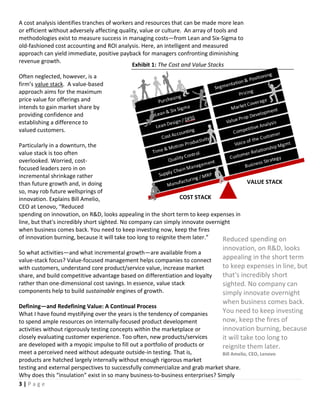
Often neglected, however, is a
firm’s value stack. A value-based
approach aims for the maximum
price value for offerings and
intends to gain market share by
providing confidence and
establishing a difference to
valued customers.
Particularly in a downturn, the
value stack is too often
overlooked. Worried, cost-
focused leaders zero in on
incremental shrinkage rather
than future growth and, in doing
so, may rob future wellsprings of
innovation. Explains Bill Amelio,
CEO at Lenovo, “Reduced
spending on innovation, on R&D, looks appealing in the short term to keep expenses in
line, but that's incredibly short sighted. No company can simply innovate overnight
when business comes back. You need to keep investing now, keep the fires
of innovation burning, because it will take too long to reignite them later.”
So what activities—and what incremental growth—are available from a
value-stack focus? Value-focused management helps companies to connect
with customers, understand core product/service value, increase market
share, and build competitive advantage based on differentiation and loyalty
rather than one-dimensional cost savings. In essence, value stack
components help to build sustainable engines of growth.
Defining—and Redefining Value: A Continual Process
What I have found mystifying over the years is the tendency of companies
to spend ample resources on internally-focused product development
activities without rigorously testing concepts within the marketplace or
closely evaluating customer experience. Too often, new products/services
are developed with a myopic impulse to fill out a portfolio of products or
meet a perceived need without adequate outside-in testing. That is,
products are hatched largely internally without enough rigorous market
testing and external perspectives to successfully commercialize and grab market share.
Why does this “insulation” exist in so many business-to-business enterprises? Simply
COST STACK
VALUE STACK
Exhibit 1: The Cost and Value Stacks
4 | P a g e
The cost stack
typically receives at
least 10 times the
human resources of
the value stack.
put, there exists a sharp imbalance in directing resources and talent to managing for
cost versus managing for value. Within enterprises both large and small, the process of
defining and differentiating value is neither understood nor properly emphasized.
In our experience, firms are typically lopsided in how they resource the value stack.
The cost stack typically receives at least 10 times the human resources of the value
stack. Why this impulse to under-emphasize value? Cost-based management is easier
to understand and relatively straightforward to measure. Value-based management,
on the other hand, is largely misunderstood and poorly measured. The task is usually
assigned to creative teams or business development teams under the marketing
umbrella—and more often than not, these individuals lack methodological tools and
quantitative rigor.
In fact, one could argue there is a deep cultural divide between the two stacks: the cost
stackers typically have more fact-based analytical talent, while value stackers generally
retain feelings-based, intuitive, creative talent. Those skills and competencies on the
cost stack—such as quantitative proficiency and analytical aptitude—are direly needed
in roles that drive company value and top-line growth.
Rebalancing the Enterprise: Focusing on Value, Even in a Downturn
What many do not realize: value creation need not be a long-term, capital-intensive
activity. Northpoint Advisors has helped a number of companies in crisis to drive
sustainable growth in short periods of time by deploying tested value-creation tools and
methodologies. Our business acceleration practice, or
QuickLiftTM
, offers fresh ideas and perspectives through
rigorous market research and voice of customer
investigations—and work focuses on delivering practical,
actionable solutions with immediate results. While many
companies are paralyzed in the current crisis, unable to
determine the best approach to market turmoil, our
engagements offer roadmaps with opportunities for quick
revenue lift. John Chambers, Cisco CEO and veteran of the dot-
com bubble, explains, “Without exception, all of my biggest
mistakes occurred because I moved too slowly." In the current
economic slowdown, nimble companies that focus on business
intensification—even within a limited timeline—can realize
immediate lift.
What are the most powerful ingredients to drive rapid-
response business growth in crisis?
1. A lead manager or consultant with deep experience in
managing through downturns and crisis. He/She must
have an ability to deploy both quantitative and creative
tactics to make sense of problems, and the vision to
focus on those activities that deliver the highest and
fastest return on investment.
case study:
Business Seeks Immediate Lift
A manufacturing company saw revenues fall by
35% in the twelve months following the
September 11 terrorist attacks, resulting in a
high number of layoffs and fundamental
business instability.
The question: How can this company rebuild
lost revenue and layer in greater resilience to
competitive forces?
The solution: Northpoint Advisors conducted a
quick-deploy market research investigation and
redefined market segments. Next, the company
realigned around these new market segments,
re-focusing on high-opportunity areas. Also, the
value proposition was revised and tested prior
to deployment. Revision included adding service
component to value proposition.
Tools: Northstar
TM
business assessment,
competitive intelligence tactics, Go2Market
framework.
Results: The business recaptured 20% of lost
revenue in Year One, and 25% in Year Two. New
business had multi-year value and better GP
returns.
5 | P a g e
2. A well-tested portfolio of investigative tools and methodologies. Driving
immediate business growth—particularly in a downturn—requires a highly tuned
set of tools to uncover hidden opportunities and value. Many firms and
individuals call themselves market researchers, but few have the rigorous
frameworks and scenario-tested experience to pull-off business acceleration
during crisis. As Niko Canner, co-founder of consultancy Katzenbach Partners,
noted in March 2009, “People are using approaches that are insufficiently
powerful to get them where they need to go.”
3. A multidisciplinary team with a balance of creative and quantitative
competencies. Value creation is too often assigned to creative marketing roles,
when in fact deep quantitative and analytical skills are needed to drive decision-
making.
4. A commitment to rapid deployment. Too many market investigations fail to
limit focus to the most critical and effective activities. Business acceleration
activities should drive results within 5 to 60 days.
5. An entrepreneurial energy and commitment to drive change. Often an outside-
in consulting perspective is necessary to refocus energy and drive. Very few
management positions are accountable for growth, and few managers have the
attention or bandwidth to contribute substantially to a growth initiative.
From Short-Term to Long-Term Value Creation
While opportunities for short-term lift exist for those with the right skills and toolset,
organizations must also seek out longer-term realignment to populate their value stack
with the right talent and institutional resolve. For companies that compete through
customer intimacy or product leadership, value stacks are a key method to achieve a
leadership position in the market. Even for companies that compete through
operational excellence, value stacks are essential in holding and realizing margins and
avoiding commoditization. In the current downturn, when many companies have
abandoned or at least minimized value creation, an organized and methodical approach
to extracting value throughout the product development cycle is key. Without
investment in the value stack, these firms are leaving money on the table.
Northpoint Advisors offers workshops to analyze organizational resources and
assist companies to install effective, growth-driving Value Stacks. Case studies of
similar engagements are available.
New York Office
19 Sylvan Glen, Suite 300
Fairport, NY 14450
585.233.6707
Midwest Office
2525 East Paris Rd, Suite 100
Grand Rapids, MI 49546
616.975.0194
Dick Van Belzen
Managing Director

The Northpoint Value Stack

  • 1.
    Thought Leadership ArticlePrepared by Dick Van Belzen for CEO Magazine March 18, 2009 Investing in the Value Stack: Balancing cost-focused bottom-line growth with top-line lift. New York Office 19 Sylvan Glen, Suite 300 Fairport, NY 14450 585.233.6707 Midwest Office 2525 East Paris Rd, Suite 100 Grand Rapids, MI 49546 616.975.0194 Dick Van Belzen Managing Director
  • 2.
    2 | Pa g e The current global recession is testing the ability of the most talented and seasoned executives to tease out growth amidst the worst economic downturn since the Great Depression. Gripped by insecurity about the future, corporate leaders are moving quickly to insulate their companies from the combined forces of tight credit markets, lower consumer spending, and the paralysis of uncertainty. This “insulation” often comes in the form of cost- cutting, which is the fastest way to back-fill profitability in an economic slowdown. The cost-cutting lever, of course, must be used with intelligence and forethought. There are too many examples of companies that move aggressively to cut costs, only to realize they have hollowed out key reservoirs of value—such as customer loyalty, brand value or product quality. What’s more, focusing on cost is essentially a defensive posture. Those companies that “hunker down” to weather the recession may find that the competitive landscape will shift dramatically around them. Consider this: Cost-cutting is a zero-sum source of future gain. In other words, managers with an overly enthusiastic focus on cost are exploiting a limited source of bottom-line growth. Sustainable future growth must come not only from a cost-obsession, but a value-obsession. Unless your company’s brand is centrally defined by low-cost products or services, you should be balancing cost-focused initiatives with an intelligent approach to value-sourcing and expansion. Value-sourcing can come from a number of programs—voice of customer investigations and competitive intelligence, among them. In this case, we are focusing on organic sources of value rather than mergers and acquisitions. Let’s examine how to balance cost and value exigencies. Your Approach: Investing in the Value Stack In Addition to the Cost Stack Most of us are familiar with the concept of a “technology stack” or a layered set of technology capabilities: applications sit on top, followed by software services and operating systems in the middle, and hardware at the bottom. The concept of a stack is useful in part because it helps us to visualize interrelationships and interdependencies, such as total and relative costs of various strata of an organization or the integration needed to successfully combine resources along a chain. For example, how do choices made within foundational layers affect technologies or services needed in subsequent layers? Many companies have managed their enterprises using a “cost stack” emphasis—that is, they are focused on understanding and tightly managing those activities that reduce the cost of delivering products or services in an attempt to maintain a competitive advantage.
  • 3.
    3 | Pa g e Reduced spending on innovation, on R&D, looks appealing in the short term to keep expenses in line, but that's incredibly short sighted. No company can simply innovate overnight when business comes back. You need to keep investing now, keep the fires of innovation burning, because it will take too long to reignite them later. Bill Amelio, CEO, Lenovo A cost analysis identifies tranches of workers and resources that can be made more lean or efficient without adversely affecting quality, value or culture. An array of tools and methodologies exist to measure success in managing costs—from Lean and Six-Sigma to old-fashioned cost accounting and ROI analysis. Here, an intelligent and measured approach can yield immediate, positive payback for managers confronting diminishing revenue growth. Often neglected, however, is a firm’s value stack. A value-based approach aims for the maximum price value for offerings and intends to gain market share by providing confidence and establishing a difference to valued customers. Particularly in a downturn, the value stack is too often overlooked. Worried, cost- focused leaders zero in on incremental shrinkage rather than future growth and, in doing so, may rob future wellsprings of innovation. Explains Bill Amelio, CEO at Lenovo, “Reduced spending on innovation, on R&D, looks appealing in the short term to keep expenses in line, but that's incredibly short sighted. No company can simply innovate overnight when business comes back. You need to keep investing now, keep the fires of innovation burning, because it will take too long to reignite them later.” So what activities—and what incremental growth—are available from a value-stack focus? Value-focused management helps companies to connect with customers, understand core product/service value, increase market share, and build competitive advantage based on differentiation and loyalty rather than one-dimensional cost savings. In essence, value stack components help to build sustainable engines of growth. Defining—and Redefining Value: A Continual Process What I have found mystifying over the years is the tendency of companies to spend ample resources on internally-focused product development activities without rigorously testing concepts within the marketplace or closely evaluating customer experience. Too often, new products/services are developed with a myopic impulse to fill out a portfolio of products or meet a perceived need without adequate outside-in testing. That is, products are hatched largely internally without enough rigorous market testing and external perspectives to successfully commercialize and grab market share. Why does this “insulation” exist in so many business-to-business enterprises? Simply COST STACK VALUE STACK Exhibit 1: The Cost and Value Stacks
  • 4.
    4 | Pa g e The cost stack typically receives at least 10 times the human resources of the value stack. put, there exists a sharp imbalance in directing resources and talent to managing for cost versus managing for value. Within enterprises both large and small, the process of defining and differentiating value is neither understood nor properly emphasized. In our experience, firms are typically lopsided in how they resource the value stack. The cost stack typically receives at least 10 times the human resources of the value stack. Why this impulse to under-emphasize value? Cost-based management is easier to understand and relatively straightforward to measure. Value-based management, on the other hand, is largely misunderstood and poorly measured. The task is usually assigned to creative teams or business development teams under the marketing umbrella—and more often than not, these individuals lack methodological tools and quantitative rigor. In fact, one could argue there is a deep cultural divide between the two stacks: the cost stackers typically have more fact-based analytical talent, while value stackers generally retain feelings-based, intuitive, creative talent. Those skills and competencies on the cost stack—such as quantitative proficiency and analytical aptitude—are direly needed in roles that drive company value and top-line growth. Rebalancing the Enterprise: Focusing on Value, Even in a Downturn What many do not realize: value creation need not be a long-term, capital-intensive activity. Northpoint Advisors has helped a number of companies in crisis to drive sustainable growth in short periods of time by deploying tested value-creation tools and methodologies. Our business acceleration practice, or QuickLiftTM , offers fresh ideas and perspectives through rigorous market research and voice of customer investigations—and work focuses on delivering practical, actionable solutions with immediate results. While many companies are paralyzed in the current crisis, unable to determine the best approach to market turmoil, our engagements offer roadmaps with opportunities for quick revenue lift. John Chambers, Cisco CEO and veteran of the dot- com bubble, explains, “Without exception, all of my biggest mistakes occurred because I moved too slowly." In the current economic slowdown, nimble companies that focus on business intensification—even within a limited timeline—can realize immediate lift. What are the most powerful ingredients to drive rapid- response business growth in crisis? 1. A lead manager or consultant with deep experience in managing through downturns and crisis. He/She must have an ability to deploy both quantitative and creative tactics to make sense of problems, and the vision to focus on those activities that deliver the highest and fastest return on investment. case study: Business Seeks Immediate Lift A manufacturing company saw revenues fall by 35% in the twelve months following the September 11 terrorist attacks, resulting in a high number of layoffs and fundamental business instability. The question: How can this company rebuild lost revenue and layer in greater resilience to competitive forces? The solution: Northpoint Advisors conducted a quick-deploy market research investigation and redefined market segments. Next, the company realigned around these new market segments, re-focusing on high-opportunity areas. Also, the value proposition was revised and tested prior to deployment. Revision included adding service component to value proposition. Tools: Northstar TM business assessment, competitive intelligence tactics, Go2Market framework. Results: The business recaptured 20% of lost revenue in Year One, and 25% in Year Two. New business had multi-year value and better GP returns.
  • 5.
    5 | Pa g e 2. A well-tested portfolio of investigative tools and methodologies. Driving immediate business growth—particularly in a downturn—requires a highly tuned set of tools to uncover hidden opportunities and value. Many firms and individuals call themselves market researchers, but few have the rigorous frameworks and scenario-tested experience to pull-off business acceleration during crisis. As Niko Canner, co-founder of consultancy Katzenbach Partners, noted in March 2009, “People are using approaches that are insufficiently powerful to get them where they need to go.” 3. A multidisciplinary team with a balance of creative and quantitative competencies. Value creation is too often assigned to creative marketing roles, when in fact deep quantitative and analytical skills are needed to drive decision- making. 4. A commitment to rapid deployment. Too many market investigations fail to limit focus to the most critical and effective activities. Business acceleration activities should drive results within 5 to 60 days. 5. An entrepreneurial energy and commitment to drive change. Often an outside- in consulting perspective is necessary to refocus energy and drive. Very few management positions are accountable for growth, and few managers have the attention or bandwidth to contribute substantially to a growth initiative. From Short-Term to Long-Term Value Creation While opportunities for short-term lift exist for those with the right skills and toolset, organizations must also seek out longer-term realignment to populate their value stack with the right talent and institutional resolve. For companies that compete through customer intimacy or product leadership, value stacks are a key method to achieve a leadership position in the market. Even for companies that compete through operational excellence, value stacks are essential in holding and realizing margins and avoiding commoditization. In the current downturn, when many companies have abandoned or at least minimized value creation, an organized and methodical approach to extracting value throughout the product development cycle is key. Without investment in the value stack, these firms are leaving money on the table. Northpoint Advisors offers workshops to analyze organizational resources and assist companies to install effective, growth-driving Value Stacks. Case studies of similar engagements are available. New York Office 19 Sylvan Glen, Suite 300 Fairport, NY 14450 585.233.6707 Midwest Office 2525 East Paris Rd, Suite 100 Grand Rapids, MI 49546 616.975.0194 Dick Van Belzen Managing Director