   Europeana is a gateway to the digital resources of
    Europe’s museums, libraries, archives and audio-
    visual collections.
   It is a multilingual space where users come to
    engage, share in and be inspired by the rich
    diversity of Europe’s cultural and scientific
    heritage.
    Europeana is a trusted source connecting users
    directly to authentic and curated material.
   to provide access to Europe's cultural and scientific heritage by way of a cross-
    domain portal
   to facilitate formal agreement across museums, archives, audiovisual archives and
    libraries on how to co-operate in the delivery and sustainability of a joint portal
   to stimulate and facilitate initiatives to bring together existing digital content
   to support and facilitate digitization of Europe's cultural and scientific heritage

   LEGAL STATUS: The Foundation is incorporated under Dutch law as Stichting
    Europeana and is housed within the Koninklijke Bibliotheek, the national library of the
    Netherlands. It provides a legal framework for the governance of Europeana,
    employing the staff, bidding for funding and enabling the sustainability of the service.
   For users:
    Europeana is a single access point to millions of books, paintings, films,
    museum objects and archival records that have been digitized
    throughout Europe. It is an authoritative source of information coming
    from European cultural and scientific institutions.
   For heritage institutions:
    Europeana is an opportunity to reach out to more users, increase their
    web traffic, enhance their users' experience and build new
    partnerships.
   For professionals in the heritage sector:
    Europeana is a platform for knowledge exchange between librarians,
    curators, archivists and the creative industries.
   For policy-makers and funders:
    Europeana is a prestigious initiative endorsed by the European
    Commission, and is a means to stimulate creative economy and
    promote cultural tourism.
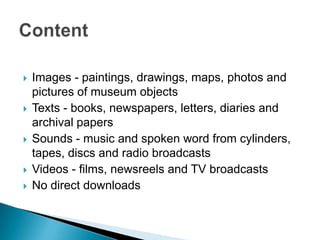
   Images - paintings, drawings, maps, photos and
    pictures of museum objects
   Texts - books, newspapers, letters, diaries and
    archival papers
   Sounds - music and spoken word from cylinders,
    tapes, discs and radio broadcasts
   Videos - films, newsreels and TV broadcasts
   No direct downloads
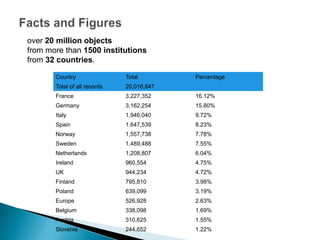
over 20 million objects
from more than 1500 institutions
from 32 countries.

       Country                Total        Percentage
       Total of all records   20,016,847
       France                 3,227,352    16.12%
       Germany                3,162,254    15.80%
       Italy                  1,946,040    9.72%
       Spain                  1,647,539    8.23%
       Norway                 1,557,738    7.78%
       Sweden                 1,489,488    7.55%
       Netherlands            1,208,807    6.04%
       Ireland                960,554      4.75%
       UK                     944,234      4.72%
       Finland                795,810      3.98%
       Poland                 639,099      3.19%
       Europe                 526,928      2.63%
       Belgium                338,098      1.69%
       Austria                310,625      1.55%
       Slovenia               244,652      1.22%
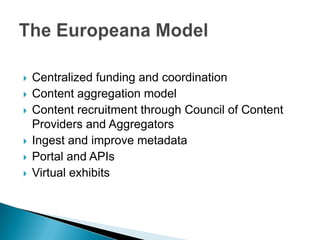
   Centralized funding and coordination
   Content aggregation model
   Content recruitment through Council of Content
    Providers and Aggregators
   Ingest and improve metadata
   Portal and APIs
   Virtual exhibits
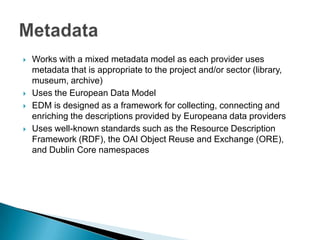
   Works with a mixed metadata model as each provider uses
    metadata that is appropriate to the project and/or sector (library,
    museum, archive)
   Uses the European Data Model
   EDM is designed as a framework for collecting, connecting and
    enriching the descriptions provided by Europeana data providers
   Uses well-known standards such as the Resource Description
    Framework (RDF), the OAI Object Reuse and Exchange (ORE),
    and Dublin Core namespaces
   Uses a Semantic search engine
   Based on who, what, when, where
    ◦ Who: Names of actors, authors, architects, artists, choreographers, composers,
      conductors, dancers, film directors, musicians or photographers.
    ◦ What: Words from titles of books, poems, newspapers, paintings, photographs, films or
      television programmes.
    ◦ Where: Names of towns, cities or countries within Europe or around the world.
    ◦ When: Dates (e.g. 1945) such as the year you were born in or a famous date in history
      or a period (e.g. Roman or Medieval).
   Supports Boolean logic
   You can also filter your search results
    ◦ By media type - will display only objects of a selected media type (images, text, video
      or sound)
    ◦ By language - will display only objects with descriptions in selected languages
    ◦ By date - will display only objects with selected dates
    ◦ By country - will display only objects from selected countries
    ◦ By provider - will display only objects from selected institutions
    ◦ By rights - will display only objects with selected rights of use
   With curatorial expertise: Our virtual exhibitions help you discover and learn
    more about specific themes,.
   Yiddish Theatre in London
   World War One in pictures, letters and memories

   By Newest content: See the latest contributions from our partner museums,
    libraries, archives and audio-visual archives

   By provider: Browse through the collections from a specific institution and open
    doors to any museum, library, archive and audio-visual archive that provides
    content to Europeana

   Through time: The interactive Timeline lets you see items categorised by date
   World War
   On a map: The Map view shows as purple circles with the size of the circle
    indicating the amount of objects on Europeana for the given search in a specific
    location.
   Isaac Newton

Europeana

  • 2.
    Europeana is a gateway to the digital resources of Europe’s museums, libraries, archives and audio- visual collections.  It is a multilingual space where users come to engage, share in and be inspired by the rich diversity of Europe’s cultural and scientific heritage.  Europeana is a trusted source connecting users directly to authentic and curated material.
  • 3.
    to provide access to Europe's cultural and scientific heritage by way of a cross- domain portal  to facilitate formal agreement across museums, archives, audiovisual archives and libraries on how to co-operate in the delivery and sustainability of a joint portal  to stimulate and facilitate initiatives to bring together existing digital content  to support and facilitate digitization of Europe's cultural and scientific heritage  LEGAL STATUS: The Foundation is incorporated under Dutch law as Stichting Europeana and is housed within the Koninklijke Bibliotheek, the national library of the Netherlands. It provides a legal framework for the governance of Europeana, employing the staff, bidding for funding and enabling the sustainability of the service.
  • 4.
    For users: Europeana is a single access point to millions of books, paintings, films, museum objects and archival records that have been digitized throughout Europe. It is an authoritative source of information coming from European cultural and scientific institutions.  For heritage institutions: Europeana is an opportunity to reach out to more users, increase their web traffic, enhance their users' experience and build new partnerships.  For professionals in the heritage sector: Europeana is a platform for knowledge exchange between librarians, curators, archivists and the creative industries.  For policy-makers and funders: Europeana is a prestigious initiative endorsed by the European Commission, and is a means to stimulate creative economy and promote cultural tourism.
  • 5.
    Images - paintings, drawings, maps, photos and pictures of museum objects  Texts - books, newspapers, letters, diaries and archival papers  Sounds - music and spoken word from cylinders, tapes, discs and radio broadcasts  Videos - films, newsreels and TV broadcasts  No direct downloads
  • 6.
    over 20 millionobjects from more than 1500 institutions from 32 countries. Country Total Percentage Total of all records 20,016,847 France 3,227,352 16.12% Germany 3,162,254 15.80% Italy 1,946,040 9.72% Spain 1,647,539 8.23% Norway 1,557,738 7.78% Sweden 1,489,488 7.55% Netherlands 1,208,807 6.04% Ireland 960,554 4.75% UK 944,234 4.72% Finland 795,810 3.98% Poland 639,099 3.19% Europe 526,928 2.63% Belgium 338,098 1.69% Austria 310,625 1.55% Slovenia 244,652 1.22%
  • 7.
    Centralized funding and coordination  Content aggregation model  Content recruitment through Council of Content Providers and Aggregators  Ingest and improve metadata  Portal and APIs  Virtual exhibits
  • 8.
    Works with a mixed metadata model as each provider uses metadata that is appropriate to the project and/or sector (library, museum, archive)  Uses the European Data Model  EDM is designed as a framework for collecting, connecting and enriching the descriptions provided by Europeana data providers  Uses well-known standards such as the Resource Description Framework (RDF), the OAI Object Reuse and Exchange (ORE), and Dublin Core namespaces
  • 9.
    Uses a Semantic search engine  Based on who, what, when, where ◦ Who: Names of actors, authors, architects, artists, choreographers, composers, conductors, dancers, film directors, musicians or photographers. ◦ What: Words from titles of books, poems, newspapers, paintings, photographs, films or television programmes. ◦ Where: Names of towns, cities or countries within Europe or around the world. ◦ When: Dates (e.g. 1945) such as the year you were born in or a famous date in history or a period (e.g. Roman or Medieval).  Supports Boolean logic  You can also filter your search results ◦ By media type - will display only objects of a selected media type (images, text, video or sound) ◦ By language - will display only objects with descriptions in selected languages ◦ By date - will display only objects with selected dates ◦ By country - will display only objects from selected countries ◦ By provider - will display only objects from selected institutions ◦ By rights - will display only objects with selected rights of use
  • 10.
    With curatorial expertise: Our virtual exhibitions help you discover and learn more about specific themes,.  Yiddish Theatre in London  World War One in pictures, letters and memories  By Newest content: See the latest contributions from our partner museums, libraries, archives and audio-visual archives  By provider: Browse through the collections from a specific institution and open doors to any museum, library, archive and audio-visual archive that provides content to Europeana  Through time: The interactive Timeline lets you see items categorised by date  World War  On a map: The Map view shows as purple circles with the size of the circle indicating the amount of objects on Europeana for the given search in a specific location.  Isaac Newton