Republic of the Philippines
Department of Education
REGION VIII - EASTERN VISAYAS
Government Center, Candahug, Palo, Leyte
(053) 832-2997 | region8@deped.gov.ph
ISO 9001:2015 Certified
Page 1 of 5
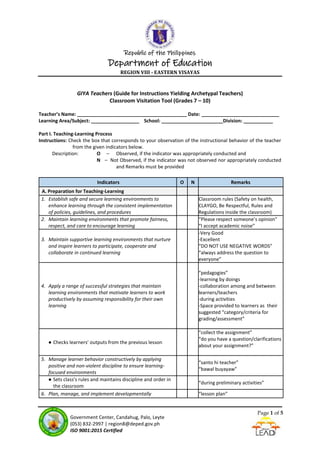
GIYA Teachers (Guide for Instructions Yielding Archetypal Teachers)
Classroom Visitation Tool (Grades 7 – 10)
Teacher’s Name: _________________________________________ Date: _____________________________
Learning Area/Subject: __________________ School: _______________________Division: ___________
Part I. Teaching-Learning Process
Instructions: Check the box that corresponds to your observation of the instructional behavior of the teacher
from the given indicators below.
Description: O – Observed, if the indicator was appropriately conducted and
N – Not Observed, if the indicator was not observed nor appropriately conducted
and Remarks must be provided
Indicators O N Remarks
A. Preparation for Teaching-Learning
1. Establish safe and secure learning environments to
enhance learning through the consistent implementation
of policies, guidelines, and procedures
Classroom rules (Safety on health,
CLAYGO, Be Respectful, Rules and
Regulations inside the classroom)
2. Maintain learning environments that promote fairness,
respect, and care to encourage learning
“Please respect someone’s opinion”
“I accept academic noise”
3. Maintain supportive learning environments that nurture
and inspire learners to participate, cooperate and
collaborate in continued learning
-Very Good
-Excellent
“DO NOT USE NEGATIVE WORDS”
“always address the question to
everyone”
4. Apply a range of successful strategies that maintain
learning environments that motivate learners to work
productively by assuming responsibility for their own
learning
“pedagogies”
-learning by doings
-collaboration among and between
learners/teachers
-during activities
-Space provided to learners as their
suggested “category/criteria for
grading/assessment”
● Checks learners’ outputs from the previous lesson
“collect the assignment”
“do you have a question/clarifications
about your assignment?”
5. Manage learner behavior constructively by applying
positive and non-violent discipline to ensure learning-
focused environments
“santo hi teacher”
“bawal buyayaw”
● Sets class’s rules and maintains discipline and order in
the classroom
“during preliminary activities”
6. Plan, manage, and implement developmentally “lesson plan”
Department of Education Regional Office VIII (Eastern Visayas)
(053) 832-2997 | region8@deped.gov.ph Page 2 of 5
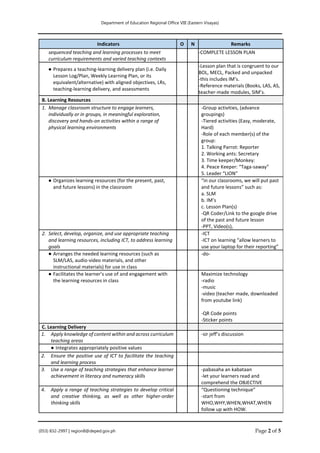
Indicators O N Remarks
sequenced teaching and learning processes to meet
curriculum requirements and varied teaching contexts
-COMPLETE LESSON PLAN
● Prepares a teaching-learning delivery plan (i.e. Daily
Lesson Log/Plan, Weekly Learning Plan, or its
equivalent/alternative) with aligned objectives, LRs,
teaching-learning delivery, and assessments
-Lesson plan that is congruent to our
BOL, MECL, Packed and unpacked
-this includes IM’s.
-Reference materials (Books, LAS, AS,
teacher-made modules, SIM’s.
B. Learning Resources
1. Manage classroom structure to engage learners,
individually or in groups, in meaningful exploration,
discovery and hands-on activities within a range of
physical learning environments
-Group activities, (advance
groupings)
-Tiered activities (Easy, moderate,
Hard)
-Role of each member(s) of the
group:
1. Talking Parrot: Reporter
2. Working ants: Secretary
3. Time keeper/Monkey:
4. Peace Keeper: “Taga-saway”
5. Leader “LION”
● Organizes learning resources (for the present, past,
and future lessons) in the classroom
“in our classrooms, we will put past
and future lessons” such as:
a. SLM
b. IM’s
c. Lesson Plan(s)
-QR Coder/Link to the google drive
of the past and future lesson
-PPT, Video(s),
2. Select, develop, organize, and use appropriate teaching
and learning resources, including ICT, to address learning
goals
-ICT
-ICT on learning “allow learners to
use your laptop for their reporting”
● Arranges the needed learning resources (such as
SLM/LAS, audio-video materials, and other
instructional materials) for use in class
-do-
● Facilitates the learner’s use of and engagement with
the learning resources in class
Maximize technology
-radio
-music
-video (teacher made, downloaded
from youtube link)
-QR Code points
-Sticker points
C. Learning Delivery
1. Apply knowledge of content within and across curriculum
teaching areas
-sir jeff’s discussion
● Integrates appropriately positive values
2. Ensure the positive use of ICT to facilitate the teaching
and learning process
3. Use a range of teaching strategies that enhance learner
achievement in literacy and numeracy skills
-pabasaha an kabataan
-let your learners read and
comprehend the OBJECTIVE
4. Apply a range of teaching strategies to develop critical
and creative thinking, as well as other higher-order
thinking skills
“Questioning technique”
-start from
WHO,WHY,WHEN,WHAT,WHEN
follow up with HOW.
Department of Education Regional Office VIII (Eastern Visayas)
(053) 832-2997 | region8@deped.gov.ph Page 3 of 5
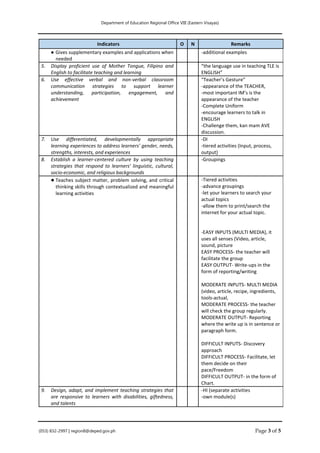
Indicators O N Remarks
● Gives supplementary examples and applications when
needed
-additional examples
5. Display proficient use of Mother Tongue, Filipino and
English to facilitate teaching and learning
“the language use in teaching TLE is
ENGLISH”
6. Use effective verbal and non-verbal classroom
communication strategies to support learner
understanding, participation, engagement, and
achievement
“Teacher’s Gesture”
-appearance of the TEACHER,
-most important IM’s is the
appearance of the teacher
-Complete Uniform
-encourage learners to talk in
ENGLISH
-Challenge them, kan mam AVE
discussion.
7. Use differentiated, developmentally appropriate
learning experiences to address learners' gender, needs,
strengths, interests, and experiences
-DI
-tiered activities (Input, process,
output)
8. Establish a learner-centered culture by using teaching
strategies that respond to learners' linguistic, cultural,
socio-economic, and religious backgrounds
-Groupings
● Teaches subject matter, problem solving, and critical
thinking skills through contextualized and meaningful
learning activities
-Tiered activities
-advance groupings
-let your learners to search your
actual topics
-allow them to print/search the
internet for your actual topic.
-EASY INPUTS (MULTI MEDIA), it
uses all senses (Video, article,
sound, picture
EASY PROCESS- the teacher will
facilitate the group
EASY OUTPUT- Write-ups in the
form of reporting/writing
MODERATE INPUTS- MULTI MEDIA
(video, article, recipe, ingredients,
tools-actual,
MODERATE PROCESS- the teacher
will check the group regularly.
MODERATE OUTPUT- Reporting
where the write up is in sentence or
paragraph form.
DIFFICULT INPUTS- Discovery
approach
DIFFICULT PROCESS- Facilitate, let
them decide on their
pace/Freedom
DIFFICULT OUTPUT- in the form of
Chart.
9. Design, adapt, and implement teaching strategies that
are responsive to learners with disabilities, giftedness,
and talents
-HI (separate activities
-own module(s)
Department of Education Regional Office VIII (Eastern Visayas)
(053) 832-2997 | region8@deped.gov.ph Page 4 of 5
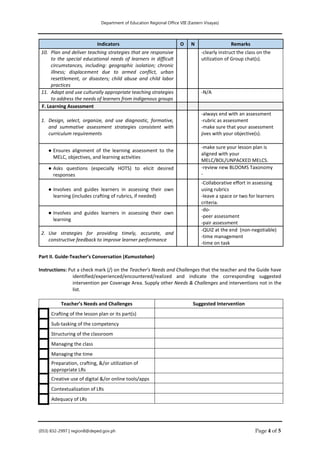
Indicators O N Remarks
10. Plan and deliver teaching strategies that are responsive
to the special educational needs of learners in difficult
circumstances, including: geographic isolation; chronic
illness; displacement due to armed conflict, urban
resettlement, or disasters; child abuse and child labor
practices
-clearly instruct the class on the
utilization of Group chat(s).
11. Adapt and use culturally appropriate teaching strategies
to address the needs of learners from indigenous groups
-N/A
F. Learning Assessment
1. Design, select, organize, and use diagnostic, formative,
and summative assessment strategies consistent with
curriculum requirements
-always end with an assessment
-rubric as assessment
-make sure that your assessment
jives with your objective(s).
● Ensures alignment of the learning assessment to the
MELC, objectives, and learning activities
-make sure your lesson plan is
aligned with your
MELC/BOL/UNPACKED MELCS.
● Asks questions (especially HOTS) to elicit desired
responses
-review new BLOOMS Taxonomy
-
● Involves and guides learners in assessing their own
learning (includes crafting of rubrics, if needed)
-Collaborative effort in assessing
using rubrics
-leave a space or two for learners
criteria.
● Involves and guides learners in assessing their own
learning
-do-
-peer assessment
-pair assessment
2. Use strategies for providing timely, accurate, and
constructive feedback to improve learner performance
-QUIZ at the end (non-negotiable)
-time management
-time on task
Part II. Guide-Teacher’s Conversation (Kumustahan)
Instructions: Put a check mark (/) on the Teacher’s Needs and Challenges that the teacher and the Guide have
identified/experienced/encountered/realized and indicate the corresponding suggested
intervention per Coverage Area. Supply other Needs & Challenges and interventions not in the
list.
Teacher’s Needs and Challenges Suggested Intervention
Crafting of the lesson plan or its part(s)
Sub-tasking of the competency
Structuring of the classroom
Managing the class
Managing the time
Preparation, crafting, &/or utilization of
appropriate LRs
Creative use of digital &/or online tools/apps
Contextualization of LRs
Adequacy of LRs
Department of Education Regional Office VIII (Eastern Visayas)
(053) 832-2997 | region8@deped.gov.ph Page 5 of 5
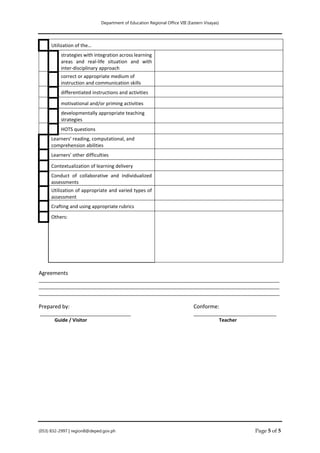
Utilization of the…
strategies with integration across learning
areas and real-life situation and with
inter-disciplinary approach
correct or appropriate medium of
instruction and communication skills
differentiated instructions and activities
motivational and/or priming activities
developmentally appropriate teaching
strategies
HOTS questions
Learners’ reading, computational, and
comprehension abilities
Learners’ other difficulties
Contextualization of learning delivery
Conduct of collaborative and individualized
assessments
Utilization of appropriate and varied types of
assessment
Crafting and using appropriate rubrics
Others:
Agreements
__________________________________________________________________________________________
__________________________________________________________________________________________
__________________________________________________________________________________________
Prepared by: Conforme:
__________________________________ _______________________________
Guide / Visitor Teacher

GIYA-Teachers-G7-10.docx

  • 1.
    Republic of thePhilippines Department of Education REGION VIII - EASTERN VISAYAS Government Center, Candahug, Palo, Leyte (053) 832-2997 | region8@deped.gov.ph ISO 9001:2015 Certified Page 1 of 5 GIYA Teachers (Guide for Instructions Yielding Archetypal Teachers) Classroom Visitation Tool (Grades 7 – 10) Teacher’s Name: _________________________________________ Date: _____________________________ Learning Area/Subject: __________________ School: _______________________Division: ___________ Part I. Teaching-Learning Process Instructions: Check the box that corresponds to your observation of the instructional behavior of the teacher from the given indicators below. Description: O – Observed, if the indicator was appropriately conducted and N – Not Observed, if the indicator was not observed nor appropriately conducted and Remarks must be provided Indicators O N Remarks A. Preparation for Teaching-Learning 1. Establish safe and secure learning environments to enhance learning through the consistent implementation of policies, guidelines, and procedures Classroom rules (Safety on health, CLAYGO, Be Respectful, Rules and Regulations inside the classroom) 2. Maintain learning environments that promote fairness, respect, and care to encourage learning “Please respect someone’s opinion” “I accept academic noise” 3. Maintain supportive learning environments that nurture and inspire learners to participate, cooperate and collaborate in continued learning -Very Good -Excellent “DO NOT USE NEGATIVE WORDS” “always address the question to everyone” 4. Apply a range of successful strategies that maintain learning environments that motivate learners to work productively by assuming responsibility for their own learning “pedagogies” -learning by doings -collaboration among and between learners/teachers -during activities -Space provided to learners as their suggested “category/criteria for grading/assessment” ● Checks learners’ outputs from the previous lesson “collect the assignment” “do you have a question/clarifications about your assignment?” 5. Manage learner behavior constructively by applying positive and non-violent discipline to ensure learning- focused environments “santo hi teacher” “bawal buyayaw” ● Sets class’s rules and maintains discipline and order in the classroom “during preliminary activities” 6. Plan, manage, and implement developmentally “lesson plan”
  • 2.
    Department of EducationRegional Office VIII (Eastern Visayas) (053) 832-2997 | region8@deped.gov.ph Page 2 of 5 Indicators O N Remarks sequenced teaching and learning processes to meet curriculum requirements and varied teaching contexts -COMPLETE LESSON PLAN ● Prepares a teaching-learning delivery plan (i.e. Daily Lesson Log/Plan, Weekly Learning Plan, or its equivalent/alternative) with aligned objectives, LRs, teaching-learning delivery, and assessments -Lesson plan that is congruent to our BOL, MECL, Packed and unpacked -this includes IM’s. -Reference materials (Books, LAS, AS, teacher-made modules, SIM’s. B. Learning Resources 1. Manage classroom structure to engage learners, individually or in groups, in meaningful exploration, discovery and hands-on activities within a range of physical learning environments -Group activities, (advance groupings) -Tiered activities (Easy, moderate, Hard) -Role of each member(s) of the group: 1. Talking Parrot: Reporter 2. Working ants: Secretary 3. Time keeper/Monkey: 4. Peace Keeper: “Taga-saway” 5. Leader “LION” ● Organizes learning resources (for the present, past, and future lessons) in the classroom “in our classrooms, we will put past and future lessons” such as: a. SLM b. IM’s c. Lesson Plan(s) -QR Coder/Link to the google drive of the past and future lesson -PPT, Video(s), 2. Select, develop, organize, and use appropriate teaching and learning resources, including ICT, to address learning goals -ICT -ICT on learning “allow learners to use your laptop for their reporting” ● Arranges the needed learning resources (such as SLM/LAS, audio-video materials, and other instructional materials) for use in class -do- ● Facilitates the learner’s use of and engagement with the learning resources in class Maximize technology -radio -music -video (teacher made, downloaded from youtube link) -QR Code points -Sticker points C. Learning Delivery 1. Apply knowledge of content within and across curriculum teaching areas -sir jeff’s discussion ● Integrates appropriately positive values 2. Ensure the positive use of ICT to facilitate the teaching and learning process 3. Use a range of teaching strategies that enhance learner achievement in literacy and numeracy skills -pabasaha an kabataan -let your learners read and comprehend the OBJECTIVE 4. Apply a range of teaching strategies to develop critical and creative thinking, as well as other higher-order thinking skills “Questioning technique” -start from WHO,WHY,WHEN,WHAT,WHEN follow up with HOW.
  • 3.
    Department of EducationRegional Office VIII (Eastern Visayas) (053) 832-2997 | region8@deped.gov.ph Page 3 of 5 Indicators O N Remarks ● Gives supplementary examples and applications when needed -additional examples 5. Display proficient use of Mother Tongue, Filipino and English to facilitate teaching and learning “the language use in teaching TLE is ENGLISH” 6. Use effective verbal and non-verbal classroom communication strategies to support learner understanding, participation, engagement, and achievement “Teacher’s Gesture” -appearance of the TEACHER, -most important IM’s is the appearance of the teacher -Complete Uniform -encourage learners to talk in ENGLISH -Challenge them, kan mam AVE discussion. 7. Use differentiated, developmentally appropriate learning experiences to address learners' gender, needs, strengths, interests, and experiences -DI -tiered activities (Input, process, output) 8. Establish a learner-centered culture by using teaching strategies that respond to learners' linguistic, cultural, socio-economic, and religious backgrounds -Groupings ● Teaches subject matter, problem solving, and critical thinking skills through contextualized and meaningful learning activities -Tiered activities -advance groupings -let your learners to search your actual topics -allow them to print/search the internet for your actual topic. -EASY INPUTS (MULTI MEDIA), it uses all senses (Video, article, sound, picture EASY PROCESS- the teacher will facilitate the group EASY OUTPUT- Write-ups in the form of reporting/writing MODERATE INPUTS- MULTI MEDIA (video, article, recipe, ingredients, tools-actual, MODERATE PROCESS- the teacher will check the group regularly. MODERATE OUTPUT- Reporting where the write up is in sentence or paragraph form. DIFFICULT INPUTS- Discovery approach DIFFICULT PROCESS- Facilitate, let them decide on their pace/Freedom DIFFICULT OUTPUT- in the form of Chart. 9. Design, adapt, and implement teaching strategies that are responsive to learners with disabilities, giftedness, and talents -HI (separate activities -own module(s)
  • 4.
    Department of EducationRegional Office VIII (Eastern Visayas) (053) 832-2997 | region8@deped.gov.ph Page 4 of 5 Indicators O N Remarks 10. Plan and deliver teaching strategies that are responsive to the special educational needs of learners in difficult circumstances, including: geographic isolation; chronic illness; displacement due to armed conflict, urban resettlement, or disasters; child abuse and child labor practices -clearly instruct the class on the utilization of Group chat(s). 11. Adapt and use culturally appropriate teaching strategies to address the needs of learners from indigenous groups -N/A F. Learning Assessment 1. Design, select, organize, and use diagnostic, formative, and summative assessment strategies consistent with curriculum requirements -always end with an assessment -rubric as assessment -make sure that your assessment jives with your objective(s). ● Ensures alignment of the learning assessment to the MELC, objectives, and learning activities -make sure your lesson plan is aligned with your MELC/BOL/UNPACKED MELCS. ● Asks questions (especially HOTS) to elicit desired responses -review new BLOOMS Taxonomy - ● Involves and guides learners in assessing their own learning (includes crafting of rubrics, if needed) -Collaborative effort in assessing using rubrics -leave a space or two for learners criteria. ● Involves and guides learners in assessing their own learning -do- -peer assessment -pair assessment 2. Use strategies for providing timely, accurate, and constructive feedback to improve learner performance -QUIZ at the end (non-negotiable) -time management -time on task Part II. Guide-Teacher’s Conversation (Kumustahan) Instructions: Put a check mark (/) on the Teacher’s Needs and Challenges that the teacher and the Guide have identified/experienced/encountered/realized and indicate the corresponding suggested intervention per Coverage Area. Supply other Needs & Challenges and interventions not in the list. Teacher’s Needs and Challenges Suggested Intervention Crafting of the lesson plan or its part(s) Sub-tasking of the competency Structuring of the classroom Managing the class Managing the time Preparation, crafting, &/or utilization of appropriate LRs Creative use of digital &/or online tools/apps Contextualization of LRs Adequacy of LRs
  • 5.
    Department of EducationRegional Office VIII (Eastern Visayas) (053) 832-2997 | region8@deped.gov.ph Page 5 of 5 Utilization of the… strategies with integration across learning areas and real-life situation and with inter-disciplinary approach correct or appropriate medium of instruction and communication skills differentiated instructions and activities motivational and/or priming activities developmentally appropriate teaching strategies HOTS questions Learners’ reading, computational, and comprehension abilities Learners’ other difficulties Contextualization of learning delivery Conduct of collaborative and individualized assessments Utilization of appropriate and varied types of assessment Crafting and using appropriate rubrics Others: Agreements __________________________________________________________________________________________ __________________________________________________________________________________________ __________________________________________________________________________________________ Prepared by: Conforme: __________________________________ _______________________________ Guide / Visitor Teacher