Feature-Based Information Processing
of Selective Attention through Entropy
Analysis system
Giacomo Veneri
November 2012
Giacomo Veneri – EVALab - Dep. Neurological and Behavioral Science - UNISI
1
Objectives
• Study the influence of (eye) motor control on
selective attention
• Develop a method to extract motor control
parameters during visual search
• Develop a method to extract selective attention
features during visual search
Giacomo Veneri – EVALab - Dep. Neurological and Behavioral Science - UNISI
2
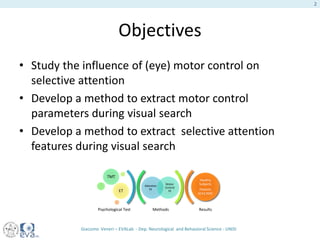
Methods Results
Attention
FE
Motor
Control
FE
TMT
ET
Healthy
Subjects
Patients
SCA2,NDC
Psychological Test
Selective Attention
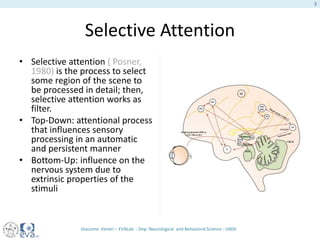
• Selective attention ( Posner,
1980) is the process to select
some region of the scene to
be processed in detail; then,
selective attention works as
filter.
• Top-Down: attentional process
that influences sensory
processing in an automatic
and persistent manner
• Bottom-Up: influence on the
nervous system due to
extrinsic properties of the
stimuli
Giacomo Veneri – EVALab - Dep. Neurological and Behavioral Science - UNISI
3
Motor Control and Cerebellum
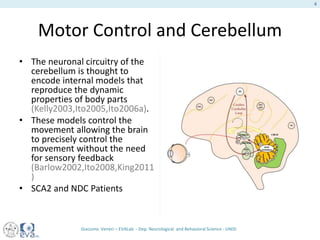
• The neuronal circuitry of the
cerebellum is thought to
encode internal models that
reproduce the dynamic
properties of body parts
(Kelly2003,Ito2005,Ito2006a).
• These models control the
movement allowing the brain
to precisely control the
movement without the need
for sensory feedback
(Barlow2002,Ito2008,King2011
)
• SCA2 and NDC Patients
Giacomo Veneri – EVALab - Dep. Neurological and Behavioral Science - UNISI
4
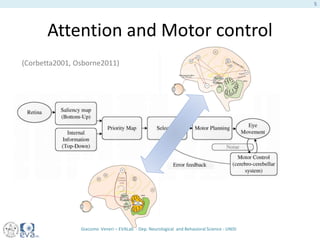
Attention and Motor control
(Corbetta2001, Osborne2011)
Giacomo Veneri – EVALab - Dep. Neurological and Behavioral Science - UNISI
5
Methods
1. Veneri, G., Federighi, P., Rosini, F., Federico, A., & Rufa, A. (2010). Influences of data filtering on human-computer interaction by gaze-contingent
display and eye-tracking applications. Computers in Human Behavior , 26 (6), 1555 - 1563. doi: 10.1016/j.chb.2010.05.030 [SCOPUS, ACM]
2. Veneri, G., Federighi, P., Rosini, F., Federico, A., & Rufa, A. (2011, Mar). Spike removal through multiscale wavelet and entropy
analysis of ocular motor noise: A case study in patients with cerebellar disease. Journal of Neuroscience Methods , 196 (2), 318–326.
doi: 10.1016/j.jneumeth.2011.01.006 [MEDLINE, SCOPUS]
3. Veneri, G., Piu, P., Rosini, F., Federighi, P., Federico, A., & Rufa, A. (2011). Automatic eye fixations identification based on analysis of variance and
covariance. Pattern Recognition Letters , 32 (13), 1588 - 1593. doi: 10.1016/j.patrec.2011.06.012 [SCOPUS]
4. Veneri, G., Pretegiani, E., Rosini, F., Federighi, P., Federico, A., & Rufa, A. (2011, Mar). Evaluating the human ongoing visual search performance by
eye tracking application and se-quencing tests. Comput Methods Programs Biomed . Retrieved from http://dx.doi.org/10.1016/j.cmpb.2011.02.006
doi:10.1016/j.cmpb.2011.02.006 [SCOPUS. MEDLINE, ACM]
5. Veneri, G., Rosini, F., Federighi, P., Federico, A., & Rufa, A.(2012, Feb). Evaluating gaze control on a multi-target sequenc-ing task:
The distribution of fixations is evidence of exploration optimisation. Comput Biol Med , 42 (2), 235–244. Retrieved from
http://dx.doi.org/10.1016/j.compbiomed.2011.11.013 doi: 10.1016/j.compbiomed.2011.11.013 [SCOPUS. MEDLINE, ACM]
InProceedings
1. Veneri, G., Federighi, P., Pretegiani, E., Rosini, F., Federico, A., & Rufa, A. (2009). Eye tracking - stimulus integrated semi automatic case base system.
In Proceeding of the 13th world multi-conference on systemics, cybernetics and informatics.
2. Veneri, G., Pretegiani, E., Federighi, P., Rosini, F., & Rufa, A. (2010). Evaluating human visual search performance by monte carlo methods and
heuristic model. In IEEE (Ed.), 10th ieee international conference on information technology and applications in biomedicine (itab 2010). [SCOPUS,
IEEE]
3. Veneri, G., Piu, P., Federighi, P., Rosini, F., Federico, A., & Rufa, A. (2010, jun.). Eye fixations identification based on statistical analysis - case study. In
Cognitive information processing (cip), 2010 2nd international workshop on (p. 446 -451). IEEE. doi: 10.1109/CIP.2010.5604221 [SCOPUS, IEEE]
Others (posters)
1. Veneri, G., Federighi, P., Rosini, F., Pretegiani, E., Federico, A., & Rufa, A. (2009). The role of latest fixations on ongoing visual search: a model to
evaluate the selection mechanism. In Rovereto workshop of attention.
2. Veneri, G., Olivetti, E., Avesani, P., Federico, A., & Rufa, A. (2011). Bayesian hypothesis on selective attention. In Rovereto visual attention congress.
Giacomo Veneri – EVALab - Dep. Neurological and Behavioral Science - UNISI
6
PSYCHOLOGICAL TEST
Eye Tracking, TMT, ET
Methods Results
Attention
FE
Motor
Control
FE
TMT
ET
Healthy
Subjects
Patients
SCA2,NDC
Psychological Test
Giacomo Veneri – EVALab - Dep. Neurological and Behavioral Science - UNISI
7
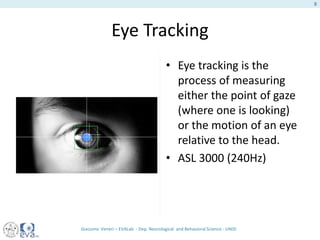
Eye Tracking
• Eye tracking is the
process of measuring
either the point of gaze
(where one is looking)
or the motion of an eye
relative to the head.
• ASL 3000 (240Hz)
Giacomo Veneri – EVALab - Dep. Neurological and Behavioral Science - UNISI
8
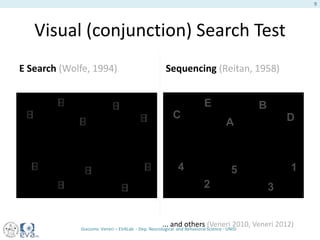
Visual (conjunction) Search Test
E Search (Wolfe, 1994) Sequencing (Reitan, 1958)
... and others (Veneri 2010, Veneri 2012)
Giacomo Veneri – EVALab - Dep. Neurological and Behavioral Science - UNISI
9
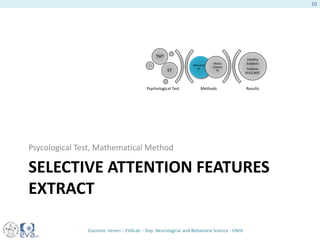
SELECTIVE ATTENTION FEATURES
EXTRACT
Psycological Test, Mathematical Method
Methods Results
Attention
FE
Motor
Control
FE
TMT
ET
Healthy
Subjects
Patients
SCA2,NDC
Psychological Test
Giacomo Veneri – EVALab - Dep. Neurological and Behavioral Science - UNISI
10
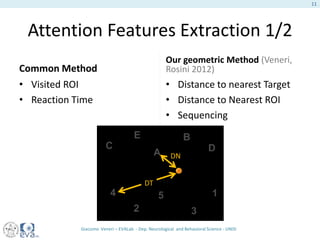
Attention Features Extraction 1/2
Common Method
• Visited ROI
• Reaction Time
Our geometric Method (Veneri,
Rosini 2012)
• Distance to nearest Target
• Distance to Nearest ROI
• Sequencing
Giacomo Veneri – EVALab - Dep. Neurological and Behavioral Science - UNISI
11
DN
DT
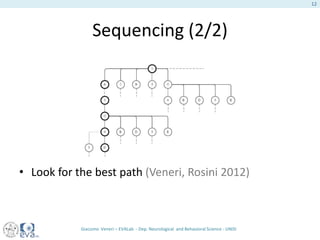
Sequencing (2/2)
• Look for the best path (Veneri, Rosini 2012)
Giacomo Veneri – EVALab - Dep. Neurological and Behavioral Science - UNISI
12
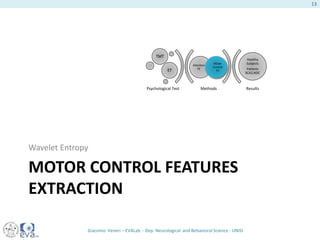
MOTOR CONTROL FEATURES
EXTRACTION
Wavelet Entropy
Methods Results
Attention
FE
Motor
Control
FE
TMT
ET
Healthy
Subjects
Patients
SCA2,NDC
Psychological Test
Giacomo Veneri – EVALab - Dep. Neurological and Behavioral Science - UNISI
13
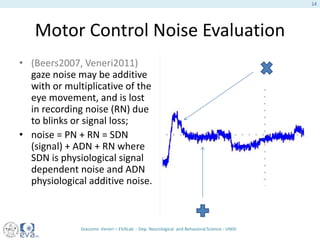
Motor Control Noise Evaluation
• (Beers2007, Veneri2011)
gaze noise may be additive
with or multiplicative of the
eye movement, and is lost
in recording noise (RN) due
to blinks or signal loss;
• noise = PN + RN = SDN
(signal) + ADN + RN where
SDN is physiological signal
dependent noise and ADN
physiological additive noise.
Giacomo Veneri – EVALab - Dep. Neurological and Behavioral Science - UNISI
14
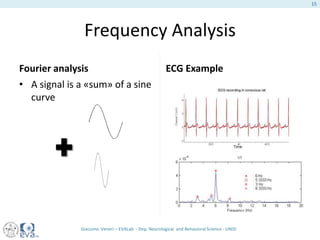
Frequency Analysis
Fourier analysis
• A signal is a «sum» of a sine
curve
ECG Example
Giacomo Veneri – EVALab - Dep. Neurological and Behavioral Science - UNISI
15
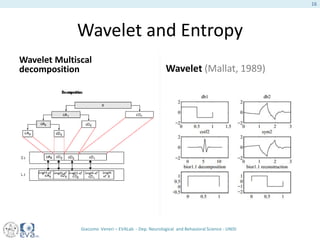
Wavelet and Entropy
Wavelet Multiscal
decomposition Wavelet (Mallat, 1989)
Giacomo Veneri – EVALab - Dep. Neurological and Behavioral Science - UNISI
16
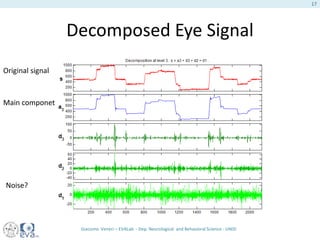
Decomposed Eye Signal
Original signal
Noise?
Main componet
Giacomo Veneri – EVALab - Dep. Neurological and Behavioral Science - UNISI
17
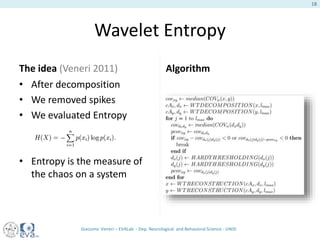
Wavelet Entropy
The idea (Veneri 2011)
• After decomposition
• We removed spikes
• We evaluated Entropy
• Entropy is the measure of
the chaos on a system
Algorithm
Giacomo Veneri – EVALab - Dep. Neurological and Behavioral Science - UNISI
18
RESULTS
Healthy Subjects and Patients
Methods Results
Attention
FE
Motor
Control
FE
TMT
ET
Healthy
Subjects
Patients
SCA2,NDC
Psychological Test
Giacomo Veneri – EVALab - Dep. Neurological and Behavioral Science - UNISI
19
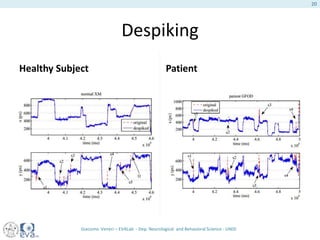
Despiking
Healthy Subject Patient
Giacomo Veneri – EVALab - Dep. Neurological and Behavioral Science - UNISI
20
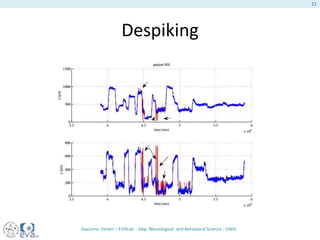
Despiking
Giacomo Veneri – EVALab - Dep. Neurological and Behavioral Science - UNISI
21
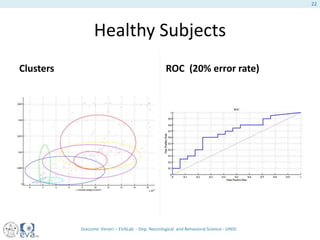
Healthy Subjects
Clusters ROC (20% error rate)
Giacomo Veneri – EVALab - Dep. Neurological and Behavioral Science - UNISI
22
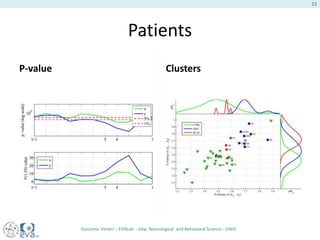
Patients
P-value Clusters
Giacomo Veneri – EVALab - Dep. Neurological and Behavioral Science - UNISI
23
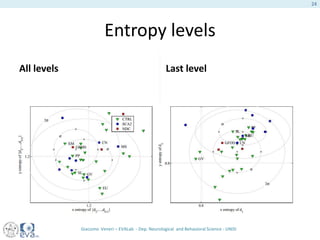
Entropy levels
All levels Last level
Giacomo Veneri – EVALab - Dep. Neurological and Behavioral Science - UNISI
24
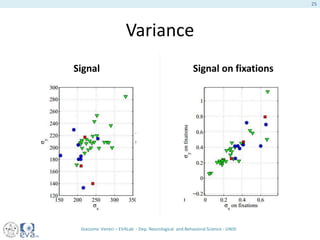
Variance
Signal Signal on fixations
Giacomo Veneri – EVALab - Dep. Neurological and Behavioral Science - UNISI
25
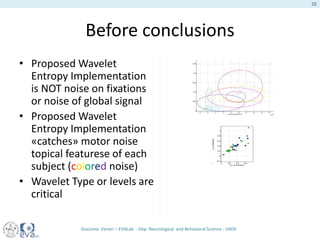
Before conclusions
• Proposed Wavelet
Entropy Implementation
is NOT noise on fixations
or noise of global signal
• Proposed Wavelet
Entropy Implementation
«catches» motor noise
topical featurese of each
subject (colored noise)
• Wavelet Type or levels are
critical
Giacomo Veneri – EVALab - Dep. Neurological and Behavioral Science - UNISI
26
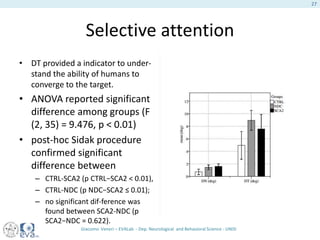
Selective attention
• DT provided a indicator to under-
stand the ability of humans to
converge to the target.
• ANOVA reported significant
difference among groups (F
(2, 35) = 9.476, p < 0.01)
• post-hoc Sidak procedure
confirmed significant
difference between
– CTRL-SCA2 (p CTRL−SCA2 < 0.01),
– CTRL-NDC (p NDC−SCA2 ≤ 0.01);
– no significant dif-ference was
found between SCA2-NDC (p
SCA2−NDC = 0.622).
Giacomo Veneri – EVALab - Dep. Neurological and Behavioral Science - UNISI
27
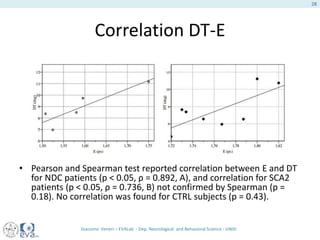
Correlation DT-E
• Pearson and Spearman test reported correlation between E and DT
for NDC patients (p < 0.05, ρ = 0.892, A), and correlation for SCA2
patients (p < 0.05, ρ = 0.736, B) not confirmed by Spearman (p =
0.18). No correlation was found for CTRL subjects (p = 0.43).
Giacomo Veneri – EVALab - Dep. Neurological and Behavioral Science - UNISI
28
CONCLUSIONS
Tools and Hypothesis
Giacomo Veneri – EVALab - Dep. Neurological and Behavioral Science - UNISI
29
Summary
• In the current work two methods have been developed:
• Selective attention evaluation
• Entropy analysis through wavelet decomposition.
• Both methods are based on eye tracking
• Subjects and patients cannot control eye movements or
fixations perfectly, then, analysing eye motor entropy it is
possible to extract some important features and conclusions.
Giacomo Veneri – EVALab - Dep. Neurological and Behavioral Science - UNISI
30
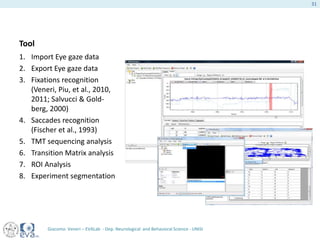
Tool
1. Import Eye gaze data
2. Export Eye gaze data
3. Fixations recognition
(Veneri, Piu, et al., 2010,
2011; Salvucci & Gold-
berg, 2000)
4. Saccades recognition
(Fischer et al., 1993)
5. TMT sequencing analysis
6. Transition Matrix analysis
7. ROI Analysis
8. Experiment segmentation
Giacomo Veneri – EVALab - Dep. Neurological and Behavioral Science - UNISI
31
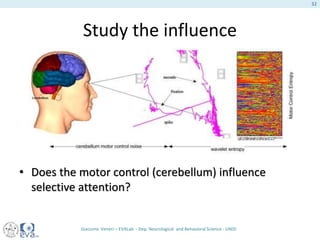
Study the influence
• Does the motor control (cerebellum) influence
selective attention?
Giacomo Veneri – EVALab - Dep. Neurological and Behavioral Science - UNISI
32
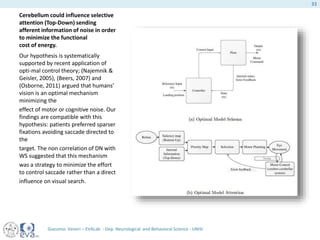
Cerebellum could influence selective
attention (Top-Down) sending
afferent information of noise in order
to minimize the functional
cost of energy.
Our hypothesis is systematically
supported by recent application of
opti-mal control theory; (Najemnik &
Geisler, 2005), (Beers, 2007) and
(Osborne, 2011) argued that humans’
vision is an optimal mechanism
minimizing the
effect of motor or cognitive noise. Our
findings are compatible with this
hypothesis: patients preferred sparser
fixations avoiding saccade directed to
the
target. The non correlation of DN with
WS suggested that this mechanism
was a strategy to minimize the effort
to control saccade rather than a direct
influence on visual search.
Giacomo Veneri – EVALab - Dep. Neurological and Behavioral Science - UNISI
33
THANKS
Feature-Based Information Processing of Selective Attention through
Entropy Analysis system
Giacomo Veneri – EVALab - Dep. Neurological and Behavioral Science - UNISI
34
Giacomo Veneri
Giacomo Veneri – EVALab - Dep. Neurological and Behavioral Science - UNISI
35
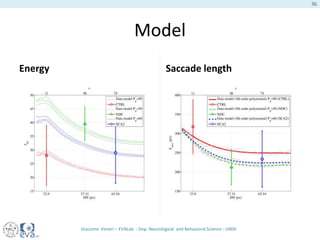
Model
Energy Saccade length
Giacomo Veneri – EVALab - Dep. Neurological and Behavioral Science - UNISI
36

Giacomo Veneri PHD Dissertation

  • 1.
    Feature-Based Information Processing ofSelective Attention through Entropy Analysis system Giacomo Veneri November 2012 Giacomo Veneri – EVALab - Dep. Neurological and Behavioral Science - UNISI 1
  • 2.
    Objectives • Study theinfluence of (eye) motor control on selective attention • Develop a method to extract motor control parameters during visual search • Develop a method to extract selective attention features during visual search Giacomo Veneri – EVALab - Dep. Neurological and Behavioral Science - UNISI 2 Methods Results Attention FE Motor Control FE TMT ET Healthy Subjects Patients SCA2,NDC Psychological Test
  • 3.
    Selective Attention • Selectiveattention ( Posner, 1980) is the process to select some region of the scene to be processed in detail; then, selective attention works as filter. • Top-Down: attentional process that influences sensory processing in an automatic and persistent manner • Bottom-Up: influence on the nervous system due to extrinsic properties of the stimuli Giacomo Veneri – EVALab - Dep. Neurological and Behavioral Science - UNISI 3
  • 4.
    Motor Control andCerebellum • The neuronal circuitry of the cerebellum is thought to encode internal models that reproduce the dynamic properties of body parts (Kelly2003,Ito2005,Ito2006a). • These models control the movement allowing the brain to precisely control the movement without the need for sensory feedback (Barlow2002,Ito2008,King2011 ) • SCA2 and NDC Patients Giacomo Veneri – EVALab - Dep. Neurological and Behavioral Science - UNISI 4
  • 5.
    Attention and Motorcontrol (Corbetta2001, Osborne2011) Giacomo Veneri – EVALab - Dep. Neurological and Behavioral Science - UNISI 5
  • 6.
    Methods 1. Veneri, G.,Federighi, P., Rosini, F., Federico, A., & Rufa, A. (2010). Influences of data filtering on human-computer interaction by gaze-contingent display and eye-tracking applications. Computers in Human Behavior , 26 (6), 1555 - 1563. doi: 10.1016/j.chb.2010.05.030 [SCOPUS, ACM] 2. Veneri, G., Federighi, P., Rosini, F., Federico, A., & Rufa, A. (2011, Mar). Spike removal through multiscale wavelet and entropy analysis of ocular motor noise: A case study in patients with cerebellar disease. Journal of Neuroscience Methods , 196 (2), 318–326. doi: 10.1016/j.jneumeth.2011.01.006 [MEDLINE, SCOPUS] 3. Veneri, G., Piu, P., Rosini, F., Federighi, P., Federico, A., & Rufa, A. (2011). Automatic eye fixations identification based on analysis of variance and covariance. Pattern Recognition Letters , 32 (13), 1588 - 1593. doi: 10.1016/j.patrec.2011.06.012 [SCOPUS] 4. Veneri, G., Pretegiani, E., Rosini, F., Federighi, P., Federico, A., & Rufa, A. (2011, Mar). Evaluating the human ongoing visual search performance by eye tracking application and se-quencing tests. Comput Methods Programs Biomed . Retrieved from http://dx.doi.org/10.1016/j.cmpb.2011.02.006 doi:10.1016/j.cmpb.2011.02.006 [SCOPUS. MEDLINE, ACM] 5. Veneri, G., Rosini, F., Federighi, P., Federico, A., & Rufa, A.(2012, Feb). Evaluating gaze control on a multi-target sequenc-ing task: The distribution of fixations is evidence of exploration optimisation. Comput Biol Med , 42 (2), 235–244. Retrieved from http://dx.doi.org/10.1016/j.compbiomed.2011.11.013 doi: 10.1016/j.compbiomed.2011.11.013 [SCOPUS. MEDLINE, ACM] InProceedings 1. Veneri, G., Federighi, P., Pretegiani, E., Rosini, F., Federico, A., & Rufa, A. (2009). Eye tracking - stimulus integrated semi automatic case base system. In Proceeding of the 13th world multi-conference on systemics, cybernetics and informatics. 2. Veneri, G., Pretegiani, E., Federighi, P., Rosini, F., & Rufa, A. (2010). Evaluating human visual search performance by monte carlo methods and heuristic model. In IEEE (Ed.), 10th ieee international conference on information technology and applications in biomedicine (itab 2010). [SCOPUS, IEEE] 3. Veneri, G., Piu, P., Federighi, P., Rosini, F., Federico, A., & Rufa, A. (2010, jun.). Eye fixations identification based on statistical analysis - case study. In Cognitive information processing (cip), 2010 2nd international workshop on (p. 446 -451). IEEE. doi: 10.1109/CIP.2010.5604221 [SCOPUS, IEEE] Others (posters) 1. Veneri, G., Federighi, P., Rosini, F., Pretegiani, E., Federico, A., & Rufa, A. (2009). The role of latest fixations on ongoing visual search: a model to evaluate the selection mechanism. In Rovereto workshop of attention. 2. Veneri, G., Olivetti, E., Avesani, P., Federico, A., & Rufa, A. (2011). Bayesian hypothesis on selective attention. In Rovereto visual attention congress. Giacomo Veneri – EVALab - Dep. Neurological and Behavioral Science - UNISI 6
  • 7.
    PSYCHOLOGICAL TEST Eye Tracking,TMT, ET Methods Results Attention FE Motor Control FE TMT ET Healthy Subjects Patients SCA2,NDC Psychological Test Giacomo Veneri – EVALab - Dep. Neurological and Behavioral Science - UNISI 7
  • 8.
    Eye Tracking • Eyetracking is the process of measuring either the point of gaze (where one is looking) or the motion of an eye relative to the head. • ASL 3000 (240Hz) Giacomo Veneri – EVALab - Dep. Neurological and Behavioral Science - UNISI 8
  • 9.
    Visual (conjunction) SearchTest E Search (Wolfe, 1994) Sequencing (Reitan, 1958) ... and others (Veneri 2010, Veneri 2012) Giacomo Veneri – EVALab - Dep. Neurological and Behavioral Science - UNISI 9
  • 10.
    SELECTIVE ATTENTION FEATURES EXTRACT PsycologicalTest, Mathematical Method Methods Results Attention FE Motor Control FE TMT ET Healthy Subjects Patients SCA2,NDC Psychological Test Giacomo Veneri – EVALab - Dep. Neurological and Behavioral Science - UNISI 10
  • 11.
    Attention Features Extraction1/2 Common Method • Visited ROI • Reaction Time Our geometric Method (Veneri, Rosini 2012) • Distance to nearest Target • Distance to Nearest ROI • Sequencing Giacomo Veneri – EVALab - Dep. Neurological and Behavioral Science - UNISI 11 DN DT
  • 12.
    Sequencing (2/2) • Lookfor the best path (Veneri, Rosini 2012) Giacomo Veneri – EVALab - Dep. Neurological and Behavioral Science - UNISI 12
  • 13.
    MOTOR CONTROL FEATURES EXTRACTION WaveletEntropy Methods Results Attention FE Motor Control FE TMT ET Healthy Subjects Patients SCA2,NDC Psychological Test Giacomo Veneri – EVALab - Dep. Neurological and Behavioral Science - UNISI 13
  • 14.
    Motor Control NoiseEvaluation • (Beers2007, Veneri2011) gaze noise may be additive with or multiplicative of the eye movement, and is lost in recording noise (RN) due to blinks or signal loss; • noise = PN + RN = SDN (signal) + ADN + RN where SDN is physiological signal dependent noise and ADN physiological additive noise. Giacomo Veneri – EVALab - Dep. Neurological and Behavioral Science - UNISI 14
  • 15.
    Frequency Analysis Fourier analysis •A signal is a «sum» of a sine curve ECG Example Giacomo Veneri – EVALab - Dep. Neurological and Behavioral Science - UNISI 15
  • 16.
    Wavelet and Entropy WaveletMultiscal decomposition Wavelet (Mallat, 1989) Giacomo Veneri – EVALab - Dep. Neurological and Behavioral Science - UNISI 16
  • 17.
    Decomposed Eye Signal Originalsignal Noise? Main componet Giacomo Veneri – EVALab - Dep. Neurological and Behavioral Science - UNISI 17
  • 18.
    Wavelet Entropy The idea(Veneri 2011) • After decomposition • We removed spikes • We evaluated Entropy • Entropy is the measure of the chaos on a system Algorithm Giacomo Veneri – EVALab - Dep. Neurological and Behavioral Science - UNISI 18
  • 19.
    RESULTS Healthy Subjects andPatients Methods Results Attention FE Motor Control FE TMT ET Healthy Subjects Patients SCA2,NDC Psychological Test Giacomo Veneri – EVALab - Dep. Neurological and Behavioral Science - UNISI 19
  • 20.
    Despiking Healthy Subject Patient GiacomoVeneri – EVALab - Dep. Neurological and Behavioral Science - UNISI 20
  • 21.
    Despiking Giacomo Veneri –EVALab - Dep. Neurological and Behavioral Science - UNISI 21
  • 22.
    Healthy Subjects Clusters ROC(20% error rate) Giacomo Veneri – EVALab - Dep. Neurological and Behavioral Science - UNISI 22
  • 23.
    Patients P-value Clusters Giacomo Veneri– EVALab - Dep. Neurological and Behavioral Science - UNISI 23
  • 24.
    Entropy levels All levelsLast level Giacomo Veneri – EVALab - Dep. Neurological and Behavioral Science - UNISI 24
  • 25.
    Variance Signal Signal onfixations Giacomo Veneri – EVALab - Dep. Neurological and Behavioral Science - UNISI 25
  • 26.
    Before conclusions • ProposedWavelet Entropy Implementation is NOT noise on fixations or noise of global signal • Proposed Wavelet Entropy Implementation «catches» motor noise topical featurese of each subject (colored noise) • Wavelet Type or levels are critical Giacomo Veneri – EVALab - Dep. Neurological and Behavioral Science - UNISI 26
  • 27.
    Selective attention • DTprovided a indicator to under- stand the ability of humans to converge to the target. • ANOVA reported significant difference among groups (F (2, 35) = 9.476, p < 0.01) • post-hoc Sidak procedure confirmed significant difference between – CTRL-SCA2 (p CTRL−SCA2 < 0.01), – CTRL-NDC (p NDC−SCA2 ≤ 0.01); – no significant dif-ference was found between SCA2-NDC (p SCA2−NDC = 0.622). Giacomo Veneri – EVALab - Dep. Neurological and Behavioral Science - UNISI 27
  • 28.
    Correlation DT-E • Pearsonand Spearman test reported correlation between E and DT for NDC patients (p < 0.05, ρ = 0.892, A), and correlation for SCA2 patients (p < 0.05, ρ = 0.736, B) not confirmed by Spearman (p = 0.18). No correlation was found for CTRL subjects (p = 0.43). Giacomo Veneri – EVALab - Dep. Neurological and Behavioral Science - UNISI 28
  • 29.
    CONCLUSIONS Tools and Hypothesis GiacomoVeneri – EVALab - Dep. Neurological and Behavioral Science - UNISI 29
  • 30.
    Summary • In thecurrent work two methods have been developed: • Selective attention evaluation • Entropy analysis through wavelet decomposition. • Both methods are based on eye tracking • Subjects and patients cannot control eye movements or fixations perfectly, then, analysing eye motor entropy it is possible to extract some important features and conclusions. Giacomo Veneri – EVALab - Dep. Neurological and Behavioral Science - UNISI 30
  • 31.
    Tool 1. Import Eyegaze data 2. Export Eye gaze data 3. Fixations recognition (Veneri, Piu, et al., 2010, 2011; Salvucci & Gold- berg, 2000) 4. Saccades recognition (Fischer et al., 1993) 5. TMT sequencing analysis 6. Transition Matrix analysis 7. ROI Analysis 8. Experiment segmentation Giacomo Veneri – EVALab - Dep. Neurological and Behavioral Science - UNISI 31
  • 32.
    Study the influence •Does the motor control (cerebellum) influence selective attention? Giacomo Veneri – EVALab - Dep. Neurological and Behavioral Science - UNISI 32
  • 33.
    Cerebellum could influenceselective attention (Top-Down) sending afferent information of noise in order to minimize the functional cost of energy. Our hypothesis is systematically supported by recent application of opti-mal control theory; (Najemnik & Geisler, 2005), (Beers, 2007) and (Osborne, 2011) argued that humans’ vision is an optimal mechanism minimizing the effect of motor or cognitive noise. Our findings are compatible with this hypothesis: patients preferred sparser fixations avoiding saccade directed to the target. The non correlation of DN with WS suggested that this mechanism was a strategy to minimize the effort to control saccade rather than a direct influence on visual search. Giacomo Veneri – EVALab - Dep. Neurological and Behavioral Science - UNISI 33
  • 34.
    THANKS Feature-Based Information Processingof Selective Attention through Entropy Analysis system Giacomo Veneri – EVALab - Dep. Neurological and Behavioral Science - UNISI 34
  • 35.
    Giacomo Veneri Giacomo Veneri– EVALab - Dep. Neurological and Behavioral Science - UNISI 35
  • 36.
    Model Energy Saccade length GiacomoVeneri – EVALab - Dep. Neurological and Behavioral Science - UNISI 36