Feedback Report
Growth factor inventory
Fady Nabil
Mantrac
26/11/2012
This report contains your feedback data from the Growth Factor Inventory
(GFI). It will help you make sense of your feedback and how to make best
use of it in your future development.
What does the GFI measure?
This survey identifies four growth factors. Growth factors are the qualities
that enable you to make the most of learning opportunities. These
opportunities may include formal development programs, mentoring or
coaching, new assignments, challenging projects or job moves. The four
growth factors are:
• Eagerness to Learn
• Breadth of Perspective
• Understanding Others
• Personal Maturity
Does the GFI measure my performance?
The GFI is not designed to focus on your current performance. Instead it
gives an indication of your readiness to grow: your preparedness to take
advantage of learning opportunities and to stretch your capabilities over
the long term.
The GFI does include a brief section on Current Work Results, which looks
at the work outcomes of your current role. This is NOT a growth factor - it
is included to help you, and your raters, distinguish the growth factors from
your current performance.
Depending on your current job, the growth factors may or may not help
you to achieve excellent results right now. However, they do tend to be
useful in a wide range of leadership and professional roles. They can also
help you to be effective in future roles.
What does the GFI mean for me?
The way you use and demonstrate the growth factors can change over
time and in different circumstances. For example, your day-to-day work
routine can place limits on your ability to show breadth of perspective if
the role you are asked to take is typically very narrow. You will find that
you may show them more readily when you are in new, non-routine or
learning stituations.
When you are aware of – and work on – these factors, you are likely to
get more out of the learning opportunities that you experience. You may
even discover or create more learning opportunities for yourself. The aim
of this report is to give you greater awareness of your growth factors, so
that you keep building your capability.
Fady Nabil - Mantrac
Introduction
26/11/2012 © 2012 Hay Acquisition Company I, Inc. 1
Continued
What does this report contain?
Your feedback report contains the following sections:
• The four Growth Factors
• Interpreting your feedback
• Data validity
• Your feedback
• Item distribution report
• Making the most of your feedback
• Development tips
Fady Nabil - Mantrac
Introduction
26/11/2012 © 2012 Hay Acquisition Company I, Inc. 2
Eagerness to Learn
Willing to take a risk to learn something new
This factor is characteristic of people who believe that their talents are
fundamentally developable (as opposed to fixed) and are worth
developing for their own sake. Curiosity provides the impetus for learning,
and supports people in developing a broader perspective.
People who come across as eager to learn are seen making an effort and
taking on opportunities to learn new things, even when their learning is
not directly related to their current or next job.
People who don't appear to learn can be seen to focus on immediate
performance – keen to demonstrate excellence by delivering the specific
performance indicators of their current job – rather than exploring in areas
which are not immediately relevant.
Breadth of Perspective
Taking a wider view on issues, bringing in additional points of view
This factor is characteristic of people who see the value and meaning in
gaining experiences and using perspectives beyond their core area of
expertise. It drives the ability to see issues in a broader context, think them
through deeply and see less obvious connections to other issues and to
other parts of the organisation. This ability becomes increasingly
important as people take on broader roles and need to coordinate across
or beyond their organisation.
People who demonstrate a breadth of perspective don't believe in one
'right' answer. They approach issues by gathering points of view from
multiple perspectives and disciplines.
People who demonstrate a narrow perspective strive for efficient
performance in their current role by attempting to have the 'right' answer
based on their core expertise.
Fady Nabil - Mantrac
The four Growth
Factors
26/11/2012 © 2012 Hay Acquisition Company I, Inc. 3
Understanding Others
Accurate understanding of others' thoughts and perspectives
This factor is characteristic of people who can build an accurate
understanding of others' experiences and perspectives. It is motivated by
a desire to listen to others with care and respect in order to learn from
them.
People who demonstrate this ability listen carefully, especially when
others perspectives are different from their own. This helps them to learn
from others experiences and take feedback constructively.
People who lack this tendency may appear more concerned with
communicating their own views effectively. Their emphasis on immediate
performance may result in a concern with being persuasive, rather than
eliciting – and understanding – the viewpoints of others.
Personal Maturity
The ability to take feedback and difficulties as a chance to learn and grow
This factor is characteristic of people who view negative feedback and
performance difficulties as a chance to learn and grow. Personal and
professional growth can be difficult and involve setbacks and criticism –
it takes emotional balance and resilience to learn from them.
People who demonstrate emotional maturity are seen to maintain an even
temper and objectivity. They cope with emotional strain and learn from it,
rather than defend themselves against it. They demonstrate persistence
with unfamiliar roles or new tasks, even when they're highly challenging.
People who are low in this growth factor may demonstrate self-confidence
in their current performance and mastery of their current role. But they
can grow defensive in the face of criticism, may handle negative emotion
poorly, or may avoid taking the sometimes painful risks needed to learn
and grow.
Fady Nabil - Mantrac
The four Growth
Factors
26/11/2012 © 2012 Hay Acquisition Company I, Inc. 4
Interpreting the GFI summary data
The GFI summary data provides an overview of your strengths and areas
for improvement.
The Current Work Results shows your view - and others - of how well you
are delivering the work outcomes of your current role. This data is
included to help you make a distinction between your growth factors and
your current performance.
Here is an example of what you will see in the report. To the right of each
Growth Factor description you will see Total Others Rating. This is the
mean score from everyone, excluding yourself, who provided you with
feedback.
Total
Others
Rating Strength
Not at all characteristic
Somewhat characteristic
Very characteristic
5.5
6.0
Total Others Rating Self Norm Group
The bars represent the Total Others score. The circle represents your own
rating, how you saw yourself on that Growth Factor.
The transparent box represents the norm group. That is, the scores
ranging from the 25th percentile to the 75th percentile of others who have
taken this survey.
When the Total Others score matches or exceeds 85% of the scale, the
Growth Factor is considered a strength. In this case, an arrow will appear
for that Growth Factor under the strength column.
Interpreting the Growth Factor Detail Report
The detailed report provides the scores by rater group for each of the
Growth Factors measured in this report.
Competency Scales: To the right of the graph is the scale the Growth
Factors were assessed on. The bar graph represents the average Growth
Factor score for each rater group.
4.9
6.7
4.3
5.4
Very characteristic
Somewhat characteristic
Not at all characteristic
Total Others Self Manager Peers
Fady Nabil - Mantrac
Interpreting your
feedback
A guide to what you'll see in your
GFI feedback data
26/11/2012 © 2012 Hay Acquisition Company I, Inc. 5
Continued
Norms: The shaded area represents the norm group (i.e. 25th to 75th
percentile)
Fady Nabil - Mantrac
Interpreting your
feedback
A guide to what you'll see in your
GFI feedback data
26/11/2012 © 2012 Hay Acquisition Company I, Inc. 6
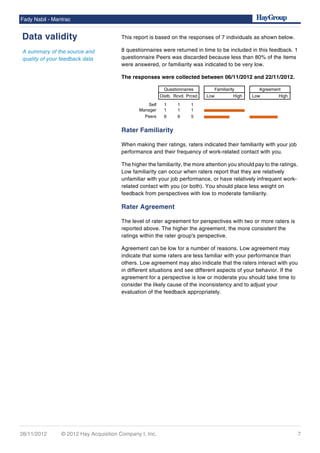
This report is based on the responses of 7 individuals as shown below.
8 questionnaires were returned in time to be included in this feedback. 1
questionnaire Peers was discarded because less than 80% of the items
were answered, or familiarity was indicated to be very low.
The responses were collected between 06/11/2012 and 22/11/2012.
Questionnaires Familiarity Agreement
Distb. Rcvd. Prcsd. Low High Low High
Self 1 1 1
Manager 1 1 1
Peers 6 6 5
Rater Familiarity
When making their ratings, raters indicated their familiarity with your job
performance and their frequency of work-related contact with you.
The higher the familiarity, the more attention you should pay to the ratings.
Low familiarity can occur when raters report that they are relatively
unfamiliar with your job performance, or have relatively infrequent work-
related contact with you (or both). You should place less weight on
feedback from perspectives with low to moderate familiarity.
Rater Agreement
The level of rater agreement for perspectives with two or more raters is
reported above. The higher the agreement, the more consistent the
ratings within the rater group's perspective.
Agreement can be low for a number of reasons. Low agreement may
indicate that some raters are less familiar with your performance than
others. Low agreement may also indicate that the raters interact with you
in different situations and see different aspects of your behavior. If the
agreement for a perspective is low or moderate you should take time to
consider the likely cause of the inconsistency and to adjust your
evaluation of the feedback appropriately.
Fady Nabil - Mantrac
Data validity
A summary of the source and
quality of your feedback data
26/11/2012 © 2012 Hay Acquisition Company I, Inc. 7
Total
Others
Rating Strength
Not at all characteristic
Somewhat characteristic
Very characteristic
Growth Factors
Eagerness to Learn 4.9
Breadth of Perspective 4.8
Understanding Others 5.1
Personal Maturity 4.5
Current Work Results
Work Result 5.8
Total Others Rating Self Norm Group
Fady Nabil - Mantrac
GFI summary data
26/11/2012 © 2012 Hay Acquisition Company I, Inc. 8
Growth Factors Strength
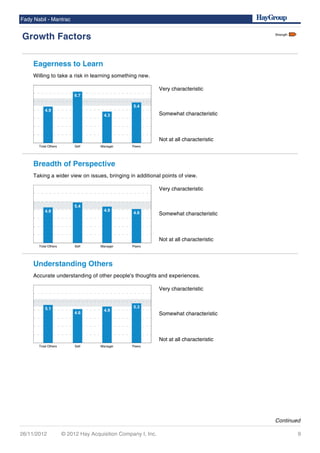
Eagerness to Learn
Willing to take a risk in learning something new.
4.9
6.7
4.3
5.4
Very characteristic
Somewhat characteristic
Not at all characteristic
Total Others Self Manager Peers
Breadth of Perspective
Taking a wider view on issues, bringing in additional points of view.
4.8
5.4
4.9
4.6
Very characteristic
Somewhat characteristic
Not at all characteristic
Total Others Self Manager Peers
Understanding Others
Accurate understanding of other people's thoughts and experiences.
5.1
4.6
4.9
5.3
Very characteristic
Somewhat characteristic
Not at all characteristic
Total Others Self Manager Peers
Fady Nabil - Mantrac
26/11/2012 © 2012 Hay Acquisition Company I, Inc. 9
Continued
Growth Factors Strength
Personal Maturity
The ability to take feedback and difficulties as a chance to learn and grow.
4.5 4.6
4.2
4.7
Very characteristic
Somewhat characteristic
Not at all characteristic
Total Others Self Manager Peers
Fady Nabil - Mantrac
26/11/2012 © 2012 Hay Acquisition Company I, Inc. 10
Continued
Current Work Results Strength
Work Result
A general measure of your current work results including quality, efficiency, timeliness, working without much
direction and working well with others.
5.8
5.5 5.7 5.8
Very characteristic
Somewhat characteristic
Not at all characteristic
Total Others Self Manager Peers
Fady Nabil - Mantrac
26/11/2012 © 2012 Hay Acquisition Company I, Inc. 11
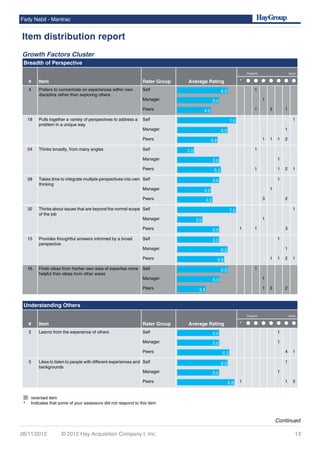
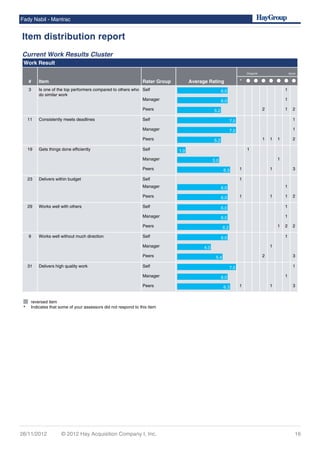
The following charts show how your raters responded to each questionnaire item. It indicates, item by item, where
raters' perceptions of your behaviour agree or differ.
The bars on the 'Average rating' column represent the average item score for each rater group. The distribution of
ratings, with a column for each point on the rating scale, are shown to the right of the bars. The number in each
column indicates the number of raters who rated you on that point. The left most column labeled with a * indicates
the number of raters who did not answer the question.
Growth Factors Cluster
Eagerness to Learn
# Item Rater Group Average Rating
Disagree Agree
*
10 Tries to find new approaches to getting work done Self 7.0 1
Manager 5.0 1
Peers 6.2 1 2 2
12 Prefers to do something he/she excels at rather than
struggle to learn something new
Self 7.0 1
Manager 4.0 1
Peers 4.2 1 1 1 2
27 Is eager to stretch beyond his/her current abilities Self 7.0 1
Manager 4.0 1
Peers 5.8 1 4
33 Tries to learn about topics outside of his/her expertise Self 7.0 1
Manager 4.0 1
Peers 6.0 1 1 2 1
34 Seeks to learn about other departments or functions
outside his/her field
Self 6.0 1
Manager 4.0 1
Peers 5.6 1 1 2 1
6 If something is not easily within his/her grasp, turns to
other activities
Self 6.0 1
Manager 1
Peers 4.2 1 1 2 1
30 Tries to learn things he/she is not good at Self 7.0 1
Manager 5.0 1
Peers 6.0 1 1 2 1
reversed item
* Indicates that some of your assessors did not respond to this item
Fady Nabil - Mantrac
Item distribution report
26/11/2012 © 2012 Hay Acquisition Company I, Inc. 12
Continued
Growth Factors Cluster
Breadth of Perspective
# Item Rater Group Average Rating
Disagree Agree
*
4 Prefers to concentrate on experiences within own
discipline rather than exploring others
Self 6.0 1
Manager 5.0 1
Peers 4.0 1 3 1
18 Pulls together a variety of perspectives to address a
problem in a unique way
Self 7.0 1
Manager 6.0 1
Peers 4.8 1 1 1 2
24 Thinks broadly, from many angles Self 2.0 1
Manager 5.0 1
Peers 5.2 1 1 2 1
28 Takes time to integrate multiple perspectives into own
thinking
Self 5.0 1
Manager 4.0 1
Peers 4.2 3 2
32 Thinks about issues that are beyond the normal scope
of the job
Self 7.0 1
Manager 3.0 1
Peers 5.0 1 1 3
15 Provides thoughtful answers informed by a broad
perspective
Self 5.0 1
Manager 6.0 1
Peers 5.6 1 1 2 1
16 Finds ideas from his/her own area of expertise more
helpful than ideas from other areas
Self 6.0 1
Manager 5.0 1
Peers 3.4 1 2 2
Understanding Others
# Item Rater Group Average Rating
Disagree Agree
*
2 Learns from the experience of others Self 5.0 1
Manager 5.0 1
Peers 6.2 4 1
5 Likes to listen to people with different experiences and
backgrounds
Self 6.0 1
Manager 5.0 1
Peers 6.8 1 1 3
reversed item
* Indicates that some of your assessors did not respond to this item
Fady Nabil - Mantrac
Item distribution report
26/11/2012 © 2012 Hay Acquisition Company I, Inc. 13
Continued
Growth Factors Cluster
Understanding Others
# Item Rater Group Average Rating
Disagree Agree
*
13 Finds it hard to understand people who are very
different from him/her
Self 2.0 1
Manager 4.0 1
Peers 4.3 2 1 2
22 Tries to understand the other person's perspective
when receiving feedback
Self 5.0 1
Manager 5.0 1
Peers 6.2 1 2 2
36 Learns through understanding others Self 6.0 1
Manager 5.0 1
Peers 5.6 2 3
1 Explores other people's ideas and view points Self 6.0 1
Manager 6.0 1
Peers 5.8 1 2 2
7 Understands other people's constraints and concerns Self 3.0 1
Manager 5.0 1
Peers 5.8 1 2 2
8 Prefers to listen to people who have a similar outlook
or attitude
Self 4.0 1
Manager 4.0 1
Peers 1.7 2 2 1
Personal Maturity
# Item Rater Group Average Rating
Disagree Agree
*
17 Criticism ruins his/her concentration for days Self 5.0 1
Manager 4.0 1
Peers 5.0 2 1 2
21 Manages own emotions well under stress Self 6.0 1
Manager 6.0 1
Peers 5.5 1 2 2
25 Recovers well from setbacks or failures Self 6.0 1
Manager 1
Peers 5.0 2 2 1
reversed item
* Indicates that some of your assessors did not respond to this item
Fady Nabil - Mantrac
Item distribution report
26/11/2012 © 2012 Hay Acquisition Company I, Inc. 14
Continued
Growth Factors Cluster
Personal Maturity
# Item Rater Group Average Rating
Disagree Agree
*
26 Sees failures as an opportunity to learn Self 7.0 1
Manager 6.0 1
Peers 5.8 1 1 2 1
14 Feels comfortable taking action when faced with
uncertainty
Self 1.0 1
Manager 3.0 1
Peers 3.8 1 1 1 1 1
20 Remains optimistic in the face of setbacks Self 6.0 1
Manager 4.0 1
Peers 5.6 1 1 2 1
35 Avoids emotional discomfort Self 1.0 1
Manager 2.0 1
Peers 2.5 1 2 2
reversed item
* Indicates that some of your assessors did not respond to this item
Fady Nabil - Mantrac
Item distribution report
26/11/2012 © 2012 Hay Acquisition Company I, Inc. 15
Continued
Current Work Results Cluster
Work Result
# Item Rater Group Average Rating
Disagree Agree
*
3 Is one of the top performers compared to others who
do similar work
Self 6.0 1
Manager 6.0 1
Peers 5.2 2 1 2
11 Consistently meets deadlines Self 7.0 1
Manager 7.0 1
Peers 5.2 1 1 1 2
19 Gets things done efficiently Self 1.0 1
Manager 5.0 1
Peers 6.3 1 1 3
23 Delivers within budget Self 1
Manager 6.0 1
Peers 6.0 1 1 1 2
29 Works well with others Self 6.0 1
Manager 6.0 1
Peers 6.2 1 2 2
9 Works well without much direction Self 6.0 1
Manager 4.0 1
Peers 5.4 2 3
31 Delivers high quality work Self 7.0 1
Manager 6.0 1
Peers 6.3 1 1 3
reversed item
* Indicates that some of your assessors did not respond to this item
Fady Nabil - Mantrac
Item distribution report
26/11/2012 © 2012 Hay Acquisition Company I, Inc. 16
The data in your GFI feedback report – your own score and others' – is a
valuable source of information. It can help you learn more about yourself,
your approach, your strengths and your readiness to grow.
The following questions may help you reflect on what your GFI feedback
means for you.
Are you pleased with the growth factor scores others gave
you?
If so, you are likely to be making the most of learning opportunities
available to you, and others can see this. Consider different ways of
learning that might be available to you: working with a coach or mentor,
enrolling in development programs, taking on assignments or projects that
stretch your capabilities and creating your own informal ways of learning.
Be sure to maintain your current performance as you do so: Growth
Factors are important abilities that can help you take advantage of
learning opportunities, but they are not enough to qualify you for
development or advancement; you must also perform well.
Are you concerned about the growth factor scores others
gave you?
If so, ask yourself honestly whether the scores tell you something useful
about yourself. Could there be a reason for these results at the present
time? Your ability to demonstrate the growth factors to your satisfaction
can be held back by a number of factors: a routine job can undermine
Eagerness to Learn, stressful life events can strain your Personal
Maturity, unusual performance expectations can leave no room for
Breadth of Perspective, a lack of time and resources can limit your
Understanding Others. We all encounter these factors at times in our
working lives and need to respond by coming up with strategies to elicit,
reinforce and demonstrate our full capabilities.
However, if your work situation is fairly normal, you may want to ask
yourself what your aspirations are. Perhaps you're keen to take on a larger
contribution or a bigger leadership role. If so, working on your growth
factors will enable you to take best advantage of any future learning
opportunities.
Are your self-scores very different from how others have
scored you?
Your self-scores represent your view of your behaviours across a wide
range of situations. They also represent your good intentions. A gap
between your own and others' scores – in either direction – is not
necessarily an issue unless it is very wide.
If your scores are lower than your manager's or others who scored you,
ask yourself:
• what do others see and value in you that you don't see, or that you take
for granted?
Fady Nabil - Mantrac
Making the most of
your feedback
Using your GFI feedback to
support your learning
26/11/2012 © 2012 Hay Acquisition Company I, Inc. 17
If your scores are higher than your manager's or others who scored you,
ask yourself:
• are you demonstrating your growth factors at work, or in other
situations?
• how visible are your growth factors – or your intentions – to others?
• what other factors might be influencing others' perceptions?
The best way to reduce gaps, in any kind of personal data, is to ask for
feedback and act upon it. The following pages give some ideas and tips
for working on your growth factors.
Fady Nabil - Mantrac
Making the most of
your feedback
Using your GFI feedback to
support your learning
26/11/2012 © 2012 Hay Acquisition Company I, Inc. 18
General tips for developing your growth factors
In general, it is helpful to set specific goals, and track your progress in
adding these behaviours to your repertoire. (This can be as simple as
tally-marks on your calendar or a brief journal). In addition, sharing your
goals with someone you trust, and meeting regularly to update them on
your progress and to brainstorm next steps or solutions to difficulties, can
significantly enhance the likelihood of real change. If your confidante is
also working on development, you can support each other, even if you are
working on different issues.
Here are some tips for working on your growth factors:
• Observe others.Think about people you know – at work or outside –
and how they demonstrate their eagerness to learn, breadth of
perspective, understanding others and emotional maturity. Think about
what they gain from their approach.
• Ask a friend.Let someone you trust know that you are working on your
growth factors. Talk about your experiences and ask for feedback on
how well you are doing.
• Practice makes perfect. Become more aware of how you go about
learning new things. Try new ways of learning in low-risk situations –
until they feel more familiar.
• Make a commitment.Go through your calendar and decide on specific
dates for reviewing your progress. Decide what you're going to be
working on before each date.
• Seek feedback again in six months time.See how you are doing with
the growth factors you've been working on. See whether you – and
others – see things differently.
Space for your notes
Fady Nabil - Mantrac
Development tips
26/11/2012 © 2012 Hay Acquisition Company I, Inc. 19
Tips for working on each of your growth factors
Eagerness to Learn
• Subscribe to and read at least two sources of news for three months.
Identify how events may impact your organisation.
• Enroll in a class or learn more about a subject you find interesting and
haven't taken the time to explore. Take a course that does not give
grades and pay attention to the fun of learning.
• Engage in conversation with people outside your department/unit and
ask them about their jobs.
• Make a conscious effort to find out about things outside your immediate
role e.g. new developments in your organisation.
• Let your focus move beyond the objectives you're directly accountable
for; allow yourself to become curious about the wider issues that affect
what you do.
Breadth of Perspective
• Identify your biases: What information sources do you read or track?
What do you not read or track? What sources feed your biases?
Endeavour to integrate perspectives outside the scope of your job when
making decisions.
• Read multiple perspectives on current trends or events. Go to the
internet and find opposing views from contrasting sources. Identify what
is consistent, what is contrasting. Engage colleagues in discussion.
• Try to get involved in cross-functional or cross-departmental projects
and use this opportunity to learn about the business perspectives of
other parts of the organisation. Who are your customer's customers?
What are their issues, and how do these affect your customer? Who
are your supplier's suppliers? What are their issues and how might
these affect your own department?
• Make a checklist of information sources available to you. Do not
overlook friends, acquaintances, colleagues, old clients, and various
intranet and internet services. When you are next facing a complex
decision, perform 'due diligence' against your checklist.
Understanding Others
• Friends, family and people you meet while volunteering outside work
may be a good place to develop your understanding of others.
• Endeavour to put yourself in the position of others to explore their
constraints. See how many new things you can learn about other people
each week.
• Listen carefully to others at work, especially those with perspectives
and motivations different from yours. Make note of what you learn.
Continued
Fady Nabil - Mantrac
Development tips
26/11/2012 © 2012 Hay Acquisition Company I, Inc. 20
• Try to get involved in cross-functional or cross-departmental projects.
Use these opportunities to get to know and understand people from
other parts of the organisation.
• Create a developmental network of people with different backgrounds
and/or experience.
Personal Maturity
• Dedicate time in meetings or other gatherings to talking about times
when, and how, you (or others) overcame setbacks. Discuss the
approaches you took.
• In team meetings, when discussing tough issues, force yourself – or
others – to question which obstacles are out of your control and which
can be resolved at your level.
• Read Martin Seligman's 'Learned Optimism,' and/or Andrew Shatte and
Karen Reivich's 'The Resilience Factor.' Actually do the exercises in the
book.
• Read Richard Boyatzis' book, 'Resonant Leadership' to understand
more about renewing yourself and connecting with others.
• Read Daniel Goleman's book on 'Working with Emotional Intelligence'
to understand more about how to manage change and conflict.
Fady Nabil - Mantrac
Development tips
26/11/2012 © 2012 Hay Acquisition Company I, Inc. 21

GFI

  • 1.
    Feedback Report Growth factorinventory Fady Nabil Mantrac 26/11/2012
  • 2.
    This report containsyour feedback data from the Growth Factor Inventory (GFI). It will help you make sense of your feedback and how to make best use of it in your future development. What does the GFI measure? This survey identifies four growth factors. Growth factors are the qualities that enable you to make the most of learning opportunities. These opportunities may include formal development programs, mentoring or coaching, new assignments, challenging projects or job moves. The four growth factors are: • Eagerness to Learn • Breadth of Perspective • Understanding Others • Personal Maturity Does the GFI measure my performance? The GFI is not designed to focus on your current performance. Instead it gives an indication of your readiness to grow: your preparedness to take advantage of learning opportunities and to stretch your capabilities over the long term. The GFI does include a brief section on Current Work Results, which looks at the work outcomes of your current role. This is NOT a growth factor - it is included to help you, and your raters, distinguish the growth factors from your current performance. Depending on your current job, the growth factors may or may not help you to achieve excellent results right now. However, they do tend to be useful in a wide range of leadership and professional roles. They can also help you to be effective in future roles. What does the GFI mean for me? The way you use and demonstrate the growth factors can change over time and in different circumstances. For example, your day-to-day work routine can place limits on your ability to show breadth of perspective if the role you are asked to take is typically very narrow. You will find that you may show them more readily when you are in new, non-routine or learning stituations. When you are aware of – and work on – these factors, you are likely to get more out of the learning opportunities that you experience. You may even discover or create more learning opportunities for yourself. The aim of this report is to give you greater awareness of your growth factors, so that you keep building your capability. Fady Nabil - Mantrac Introduction 26/11/2012 © 2012 Hay Acquisition Company I, Inc. 1 Continued
  • 3.
    What does thisreport contain? Your feedback report contains the following sections: • The four Growth Factors • Interpreting your feedback • Data validity • Your feedback • Item distribution report • Making the most of your feedback • Development tips Fady Nabil - Mantrac Introduction 26/11/2012 © 2012 Hay Acquisition Company I, Inc. 2
  • 4.
    Eagerness to Learn Willingto take a risk to learn something new This factor is characteristic of people who believe that their talents are fundamentally developable (as opposed to fixed) and are worth developing for their own sake. Curiosity provides the impetus for learning, and supports people in developing a broader perspective. People who come across as eager to learn are seen making an effort and taking on opportunities to learn new things, even when their learning is not directly related to their current or next job. People who don't appear to learn can be seen to focus on immediate performance – keen to demonstrate excellence by delivering the specific performance indicators of their current job – rather than exploring in areas which are not immediately relevant. Breadth of Perspective Taking a wider view on issues, bringing in additional points of view This factor is characteristic of people who see the value and meaning in gaining experiences and using perspectives beyond their core area of expertise. It drives the ability to see issues in a broader context, think them through deeply and see less obvious connections to other issues and to other parts of the organisation. This ability becomes increasingly important as people take on broader roles and need to coordinate across or beyond their organisation. People who demonstrate a breadth of perspective don't believe in one 'right' answer. They approach issues by gathering points of view from multiple perspectives and disciplines. People who demonstrate a narrow perspective strive for efficient performance in their current role by attempting to have the 'right' answer based on their core expertise. Fady Nabil - Mantrac The four Growth Factors 26/11/2012 © 2012 Hay Acquisition Company I, Inc. 3
  • 5.
    Understanding Others Accurate understandingof others' thoughts and perspectives This factor is characteristic of people who can build an accurate understanding of others' experiences and perspectives. It is motivated by a desire to listen to others with care and respect in order to learn from them. People who demonstrate this ability listen carefully, especially when others perspectives are different from their own. This helps them to learn from others experiences and take feedback constructively. People who lack this tendency may appear more concerned with communicating their own views effectively. Their emphasis on immediate performance may result in a concern with being persuasive, rather than eliciting – and understanding – the viewpoints of others. Personal Maturity The ability to take feedback and difficulties as a chance to learn and grow This factor is characteristic of people who view negative feedback and performance difficulties as a chance to learn and grow. Personal and professional growth can be difficult and involve setbacks and criticism – it takes emotional balance and resilience to learn from them. People who demonstrate emotional maturity are seen to maintain an even temper and objectivity. They cope with emotional strain and learn from it, rather than defend themselves against it. They demonstrate persistence with unfamiliar roles or new tasks, even when they're highly challenging. People who are low in this growth factor may demonstrate self-confidence in their current performance and mastery of their current role. But they can grow defensive in the face of criticism, may handle negative emotion poorly, or may avoid taking the sometimes painful risks needed to learn and grow. Fady Nabil - Mantrac The four Growth Factors 26/11/2012 © 2012 Hay Acquisition Company I, Inc. 4
  • 6.
    Interpreting the GFIsummary data The GFI summary data provides an overview of your strengths and areas for improvement. The Current Work Results shows your view - and others - of how well you are delivering the work outcomes of your current role. This data is included to help you make a distinction between your growth factors and your current performance. Here is an example of what you will see in the report. To the right of each Growth Factor description you will see Total Others Rating. This is the mean score from everyone, excluding yourself, who provided you with feedback. Total Others Rating Strength Not at all characteristic Somewhat characteristic Very characteristic 5.5 6.0 Total Others Rating Self Norm Group The bars represent the Total Others score. The circle represents your own rating, how you saw yourself on that Growth Factor. The transparent box represents the norm group. That is, the scores ranging from the 25th percentile to the 75th percentile of others who have taken this survey. When the Total Others score matches or exceeds 85% of the scale, the Growth Factor is considered a strength. In this case, an arrow will appear for that Growth Factor under the strength column. Interpreting the Growth Factor Detail Report The detailed report provides the scores by rater group for each of the Growth Factors measured in this report. Competency Scales: To the right of the graph is the scale the Growth Factors were assessed on. The bar graph represents the average Growth Factor score for each rater group. 4.9 6.7 4.3 5.4 Very characteristic Somewhat characteristic Not at all characteristic Total Others Self Manager Peers Fady Nabil - Mantrac Interpreting your feedback A guide to what you'll see in your GFI feedback data 26/11/2012 © 2012 Hay Acquisition Company I, Inc. 5 Continued
  • 7.
    Norms: The shadedarea represents the norm group (i.e. 25th to 75th percentile) Fady Nabil - Mantrac Interpreting your feedback A guide to what you'll see in your GFI feedback data 26/11/2012 © 2012 Hay Acquisition Company I, Inc. 6
  • 8.
    This report isbased on the responses of 7 individuals as shown below. 8 questionnaires were returned in time to be included in this feedback. 1 questionnaire Peers was discarded because less than 80% of the items were answered, or familiarity was indicated to be very low. The responses were collected between 06/11/2012 and 22/11/2012. Questionnaires Familiarity Agreement Distb. Rcvd. Prcsd. Low High Low High Self 1 1 1 Manager 1 1 1 Peers 6 6 5 Rater Familiarity When making their ratings, raters indicated their familiarity with your job performance and their frequency of work-related contact with you. The higher the familiarity, the more attention you should pay to the ratings. Low familiarity can occur when raters report that they are relatively unfamiliar with your job performance, or have relatively infrequent work- related contact with you (or both). You should place less weight on feedback from perspectives with low to moderate familiarity. Rater Agreement The level of rater agreement for perspectives with two or more raters is reported above. The higher the agreement, the more consistent the ratings within the rater group's perspective. Agreement can be low for a number of reasons. Low agreement may indicate that some raters are less familiar with your performance than others. Low agreement may also indicate that the raters interact with you in different situations and see different aspects of your behavior. If the agreement for a perspective is low or moderate you should take time to consider the likely cause of the inconsistency and to adjust your evaluation of the feedback appropriately. Fady Nabil - Mantrac Data validity A summary of the source and quality of your feedback data 26/11/2012 © 2012 Hay Acquisition Company I, Inc. 7
  • 9.
    Total Others Rating Strength Not atall characteristic Somewhat characteristic Very characteristic Growth Factors Eagerness to Learn 4.9 Breadth of Perspective 4.8 Understanding Others 5.1 Personal Maturity 4.5 Current Work Results Work Result 5.8 Total Others Rating Self Norm Group Fady Nabil - Mantrac GFI summary data 26/11/2012 © 2012 Hay Acquisition Company I, Inc. 8
  • 10.
    Growth Factors Strength Eagernessto Learn Willing to take a risk in learning something new. 4.9 6.7 4.3 5.4 Very characteristic Somewhat characteristic Not at all characteristic Total Others Self Manager Peers Breadth of Perspective Taking a wider view on issues, bringing in additional points of view. 4.8 5.4 4.9 4.6 Very characteristic Somewhat characteristic Not at all characteristic Total Others Self Manager Peers Understanding Others Accurate understanding of other people's thoughts and experiences. 5.1 4.6 4.9 5.3 Very characteristic Somewhat characteristic Not at all characteristic Total Others Self Manager Peers Fady Nabil - Mantrac 26/11/2012 © 2012 Hay Acquisition Company I, Inc. 9 Continued
  • 11.
    Growth Factors Strength PersonalMaturity The ability to take feedback and difficulties as a chance to learn and grow. 4.5 4.6 4.2 4.7 Very characteristic Somewhat characteristic Not at all characteristic Total Others Self Manager Peers Fady Nabil - Mantrac 26/11/2012 © 2012 Hay Acquisition Company I, Inc. 10 Continued
  • 12.
    Current Work ResultsStrength Work Result A general measure of your current work results including quality, efficiency, timeliness, working without much direction and working well with others. 5.8 5.5 5.7 5.8 Very characteristic Somewhat characteristic Not at all characteristic Total Others Self Manager Peers Fady Nabil - Mantrac 26/11/2012 © 2012 Hay Acquisition Company I, Inc. 11
  • 13.
    The following chartsshow how your raters responded to each questionnaire item. It indicates, item by item, where raters' perceptions of your behaviour agree or differ. The bars on the 'Average rating' column represent the average item score for each rater group. The distribution of ratings, with a column for each point on the rating scale, are shown to the right of the bars. The number in each column indicates the number of raters who rated you on that point. The left most column labeled with a * indicates the number of raters who did not answer the question. Growth Factors Cluster Eagerness to Learn # Item Rater Group Average Rating Disagree Agree * 10 Tries to find new approaches to getting work done Self 7.0 1 Manager 5.0 1 Peers 6.2 1 2 2 12 Prefers to do something he/she excels at rather than struggle to learn something new Self 7.0 1 Manager 4.0 1 Peers 4.2 1 1 1 2 27 Is eager to stretch beyond his/her current abilities Self 7.0 1 Manager 4.0 1 Peers 5.8 1 4 33 Tries to learn about topics outside of his/her expertise Self 7.0 1 Manager 4.0 1 Peers 6.0 1 1 2 1 34 Seeks to learn about other departments or functions outside his/her field Self 6.0 1 Manager 4.0 1 Peers 5.6 1 1 2 1 6 If something is not easily within his/her grasp, turns to other activities Self 6.0 1 Manager 1 Peers 4.2 1 1 2 1 30 Tries to learn things he/she is not good at Self 7.0 1 Manager 5.0 1 Peers 6.0 1 1 2 1 reversed item * Indicates that some of your assessors did not respond to this item Fady Nabil - Mantrac Item distribution report 26/11/2012 © 2012 Hay Acquisition Company I, Inc. 12 Continued
  • 14.
    Growth Factors Cluster Breadthof Perspective # Item Rater Group Average Rating Disagree Agree * 4 Prefers to concentrate on experiences within own discipline rather than exploring others Self 6.0 1 Manager 5.0 1 Peers 4.0 1 3 1 18 Pulls together a variety of perspectives to address a problem in a unique way Self 7.0 1 Manager 6.0 1 Peers 4.8 1 1 1 2 24 Thinks broadly, from many angles Self 2.0 1 Manager 5.0 1 Peers 5.2 1 1 2 1 28 Takes time to integrate multiple perspectives into own thinking Self 5.0 1 Manager 4.0 1 Peers 4.2 3 2 32 Thinks about issues that are beyond the normal scope of the job Self 7.0 1 Manager 3.0 1 Peers 5.0 1 1 3 15 Provides thoughtful answers informed by a broad perspective Self 5.0 1 Manager 6.0 1 Peers 5.6 1 1 2 1 16 Finds ideas from his/her own area of expertise more helpful than ideas from other areas Self 6.0 1 Manager 5.0 1 Peers 3.4 1 2 2 Understanding Others # Item Rater Group Average Rating Disagree Agree * 2 Learns from the experience of others Self 5.0 1 Manager 5.0 1 Peers 6.2 4 1 5 Likes to listen to people with different experiences and backgrounds Self 6.0 1 Manager 5.0 1 Peers 6.8 1 1 3 reversed item * Indicates that some of your assessors did not respond to this item Fady Nabil - Mantrac Item distribution report 26/11/2012 © 2012 Hay Acquisition Company I, Inc. 13 Continued
  • 15.
    Growth Factors Cluster UnderstandingOthers # Item Rater Group Average Rating Disagree Agree * 13 Finds it hard to understand people who are very different from him/her Self 2.0 1 Manager 4.0 1 Peers 4.3 2 1 2 22 Tries to understand the other person's perspective when receiving feedback Self 5.0 1 Manager 5.0 1 Peers 6.2 1 2 2 36 Learns through understanding others Self 6.0 1 Manager 5.0 1 Peers 5.6 2 3 1 Explores other people's ideas and view points Self 6.0 1 Manager 6.0 1 Peers 5.8 1 2 2 7 Understands other people's constraints and concerns Self 3.0 1 Manager 5.0 1 Peers 5.8 1 2 2 8 Prefers to listen to people who have a similar outlook or attitude Self 4.0 1 Manager 4.0 1 Peers 1.7 2 2 1 Personal Maturity # Item Rater Group Average Rating Disagree Agree * 17 Criticism ruins his/her concentration for days Self 5.0 1 Manager 4.0 1 Peers 5.0 2 1 2 21 Manages own emotions well under stress Self 6.0 1 Manager 6.0 1 Peers 5.5 1 2 2 25 Recovers well from setbacks or failures Self 6.0 1 Manager 1 Peers 5.0 2 2 1 reversed item * Indicates that some of your assessors did not respond to this item Fady Nabil - Mantrac Item distribution report 26/11/2012 © 2012 Hay Acquisition Company I, Inc. 14 Continued
  • 16.
    Growth Factors Cluster PersonalMaturity # Item Rater Group Average Rating Disagree Agree * 26 Sees failures as an opportunity to learn Self 7.0 1 Manager 6.0 1 Peers 5.8 1 1 2 1 14 Feels comfortable taking action when faced with uncertainty Self 1.0 1 Manager 3.0 1 Peers 3.8 1 1 1 1 1 20 Remains optimistic in the face of setbacks Self 6.0 1 Manager 4.0 1 Peers 5.6 1 1 2 1 35 Avoids emotional discomfort Self 1.0 1 Manager 2.0 1 Peers 2.5 1 2 2 reversed item * Indicates that some of your assessors did not respond to this item Fady Nabil - Mantrac Item distribution report 26/11/2012 © 2012 Hay Acquisition Company I, Inc. 15 Continued
  • 17.
    Current Work ResultsCluster Work Result # Item Rater Group Average Rating Disagree Agree * 3 Is one of the top performers compared to others who do similar work Self 6.0 1 Manager 6.0 1 Peers 5.2 2 1 2 11 Consistently meets deadlines Self 7.0 1 Manager 7.0 1 Peers 5.2 1 1 1 2 19 Gets things done efficiently Self 1.0 1 Manager 5.0 1 Peers 6.3 1 1 3 23 Delivers within budget Self 1 Manager 6.0 1 Peers 6.0 1 1 1 2 29 Works well with others Self 6.0 1 Manager 6.0 1 Peers 6.2 1 2 2 9 Works well without much direction Self 6.0 1 Manager 4.0 1 Peers 5.4 2 3 31 Delivers high quality work Self 7.0 1 Manager 6.0 1 Peers 6.3 1 1 3 reversed item * Indicates that some of your assessors did not respond to this item Fady Nabil - Mantrac Item distribution report 26/11/2012 © 2012 Hay Acquisition Company I, Inc. 16
  • 18.
    The data inyour GFI feedback report – your own score and others' – is a valuable source of information. It can help you learn more about yourself, your approach, your strengths and your readiness to grow. The following questions may help you reflect on what your GFI feedback means for you. Are you pleased with the growth factor scores others gave you? If so, you are likely to be making the most of learning opportunities available to you, and others can see this. Consider different ways of learning that might be available to you: working with a coach or mentor, enrolling in development programs, taking on assignments or projects that stretch your capabilities and creating your own informal ways of learning. Be sure to maintain your current performance as you do so: Growth Factors are important abilities that can help you take advantage of learning opportunities, but they are not enough to qualify you for development or advancement; you must also perform well. Are you concerned about the growth factor scores others gave you? If so, ask yourself honestly whether the scores tell you something useful about yourself. Could there be a reason for these results at the present time? Your ability to demonstrate the growth factors to your satisfaction can be held back by a number of factors: a routine job can undermine Eagerness to Learn, stressful life events can strain your Personal Maturity, unusual performance expectations can leave no room for Breadth of Perspective, a lack of time and resources can limit your Understanding Others. We all encounter these factors at times in our working lives and need to respond by coming up with strategies to elicit, reinforce and demonstrate our full capabilities. However, if your work situation is fairly normal, you may want to ask yourself what your aspirations are. Perhaps you're keen to take on a larger contribution or a bigger leadership role. If so, working on your growth factors will enable you to take best advantage of any future learning opportunities. Are your self-scores very different from how others have scored you? Your self-scores represent your view of your behaviours across a wide range of situations. They also represent your good intentions. A gap between your own and others' scores – in either direction – is not necessarily an issue unless it is very wide. If your scores are lower than your manager's or others who scored you, ask yourself: • what do others see and value in you that you don't see, or that you take for granted? Fady Nabil - Mantrac Making the most of your feedback Using your GFI feedback to support your learning 26/11/2012 © 2012 Hay Acquisition Company I, Inc. 17
  • 19.
    If your scoresare higher than your manager's or others who scored you, ask yourself: • are you demonstrating your growth factors at work, or in other situations? • how visible are your growth factors – or your intentions – to others? • what other factors might be influencing others' perceptions? The best way to reduce gaps, in any kind of personal data, is to ask for feedback and act upon it. The following pages give some ideas and tips for working on your growth factors. Fady Nabil - Mantrac Making the most of your feedback Using your GFI feedback to support your learning 26/11/2012 © 2012 Hay Acquisition Company I, Inc. 18
  • 20.
    General tips fordeveloping your growth factors In general, it is helpful to set specific goals, and track your progress in adding these behaviours to your repertoire. (This can be as simple as tally-marks on your calendar or a brief journal). In addition, sharing your goals with someone you trust, and meeting regularly to update them on your progress and to brainstorm next steps or solutions to difficulties, can significantly enhance the likelihood of real change. If your confidante is also working on development, you can support each other, even if you are working on different issues. Here are some tips for working on your growth factors: • Observe others.Think about people you know – at work or outside – and how they demonstrate their eagerness to learn, breadth of perspective, understanding others and emotional maturity. Think about what they gain from their approach. • Ask a friend.Let someone you trust know that you are working on your growth factors. Talk about your experiences and ask for feedback on how well you are doing. • Practice makes perfect. Become more aware of how you go about learning new things. Try new ways of learning in low-risk situations – until they feel more familiar. • Make a commitment.Go through your calendar and decide on specific dates for reviewing your progress. Decide what you're going to be working on before each date. • Seek feedback again in six months time.See how you are doing with the growth factors you've been working on. See whether you – and others – see things differently. Space for your notes Fady Nabil - Mantrac Development tips 26/11/2012 © 2012 Hay Acquisition Company I, Inc. 19
  • 21.
    Tips for workingon each of your growth factors Eagerness to Learn • Subscribe to and read at least two sources of news for three months. Identify how events may impact your organisation. • Enroll in a class or learn more about a subject you find interesting and haven't taken the time to explore. Take a course that does not give grades and pay attention to the fun of learning. • Engage in conversation with people outside your department/unit and ask them about their jobs. • Make a conscious effort to find out about things outside your immediate role e.g. new developments in your organisation. • Let your focus move beyond the objectives you're directly accountable for; allow yourself to become curious about the wider issues that affect what you do. Breadth of Perspective • Identify your biases: What information sources do you read or track? What do you not read or track? What sources feed your biases? Endeavour to integrate perspectives outside the scope of your job when making decisions. • Read multiple perspectives on current trends or events. Go to the internet and find opposing views from contrasting sources. Identify what is consistent, what is contrasting. Engage colleagues in discussion. • Try to get involved in cross-functional or cross-departmental projects and use this opportunity to learn about the business perspectives of other parts of the organisation. Who are your customer's customers? What are their issues, and how do these affect your customer? Who are your supplier's suppliers? What are their issues and how might these affect your own department? • Make a checklist of information sources available to you. Do not overlook friends, acquaintances, colleagues, old clients, and various intranet and internet services. When you are next facing a complex decision, perform 'due diligence' against your checklist. Understanding Others • Friends, family and people you meet while volunteering outside work may be a good place to develop your understanding of others. • Endeavour to put yourself in the position of others to explore their constraints. See how many new things you can learn about other people each week. • Listen carefully to others at work, especially those with perspectives and motivations different from yours. Make note of what you learn. Continued Fady Nabil - Mantrac Development tips 26/11/2012 © 2012 Hay Acquisition Company I, Inc. 20
  • 22.
    • Try toget involved in cross-functional or cross-departmental projects. Use these opportunities to get to know and understand people from other parts of the organisation. • Create a developmental network of people with different backgrounds and/or experience. Personal Maturity • Dedicate time in meetings or other gatherings to talking about times when, and how, you (or others) overcame setbacks. Discuss the approaches you took. • In team meetings, when discussing tough issues, force yourself – or others – to question which obstacles are out of your control and which can be resolved at your level. • Read Martin Seligman's 'Learned Optimism,' and/or Andrew Shatte and Karen Reivich's 'The Resilience Factor.' Actually do the exercises in the book. • Read Richard Boyatzis' book, 'Resonant Leadership' to understand more about renewing yourself and connecting with others. • Read Daniel Goleman's book on 'Working with Emotional Intelligence' to understand more about how to manage change and conflict. Fady Nabil - Mantrac Development tips 26/11/2012 © 2012 Hay Acquisition Company I, Inc. 21