9 -
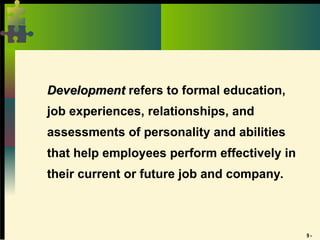
Development
Development refersto formal education,
job experiences, relationships, and
assessments of personality and abilities
that help employees perform effectively in
their current or future job and company.
3.
9 -
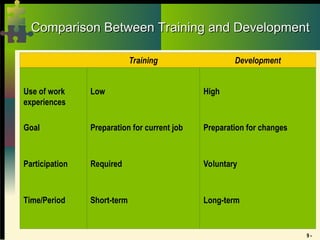
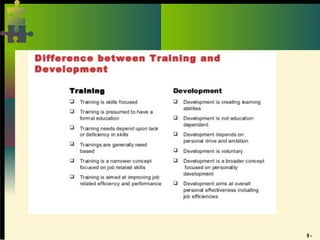
Comparison BetweenTraining and Development
Comparison Between Training and Development
Training Development
Use of work
experiences
Low High
Goal Preparation for current job Preparation for changes
Participation Required Voluntary
Time/Period Short-term Long-term
9 -
Why isemployee development important?
Why is employee development important?
Employee development is a necessary component
of a company’s efforts to:
improve quality
retain key employees
meet the challenges of global competition and social
change
incorporate technological advances and changes in
work design
6.
9 -
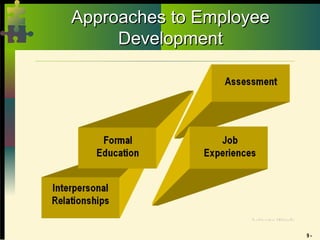
Approaches toEmployee
Approaches to Employee
Development
Development
7.
9 -
Formal Education
FormalEducation
Formal education programs include:
off-site and on-site programs designed specifically for
the company’s employees
short courses offered by consultants or universities
executive MBA programs
university programs in which participants actually live
at the university while taking classes
8.
9 -
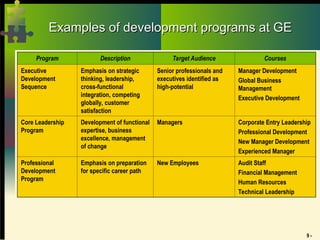
Examples ofdevelopment programs at GE
Examples of development programs at GE
Program Description Target Audience Courses
Executive
Development
Sequence
Emphasis on strategic
thinking, leadership,
cross-functional
integration, competing
globally, customer
satisfaction
Senior professionals and
executives identified as
high-potential
Manager Development
Global Business
Management
Executive Development
Core Leadership
Program
Development of functional
expertise, business
excellence, management
of change
Managers Corporate Entry Leadership
Professional Development
New Manager Development
Experienced Manager
Professional
Development
Program
Emphasis on preparation
for specific career path
New Employees Audit Staff
Financial Management
Human Resources
Technical Leadership
9.
9 -
Important trendsin executive education:
Important trends in executive education:
Increasing use of distance learning by many
companies and universities
Companies and the education provider create
short, customize courses, with content designed
specifically to needs of the audience
Supplementing formal courses from consultants
or university faculty with other types of training
and development activities
10.
9 -
Assessment involvescollecting
information and providing feedback
to employees about their behavior,
communication style, or skills in a
given job.
11.
9 -
Assessment
Assessment (continued)
(continued)
Usedmost frequently to:
identify employees with managerial potential
measure current managers’ strengths and weaknesses
identify managers with potential to move into higher-
level executive positions
work with teams to identify members’ strengths and
weaknesses, and factors that inhibit productivity
9 -
Assessment Tools:
AssessmentTools: Myers-Briggs (MBTI)
Myers-Briggs (MBTI)
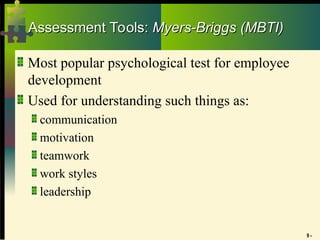
Most popular psychological test for employee
development
Used for understanding such things as:
communication
motivation
teamwork
work styles
leadership
14.
9 -
Examples ofMBTI Use:
Examples of MBTI Use:
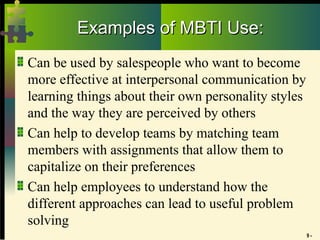
Can be used by salespeople who want to become
more effective at interpersonal communication by
learning things about their own personality styles
and the way they are perceived by others
Can help to develop teams by matching team
members with assignments that allow them to
capitalize on their preferences
Can help employees to understand how the
different approaches can lead to useful problem
solving
15.
9 -
Assessment Tools:
AssessmentTools: Assessment Center
Assessment Center
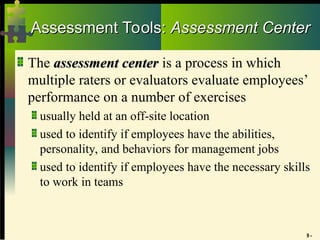
The assessment center
assessment center is a process in which
multiple raters or evaluators evaluate employees’
performance on a number of exercises
usually held at an off-site location
used to identify if employees have the abilities,
personality, and behaviors for management jobs
used to identify if employees have the necessary skills
to work in teams
16.
9 -
Examples ofSkills Measured by Assessment
Examples of Skills Measured by Assessment
Center Exercises
Center Exercises
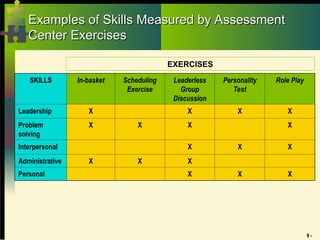
SKILLS In-basket Scheduling
Exercise
Leaderless
Group
Discussion
Personality
Test
Role Play
Leadership X X X X
Problem
solving
X X X X
Interpersonal X X X
Administrative X X X
Personal X X X
EXERCISES
9 -
Skills Relatedto Managerial Success
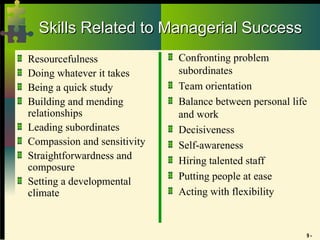
Skills Related to Managerial Success
Resourcefulness
Doing whatever it takes
Being a quick study
Building and mending
relationships
Leading subordinates
Compassion and sensitivity
Straightforwardness and
composure
Setting a developmental
climate
Confronting problem
subordinates
Team orientation
Balance between personal life
and work
Decisiveness
Self-awareness
Hiring talented staff
Putting people at ease
Acting with flexibility
19.
9 -
Assessment Tools:
AssessmentTools:
Performance Appraisals
Performance Appraisals
Performance appraisal
Performance appraisal - the process of
measuring employees’ performance
Approaches for measuring performance:
ranking employees
rating work behaviors
rating the extent to which employees have desirable
traits believed to be necessary for job success (e.g.,
leadership)
directly measuring the results of work performance
(e.g., productivity)
20.
9 -
Conditions underwhich performance
Conditions under which performance
measurement is useful for development:
measurement is useful for development:
The appraisal system must give employees specific
information about their performance problems and
ways they can improve their performance
Managers must be trained in providing
performance feedback
Managers must frequently give employees
performance feedback
Managers also need to monitor employees’
progress in carrying out the action plan
21.
9 -
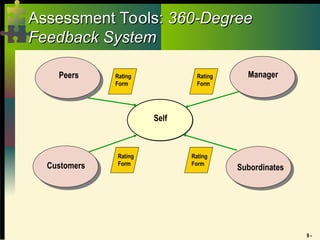
Assessment Tools:
AssessmentTools: 360-Degree
360-Degree
Feedback System
Feedback System
Rating
Form
Rating
Form
Rating
Form
Rating
Form
Self
Peers
Customers Subordinates
Manager
22.
9 -
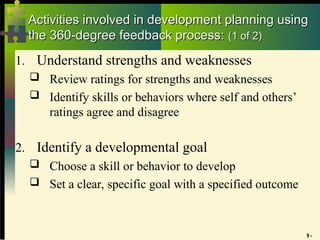
Activities involvedin development planning using
Activities involved in development planning using
the 360-degree feedback process:
the 360-degree feedback process: (1 of 2)
(1 of 2)
1. Understand strengths and weaknesses
Review ratings for strengths and weaknesses
Identify skills or behaviors where self and others’
ratings agree and disagree
2. Identify a developmental goal
Choose a skill or behavior to develop
Set a clear, specific goal with a specified outcome
23.
9 -
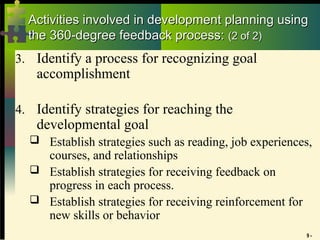
Activities involvedin development planning using
Activities involved in development planning using
the 360-degree feedback process:
the 360-degree feedback process: (2 of 2)
(2 of 2)
3. Identify a process for recognizing goal
accomplishment
4. Identify strategies for reaching the
developmental goal
Establish strategies such as reading, job experiences,
courses, and relationships
Establish strategies for receiving feedback on
progress in each process.
Establish strategies for receiving reinforcement for
new skills or behavior
24.
9 -
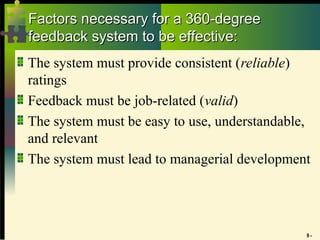
Factors necessaryfor a 360-degree
Factors necessary for a 360-degree
feedback system to be effective:
feedback system to be effective:
The system must provide consistent (reliable)
ratings
Feedback must be job-related (valid)
The system must be easy to use, understandable,
and relevant
The system must lead to managerial development
25.
9 -
360-Degree Feedback:
360-DegreeFeedback:
Important Issues to Consider
Important Issues to Consider
Who will the raters be?
How will you maintain the confidentiality of the
raters?
What behaviors and skills are job-related?
How will you ensure full participation and
complete responses from every employee who is
asked to be a rater?
What will the feedback report include?
How will you ensure that managers receive and
act on the feedback?
26.
9 -
Job Experiences
JobExperiences
Job experiences refer to relationships, problems,
skills demands, tasks, or other features that
employees face in their jobs
Most employee development occurs through job
experiences
A major assumption is that development is most
likely to occur when there is a mismatch between
the employee’s skills and past experiences and
the skills required for the job
27.
9 -
To besuccessful in their jobs,
employees must improve their
skills.
They must be forced to learn
new skills, apply their skills
and knowledge in a new ways,
and master new experiences.
28.
9 -
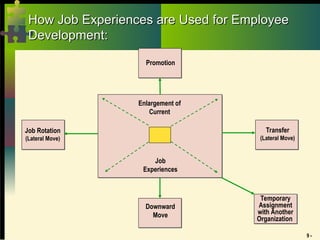
How JobExperiences are Used for Employee
How Job Experiences are Used for Employee
Development:
Development:
Enlargement of
Current
Job
Experiences
Promotion
Job Rotation
(Lateral Move)
Transfer
(Lateral Move)
Downward
Move
Temporary
Assignment
with Another
Organization
29.
9 -
Characteristics ofEffective Job Rotation
Characteristics of Effective Job Rotation
Systems
Systems (1 of 2)
(1 of 2)
1. Job rotation is used to develop skills as well as
give employees experience needed for
managerial positions
2. Employees understand specific skills that will
be developed by rotation
3. Job rotation is used for all levels and types of
employees
4. All employees have equal opportunities for job
rotation assignments
30.
9 -
Characteristics ofEffective Job Rotation
Characteristics of Effective Job Rotation
Systems
Systems (2 of 2)
(2 of 2)
5. Job rotation is linked with the career
management process so employees know the
development needs addressed by each job
assignment
6. Benefits of rotation are maximized and costs are
minimized through managing time of rotations
to reduce workload costs and help employees
understand job rotation’s role in their
development plans
31.
9 -
Interpersonal Relationships
InterpersonalRelationships
Employees can also develop skills and increase
their knowledge about the company and its
customers by interacting with a more experienced
organizational member
Two types of interpersonal relationships used to
develop employees:
Mentoring
Coaching
32.
9 -
Characteristics ofSuccessful Formal
Characteristics of Successful Formal
Mentoring Programs:
Mentoring Programs: (1 of 2)
(1 of 2)
Mentor and mentee participation is voluntary
relationship can be ended at any time without fear of
punishment
Mentor-mentee matching process does not limit the
ability of informal relationships to develop
Mentors are chosen on the basis of:
their past record in developing employees
willingness to serve as a mentor
evidence of positive coaching, communication, and
listening skills
33.
9 -
Characteristics ofSuccessful Formal
Characteristics of Successful Formal
Mentoring Programs:
Mentoring Programs: (2 of 2)
(2 of 2)
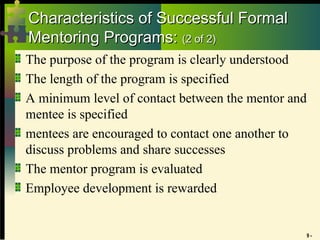
The purpose of the program is clearly understood
The length of the program is specified
A minimum level of contact between the mentor and
mentee is specified
mentees are encouraged to contact one another to
discuss problems and share successes
The mentor program is evaluated
Employee development is rewarded
34.
9 -
Coaching Relationships
CoachingRelationships
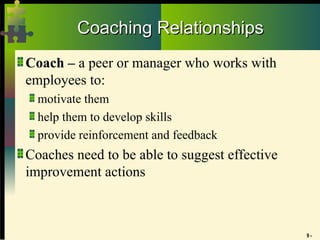
Coach – a peer or manager who works with
employees to:
motivate them
help them to develop skills
provide reinforcement and feedback
Coaches need to be able to suggest effective
improvement actions
35.
9 -
The DevelopmentPlanning Process
The Development Planning Process
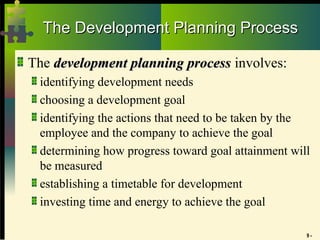
The development planning process
development planning process involves:
identifying development needs
choosing a development goal
identifying the actions that need to be taken by the
employee and the company to achieve the goal
determining how progress toward goal attainment will
be measured
establishing a timetable for development
investing time and energy to achieve the goal
36.
9 -
Development Planning
DevelopmentPlanning (continued)
(continued)
An emerging trend in development should also be
followed in development planning process
The development approach used is dependent on
the needs and development goal