Rudar Daman Singla
Trainee | Software Consultant
Knoldus Inc.
Getting Started with
MEAN STACK
OUR AGENDA
01 JS Introduction
02 What is MEAN Stack?
03 Flow Diagram
04
05
Advantages
06
MEAN Stack Applications
07
Demo
References
JavaScript both on
Front-end and Back-
end?
MEAN STACK
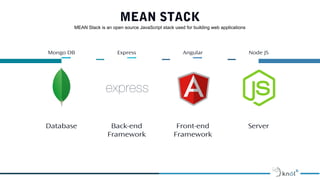
MEAN Stack is an open source JavaScript stack used for building web applications
Database
Mongo DB
Back-end
Framework
Express
Front-end
Framework
Angular
Server
Node JS
Mongo DB
Mongo DB is the world’s leading NoSQL database that
stores its data into a JSON (JavaScript Object Notation)
format.
MongoDB provides high performance data
persistence because it supports the
embedded data models that reduces I/O
activity on database system.
01
Mongo DB is document oriented database
designed for storing and retrieving data in
the form of documents. Each record in
MongoDB is a document.
02
MongoDB provides horizontal scalability
as part of its core functionality. Automatic
sharding distributes data across a cluster
of machines.
03
Express
Express is a minimal and flexible Node.js web application
framework that provides a robust set of features to
develop web and mobile applications.
Allows to set up middlewares to respond
to HTTP Requests01
Defines a routing table which is used to
perform different actions based on HTTP
Method and URL.
02
Allows to dynamically render HTML Pages
based on passing arguments to
templates.
03
Image Placeholder
Angular
Angular is a platform that makes it easy to build
applications with the web. Angular empowers developers
to build applications that live on the web, mobile, or the
desktop.
Component-based architecture that
provides a reusability and higher quality of
code01
Typescript provides better tooling, cleaner
code, and higher scalability
02
Google Long-Term Support
03
Node JS
Node.js is a cross-platform runtime environment and
library for running JavaScript applications outside the
browser. It is used for creating server-side and
networking web applications.
Node.js is highly scalable because event
mechanism helps the server to respond in
a non-blocking way.
01
Node.js is built on Google Chrome's V8
JavaScript Engine, so its library is very
fast in code execution.
02
Node.js has an open source community
which has produced many excellent
modules to add additional capabilities to
Node.js applications.
03
Image Placeholder
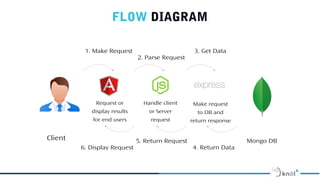
FLOW DIAGRAM
Client
1. Make Request
2. Parse Request
3. Get Data
Mongo DB
4. Return Data
5. Return Request
6. Display Request
Request or
display results
for end users
Handle client
or Server
request
Make request
to DB and
return response
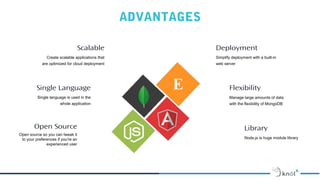
ADVANTAGES
Scalable
Create scalable applications that
are optimized for cloud deployment
Deployment
Simplify deployment with a built-in
web server
Single Language
Single language is used in the
whole application
Flexibility
1 2
3 4
Manage large amounts of data
with the flexibility of MongoDB
Library
Node.js is huge module library
65Open Source
Open source so you can tweak it
to your preferences if you're an
experienced user
MEAN STACK APPLICATIONS
REFERENCES
• https://docs.mongodb.com/
• https://angular.io/docs/
• https://nodejs.org/en/docs/
•http://mean.io/
•http://meanjs.org/
Thank You !

Getting Started With Mean Stack

  • 1.
    Rudar Daman Singla Trainee| Software Consultant Knoldus Inc. Getting Started with MEAN STACK
  • 2.
    OUR AGENDA 01 JSIntroduction 02 What is MEAN Stack? 03 Flow Diagram 04 05 Advantages 06 MEAN Stack Applications 07 Demo References
  • 3.
  • 4.
    MEAN STACK MEAN Stackis an open source JavaScript stack used for building web applications Database Mongo DB Back-end Framework Express Front-end Framework Angular Server Node JS
  • 5.
    Mongo DB Mongo DBis the world’s leading NoSQL database that stores its data into a JSON (JavaScript Object Notation) format. MongoDB provides high performance data persistence because it supports the embedded data models that reduces I/O activity on database system. 01 Mongo DB is document oriented database designed for storing and retrieving data in the form of documents. Each record in MongoDB is a document. 02 MongoDB provides horizontal scalability as part of its core functionality. Automatic sharding distributes data across a cluster of machines. 03
  • 6.
    Express Express is aminimal and flexible Node.js web application framework that provides a robust set of features to develop web and mobile applications. Allows to set up middlewares to respond to HTTP Requests01 Defines a routing table which is used to perform different actions based on HTTP Method and URL. 02 Allows to dynamically render HTML Pages based on passing arguments to templates. 03 Image Placeholder
  • 7.
    Angular Angular is aplatform that makes it easy to build applications with the web. Angular empowers developers to build applications that live on the web, mobile, or the desktop. Component-based architecture that provides a reusability and higher quality of code01 Typescript provides better tooling, cleaner code, and higher scalability 02 Google Long-Term Support 03
  • 8.
    Node JS Node.js isa cross-platform runtime environment and library for running JavaScript applications outside the browser. It is used for creating server-side and networking web applications. Node.js is highly scalable because event mechanism helps the server to respond in a non-blocking way. 01 Node.js is built on Google Chrome's V8 JavaScript Engine, so its library is very fast in code execution. 02 Node.js has an open source community which has produced many excellent modules to add additional capabilities to Node.js applications. 03 Image Placeholder
  • 9.
    FLOW DIAGRAM Client 1. MakeRequest 2. Parse Request 3. Get Data Mongo DB 4. Return Data 5. Return Request 6. Display Request Request or display results for end users Handle client or Server request Make request to DB and return response
  • 10.
    ADVANTAGES Scalable Create scalable applicationsthat are optimized for cloud deployment Deployment Simplify deployment with a built-in web server Single Language Single language is used in the whole application Flexibility 1 2 3 4 Manage large amounts of data with the flexibility of MongoDB Library Node.js is huge module library 65Open Source Open source so you can tweak it to your preferences if you're an experienced user
  • 11.
  • 12.
    REFERENCES • https://docs.mongodb.com/ • https://angular.io/docs/ •https://nodejs.org/en/docs/ •http://mean.io/ •http://meanjs.org/
  • 13.

Editor's Notes

  • #3 <number>
  • #4 So, if you’re a software developer? You are familiar with various tech stacks as a lot of tech stacks are there in market. But if you’re developing for the web, a knowledge of HTML, CSS is a must. Also knowledge of JS and the popular library jQuery is also expected. So, if we take the knowledge of HTML, CSS as a must, then in order to develop web application you still need to have skills in JS for frontend and any language - scala, PHP, java for backend, plus any DB of your choice. So, instead of learning additional language for backend part of application, using MEAN stack you can do everything you could with different languages, by using only one language – Javascript! <number>
  • #5 <number>
  • #6 Sharding is a method for distributing data across multiple machines. MongoDB uses sharding to support deployments with very large data sets and high throughput operations. You may embed related data in a single structure or document
  • #8 Angular is written using TypeScript language, which is basically a superset for JavaScript. It fully compiles to JavaScript, but helps spot and eliminate common mistakes when actually typing the code. Fact is: Angular is supported by Google a major advantage of the technology. While this may sound justified, Google itself is not enough.