How MEAN Stack
Development Services Drive
Business Growth with Full-
Stack Efficiency
by Henry Lockwood
Introduction to the MEAN Stack: Leveraging the Power of
MongoDB, Express.js, Angular, and Node.js
MongoDB: The
NoSQL Database
MongoDB is a flexible and
scalable NoSQL database
designed for modern
applications. It's known for
its ease of use and high
performance.
Express.js: The Web
Application
Framework
Express.js provides a
robust framework for
building web applications
using Node.js. It's popular
for its speed and efficiency.
Angular: The Front-
end Framework
Angular is a powerful
front-end framework for
building dynamic web
applications. Its modular
architecture and data
binding features enable
clean code and interactive
experiences.
Node.js: The
JavaScript Runtime
Environment
Node.js is a JavaScript
runtime environment that
allows developers to run
JavaScript code on the
server. It's known for its
asynchronous, event-
driven architecture.
Benefits of MEAN Stack Development: Improved Scalability,
Flexibility, and Time-to-Market
Enhanced Scalability
MEAN Stack applications can
easily scale to handle increasing
traffic and data loads, ensuring
smooth performance as your
business grows.
Increased Flexibility
The MEAN Stack's use of
JavaScript across the entire stack
simplifies development and
makes it easier to adapt to
changing requirements.
Faster Time-to-Market
MEAN Stack's component
reusability and streamlined
development process accelerate
development cycles, allowing you
to launch applications faster.
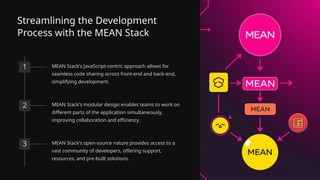
Streamlining the Development
Process with the MEAN Stack
1 MEAN Stack's JavaScript-centric approach allows for
seamless code sharing across front-end and back-end,
simplifying development.
2 MEAN Stack's modular design enables teams to work on
different parts of the application simultaneously,
improving collaboration and efficiency.
3 MEAN Stack's open-source nature provides access to a
vast community of developers, offering support,
resources, and pre-built solutions.
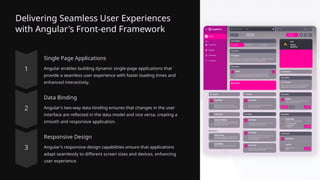
Delivering Seamless User Experiences
with Angular's Front-end Framework
Single Page Applications
Angular enables building dynamic single-page applications that
provide a seamless user experience with faster loading times and
enhanced interactivity.
Data Binding
Angular's two-way data binding ensures that changes in the user
interface are reflected in the data model and vice versa, creating a
smooth and responsive application.
Responsive Design
Angular's responsive design capabilities ensure that applications
adapt seamlessly to different screen sizes and devices, enhancing
user experience.
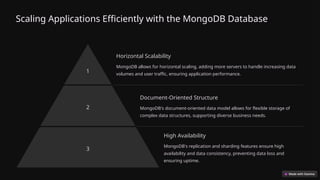
Scaling Applications Efficiently with the MongoDB Database
1
Horizontal Scalability
MongoDB allows for horizontal scaling, adding more servers to handle increasing data
volumes and user traffic, ensuring application performance.
2
Document-Oriented Structure
MongoDB's document-oriented data model allows for flexible storage of
complex data structures, supporting diverse business needs.
3
High Availability
MongoDB's replication and sharding features ensure high
availability and data consistency, preventing data loss and
ensuring uptime.
Enhancing Server-side Performance
with Node.js and Express.js
Asynchronous Architecture
Node.js's asynchronous architecture enables efficient handling of
multiple requests simultaneously, maximizing server-side
performance.
Event-driven Model
Node.js's event-driven model allows for non-blocking operations,
reducing waiting times and increasing responsiveness.
Lightweight Architecture
Node.js's lightweight architecture requires minimal resources,
optimizing server-side performance and reducing operational
costs.
Advantages of Full-stack MEAN Development
for Businesses
Reduced Development Costs
MEAN Stack's use of JavaScript across the entire stack simplifies development,
reducing the need for multiple developers and languages, saving on costs.
Faster Development Cycles
MEAN Stack's streamlined development process and reusable components accelerate
development cycles, enabling faster time-to-market and increased agility.
Enhanced Scalability
MEAN Stack's scalable architecture ensures that applications can handle increasing
traffic and data volumes as your business grows.
Improved User Experience
MEAN Stack's front-end and back-end integration ensures seamless user experiences,
fostering customer satisfaction and loyalty.
Case Studies: Successful MEAN Stack
Implementations and Their Impact
E-commerce
Platform
A leading e-commerce
platform successfully
implemented the MEAN
Stack, resulting in
improved scalability,
faster loading times, and
a more engaging user
experience, leading to
increased sales and
customer satisfaction.
Social Media
Application
A popular social media
application leveraged the
MEAN Stack to build a
dynamic and scalable
platform, handling
millions of users and
providing real-time
updates and
personalized content,
boosting user
engagement and growth.
Global Content
Management
System
A global content
management system
adopted the MEAN Stack,
enabling the efficient
management of large
volumes of content
across multiple
languages and regions,
enhancing content
delivery and user access.
Conclusion: Unlocking
Business Growth through M
EAN Stack Development Ser
vices
The MEAN stack empowers businesses to build robust, scalable, and
user-friendly applications, fostering growth and innovation.