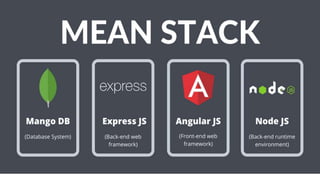
The MEAN stack is JavaScript-based framework for developing web applications. MEAN is named
after MongoDB, Express, Angular, and Node, the four key technologies that make up the layers of the stack.
•MongoDB - document database
•Express(.js) - Node.js web framework
•Angular(.js) - a client-side JavaScript framework
•Node(.js) - the premier JavaScript web server
There are variations to the MEAN stack such as MERN (replacing Angular.js with React.js) and MEVN (using Vue.js).
The MEAN stack is one of the most popular technology concepts for building web applications.
What is MEAN stack?
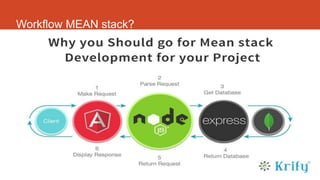
Workflow MEAN stack?
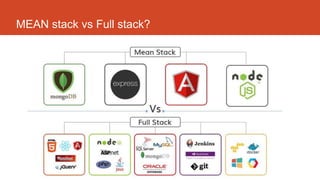
MEAN stack vs Full stack?
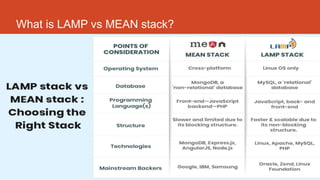
What is LAMP vs MEAN stack?
MEAN applications can be used in many ways with a cross platform write once approach. While MEAN is particularly
suited to real-time applications, particularly those running natively in the cloud and single-page (dynamic) web
applications built in Angular.js, it can be used for other use cases such as:
•Workflow management tools.
•News aggregation sites.
•Todo and calendar applications.
•Interactive forums.
And much more.
Since all the components are based on JavaScript and JSON, the integration between the components of the stack is
intuitive and straightforward.
Additionally, the E and A of MEAN (Express and Angular) are two of the most popular and well-supported JavaScript
frameworks for back-end and front-end development, respectively. Express makes routing and managing HTTP
requests and responses super easy, and includes great support for middleware to handle JSON endpoints and form
posts. Angular is a powerful tool for building dynamic HTML pages that communicate with a back-end server.
Whether you’re building a high-throughput API, a simple web application, or a microservice, MEAN is the ideal stack
for building Node.js applications.
All of the MEAN stack components are open source in nature and therefore allow a generous, free-of-charge
opportunity for developers.
Advantage of MEAN stack?
JavaScript is a great modern language, but it wasn’t initially designed to build back-end servers. Since the foundation
of the MEAN stack is JavaScript, including the back-end server, it might come with concurrency and performance
problems at scale due to JavaScript nature.
Additionally, since the development opportunity is so rapid, business and server logic might suffer from poor isolation,
making potential spaghetti code and bad practices a reality along the way.
Finally, although there are many guides and tutorials out there, they generally will not include concrete JS coding
guidelines appropriate for this stack. Therefore, something that worked really well for one application might surface
issues for another.
Disadvantage of MEAN stack?