1
Getting Started with mBlock
by Wang Yu, Product Manager at Makeblock
2
Getting Started with mBlock
What is mBlock
You write programs to control your computer. To do that,
you need to know the languages of the computer - Java,
C, or Python are among those. If you want to control a
robot, probably you need to know Arduino C++ or a
similar language.
mBlock comes to help. You can write programs by
dragging and dropping building blocks. Furthermore,
with mBlock, you can not only design games and visual
effects in your computer, you may also write programs to
Arduino based robots.
mBlock and Scratch
mBlock is an open source branch of Scratch, a graphic
programming language developed by MIT Media Lab Lifelong
Kindergarten. That means you can make almost all Scratch
projects and open almost every Scratch files in mBlock; besides,
you earn the possibility of working with Arduino based robots.
mBlock and Makeblock
Makeblock, the company making the famous mBot and
construction kits for makers, is the one who translated Scratch into
mBlock. Currently mBlock is actively maintained by Makeblock.
But as an open source project, mBlock embraces a larger maker
and educator community by providing features like extension
center, supporting not only Makeblock’s products by also arduino
boards, Seeed Studio kits, Littlebits and more.
Tips
Tips
Controls pictures
(“Sprites”) on the screen
Controls robots and
Arduino boards
Getting Started with mBlock 3
mBlock can be downloaded for free at
http://www.mblock.cc
It supports windows and mac. Linux users can use an
online beta version at:
http://edu.makeblock.com
Getting mBlock
Goto www.mblock.cc. Click the big
“Windows Download” button.
Goto www.mblock.cc. Click “mBlock for mac” link.
After that, open the .zip file, and drag the mBlock.app to your
Applications folder.
After downloaded, click on the downloaded file or
double-click it in the windows explorer.
1
1
2
2
For Windows Users
For Mac Users
Virus?
Some old anti-virus software may claim mBlock as a virus. In this
case you may need to close that software before installing. Every
mBlock version is thoroughly tested, but since mBlock operates
with the hardware (Robots), some anti-virus software are just
vigilant about this kind of software.
Mac OS Sierra
For the latest Mac OS Sierra
Users: When opening mBlock
the first time, you need to go
to the “Application” folder,
right click the mBlock icon, and
choose “Open” to avoid the
“unknown source” error.
Tips
Tips
Drag
Getting Started with mBlock 4
A tour around mBlock
Open mBlock and you’ll see the following interface. Feel
free to experiment around.
The “Stage” to
hold drawings and
moving pictures (we
call those pictures
“Sprites”)
The Sprite panel.
You can create new
sprites here. Drag blocks from
here to the script
zone.
the “script zone”,
where you place
your command
blocks.
Switch between different
types of command blocks.
Arduino and robot related
blocks are located here.
Save or load
project files.
Connect to your robots
or upload firmware.
Select which type
of hardware you’re
using
Introduce new blocks by
downloading extensions.
Getting Started with mBlock 5
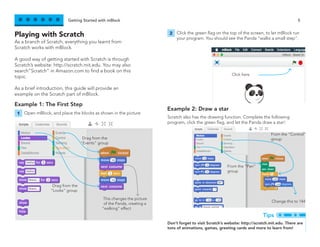
As a branch of Scratch, everything you learnt from
Scratch works with mBlock.
A good way of getting started with Scratch is through
Scratch’s website: http://scratch.mit.edu. You may also
search”Scratch” in Amazon.com to find a book on this
topic.
As a brief introduction, this guide will provide an
example on the Scratch part of mBlock.
Playing with Scratch
Open mBlock, and place the blocks as shown in the picture
Scratch also has the drawing function. Complete the following
program, click the green flag, and let the Panda draw a star!
Click the green flag on the top of the screen, to let mBlock run
your program. You should see the Panda “walks a small step”.
1
2
Don’t forget to visit Scratch’s website: http://scratch.mit.edu. There are
tons of animations, games, greeting cards and more to learn from!
Tips
Example 1: The First Step
Example 2: Draw a star
Drag from the
“Events” group
This changes the picture
of the Panda, creating a
“walking” effect
Drag from the
“Looks” group
Click here
From the “Pen”
group
From the “Control”
group
Change this to 144
Getting Started with mBlock 6
The primary reason of using mBlock is its power to
control and program robots. Here is a short guide of
how to connect it in several methods.
Connect Your Robot / Boards
Connect through the USB cable
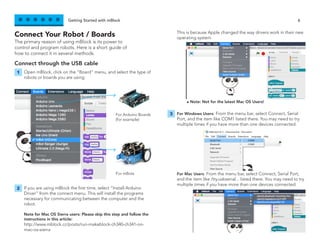
Open mBlock, click on the “Board” menu, and select the type of
robots or boards you are using.
For Windows Users: From the menu bar, select Connect, Serial
Port, and the item like COM1 listed there. You may need to try
multiple times if you have more than one devices connected.
For Mac Users: From the menu bar, select Connect, Serial Port,
and the item like /tty.usbserial... listed there. You may need to try
multiple times if you have more than one devices connected.
If you are using mBlock the first time, select “Install Arduino
Driver” from the connect menu. This will install the programs
necessary for communicating between the computer and the
robot.
Note for Mac OS Sierra users: Please skip this step and follow the
instructions in this article:
http://www.mblock.cc/posts/run-makeblock-ch340-ch341-on-
mac-os-sierra
This is because Apple changed the way drivers work in their new
operating system.
1
3
2
For Arduino Boards
(for example)
For mBots
- Note: Not for the latest Mac OS Users!
Getting Started with mBlock 7
The 2.4G dongle is a nice way to control your Makeblock
robots wirelessly. It comes in a dongle for your computer,
and a 2.4G module for your robots.
Connect through the 2.4G dongle
Plug the 2.4G Module to your robot, and turn on the power
switch.
Press the button on the top of the 2.4G module, the LED light
should turn from blinking to blinking very quickly.
1
2
While the LED light on top of the 2.4G module is blinking quickly,
plug the 2.4G Dongle into the computer.
After that, the light on the 2.4G Module should be lighten on
Steadily. Select “Connect, 2.4G Serial, the Connect” from the top
menu.
3
4
Now you can use your robot freely with the 2.4G
dongle!
Getting Started with mBlock 8
You may try to connect to your boards/robots through
Bluetooth, but this function is still unstable and is not
guaranteed to work in every computer. This is because
Bluetooth chips differ between computers, and operating
systems (eg. Windows 7, Windows 10) treat them in different
ways.
If you wish to try, here is a short guide about connecting boards/
robots via Bluetooth. To finish this guide, you need a computer
supporting Bluetooth, and the Bluetooth function needs to be
enabled from the system settings menu.
Connect through the Bluetooth (Beta)
For Windows Users
For Mac Users
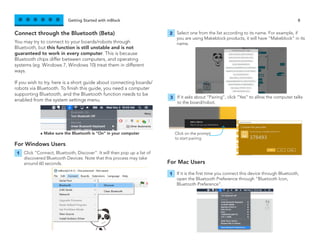
Click “Connect, Bluetooth, Discover”. It will then pop up a list of
discovered Bluetooth Devices. Note that this process may take
around 60 seconds.
If it is the first time you connect this device through Bluetooth,
open the Bluetooth Preference through “Bluetooth Icon,
Bluetooth Preference”.
Select one from the list according to its name. For example, if
you are using Makeblock products, it will have “Makeblock” in its
name.
If it asks about “Pairing”, click “Yes” to allow the computer talks
to the board/robot.
1
1
2
3
- Make sure the Bluetooth is “On” in your computer Click on the prompt
to start pairing
Getting Started with mBlock 9
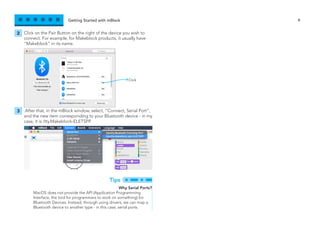
Click on the Pair Button on the right of the device you wish to
connect. For example, for Makeblock products, it usually have
“Makeblock” in its name.
.After that, in the mBlock window, select, “Connect, Serial Port”,
and the new item corresponding to your Bluetooth device - in my
case, it is /tty.Makeblock-ELETSPP.
2
3
Why Serial Ports?
MacOS does not provide the API (Application Programming
Interface, the tool for programmers to work on something) for
Bluetooth Devices. Instead, through using drivers, we can map a
Bluetooth device to another type - in this case, serial ports.
Tips
Click
Getting Started with mBlock 10
Hello, mBot
This tutorial will guide you through writing the first
program for mBot, Makeblock’s educational robot. If you
are more interested in Arduino, you may jump to the
next chapter.
Connect the mBot with one of the three methods described
above (USB Cable recommended). When connected, it will say
“connected” in the title bar.
Select mBot from the “Boards” menu. This will bring up mBot
related commands in the “Robots” group.
(Optional) From the “Connect” menu, select “Upgrade
Firmware”. Wait until the upgrade is complete. This will allow the
mBot to talk with the computer.
Drag “when (Flag) clicked” from the “Events” shelf; “forever”
from the “Control” shelf; inside the “forever” block, place “say”
from “Look” shelf, then “light sensor” from “Robots” shelf.
With mBot connected, click the green flag, and you will say the
panda “saying” readings from the light sensor. Try cover the
mBot with your hand, and you will see the number decrease.
1
2
3
4
5
“Upgrade Firmware” and “Reset Default Program”
“Upgrade Firmware” will allow you control the mBot from mBlock,
but it will disable the IR remote controller and switching mode
with the on-top button; “Reset Default Program” will enable
these functions like the mBot has just come from the factory, while
it only support a part of the sensors available in mBlock. If you
buy extra sensors from Makeblock, you may need to “Upgrade
Firmware”.
Tips
Click
See the number
change
Getting Started with mBlock 11
Now let’s try upload a program into the mBot. Drag “mBot
Program” from the “Robot” group, and attach “forever” to
“mBot Program”. You may delete the “When (flag) clicked” block
Select “Edit, Arduino Mode” from the menu. See what happens
Oops, mBlock says “unsupported block found”. This means not
every block can be run in the Arduino Mode.
6
7
> Scratch Mode
In Scratch Mode, the
robot or Arduino board
must be connect to
the computer in order
to run the program. You
can use Scratch blocks to
create graphics or make
games.
use Edit/Arduino Mode menu item to
toggle between Scratch and Arduino
modes
This “Say” block
can only be used in
the Scratch mode;
while the “(Repeat)
Forever” block can
be accessed in both
modes.
- Arduino Mode
In Arduino Mode, the
program is uploaded
into the robot and the
robot is run on its own.
However, you cannot use
graphics from Scratch
since the computer is no
longer there.
Getting Started with mBlock 12
Now let’s try another program. Place blocks as shown below: The
green block is from the “Operators” shelf.
Make sure “Arduino Mode” is selected in the “Edit” menu. Find
“Upload to Arduino” button and click it.
Now unplug the USB cable, put the mBot on the ground,
you’ll find it keeps running forward and turns left when there is
obstacles ahead!
8
9
10
Click
Reset Default Program?
You will find that mBot now does not respond to your command
from the Makeblock App or the Scratch Mode in the mBlock. This
is because the default program used to talk with these apps is
overwriten by the obstacle-avoiding program you uploaded. You’ll
need to update firmware or “reset default program” to let it work
again with the Scratch Mode or other Apps.
Tips
Getting Started with mBlock 13
Hello, Arduino
This guide will give a short introduction on how to
program Arduino boards with mBlock.
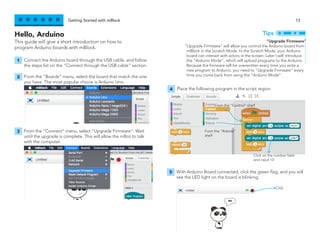
Connect the Arduino board through the USB cable, and follow
the steps list on the “Connect through the USB cable” section.
From the “Boards” menu, select the board that match the one
you have. The most popular choice is Arduino Uno.
1
2
From the “Connect” menu, select “Upgrade Firmware”. Wait
until the upgrade is complete. This will allow the mBot to talk
with the computer.
3
“Upgrade Firmware”
“Upgrade Firmware” will allow you control the Arduino board from
mBlock in the Scratch Mode. In the Scratch Mode, your Arduino
board can interact with actors in the screen. Later I will introduce
the “Arduino Mode”, which will upload programs to the Arduino.
Because the firmware will be overwritten every time you write a
new program to Arduino, you need to “Upgrade Firmware” every
time you come back from using the “Arduino Mode”.
Tips
Place the following program in the script region
4
From the “Control” shelf
Click on the number field
and input 13
From the “Robots”
shelf
With Arduino Board connected, click the green flag, and you will
see the LED light on the board is blinking.
5
Click
Getting Started with mBlock 14
In Scratch Mode, it is required that your Arduino Board is
connected to the computer. You may also choose uploading your
program into the Arduino Board to do this, select “Edit, Arduino
Mode”.
Place the following program in the script region
7
8
From the “Control” shelf
Click on the number field
and input 13
From the “Robots”
shelf
Click the “Upload to Arduino” button on the right panel
You will find a LED on the Arduino board starts blinking.
9
10
Click
Why the LED blinks?
This is because in Arduino Boards, PIN13 is connected to an on-
board LED; this is usually used as a test device. The program we
wrote tells PIN13 to output high(on) and low(off) every 2 seconds,
resulting in a blinking LED.
Scratch Mode and Arduino Mode
In Scratch Mode, the robot or Arduino board must be connect to
the computer in order to run the program. You can use Scratch
blocks to create graphics or make games.
In Arduino Mode, the program is uploaded into the robot and
the robot is run on its own. However, you cannot use graphics
from Scratch since the computer is no longer there.
Tips
Tips

getting-started-with-mblock_2 and mmany thingd .pdf

  • 1.
    1 Getting Started withmBlock by Wang Yu, Product Manager at Makeblock
  • 2.
    2 Getting Started withmBlock What is mBlock You write programs to control your computer. To do that, you need to know the languages of the computer - Java, C, or Python are among those. If you want to control a robot, probably you need to know Arduino C++ or a similar language. mBlock comes to help. You can write programs by dragging and dropping building blocks. Furthermore, with mBlock, you can not only design games and visual effects in your computer, you may also write programs to Arduino based robots. mBlock and Scratch mBlock is an open source branch of Scratch, a graphic programming language developed by MIT Media Lab Lifelong Kindergarten. That means you can make almost all Scratch projects and open almost every Scratch files in mBlock; besides, you earn the possibility of working with Arduino based robots. mBlock and Makeblock Makeblock, the company making the famous mBot and construction kits for makers, is the one who translated Scratch into mBlock. Currently mBlock is actively maintained by Makeblock. But as an open source project, mBlock embraces a larger maker and educator community by providing features like extension center, supporting not only Makeblock’s products by also arduino boards, Seeed Studio kits, Littlebits and more. Tips Tips Controls pictures (“Sprites”) on the screen Controls robots and Arduino boards
  • 3.
    Getting Started withmBlock 3 mBlock can be downloaded for free at http://www.mblock.cc It supports windows and mac. Linux users can use an online beta version at: http://edu.makeblock.com Getting mBlock Goto www.mblock.cc. Click the big “Windows Download” button. Goto www.mblock.cc. Click “mBlock for mac” link. After that, open the .zip file, and drag the mBlock.app to your Applications folder. After downloaded, click on the downloaded file or double-click it in the windows explorer. 1 1 2 2 For Windows Users For Mac Users Virus? Some old anti-virus software may claim mBlock as a virus. In this case you may need to close that software before installing. Every mBlock version is thoroughly tested, but since mBlock operates with the hardware (Robots), some anti-virus software are just vigilant about this kind of software. Mac OS Sierra For the latest Mac OS Sierra Users: When opening mBlock the first time, you need to go to the “Application” folder, right click the mBlock icon, and choose “Open” to avoid the “unknown source” error. Tips Tips Drag
  • 4.
    Getting Started withmBlock 4 A tour around mBlock Open mBlock and you’ll see the following interface. Feel free to experiment around. The “Stage” to hold drawings and moving pictures (we call those pictures “Sprites”) The Sprite panel. You can create new sprites here. Drag blocks from here to the script zone. the “script zone”, where you place your command blocks. Switch between different types of command blocks. Arduino and robot related blocks are located here. Save or load project files. Connect to your robots or upload firmware. Select which type of hardware you’re using Introduce new blocks by downloading extensions.
  • 5.
    Getting Started withmBlock 5 As a branch of Scratch, everything you learnt from Scratch works with mBlock. A good way of getting started with Scratch is through Scratch’s website: http://scratch.mit.edu. You may also search”Scratch” in Amazon.com to find a book on this topic. As a brief introduction, this guide will provide an example on the Scratch part of mBlock. Playing with Scratch Open mBlock, and place the blocks as shown in the picture Scratch also has the drawing function. Complete the following program, click the green flag, and let the Panda draw a star! Click the green flag on the top of the screen, to let mBlock run your program. You should see the Panda “walks a small step”. 1 2 Don’t forget to visit Scratch’s website: http://scratch.mit.edu. There are tons of animations, games, greeting cards and more to learn from! Tips Example 1: The First Step Example 2: Draw a star Drag from the “Events” group This changes the picture of the Panda, creating a “walking” effect Drag from the “Looks” group Click here From the “Pen” group From the “Control” group Change this to 144
  • 6.
    Getting Started withmBlock 6 The primary reason of using mBlock is its power to control and program robots. Here is a short guide of how to connect it in several methods. Connect Your Robot / Boards Connect through the USB cable Open mBlock, click on the “Board” menu, and select the type of robots or boards you are using. For Windows Users: From the menu bar, select Connect, Serial Port, and the item like COM1 listed there. You may need to try multiple times if you have more than one devices connected. For Mac Users: From the menu bar, select Connect, Serial Port, and the item like /tty.usbserial... listed there. You may need to try multiple times if you have more than one devices connected. If you are using mBlock the first time, select “Install Arduino Driver” from the connect menu. This will install the programs necessary for communicating between the computer and the robot. Note for Mac OS Sierra users: Please skip this step and follow the instructions in this article: http://www.mblock.cc/posts/run-makeblock-ch340-ch341-on- mac-os-sierra This is because Apple changed the way drivers work in their new operating system. 1 3 2 For Arduino Boards (for example) For mBots - Note: Not for the latest Mac OS Users!
  • 7.
    Getting Started withmBlock 7 The 2.4G dongle is a nice way to control your Makeblock robots wirelessly. It comes in a dongle for your computer, and a 2.4G module for your robots. Connect through the 2.4G dongle Plug the 2.4G Module to your robot, and turn on the power switch. Press the button on the top of the 2.4G module, the LED light should turn from blinking to blinking very quickly. 1 2 While the LED light on top of the 2.4G module is blinking quickly, plug the 2.4G Dongle into the computer. After that, the light on the 2.4G Module should be lighten on Steadily. Select “Connect, 2.4G Serial, the Connect” from the top menu. 3 4 Now you can use your robot freely with the 2.4G dongle!
  • 8.
    Getting Started withmBlock 8 You may try to connect to your boards/robots through Bluetooth, but this function is still unstable and is not guaranteed to work in every computer. This is because Bluetooth chips differ between computers, and operating systems (eg. Windows 7, Windows 10) treat them in different ways. If you wish to try, here is a short guide about connecting boards/ robots via Bluetooth. To finish this guide, you need a computer supporting Bluetooth, and the Bluetooth function needs to be enabled from the system settings menu. Connect through the Bluetooth (Beta) For Windows Users For Mac Users Click “Connect, Bluetooth, Discover”. It will then pop up a list of discovered Bluetooth Devices. Note that this process may take around 60 seconds. If it is the first time you connect this device through Bluetooth, open the Bluetooth Preference through “Bluetooth Icon, Bluetooth Preference”. Select one from the list according to its name. For example, if you are using Makeblock products, it will have “Makeblock” in its name. If it asks about “Pairing”, click “Yes” to allow the computer talks to the board/robot. 1 1 2 3 - Make sure the Bluetooth is “On” in your computer Click on the prompt to start pairing
  • 9.
    Getting Started withmBlock 9 Click on the Pair Button on the right of the device you wish to connect. For example, for Makeblock products, it usually have “Makeblock” in its name. .After that, in the mBlock window, select, “Connect, Serial Port”, and the new item corresponding to your Bluetooth device - in my case, it is /tty.Makeblock-ELETSPP. 2 3 Why Serial Ports? MacOS does not provide the API (Application Programming Interface, the tool for programmers to work on something) for Bluetooth Devices. Instead, through using drivers, we can map a Bluetooth device to another type - in this case, serial ports. Tips Click
  • 10.
    Getting Started withmBlock 10 Hello, mBot This tutorial will guide you through writing the first program for mBot, Makeblock’s educational robot. If you are more interested in Arduino, you may jump to the next chapter. Connect the mBot with one of the three methods described above (USB Cable recommended). When connected, it will say “connected” in the title bar. Select mBot from the “Boards” menu. This will bring up mBot related commands in the “Robots” group. (Optional) From the “Connect” menu, select “Upgrade Firmware”. Wait until the upgrade is complete. This will allow the mBot to talk with the computer. Drag “when (Flag) clicked” from the “Events” shelf; “forever” from the “Control” shelf; inside the “forever” block, place “say” from “Look” shelf, then “light sensor” from “Robots” shelf. With mBot connected, click the green flag, and you will say the panda “saying” readings from the light sensor. Try cover the mBot with your hand, and you will see the number decrease. 1 2 3 4 5 “Upgrade Firmware” and “Reset Default Program” “Upgrade Firmware” will allow you control the mBot from mBlock, but it will disable the IR remote controller and switching mode with the on-top button; “Reset Default Program” will enable these functions like the mBot has just come from the factory, while it only support a part of the sensors available in mBlock. If you buy extra sensors from Makeblock, you may need to “Upgrade Firmware”. Tips Click See the number change
  • 11.
    Getting Started withmBlock 11 Now let’s try upload a program into the mBot. Drag “mBot Program” from the “Robot” group, and attach “forever” to “mBot Program”. You may delete the “When (flag) clicked” block Select “Edit, Arduino Mode” from the menu. See what happens Oops, mBlock says “unsupported block found”. This means not every block can be run in the Arduino Mode. 6 7 > Scratch Mode In Scratch Mode, the robot or Arduino board must be connect to the computer in order to run the program. You can use Scratch blocks to create graphics or make games. use Edit/Arduino Mode menu item to toggle between Scratch and Arduino modes This “Say” block can only be used in the Scratch mode; while the “(Repeat) Forever” block can be accessed in both modes. - Arduino Mode In Arduino Mode, the program is uploaded into the robot and the robot is run on its own. However, you cannot use graphics from Scratch since the computer is no longer there.
  • 12.
    Getting Started withmBlock 12 Now let’s try another program. Place blocks as shown below: The green block is from the “Operators” shelf. Make sure “Arduino Mode” is selected in the “Edit” menu. Find “Upload to Arduino” button and click it. Now unplug the USB cable, put the mBot on the ground, you’ll find it keeps running forward and turns left when there is obstacles ahead! 8 9 10 Click Reset Default Program? You will find that mBot now does not respond to your command from the Makeblock App or the Scratch Mode in the mBlock. This is because the default program used to talk with these apps is overwriten by the obstacle-avoiding program you uploaded. You’ll need to update firmware or “reset default program” to let it work again with the Scratch Mode or other Apps. Tips
  • 13.
    Getting Started withmBlock 13 Hello, Arduino This guide will give a short introduction on how to program Arduino boards with mBlock. Connect the Arduino board through the USB cable, and follow the steps list on the “Connect through the USB cable” section. From the “Boards” menu, select the board that match the one you have. The most popular choice is Arduino Uno. 1 2 From the “Connect” menu, select “Upgrade Firmware”. Wait until the upgrade is complete. This will allow the mBot to talk with the computer. 3 “Upgrade Firmware” “Upgrade Firmware” will allow you control the Arduino board from mBlock in the Scratch Mode. In the Scratch Mode, your Arduino board can interact with actors in the screen. Later I will introduce the “Arduino Mode”, which will upload programs to the Arduino. Because the firmware will be overwritten every time you write a new program to Arduino, you need to “Upgrade Firmware” every time you come back from using the “Arduino Mode”. Tips Place the following program in the script region 4 From the “Control” shelf Click on the number field and input 13 From the “Robots” shelf With Arduino Board connected, click the green flag, and you will see the LED light on the board is blinking. 5 Click
  • 14.
    Getting Started withmBlock 14 In Scratch Mode, it is required that your Arduino Board is connected to the computer. You may also choose uploading your program into the Arduino Board to do this, select “Edit, Arduino Mode”. Place the following program in the script region 7 8 From the “Control” shelf Click on the number field and input 13 From the “Robots” shelf Click the “Upload to Arduino” button on the right panel You will find a LED on the Arduino board starts blinking. 9 10 Click Why the LED blinks? This is because in Arduino Boards, PIN13 is connected to an on- board LED; this is usually used as a test device. The program we wrote tells PIN13 to output high(on) and low(off) every 2 seconds, resulting in a blinking LED. Scratch Mode and Arduino Mode In Scratch Mode, the robot or Arduino board must be connect to the computer in order to run the program. You can use Scratch blocks to create graphics or make games. In Arduino Mode, the program is uploaded into the robot and the robot is run on its own. However, you cannot use graphics from Scratch since the computer is no longer there. Tips Tips