








Gestational DiabetesGestational Diabetes
Update on Diagnosis and ManagementUpdate on Diagnosis and Management
GDM: Controversies ??GDM: Controversies ??
 Should all pregnant women be screened or onlyShould all pregnant women be screened or only
those with risk factors? Is it safe to screen all?those with risk factors? Is it safe to screen all?
 Which screening test and which diagnostic test areWhich screening test and which diagnostic test are
most reliable? Which cut-off values should we use?most reliable? Which cut-off values should we use?
 What are the risk for mothers/babies and canWhat are the risk for mothers/babies and can
treatment improve outcome?treatment improve outcome?
 What are the connections between gestationalWhat are the connections between gestational
diabetes and type 2 DM?diabetes and type 2 DM?
GDM: Brief overviewGDM: Brief overview
 Defined as carbohydrate intoleranceDefined as carbohydrate intolerance
that begins or is first recognized duringthat begins or is first recognized during
pregnancypregnancy
 Important because it impacts maternalImportant because it impacts maternal
health care both during/after pregnancyhealth care both during/after pregnancy
and increases perinatal complicationsand increases perinatal complications
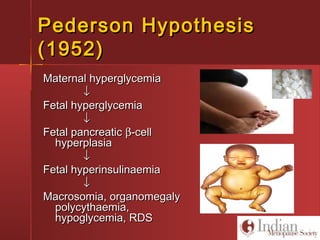
Pederson HypothesisPederson Hypothesis
(1952)(1952)
Maternal hyperglycemiaMaternal hyperglycemia
↓↓
Fetal hyperglycemiaFetal hyperglycemia
↓↓
Fetal pancreaticFetal pancreatic ββ-cell-cell
hyperplasiahyperplasia
↓↓
Fetal hyperinsulinaemiaFetal hyperinsulinaemia
↓↓
Macrosomia, organomegalyMacrosomia, organomegaly
polycythaemia,polycythaemia,
hypoglycemia, RDShypoglycemia, RDS
EPIDEMIOLOGYEPIDEMIOLOGY
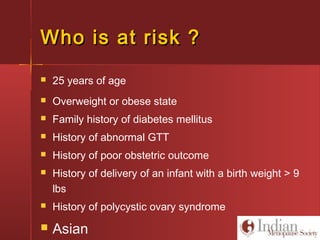
Who is at risk ?Who is at risk ?
 25 years of age
 Overweight or obese state
 Family history of diabetes mellitus
 History of abnormal GTT
 History of poor obstetric outcome
 History of delivery of an infant with a birth weight > 9
lbs
 History of polycystic ovary syndrome
 Asian
Indian ScenarioIndian Scenario
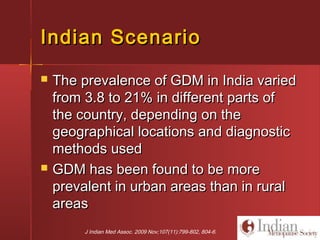
 The prevalence of GDM in India variedThe prevalence of GDM in India varied
from 3.8 to 21% in different parts offrom 3.8 to 21% in different parts of
the country, depending on thethe country, depending on the
geographical locations and diagnosticgeographical locations and diagnostic
methods usedmethods used
 GDM has been found to be moreGDM has been found to be more
prevalent in urban areas than in ruralprevalent in urban areas than in rural
areasareas
J Indian Med Assoc. 2009 Nov;107(11):799-802, 804-6.
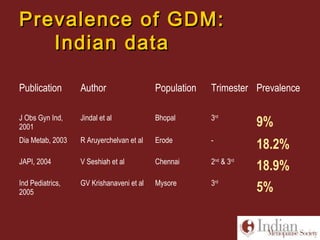
Prevalence of GDM:Prevalence of GDM:
Indian dataIndian data
Publication Author Population Trimester Prevalence
J Obs Gyn Ind,
2001
Jindal et al Bhopal 3rd
9%
Dia Metab, 2003 R Aruyerchelvan et al Erode -
18.2%
JAPI, 2004 V Seshiah et al Chennai 2nd
& 3rd
18.9%
Ind Pediatrics,
2005
GV Krishanaveni et al Mysore 3rd
5%
SCREENING ANDSCREENING AND
DIAGNOSISDIAGNOSIS
Current recommendations for
screening for GDM
 Depends on who you ask!!
– ADA
– ACOG
– WHO
– 4th
International Workshop-Conference on GDM
– National Diabetes Data Group
– United States Preventive Services Task Force
– 5th
International Workshop-Conference on GDM
– DIPSI
Gestational diabetesGestational diabetes
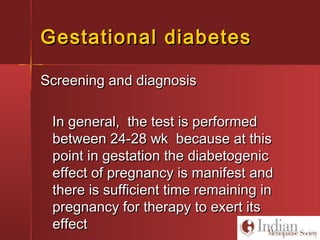
Screening and diagnosisScreening and diagnosis
In general, the test is performedIn general, the test is performed
between 24-28 wk because at thisbetween 24-28 wk because at this
point in gestation the diabetogenicpoint in gestation the diabetogenic
effect of pregnancy is manifest andeffect of pregnancy is manifest and
there is sufficient time remaining inthere is sufficient time remaining in
pregnancy for therapy to exert itspregnancy for therapy to exert its
effecteffect
SCREENINGSCREENING
SELECTIVESELECTIVE
SCREENINGSCREENING
OROR
UNIVERSALUNIVERSAL
SCREENINGSCREENING
UNIVERSAL SCREENINGUNIVERSAL SCREENING
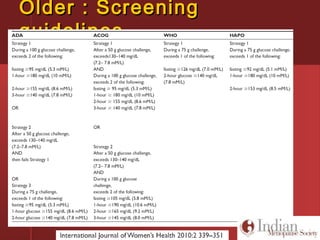
Older : ScreeningOlder : Screening
guidelinesguidelines
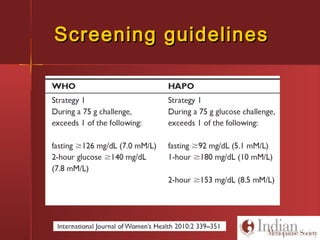
Screening guidelinesScreening guidelines
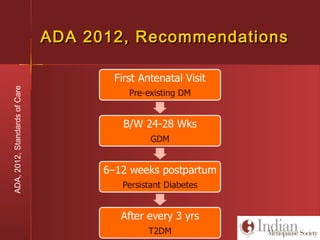
ADA 2012, RecommendationsADA 2012, Recommendations
ADA,2012,StandardsofCare
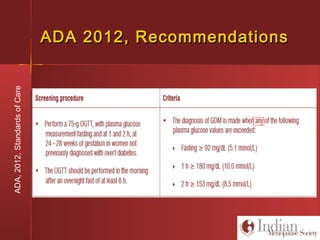
ADA 2012, RecommendationsADA 2012, Recommendations
ADA,2012,StandardsofCare
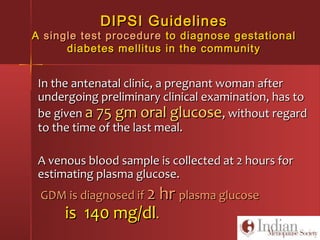
DIPSI GuidelinesDIPSI Guidelines
AA single test proceduresingle test procedure to diagnose gestationalto diagnose gestational
diabetes mellitus in the communitydiabetes mellitus in the community
In the antenatal clinic, a pregnant woman afterIn the antenatal clinic, a pregnant woman after
undergoing preliminary clinical examination, has toundergoing preliminary clinical examination, has to
be givenbe given a 75 gm oral glucosea 75 gm oral glucose, without regard, without regard
to the time of the last meal.to the time of the last meal.
A venous blood sample is collected at 2 hours forA venous blood sample is collected at 2 hours for
estimating plasma glucose.estimating plasma glucose.
GDM is diagnosed ifGDM is diagnosed if 2 hr2 hr plasma glucoseplasma glucose
is 140 mg/dlis 140 mg/dl..
MANAGEMENTMANAGEMENT
GDM: ManagementGDM: Management
General PrinciplesGeneral Principles
 Management similar as preexistingManagement similar as preexisting
DMDM
 Need for glucose monitoringNeed for glucose monitoring
 Start with Diet controlStart with Diet control
 Commence insulin for poor controlCommence insulin for poor control
 Delivery plan individualizedDelivery plan individualized
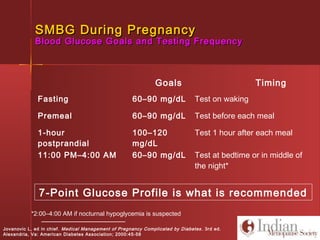
SMBG During PregnancySMBG During Pregnancy
Blood Glucose Goals and Testing FrequencyBlood Glucose Goals and Testing Frequency
Goals Timing
Fasting 60–90 mg/dL Test on waking
Premeal 60–90 mg/dL Test before each meal
1-hour
postprandial
100–120
mg/dL
Test 1 hour after each meal
11:00 PM–4:00 AM 60–90 mg/dL Test at bedtime or in middle of
the night*
*2:00–4:00 AM if nocturnal hypoglycemia is suspected
Jovanovic L, ed in chief. Medical Management of Pregnancy Complicated by Diabetes. 3rd ed.
Alexandria, Va: American Diabetes Association; 2000:45-58
7-Point Glucose Profile is what is recommended
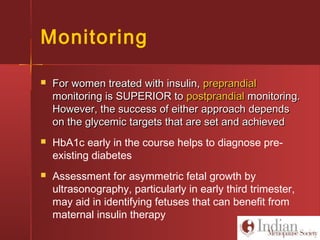
Monitoring
 For women treated with insulin,For women treated with insulin, preprandialpreprandial
monitoring is SUPERIOR tomonitoring is SUPERIOR to postprandialpostprandial monitoring.monitoring.
However, the success of either approach dependsHowever, the success of either approach depends
on the glycemic targets that are set and achievedon the glycemic targets that are set and achieved
 HbA1c early in the course helps to diagnose pre-
existing diabetes
 Assessment for asymmetric fetal growth by
ultrasonography, particularly in early third trimester,
may aid in identifying fetuses that can benefit from
maternal insulin therapy
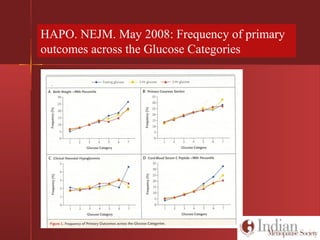
HAPO. NEJM. May 2008: Frequency of primary
outcomes across the Glucose Categories
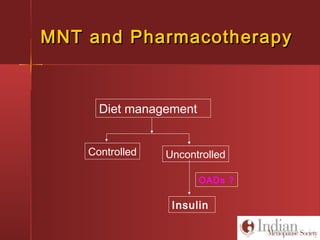
MNT and PharmacotherapyMNT and Pharmacotherapy
Diet management
Controlled Uncontrolled
Insulin
OADs ?
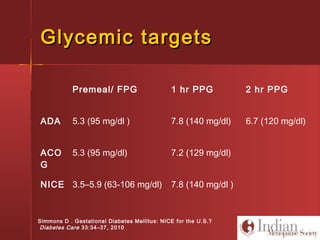
Glycemic targetsGlycemic targets
Premeal/ FPG 1 hr PPG 2 hr PPG
ADA 5.3 (95 mg/dl ) 7.8 (140 mg/dl) 6.7 (120 mg/dl)
ACO
G
5.3 (95 mg/dl) 7.2 (129 mg/dl)
NICE 3.5–5.9 (63-106 mg/dl) 7.8 (140 mg/dl )
Simmons D . Gestational Diabetes Mellitus: NICE for the U.S.?
Diabetes Care 33:34–37, 2010
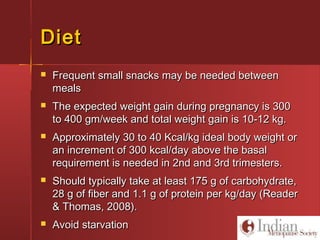
DietDiet
 Frequent small snacks may be needed betweenFrequent small snacks may be needed between
mealsmeals
 The expected weight gain during pregnancy is 300The expected weight gain during pregnancy is 300
to 400 gm/week and total weight gain is 10-12 kg.to 400 gm/week and total weight gain is 10-12 kg.
 Approximately 30 to 40 Kcal/kg ideal body weight orApproximately 30 to 40 Kcal/kg ideal body weight or
an increment of 300 kcal/day above the basalan increment of 300 kcal/day above the basal
requirement is needed in 2nd and 3rd trimesters.requirement is needed in 2nd and 3rd trimesters.
 Should typically take at least 175 g of carbohydrate,Should typically take at least 175 g of carbohydrate,
28 g of fiber and 1.1 g of protein per kg/day (Reader28 g of fiber and 1.1 g of protein per kg/day (Reader
& Thomas, 2008).& Thomas, 2008).
 Avoid starvationAvoid starvation
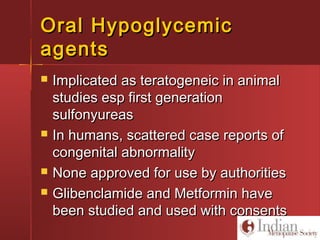
Oral HypoglycemicOral Hypoglycemic
agentsagents
 Implicated as teratogeneic in animalImplicated as teratogeneic in animal
studies esp first generationstudies esp first generation
sulfonyureassulfonyureas
 In humans, scattered case reports ofIn humans, scattered case reports of
congenital abnormalitycongenital abnormality
 None approved for use by authoritiesNone approved for use by authorities
 Glibenclamide and Metformin haveGlibenclamide and Metformin have
been studied and used with consentsbeen studied and used with consents
Oral hypoglycemicOral hypoglycemic
agentsagents
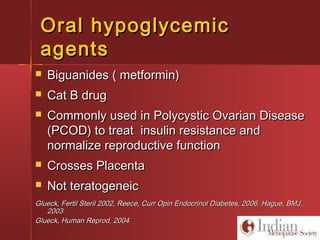
 Biguanides ( metformin)Biguanides ( metformin)
 Cat B drugCat B drug
 Commonly used in Polycystic Ovarian DiseaseCommonly used in Polycystic Ovarian Disease
(PCOD) to treat insulin resistance and(PCOD) to treat insulin resistance and
normalize reproductive functionnormalize reproductive function
 Crosses PlacentaCrosses Placenta
 Not teratogeneicNot teratogeneic
Glueck, Fertil Steril 2002, Reece, Curr Opin Endocrinol Diabetes, 2006. Hague, BMJ,Glueck, Fertil Steril 2002, Reece, Curr Opin Endocrinol Diabetes, 2006. Hague, BMJ,
20032003
Glueck, Human Reprod, 2004Glueck, Human Reprod, 2004
Oral hypoglycemicOral hypoglycemic
agentsagents
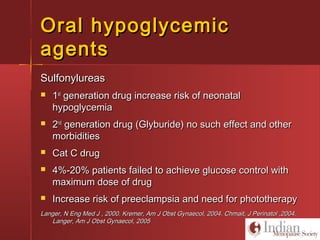
SulfonylureasSulfonylureas
 11stst
generation drug increase risk of neonatalgeneration drug increase risk of neonatal
hypoglycemiahypoglycemia
 22ndnd
generation drug (Glyburide) no such effect and othergeneration drug (Glyburide) no such effect and other
morbiditiesmorbidities
 Cat C drugCat C drug
 4%-20% patients failed to achieve glucose control with4%-20% patients failed to achieve glucose control with
maximum dose of drugmaximum dose of drug
 Increase risk of preeclampsia and need for phototherapyIncrease risk of preeclampsia and need for phototherapy
Langer, N Eng Med J , 2000. Kremer, Am J Obst Gynaecol, 2004. Chmait, J Perinatol ,2004.Langer, N Eng Med J , 2000. Kremer, Am J Obst Gynaecol, 2004. Chmait, J Perinatol ,2004.
Langer, Am J Obst Gynaecol, 2005Langer, Am J Obst Gynaecol, 2005
Insulin in pregnancyInsulin in pregnancy
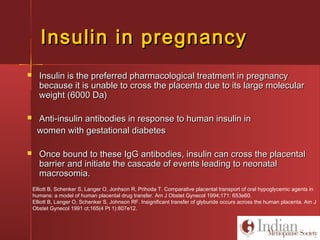
 Insulin is the preferred pharmacological treatment in pregnancyInsulin is the preferred pharmacological treatment in pregnancy
because it is unable to cross the placenta due to its large molecularbecause it is unable to cross the placenta due to its large molecular
weight (6000 Da)weight (6000 Da)
 Anti-insulin antibodies in response to human insulin inAnti-insulin antibodies in response to human insulin in
women with gestational diabeteswomen with gestational diabetes
 Once bound to these IgG antibodies, insulin can cross the placentalOnce bound to these IgG antibodies, insulin can cross the placental
barrier and initiate the cascade of events leading to neonatalbarrier and initiate the cascade of events leading to neonatal
macrosomia.macrosomia.
Elliott B, Schenker S, Langer O, Jonhson R, Prihoda T. Comparative placental transport of oral hypoglycemic agents in
humans: a model of human placental drug transfer. Am J Obstet Gynecol 1994;171: 653e60.
Elliott B, Langer O, Schenker S, Johnson RF. Insignificant transfer of glyburide occurs across the human placenta. Am J
Obstet Gynecol 1991 ct;165(4 Pt 1):807e12.
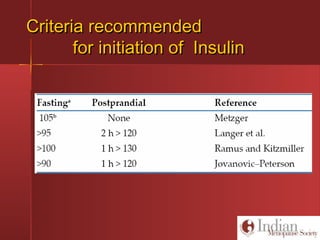
Criteria recommendedCriteria recommended
for initiation of Insulinfor initiation of Insulin
PRE-MIX OR BASALPRE-MIX OR BASAL
BOLUSBOLUS
 PRE MIX – ADJUSTING THEPRE MIX – ADJUSTING THE
DOSE ACCORDING TO THEDOSE ACCORDING TO THE
NEED MAY NOT BE POSSIBLENEED MAY NOT BE POSSIBLE
 BASAL BOLUS – IDEALBASAL BOLUS – IDEAL
ADJUSTMENT OFADJUSTMENT OF
FASTING,POST PRANDIALFASTING,POST PRANDIAL
CONTROL IS POSSIBLECONTROL IS POSSIBLE
InsulinInsulin
 3 pre-meal short acting analog/insulin3 pre-meal short acting analog/insulin
+/- intermediate-acting insulin (NPH/ ?+/- intermediate-acting insulin (NPH/ ?
Glargine) as it allows maximumGlargine) as it allows maximum
flexibilityflexibility
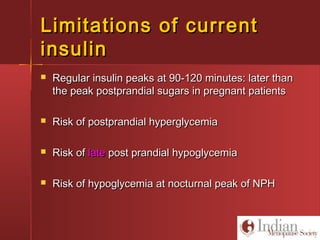
Limitations of currentLimitations of current
insulininsulin
 Regular insulin peaks at 90-120 minutes: later thanRegular insulin peaks at 90-120 minutes: later than
the peak postprandial sugars in pregnant patientsthe peak postprandial sugars in pregnant patients
 Risk of postprandial hyperglycemiaRisk of postprandial hyperglycemia
 Risk ofRisk of latelate post prandial hypoglycemiapost prandial hypoglycemia
 Risk of hypoglycemia at nocturnal peak of NPHRisk of hypoglycemia at nocturnal peak of NPH
Judging analogsJudging analogs
 EfficacyEfficacy
 SafetySafety
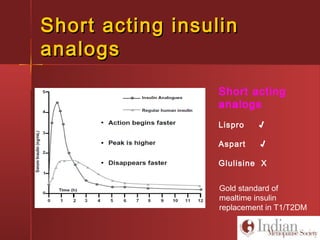
Short acting insulinShort acting insulin
analogsanalogs
Short acting
analogs
Lispro √
Aspart √
Glulisine X
Gold standard of
mealtime insulin
replacement in T1/T2DM
SafetySafety
LisproLispro
 Greater homology with IGF -1Greater homology with IGF -1
 Low dose lispro: not found in the umbilical cord ofLow dose lispro: not found in the umbilical cord of
infants after low dose infusion in laborinfants after low dose infusion in labor
 High dose 4 hour infusion: small dose dependentHigh dose 4 hour infusion: small dose dependent
transfertransfer
 In vitro study : placental accumulation, but notIn vitro study : placental accumulation, but not
transferred to umbilical cordtransferred to umbilical cord
 Prospective open label study showing that there areProspective open label study showing that there are
no difference in progression of retinopathy in womenno difference in progression of retinopathy in women
on lisproon lispro
SafetySafety
AspartAspart
 Comparable receptor affinity to LisproComparable receptor affinity to Lispro
 IGF-1 affinity same as that of humanIGF-1 affinity same as that of human
insulininsulin
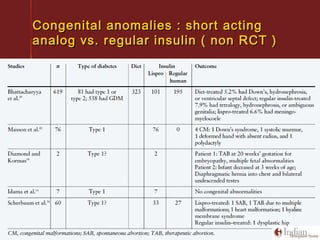
Congenital anomalies : short actingCongenital anomalies : short acting
analog vs. regular insulin ( non RCT )analog vs. regular insulin ( non RCT )
Glargine in pregnancyGlargine in pregnancy
Reproductive toxicity in animal studiesReproductive toxicity in animal studies
No direct effect on reproduction or embryoNo direct effect on reproduction or embryo
fetal developmentfetal development
Hypoglycemia related effect ( similar toHypoglycemia related effect ( similar to
NPH )NPH )
Increased IGF-1 receptor actionIncreased IGF-1 receptor action
Increased DNA stimulationIncreased DNA stimulation
No proof of malignancy in humansNo proof of malignancy in humans
Concerns about GlargineConcerns about Glargine
 Glargine has increased affinity for IGF-1 receptorGlargine has increased affinity for IGF-1 receptor
compared to regular insulin ( X 6.5 )compared to regular insulin ( X 6.5 )
 Possible interaction with trophoblast IGF-1 receptorPossible interaction with trophoblast IGF-1 receptor
 Glargine molecule is large and does not traverseGlargine molecule is large and does not traverse
placentaplacenta
 No animal studies in therapeutic doses to substantiateNo animal studies in therapeutic doses to substantiate
Henderson C . A retrospective review of Glargine Use in Pregnancy J Rep Med 2009; 54: 208-210
Kurtzhals P. Diabetes 2000 ; 49: 999-1005.
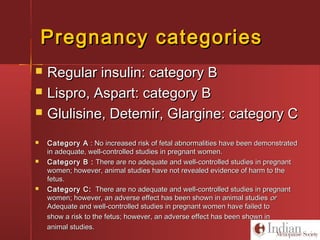
Pregnancy categoriesPregnancy categories
 Regular insulin: category BRegular insulin: category B
 Lispro, Aspart: category BLispro, Aspart: category B
 Glulisine, Detemir, Glargine: category CGlulisine, Detemir, Glargine: category C
 Category ACategory A : No increased risk of fetal abnormalities have been demonstrated: No increased risk of fetal abnormalities have been demonstrated
in adequate, well-controlled studies in pregnant women.in adequate, well-controlled studies in pregnant women.
 Category B :Category B : There are no adequate and well-controlled studies in pregnantThere are no adequate and well-controlled studies in pregnant
women; however, animal studies have not revealed evidence of harm to thewomen; however, animal studies have not revealed evidence of harm to the
fetus.fetus.
 Category C:Category C: There are no adequate and well-controlled studies in pregnantThere are no adequate and well-controlled studies in pregnant
women; however, an adverse effect has been shown in animal studieswomen; however, an adverse effect has been shown in animal studies oror
Adequate and well-controlled studies in pregnant women have failed toAdequate and well-controlled studies in pregnant women have failed to
show a risk to the fetus; however, an adverse effect has been shown inshow a risk to the fetus; however, an adverse effect has been shown in
animal studies.animal studies.
J Indian Med Assoc. 2009 Nov;107(11):799-802, 804-6.
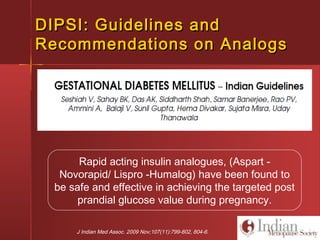
Rapid acting insulin analogues, (Aspart -
Novorapid/ Lispro -Humalog) have been found to
be safe and effective in achieving the targeted post
prandial glucose value during pregnancy.
DIPSI: Guidelines andDIPSI: Guidelines and
Recommendations on AnalogsRecommendations on Analogs
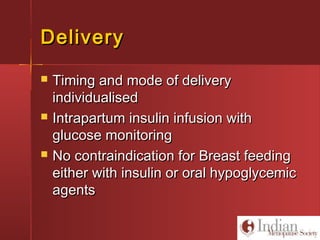
DeliveryDelivery
 Timing and mode of deliveryTiming and mode of delivery
individualisedindividualised
 Intrapartum insulin infusion withIntrapartum insulin infusion with
glucose monitoringglucose monitoring
 No contraindication for Breast feedingNo contraindication for Breast feeding
either with insulin or oral hypoglycemiceither with insulin or oral hypoglycemic
agentsagents
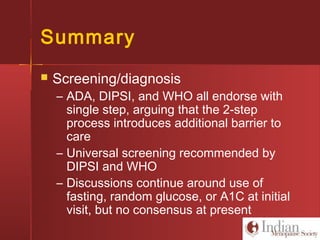
Summary
 Screening/diagnosis
– ADA, DIPSI, and WHO all endorse with
single step, arguing that the 2-step
process introduces additional barrier to
care
– Universal screening recommended by
DIPSI and WHO
– Discussions continue around use of
fasting, random glucose, or A1C at initial
visit, but no consensus at present
Summary
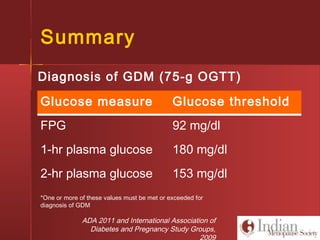
Glucose measure Glucose threshold
FPG 92 mg/dl
1-hr plasma glucose 180 mg/dl
2-hr plasma glucose 153 mg/dl
Diagnosis of GDM (75-g OGTT)
*One or more of these values must be met or exceeded for
diagnosis of GDM
ADA 2011 and International Association of
Diabetes and Pregnancy Study Groups,
2009
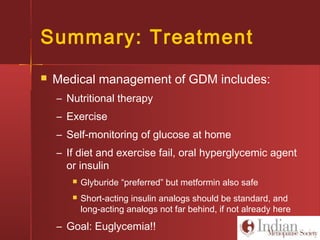
Summary: Treatment
 Medical management of GDM includes:
– Nutritional therapy
– Exercise
– Self-monitoring of glucose at home
– If diet and exercise fail, oral hyperglycemic agent
or insulin
 Glyburide “preferred” but metformin also safe
 Short-acting insulin analogs should be standard, and
long-acting analogs not far behind, if not already here
– Goal: Euglycemia!!
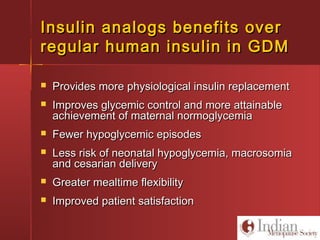
Insulin analogs benefits overInsulin analogs benefits over
regular human insulin in GDMregular human insulin in GDM
 Provides more physiological insulin replacementProvides more physiological insulin replacement
 Improves glycemic control and more attainableImproves glycemic control and more attainable
achievement of maternal normoglycemiaachievement of maternal normoglycemia
 Fewer hypoglycemic episodesFewer hypoglycemic episodes
 Less risk of neonatal hypoglycemia, macrosomiaLess risk of neonatal hypoglycemia, macrosomia
and cesarian deliveryand cesarian delivery
 Greater mealtime flexibilityGreater mealtime flexibility
 Improved patient satisfactionImproved patient satisfaction
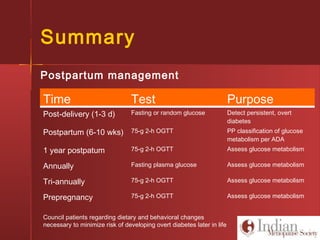
Summary
Time Test Purpose
Post-delivery (1-3 d) Fasting or random glucose Detect persistent, overt
diabetes
Postpartum (6-10 wks) 75-g 2-h OGTT PP classification of glucose
metabolism per ADA
1 year postpatum 75-g 2-h OGTT Assess glucose metabolism
Annually Fasting plasma glucose Assess glucose metabolism
Tri-annually 75-g 2-h OGTT Assess glucose metabolism
Prepregnancy 75-g 2-h OGTT Assess glucose metabolism
Postpartum management
Council patients regarding dietary and behavioral changes
necessary to minimize risk of developing overt diabetes later in life

Gestational diabetics

  • 1.
    Gestational DiabetesGestational Diabetes Updateon Diagnosis and ManagementUpdate on Diagnosis and Management
  • 2.
    GDM: Controversies ??GDM:Controversies ??  Should all pregnant women be screened or onlyShould all pregnant women be screened or only those with risk factors? Is it safe to screen all?those with risk factors? Is it safe to screen all?  Which screening test and which diagnostic test areWhich screening test and which diagnostic test are most reliable? Which cut-off values should we use?most reliable? Which cut-off values should we use?  What are the risk for mothers/babies and canWhat are the risk for mothers/babies and can treatment improve outcome?treatment improve outcome?  What are the connections between gestationalWhat are the connections between gestational diabetes and type 2 DM?diabetes and type 2 DM?
  • 4.
    GDM: Brief overviewGDM:Brief overview  Defined as carbohydrate intoleranceDefined as carbohydrate intolerance that begins or is first recognized duringthat begins or is first recognized during pregnancypregnancy  Important because it impacts maternalImportant because it impacts maternal health care both during/after pregnancyhealth care both during/after pregnancy and increases perinatal complicationsand increases perinatal complications
  • 5.
    Pederson HypothesisPederson Hypothesis (1952)(1952) MaternalhyperglycemiaMaternal hyperglycemia ↓↓ Fetal hyperglycemiaFetal hyperglycemia ↓↓ Fetal pancreaticFetal pancreatic ββ-cell-cell hyperplasiahyperplasia ↓↓ Fetal hyperinsulinaemiaFetal hyperinsulinaemia ↓↓ Macrosomia, organomegalyMacrosomia, organomegaly polycythaemia,polycythaemia, hypoglycemia, RDShypoglycemia, RDS
  • 6.
  • 7.
    Who is atrisk ?Who is at risk ?  25 years of age  Overweight or obese state  Family history of diabetes mellitus  History of abnormal GTT  History of poor obstetric outcome  History of delivery of an infant with a birth weight > 9 lbs  History of polycystic ovary syndrome  Asian
  • 8.
    Indian ScenarioIndian Scenario The prevalence of GDM in India variedThe prevalence of GDM in India varied from 3.8 to 21% in different parts offrom 3.8 to 21% in different parts of the country, depending on thethe country, depending on the geographical locations and diagnosticgeographical locations and diagnostic methods usedmethods used  GDM has been found to be moreGDM has been found to be more prevalent in urban areas than in ruralprevalent in urban areas than in rural areasareas J Indian Med Assoc. 2009 Nov;107(11):799-802, 804-6.
  • 9.
    Prevalence of GDM:Prevalenceof GDM: Indian dataIndian data Publication Author Population Trimester Prevalence J Obs Gyn Ind, 2001 Jindal et al Bhopal 3rd 9% Dia Metab, 2003 R Aruyerchelvan et al Erode - 18.2% JAPI, 2004 V Seshiah et al Chennai 2nd & 3rd 18.9% Ind Pediatrics, 2005 GV Krishanaveni et al Mysore 3rd 5%
  • 10.
  • 11.
    Current recommendations for screeningfor GDM  Depends on who you ask!! – ADA – ACOG – WHO – 4th International Workshop-Conference on GDM – National Diabetes Data Group – United States Preventive Services Task Force – 5th International Workshop-Conference on GDM – DIPSI
  • 12.
    Gestational diabetesGestational diabetes Screeningand diagnosisScreening and diagnosis In general, the test is performedIn general, the test is performed between 24-28 wk because at thisbetween 24-28 wk because at this point in gestation the diabetogenicpoint in gestation the diabetogenic effect of pregnancy is manifest andeffect of pregnancy is manifest and there is sufficient time remaining inthere is sufficient time remaining in pregnancy for therapy to exert itspregnancy for therapy to exert its effecteffect
  • 13.
  • 14.
    Older : ScreeningOlder: Screening guidelinesguidelines
  • 15.
  • 16.
    ADA 2012, RecommendationsADA2012, Recommendations ADA,2012,StandardsofCare
  • 17.
    ADA 2012, RecommendationsADA2012, Recommendations ADA,2012,StandardsofCare
  • 18.
    DIPSI GuidelinesDIPSI Guidelines AAsingle test proceduresingle test procedure to diagnose gestationalto diagnose gestational diabetes mellitus in the communitydiabetes mellitus in the community In the antenatal clinic, a pregnant woman afterIn the antenatal clinic, a pregnant woman after undergoing preliminary clinical examination, has toundergoing preliminary clinical examination, has to be givenbe given a 75 gm oral glucosea 75 gm oral glucose, without regard, without regard to the time of the last meal.to the time of the last meal. A venous blood sample is collected at 2 hours forA venous blood sample is collected at 2 hours for estimating plasma glucose.estimating plasma glucose. GDM is diagnosed ifGDM is diagnosed if 2 hr2 hr plasma glucoseplasma glucose is 140 mg/dlis 140 mg/dl..
  • 19.
  • 20.
    GDM: ManagementGDM: Management GeneralPrinciplesGeneral Principles  Management similar as preexistingManagement similar as preexisting DMDM  Need for glucose monitoringNeed for glucose monitoring  Start with Diet controlStart with Diet control  Commence insulin for poor controlCommence insulin for poor control  Delivery plan individualizedDelivery plan individualized
  • 21.
    SMBG During PregnancySMBGDuring Pregnancy Blood Glucose Goals and Testing FrequencyBlood Glucose Goals and Testing Frequency Goals Timing Fasting 60–90 mg/dL Test on waking Premeal 60–90 mg/dL Test before each meal 1-hour postprandial 100–120 mg/dL Test 1 hour after each meal 11:00 PM–4:00 AM 60–90 mg/dL Test at bedtime or in middle of the night* *2:00–4:00 AM if nocturnal hypoglycemia is suspected Jovanovic L, ed in chief. Medical Management of Pregnancy Complicated by Diabetes. 3rd ed. Alexandria, Va: American Diabetes Association; 2000:45-58 7-Point Glucose Profile is what is recommended
  • 22.
    Monitoring  For womentreated with insulin,For women treated with insulin, preprandialpreprandial monitoring is SUPERIOR tomonitoring is SUPERIOR to postprandialpostprandial monitoring.monitoring. However, the success of either approach dependsHowever, the success of either approach depends on the glycemic targets that are set and achievedon the glycemic targets that are set and achieved  HbA1c early in the course helps to diagnose pre- existing diabetes  Assessment for asymmetric fetal growth by ultrasonography, particularly in early third trimester, may aid in identifying fetuses that can benefit from maternal insulin therapy
  • 23.
    HAPO. NEJM. May2008: Frequency of primary outcomes across the Glucose Categories
  • 24.
    MNT and PharmacotherapyMNTand Pharmacotherapy Diet management Controlled Uncontrolled Insulin OADs ?
  • 25.
    Glycemic targetsGlycemic targets Premeal/FPG 1 hr PPG 2 hr PPG ADA 5.3 (95 mg/dl ) 7.8 (140 mg/dl) 6.7 (120 mg/dl) ACO G 5.3 (95 mg/dl) 7.2 (129 mg/dl) NICE 3.5–5.9 (63-106 mg/dl) 7.8 (140 mg/dl ) Simmons D . Gestational Diabetes Mellitus: NICE for the U.S.? Diabetes Care 33:34–37, 2010
  • 26.
    DietDiet  Frequent smallsnacks may be needed betweenFrequent small snacks may be needed between mealsmeals  The expected weight gain during pregnancy is 300The expected weight gain during pregnancy is 300 to 400 gm/week and total weight gain is 10-12 kg.to 400 gm/week and total weight gain is 10-12 kg.  Approximately 30 to 40 Kcal/kg ideal body weight orApproximately 30 to 40 Kcal/kg ideal body weight or an increment of 300 kcal/day above the basalan increment of 300 kcal/day above the basal requirement is needed in 2nd and 3rd trimesters.requirement is needed in 2nd and 3rd trimesters.  Should typically take at least 175 g of carbohydrate,Should typically take at least 175 g of carbohydrate, 28 g of fiber and 1.1 g of protein per kg/day (Reader28 g of fiber and 1.1 g of protein per kg/day (Reader & Thomas, 2008).& Thomas, 2008).  Avoid starvationAvoid starvation
  • 27.
    Oral HypoglycemicOral Hypoglycemic agentsagents Implicated as teratogeneic in animalImplicated as teratogeneic in animal studies esp first generationstudies esp first generation sulfonyureassulfonyureas  In humans, scattered case reports ofIn humans, scattered case reports of congenital abnormalitycongenital abnormality  None approved for use by authoritiesNone approved for use by authorities  Glibenclamide and Metformin haveGlibenclamide and Metformin have been studied and used with consentsbeen studied and used with consents
  • 28.
    Oral hypoglycemicOral hypoglycemic agentsagents Biguanides ( metformin)Biguanides ( metformin)  Cat B drugCat B drug  Commonly used in Polycystic Ovarian DiseaseCommonly used in Polycystic Ovarian Disease (PCOD) to treat insulin resistance and(PCOD) to treat insulin resistance and normalize reproductive functionnormalize reproductive function  Crosses PlacentaCrosses Placenta  Not teratogeneicNot teratogeneic Glueck, Fertil Steril 2002, Reece, Curr Opin Endocrinol Diabetes, 2006. Hague, BMJ,Glueck, Fertil Steril 2002, Reece, Curr Opin Endocrinol Diabetes, 2006. Hague, BMJ, 20032003 Glueck, Human Reprod, 2004Glueck, Human Reprod, 2004
  • 29.
    Oral hypoglycemicOral hypoglycemic agentsagents SulfonylureasSulfonylureas 11stst generation drug increase risk of neonatalgeneration drug increase risk of neonatal hypoglycemiahypoglycemia  22ndnd generation drug (Glyburide) no such effect and othergeneration drug (Glyburide) no such effect and other morbiditiesmorbidities  Cat C drugCat C drug  4%-20% patients failed to achieve glucose control with4%-20% patients failed to achieve glucose control with maximum dose of drugmaximum dose of drug  Increase risk of preeclampsia and need for phototherapyIncrease risk of preeclampsia and need for phototherapy Langer, N Eng Med J , 2000. Kremer, Am J Obst Gynaecol, 2004. Chmait, J Perinatol ,2004.Langer, N Eng Med J , 2000. Kremer, Am J Obst Gynaecol, 2004. Chmait, J Perinatol ,2004. Langer, Am J Obst Gynaecol, 2005Langer, Am J Obst Gynaecol, 2005
  • 30.
    Insulin in pregnancyInsulinin pregnancy  Insulin is the preferred pharmacological treatment in pregnancyInsulin is the preferred pharmacological treatment in pregnancy because it is unable to cross the placenta due to its large molecularbecause it is unable to cross the placenta due to its large molecular weight (6000 Da)weight (6000 Da)  Anti-insulin antibodies in response to human insulin inAnti-insulin antibodies in response to human insulin in women with gestational diabeteswomen with gestational diabetes  Once bound to these IgG antibodies, insulin can cross the placentalOnce bound to these IgG antibodies, insulin can cross the placental barrier and initiate the cascade of events leading to neonatalbarrier and initiate the cascade of events leading to neonatal macrosomia.macrosomia. Elliott B, Schenker S, Langer O, Jonhson R, Prihoda T. Comparative placental transport of oral hypoglycemic agents in humans: a model of human placental drug transfer. Am J Obstet Gynecol 1994;171: 653e60. Elliott B, Langer O, Schenker S, Johnson RF. Insignificant transfer of glyburide occurs across the human placenta. Am J Obstet Gynecol 1991 ct;165(4 Pt 1):807e12.
  • 31.
    Criteria recommendedCriteria recommended forinitiation of Insulinfor initiation of Insulin
  • 32.
    PRE-MIX OR BASALPRE-MIXOR BASAL BOLUSBOLUS  PRE MIX – ADJUSTING THEPRE MIX – ADJUSTING THE DOSE ACCORDING TO THEDOSE ACCORDING TO THE NEED MAY NOT BE POSSIBLENEED MAY NOT BE POSSIBLE  BASAL BOLUS – IDEALBASAL BOLUS – IDEAL ADJUSTMENT OFADJUSTMENT OF FASTING,POST PRANDIALFASTING,POST PRANDIAL CONTROL IS POSSIBLECONTROL IS POSSIBLE
  • 33.
    InsulinInsulin  3 pre-mealshort acting analog/insulin3 pre-meal short acting analog/insulin +/- intermediate-acting insulin (NPH/ ?+/- intermediate-acting insulin (NPH/ ? Glargine) as it allows maximumGlargine) as it allows maximum flexibilityflexibility
  • 34.
    Limitations of currentLimitationsof current insulininsulin  Regular insulin peaks at 90-120 minutes: later thanRegular insulin peaks at 90-120 minutes: later than the peak postprandial sugars in pregnant patientsthe peak postprandial sugars in pregnant patients  Risk of postprandial hyperglycemiaRisk of postprandial hyperglycemia  Risk ofRisk of latelate post prandial hypoglycemiapost prandial hypoglycemia  Risk of hypoglycemia at nocturnal peak of NPHRisk of hypoglycemia at nocturnal peak of NPH
  • 35.
    Judging analogsJudging analogs EfficacyEfficacy  SafetySafety
  • 36.
    Short acting insulinShortacting insulin analogsanalogs Short acting analogs Lispro √ Aspart √ Glulisine X Gold standard of mealtime insulin replacement in T1/T2DM
  • 37.
    SafetySafety LisproLispro  Greater homologywith IGF -1Greater homology with IGF -1  Low dose lispro: not found in the umbilical cord ofLow dose lispro: not found in the umbilical cord of infants after low dose infusion in laborinfants after low dose infusion in labor  High dose 4 hour infusion: small dose dependentHigh dose 4 hour infusion: small dose dependent transfertransfer  In vitro study : placental accumulation, but notIn vitro study : placental accumulation, but not transferred to umbilical cordtransferred to umbilical cord  Prospective open label study showing that there areProspective open label study showing that there are no difference in progression of retinopathy in womenno difference in progression of retinopathy in women on lisproon lispro
  • 38.
    SafetySafety AspartAspart  Comparable receptoraffinity to LisproComparable receptor affinity to Lispro  IGF-1 affinity same as that of humanIGF-1 affinity same as that of human insulininsulin
  • 39.
    Congenital anomalies :short actingCongenital anomalies : short acting analog vs. regular insulin ( non RCT )analog vs. regular insulin ( non RCT )
  • 40.
    Glargine in pregnancyGlarginein pregnancy Reproductive toxicity in animal studiesReproductive toxicity in animal studies No direct effect on reproduction or embryoNo direct effect on reproduction or embryo fetal developmentfetal development Hypoglycemia related effect ( similar toHypoglycemia related effect ( similar to NPH )NPH ) Increased IGF-1 receptor actionIncreased IGF-1 receptor action Increased DNA stimulationIncreased DNA stimulation No proof of malignancy in humansNo proof of malignancy in humans
  • 41.
    Concerns about GlargineConcernsabout Glargine  Glargine has increased affinity for IGF-1 receptorGlargine has increased affinity for IGF-1 receptor compared to regular insulin ( X 6.5 )compared to regular insulin ( X 6.5 )  Possible interaction with trophoblast IGF-1 receptorPossible interaction with trophoblast IGF-1 receptor  Glargine molecule is large and does not traverseGlargine molecule is large and does not traverse placentaplacenta  No animal studies in therapeutic doses to substantiateNo animal studies in therapeutic doses to substantiate Henderson C . A retrospective review of Glargine Use in Pregnancy J Rep Med 2009; 54: 208-210 Kurtzhals P. Diabetes 2000 ; 49: 999-1005.
  • 42.
    Pregnancy categoriesPregnancy categories Regular insulin: category BRegular insulin: category B  Lispro, Aspart: category BLispro, Aspart: category B  Glulisine, Detemir, Glargine: category CGlulisine, Detemir, Glargine: category C  Category ACategory A : No increased risk of fetal abnormalities have been demonstrated: No increased risk of fetal abnormalities have been demonstrated in adequate, well-controlled studies in pregnant women.in adequate, well-controlled studies in pregnant women.  Category B :Category B : There are no adequate and well-controlled studies in pregnantThere are no adequate and well-controlled studies in pregnant women; however, animal studies have not revealed evidence of harm to thewomen; however, animal studies have not revealed evidence of harm to the fetus.fetus.  Category C:Category C: There are no adequate and well-controlled studies in pregnantThere are no adequate and well-controlled studies in pregnant women; however, an adverse effect has been shown in animal studieswomen; however, an adverse effect has been shown in animal studies oror Adequate and well-controlled studies in pregnant women have failed toAdequate and well-controlled studies in pregnant women have failed to show a risk to the fetus; however, an adverse effect has been shown inshow a risk to the fetus; however, an adverse effect has been shown in animal studies.animal studies.
  • 43.
    J Indian MedAssoc. 2009 Nov;107(11):799-802, 804-6. Rapid acting insulin analogues, (Aspart - Novorapid/ Lispro -Humalog) have been found to be safe and effective in achieving the targeted post prandial glucose value during pregnancy. DIPSI: Guidelines andDIPSI: Guidelines and Recommendations on AnalogsRecommendations on Analogs
  • 44.
    DeliveryDelivery  Timing andmode of deliveryTiming and mode of delivery individualisedindividualised  Intrapartum insulin infusion withIntrapartum insulin infusion with glucose monitoringglucose monitoring  No contraindication for Breast feedingNo contraindication for Breast feeding either with insulin or oral hypoglycemiceither with insulin or oral hypoglycemic agentsagents
  • 45.
    Summary  Screening/diagnosis – ADA,DIPSI, and WHO all endorse with single step, arguing that the 2-step process introduces additional barrier to care – Universal screening recommended by DIPSI and WHO – Discussions continue around use of fasting, random glucose, or A1C at initial visit, but no consensus at present
  • 46.
    Summary Glucose measure Glucosethreshold FPG 92 mg/dl 1-hr plasma glucose 180 mg/dl 2-hr plasma glucose 153 mg/dl Diagnosis of GDM (75-g OGTT) *One or more of these values must be met or exceeded for diagnosis of GDM ADA 2011 and International Association of Diabetes and Pregnancy Study Groups, 2009
  • 47.
    Summary: Treatment  Medicalmanagement of GDM includes: – Nutritional therapy – Exercise – Self-monitoring of glucose at home – If diet and exercise fail, oral hyperglycemic agent or insulin  Glyburide “preferred” but metformin also safe  Short-acting insulin analogs should be standard, and long-acting analogs not far behind, if not already here – Goal: Euglycemia!!
  • 48.
    Insulin analogs benefitsoverInsulin analogs benefits over regular human insulin in GDMregular human insulin in GDM  Provides more physiological insulin replacementProvides more physiological insulin replacement  Improves glycemic control and more attainableImproves glycemic control and more attainable achievement of maternal normoglycemiaachievement of maternal normoglycemia  Fewer hypoglycemic episodesFewer hypoglycemic episodes  Less risk of neonatal hypoglycemia, macrosomiaLess risk of neonatal hypoglycemia, macrosomia and cesarian deliveryand cesarian delivery  Greater mealtime flexibilityGreater mealtime flexibility  Improved patient satisfactionImproved patient satisfaction
  • 49.
    Summary Time Test Purpose Post-delivery(1-3 d) Fasting or random glucose Detect persistent, overt diabetes Postpartum (6-10 wks) 75-g 2-h OGTT PP classification of glucose metabolism per ADA 1 year postpatum 75-g 2-h OGTT Assess glucose metabolism Annually Fasting plasma glucose Assess glucose metabolism Tri-annually 75-g 2-h OGTT Assess glucose metabolism Prepregnancy 75-g 2-h OGTT Assess glucose metabolism Postpartum management Council patients regarding dietary and behavioral changes necessary to minimize risk of developing overt diabetes later in life