National Guidelines for
Diagnosis & Management of
Gestational Diabetes Mellitus
Maternal Health Division
Ministry of Health and Family Welfare
Government of India
December 2014
Designed and printed with support from UNICEF
Designed by: ​New Concept Information Systems (P) Ltd., New Delhi
communication@newconceptinfosys.com
National Guidelines for
Diagnosis & Management of
Gestational Diabetes Mellitus
Maternal Health Division
Ministry of Health and Family Welfare
Government of India
December 2014
Preface
In view of the high prevalence of“Gestational Diabetes Mellitus (GDM)”
in the Indian population and the maternal & fetal risks associated with
inappropriatelymanagedGDM,theMinistryofHealthandFamilyWelfare
has preparedTechnical and Operational Guidelines for identification and
management of Gestational Diabetes Mellitus in pregnant women.
In the past two decades Ante-natal Care coverage has improved across India, but some
of the key tests, for instance, screening for GDM were not part of our routine ANC service
package leading to dilution in the quality of care. Identification of GDM in pregnant
women is critical in view of its wide prevalence and the impact it has on pregnancy
outcomes.Taking cognisance of this situation, the Ministry of Health and FamilyWelfare
has developed these technical guidelines, which clearly articulate the standard protocols
for the diagnosis and management of GDM.
These guidelines will go a long way in minimising the ill effects of unmanaged GDM at
the community level which in turn will lead to further reduction in maternal morbidity
and mortality.
I wish to put on record my appreciation of the domain experts and technical experts who
gave their time and their unstinting support in developing the guidelines for diagnosis
and management of GDM.
I am certain that the States and programme officers will make optimum use of this
valuable resource which will help both the mother and neonate in leading a healthy life.
(Lov Verma)
yo oekZ
lfpo
LOV VERMA
Secretary
Hkkjr ljdkj
LokLF; ,oa ifjokj dY;k.k foHkkx
LokLF; ,oa ifjokj dY;k.k ea=ky;
Government of India
Department of Health & Family Welfare
Ministry of Health & Family Welfare
dejk ua 156] ,&Lda/k] fuekZ.k Hkou] ubZ fnYyh&110011
Room No. 156, A-Wing, Nirman Bhawan, New Delhi-110011
Tele : (O) 011-23061863, Fax : 011-23061252, E-mail : secyhfw@gmail.com
Foreword
Strong health systems are lynch pins of a successful public health programme.
I am happy to note that India has made substantial progress in improving its
health systems at all levels – increased footfalls and improved service provision
are a testimony to this.We have also turned to corner to improving maternal and
child health with considerable improvement in reduction of maternal and infant
mortality in the country.
However, there are certain burden of diseases especially non- communicable disease which need to
be addressed from our public health facilities if we are to optimise the ground gained and keep the
momentum of reducing maternal and infant morbidity and mortality.
“Gestational Diabetes Mellitus (GDM)”has been identified as a potential risk factor for poor health status
in pregnant mothers which has a causal relationship with various complications during pregnancy and
child birth, contributing directly to increased maternal or neonate morbidity and mortality.
As we move into the last leg of race in arresting the incidences of maternal mortality, we have
sharpened our focus on reducing the prevalence of neonatal mortality or early neonatal mortality.
Diagnosis and management of Gestational Diabetes Mellitus is a step forward in preventing the risk
factors and causes of morbidity and mortality among mothers and young infants.
Maternal Health Division after wide based consultations with domain experts has developed the
technical and operational guidelines to address this issue.These guidelines are aimed at state policy
drivers and programme officers and will serve as handy resource for rolling out this intervention,
which is now an integral part of our ANC package of services – leading improved quality of ANC
services at various level.
I sincerely believe that the state programme officers will utilise this guideline effectively for
implementing GDM in public health programme.
C.K. Mishra
C.K. Mishra, IAS
Additional Secretary &
Mission Director, NHM
Telefax : 23061066, 23063809
E-mail : asmd-mohfw@nic.in
Hkkjr ljdkj
LokLF; ,oa ifjokj dY;k.k ea=ky;
fuekZ.k Hkou] ubZ fnYyh & 110011
Government of India
Ministry of Health & Family Welfare
Nirman Bhavan, New Delhi - 110011
Dated: 28th
November, 2014
Foreword
In past few years the RCH Programme has especially focussed on reducing the
maternal mortality ratio and infant mortality rates.This decline however needs to be
accelerated and will only happen if we address all the possible contributory factors.
Prevalence of Gestational Diabetes Mellitus (GDM) is an identified high risk both
for the pregnant women and the foetus. If not managed on time, this can pose
severe risk both to mother and the neonate.Tamil Nadu is the only State which has implemented the
universal screening and management of GDM for pregnant women and evidences clearly indicate its
positive outcome.
The indigenous learning and various round of consultations with experts and development partners
has lead to the preparation of guidelines on diagnosis & management of GDM for implementation in
public health programme as a part of routine ANC in India.
The tireless efforts by the MH Division with support from technical expert from various institutes and
development partners has facilitated drafting of this document and made it ready for implementation
across the country.
I am confident that this guideline will not only help mother and neonates but also help in preventing
GDM. States should effectively utilise this guideline in implementation of GDM programme.
(Dr. Rakesh Kumar)
Dr. RAKESH KUMAR, IAS
JOINT Secretary
Telefax : 23061723
E-mail : rk1992uk@gmail.com
E-mail : rkumar92@hotmail.com
Hkkjr ljdkj
LokLF; ,oa ifjokj dY;k.k ea=ky;
fuekZ.k Hkou] ubZ fnYyh & 110011
Government of India
Ministry of Health & Family Welfare
Nirman Bhavan, New Delhi - 110011
Programme Officer’s Message
The prevalence of GDM has been observed across the country, however
a consistent understanding, standard operating procedures (SOP) for
identification and its management is varying from state to state or even
within the state.To streamline this important intervention, a working group
was constituted to standardise the process and suggest the implementable
model.This guidelines has been prepared based on the recommendation of
the experts after due deliberations. It is believed states will utilise this to effectively treat
all the GDM cases.
I would like to express that these guidelines would not have been possible without the
constant encouragement from Mr. C.K Mishra, AS&MD & Ms Anuradha Gupta, Ex AS&
MD. Dr. Rakesh Kumar, Joint Secretary (RMNCH+A) headed the expert group meeting and
gave valuable inputs in framing this guideline.
I would like to acknowledge the contribution of all members of the Expert Group in
developing the content of these technical and operational guidelines. I would also like to
acknowledge my colleagues in MH Division especially Dr. Dinesh Baswal, DC (MH) and
development partner’s for their valuable efforts and inputs in developing this document.
My sincere wishes to all the stakeholders at State and district level to plan and implement
this important intervention in improving the quality of ANC services and saving the
mothers and neonates from the burden of GDM.
(Dr Himanshu Bhushan)
Dr. H. BHUSHAN
Deputy Commissioner (MH)
Telefax : 23062930
E-mail : drhbhushan@gmail.com
Hkkjr ljdkj
LokLF; ,oa ifjokj dY;k.k ea=ky;
fuekZ.k Hkou] ubZ fnYyh & 110011
Government of India
Ministry of Health & Family Welfare
Nirman Bhavan, New Delhi - 110011
viiNational Guidelines for Diagnosis & Management
of Gestational Diabetes Mellitus
List of Contributors
1 Mr C. K. Mishra AS & MD (NHM), MoHFW
2 Dr Rakesh Kumar JS (RMNCH+A), MoHFW
3 Dr Himanshu Bhushan DC (I/c MH), MoHFW
4 Dr Dinesh Baswal DC (MH), MoHFW
5 Dr Manisha Malhotra DC (MH), MoHFW
6 Dr V. Seshiah Diabetes Care Centre, Chennai
7 Dr Rajesh Khadgawat Add. Prof., Dept. of Endocrinology & Metabolism,
AIIMS, New Delhi
8 Dr Hema Divakar FOGSI
9 Dr Prema Ramchandran Nutritional Expert, Hyderabad
10 Dr Abha Singh HOD OBGY, LHMC, New Delhi
11 Dr Himali H. Sinha Dept. of OBGY, AIIMS, Patna
12 Dr Aboli Gore MP-TAST, Bhopal
13 Dr Ratna Kumar Ex HOD, Institute of OBGYN, Chennai,Tamil Nadu
14 Dr B. Shailaja Epidemiologist, Andhra Pradesh
15 Dr Genevieve Begkoyian UNICEF
16 Dr Malalay Ahmadzai UNICEF
17 Dr Sudha Balakrishnan UNICEF
18 Ms Vani Sethi UNICEF
19 Dr Somesh Kumar Jhpiego
20 Dr VikasYadav Jhpiego
21 Dr Vidushi Kulshreshtha AIIMS, New Delhi
22 Dr Arunabh Ray BTAST, Patna
23 Mr K. S. Prasanth Senior Consultant, NHSRC
24 Dr Manju Chuggani Principal, Rufaida College Of Nursing, New Delhi
25 Dr Ritu Agrawal LSTM, New Delhi
26 Dr Sudhir Maknikar National RMNCH+A Expert, JSI
viii National Guidelines for Diagnosis & Management
of Gestational Diabetes Mellitus
27 Dr Pushkar Kumar Lead Consultant, MH, MoHFW
28 Dr Rajeev Agrawal Senior Mgt. Consultant, MH, MoHFW
29 Dr Ravinder Kaur Senior Consultant, MH, MoHFW
30 Dr Gulfam Ahmed Hashmi Regional Coordinator, NRU, MoHFW
31 Dr Sonali Rawal NHM Consultant, MoHFW
32 Mr Shridhar B. Pandit PO, NHM, Maharashtra
33 Dr Neeraj Agarwal Jhpiego
34 Ms Geeta Sharma UNICEF
35 Ms Monita Gahlot Nutritionist AIIMS, New Delhi
J&K Team
36 Dr Yashpal Sharma MD, NHM, Govt. of J&K
37 Dr Harjeet Rai NHM, Govt. of J&K
38 Dr Mushtaq Ahmad Dar NHM, Govt. of J&K
UP Team
39 Mr Sanjay Prasad Secretary, Health, Govt of UP
40 Dr Neera Jain GM, MH, NHM, Govt. of UP
41 Dr Vikas Singhal NHM, Govt. of UP
42 Dr Sapna Das NHM, Govt. of UP
43 Dr Pravesh Kumari NHM, Govt. of UP
44 Dr Ranjana Khare Senior Gynaecologist, Jhalkaribai Hospital,
Lucknow
KGMU Team, Lucknow
45 Dr Vinita Das Prof. & HOD, Dept. of OBGY, KGMU, Lucknow
46 Dr Anjoo Agarwal Prof. of OBGY, KGMU, Lucknow
47 Dr Amita Pandey Assoc. Prof, Deptt of OBGY, KGMU, Lucknow
48 Dr Smriti Agarwal Asst. Prof. of OBGY, KGMU, Lucknow
49 Dr Madhukar Mittal Asst. Prof. of Dept. of Medicine, KGMU, Lucknow
ixNational Guidelines for Diagnosis & Management
of Gestational Diabetes Mellitus
List of Abbreviations
ANC 	 Antenatal Care
ANM	 Auxiliary Nurse Midwife
BMI	 Body Mass Index
BMR	 Basal Metabolic Rate
CHC 	 Community Health Centre
DH 	 District Hospital
FBG	 Fasting Blood Glucose
GDM	 Gestational Diabetes Mellitus
IGT	 Impaired GlucoseTolerance
MC	 Medical College
MO 	 Medical Officer
PAL	 Physical Activity Level
PHC 	 Primary Health Centre
PPPG	 Post Prandial Plasma Glucose
PW	 PregnantWomen
SN 	 Staff Nurse
TSF	 Table Spoonfull
xiNational Guidelines for Diagnosis & Management
of Gestational Diabetes Mellitus
Contents
1. 	 Introduction	 1
2. 	 Evidence	 3
3. 	 Technical guidelines on testing  management of GDM	 4
4. 	 Operational aspects of GDM Programme	 31
5. 	 Records  Registers	 37
6. 	 Monitoring and Quality Assurance	 37
7. 	 Outcome measures to be assessed	 38
8. 	 Key points	 38
9. 	 Budget	 39
10.	Annexures	 45
	 Annexure 1:  BMI Chart (Ideal height weight chart)	 47
	 Annexure 2:  MNT  Sample diet chart 	 48
	 Annexure 3:  Food exchange list	 56
	 Annexure 4: Monthly GDM Reporting format for State
 District Programme managers	 59
	 Annexure 5: Monthly GDM Reporting Format for Health Facility 	 60
	 Annexure 6:  Migration form	 61
	 Annexure 7:  Referral Slip	 62
	 Annexure 8:  Glucometer Specification	 64
	 Annexure 9:  Glucometer Calibration 	 66
11. 	Bibliography	 68
1National Guidelines for Diagnosis  Management
of Gestational Diabetes Mellitus
1. Introduction
Gestational Diabetes Mellitus (GDM) is defined as Impaired Glucose
Tolerance (IGT) with onset or first recognition during pregnancy.Worldwide,
one in 10 pregnancies is associated with diabetes, 90% of which are GDM.
Undiagnosed or inadequately treated GDM can lead to significant maternal
 fetal complications. Moreover, women with GDM and their offsprings are
at increased risk of developing type 2 diabetes later in life.
In India, one of the most populous country globally, rates of GDM are
estimated to be 10-14.3% which is much higher than the west. As of
2010, there were an estimated 22 million women with diabetes between
the ages of 20 and 39  an additional 54 million women in this age group
with impaired glucose tolerance (IGT) or pre-diabetes with the potential
to develop GDM if they become pregnant. In a field study in Tamil Nadu
performed under the Diabetes in Pregnancy – Awareness and Prevention
project, of the 4151, 3960 and 3945 pregnant women screened in urban,
semi urban and rural areas, respectively, the prevalence of GDM was
17.8% in the urban, 13.8% in the semi urban and 9.9% in the rural areas.
The incidence of GDM is expected to increase to 20% i.e. one in every
5 pregnant women is likely to have GDM.
Despite a high prevalence of GDM in Indian women, currently screening
of pregnant women for GDM is not being done universally as part of the
essential antenatal package.The test is sporadically being done at DH and
MC in some states as per direction of individual clinician except in the state
of Tamil Nadu where every pregnant woman is being screened up to the
level of PHC as a part of the government ofTamil Nadu initiative.
Despite the fact that GDM is a sizeable public health problem with serious
adverse effects on mother  child, we do not have a standard GoI guideline
for diagnosis and management of GDM.
2 National Guidelines for Diagnosis  Management
of Gestational Diabetes Mellitus
1.1 Consequences of GDM
Maternal risks of GDM include polyhydramnios, pre-eclampsia, prolonged
labour, obstructed labour, caesarean section, uterine atony, postpartum
haemorrhage, infection and progression of retinopathy which are the
leading global causes of maternal mortality.
Fetal risks include spontaneous abortion, intra-uterine death, stillbirth,
congenital malformation, shoulder dystocia, birth injuries, neonatal
hypoglycaemia and infant respiratory distress syndrome. Immediate and
long-term clinical effects of GDM are important contributors to the burden
of non-communicable diseases in many countries.
Maternal Risk Fetal Risk
w	Polyhydramnios
w	Pre-eclampsia
w	 Prolonged labour
w	 Obstructed labour
w	 Caesarean section
w	 Uterine atony
w	 Postpartum haemorrhage
w	Infection
w	 Spontaneous abortion
w	 Intra-uterine death
w	Stillbirth
w	 Congenital malformation
w	 Shoulder dystocia
w	 Birth injuries
w	 Neonatal hypoglycaemia
w	 Infant respiratory distress
syndrome
3National Guidelines for Diagnosis  Management
of Gestational Diabetes Mellitus
2. Evidence
2.1 International evidence
Review of international evidences shows definite guidelines for screening
pregnant women for GDM. The American  Canadian guidelines
recommend universal screening by two step approach. This includes a
screening with 50g one hour plasma glucose test (140 mg/dL taken
as screen positive).The screen positive women are subjected to 100gm
OGTT and those with 2 or more abnormal values of plasma glucose are
diagnosed as GDM.The NICE  Australian guidelines recommend a risk
based screening with 75gm 2 hour OGTT with fasting blood glucose
≥126mg/dL  2hr ≥ 140 mg/dL taken as diagnostic for GDM.The WHO
endorses universal screening for GDM at 24-28 weeks of gestation using
the 75gm 2hr PG (cut offs fasting ≥126mg/dL  ≥140mg/dL). Almost all
guidelines agree to management of GDM using Medical NutritionTherapy
(Diet plan)  insulin therapy if needed.
2.2 National evidence
The Diabetes in Pregnancy Study Group in India endorses the single step
test recommended by WHO for diagnosis of GDM using a 75gm OGTT
irrespective of the last meal with a threshold value of 2 hour PG140
mg/dL.Tamil Nadu endorses universal screening of all pregnant women at
12-16 weeks gestation or at first antenatal visit. If the reports are normal,
the next screening is done at 24-28 weeks gestation and later at 32-34
weeks. GDM is managed by MNT and Insulin therapy is added if required.
In the postpartum period, 75gm OGTT is repeated at 6-12 weeks after
delivery. If normal, OGTT is repeated at 6 months  thereafter, every year
after delivery.
4 National Guidelines for Diagnosis  Management
of Gestational Diabetes Mellitus
2.3 Need for National guidelines
Considering the high prevalence of GDM in India and the maternal  fetal
morbidity associated with untreated or inappropriately managed GDM,
there was an urgent need to formulate our own guidelines for testing all
PW for GDM.Timely diagnosis of GDM will allow initiation of appropriate
treatment to prevent  minimise the ill effects of uncontrolled GDM on
the mother  child in the short term  long term. For this reason, GoI
constituted an expert group to deliberate on GDM in detail  formulate
guidelines for India.
The present guideline has been prepared based on the recommendations of
the experts  available national/international evidences.
3. Technical guidelines on testing 
management of GDM
3.1 Target population
All pregnant women in the community
3.2 Pre-requisites for testing  management of GDM
	 Availability of supply  testing facility
	 Trained human resources to manage the cases after diagnosis
	 Appropriate referral linkages
3.3 Selection of facility
	 States are free to choose the number of districts where the programme
will be implemented
	 Once a district is chosen, implementation of programme should be
universal in that district from Medical College to sub-centre
	 A health facility chosen for implementation of programme should have
all the pre-requisites in place
5National Guidelines for Diagnosis  Management
of Gestational Diabetes Mellitus
	 The service provider  programme officer must be oriented and
trained about the programme
3.4 Protocol for investigation
	 Testing for GDM is recommended twice during ANC.
	 The first testing should be done during first antenatal contact as early
as possible in pregnancy.
	 The second testing should be done during 24-28 weeks of pregnancy
if the first test is negative.
	 There should be at least 4 weeks gap between the two tests.
	 The test is to be conducted for all PW even if she comes late in
pregnancy for ANC at the time of first contact.
	 If she presents beyond 28 weeks of pregnancy, only one test is to be
done at the first point of contact.
	 If the test is positive at any point, protocol of management should be
followed as given in this guideline.
	 At MC/DH/other CEmOC Centres, availability of glucometer must be
ensured at all ANC clinics with facility for collection of sample and
interpretation of result there itself (by training of personnel).
	 At all other facilities upto PHC level, there should be an in-house
arrangement for conducting the test  giving report immediately so that
necessary advice can be given on the same day by the treating doctor.
3.5 Methodology: Test for diagnosis
	 Single step testing using 75 g oral glucose  measuring plasma
glucose 2 hour after ingestion.
	 75g glucose is to be given orally after dissolving in approximately
300ml water whether the PW comes in fasting or non-fasting state,
irrespective of the last meal. The intake of the solution has to be
completed within 5 min.
6 National Guidelines for Diagnosis  Management
of Gestational Diabetes Mellitus
	 A plasma standardised glucometer should be used to evaluate blood
glucose 2 hours after the oral glucose load.
	 If vomiting occurs within 30 min of oral glucose intake, the test has to
be repeated the next day, if vomiting occurs after 30 minutes, the test
continues.
	 The threshold plasma glucose level of ≥140 mg/dL (more than or equal
to 140) is taken as cut off for diagnosis of GDM.
3.6 Instrument used for diagnosis
	 For this programme, it has been decided that a plasma calibrated
glucometer should be used for diagnosis of GDM instead of a semi-
auto-analyser or auto-analyser or any other testing methodology as it
may lead to delay in getting the results immediately.
	 Since it will be difficult for PW to come another day just to collect
the result, testing facility with a glucometer should be available
at all facilities in the ANC clinic itself.This facilitates getting the result
immediately so that necessary advice may be given the same day.
	 A glucometer should also be available in the labour room for close
monitoring of GDM cases during labour.
	 Calibration of Glucometer recommended after 20 measurements using
calibration test strips, provided with glucometers.
	 Specification for the glucometer is given at Annexure 8
	 Details on plasma calibration of glucometer is given in Annexure 9
3.7 Management of GDM
Guiding Principles
	 All PW who test positive for GDM for the first time should be started on
Medical NutritionTherapy (MNT) for 2 weeks.
	 After 2 weeks on MNT, a 2 hrs PPPG (post meal) should be done.
7National Guidelines for Diagnosis  Management
of Gestational Diabetes Mellitus
PregnantWoman in Community
Testing for GDM at 1st Antenatal visit
(75 g oral glucose- 2 hr Plasma Glucose value)
Positive
(2 hr PG ≥ 140 mg/dl)
Positive
(2 hr PG 140 mg/dl)
Manage as GDM as
per guidelines
Negative
(2 hr PG 140mg/dl)
Negative
(2 hr PG 140mg/dl)
Manage as Normal
ANC
Manage as GDM as
per guidelines
RepeatTesting
at 24-28 weeks
	 If 2hr PPPG 120 mg/dL, repeat test every 2 weeks in second
trimester  every week in third trimester
	 If 2hr PPPG ≥120mg/dL medical management (InsulinTherapy) to be
started as per guidelines.
Universal testing for GDM
8 National Guidelines for Diagnosis  Management
of Gestational Diabetes Mellitus
Medical Nutrition Therapy (MNT)
Principles of MNT
w	 Healthy eating during pregnancy
All pregnant women with GDM should get Medical nutrition therapy
(MNT) as soon as diagnosis is made. MNT for GDM primarily involves a
carbohydrate controlled balanced meal plan which promotes
	 Optimal nutrition for maternal and fetal health
	 Adequate energy for appropriate gestational weight gain,
	 Achievement and maintenance of normoglycemia
w	 The importance of the individualised nutrition assessment in GDM
Nutrition assessment in GDM should be individualised to allow an accurate
appraisal of the woman’s nutritional status.This assessment includes defining
her Body Mass Index (BMI) or percentage of desirable pre-pregnancy body
weight and optimal pattern of weight gain during pregnancy.
w	 Calories and GDM
	 Individualisation is important when determining energy requirement,
and adjustments should be made based on weight change patterns.
	 Energy requirement during pregnancy includes the normal requirement
of adult and an additional requirement for fetal growth plus the
associate increase in the body weight of pregnant woman.
Thus, GDM is managed initially with MNT and if it is not
controlled with MNT, insulin therapy is added to the MNT.
9National Guidelines for Diagnosis  Management
of Gestational Diabetes Mellitus
	 Energy requirement does not increase in the first trimester unless a
woman is underweight.
	 Energy requirement increases during second and third trimester.
	 Energy intake should be adequate enough to provide appropriate
weight gain during pregnancy.
	 As per Indian ICMR guidelines for an average weight gain of 10-
12 Kg, an addition of 350 K.cal/day above the adult requirement is
recommended during second and third trimester.
	 Equations proposed by ICMR (1989) expert group can be used to
calculate adult energy requirement which are as follows:
l	 Energy requirement (K.cal/d)= BMR ×PAL
	 *BMR= Basal metabolic rate
	 *PAL= Physical activity level
l	 BMR (K.cal/d)for adult females (18-30yrs)= 14×B.W (Kg) + 471
l	 BMR (K.cal/d)for adult females (30-60yrs)= 8.3×B.W (Kg) + 788
	 *B.W= body weight
l	 Ideal body weight can be taken in to consideration when
calculating the requirement.
l	 PAL values proposed by ICMR expert group (2009) are as follows
Level of activity PAL value
Sedentary work 1.53
Moderate work 1.8
Heavy work 2.3
	 An addition of 350 k. cal can be made after calculating the energy
requirement for adults as stated in above table.
10 National Guidelines for Diagnosis  Management
of Gestational Diabetes Mellitus
Example
How to determine calorie requirement of a 28 years of age sedentary active pregnant
woman in second trimester with height=153 cm, current weight=60 Kg, and
pre-pregnancy weight=54 Kg.
1. 	 First calculate the BMI
	 BMI (kg/m2) = weight in Kg/Height in meter square
				 = 54/1.53*1.53
				 = 23.06 Kg/m2
	 BMI is in normal range
2.	 Calculate BMR
l	 BMR (K.cal/d)for adult females (18-30yrs) 	 = 14×B.W(Kg) + 471
							 = 14 ×53+471
								 = 1213K.cal
3.	 Identify PAL
	 PAL of sedentary activity is 1.53
4.	 Total energy requirement of adult	 = BMR×PAL
				 = 1213×1.53
				 = 1856K.cal
5.	 Total energy requirement in pregnancy =Total energy requirement of adult+350 Kcal/d
	 		 =1856+350 = 2206 kcal per day
Maternal weight gain is the important measure in follow up visits
to determine whether energy intake is adequate to support fetal
growth. Weight gain targets for pregnancy are based on women’s pre
pregnancy Body Mass Index (BMI).
11National Guidelines for Diagnosis  Management
of Gestational Diabetes Mellitus
Pre-pregnancy weight BMI (kg/m2
) Total weight gain
range (kg)
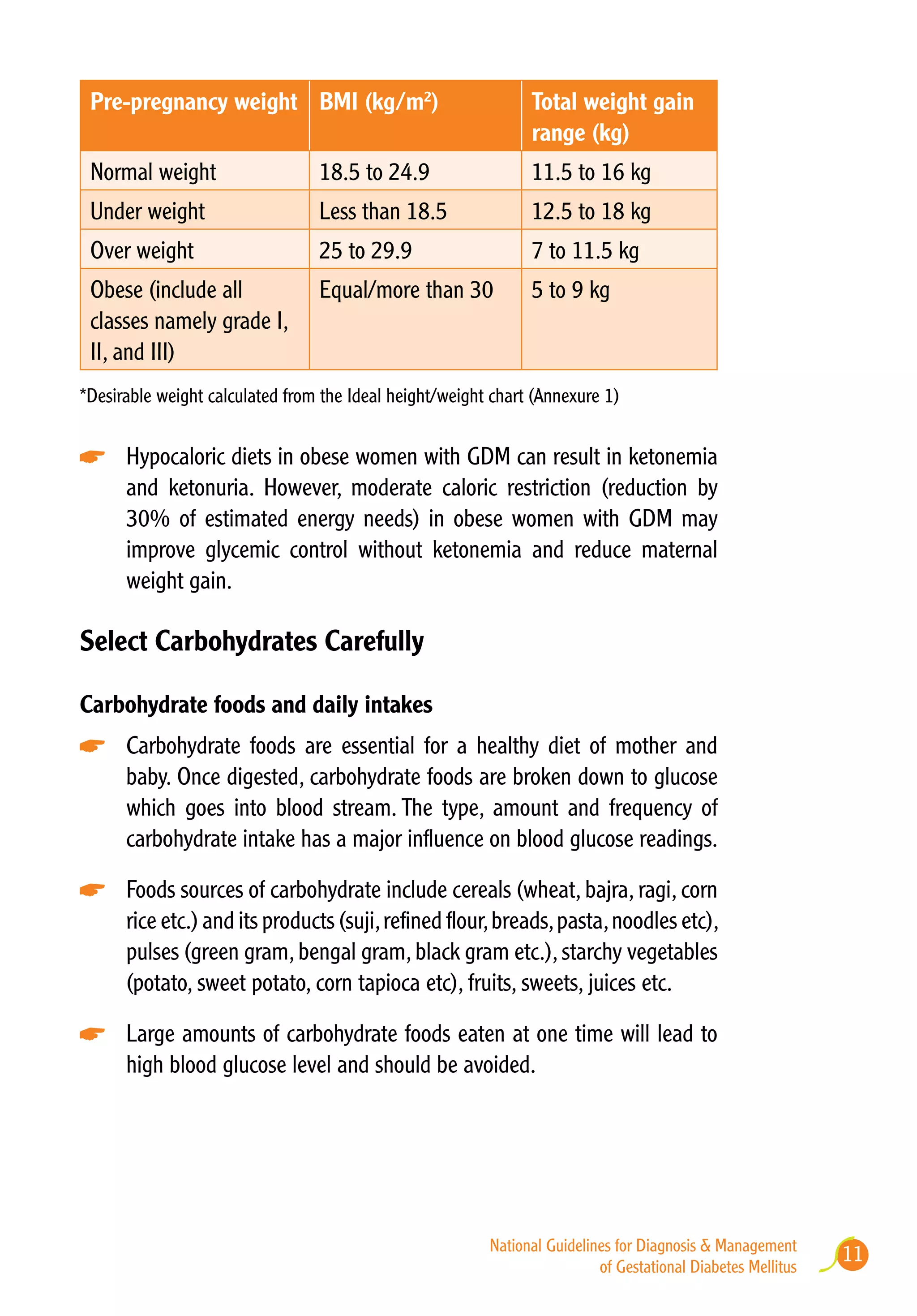
Normal weight 18.5 to 24.9 11.5 to 16 kg
Under weight Less than 18.5 12.5 to 18 kg
Over weight 25 to 29.9 7 to 11.5 kg
Obese (include all
classes namely grade I,
II, and III)
Equal/more than 30 5 to 9 kg
*Desirable weight calculated from the Ideal height/weight chart (Annexure 1)
	 Hypocaloric diets in obese women with GDM can result in ketonemia
and ketonuria. However, moderate caloric restriction (reduction by
30% of estimated energy needs) in obese women with GDM may
improve glycemic control without ketonemia and reduce maternal
weight gain.
Select Carbohydrates Carefully
Carbohydrate foods and daily intakes
	 Carbohydrate foods are essential for a healthy diet of mother and
baby. Once digested, carbohydrate foods are broken down to glucose
which goes into blood stream. The type, amount and frequency of
carbohydrate intake has a major influence on blood glucose readings.
	 Foods sources of carbohydrate include cereals (wheat, bajra, ragi, corn
rice etc.) and its products (suji,refined flour,breads,pasta,noodles etc),
pulses (green gram, bengal gram, black gram etc.), starchy vegetables
(potato, sweet potato, corn tapioca etc), fruits, sweets, juices etc.
	 Large amounts of carbohydrate foods eaten at one time will lead to
high blood glucose level and should be avoided.
12 National Guidelines for Diagnosis  Management
of Gestational Diabetes Mellitus
	 Spreading carbohydrate foods over the day will help to prevent this.
It is better to spread carbohydrate foods over 3 small meals and 2–3
snacks each day than taking 3 large meals
	 Complex carbohydrates ( like whole-grain cereals like oats,bajra,jowar,
ragi,whole pulses,vegetables and fruits with skins ) should be preferred
over simple carbohydrates like food with lots of added sugar or honey,
or foods that are made from refined white flour. Some examples of
simple carbohydrates include sweets, cakes, puddings, sweet biscuits,
pastry, juice, soft drinks, chips, white bread, naan, pizza etc
	 Counting the number of carbohydrate serves that a mother eats during
the day will help her to eat the right amount of carbohydrate. As a
guide, aim should be for 2–3 carbohydrate serves at each major meal
and 1–2 carbohydrate serves at each snack.
	 One serve = approximately 15 grams of carbohydrate. Exchange list
for carbohydrate is given in annexure 3
Understanding Fat Intake during Pregnancy
Saturated fat intake (sources - ghee, butter, coconut oil, palm oil, red meat,
organ meat,full cream milk etc) should be less than 10 % of total calories and
dietary cholesterol should be less than 300mg/d. In obese and overweight
patients, a lower-fat diet overall can help slow the rate of weight gain.
Ways to trim the fat from your diet
	 Use less fat in cooking and avoid frying of foods
	 Using to low-fat dairy products in place of whole milk or full cream
products.
	 Choosing low fat snacks like substituting fresh fruit for high-fat snacks
such as cakes, biscuits, chocolates and pastries.
	 Using lean meat in place of red meat
13National Guidelines for Diagnosis  Management
of Gestational Diabetes Mellitus
Protein: Protein requirement in pregnancy is increased (additional 23 g/d)
to allow for fetal growth. At least 3 serving of protein foods are required
every day to meet the increased demand. Sources of protein are milk and
milk products, egg, fish, chicken, pulses (dal), nuts etc
Fiber: High fibre foods especially soluble fibre may help control blood
sugar by delaying gastric emptying, retarding the entry of glucose into the
bloodstream and lessening the postprandial rise in blood glucose. Soluble
fibre in flax seed, psyllium husk, oat bran, legumes (dried beans of all kinds,
peas and lentils), and pectin (from fruit, such as apples) and forms in root
vegetables (such as carrots) are helpful.
Further details on dietary intake, sample diet chart (Annexure 2)
and food exchange chart for MNT (Annexure 3).
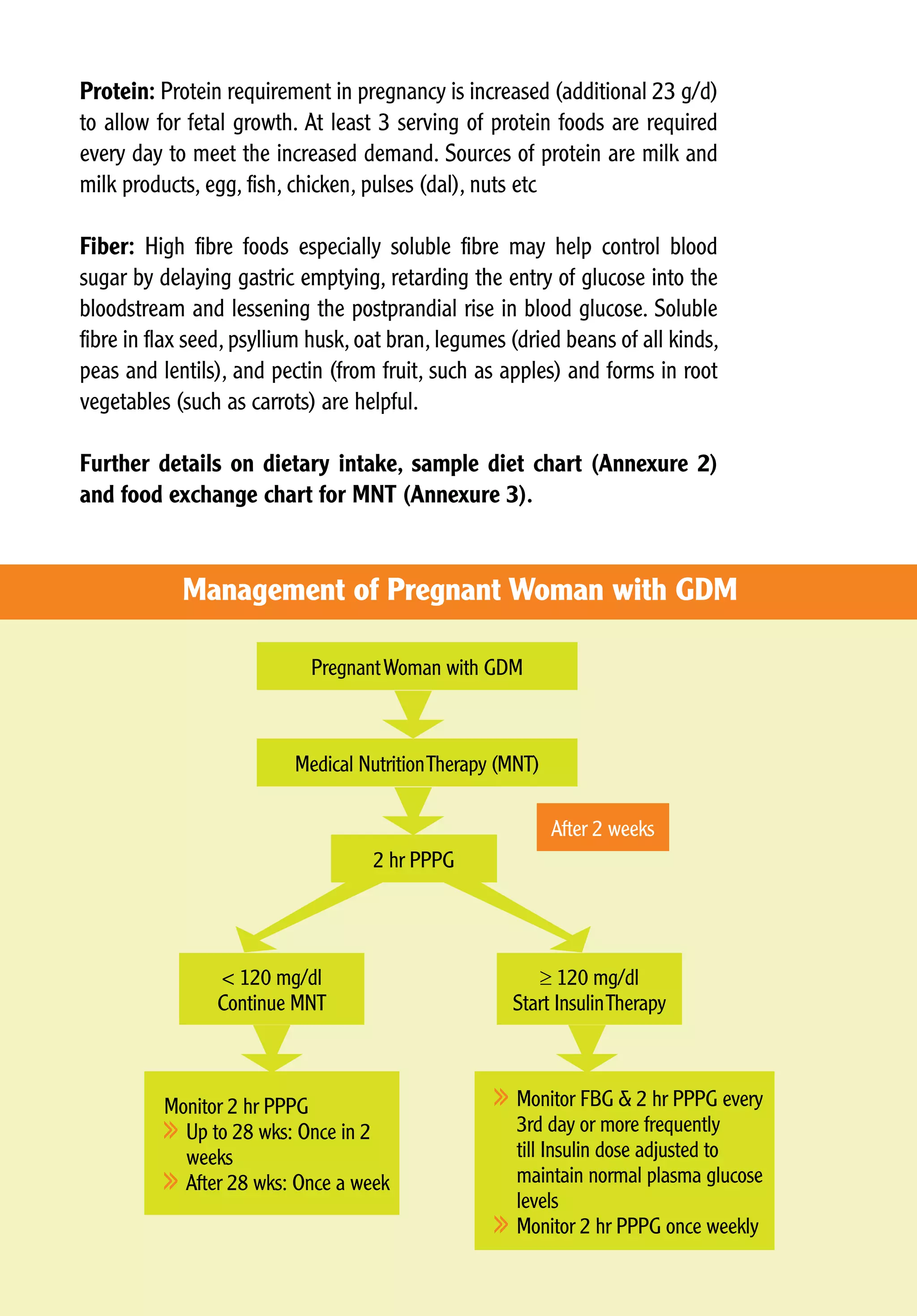
PregnantWoman with GDM
Medical NutritionTherapy (MNT)
Monitor 2 hr PPPG
	Up to 28 wks: Once in 2
weeks
	 After 28 wks: Once a week
	Monitor FBG  2 hr PPPG every
3rd day or more frequently
till Insulin dose adjusted to
maintain normal plasma glucose
levels
	Monitor 2 hr PPPG once weekly
 120 mg/dl
Continue MNT
≥ 120 mg/dl
Start InsulinTherapy
2 hr PPPG
After 2 weeks
Management of Pregnant Woman with GDM
14 National Guidelines for Diagnosis  Management
of Gestational Diabetes Mellitus
Medical Management (Insulin Therapy)
	 Insulin therapy is the accepted medical management of PW with GDM
not controlled on MNT in 2 weeks..
	 Oral tablets for diabetes treatment in pregnancy– not to be given as
they are not safe
	 All PW in whom MNT fails to achieve a 2 hr PPG 120 mg/dL are
started on insulin, along with MNT.
	 At PHC, MO should initiate treatment  refer PW with GDM to a
higher centre if plasma glucose levels are not controlled or there is
some other complication.
	 At CHC/DH/MC, a Specialist/Gynaecologist/Physician/MO can start
Insulin
	 Any PW on insulin therapy should be instructed to keep sugar/jaggery/
glucose powder handy at home to treat hypoglycemia if it occurs
Very high 2 hr PPPG:
	 If 2hr PPPG is 200mg/dL at diagnosis, starting dose of insulin
should be 8 units pre-mixed insulin.
	 The dose to be adjusted on follow-up and at the same time MNT has
to be followed. Frequency of monitoring to be decided by the treating
Physician/Gynaecologist/MO.
	 If PW requires more than 20 units insulin/day, she should be referred
to higher health-care centre.
	 The dose of insulin should be followed as per the flow chart given on
page 18.
15National Guidelines for Diagnosis  Management
of Gestational Diabetes Mellitus
Site of Insulin Injection:
	 Front/Lateral aspect of the thigh or over abdomen
	 Insulin injection is to be given subcutaneously only.
Insulin Injection Sites
Details of Insulin injection  Syringe
	 Only Injection Human premix insulin 30/70 is to be administered
	 Insulin syringe – 40 IU syringe is to be used
	 Insulin vial – 40 IU/mL is to be used
16 National Guidelines for Diagnosis  Management
of Gestational Diabetes Mellitus
Storage of insulin vial  syringe:
	 Insulin vials have to be made available along with disposable syringe
to the PW for use.
	 Appropriate arrangement should be made for storage of insulin in
refrigerators at 40
–80
C (in the door of the refrigerator) and battery
backup in areas with an erratic supply of electricity.Vial should never
be kept in freezer compartment of refrigerators. If by mistake, vials
are stored in freezer and frozen, they should be not be used at all and
discarded
	 At PHCs, stock of insulin vials should be stored in refrigerators.
	 Insulin vials should not be exposed to direct heat/sunlight, and are
stable up to 250
-300
C
	 Open insulin vials (in current use) should be stored in refrigerator or in
dark and cool place. If refrigerator is not available, the vial should be
kept in earthen pots filled in water or kept in cool place (near drinking
water storage).
	 Once opened, an insulin vial should be used within one month. If not
used within one month, it should not be used and discarded.
Insulin syringe
	 Single insulin syringe can be used safely for 14 injections if capped 
stored properly.
	 Before use, check syringe every time whether needle is straight or not
	 Never clean needle with spirit or any other disinfectant. It will make
needle blunt
	 Tip of needle should not come in contact with anything else except
cleaned skin
	 After use, place the cap over needle carefully without touching the tip
of needle
17National Guidelines for Diagnosis  Management
of Gestational Diabetes Mellitus
	 Syringe in use can be stored at room temperature without direct
exposure to sunlight or heat.There is no need to store in refrigerator.
	 Proper disposal of syringe should be taught to the PW.
Disposal of syringe
(i)	 Disposal of home used syringes:
	 Syringe with needle should be discarded if tip is blunt, bent, causing
pain or has been used for 14 injections.
	 This syringe should not be used by any other person or PW.
	 Recap syringe and place the entire syringe with needle in an opaque
plastic bottle with a screw cap or a plastic or metal box that closes
tightly. Carry it to hospital on next visit where it can be given to the
staff for disposal.
	 The disposal after recommended number of syringe use:
l	 At home, the used syringe should be either burnt or buried far
away from reach of children
l	 Or the PW should carry the used syringe to the health facility for
the waste management
	 Never throw used syringe in dustbin
(ii)	 Waste management including syringe disposal at health facility
Syringes causes the most injuries to the health care providers at all levels.
The following safety guideline should be followed when handling sharp
instruments such as needles and syringes:
	 Sharp instruments should never be passed from one hand to other
hand directly
	 After use, syringes should be decontaminated by flushing them with a
0.5% chlorine solution three times for ten minutes
18 National Guidelines for Diagnosis  Management
of Gestational Diabetes Mellitus
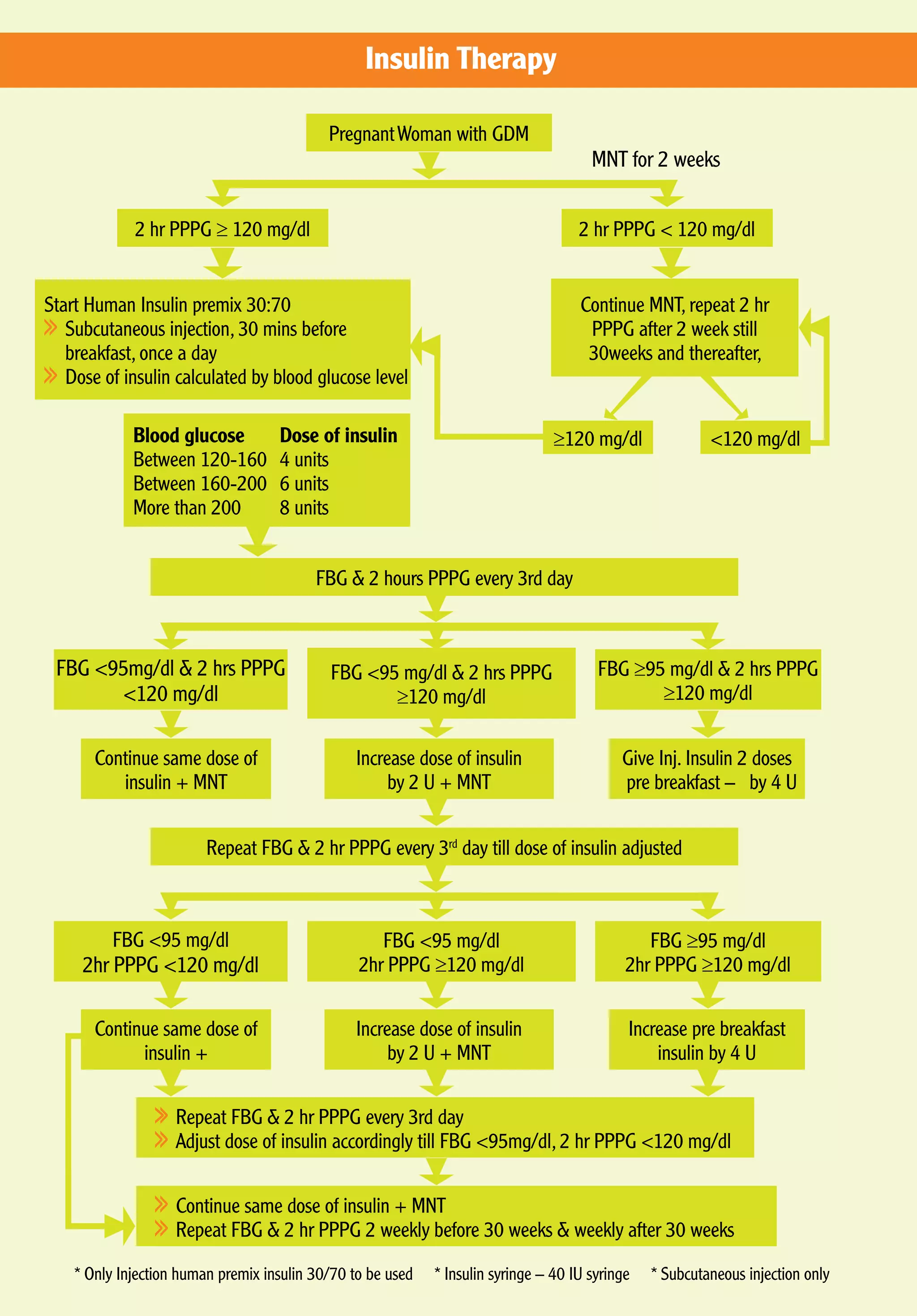
MNT for 2 weeks
PregnantWoman with GDM
2 hr PPPG ≥ 120 mg/dl 2 hr PPPG  120 mg/dl
Start Human Insulin premix 30:70
	Subcutaneous injection, 30 mins before
breakfast, once a day
	Dose of insulin calculated by blood glucose level
Continue MNT, repeat 2 hr
PPPG after 2 week still
30weeks and thereafter,
Blood glucose	 Dose of insulin
Between 120-160	 4 units
Between 160-200	 6 units
More than 200	 8 units
≥120 mg/dl 120 mg/dl
FBG  2 hours PPPG every 3rd day
Repeat FBG  2 hr PPPG every 3rd
day till dose of insulin adjusted
FBG 95mg/dl  2 hrs PPPG
120 mg/dl
FBG 95 mg/dl
2hr PPPG 120 mg/dl
FBG 95 mg/dl  2 hrs PPPG
≥120 mg/dl
FBG 95 mg/dl
2hr PPPG ≥120 mg/dl
FBG ≥95 mg/dl  2 hrs PPPG
≥120 mg/dl
FBG ≥95 mg/dl
2hr PPPG ≥120 mg/dl
Continue same dose of
insulin + MNT
Continue same dose of
insulin +
Increase dose of insulin
by 2 U + MNT
Increase dose of insulin
by 2 U + MNT
Give Inj. Insulin 2 doses
‐ pre breakfast – ↑ by 4 U
Increase pre breakfast
insulin by 4 U
	 Repeat FBG  2 hr PPPG every 3rd day
	 Adjust dose of insulin accordingly till FBG 95mg/dl, 2 hr PPPG 120 mg/dl
	 Continue same dose of insulin + MNT
	 Repeat FBG  2 hr PPPG 2 weekly before 30 weeks  weekly after 30 weeks
* Only Injection human premix insulin 30/70 to be used   * Insulin syringe – 40 IU syringe   * Subcutaneous injection only
Insulin Therapy
19National Guidelines for Diagnosis  Management
of Gestational Diabetes Mellitus
	 All syringes/needles should be handled properly and disposed in
puncture proof container
	 Needles should be destroyed immediately using hub-cutter
	 Sharps should be disposed immediately in a puncture resistant
container. Needles should not be recapped, bent or broken or
disassembled before disposal
	 The used needles/syringes once decontaminated and destroyed using
hub-cutter should be placed in the red bag and bag should be sealed
labelled and audited before disposal
	 All sharps including needles once processed as above should be
disposed of in the sharps pit located at the health facility
Refer to higher centre if one or more of the following conditions
are met:
	 Nausea  vomiting and not able to take food orally
	 Fasting blood glucose 200mg/dL with or without insulin
	 Fasting blood glucose 150 mg/dL or post breakfast250 mg/dL
even after giving insulin is uniformly required.
	 Total dose of insulin (combined morning and evening dose) on each
day exceeds 20 units
	 If pregnant women develops low blood glucose (hypoglycaemia) more
than once in a day.
	 If pregnant woman refuses to take insulin injection
20 National Guidelines for Diagnosis  Management
of Gestational Diabetes Mellitus
How to Recognise  Manage Hypoglycemia
w	 Any PW on insulin can develop hypoglycaemia at any time
w	 Hypoglycemia is diagnosed when blood glucose level is  70 mg/dl.
w	 Important to recognise symptoms of hypoglycaemia  treat immediately
How to recognise hypoglycaemia?
w	 Early symptoms - Tremors of hands,sweating,palpitations,hunger,easy fatigability,
headache, mood changes, irritability, low attentiveness, tingling sensation around
the mouth/lips or any other abnormal feeling
w	 Severe - Confusion, abnormal behaviour or both, visual disturbances, nervousness
or anxiety, abnormal behaviour.
w	 Uncommon - Seizures and loss of consciousness
How to manage hypoglycaemia?
w	 Ask PW to take 3TSF of glucose powder (15-20 grams) dissolved in a glass of water
w	 After taking oral glucose, she must take rest  avoid any physical activity
w	 15 minutes after taking glucose, she must eat one chapati with vegetable/rice/one
glass of milk/idli/fruits/anything eatable which is available
w	 If hypoglycemia continues, repeat same amount of glucose and wait
w	 If glucose is not available, take one of the following: Sugar - 6 TSF in a glass of
water/fruit juice/honey/anything which is sweet/any food
w	 Take rest, eat regularly and check blood glucose if possible
w	 If PW develops 1 episode of hypoglycemia in a day, she should consult any doctor
immediately
21National Guidelines for Diagnosis  Management
of Gestational Diabetes Mellitus
3.8 Special obstetric care for PW with GDM
Antenatal care
	 Antenatal care of a PW with GDM should be provided by gynaecologist
if available.
	 In cases diagnosed before 20 weeks of pregnancy, a fetal anatomical
survey by USG should be performed at 18-20 weeks.
	 For all pregnancies with GDM,a fetal growth scan should be performed
at 28-30 weeks gestation  repeated at 34-36 weeks gestation.There
should be at least 3 weeks gap between the two ultrasounds and it
should include fetal biometry  amniotic fluid estimation.
	 PW with GDM in whom blood glucose level is well controlled  there
are no complications, should go for routine antenatal care as per GoI
guidelines.
	 In PW with GDM having uncontrolled blood glucose level or any other
complication of pregnancy, the frequency of antenatal visits should be
increased to every 2 weeks in second trimester  every week in third
trimester.
	 Monitor for abnormal fetal growth (macrosomia/growth restriction)
and polyhydramnios at each ANC visit
	 PW with GDM to be diligently monitored for hypertension in pregnancy,
proteinuria and other obstetric complications
	 In PW with GDM between 24-34 weeks of gestation and requiring
early delivery, antenatal steroids should be given as per GoI guidelines
i.e. Inj. Dexamethasone 6 mg IM 12 hourly for 2 days. More vigilant
monitoring of blood glucose levels should be done for next 72 hours
following injection. In case of raised blood glucose levels during this
period, adjustment of insulin dose should be made accordingly.
22 National Guidelines for Diagnosis  Management
of Gestational Diabetes Mellitus
Fetal surveillance in PW with GDM:
	 PW with GDM are at an increased risk for fetal death in utero and this
risk is increased in PW requiring medical management. Hence vigilant
fetal surveillance is required.
	 Fetal heart should be monitored by auscultation on each antenatal visit.
PW should be explained about Daily Fetal Activity Assessment. One
simple method is to ask her to lie down on her side after a meal and
note how long it takes for the foetus to kick 10 times. If the foetus does
not kick 10 times within 2 hrs, she should immediately consult a health
care worker and if required should be referred to a higher centre for
further evaluation.
Labour  Delivery
	 PW with GDM with good control of Blood glucose (2 hr PPPG  120
mg/dl) levels may be delivered at their respective health facility.
	 PW with GDM on insulin therapy with uncontrolled blood glucose levels
(2 hr PPPG ≥120 mg/dl) or insulin requirement 20 U/day should be
referred for delivery at CEmOC centres under care of gynaecologist at
least a week before the planned delivery.
	 Such referred cases must get assured indoor admission or can be kept
in a birth waiting home with round the clock availability of medical
staff for monitoring.
	 Timing of delivery: GDM pregnancies are associated with delay in lung
maturity of the fetus; so routine delivery prior to 39 weeks is not
recommended.
	 If a PW with GDM with well controlled plasma glucose has not already
delivered spontaneously, induction of labour should be scheduled at or
after 39 weeks pregnancy.
23National Guidelines for Diagnosis  Management
of Gestational Diabetes Mellitus
	 In PW with GDM with poor plasma glucose control, those with risk
factors like hypertensive disorder of pregnancy, previous still birth 
other complications should be delivered earlier.The timing of delivery
should be individualised by the obstetrician accordingly.
	 Vaginal delivery should be preferred and LSCS should be done for
obstetric indications only.
	 In case of fetal macrosomia (estimated fetal weight  4 Kg)
consideration should be given for a primary cesarean section at 39
weeks to avoid shoulder dystocia.
Special precaution during labour
	 PW with GDM on Insulin require plasma glucose monitoring during
labour by a glucometer.
	 The morning dose of Insulin is withheld on the day of induction/labour
and the PW should be started on 2 hourly monitoring of plasma
glucose.
	 IV infusion with normal saline (NS) to be started  regular insulin to
be added according to blood glucose levels as per theTable below.
Blood glucose
level
Amount of Insulin
added in 500 ml NS
Rate of NS Infusion
90-120 mg/dl 0 100 ml/hr (16 drops/min)
120-140 mg/dl 4 U 100 ml/hr (16 drops/min)
140-180 mg/dl 6 U 100 ml/hr (16 drops/min)
180 mg/dl 8 U 100 ml/hr (16 drops/min)
24 National Guidelines for Diagnosis  Management
of Gestational Diabetes Mellitus
3.9 Immediate neonatal care for baby of mother
with GDM
	 All neonates should receive immediately essential newborn care with
emphasis with early breastfeeding to prevent hypoglycemia.
	 If required, the sick neonates should be immediately resuscitated as
per GoI guidelines.
	 Newborn should be monitored for hypoglycemia (capillary blood
glucose 44 mg/dl).Monitoring should be started at 1 hour of delivery
and continued every 4 hours (prior to next feed) till four stable glucose
values are obtained.
	 Neonate should be also be evaluated for other neonatal complications
like respiratory distress, convulsions, hyperbilirubinemia.
3.9.1 Hypoglycemia in a newborn with GDM mother
All babies born to mothers with GDM are at risk for development of
hypoglycemia irrespective of treatment whether they are on insulin or
not and should be observed closely. All babies of GDM mother should be
checked for hypoglycemia at or within one hour of delivery by glucoemeter.
Diagnosis of hypoglycemia
The operational definition cut off of plasma glucose by glucometer is 45
mg/dl. Any new-born with blood glucose lees than 45 mg/dL should be
considered as ‘baby with hypoglycemia’.
The glucometers are not very reliable for diagnosis of hypoglycemia
as their sensitivity decreases at lower blood glucose range. The most
definite diagnosis of hypoglycemia is by measurement of blood
glucose by established laboratory methods (glucose oxidase method by
25National Guidelines for Diagnosis  Management
of Gestational Diabetes Mellitus
calorimetric). In view of non-availability of laboratory facilities at all
places and time delay in getting result, plasma glucose values obtained
by glucometers will be considered for all operational steps. Where ever
lab facilities are available, treating physician can take a decision to
send a blood glucose sample to the lab without delaying next
management step.
Symptoms of hypoglycemia
Mostofthetime,new-bornbabymaynothaveanysymptomofhypoglycemia
at all. Symptoms of hypoglycemia are very variable and seen only in a
smaller proportion of patients. A physician should observe for following sign
in a new-born child for hypoglycemia:
	 Stupor or Apathy
	 Jitteriness or tremors
	 Episodes of cyanosis
	 Convulsions
	 Intermittent apnoeic spells or tachypnea
	 Weak and high pitched cry, limpness and lethargy
	 Difficulty in feeding
	 Eye rolling
	 Episodes of sweating
	 Any unexplained clinical feature in baby of diabetic mother
26 National Guidelines for Diagnosis  Management
of Gestational Diabetes Mellitus
Management of hypoglycemia
All cases of hypoglycemia should be managed in following manner:
Step 1:
Whenever there is suspicion of hypoglycemia BG should be checked
immediately with glucometer. In all babies born to diabetic mother,
BG should be checked by glucometer between 1-2 hours after birth.
Step 2:
If plasma glucose values is 45 mg/dl, this should be considered as
‘hypoglycemia’, move to next step
Step 3:
New-born with hypoglycemia – immediately ask mother to give breast
feed without any delay. Direct breast feeding is the best management
step for neonatal hypoglycemia.If the infant is unable to suck,expressed
breast milk from mother should be given.If mother is not in a position to
give breast feed or no breast milk secretion/production, baby should be
given any formula feed. One of the good options is to dissolve oneTSF
of table sugar in 100 ml of normal cow’s milk and give.
Step 4:
Once feed has been given, check blood glucose again after one hour.
If blood glucose is 45 mg/dl, 2 hourly feeding (breast feeding is the
best option but if not available, formula feed can be given) should be
ensured by explaining to mother/relatives and supervised.
Step 5:
If at any time plasma glucose by glucometer is 20 mg/dl, give
immediate intravenous bolus injection of 10% dextrose 2 ml/kg body
weight of baby.This should be followed by intravenous infusion of 10%
dextrose at a rate of 100 ml/kg/day.Blood glucose should be checked 30
minutes after starting the infusion. If it is still less than 20 mg/dl, infant
should be referred to higher centre where paediatrician is available.
Signs of danger: Refer to higher centre
If any of the following sign/reports are observed, infant should be referred to higher
centre with 10% dextrose IV infusion drip (100 ml/kg/day)
	 Two values of plasma glucose 20 mg/dL in spite of starting 10% dextrose
IV infusion
27National Guidelines for Diagnosis  Management
of Gestational Diabetes Mellitus
	 Occurrence of seizures
	 Baby is not able to suck at repeated attempts and blood glucose is
20 mg/dl
	 Failure to maintain IV line and blood glucose is 20 mg/dl
Procedure for capillary blood glucose testing
A blood sample obtained from a heel puncture is useful and simple way
of collecting blood sample from newborns and is recommended for blood
glucose testing.The procedure is not without risk and might cause increased
pain in newborns, local trauma, damage to nerves, blood vessels and bones,
excessive blood loss and infection. So, It should be performed by a trained
health care personnel, preferably by a paediatrician.
Preparation:
Gather the following equipments:
	 Gloves
	 Cotton wool
	 Capillary tube/and or blood bottle
	 Clean tray to hold equipments
	 Sharps disposal box
Procedure:
	 Wash hands and wear gloves
	 Select the heel site for puncture
	 The back of the heel should be avoided
	 The site chosen for the sampling should be free from previous injury
	 Ensure baby is lying in a safe and secure place
28 National Guidelines for Diagnosis  Management
of Gestational Diabetes Mellitus
	 Hold the baby’s heel
	 Hold the ankle with index and middle finger
	 Use other fingers to steady the baby’s leg
	 Partly encircle the baby’s heel with thumb
	 Clean the proposed puncture site with disinfectant
	 Allow the area to dry
	 Gently compress the heel and hold the skin under tension
	 Puncture the skin in a steady manner
	 Relax the tension and wipe away the initial blood flow with cotton
	 Whilst maintain the grip hold the heel so that blood is allowed to come out
	 Gently but firmly press the baby’s heel to form a large droplet of blood
	 Do not squeeze
	 Hold the capillary tube or blood bottle to the blood droplet and touch
	 Momentarily release the pressure to collect subsequent blood then
reapply pressure allowing the blood to flow
	 Continue until sufficient blood has been obtained
	 Once the sample has been obtained apply pressure to the site with
gauze, maintain the pressure until bleeding has stopped
	 Use the hypoallergenic tape
	 Baby should be kept comfortable and handed to mother
	 Equipments should be disposed
29National Guidelines for Diagnosis  Management
of Gestational Diabetes Mellitus
	 The staff doing the puncture should wash hands after the procedure
	 The sample should be sent for analysis as soon as possible.
3.10 Post-delivery follow up of PW with GDM
	 Immediate postpartum care women with GDM is not different from
women without GDM but these women are at high risk to developType
2 Diabetes mellitus in future.
	 Maternal glucose levels usually return to normal after delivery.
Nevertheless, a FPG  2 hr PPPG is performed on the 3rd day of
delivery at the place of delivery. For this reason, GDM cases are not
discharged after 48 hours unlike other normal PNC cases.
	 Subsequently, ANM to perform 75 g GTT at 6 weeks postpartum to
evaluate glycemic status of woman. Cut offs for normal blood glucose
values are:
l	 Fasting plasma glucose: ≥ 126 mg/dl
l	 75 g OGTT 2 hour plasma glucose
	 v  Normal:  140 mg/dl
	 v  IGT: 140-199mg/dl
	 v  Diabetes: ≥ 200 mg/dl
w	 Test normal:Woman is counselled about lifestyle modifications, weight
monitoring  exercise.
w	 Test positive:Woman advised to consult a physician.
w	 PW with GDM and their offsprings are at increased risk of developing
Type II Diabetes mellitus in later life.They should be counselled for
healthy lifestyle and behaviour, particularly role of diet  exercise.
w	 GDM should be a part of NCD programme.
30 National Guidelines for Diagnosis  Management
of Gestational Diabetes Mellitus
3.11 Pre-conception care  counselling
	 Woman with h/o GDM to be counselled about BMI  Plasma glucose
estimation before next pregnancy
	 Desired Plasma glucose levels:
	 l	FPG - 100 mg/dl
	 l	2 hr PPPG - 140 mg/dl
	 Appropriate antihypertensive to be started if needed
	 Counselled to consult Gynaecologist as soon as she misses her period
Counselling tips:
w	 Gestational diabetes mellitus (GDM) can be easily controlled by diet (MNT) and
exercise
w	 Only in few women in whom blood glucose is not controlled by diet, insulin injections
are required
w	 Insulin injections are required only during pregnancy. Insulin will be stopped in most
of the cases after pregnancy.
w	 GDM can not be treated with oral tablets as they may harm the fetus.
w	 If you are injecting insulin over abdomen, it can not reach your baby in any condition.
Injecting insulin over abdomen is 100% safe.
w	 Modification of diet is very easy and will not cost more. Sweets should be avoided at
all times during pregnancy
w	 If blood glucose is controlled, you and your baby both are safe and healthy
w	 If blood glucose is not properly monitored, it may harm to both you and baby
w	 If you are taking insulin, always keep glucose, sugar with you.
w	 Pregnant women with GDM should deliver at health facilities. It will help in
management of any complications which can be countered during delivery.
31National Guidelines for Diagnosis  Management
of Gestational Diabetes Mellitus
4. Operational aspects of GDM Programme
4.1 Role of Health personnel at different levels of
Health Facility
Village
l	 ASHA: To mobilise  counsel PW for timely testing  follow up
VHND
l	 ANM: Testing/MNT/Referral of cases needing medical
management
Level I: Sub-centre
l	 ANM: Testing/MNT/Referral of cases needing medical
management
l	 Maintaining records, monitoring  follow up
Level II: PHC/corresponding Urban centre
l	 MO/SN/ANM/LT: To undertake activities as per their training 
defined jobs
l	 Counselling  Testing/MNT/Delivery of uncomplicated 
controlled GDM cases/referral of uncontrolled  complicated
GDM cases to higher centre
l	 GDM controlled on MNT can be delivered by ANM/SN
l	 Medical management with Insulin  delivery of GDM controlled
on Insulin therapy should be undertaken by MOs
l	 GDM not controlled on Insulin therapy/GDM with complications
should be referred to higher facility for care by a specialist.
l	 Maintaining records, monitoring  follow up
32 National Guidelines for Diagnosis  Management
of Gestational Diabetes Mellitus
Level III
A) 	 DH  All CEmOC centres
	 v  All jobs as defined under Level II
	   +
	 v Specialist/Gynaecologist/MO: Management of all types of
GDM cases
B) 	 MC  other Super-speciality centres
	 v Comprehensive management of GDM including all referral
cases
Community linkages
w	 ASHA  ANM are the key persons connecting PW in community with health facilities
and therefore they have an important role in detection  follow up of GDM cases.
w	 Testing for GDM for all PW should be integral part of existing Antenatal care.
w	 GDM cases should be followed during ANC as per the advice of the treating doctor
 in the post natal period as defined under follow up protocol.
w	 In case of any complication or for delivery of PW with GDM, referral facility under
JSSK should be made available.
w	 ANM  outreach workers from sub centre/PHC should periodically visit all those
mothers on treatment for GDM in their area  ensure that PW with GDM follow the
advice of MNT and medical management.
w	 MO at PHC should make sure that periodic visits by the GDM mothers are done as
per schedule and there are no drop outs.
w	 In case GDM mothers are moving out of the area, a detailed report should be given
to her regarding the management plan for continuing care wherever she goes.
w	 She should be tracked through MCTS  the concerned District Programme Manager
should be informed by the treating doctor/designated officer about her migration
along with duly filled in Migration form.
33National Guidelines for Diagnosis  Management
of Gestational Diabetes Mellitus
4.2 Capacity building of Health personnel under
GDM programme
Activity General
orientation
about
Programme
including
awareness
 IEC
Counselling

Motivation
Knowledge
 Skills
forTesting
GDM
MNT Medical
Management
(Insulin
therapy)
Special
obstetric care
(antenatal/
intrapartum/
postpartum)
Maintaining
records 
Follow up
Health
personnel
ASHA √ √ √ √
ANM/SN/
LHV/LT/
√ √ √ √ √
MO √ √ √ √ √ √ √
Ob/Gyn 
Specialist
√ √ √ √ √ √ √
State/
District
Programme
Managers
 Facility
in-charges
√ √
4.3 Training
Training needs for different cadres
Cadre of health workers Type of training Content of training
ASHA w	General
orientation about
Programme
including
awareness  IEC
w	Maintaining
records  follow
up
w	 1st day orientation on GDM,
disease burden, consequences on
pregnant women and neonates
w	 Importance of healthy lifestyle
including diet in preventing diabetes
w	 Do’s and Don’ts for GDM
w	 Recognition of Hypoglycemia
w	 IEC materials on awareness
w	 Maintenance of records and
different reporting formats
34 National Guidelines for Diagnosis  Management
of Gestational Diabetes Mellitus
ANM/SN/LHV/LT/MO/
ObGyn/Programme
Manager
w	 All of the above
+
w	 Counselling 
Motivation
w	 Knowledge 
Skills forTesting
GDM
w	MNT
w	 2nd day orientation on
w	 Methodology of counselling
w	 Awareness  Counselling tips
w	 How to measure blood glucose
using a glucometer
w	 How to calibrate glucometer
w	 Diagnosis of GDM based on Blood
glucose values
w	 MNT: Calculation of caloric
requirement  planning a diet
accordingly
w	 Diet charts with locally available
foods
w	 How to administer Insulin injection:
Site  route of insulin injection
w	 Post-partum testing of glycemic
status of mother with GDM
MO  Ob/Gyn w	 All of the above
	+
w	Medical
Management
(Insulin therapy
w	 Special obstetric
care (antenatal/
intrapartum/
postpartum)
w	 3rd day orientation on
w	 Medical management:When 
how to initiate Insulin therapy,
titration of dose of Insulin
w	 Recognition  management of
Hypoglycemia
w	 Special obstetric care: Antepartum,
Intrapartum  postpartum
w	 Management of Neonate
w	 Identification of cases requiring
referral and referral protocols
Structure of Training for GDM Programme
	 A 3 days training will be organised for GDM programme in every
District
	 1st Day: All participants (Programme managers/ANM/SN/LHV/LT/
MO/ObGyn) will attend
	 2nd Day: Only ANM/SN/LHV/LT/MO/ObGyn will attend
35National Guidelines for Diagnosis  Management
of Gestational Diabetes Mellitus
	 3rd Day: Only MO/ObGyn will attend
	 ASHA: Will have separate batch  1 day training will be incorporated
either in their existing module or separate orientation at block level
can be organised.
Batch size
	 All delivery points in a District will be mapped
	 Health personnel of all delivery points need to be oriented/trained on
rotation basis
	 One batch can have 40-60 trainees from all cadres
	 After the 1st day of training, the number of participants will keep
reducing
	 One Batch ofTrainees will consist of
l	 Programme managers: 3-5
l	 ANM/SN/LHV: 20-25
l	 LT: 5-10
l	 MO/ObGyn: 10-15
	 Once delivery points are saturated, other health personnel involved in
antenatal care will be oriented
	 District Training In charge will accordingly prepare Training plan
 calendar
Training sites
Prerequisites:
	 Seminar/Conference Room with capacity of 50-60 participants
	 AV aids  otherTraining aids
	 Facility conducting about 500 deliveries per month
36 National Guidelines for Diagnosis  Management
of Gestational Diabetes Mellitus
	 At least 2 in-house Ob/Gyn  1 Physician/Endocrinologist
	 Availability of in house 1 Paediatrician, 1 counsellor  1 dietician is
preferred
	 Facility conducting comprehensive management of GDM including
both controlled  uncontrolled cases
	 Any Medical College/District Hospital having above prerequisites can
be chosen as aTraining site
Trainer
	 Ob/Gyn,Physician/Endocrinologist,Paediatrician,Counsellor,Dietician
to be included asTrainers as per their availability  area of expertise
	 1 dayTOT should be organised for 20-25Trainers at Medical College
level
Training material
	 GoI guidelines on GDM
	 Any other teaching or training material synchronised with GoI
guidelines
Training aids
	 Job aids/Posters/Handouts
	 Presentations
	 Video
	 Hands on workshop
37National Guidelines for Diagnosis  Management
of Gestational Diabetes Mellitus
5. Records  Registers
	 GDM reporting should be synchronised with MCTS/RCH portal for
reporting purpose
	 Health personnel at various levels should keep/maintain records as
defined under the programme for various levels as indicated below:
l	 Monthly GDM Reporting format for State  District Programme
managers (Annexure 4)
l	 Monthly GDM Reporting Format for Health Facility (Annexure 5)
l	 Migration form for PW with GDM (Annexure 6)
l	 Referral slip (Annexure 7)
	 Use of SMS and mobile phones may be promoted for collection of
information/data regarding GDM.
6. Monitoring and Quality Assurance
State  district Programme Managers to ensure
	 Constant supply of Insulin  its proper storage and distribution
	 Supply, maintenance  calibration of glucometers and glucometer
strips
	 Accreditation of training sites and timely completion of training
	 Periodic evaluation of technical skills of ANM/SN/LHV
	 Any maternal death if attributed to GDM should be specially mentioned
in Maternal Death Review (MDR reporting)
	 Include GDM in State IEC plans
	 GDM testing  care to be linked to the existing NCD programme
	 Reflecting adequate budget in PIP  ensuring timely release of funds
	 Monitoring the outcome  progress
38 National Guidelines for Diagnosis  Management
of Gestational Diabetes Mellitus
7. Outcome measures to be assessed
	 Number/Percentage of PW who tested positive for GDM out of total ANC
	 Number/Percentage of PW diagnosed as GDM in 1st trimester out of
total ANC
	 Number/Percentage of GDM women requiring Insulin out of total
diagnosed as GDM
	 Number/Percentage of GDM women requiring referral for further
management out of total diagnosed as GDM
8. Key points
w	 Universal testing of all PW for GDM
w	 Testing recommended twice in pregnancy at 1st
antenatal visit and then at 24-28
weeks of gestation.
w	 Single step 75 g 2 hr PPPG test performed.
w	 PW testing positive (2 hr PPPG  140mg/dl) should be started on MNT for 2 weeks
w	 If 2 hr PPPG ≥ 120 mg/dL after MNT, medical management (Insulin therapy) of PW
to be started as per guidelines.
w	 PW to be monitored by 2 hr PPPG throughout pregnancy as per guidelines.
w	 Antenatal visits 2 weekly in 2nd
trimester  weekly in third trimester
w	 PW with GDM on Insulin therapy with uncontrolled Blood glucose levels (2 hr PPPG
≥120 mg/dl) or insulin requirement 20 U/day should be referred for delivery at
CEmOC centres
w	 GDM pregnancies are associated with delay in lung maturity of the fetus; so routine
delivery prior to 39 weeks is not recommended.
39National Guidelines for Diagnosis  Management
of Gestational Diabetes Mellitus
w	 Early delivery with administration of prophylactic corticosteroid therapy for fetal lung
maturity to be planned only if uncontrolled plasma glucose or any other obstetric
indication
w	 Vaginal delivery preferred, LSCS for only obstetric indications or fetal macrosomia.
w	 Neonatal monitoring for hypoglycaemia and other complications
w	 Postpartum evaluation of glycemic status by a 75 g OGTT at 6 weeks after delivery.
9. Budget
	 Infrastructure: Not required
	 Human resource: No separate human resource required
	 Equipments/Instruments:
i.	 Plasma calibrated Glucometers
ii.	 Glucometer strips
iii.	Insulin syringe: 40 IU
	 Drugs:
i.	 Insulin: pre-mixed 30:70  regular
	 Stationery:
i.	 Monthly GDM Reporting format for State  District Programme
managers (Annexure 4)
ii.	 Monthly GDM Reporting Format for Health Facility (Annexure 5)
iii.	Migration form for PW with GDM (Annexure 6)
iv.	Referral slip (Annexure 7)
Case Load for GDM program:
a.	 Nearly 14% of ANC screened pregnant women may be tested positive
for GDM.
b.	 Around 3% of these women may need insulin therapy.
40 National Guidelines for Diagnosis  Management
of Gestational Diabetes Mellitus
Budget estimates and provision for following needs to be done by
the state/district programme officer:
1	 (a)	Insulin: Human Premix insulin 30/70
	 (b)	Insulin syringe
i.	 On an average one woman may need 5 units of insulin per day
and initial estimation for 180 days needs to be done.
ii.	 Thus one woman will need average 900 units of insulin during
her treatment of 180 days, this amount to an average 9 vials of
insulin per woman.
iii.	 One syringe can be used for 10 days.Thus each woman will need
18 insulin syringes during her treatment of 180 days.
2	 (a)	Glucometer
i.	 Availability of glucometer is to be ensured at all such centres
where GDM is being implemented
ii.	 Before procuring new equipment, availability of existing
glucometer through regular programme or under NCD needs to
be accounted for.
iii.	 No separate budget for sub centre may be required since untied
funds can be utilised for this
iv.	 Even at higher facility the untied funds can be utilised since the
cost of device is not high
v.	 MCH L2 level centres should have 2 glucometers. One to be kept
in Labour room and another in lab/ANC room for testing blood
sugar during ANC.
vi.	 MCH L3 level centres including Medical Colleges should have 3
glucometers. One to be kept in Labour room, another in lab/ANC
room for testing blood sugar during ANC. One standby glucometer
is suggested to be kept in the equipment store for use due to any
exigency like currently used glucometer becoming non-functional.
41National Guidelines for Diagnosis  Management
of Gestational Diabetes Mellitus
vii.	 Sub health centres (MCH L1) needs to have one Glucometer.
	 (b)	Testing strips for Glucometer	
i.	 It is estimated that each PW will be tested twice during the ANC
period for diagnosis of GDM.
ii.	 The PW on MNT will require Fasting and Post-Prandial Blood
sugar estimation every month.Thus each such PW will require 2
strips per month i.e 16 strips for the 6 months of treatment.
iii.	 The PW on Insulin will require Fasting and Post-Prandial Blood
sugar estimation every 15 days. Thus each PW will require 4
strips per month i.e 24 strips for the 6 months of treatment.
iv.	 Strips can be purchased either from state/regular PIP budget or
JSSK diagnostic funds
3.	 Glucose pouch
i.	 Ideally state should procure 75 gm glucose pouch
ii.	 It is estimated that each PW will be tested twice during the ANC
period for diagnosis of GDM.
iii.	 The PW on Insulin will require Fasting and Post Prandial Blood
sugar estimation every 15 days. Thus each PW will require 4
glucose pouch per month, i.e. 24 glucose pouch for the 6 months
of treatment.
4. 	 Training:
i.	 A 3 days training will be organised for GDM programme in every
District
ii.	 1st Day: All participants (Programme managers/ANM/SN/LHV/
LT/MO/ObGyn) will attend
iii.	2nd Day: Only ANM/SN/LHV/LT/MO/ObGyn will attend
iv.	3rd Day: Only MO/ObGyn will attend
42 National Guidelines for Diagnosis  Management
of Gestational Diabetes Mellitus
Budget for 3 days training of District level officers for GDM, Batch size of 50
Sr.
No
Head Unit Cost Number of
Participants
Days Total
1 DA to district level Programme
officers
Rs. 700/day 10 1 Rs. 7,000/-
2 DA to Staff Nurses/ANM/LHV Rs. 400/day 25 2 Rs. 20,000/-
3 DA to Medical Officers/ObGy Rs. 700/day 15 3 Rs. 31,500/-
4. Lunch Tea Day 1 Rs. 200/day 50 1 Rs.10,000/-
5 Lunch Tea Day 2 Rs. 200/day 45 1 Rs. 9,000/-
6 Lunch Tea Day 3 Rs. 200/day 20 1 Rs. 4,000/-
7 Honorarium to district and
Sub-district level guest
faculty**
Rs. 600/
(per day)
2 3 Rs. 3,600/-
8 Honorarium to State level
faculty
Rs. 1000/day 2 3 Rs. 6,000/-
9 Accommodation for State level
faculty (as per actual, if Govt.
accommodation not available,
receipts to be produced)
Rs. 2000/day 2 3 Rs. 12,000/-
10 Logistic expenses like study
material, course material,
photocopying, job aids, flip
chart, AudioVisuals etc. ( Rate
x number of participants)
200 50 - Rs. 10,000/-
SubTotal Rs. 1,13,100/-
11 Incidental overhead ( 10% of
sub-total)
Rs. 11,310/-
Total for One batch Rs. 124,410/-
Note: ***TA to be given as per state Norms.
*The state need to adjust the training norms as per the training load of the district and state.
43National Guidelines for Diagnosis  Management
of Gestational Diabetes Mellitus
Note:
Every district programme officer needs to undertake advanced planning and
budget estimates for universal screening of GDM in the district
State programme officer needs to reflect the budgetary requirement either
in the state/NHM PIP
Necessary equipments/supplies either cash or in kind needs to be made
available in advance to all the health facilities in the district.
Similarly training institutes also needs to be provided the training budget as
per the estimates in advance
Any procurement should be done through competitive and transparent
bidding.
Certification of manufacturer for meeting the requirement of specifications
and variations, if any by comparing the results from a regularly calibrated
auto analyser for precision and accuracy needs to be clearly mentioned for
glucometer supplied
Process of calibration and standardisation of glucometer also needs to be
mentioned in manufacturer certificate
Wherever applicable AMC should be in built against all major procurements
45National Guidelines for Diagnosis  Management
of Gestational Diabetes Mellitus
Annexures
Annexure 1:  BMI Chart (Ideal height weight chart)	 47
Annexure 2:  MNT  Sample diet chart 	 48
Annexure 3:  Food exchange list	 56
Annexure 4: Monthly GDM Reporting format for State
 District Programme managers	 59
Annexure 5: Monthly GDM Reporting Format for
Health Facility 	 60
Annexure 6:  Migration form	 61
Annexure 7:  Referral Slip	 62
Annexure 8:  Glucometer Specification	 64
Annexure 9:  Glucometer Calibration 	 66
47National Guidelines for Diagnosis  Management
of Gestational Diabetes Mellitus
10. Annexures
Annexure 1: BMI Chart (Ideal height weight chart)
48 National Guidelines for Diagnosis  Management
of Gestational Diabetes Mellitus
Annexure 2: MNT  Sample diet chart
The meal plan composition:
	 The recommended composition of the GDM mother diet is~50%-
60% calories from carbohydrate, 10-20% from protein, 25-30%
from fat.
	 The distribution of calories, particularly carbohydrate, makes a
difference in the postprandial blood sugars. The total intake of
carbohydrate should be controlled and monitored and carbohydrate
foods with a lower glycemic index should be emphasised.
Important tips for planning meals for GDM mother
	 A mother should follow discipline regarding meal timings. Eating
heavy at one meal or skipping any meal or fasting for long hours
should be avoided. She should include all food groups in her daily diet
i.e cereal, pulses, milk and milk products, fruits, vegetable, and fats.
For non- vegetarian mothers eggs, low fat meat like well- cooked fish
or chicken can be included. Meal plan should be divided in to 3 major
meals (breakfast, lunch and dinner) and 2-3 mid-day snack.
Breakfast
	 A pregnant woman should start her day with a healthy breakfast.
She should never skip her breakfast. Breakfast should consist of 1-2
carbohydrate servings (like chapati/dalia/sandwich/poha/idli etc) as
mentioned in exchange list along with one serving from protein rich
foods (like milk/curd/paneer/egg etc.)
Lunch/dinner
	 In lunch and dinner the thali/plate can be divided in two halves
	 Fill the first ½ with vegetables like bottle gourd, ridge gourd, lettuce,
broccoli, spinach, carrots, green beans, tomatoes, celery, cabbage,
49National Guidelines for Diagnosis  Management
of Gestational Diabetes Mellitus
mushrooms etc. as vegetable provide fibre which helps in controlling
post prandial glucose level.
	 The remaining half should be divided into two equal ¼th
parts.
	 The ¼ portion of the plate can be filled with protein rich food like dal,
soy nuggets, tofu, eggs, paneer, chicken, fish etc
	 The remaining ¼ can be filled with chapati, brown rice, bread,
cereals etc.
	 Mother should have at least 1 serving of low fat, sugar-free yoghurt,
curd or milk.
	 It is also important for a mother to have at least 1 serving of fruits like
guava, apple, berries or any citrus fruits.
Composition of lunch and dinner thali
Half portion of thali should contain
vegetables (cooked as well as in
form of salad)
One fourth of thali should
contain protein rich foods
One serving of
fruit
One serving
of dairy
product
One fourth of thali
should contain cereals
Fruit
Vegetable
Dairy
Bread/Starch/Grain Meat/Protein
50 National Guidelines for Diagnosis  Management
of Gestational Diabetes Mellitus
	 Carbohydrate serving in lunch and dinner should be between 2 to 3.
Taking heavy meals should be avoided.
	 Skipping lunch and dinner and taking meal at irregular time should be
avoided.
Mid day snack
	 Along with major meals a pregnant woman should consume at least
2-3 healthy mid-day snacks.
	 One to two carbohydrate serving can be taken in mid-day snack.
	 A mother should maintain 2-3 hour gap with major meal when taking
mid-day snack.
	 Eating fried foods or junk foods or food with high amount of free
sugars should be avoided.
	 Some options for snack could be murmura chat, sprouts, vegetable
dalia, vegetable poha, idli, vegetable uttapam, besan chilla with low
amount of oil etc.
General tips
	 Fried foods should be avoided rather mother should steam, boil or
sauté food in a non-stick pan.
	 Whole fruits should be preferred over juices
	 Prefer fish or chicken over red or organ meat.
	 Fiber should be increased in the diet by including salad, beans, non-
starchy vegetables, whole fruit, whole grain cereals, whole pulses.
	 A mother should drink water, buttermilk, soups, soy milk and other
unsweetened healthy beverages instead of soda or fruit juices.
51National Guidelines for Diagnosis  Management
of Gestational Diabetes Mellitus
Sample Meal plan
Sample meal pattern for pregnant woman are planned using cup measures.
1 cup measure and equivalents are as follows
1cup= 240 ml (8 oz or 227 gm) = 16 table spoon=48 tea spoon
½ cup= 120 ml (4oz or 113 gm) =8 table spoon=24 tea spoon
1/3 cup= 80 ml (2.6 oz. or 76 gm) =5 table spoon= 16 tea spoon
¼ cup=60 ml (2 oz. or 57 gm) = 4 table spoon= 12 tea spoon
1 table spoon = 3 tea spoon
1 tea spoon = 5ml
52 National Guidelines for Diagnosis  Management
of Gestational Diabetes Mellitus
1800 Calories sample meal plan for GDM
Meal Menu Amount Number of carbohydrate
serves as per exchange list
Breakfast
(7-8 am)
Dalia/Porridge/Oats
Milk
½ cup
1 cup
2
Other varieties can be
included in meal plan as
per the exchange list
Mid- Morning
(10-10.30 am)
Mung bean sprouts (ankurit
mung)/Roasted Mung
½ cup 1
Lunch
(1-1.30 pm)
Chapati
Or chapati + Rice
2
1+1/3 cup
2-3
Vegetables 1 cup
Yogurt/Curd ¾ cup
Soya nugget (soya badi)
curry/Dal
½ cup
Evening
(4.30-5 pm)
Seasonal fruit (medium size) 1 1-2
Murmura chat with
vegetables/idli with sambhar
1 ½ cup/1
Dinner
(8-8.30 pm)
Chapati
Or
chapati + Rice
2
1+ 1/3 cup
2-3
Vegetable 1 cup
Dal
Or
Fish (curry/grilled/steamed)
½ cup
½ cup
Bed time
(10-10.30 pm)
Milk 1 cup 1
Brown bread 1
Total fat/d 4 tsp/d
* Meal plan containing 1800 k.cal approximately provides 70 gm protein, 60 gm fat and 247 gm carbohydrate
53National Guidelines for Diagnosis  Management
of Gestational Diabetes Mellitus
2000 Calories sample meal plan for GDM
Meal Menu Amount Number of
carbohydrate
serves as per
exchange list
Breakfast
(7-8 am)
Whole grain Bread (Brown Bread)
Egg bhurji/egg omelet
2
1
2
Mid- Morning
(10-10.30 am)
Vegetable Dalia ½ cup 1
Lunch
(1-1.30 pm)
Chapati
Or
chapati + Rice
3
2+1/3 cup
3-4
Vegetables 1 cup
Yogurt/Curd ¾ cup
Soya nugget curry/Dal
Or
Chicken/fish curry
½ cup
1 cup
Evening
(4.30-5 pm)
Seasonal fruit (medium size) 1 1-2
Vegetable Poha/vegetable upma ½ cup
Dinner
(8-8.30 pm)
Chapati
Or
chapati + Rice
2
1+ 1/3 cup
2-3
Vegetable 1 cup
Dal ½ cup
Bed time
(10-10.30 pm)
Milk 1 cup 1
Chapati 1
Total fat/d 5 tsp/d
* Meal plan containing 2000 k.cal approximately provides 80 gm protein, 65 gm fat and 270 gm carbohydrate
54 National Guidelines for Diagnosis  Management
of Gestational Diabetes Mellitus
2200 Calories sample meal plan for GDM
Meal Menu Amount Number of carbohydrate
serves as per exchange list
Breakfast
(7-8 am)
Veg uttapam/Besan chilla
with green chutney
Veg Raita
2
1 cup
2
Mid- Morning
(10-10.30 am)
Vegetable sandwich
(whole grain bread)
½ 1
Lunch
(1-1.30 pm)
Chapati
Or chapati + Rice
3
2+1/3 cup
3-4
Vegetables 1 cup
Yogurt/Curd ¾ cup
Soya nugget curry/Dal
Or
Chicken curry
½ cup
1 cup
Evening
(4.30-5 pm)
Seasonal fruit
(medium size)
1 1-2
Thepla 2
Dinner
(8-8.30 pm)
Chapati
or
Or chapati + Rice
3
2+ 1/3 cup
3-4
Vegetable 1 cup
Dal
Or
Fish (curry/grilled/steamed)
½ cup
½ cup
Bed time
(10-10.30 pm)
Milk 1 cup 1
Whole grain biscuits
(sugar free)
3
Total fat/d 6tsp/d
*Meal plan containing 2200 k.cal approximately provides 85 gm protein,70 gm fat and 300 gm carbohydrate
55National Guidelines for Diagnosis  Management
of Gestational Diabetes Mellitus
2400 Calories sample meal plan for GDM
Meal Menu Amount Number of carbohydrate
serves as per exchange list
Breakfast
(7-8 am)
Vegetable stuffed chapati
(sabjiyo bhari roti) Curd/
Raita
3
1 cup
3
Mid- Morning
(10-10.30 am)
Vegetable poha ½ cup 1
Lunch
(1-1.30 pm)
Chapati
Or chapati + Rice
3
2+1/3 cup
3-4
Vegetables 1 cup
Yogurt/Curd ¾ cup
Soya nugget curry/Dal
Or
Chicken curry
½ cup
1 cup
Evening
(4.30-5 pm)
Seasonal fruit
(medium size)
1 2
Idli
With green chutney
2
As desired
Dinner
(8-8.30 pm)
Chapati
or chapati + Rice
3
2+ 1/3 cup
3-4
Vegetable 1 cup
Dal
Or
Fish (curry/grilled/
steamed)
½ cup
½ cup
Bed time
(10-10.30 pm)
Milk 1 cup 1
1
Total fat/d 7tsp/d
*Meal plan containing 2400 k.cal approximately provides 90 gm protein,75 gm fat and 330 gm carbohydrate
**Any food item in above mentioned meals can be substituted with other food item as per the amount mentioned in the exchange list
56 National Guidelines for Diagnosis  Management
of Gestational Diabetes Mellitus
Annexure 3: Food exchange list
Food Exchange list
Carbohydrate food exchange list is a comprehensive guide to make you understand amount of
particularfoodtobetakeninplaceofotherfoodwithoutaffectingthetotalamountofcarbohydrate.
For example – if you are taking one cup of rice (cooked) and want to change with idli, as per
list, one third cup of white rice will be equal to one three inch round idli or 1 chapati.
Food Groups Food Portion
Carbohydrate Exchange
Serving
Choose any serving of the
food mentioned here,each
serving will provide –
80 calories
3 gm protein
0-1 gm fat
Bread
Idli plain
Naan
Plain dosa
Rice white or brown, cooked
Roti (bajra, corn, juwar)
Murmura (puffed rice)
Millet, cooked
Museli
Oats, cooked
Pasta, cooked
Puffed cereal
Pop-corn (no fat)
Biscuit (2 ½’’ across)
Chowmein noodles
Muffin, small
Popcorn, microwave
Dhokla
Poha
Starchy vegetables:
Potato , baked or boiled
Potato mashed
Yam, sweet potato, plain
1 slice (1oz)
3”round
¼ of 8”x2”
1
1/3 cup
½ (6”)
1 ½ cup
1/3 cup
¼ cup
½ cup
½ cup
1 ½ cup
3 cups
1
½ cup
1 (1 ½ oz)
3 cups
1“square
1 cup
½ cup
½ cup
1 small
½ cup
½ cup
57National Guidelines for Diagnosis  Management
of Gestational Diabetes Mellitus
Fruit Exchange Serving
Choose any serving of the
fruits mentioned here,
each serving will provide –
60 calories
15 grams carbohydrate
Apple, small, unpeeled
Apricots, fresh
Blueberries
Dates
Grapes , small
Guava, medium
Mango, small
Orange, small
Papaya cubes
Peaches, medium, fresh
Pear, large, fresh
Pineapple, fresh
Plums, small
Sapota, (chikoo)
Seetaphal
Strawberries whole
Watermelon, 1 slice
Grapes, small
Guava, medium
Mango, small
Orange small
Papaya, cubes
Kiwi, medium
1 (4 oz)
4 whole
¾ cup
3
17 (3 oz)
1 ½
½ cup
1
1 cup
1 (6 oz)
½
¾ cup
2
1 med
1 med
1 ¼ cup
1 ¼ cup
17 (3oz)
1 ½
½
1
1 cup
1
58 National Guidelines for Diagnosis  Management
of Gestational Diabetes Mellitus
Vegetable Exchange
Serving
1 serving = ½ cup cooked
(100 gms) or 1 cup raw
vegetables .
Choose any serving of the
food mentioned here, each
serving will provide-
25 calories
5 gms carbohydrate
2 gms protein
0 gm fat
Beans (green, wax, italian)
Bean sprouts (moong)
Beets (chakunder)
Bottle gourd (lauki)
Broad beans (papdi)
Broccoli
Brussels sprouts
Cabbage
Carrots
Cauliflower
Cluster beans (guvar)
Cucumber
Drumsticks (surgavo)
Eggplant (brinjal)
Fenugreek leaves
Green onion
Green papaya
Onion
Parwal
Radish
Ridge gourd (torai or turia)
Salad greens
Spinach (palak)
Tomatoes fresh
Zucchini
Milk Exchange Serving
Choose any serving of the
food mentioned here, each
serving will provide –
25 calories
12 gms carbohydrate
8 gms protein
Skim and very low fat
milk (1-3gm fat)
Skimmed milk
Non fat buttermilk
Plain non fat yogurt
Paneer, 1% milk
Masala tea , with 1% milk
Whole milk (8 gm fat)
Whole milk
Goat’s milk
Lassi, regular
1 cup
1 cup
¾ cup
1 cup
1 cup
1 cup
1 cup
1 cup
1 cup
59National Guidelines for Diagnosis  Management
of Gestational Diabetes Mellitus
Annexure 4: Monthly GDM Reporting format for
State  District Programme managers
Monthly GDM Reporting format for State  District
Programme managers for month of …………………,
year………………
Name of State:			 Name of District:
Estimated no of PregnantWomen:
Estimated no of deliveries:
Total no of ANC conducted (including all 4 ANC visits) in reporting month:
No of new GDM cases diagnosed in the reporting month:
No of GDM cases diagnosed in 1st
trimester in reporting month:
No of new GDM cases on treatment in the reporting month:	
No of new GDM cases started on Insulin therapy in the reporting month:
Cumulative no of GDM cases on Insulin therapy in the reporting month:
Supplies (Insulin  Glucometer) available in all districts-Yes/No
If No, identify district  reflect requirement in PIP
Note:
Districts will report to their States
Information will be compiled at State level for sending information to GoI
60 National Guidelines for Diagnosis  Management
of Gestational Diabetes Mellitus
Annexure 5: Monthly GDM Reporting Format for
Health Facility
Monthly GDM Reporting Format for Health Facility
Name of the Health facility: …………………… Month: ……Year:……
Name of State:			 Name of District:
Total no of deliveries:
Total no of ANC conducted (including all 4 ANC visits) in reporting month:
No of new GDM cases diagnosed in the reporting month:
No of GDM cases diagnosed in 1st
trimester in reporting month:
No of new GDM cases on treatment in the reporting month:	
No of new GDM cases started on Insulin therapy in the reporting month:
Cumulative no of GDM cases on Insulin therapy in the reporting month:
No of GDM cases referred for management to higher facility:
Whether adequate supplies (Insulin  Glucometer) were available throughout
the month at reporting facility-Yes/No
If No, indicate requirement:
Note:
Facility will send report to the District
Information will be compiled at District level for sending information to State
61National Guidelines for Diagnosis  Management
of Gestational Diabetes Mellitus
Annexure 6: Migration form
Migration form for PW with GDM
Name:
Husband’s/Father’s Name:
Present Address:
Health Facility attended:
Migration Address:
Address of Health Facility to be attended:
Diagnosis of GDM: 	Date		 Period of gestation: 	 weeks
Treatment given:
Information about migration given to:
Name:
Designation:
Mobile no/Telephone no:
Place of work:
Signature of Doctor
62 National Guidelines for Diagnosis  Management
of Gestational Diabetes Mellitus
Annexure 7: Referral Slip
Referral Slip
Name of referring facility:
Address:						Telephone:
Name of the patient________________________________________________
Father’s/Husband’s Name: _____________________ Contact no______________
Address: ____________________________
Referred on ____/____/____ (d/m/yr) at _____________Time ______________
__________________________________ (Name of the facility) for management.
Provisional Diagnosis:
Admitted in the referring facility on ___/___/___ (d/m/yr) at ________ (time) with
chief
Complaints of: ___________________________________________________
Summary of management:
Blood group:			Hb:
Value of last Blood sugar measure
63National Guidelines for Diagnosis  Management
of Gestational Diabetes Mellitus
Other investigations
Procedures and critical interventions carried out
Treatment given
Dose of insulin…………………… Duration
Condition at time of referral:
Consciousness:Temp: 			Pulse: 			BP:
Reason for referral:
Mode of transport for referral: Govt./PPP/Vehicle arranged by patient/any other:
Telephonic information on referral provided to the institution referred to:
Name of the person spoken to_________________________________________
Signature of referring physician/Health functionary
(Name/Designation/Stamp):
64 National Guidelines for Diagnosis  Management
of Gestational Diabetes Mellitus
Annexure 8: Glucometer Specification
Glucometer specification
Construction - Hand-held
Blood volume – should be 1μL
Sample of blood used - Fresh whole blood		
Measuring time – should be less than 10 seconds
Reported result range 20–600 mg/dL
Unit of measure - mg/dL
Haematocrit - 30–55%
Assay method - Glucose oxidase biosensor
Should be able to work at high altitude up to 10,000 feet
Test strip storage conditions - 2°C to 35°C
Meter storage temperature range -25°C to 70ºC
System operating conditions - 5°C to 45ºC
Relative humidity operating range - 10% to 90%	
Memory capacity of glucometer - 500 blood glucose results with time and date	
Automatic power off
65National Guidelines for Diagnosis  Management
of Gestational Diabetes Mellitus
Power supply - One replaceable battery
Calibration – should be plasma-equivalent
Calibration – calibration strips/fluid should be provided along with it.
Automatic shutoff 2 minutes after last action
66 National Guidelines for Diagnosis  Management
of Gestational Diabetes Mellitus
Annexure 9: Glucometer Calibration
What is glucometer calibration?
	 Calibration means checking accuracy and correctness of glucometer
	 It should be done regularly to check correctness of glucometer
Why we need to do calibration of glucometer?
	 Glucometer needs to be calibrated regularly to get accurate results
What will happen if we do not calibrate regularly?
	 It may give incorrect reports which may be higher or lower than actual
blood glucose report
How frequently glucometer should be calibrated?
	 After every 20 measurements of blood glucose
	 A new vial of test strips is used
	 Whenever the machine is dropped
What to do if glucometer calibration shows out of range result?
	 It should not be used for testing
	 It should be sent back to manufacturers for calibration corrections
How to do calibration?
	 It is carried out by calibration strip or calibration fluid
	 It will be demonstrated during training of glucometer
Who will do calibration?
	 Calibration is very simple and can be done by the person who is using it
67National Guidelines for Diagnosis  Management
of Gestational Diabetes Mellitus
11. Bibliography
1.	 Colagiuri, S., Sandbaek, A., Carstensen, B., Christensen, J., Glumert,
C., Lauritzen,  Borch-Johnsen, K.B. (2003). Comparability of venous
and capillary glucose measurements in blood. Diabetic Medicine, 20,
953-956.
2.	 Farrar D, Duley L, and Lawlor D. (2011). Different strategies for
diagnosing gestational diabetes to improve maternal and infant
health. Cochrane Database of Systematic Reviews (10).
3.	 Harlting L, Dryden D, Guthrie A, Muise M, Vandermeer B, Aktary
W, and Donovan L. (2012). Screening and Diagnosing Gestational
Diabetes Mellitus: Evidence Report/Technology Assessment. Agency
for Healthcare Research and Quality: U.S. Department of Health and
Human Services. Number 210.
4.	 International Diabetes Federation. (2012). IDF Diabetes Atlas, South-
east Asia. Retrieved from: http://www.idf.org/diabetesatlas/5e/south-
east-asia
5.	 Jiwani A, Marseille E, Lohse N, Damm P, Hod M, and Kahn J. (2012).
Gestational diabetes mellitus: Results from a survey of country
prevalence and practices. Journal of Maternal-Fetal  Neonatal
Medicine 25(6): 600-610.
6.	 Khan KS,Wojdlya D, Say L, Gulmezoglu AM, andVan Look PF. (2006).
WHO analysis of causes of maternal death: A systematic review.
Lancet 367 (9516): 1066-1074.
7.	 Priya, M. Anhan, R., Pradeepa, R., Jayashuri, R., Deepa, M., Bhansali,
A.  Mohan, V. (2011) Comparison of Capilary Whole Blood Versus
Venous Plasma Glucose Estimations in Screening for Diabetes
Mellitus in Epidemiological Studies in Developing Countries. Diabetes
Technology Therapeutics, 13, 586-591.
68 National Guidelines for Diagnosis  Management
of Gestational Diabetes Mellitus
8.	 SeshiahV, BalajiV,Vitull G, and Anil K. (2012). Gestational diabetes:
The public health relevance and approach. Diabetes Research and
Clinical Practice 97: 350-358.
9.	 SeshiahV, BalajiV, Balaji MS, Paneerselvam A, and Kapur A. (2009).
Pregnancy and diabetes scenario around the world: India.International
Journal of Gynecology  Obstetrics 104 (Suppl. 1): S35-38.
10.	 Seshiah V, Balaji V, Balaji M, Sanjeevi C, and Green A. (2004).
Gestational diabetes mellitus in India. Journal of the Association of
Physicians in India 52: 707-71 1.
11.	 Crowther CA, Hiller JE, Moss JR, et al. (2005). Effects of treatment of
gestational diabetes mellitus on pregnancy outcomes. N EnglJ Med
352: 2477-2486
12.	 Langer O. (1998). Maternal glycemic criteria for insulin therapy in
gestational diabetes mellitus. Diabetes Care 21 (Suppl 2): B91.
13.	 Mangesi L and Hofmeyr GJ. (2007). Fetal movement counting for
assessment of fetal well-being. Cochrane Database Syst Rev ():
CD004909.
14.	 McFarland MB, Langer O, Conway DL, et al. (2005). Dietary therapy
for gestational diabetes: How long is long enough? Obstet Gynecol 93:
978.
15.	 MooreTR and Catalano P. Diabetes in Pregnancy in Creasy RK, Resnik
R, et al. Maternal-Fetal Medicine: Principles and Practice, 6th edition.
Elsevier, Inc.2009 Chapter 46, pp. 953-993.
16.	 World Health Organization (WHO). (2003). Diet, Nutrition and the
Prevention of Chronic Diseases.Technical Report Series 916.
17.	 Gabrilla Pridjian. Pregestational Diabetes in Obs  Gynae Clinics of
North America (Update on Medical Disorders in pregnancy), June 2010,
Vol 37. (No.2) Publishers- Saunders  Elsevier Inc Pg-143-158.
69National Guidelines for Diagnosis  Management
of Gestational Diabetes Mellitus
18.	 Gabrilla Pridjian, Tara D Benjamine. Gestational Diabetes in Obs
 Gynae Clinics of North America (Update on Medical Disorders in
pregnancy),June 2010,Vol 37.(No.2) Publishers- Saunders  Elsevier
Inc, Pg-257-267.
19.	 Lisa Nainggolon, ACOG New Practice bulletin on gestational Diabetes.
Obstetrics Gynaecology 2013; 122; Pg 406-416
20.	 Diagnostic Criteria  Classification of Hyperglycemia first detected in
pregnancy.World Health Organization (2013)
21.	 Berger H, Crane J, Faisal D etal Screening for gestational Diabetes
mellitus. SOGC Clinical Practice Guidelines No.12, Nov 2002
22.	 Nankervis A, Mc Intyre HD, Moses R etal ADIPS consensus guidelines
for theTesting  Diagnosis of Gestational Diabetes Mellitus in Austria.
2013
23.	HAPO Collaboration Research Group Hyperglycemia  adverse
pregnancy outcomes. NEJM 2008;358: 1991-2002
24.	IADPSG consensus panel International association of diabetes
 pregnancy study groups recommendations on the diagnosis
 classification of hyperglycemia in pregnancy. Diabetes care
2010;33;676-682.
25.	 American Diabetes Association. Standard of medical care in diabetes.
Diabetes care 2011; 34 supple 1 : S 11-61.
26.	 Diabetes in pregnancy-NICE clinical guidelines (2008) issued by
National Institute for Health  Clinical Excellence
Notes
Maternal Health Division
Ministry of Health  Family Welfare
Government of India
Nirman Bhawan
New Delhi-110011
www.mohfw.gov.in  www.nhm.gov.in

National Guidelines for Diagnosis & Management of Gestational Diabetes Mellitus By Diabetesasia.org

  • 1.
    National Guidelines for Diagnosis& Management of Gestational Diabetes Mellitus Maternal Health Division Ministry of Health and Family Welfare Government of India December 2014
  • 2.
    Designed and printedwith support from UNICEF Designed by: ​New Concept Information Systems (P) Ltd., New Delhi communication@newconceptinfosys.com
  • 3.
    National Guidelines for Diagnosis& Management of Gestational Diabetes Mellitus Maternal Health Division Ministry of Health and Family Welfare Government of India December 2014
  • 5.
    Preface In view ofthe high prevalence of“Gestational Diabetes Mellitus (GDM)” in the Indian population and the maternal & fetal risks associated with inappropriatelymanagedGDM,theMinistryofHealthandFamilyWelfare has preparedTechnical and Operational Guidelines for identification and management of Gestational Diabetes Mellitus in pregnant women. In the past two decades Ante-natal Care coverage has improved across India, but some of the key tests, for instance, screening for GDM were not part of our routine ANC service package leading to dilution in the quality of care. Identification of GDM in pregnant women is critical in view of its wide prevalence and the impact it has on pregnancy outcomes.Taking cognisance of this situation, the Ministry of Health and FamilyWelfare has developed these technical guidelines, which clearly articulate the standard protocols for the diagnosis and management of GDM. These guidelines will go a long way in minimising the ill effects of unmanaged GDM at the community level which in turn will lead to further reduction in maternal morbidity and mortality. I wish to put on record my appreciation of the domain experts and technical experts who gave their time and their unstinting support in developing the guidelines for diagnosis and management of GDM. I am certain that the States and programme officers will make optimum use of this valuable resource which will help both the mother and neonate in leading a healthy life. (Lov Verma) yo oekZ lfpo LOV VERMA Secretary Hkkjr ljdkj LokLF; ,oa ifjokj dY;k.k foHkkx LokLF; ,oa ifjokj dY;k.k ea=ky; Government of India Department of Health & Family Welfare Ministry of Health & Family Welfare dejk ua 156] ,&Lda/k] fuekZ.k Hkou] ubZ fnYyh&110011 Room No. 156, A-Wing, Nirman Bhawan, New Delhi-110011 Tele : (O) 011-23061863, Fax : 011-23061252, E-mail : secyhfw@gmail.com
  • 6.
    Foreword Strong health systemsare lynch pins of a successful public health programme. I am happy to note that India has made substantial progress in improving its health systems at all levels – increased footfalls and improved service provision are a testimony to this.We have also turned to corner to improving maternal and child health with considerable improvement in reduction of maternal and infant mortality in the country. However, there are certain burden of diseases especially non- communicable disease which need to be addressed from our public health facilities if we are to optimise the ground gained and keep the momentum of reducing maternal and infant morbidity and mortality. “Gestational Diabetes Mellitus (GDM)”has been identified as a potential risk factor for poor health status in pregnant mothers which has a causal relationship with various complications during pregnancy and child birth, contributing directly to increased maternal or neonate morbidity and mortality. As we move into the last leg of race in arresting the incidences of maternal mortality, we have sharpened our focus on reducing the prevalence of neonatal mortality or early neonatal mortality. Diagnosis and management of Gestational Diabetes Mellitus is a step forward in preventing the risk factors and causes of morbidity and mortality among mothers and young infants. Maternal Health Division after wide based consultations with domain experts has developed the technical and operational guidelines to address this issue.These guidelines are aimed at state policy drivers and programme officers and will serve as handy resource for rolling out this intervention, which is now an integral part of our ANC package of services – leading improved quality of ANC services at various level. I sincerely believe that the state programme officers will utilise this guideline effectively for implementing GDM in public health programme. C.K. Mishra C.K. Mishra, IAS Additional Secretary & Mission Director, NHM Telefax : 23061066, 23063809 E-mail : asmd-mohfw@nic.in Hkkjr ljdkj LokLF; ,oa ifjokj dY;k.k ea=ky; fuekZ.k Hkou] ubZ fnYyh & 110011 Government of India Ministry of Health & Family Welfare Nirman Bhavan, New Delhi - 110011 Dated: 28th November, 2014
  • 7.
    Foreword In past fewyears the RCH Programme has especially focussed on reducing the maternal mortality ratio and infant mortality rates.This decline however needs to be accelerated and will only happen if we address all the possible contributory factors. Prevalence of Gestational Diabetes Mellitus (GDM) is an identified high risk both for the pregnant women and the foetus. If not managed on time, this can pose severe risk both to mother and the neonate.Tamil Nadu is the only State which has implemented the universal screening and management of GDM for pregnant women and evidences clearly indicate its positive outcome. The indigenous learning and various round of consultations with experts and development partners has lead to the preparation of guidelines on diagnosis & management of GDM for implementation in public health programme as a part of routine ANC in India. The tireless efforts by the MH Division with support from technical expert from various institutes and development partners has facilitated drafting of this document and made it ready for implementation across the country. I am confident that this guideline will not only help mother and neonates but also help in preventing GDM. States should effectively utilise this guideline in implementation of GDM programme. (Dr. Rakesh Kumar) Dr. RAKESH KUMAR, IAS JOINT Secretary Telefax : 23061723 E-mail : rk1992uk@gmail.com E-mail : rkumar92@hotmail.com Hkkjr ljdkj LokLF; ,oa ifjokj dY;k.k ea=ky; fuekZ.k Hkou] ubZ fnYyh & 110011 Government of India Ministry of Health & Family Welfare Nirman Bhavan, New Delhi - 110011
  • 8.
    Programme Officer’s Message Theprevalence of GDM has been observed across the country, however a consistent understanding, standard operating procedures (SOP) for identification and its management is varying from state to state or even within the state.To streamline this important intervention, a working group was constituted to standardise the process and suggest the implementable model.This guidelines has been prepared based on the recommendation of the experts after due deliberations. It is believed states will utilise this to effectively treat all the GDM cases. I would like to express that these guidelines would not have been possible without the constant encouragement from Mr. C.K Mishra, AS&MD & Ms Anuradha Gupta, Ex AS& MD. Dr. Rakesh Kumar, Joint Secretary (RMNCH+A) headed the expert group meeting and gave valuable inputs in framing this guideline. I would like to acknowledge the contribution of all members of the Expert Group in developing the content of these technical and operational guidelines. I would also like to acknowledge my colleagues in MH Division especially Dr. Dinesh Baswal, DC (MH) and development partner’s for their valuable efforts and inputs in developing this document. My sincere wishes to all the stakeholders at State and district level to plan and implement this important intervention in improving the quality of ANC services and saving the mothers and neonates from the burden of GDM. (Dr Himanshu Bhushan) Dr. H. BHUSHAN Deputy Commissioner (MH) Telefax : 23062930 E-mail : drhbhushan@gmail.com Hkkjr ljdkj LokLF; ,oa ifjokj dY;k.k ea=ky; fuekZ.k Hkou] ubZ fnYyh & 110011 Government of India Ministry of Health & Family Welfare Nirman Bhavan, New Delhi - 110011
  • 9.
    viiNational Guidelines forDiagnosis & Management of Gestational Diabetes Mellitus List of Contributors 1 Mr C. K. Mishra AS & MD (NHM), MoHFW 2 Dr Rakesh Kumar JS (RMNCH+A), MoHFW 3 Dr Himanshu Bhushan DC (I/c MH), MoHFW 4 Dr Dinesh Baswal DC (MH), MoHFW 5 Dr Manisha Malhotra DC (MH), MoHFW 6 Dr V. Seshiah Diabetes Care Centre, Chennai 7 Dr Rajesh Khadgawat Add. Prof., Dept. of Endocrinology & Metabolism, AIIMS, New Delhi 8 Dr Hema Divakar FOGSI 9 Dr Prema Ramchandran Nutritional Expert, Hyderabad 10 Dr Abha Singh HOD OBGY, LHMC, New Delhi 11 Dr Himali H. Sinha Dept. of OBGY, AIIMS, Patna 12 Dr Aboli Gore MP-TAST, Bhopal 13 Dr Ratna Kumar Ex HOD, Institute of OBGYN, Chennai,Tamil Nadu 14 Dr B. Shailaja Epidemiologist, Andhra Pradesh 15 Dr Genevieve Begkoyian UNICEF 16 Dr Malalay Ahmadzai UNICEF 17 Dr Sudha Balakrishnan UNICEF 18 Ms Vani Sethi UNICEF 19 Dr Somesh Kumar Jhpiego 20 Dr VikasYadav Jhpiego 21 Dr Vidushi Kulshreshtha AIIMS, New Delhi 22 Dr Arunabh Ray BTAST, Patna 23 Mr K. S. Prasanth Senior Consultant, NHSRC 24 Dr Manju Chuggani Principal, Rufaida College Of Nursing, New Delhi 25 Dr Ritu Agrawal LSTM, New Delhi 26 Dr Sudhir Maknikar National RMNCH+A Expert, JSI
  • 10.
    viii National Guidelinesfor Diagnosis & Management of Gestational Diabetes Mellitus 27 Dr Pushkar Kumar Lead Consultant, MH, MoHFW 28 Dr Rajeev Agrawal Senior Mgt. Consultant, MH, MoHFW 29 Dr Ravinder Kaur Senior Consultant, MH, MoHFW 30 Dr Gulfam Ahmed Hashmi Regional Coordinator, NRU, MoHFW 31 Dr Sonali Rawal NHM Consultant, MoHFW 32 Mr Shridhar B. Pandit PO, NHM, Maharashtra 33 Dr Neeraj Agarwal Jhpiego 34 Ms Geeta Sharma UNICEF 35 Ms Monita Gahlot Nutritionist AIIMS, New Delhi J&K Team 36 Dr Yashpal Sharma MD, NHM, Govt. of J&K 37 Dr Harjeet Rai NHM, Govt. of J&K 38 Dr Mushtaq Ahmad Dar NHM, Govt. of J&K UP Team 39 Mr Sanjay Prasad Secretary, Health, Govt of UP 40 Dr Neera Jain GM, MH, NHM, Govt. of UP 41 Dr Vikas Singhal NHM, Govt. of UP 42 Dr Sapna Das NHM, Govt. of UP 43 Dr Pravesh Kumari NHM, Govt. of UP 44 Dr Ranjana Khare Senior Gynaecologist, Jhalkaribai Hospital, Lucknow KGMU Team, Lucknow 45 Dr Vinita Das Prof. & HOD, Dept. of OBGY, KGMU, Lucknow 46 Dr Anjoo Agarwal Prof. of OBGY, KGMU, Lucknow 47 Dr Amita Pandey Assoc. Prof, Deptt of OBGY, KGMU, Lucknow 48 Dr Smriti Agarwal Asst. Prof. of OBGY, KGMU, Lucknow 49 Dr Madhukar Mittal Asst. Prof. of Dept. of Medicine, KGMU, Lucknow
  • 11.
    ixNational Guidelines forDiagnosis & Management of Gestational Diabetes Mellitus List of Abbreviations ANC Antenatal Care ANM Auxiliary Nurse Midwife BMI Body Mass Index BMR Basal Metabolic Rate CHC Community Health Centre DH District Hospital FBG Fasting Blood Glucose GDM Gestational Diabetes Mellitus IGT Impaired GlucoseTolerance MC Medical College MO Medical Officer PAL Physical Activity Level PHC Primary Health Centre PPPG Post Prandial Plasma Glucose PW PregnantWomen SN Staff Nurse TSF Table Spoonfull
  • 13.
    xiNational Guidelines forDiagnosis & Management of Gestational Diabetes Mellitus Contents 1. Introduction 1 2. Evidence 3 3. Technical guidelines on testing management of GDM 4 4. Operational aspects of GDM Programme 31 5. Records Registers 37 6. Monitoring and Quality Assurance 37 7. Outcome measures to be assessed 38 8. Key points 38 9. Budget 39 10. Annexures 45 Annexure 1:  BMI Chart (Ideal height weight chart) 47 Annexure 2:  MNT Sample diet chart 48 Annexure 3:  Food exchange list 56 Annexure 4: Monthly GDM Reporting format for State District Programme managers 59 Annexure 5: Monthly GDM Reporting Format for Health Facility 60 Annexure 6:  Migration form 61 Annexure 7:  Referral Slip 62 Annexure 8:  Glucometer Specification 64 Annexure 9:  Glucometer Calibration 66 11. Bibliography 68
  • 15.
    1National Guidelines forDiagnosis Management of Gestational Diabetes Mellitus 1. Introduction Gestational Diabetes Mellitus (GDM) is defined as Impaired Glucose Tolerance (IGT) with onset or first recognition during pregnancy.Worldwide, one in 10 pregnancies is associated with diabetes, 90% of which are GDM. Undiagnosed or inadequately treated GDM can lead to significant maternal fetal complications. Moreover, women with GDM and their offsprings are at increased risk of developing type 2 diabetes later in life. In India, one of the most populous country globally, rates of GDM are estimated to be 10-14.3% which is much higher than the west. As of 2010, there were an estimated 22 million women with diabetes between the ages of 20 and 39 an additional 54 million women in this age group with impaired glucose tolerance (IGT) or pre-diabetes with the potential to develop GDM if they become pregnant. In a field study in Tamil Nadu performed under the Diabetes in Pregnancy – Awareness and Prevention project, of the 4151, 3960 and 3945 pregnant women screened in urban, semi urban and rural areas, respectively, the prevalence of GDM was 17.8% in the urban, 13.8% in the semi urban and 9.9% in the rural areas. The incidence of GDM is expected to increase to 20% i.e. one in every 5 pregnant women is likely to have GDM. Despite a high prevalence of GDM in Indian women, currently screening of pregnant women for GDM is not being done universally as part of the essential antenatal package.The test is sporadically being done at DH and MC in some states as per direction of individual clinician except in the state of Tamil Nadu where every pregnant woman is being screened up to the level of PHC as a part of the government ofTamil Nadu initiative. Despite the fact that GDM is a sizeable public health problem with serious adverse effects on mother child, we do not have a standard GoI guideline for diagnosis and management of GDM.
  • 16.
    2 National Guidelinesfor Diagnosis Management of Gestational Diabetes Mellitus 1.1 Consequences of GDM Maternal risks of GDM include polyhydramnios, pre-eclampsia, prolonged labour, obstructed labour, caesarean section, uterine atony, postpartum haemorrhage, infection and progression of retinopathy which are the leading global causes of maternal mortality. Fetal risks include spontaneous abortion, intra-uterine death, stillbirth, congenital malformation, shoulder dystocia, birth injuries, neonatal hypoglycaemia and infant respiratory distress syndrome. Immediate and long-term clinical effects of GDM are important contributors to the burden of non-communicable diseases in many countries. Maternal Risk Fetal Risk w Polyhydramnios w Pre-eclampsia w Prolonged labour w Obstructed labour w Caesarean section w Uterine atony w Postpartum haemorrhage w Infection w Spontaneous abortion w Intra-uterine death w Stillbirth w Congenital malformation w Shoulder dystocia w Birth injuries w Neonatal hypoglycaemia w Infant respiratory distress syndrome
  • 17.
    3National Guidelines forDiagnosis Management of Gestational Diabetes Mellitus 2. Evidence 2.1 International evidence Review of international evidences shows definite guidelines for screening pregnant women for GDM. The American Canadian guidelines recommend universal screening by two step approach. This includes a screening with 50g one hour plasma glucose test (140 mg/dL taken as screen positive).The screen positive women are subjected to 100gm OGTT and those with 2 or more abnormal values of plasma glucose are diagnosed as GDM.The NICE Australian guidelines recommend a risk based screening with 75gm 2 hour OGTT with fasting blood glucose ≥126mg/dL 2hr ≥ 140 mg/dL taken as diagnostic for GDM.The WHO endorses universal screening for GDM at 24-28 weeks of gestation using the 75gm 2hr PG (cut offs fasting ≥126mg/dL ≥140mg/dL). Almost all guidelines agree to management of GDM using Medical NutritionTherapy (Diet plan) insulin therapy if needed. 2.2 National evidence The Diabetes in Pregnancy Study Group in India endorses the single step test recommended by WHO for diagnosis of GDM using a 75gm OGTT irrespective of the last meal with a threshold value of 2 hour PG140 mg/dL.Tamil Nadu endorses universal screening of all pregnant women at 12-16 weeks gestation or at first antenatal visit. If the reports are normal, the next screening is done at 24-28 weeks gestation and later at 32-34 weeks. GDM is managed by MNT and Insulin therapy is added if required. In the postpartum period, 75gm OGTT is repeated at 6-12 weeks after delivery. If normal, OGTT is repeated at 6 months thereafter, every year after delivery.
  • 18.
    4 National Guidelinesfor Diagnosis Management of Gestational Diabetes Mellitus 2.3 Need for National guidelines Considering the high prevalence of GDM in India and the maternal fetal morbidity associated with untreated or inappropriately managed GDM, there was an urgent need to formulate our own guidelines for testing all PW for GDM.Timely diagnosis of GDM will allow initiation of appropriate treatment to prevent minimise the ill effects of uncontrolled GDM on the mother child in the short term long term. For this reason, GoI constituted an expert group to deliberate on GDM in detail formulate guidelines for India. The present guideline has been prepared based on the recommendations of the experts available national/international evidences. 3. Technical guidelines on testing management of GDM 3.1 Target population All pregnant women in the community 3.2 Pre-requisites for testing management of GDM Availability of supply testing facility Trained human resources to manage the cases after diagnosis Appropriate referral linkages 3.3 Selection of facility States are free to choose the number of districts where the programme will be implemented Once a district is chosen, implementation of programme should be universal in that district from Medical College to sub-centre A health facility chosen for implementation of programme should have all the pre-requisites in place
  • 19.
    5National Guidelines forDiagnosis Management of Gestational Diabetes Mellitus The service provider programme officer must be oriented and trained about the programme 3.4 Protocol for investigation Testing for GDM is recommended twice during ANC. The first testing should be done during first antenatal contact as early as possible in pregnancy. The second testing should be done during 24-28 weeks of pregnancy if the first test is negative. There should be at least 4 weeks gap between the two tests. The test is to be conducted for all PW even if she comes late in pregnancy for ANC at the time of first contact. If she presents beyond 28 weeks of pregnancy, only one test is to be done at the first point of contact. If the test is positive at any point, protocol of management should be followed as given in this guideline. At MC/DH/other CEmOC Centres, availability of glucometer must be ensured at all ANC clinics with facility for collection of sample and interpretation of result there itself (by training of personnel). At all other facilities upto PHC level, there should be an in-house arrangement for conducting the test giving report immediately so that necessary advice can be given on the same day by the treating doctor. 3.5 Methodology: Test for diagnosis Single step testing using 75 g oral glucose measuring plasma glucose 2 hour after ingestion. 75g glucose is to be given orally after dissolving in approximately 300ml water whether the PW comes in fasting or non-fasting state, irrespective of the last meal. The intake of the solution has to be completed within 5 min.
  • 20.
    6 National Guidelinesfor Diagnosis Management of Gestational Diabetes Mellitus A plasma standardised glucometer should be used to evaluate blood glucose 2 hours after the oral glucose load. If vomiting occurs within 30 min of oral glucose intake, the test has to be repeated the next day, if vomiting occurs after 30 minutes, the test continues. The threshold plasma glucose level of ≥140 mg/dL (more than or equal to 140) is taken as cut off for diagnosis of GDM. 3.6 Instrument used for diagnosis For this programme, it has been decided that a plasma calibrated glucometer should be used for diagnosis of GDM instead of a semi- auto-analyser or auto-analyser or any other testing methodology as it may lead to delay in getting the results immediately. Since it will be difficult for PW to come another day just to collect the result, testing facility with a glucometer should be available at all facilities in the ANC clinic itself.This facilitates getting the result immediately so that necessary advice may be given the same day. A glucometer should also be available in the labour room for close monitoring of GDM cases during labour. Calibration of Glucometer recommended after 20 measurements using calibration test strips, provided with glucometers. Specification for the glucometer is given at Annexure 8 Details on plasma calibration of glucometer is given in Annexure 9 3.7 Management of GDM Guiding Principles All PW who test positive for GDM for the first time should be started on Medical NutritionTherapy (MNT) for 2 weeks. After 2 weeks on MNT, a 2 hrs PPPG (post meal) should be done.
  • 21.
    7National Guidelines forDiagnosis Management of Gestational Diabetes Mellitus PregnantWoman in Community Testing for GDM at 1st Antenatal visit (75 g oral glucose- 2 hr Plasma Glucose value) Positive (2 hr PG ≥ 140 mg/dl) Positive (2 hr PG 140 mg/dl) Manage as GDM as per guidelines Negative (2 hr PG 140mg/dl) Negative (2 hr PG 140mg/dl) Manage as Normal ANC Manage as GDM as per guidelines RepeatTesting at 24-28 weeks If 2hr PPPG 120 mg/dL, repeat test every 2 weeks in second trimester every week in third trimester If 2hr PPPG ≥120mg/dL medical management (InsulinTherapy) to be started as per guidelines. Universal testing for GDM
  • 22.
    8 National Guidelinesfor Diagnosis Management of Gestational Diabetes Mellitus Medical Nutrition Therapy (MNT) Principles of MNT w Healthy eating during pregnancy All pregnant women with GDM should get Medical nutrition therapy (MNT) as soon as diagnosis is made. MNT for GDM primarily involves a carbohydrate controlled balanced meal plan which promotes Optimal nutrition for maternal and fetal health Adequate energy for appropriate gestational weight gain, Achievement and maintenance of normoglycemia w The importance of the individualised nutrition assessment in GDM Nutrition assessment in GDM should be individualised to allow an accurate appraisal of the woman’s nutritional status.This assessment includes defining her Body Mass Index (BMI) or percentage of desirable pre-pregnancy body weight and optimal pattern of weight gain during pregnancy. w Calories and GDM Individualisation is important when determining energy requirement, and adjustments should be made based on weight change patterns. Energy requirement during pregnancy includes the normal requirement of adult and an additional requirement for fetal growth plus the associate increase in the body weight of pregnant woman. Thus, GDM is managed initially with MNT and if it is not controlled with MNT, insulin therapy is added to the MNT.
  • 23.
    9National Guidelines forDiagnosis Management of Gestational Diabetes Mellitus Energy requirement does not increase in the first trimester unless a woman is underweight. Energy requirement increases during second and third trimester. Energy intake should be adequate enough to provide appropriate weight gain during pregnancy. As per Indian ICMR guidelines for an average weight gain of 10- 12 Kg, an addition of 350 K.cal/day above the adult requirement is recommended during second and third trimester. Equations proposed by ICMR (1989) expert group can be used to calculate adult energy requirement which are as follows: l Energy requirement (K.cal/d)= BMR ×PAL *BMR= Basal metabolic rate *PAL= Physical activity level l BMR (K.cal/d)for adult females (18-30yrs)= 14×B.W (Kg) + 471 l BMR (K.cal/d)for adult females (30-60yrs)= 8.3×B.W (Kg) + 788 *B.W= body weight l Ideal body weight can be taken in to consideration when calculating the requirement. l PAL values proposed by ICMR expert group (2009) are as follows Level of activity PAL value Sedentary work 1.53 Moderate work 1.8 Heavy work 2.3 An addition of 350 k. cal can be made after calculating the energy requirement for adults as stated in above table.
  • 24.
    10 National Guidelinesfor Diagnosis Management of Gestational Diabetes Mellitus Example How to determine calorie requirement of a 28 years of age sedentary active pregnant woman in second trimester with height=153 cm, current weight=60 Kg, and pre-pregnancy weight=54 Kg. 1. First calculate the BMI BMI (kg/m2) = weight in Kg/Height in meter square = 54/1.53*1.53 = 23.06 Kg/m2 BMI is in normal range 2. Calculate BMR l BMR (K.cal/d)for adult females (18-30yrs) = 14×B.W(Kg) + 471 = 14 ×53+471 = 1213K.cal 3. Identify PAL PAL of sedentary activity is 1.53 4. Total energy requirement of adult = BMR×PAL = 1213×1.53 = 1856K.cal 5. Total energy requirement in pregnancy =Total energy requirement of adult+350 Kcal/d =1856+350 = 2206 kcal per day Maternal weight gain is the important measure in follow up visits to determine whether energy intake is adequate to support fetal growth. Weight gain targets for pregnancy are based on women’s pre pregnancy Body Mass Index (BMI).
  • 25.
    11National Guidelines forDiagnosis Management of Gestational Diabetes Mellitus Pre-pregnancy weight BMI (kg/m2 ) Total weight gain range (kg) Normal weight 18.5 to 24.9 11.5 to 16 kg Under weight Less than 18.5 12.5 to 18 kg Over weight 25 to 29.9 7 to 11.5 kg Obese (include all classes namely grade I, II, and III) Equal/more than 30 5 to 9 kg *Desirable weight calculated from the Ideal height/weight chart (Annexure 1) Hypocaloric diets in obese women with GDM can result in ketonemia and ketonuria. However, moderate caloric restriction (reduction by 30% of estimated energy needs) in obese women with GDM may improve glycemic control without ketonemia and reduce maternal weight gain. Select Carbohydrates Carefully Carbohydrate foods and daily intakes Carbohydrate foods are essential for a healthy diet of mother and baby. Once digested, carbohydrate foods are broken down to glucose which goes into blood stream. The type, amount and frequency of carbohydrate intake has a major influence on blood glucose readings. Foods sources of carbohydrate include cereals (wheat, bajra, ragi, corn rice etc.) and its products (suji,refined flour,breads,pasta,noodles etc), pulses (green gram, bengal gram, black gram etc.), starchy vegetables (potato, sweet potato, corn tapioca etc), fruits, sweets, juices etc. Large amounts of carbohydrate foods eaten at one time will lead to high blood glucose level and should be avoided.
  • 26.
    12 National Guidelinesfor Diagnosis Management of Gestational Diabetes Mellitus Spreading carbohydrate foods over the day will help to prevent this. It is better to spread carbohydrate foods over 3 small meals and 2–3 snacks each day than taking 3 large meals Complex carbohydrates ( like whole-grain cereals like oats,bajra,jowar, ragi,whole pulses,vegetables and fruits with skins ) should be preferred over simple carbohydrates like food with lots of added sugar or honey, or foods that are made from refined white flour. Some examples of simple carbohydrates include sweets, cakes, puddings, sweet biscuits, pastry, juice, soft drinks, chips, white bread, naan, pizza etc Counting the number of carbohydrate serves that a mother eats during the day will help her to eat the right amount of carbohydrate. As a guide, aim should be for 2–3 carbohydrate serves at each major meal and 1–2 carbohydrate serves at each snack. One serve = approximately 15 grams of carbohydrate. Exchange list for carbohydrate is given in annexure 3 Understanding Fat Intake during Pregnancy Saturated fat intake (sources - ghee, butter, coconut oil, palm oil, red meat, organ meat,full cream milk etc) should be less than 10 % of total calories and dietary cholesterol should be less than 300mg/d. In obese and overweight patients, a lower-fat diet overall can help slow the rate of weight gain. Ways to trim the fat from your diet Use less fat in cooking and avoid frying of foods Using to low-fat dairy products in place of whole milk or full cream products. Choosing low fat snacks like substituting fresh fruit for high-fat snacks such as cakes, biscuits, chocolates and pastries. Using lean meat in place of red meat
  • 27.
    13National Guidelines forDiagnosis Management of Gestational Diabetes Mellitus Protein: Protein requirement in pregnancy is increased (additional 23 g/d) to allow for fetal growth. At least 3 serving of protein foods are required every day to meet the increased demand. Sources of protein are milk and milk products, egg, fish, chicken, pulses (dal), nuts etc Fiber: High fibre foods especially soluble fibre may help control blood sugar by delaying gastric emptying, retarding the entry of glucose into the bloodstream and lessening the postprandial rise in blood glucose. Soluble fibre in flax seed, psyllium husk, oat bran, legumes (dried beans of all kinds, peas and lentils), and pectin (from fruit, such as apples) and forms in root vegetables (such as carrots) are helpful. Further details on dietary intake, sample diet chart (Annexure 2) and food exchange chart for MNT (Annexure 3). PregnantWoman with GDM Medical NutritionTherapy (MNT) Monitor 2 hr PPPG Up to 28 wks: Once in 2 weeks After 28 wks: Once a week Monitor FBG 2 hr PPPG every 3rd day or more frequently till Insulin dose adjusted to maintain normal plasma glucose levels Monitor 2 hr PPPG once weekly 120 mg/dl Continue MNT ≥ 120 mg/dl Start InsulinTherapy 2 hr PPPG After 2 weeks Management of Pregnant Woman with GDM
  • 28.
    14 National Guidelinesfor Diagnosis Management of Gestational Diabetes Mellitus Medical Management (Insulin Therapy) Insulin therapy is the accepted medical management of PW with GDM not controlled on MNT in 2 weeks.. Oral tablets for diabetes treatment in pregnancy– not to be given as they are not safe All PW in whom MNT fails to achieve a 2 hr PPG 120 mg/dL are started on insulin, along with MNT. At PHC, MO should initiate treatment refer PW with GDM to a higher centre if plasma glucose levels are not controlled or there is some other complication. At CHC/DH/MC, a Specialist/Gynaecologist/Physician/MO can start Insulin Any PW on insulin therapy should be instructed to keep sugar/jaggery/ glucose powder handy at home to treat hypoglycemia if it occurs Very high 2 hr PPPG: If 2hr PPPG is 200mg/dL at diagnosis, starting dose of insulin should be 8 units pre-mixed insulin. The dose to be adjusted on follow-up and at the same time MNT has to be followed. Frequency of monitoring to be decided by the treating Physician/Gynaecologist/MO. If PW requires more than 20 units insulin/day, she should be referred to higher health-care centre. The dose of insulin should be followed as per the flow chart given on page 18.
  • 29.
    15National Guidelines forDiagnosis Management of Gestational Diabetes Mellitus Site of Insulin Injection: Front/Lateral aspect of the thigh or over abdomen Insulin injection is to be given subcutaneously only. Insulin Injection Sites Details of Insulin injection Syringe Only Injection Human premix insulin 30/70 is to be administered Insulin syringe – 40 IU syringe is to be used Insulin vial – 40 IU/mL is to be used
  • 30.
    16 National Guidelinesfor Diagnosis Management of Gestational Diabetes Mellitus Storage of insulin vial syringe: Insulin vials have to be made available along with disposable syringe to the PW for use. Appropriate arrangement should be made for storage of insulin in refrigerators at 40 –80 C (in the door of the refrigerator) and battery backup in areas with an erratic supply of electricity.Vial should never be kept in freezer compartment of refrigerators. If by mistake, vials are stored in freezer and frozen, they should be not be used at all and discarded At PHCs, stock of insulin vials should be stored in refrigerators. Insulin vials should not be exposed to direct heat/sunlight, and are stable up to 250 -300 C Open insulin vials (in current use) should be stored in refrigerator or in dark and cool place. If refrigerator is not available, the vial should be kept in earthen pots filled in water or kept in cool place (near drinking water storage). Once opened, an insulin vial should be used within one month. If not used within one month, it should not be used and discarded. Insulin syringe Single insulin syringe can be used safely for 14 injections if capped stored properly. Before use, check syringe every time whether needle is straight or not Never clean needle with spirit or any other disinfectant. It will make needle blunt Tip of needle should not come in contact with anything else except cleaned skin After use, place the cap over needle carefully without touching the tip of needle
  • 31.
    17National Guidelines forDiagnosis Management of Gestational Diabetes Mellitus Syringe in use can be stored at room temperature without direct exposure to sunlight or heat.There is no need to store in refrigerator. Proper disposal of syringe should be taught to the PW. Disposal of syringe (i) Disposal of home used syringes: Syringe with needle should be discarded if tip is blunt, bent, causing pain or has been used for 14 injections. This syringe should not be used by any other person or PW. Recap syringe and place the entire syringe with needle in an opaque plastic bottle with a screw cap or a plastic or metal box that closes tightly. Carry it to hospital on next visit where it can be given to the staff for disposal. The disposal after recommended number of syringe use: l At home, the used syringe should be either burnt or buried far away from reach of children l Or the PW should carry the used syringe to the health facility for the waste management Never throw used syringe in dustbin (ii) Waste management including syringe disposal at health facility Syringes causes the most injuries to the health care providers at all levels. The following safety guideline should be followed when handling sharp instruments such as needles and syringes: Sharp instruments should never be passed from one hand to other hand directly After use, syringes should be decontaminated by flushing them with a 0.5% chlorine solution three times for ten minutes
  • 32.
    18 National Guidelinesfor Diagnosis Management of Gestational Diabetes Mellitus MNT for 2 weeks PregnantWoman with GDM 2 hr PPPG ≥ 120 mg/dl 2 hr PPPG 120 mg/dl Start Human Insulin premix 30:70 Subcutaneous injection, 30 mins before breakfast, once a day Dose of insulin calculated by blood glucose level Continue MNT, repeat 2 hr PPPG after 2 week still 30weeks and thereafter, Blood glucose Dose of insulin Between 120-160 4 units Between 160-200 6 units More than 200 8 units ≥120 mg/dl 120 mg/dl FBG 2 hours PPPG every 3rd day Repeat FBG 2 hr PPPG every 3rd day till dose of insulin adjusted FBG 95mg/dl 2 hrs PPPG 120 mg/dl FBG 95 mg/dl 2hr PPPG 120 mg/dl FBG 95 mg/dl 2 hrs PPPG ≥120 mg/dl FBG 95 mg/dl 2hr PPPG ≥120 mg/dl FBG ≥95 mg/dl 2 hrs PPPG ≥120 mg/dl FBG ≥95 mg/dl 2hr PPPG ≥120 mg/dl Continue same dose of insulin + MNT Continue same dose of insulin + Increase dose of insulin by 2 U + MNT Increase dose of insulin by 2 U + MNT Give Inj. Insulin 2 doses ‐ pre breakfast – ↑ by 4 U Increase pre breakfast insulin by 4 U Repeat FBG 2 hr PPPG every 3rd day Adjust dose of insulin accordingly till FBG 95mg/dl, 2 hr PPPG 120 mg/dl Continue same dose of insulin + MNT Repeat FBG 2 hr PPPG 2 weekly before 30 weeks weekly after 30 weeks * Only Injection human premix insulin 30/70 to be used   * Insulin syringe – 40 IU syringe   * Subcutaneous injection only Insulin Therapy
  • 33.
    19National Guidelines forDiagnosis Management of Gestational Diabetes Mellitus All syringes/needles should be handled properly and disposed in puncture proof container Needles should be destroyed immediately using hub-cutter Sharps should be disposed immediately in a puncture resistant container. Needles should not be recapped, bent or broken or disassembled before disposal The used needles/syringes once decontaminated and destroyed using hub-cutter should be placed in the red bag and bag should be sealed labelled and audited before disposal All sharps including needles once processed as above should be disposed of in the sharps pit located at the health facility Refer to higher centre if one or more of the following conditions are met: Nausea vomiting and not able to take food orally Fasting blood glucose 200mg/dL with or without insulin Fasting blood glucose 150 mg/dL or post breakfast250 mg/dL even after giving insulin is uniformly required. Total dose of insulin (combined morning and evening dose) on each day exceeds 20 units If pregnant women develops low blood glucose (hypoglycaemia) more than once in a day. If pregnant woman refuses to take insulin injection
  • 34.
    20 National Guidelinesfor Diagnosis Management of Gestational Diabetes Mellitus How to Recognise Manage Hypoglycemia w Any PW on insulin can develop hypoglycaemia at any time w Hypoglycemia is diagnosed when blood glucose level is 70 mg/dl. w Important to recognise symptoms of hypoglycaemia treat immediately How to recognise hypoglycaemia? w Early symptoms - Tremors of hands,sweating,palpitations,hunger,easy fatigability, headache, mood changes, irritability, low attentiveness, tingling sensation around the mouth/lips or any other abnormal feeling w Severe - Confusion, abnormal behaviour or both, visual disturbances, nervousness or anxiety, abnormal behaviour. w Uncommon - Seizures and loss of consciousness How to manage hypoglycaemia? w Ask PW to take 3TSF of glucose powder (15-20 grams) dissolved in a glass of water w After taking oral glucose, she must take rest avoid any physical activity w 15 minutes after taking glucose, she must eat one chapati with vegetable/rice/one glass of milk/idli/fruits/anything eatable which is available w If hypoglycemia continues, repeat same amount of glucose and wait w If glucose is not available, take one of the following: Sugar - 6 TSF in a glass of water/fruit juice/honey/anything which is sweet/any food w Take rest, eat regularly and check blood glucose if possible w If PW develops 1 episode of hypoglycemia in a day, she should consult any doctor immediately
  • 35.
    21National Guidelines forDiagnosis Management of Gestational Diabetes Mellitus 3.8 Special obstetric care for PW with GDM Antenatal care Antenatal care of a PW with GDM should be provided by gynaecologist if available. In cases diagnosed before 20 weeks of pregnancy, a fetal anatomical survey by USG should be performed at 18-20 weeks. For all pregnancies with GDM,a fetal growth scan should be performed at 28-30 weeks gestation repeated at 34-36 weeks gestation.There should be at least 3 weeks gap between the two ultrasounds and it should include fetal biometry amniotic fluid estimation. PW with GDM in whom blood glucose level is well controlled there are no complications, should go for routine antenatal care as per GoI guidelines. In PW with GDM having uncontrolled blood glucose level or any other complication of pregnancy, the frequency of antenatal visits should be increased to every 2 weeks in second trimester every week in third trimester. Monitor for abnormal fetal growth (macrosomia/growth restriction) and polyhydramnios at each ANC visit PW with GDM to be diligently monitored for hypertension in pregnancy, proteinuria and other obstetric complications In PW with GDM between 24-34 weeks of gestation and requiring early delivery, antenatal steroids should be given as per GoI guidelines i.e. Inj. Dexamethasone 6 mg IM 12 hourly for 2 days. More vigilant monitoring of blood glucose levels should be done for next 72 hours following injection. In case of raised blood glucose levels during this period, adjustment of insulin dose should be made accordingly.
  • 36.
    22 National Guidelinesfor Diagnosis Management of Gestational Diabetes Mellitus Fetal surveillance in PW with GDM: PW with GDM are at an increased risk for fetal death in utero and this risk is increased in PW requiring medical management. Hence vigilant fetal surveillance is required. Fetal heart should be monitored by auscultation on each antenatal visit. PW should be explained about Daily Fetal Activity Assessment. One simple method is to ask her to lie down on her side after a meal and note how long it takes for the foetus to kick 10 times. If the foetus does not kick 10 times within 2 hrs, she should immediately consult a health care worker and if required should be referred to a higher centre for further evaluation. Labour Delivery PW with GDM with good control of Blood glucose (2 hr PPPG 120 mg/dl) levels may be delivered at their respective health facility. PW with GDM on insulin therapy with uncontrolled blood glucose levels (2 hr PPPG ≥120 mg/dl) or insulin requirement 20 U/day should be referred for delivery at CEmOC centres under care of gynaecologist at least a week before the planned delivery. Such referred cases must get assured indoor admission or can be kept in a birth waiting home with round the clock availability of medical staff for monitoring. Timing of delivery: GDM pregnancies are associated with delay in lung maturity of the fetus; so routine delivery prior to 39 weeks is not recommended. If a PW with GDM with well controlled plasma glucose has not already delivered spontaneously, induction of labour should be scheduled at or after 39 weeks pregnancy.
  • 37.
    23National Guidelines forDiagnosis Management of Gestational Diabetes Mellitus In PW with GDM with poor plasma glucose control, those with risk factors like hypertensive disorder of pregnancy, previous still birth other complications should be delivered earlier.The timing of delivery should be individualised by the obstetrician accordingly. Vaginal delivery should be preferred and LSCS should be done for obstetric indications only. In case of fetal macrosomia (estimated fetal weight 4 Kg) consideration should be given for a primary cesarean section at 39 weeks to avoid shoulder dystocia. Special precaution during labour PW with GDM on Insulin require plasma glucose monitoring during labour by a glucometer. The morning dose of Insulin is withheld on the day of induction/labour and the PW should be started on 2 hourly monitoring of plasma glucose. IV infusion with normal saline (NS) to be started regular insulin to be added according to blood glucose levels as per theTable below. Blood glucose level Amount of Insulin added in 500 ml NS Rate of NS Infusion 90-120 mg/dl 0 100 ml/hr (16 drops/min) 120-140 mg/dl 4 U 100 ml/hr (16 drops/min) 140-180 mg/dl 6 U 100 ml/hr (16 drops/min) 180 mg/dl 8 U 100 ml/hr (16 drops/min)
  • 38.
    24 National Guidelinesfor Diagnosis Management of Gestational Diabetes Mellitus 3.9 Immediate neonatal care for baby of mother with GDM All neonates should receive immediately essential newborn care with emphasis with early breastfeeding to prevent hypoglycemia. If required, the sick neonates should be immediately resuscitated as per GoI guidelines. Newborn should be monitored for hypoglycemia (capillary blood glucose 44 mg/dl).Monitoring should be started at 1 hour of delivery and continued every 4 hours (prior to next feed) till four stable glucose values are obtained. Neonate should be also be evaluated for other neonatal complications like respiratory distress, convulsions, hyperbilirubinemia. 3.9.1 Hypoglycemia in a newborn with GDM mother All babies born to mothers with GDM are at risk for development of hypoglycemia irrespective of treatment whether they are on insulin or not and should be observed closely. All babies of GDM mother should be checked for hypoglycemia at or within one hour of delivery by glucoemeter. Diagnosis of hypoglycemia The operational definition cut off of plasma glucose by glucometer is 45 mg/dl. Any new-born with blood glucose lees than 45 mg/dL should be considered as ‘baby with hypoglycemia’. The glucometers are not very reliable for diagnosis of hypoglycemia as their sensitivity decreases at lower blood glucose range. The most definite diagnosis of hypoglycemia is by measurement of blood glucose by established laboratory methods (glucose oxidase method by
  • 39.
    25National Guidelines forDiagnosis Management of Gestational Diabetes Mellitus calorimetric). In view of non-availability of laboratory facilities at all places and time delay in getting result, plasma glucose values obtained by glucometers will be considered for all operational steps. Where ever lab facilities are available, treating physician can take a decision to send a blood glucose sample to the lab without delaying next management step. Symptoms of hypoglycemia Mostofthetime,new-bornbabymaynothaveanysymptomofhypoglycemia at all. Symptoms of hypoglycemia are very variable and seen only in a smaller proportion of patients. A physician should observe for following sign in a new-born child for hypoglycemia: Stupor or Apathy Jitteriness or tremors Episodes of cyanosis Convulsions Intermittent apnoeic spells or tachypnea Weak and high pitched cry, limpness and lethargy Difficulty in feeding Eye rolling Episodes of sweating Any unexplained clinical feature in baby of diabetic mother
  • 40.
    26 National Guidelinesfor Diagnosis Management of Gestational Diabetes Mellitus Management of hypoglycemia All cases of hypoglycemia should be managed in following manner: Step 1: Whenever there is suspicion of hypoglycemia BG should be checked immediately with glucometer. In all babies born to diabetic mother, BG should be checked by glucometer between 1-2 hours after birth. Step 2: If plasma glucose values is 45 mg/dl, this should be considered as ‘hypoglycemia’, move to next step Step 3: New-born with hypoglycemia – immediately ask mother to give breast feed without any delay. Direct breast feeding is the best management step for neonatal hypoglycemia.If the infant is unable to suck,expressed breast milk from mother should be given.If mother is not in a position to give breast feed or no breast milk secretion/production, baby should be given any formula feed. One of the good options is to dissolve oneTSF of table sugar in 100 ml of normal cow’s milk and give. Step 4: Once feed has been given, check blood glucose again after one hour. If blood glucose is 45 mg/dl, 2 hourly feeding (breast feeding is the best option but if not available, formula feed can be given) should be ensured by explaining to mother/relatives and supervised. Step 5: If at any time plasma glucose by glucometer is 20 mg/dl, give immediate intravenous bolus injection of 10% dextrose 2 ml/kg body weight of baby.This should be followed by intravenous infusion of 10% dextrose at a rate of 100 ml/kg/day.Blood glucose should be checked 30 minutes after starting the infusion. If it is still less than 20 mg/dl, infant should be referred to higher centre where paediatrician is available. Signs of danger: Refer to higher centre If any of the following sign/reports are observed, infant should be referred to higher centre with 10% dextrose IV infusion drip (100 ml/kg/day) Two values of plasma glucose 20 mg/dL in spite of starting 10% dextrose IV infusion
  • 41.
    27National Guidelines forDiagnosis Management of Gestational Diabetes Mellitus Occurrence of seizures Baby is not able to suck at repeated attempts and blood glucose is 20 mg/dl Failure to maintain IV line and blood glucose is 20 mg/dl Procedure for capillary blood glucose testing A blood sample obtained from a heel puncture is useful and simple way of collecting blood sample from newborns and is recommended for blood glucose testing.The procedure is not without risk and might cause increased pain in newborns, local trauma, damage to nerves, blood vessels and bones, excessive blood loss and infection. So, It should be performed by a trained health care personnel, preferably by a paediatrician. Preparation: Gather the following equipments: Gloves Cotton wool Capillary tube/and or blood bottle Clean tray to hold equipments Sharps disposal box Procedure: Wash hands and wear gloves Select the heel site for puncture The back of the heel should be avoided The site chosen for the sampling should be free from previous injury Ensure baby is lying in a safe and secure place
  • 42.
    28 National Guidelinesfor Diagnosis Management of Gestational Diabetes Mellitus Hold the baby’s heel Hold the ankle with index and middle finger Use other fingers to steady the baby’s leg Partly encircle the baby’s heel with thumb Clean the proposed puncture site with disinfectant Allow the area to dry Gently compress the heel and hold the skin under tension Puncture the skin in a steady manner Relax the tension and wipe away the initial blood flow with cotton Whilst maintain the grip hold the heel so that blood is allowed to come out Gently but firmly press the baby’s heel to form a large droplet of blood Do not squeeze Hold the capillary tube or blood bottle to the blood droplet and touch Momentarily release the pressure to collect subsequent blood then reapply pressure allowing the blood to flow Continue until sufficient blood has been obtained Once the sample has been obtained apply pressure to the site with gauze, maintain the pressure until bleeding has stopped Use the hypoallergenic tape Baby should be kept comfortable and handed to mother Equipments should be disposed
  • 43.
    29National Guidelines forDiagnosis Management of Gestational Diabetes Mellitus The staff doing the puncture should wash hands after the procedure The sample should be sent for analysis as soon as possible. 3.10 Post-delivery follow up of PW with GDM Immediate postpartum care women with GDM is not different from women without GDM but these women are at high risk to developType 2 Diabetes mellitus in future. Maternal glucose levels usually return to normal after delivery. Nevertheless, a FPG 2 hr PPPG is performed on the 3rd day of delivery at the place of delivery. For this reason, GDM cases are not discharged after 48 hours unlike other normal PNC cases. Subsequently, ANM to perform 75 g GTT at 6 weeks postpartum to evaluate glycemic status of woman. Cut offs for normal blood glucose values are: l Fasting plasma glucose: ≥ 126 mg/dl l 75 g OGTT 2 hour plasma glucose v  Normal: 140 mg/dl v  IGT: 140-199mg/dl v  Diabetes: ≥ 200 mg/dl w Test normal:Woman is counselled about lifestyle modifications, weight monitoring exercise. w Test positive:Woman advised to consult a physician. w PW with GDM and their offsprings are at increased risk of developing Type II Diabetes mellitus in later life.They should be counselled for healthy lifestyle and behaviour, particularly role of diet exercise. w GDM should be a part of NCD programme.
  • 44.
    30 National Guidelinesfor Diagnosis Management of Gestational Diabetes Mellitus 3.11 Pre-conception care counselling Woman with h/o GDM to be counselled about BMI Plasma glucose estimation before next pregnancy Desired Plasma glucose levels: l FPG - 100 mg/dl l 2 hr PPPG - 140 mg/dl Appropriate antihypertensive to be started if needed Counselled to consult Gynaecologist as soon as she misses her period Counselling tips: w Gestational diabetes mellitus (GDM) can be easily controlled by diet (MNT) and exercise w Only in few women in whom blood glucose is not controlled by diet, insulin injections are required w Insulin injections are required only during pregnancy. Insulin will be stopped in most of the cases after pregnancy. w GDM can not be treated with oral tablets as they may harm the fetus. w If you are injecting insulin over abdomen, it can not reach your baby in any condition. Injecting insulin over abdomen is 100% safe. w Modification of diet is very easy and will not cost more. Sweets should be avoided at all times during pregnancy w If blood glucose is controlled, you and your baby both are safe and healthy w If blood glucose is not properly monitored, it may harm to both you and baby w If you are taking insulin, always keep glucose, sugar with you. w Pregnant women with GDM should deliver at health facilities. It will help in management of any complications which can be countered during delivery.
  • 45.
    31National Guidelines forDiagnosis Management of Gestational Diabetes Mellitus 4. Operational aspects of GDM Programme 4.1 Role of Health personnel at different levels of Health Facility Village l ASHA: To mobilise counsel PW for timely testing follow up VHND l ANM: Testing/MNT/Referral of cases needing medical management Level I: Sub-centre l ANM: Testing/MNT/Referral of cases needing medical management l Maintaining records, monitoring follow up Level II: PHC/corresponding Urban centre l MO/SN/ANM/LT: To undertake activities as per their training defined jobs l Counselling Testing/MNT/Delivery of uncomplicated controlled GDM cases/referral of uncontrolled complicated GDM cases to higher centre l GDM controlled on MNT can be delivered by ANM/SN l Medical management with Insulin delivery of GDM controlled on Insulin therapy should be undertaken by MOs l GDM not controlled on Insulin therapy/GDM with complications should be referred to higher facility for care by a specialist. l Maintaining records, monitoring follow up
  • 46.
    32 National Guidelinesfor Diagnosis Management of Gestational Diabetes Mellitus Level III A) DH All CEmOC centres v  All jobs as defined under Level II   + v Specialist/Gynaecologist/MO: Management of all types of GDM cases B) MC other Super-speciality centres v Comprehensive management of GDM including all referral cases Community linkages w ASHA ANM are the key persons connecting PW in community with health facilities and therefore they have an important role in detection follow up of GDM cases. w Testing for GDM for all PW should be integral part of existing Antenatal care. w GDM cases should be followed during ANC as per the advice of the treating doctor in the post natal period as defined under follow up protocol. w In case of any complication or for delivery of PW with GDM, referral facility under JSSK should be made available. w ANM outreach workers from sub centre/PHC should periodically visit all those mothers on treatment for GDM in their area ensure that PW with GDM follow the advice of MNT and medical management. w MO at PHC should make sure that periodic visits by the GDM mothers are done as per schedule and there are no drop outs. w In case GDM mothers are moving out of the area, a detailed report should be given to her regarding the management plan for continuing care wherever she goes. w She should be tracked through MCTS the concerned District Programme Manager should be informed by the treating doctor/designated officer about her migration along with duly filled in Migration form.
  • 47.
    33National Guidelines forDiagnosis Management of Gestational Diabetes Mellitus 4.2 Capacity building of Health personnel under GDM programme Activity General orientation about Programme including awareness IEC Counselling Motivation Knowledge Skills forTesting GDM MNT Medical Management (Insulin therapy) Special obstetric care (antenatal/ intrapartum/ postpartum) Maintaining records Follow up Health personnel ASHA √ √ √ √ ANM/SN/ LHV/LT/ √ √ √ √ √ MO √ √ √ √ √ √ √ Ob/Gyn Specialist √ √ √ √ √ √ √ State/ District Programme Managers Facility in-charges √ √ 4.3 Training Training needs for different cadres Cadre of health workers Type of training Content of training ASHA w General orientation about Programme including awareness IEC w Maintaining records follow up w 1st day orientation on GDM, disease burden, consequences on pregnant women and neonates w Importance of healthy lifestyle including diet in preventing diabetes w Do’s and Don’ts for GDM w Recognition of Hypoglycemia w IEC materials on awareness w Maintenance of records and different reporting formats
  • 48.
    34 National Guidelinesfor Diagnosis Management of Gestational Diabetes Mellitus ANM/SN/LHV/LT/MO/ ObGyn/Programme Manager w All of the above + w Counselling Motivation w Knowledge Skills forTesting GDM w MNT w 2nd day orientation on w Methodology of counselling w Awareness Counselling tips w How to measure blood glucose using a glucometer w How to calibrate glucometer w Diagnosis of GDM based on Blood glucose values w MNT: Calculation of caloric requirement planning a diet accordingly w Diet charts with locally available foods w How to administer Insulin injection: Site route of insulin injection w Post-partum testing of glycemic status of mother with GDM MO Ob/Gyn w All of the above + w Medical Management (Insulin therapy w Special obstetric care (antenatal/ intrapartum/ postpartum) w 3rd day orientation on w Medical management:When how to initiate Insulin therapy, titration of dose of Insulin w Recognition management of Hypoglycemia w Special obstetric care: Antepartum, Intrapartum postpartum w Management of Neonate w Identification of cases requiring referral and referral protocols Structure of Training for GDM Programme A 3 days training will be organised for GDM programme in every District 1st Day: All participants (Programme managers/ANM/SN/LHV/LT/ MO/ObGyn) will attend 2nd Day: Only ANM/SN/LHV/LT/MO/ObGyn will attend
  • 49.
    35National Guidelines forDiagnosis Management of Gestational Diabetes Mellitus 3rd Day: Only MO/ObGyn will attend ASHA: Will have separate batch 1 day training will be incorporated either in their existing module or separate orientation at block level can be organised. Batch size All delivery points in a District will be mapped Health personnel of all delivery points need to be oriented/trained on rotation basis One batch can have 40-60 trainees from all cadres After the 1st day of training, the number of participants will keep reducing One Batch ofTrainees will consist of l Programme managers: 3-5 l ANM/SN/LHV: 20-25 l LT: 5-10 l MO/ObGyn: 10-15 Once delivery points are saturated, other health personnel involved in antenatal care will be oriented District Training In charge will accordingly prepare Training plan calendar Training sites Prerequisites: Seminar/Conference Room with capacity of 50-60 participants AV aids otherTraining aids Facility conducting about 500 deliveries per month
  • 50.
    36 National Guidelinesfor Diagnosis Management of Gestational Diabetes Mellitus At least 2 in-house Ob/Gyn 1 Physician/Endocrinologist Availability of in house 1 Paediatrician, 1 counsellor 1 dietician is preferred Facility conducting comprehensive management of GDM including both controlled uncontrolled cases Any Medical College/District Hospital having above prerequisites can be chosen as aTraining site Trainer Ob/Gyn,Physician/Endocrinologist,Paediatrician,Counsellor,Dietician to be included asTrainers as per their availability area of expertise 1 dayTOT should be organised for 20-25Trainers at Medical College level Training material GoI guidelines on GDM Any other teaching or training material synchronised with GoI guidelines Training aids Job aids/Posters/Handouts Presentations Video Hands on workshop
  • 51.
    37National Guidelines forDiagnosis Management of Gestational Diabetes Mellitus 5. Records Registers GDM reporting should be synchronised with MCTS/RCH portal for reporting purpose Health personnel at various levels should keep/maintain records as defined under the programme for various levels as indicated below: l Monthly GDM Reporting format for State District Programme managers (Annexure 4) l Monthly GDM Reporting Format for Health Facility (Annexure 5) l Migration form for PW with GDM (Annexure 6) l Referral slip (Annexure 7) Use of SMS and mobile phones may be promoted for collection of information/data regarding GDM. 6. Monitoring and Quality Assurance State district Programme Managers to ensure Constant supply of Insulin its proper storage and distribution Supply, maintenance calibration of glucometers and glucometer strips Accreditation of training sites and timely completion of training Periodic evaluation of technical skills of ANM/SN/LHV Any maternal death if attributed to GDM should be specially mentioned in Maternal Death Review (MDR reporting) Include GDM in State IEC plans GDM testing care to be linked to the existing NCD programme Reflecting adequate budget in PIP ensuring timely release of funds Monitoring the outcome progress
  • 52.
    38 National Guidelinesfor Diagnosis Management of Gestational Diabetes Mellitus 7. Outcome measures to be assessed Number/Percentage of PW who tested positive for GDM out of total ANC Number/Percentage of PW diagnosed as GDM in 1st trimester out of total ANC Number/Percentage of GDM women requiring Insulin out of total diagnosed as GDM Number/Percentage of GDM women requiring referral for further management out of total diagnosed as GDM 8. Key points w Universal testing of all PW for GDM w Testing recommended twice in pregnancy at 1st antenatal visit and then at 24-28 weeks of gestation. w Single step 75 g 2 hr PPPG test performed. w PW testing positive (2 hr PPPG 140mg/dl) should be started on MNT for 2 weeks w If 2 hr PPPG ≥ 120 mg/dL after MNT, medical management (Insulin therapy) of PW to be started as per guidelines. w PW to be monitored by 2 hr PPPG throughout pregnancy as per guidelines. w Antenatal visits 2 weekly in 2nd trimester weekly in third trimester w PW with GDM on Insulin therapy with uncontrolled Blood glucose levels (2 hr PPPG ≥120 mg/dl) or insulin requirement 20 U/day should be referred for delivery at CEmOC centres w GDM pregnancies are associated with delay in lung maturity of the fetus; so routine delivery prior to 39 weeks is not recommended.
  • 53.
    39National Guidelines forDiagnosis Management of Gestational Diabetes Mellitus w Early delivery with administration of prophylactic corticosteroid therapy for fetal lung maturity to be planned only if uncontrolled plasma glucose or any other obstetric indication w Vaginal delivery preferred, LSCS for only obstetric indications or fetal macrosomia. w Neonatal monitoring for hypoglycaemia and other complications w Postpartum evaluation of glycemic status by a 75 g OGTT at 6 weeks after delivery. 9. Budget Infrastructure: Not required Human resource: No separate human resource required Equipments/Instruments: i. Plasma calibrated Glucometers ii. Glucometer strips iii. Insulin syringe: 40 IU Drugs: i. Insulin: pre-mixed 30:70 regular Stationery: i. Monthly GDM Reporting format for State District Programme managers (Annexure 4) ii. Monthly GDM Reporting Format for Health Facility (Annexure 5) iii. Migration form for PW with GDM (Annexure 6) iv. Referral slip (Annexure 7) Case Load for GDM program: a. Nearly 14% of ANC screened pregnant women may be tested positive for GDM. b. Around 3% of these women may need insulin therapy.
  • 54.
    40 National Guidelinesfor Diagnosis Management of Gestational Diabetes Mellitus Budget estimates and provision for following needs to be done by the state/district programme officer: 1 (a) Insulin: Human Premix insulin 30/70 (b) Insulin syringe i. On an average one woman may need 5 units of insulin per day and initial estimation for 180 days needs to be done. ii. Thus one woman will need average 900 units of insulin during her treatment of 180 days, this amount to an average 9 vials of insulin per woman. iii. One syringe can be used for 10 days.Thus each woman will need 18 insulin syringes during her treatment of 180 days. 2 (a) Glucometer i. Availability of glucometer is to be ensured at all such centres where GDM is being implemented ii. Before procuring new equipment, availability of existing glucometer through regular programme or under NCD needs to be accounted for. iii. No separate budget for sub centre may be required since untied funds can be utilised for this iv. Even at higher facility the untied funds can be utilised since the cost of device is not high v. MCH L2 level centres should have 2 glucometers. One to be kept in Labour room and another in lab/ANC room for testing blood sugar during ANC. vi. MCH L3 level centres including Medical Colleges should have 3 glucometers. One to be kept in Labour room, another in lab/ANC room for testing blood sugar during ANC. One standby glucometer is suggested to be kept in the equipment store for use due to any exigency like currently used glucometer becoming non-functional.
  • 55.
    41National Guidelines forDiagnosis Management of Gestational Diabetes Mellitus vii. Sub health centres (MCH L1) needs to have one Glucometer. (b) Testing strips for Glucometer i. It is estimated that each PW will be tested twice during the ANC period for diagnosis of GDM. ii. The PW on MNT will require Fasting and Post-Prandial Blood sugar estimation every month.Thus each such PW will require 2 strips per month i.e 16 strips for the 6 months of treatment. iii. The PW on Insulin will require Fasting and Post-Prandial Blood sugar estimation every 15 days. Thus each PW will require 4 strips per month i.e 24 strips for the 6 months of treatment. iv. Strips can be purchased either from state/regular PIP budget or JSSK diagnostic funds 3. Glucose pouch i. Ideally state should procure 75 gm glucose pouch ii. It is estimated that each PW will be tested twice during the ANC period for diagnosis of GDM. iii. The PW on Insulin will require Fasting and Post Prandial Blood sugar estimation every 15 days. Thus each PW will require 4 glucose pouch per month, i.e. 24 glucose pouch for the 6 months of treatment. 4. Training: i. A 3 days training will be organised for GDM programme in every District ii. 1st Day: All participants (Programme managers/ANM/SN/LHV/ LT/MO/ObGyn) will attend iii. 2nd Day: Only ANM/SN/LHV/LT/MO/ObGyn will attend iv. 3rd Day: Only MO/ObGyn will attend
  • 56.
    42 National Guidelinesfor Diagnosis Management of Gestational Diabetes Mellitus Budget for 3 days training of District level officers for GDM, Batch size of 50 Sr. No Head Unit Cost Number of Participants Days Total 1 DA to district level Programme officers Rs. 700/day 10 1 Rs. 7,000/- 2 DA to Staff Nurses/ANM/LHV Rs. 400/day 25 2 Rs. 20,000/- 3 DA to Medical Officers/ObGy Rs. 700/day 15 3 Rs. 31,500/- 4. Lunch Tea Day 1 Rs. 200/day 50 1 Rs.10,000/- 5 Lunch Tea Day 2 Rs. 200/day 45 1 Rs. 9,000/- 6 Lunch Tea Day 3 Rs. 200/day 20 1 Rs. 4,000/- 7 Honorarium to district and Sub-district level guest faculty** Rs. 600/ (per day) 2 3 Rs. 3,600/- 8 Honorarium to State level faculty Rs. 1000/day 2 3 Rs. 6,000/- 9 Accommodation for State level faculty (as per actual, if Govt. accommodation not available, receipts to be produced) Rs. 2000/day 2 3 Rs. 12,000/- 10 Logistic expenses like study material, course material, photocopying, job aids, flip chart, AudioVisuals etc. ( Rate x number of participants) 200 50 - Rs. 10,000/- SubTotal Rs. 1,13,100/- 11 Incidental overhead ( 10% of sub-total) Rs. 11,310/- Total for One batch Rs. 124,410/- Note: ***TA to be given as per state Norms. *The state need to adjust the training norms as per the training load of the district and state.
  • 57.
    43National Guidelines forDiagnosis Management of Gestational Diabetes Mellitus Note: Every district programme officer needs to undertake advanced planning and budget estimates for universal screening of GDM in the district State programme officer needs to reflect the budgetary requirement either in the state/NHM PIP Necessary equipments/supplies either cash or in kind needs to be made available in advance to all the health facilities in the district. Similarly training institutes also needs to be provided the training budget as per the estimates in advance Any procurement should be done through competitive and transparent bidding. Certification of manufacturer for meeting the requirement of specifications and variations, if any by comparing the results from a regularly calibrated auto analyser for precision and accuracy needs to be clearly mentioned for glucometer supplied Process of calibration and standardisation of glucometer also needs to be mentioned in manufacturer certificate Wherever applicable AMC should be in built against all major procurements
  • 59.
    45National Guidelines forDiagnosis Management of Gestational Diabetes Mellitus Annexures Annexure 1:  BMI Chart (Ideal height weight chart) 47 Annexure 2:  MNT Sample diet chart 48 Annexure 3:  Food exchange list 56 Annexure 4: Monthly GDM Reporting format for State District Programme managers 59 Annexure 5: Monthly GDM Reporting Format for Health Facility 60 Annexure 6:  Migration form 61 Annexure 7:  Referral Slip 62 Annexure 8:  Glucometer Specification 64 Annexure 9:  Glucometer Calibration 66
  • 61.
    47National Guidelines forDiagnosis Management of Gestational Diabetes Mellitus 10. Annexures Annexure 1: BMI Chart (Ideal height weight chart)
  • 62.
    48 National Guidelinesfor Diagnosis Management of Gestational Diabetes Mellitus Annexure 2: MNT Sample diet chart The meal plan composition: The recommended composition of the GDM mother diet is~50%- 60% calories from carbohydrate, 10-20% from protein, 25-30% from fat. The distribution of calories, particularly carbohydrate, makes a difference in the postprandial blood sugars. The total intake of carbohydrate should be controlled and monitored and carbohydrate foods with a lower glycemic index should be emphasised. Important tips for planning meals for GDM mother A mother should follow discipline regarding meal timings. Eating heavy at one meal or skipping any meal or fasting for long hours should be avoided. She should include all food groups in her daily diet i.e cereal, pulses, milk and milk products, fruits, vegetable, and fats. For non- vegetarian mothers eggs, low fat meat like well- cooked fish or chicken can be included. Meal plan should be divided in to 3 major meals (breakfast, lunch and dinner) and 2-3 mid-day snack. Breakfast A pregnant woman should start her day with a healthy breakfast. She should never skip her breakfast. Breakfast should consist of 1-2 carbohydrate servings (like chapati/dalia/sandwich/poha/idli etc) as mentioned in exchange list along with one serving from protein rich foods (like milk/curd/paneer/egg etc.) Lunch/dinner In lunch and dinner the thali/plate can be divided in two halves Fill the first ½ with vegetables like bottle gourd, ridge gourd, lettuce, broccoli, spinach, carrots, green beans, tomatoes, celery, cabbage,
  • 63.
    49National Guidelines forDiagnosis Management of Gestational Diabetes Mellitus mushrooms etc. as vegetable provide fibre which helps in controlling post prandial glucose level. The remaining half should be divided into two equal ¼th parts. The ¼ portion of the plate can be filled with protein rich food like dal, soy nuggets, tofu, eggs, paneer, chicken, fish etc The remaining ¼ can be filled with chapati, brown rice, bread, cereals etc. Mother should have at least 1 serving of low fat, sugar-free yoghurt, curd or milk. It is also important for a mother to have at least 1 serving of fruits like guava, apple, berries or any citrus fruits. Composition of lunch and dinner thali Half portion of thali should contain vegetables (cooked as well as in form of salad) One fourth of thali should contain protein rich foods One serving of fruit One serving of dairy product One fourth of thali should contain cereals Fruit Vegetable Dairy Bread/Starch/Grain Meat/Protein
  • 64.
    50 National Guidelinesfor Diagnosis Management of Gestational Diabetes Mellitus Carbohydrate serving in lunch and dinner should be between 2 to 3. Taking heavy meals should be avoided. Skipping lunch and dinner and taking meal at irregular time should be avoided. Mid day snack Along with major meals a pregnant woman should consume at least 2-3 healthy mid-day snacks. One to two carbohydrate serving can be taken in mid-day snack. A mother should maintain 2-3 hour gap with major meal when taking mid-day snack. Eating fried foods or junk foods or food with high amount of free sugars should be avoided. Some options for snack could be murmura chat, sprouts, vegetable dalia, vegetable poha, idli, vegetable uttapam, besan chilla with low amount of oil etc. General tips Fried foods should be avoided rather mother should steam, boil or sauté food in a non-stick pan. Whole fruits should be preferred over juices Prefer fish or chicken over red or organ meat. Fiber should be increased in the diet by including salad, beans, non- starchy vegetables, whole fruit, whole grain cereals, whole pulses. A mother should drink water, buttermilk, soups, soy milk and other unsweetened healthy beverages instead of soda or fruit juices.
  • 65.
    51National Guidelines forDiagnosis Management of Gestational Diabetes Mellitus Sample Meal plan Sample meal pattern for pregnant woman are planned using cup measures. 1 cup measure and equivalents are as follows 1cup= 240 ml (8 oz or 227 gm) = 16 table spoon=48 tea spoon ½ cup= 120 ml (4oz or 113 gm) =8 table spoon=24 tea spoon 1/3 cup= 80 ml (2.6 oz. or 76 gm) =5 table spoon= 16 tea spoon ¼ cup=60 ml (2 oz. or 57 gm) = 4 table spoon= 12 tea spoon 1 table spoon = 3 tea spoon 1 tea spoon = 5ml
  • 66.
    52 National Guidelinesfor Diagnosis Management of Gestational Diabetes Mellitus 1800 Calories sample meal plan for GDM Meal Menu Amount Number of carbohydrate serves as per exchange list Breakfast (7-8 am) Dalia/Porridge/Oats Milk ½ cup 1 cup 2 Other varieties can be included in meal plan as per the exchange list Mid- Morning (10-10.30 am) Mung bean sprouts (ankurit mung)/Roasted Mung ½ cup 1 Lunch (1-1.30 pm) Chapati Or chapati + Rice 2 1+1/3 cup 2-3 Vegetables 1 cup Yogurt/Curd ¾ cup Soya nugget (soya badi) curry/Dal ½ cup Evening (4.30-5 pm) Seasonal fruit (medium size) 1 1-2 Murmura chat with vegetables/idli with sambhar 1 ½ cup/1 Dinner (8-8.30 pm) Chapati Or chapati + Rice 2 1+ 1/3 cup 2-3 Vegetable 1 cup Dal Or Fish (curry/grilled/steamed) ½ cup ½ cup Bed time (10-10.30 pm) Milk 1 cup 1 Brown bread 1 Total fat/d 4 tsp/d * Meal plan containing 1800 k.cal approximately provides 70 gm protein, 60 gm fat and 247 gm carbohydrate
  • 67.
    53National Guidelines forDiagnosis Management of Gestational Diabetes Mellitus 2000 Calories sample meal plan for GDM Meal Menu Amount Number of carbohydrate serves as per exchange list Breakfast (7-8 am) Whole grain Bread (Brown Bread) Egg bhurji/egg omelet 2 1 2 Mid- Morning (10-10.30 am) Vegetable Dalia ½ cup 1 Lunch (1-1.30 pm) Chapati Or chapati + Rice 3 2+1/3 cup 3-4 Vegetables 1 cup Yogurt/Curd ¾ cup Soya nugget curry/Dal Or Chicken/fish curry ½ cup 1 cup Evening (4.30-5 pm) Seasonal fruit (medium size) 1 1-2 Vegetable Poha/vegetable upma ½ cup Dinner (8-8.30 pm) Chapati Or chapati + Rice 2 1+ 1/3 cup 2-3 Vegetable 1 cup Dal ½ cup Bed time (10-10.30 pm) Milk 1 cup 1 Chapati 1 Total fat/d 5 tsp/d * Meal plan containing 2000 k.cal approximately provides 80 gm protein, 65 gm fat and 270 gm carbohydrate
  • 68.
    54 National Guidelinesfor Diagnosis Management of Gestational Diabetes Mellitus 2200 Calories sample meal plan for GDM Meal Menu Amount Number of carbohydrate serves as per exchange list Breakfast (7-8 am) Veg uttapam/Besan chilla with green chutney Veg Raita 2 1 cup 2 Mid- Morning (10-10.30 am) Vegetable sandwich (whole grain bread) ½ 1 Lunch (1-1.30 pm) Chapati Or chapati + Rice 3 2+1/3 cup 3-4 Vegetables 1 cup Yogurt/Curd ¾ cup Soya nugget curry/Dal Or Chicken curry ½ cup 1 cup Evening (4.30-5 pm) Seasonal fruit (medium size) 1 1-2 Thepla 2 Dinner (8-8.30 pm) Chapati or Or chapati + Rice 3 2+ 1/3 cup 3-4 Vegetable 1 cup Dal Or Fish (curry/grilled/steamed) ½ cup ½ cup Bed time (10-10.30 pm) Milk 1 cup 1 Whole grain biscuits (sugar free) 3 Total fat/d 6tsp/d *Meal plan containing 2200 k.cal approximately provides 85 gm protein,70 gm fat and 300 gm carbohydrate
  • 69.
    55National Guidelines forDiagnosis Management of Gestational Diabetes Mellitus 2400 Calories sample meal plan for GDM Meal Menu Amount Number of carbohydrate serves as per exchange list Breakfast (7-8 am) Vegetable stuffed chapati (sabjiyo bhari roti) Curd/ Raita 3 1 cup 3 Mid- Morning (10-10.30 am) Vegetable poha ½ cup 1 Lunch (1-1.30 pm) Chapati Or chapati + Rice 3 2+1/3 cup 3-4 Vegetables 1 cup Yogurt/Curd ¾ cup Soya nugget curry/Dal Or Chicken curry ½ cup 1 cup Evening (4.30-5 pm) Seasonal fruit (medium size) 1 2 Idli With green chutney 2 As desired Dinner (8-8.30 pm) Chapati or chapati + Rice 3 2+ 1/3 cup 3-4 Vegetable 1 cup Dal Or Fish (curry/grilled/ steamed) ½ cup ½ cup Bed time (10-10.30 pm) Milk 1 cup 1 1 Total fat/d 7tsp/d *Meal plan containing 2400 k.cal approximately provides 90 gm protein,75 gm fat and 330 gm carbohydrate **Any food item in above mentioned meals can be substituted with other food item as per the amount mentioned in the exchange list
  • 70.
    56 National Guidelinesfor Diagnosis Management of Gestational Diabetes Mellitus Annexure 3: Food exchange list Food Exchange list Carbohydrate food exchange list is a comprehensive guide to make you understand amount of particularfoodtobetakeninplaceofotherfoodwithoutaffectingthetotalamountofcarbohydrate. For example – if you are taking one cup of rice (cooked) and want to change with idli, as per list, one third cup of white rice will be equal to one three inch round idli or 1 chapati. Food Groups Food Portion Carbohydrate Exchange Serving Choose any serving of the food mentioned here,each serving will provide – 80 calories 3 gm protein 0-1 gm fat Bread Idli plain Naan Plain dosa Rice white or brown, cooked Roti (bajra, corn, juwar) Murmura (puffed rice) Millet, cooked Museli Oats, cooked Pasta, cooked Puffed cereal Pop-corn (no fat) Biscuit (2 ½’’ across) Chowmein noodles Muffin, small Popcorn, microwave Dhokla Poha Starchy vegetables: Potato , baked or boiled Potato mashed Yam, sweet potato, plain 1 slice (1oz) 3”round ¼ of 8”x2” 1 1/3 cup ½ (6”) 1 ½ cup 1/3 cup ¼ cup ½ cup ½ cup 1 ½ cup 3 cups 1 ½ cup 1 (1 ½ oz) 3 cups 1“square 1 cup ½ cup ½ cup 1 small ½ cup ½ cup
  • 71.
    57National Guidelines forDiagnosis Management of Gestational Diabetes Mellitus Fruit Exchange Serving Choose any serving of the fruits mentioned here, each serving will provide – 60 calories 15 grams carbohydrate Apple, small, unpeeled Apricots, fresh Blueberries Dates Grapes , small Guava, medium Mango, small Orange, small Papaya cubes Peaches, medium, fresh Pear, large, fresh Pineapple, fresh Plums, small Sapota, (chikoo) Seetaphal Strawberries whole Watermelon, 1 slice Grapes, small Guava, medium Mango, small Orange small Papaya, cubes Kiwi, medium 1 (4 oz) 4 whole ¾ cup 3 17 (3 oz) 1 ½ ½ cup 1 1 cup 1 (6 oz) ½ ¾ cup 2 1 med 1 med 1 ¼ cup 1 ¼ cup 17 (3oz) 1 ½ ½ 1 1 cup 1
  • 72.
    58 National Guidelinesfor Diagnosis Management of Gestational Diabetes Mellitus Vegetable Exchange Serving 1 serving = ½ cup cooked (100 gms) or 1 cup raw vegetables . Choose any serving of the food mentioned here, each serving will provide- 25 calories 5 gms carbohydrate 2 gms protein 0 gm fat Beans (green, wax, italian) Bean sprouts (moong) Beets (chakunder) Bottle gourd (lauki) Broad beans (papdi) Broccoli Brussels sprouts Cabbage Carrots Cauliflower Cluster beans (guvar) Cucumber Drumsticks (surgavo) Eggplant (brinjal) Fenugreek leaves Green onion Green papaya Onion Parwal Radish Ridge gourd (torai or turia) Salad greens Spinach (palak) Tomatoes fresh Zucchini Milk Exchange Serving Choose any serving of the food mentioned here, each serving will provide – 25 calories 12 gms carbohydrate 8 gms protein Skim and very low fat milk (1-3gm fat) Skimmed milk Non fat buttermilk Plain non fat yogurt Paneer, 1% milk Masala tea , with 1% milk Whole milk (8 gm fat) Whole milk Goat’s milk Lassi, regular 1 cup 1 cup ¾ cup 1 cup 1 cup 1 cup 1 cup 1 cup 1 cup
  • 73.
    59National Guidelines forDiagnosis Management of Gestational Diabetes Mellitus Annexure 4: Monthly GDM Reporting format for State District Programme managers Monthly GDM Reporting format for State District Programme managers for month of …………………, year……………… Name of State: Name of District: Estimated no of PregnantWomen: Estimated no of deliveries: Total no of ANC conducted (including all 4 ANC visits) in reporting month: No of new GDM cases diagnosed in the reporting month: No of GDM cases diagnosed in 1st trimester in reporting month: No of new GDM cases on treatment in the reporting month: No of new GDM cases started on Insulin therapy in the reporting month: Cumulative no of GDM cases on Insulin therapy in the reporting month: Supplies (Insulin Glucometer) available in all districts-Yes/No If No, identify district reflect requirement in PIP Note: Districts will report to their States Information will be compiled at State level for sending information to GoI
  • 74.
    60 National Guidelinesfor Diagnosis Management of Gestational Diabetes Mellitus Annexure 5: Monthly GDM Reporting Format for Health Facility Monthly GDM Reporting Format for Health Facility Name of the Health facility: …………………… Month: ……Year:…… Name of State: Name of District: Total no of deliveries: Total no of ANC conducted (including all 4 ANC visits) in reporting month: No of new GDM cases diagnosed in the reporting month: No of GDM cases diagnosed in 1st trimester in reporting month: No of new GDM cases on treatment in the reporting month: No of new GDM cases started on Insulin therapy in the reporting month: Cumulative no of GDM cases on Insulin therapy in the reporting month: No of GDM cases referred for management to higher facility: Whether adequate supplies (Insulin Glucometer) were available throughout the month at reporting facility-Yes/No If No, indicate requirement: Note: Facility will send report to the District Information will be compiled at District level for sending information to State
  • 75.
    61National Guidelines forDiagnosis Management of Gestational Diabetes Mellitus Annexure 6: Migration form Migration form for PW with GDM Name: Husband’s/Father’s Name: Present Address: Health Facility attended: Migration Address: Address of Health Facility to be attended: Diagnosis of GDM: Date Period of gestation: weeks Treatment given: Information about migration given to: Name: Designation: Mobile no/Telephone no: Place of work: Signature of Doctor
  • 76.
    62 National Guidelinesfor Diagnosis Management of Gestational Diabetes Mellitus Annexure 7: Referral Slip Referral Slip Name of referring facility: Address: Telephone: Name of the patient________________________________________________ Father’s/Husband’s Name: _____________________ Contact no______________ Address: ____________________________ Referred on ____/____/____ (d/m/yr) at _____________Time ______________ __________________________________ (Name of the facility) for management. Provisional Diagnosis: Admitted in the referring facility on ___/___/___ (d/m/yr) at ________ (time) with chief Complaints of: ___________________________________________________ Summary of management: Blood group: Hb: Value of last Blood sugar measure
  • 77.
    63National Guidelines forDiagnosis Management of Gestational Diabetes Mellitus Other investigations Procedures and critical interventions carried out Treatment given Dose of insulin…………………… Duration Condition at time of referral: Consciousness:Temp: Pulse: BP: Reason for referral: Mode of transport for referral: Govt./PPP/Vehicle arranged by patient/any other: Telephonic information on referral provided to the institution referred to: Name of the person spoken to_________________________________________ Signature of referring physician/Health functionary (Name/Designation/Stamp):
  • 78.
    64 National Guidelinesfor Diagnosis Management of Gestational Diabetes Mellitus Annexure 8: Glucometer Specification Glucometer specification Construction - Hand-held Blood volume – should be 1μL Sample of blood used - Fresh whole blood Measuring time – should be less than 10 seconds Reported result range 20–600 mg/dL Unit of measure - mg/dL Haematocrit - 30–55% Assay method - Glucose oxidase biosensor Should be able to work at high altitude up to 10,000 feet Test strip storage conditions - 2°C to 35°C Meter storage temperature range -25°C to 70ºC System operating conditions - 5°C to 45ºC Relative humidity operating range - 10% to 90% Memory capacity of glucometer - 500 blood glucose results with time and date Automatic power off
  • 79.
    65National Guidelines forDiagnosis Management of Gestational Diabetes Mellitus Power supply - One replaceable battery Calibration – should be plasma-equivalent Calibration – calibration strips/fluid should be provided along with it. Automatic shutoff 2 minutes after last action
  • 80.
    66 National Guidelinesfor Diagnosis Management of Gestational Diabetes Mellitus Annexure 9: Glucometer Calibration What is glucometer calibration? Calibration means checking accuracy and correctness of glucometer It should be done regularly to check correctness of glucometer Why we need to do calibration of glucometer? Glucometer needs to be calibrated regularly to get accurate results What will happen if we do not calibrate regularly? It may give incorrect reports which may be higher or lower than actual blood glucose report How frequently glucometer should be calibrated? After every 20 measurements of blood glucose A new vial of test strips is used Whenever the machine is dropped What to do if glucometer calibration shows out of range result? It should not be used for testing It should be sent back to manufacturers for calibration corrections How to do calibration? It is carried out by calibration strip or calibration fluid It will be demonstrated during training of glucometer Who will do calibration? Calibration is very simple and can be done by the person who is using it
  • 81.
    67National Guidelines forDiagnosis Management of Gestational Diabetes Mellitus 11. Bibliography 1. Colagiuri, S., Sandbaek, A., Carstensen, B., Christensen, J., Glumert, C., Lauritzen, Borch-Johnsen, K.B. (2003). Comparability of venous and capillary glucose measurements in blood. Diabetic Medicine, 20, 953-956. 2. Farrar D, Duley L, and Lawlor D. (2011). Different strategies for diagnosing gestational diabetes to improve maternal and infant health. Cochrane Database of Systematic Reviews (10). 3. Harlting L, Dryden D, Guthrie A, Muise M, Vandermeer B, Aktary W, and Donovan L. (2012). Screening and Diagnosing Gestational Diabetes Mellitus: Evidence Report/Technology Assessment. Agency for Healthcare Research and Quality: U.S. Department of Health and Human Services. Number 210. 4. International Diabetes Federation. (2012). IDF Diabetes Atlas, South- east Asia. Retrieved from: http://www.idf.org/diabetesatlas/5e/south- east-asia 5. Jiwani A, Marseille E, Lohse N, Damm P, Hod M, and Kahn J. (2012). Gestational diabetes mellitus: Results from a survey of country prevalence and practices. Journal of Maternal-Fetal Neonatal Medicine 25(6): 600-610. 6. Khan KS,Wojdlya D, Say L, Gulmezoglu AM, andVan Look PF. (2006). WHO analysis of causes of maternal death: A systematic review. Lancet 367 (9516): 1066-1074. 7. Priya, M. Anhan, R., Pradeepa, R., Jayashuri, R., Deepa, M., Bhansali, A. Mohan, V. (2011) Comparison of Capilary Whole Blood Versus Venous Plasma Glucose Estimations in Screening for Diabetes Mellitus in Epidemiological Studies in Developing Countries. Diabetes Technology Therapeutics, 13, 586-591.
  • 82.
    68 National Guidelinesfor Diagnosis Management of Gestational Diabetes Mellitus 8. SeshiahV, BalajiV,Vitull G, and Anil K. (2012). Gestational diabetes: The public health relevance and approach. Diabetes Research and Clinical Practice 97: 350-358. 9. SeshiahV, BalajiV, Balaji MS, Paneerselvam A, and Kapur A. (2009). Pregnancy and diabetes scenario around the world: India.International Journal of Gynecology Obstetrics 104 (Suppl. 1): S35-38. 10. Seshiah V, Balaji V, Balaji M, Sanjeevi C, and Green A. (2004). Gestational diabetes mellitus in India. Journal of the Association of Physicians in India 52: 707-71 1. 11. Crowther CA, Hiller JE, Moss JR, et al. (2005). Effects of treatment of gestational diabetes mellitus on pregnancy outcomes. N EnglJ Med 352: 2477-2486 12. Langer O. (1998). Maternal glycemic criteria for insulin therapy in gestational diabetes mellitus. Diabetes Care 21 (Suppl 2): B91. 13. Mangesi L and Hofmeyr GJ. (2007). Fetal movement counting for assessment of fetal well-being. Cochrane Database Syst Rev (): CD004909. 14. McFarland MB, Langer O, Conway DL, et al. (2005). Dietary therapy for gestational diabetes: How long is long enough? Obstet Gynecol 93: 978. 15. MooreTR and Catalano P. Diabetes in Pregnancy in Creasy RK, Resnik R, et al. Maternal-Fetal Medicine: Principles and Practice, 6th edition. Elsevier, Inc.2009 Chapter 46, pp. 953-993. 16. World Health Organization (WHO). (2003). Diet, Nutrition and the Prevention of Chronic Diseases.Technical Report Series 916. 17. Gabrilla Pridjian. Pregestational Diabetes in Obs Gynae Clinics of North America (Update on Medical Disorders in pregnancy), June 2010, Vol 37. (No.2) Publishers- Saunders Elsevier Inc Pg-143-158.
  • 83.
    69National Guidelines forDiagnosis Management of Gestational Diabetes Mellitus 18. Gabrilla Pridjian, Tara D Benjamine. Gestational Diabetes in Obs Gynae Clinics of North America (Update on Medical Disorders in pregnancy),June 2010,Vol 37.(No.2) Publishers- Saunders Elsevier Inc, Pg-257-267. 19. Lisa Nainggolon, ACOG New Practice bulletin on gestational Diabetes. Obstetrics Gynaecology 2013; 122; Pg 406-416 20. Diagnostic Criteria Classification of Hyperglycemia first detected in pregnancy.World Health Organization (2013) 21. Berger H, Crane J, Faisal D etal Screening for gestational Diabetes mellitus. SOGC Clinical Practice Guidelines No.12, Nov 2002 22. Nankervis A, Mc Intyre HD, Moses R etal ADIPS consensus guidelines for theTesting Diagnosis of Gestational Diabetes Mellitus in Austria. 2013 23. HAPO Collaboration Research Group Hyperglycemia adverse pregnancy outcomes. NEJM 2008;358: 1991-2002 24. IADPSG consensus panel International association of diabetes pregnancy study groups recommendations on the diagnosis classification of hyperglycemia in pregnancy. Diabetes care 2010;33;676-682. 25. American Diabetes Association. Standard of medical care in diabetes. Diabetes care 2011; 34 supple 1 : S 11-61. 26. Diabetes in pregnancy-NICE clinical guidelines (2008) issued by National Institute for Health Clinical Excellence
  • 85.
  • 88.
    Maternal Health Division Ministryof Health Family Welfare Government of India Nirman Bhawan New Delhi-110011 www.mohfw.gov.in www.nhm.gov.in