Group Members
Syed Taimur Ashfaq
Saira Bibi
Muhammad Faheem Akhtar
Germany
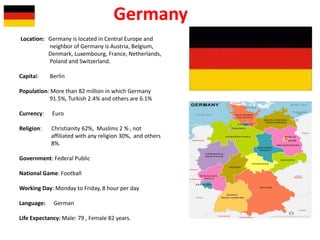
Location: Germany is located in Central Europe and
neighbor of Germany is Austria, Belgium,
Denmark, Luxembourg, France, Netherlands,
Poland and Switzerland.
Capital: Berlin
Population: More than 82 million in which Germany
91.5%, Turkish 2.4% and others are 6.1%
Currency: Euro
Religion: Christianity 62%, Muslims 2 % , not
affiliated with any religion 30%, and others
8%.
Government: Federal Public
National Game: Football
Working Day: Monday to Friday, 8 hour per day
Language: German
Life Expectancy: Male: 79 , Female 82 years.
German Society and Culture
A Planning Culture
• In many respects, German can be considered the
master of planning. This is a culture that prizes
forward thinking and knowing what they will be doing
at a specific time on a specific day.
• Once a proper way to perform a task is discovered,
there is no need to think of doing it any other way.
• Work and personal lives are rigidly divided.
• There is a proper time for every activity. When the
business day ends, you are expected to leave the
office. If you remain after normal closing, it indicated
that you did not plan your day properly
The German Home
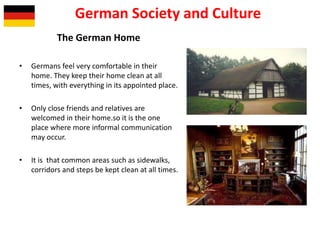
• Germans feel very comfortable in their
home. They keep their home clean at all
times, with everything in its appointed place.
• Only close friends and relatives are
welcomed in their home.so it is the one
place where more informal communication
may occur.
• It is that common areas such as sidewalks,
corridors and steps be kept clean at all times.
German Society and Culture
Syed Taimur Ashfaq
Meeting Etiquette
• Greeting are formal. A quick, firm handshake is the
traditional greeting.
• Titles are very important and denoted respect.
Use a person’s title and their surname.
• In general, wait for your host or hostess to
introduce you to a group.
• When entering a room, shake hands with
everyone individually, including children.
German Society and Culture
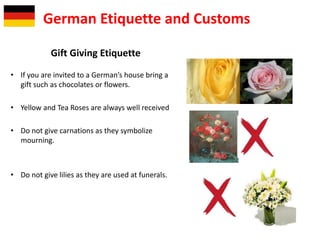
Gift Giving Etiquette
• If you are invited to a German’s house bring a
gift such as chocolates or flowers.
• Yellow and Tea Roses are always well received
• Do not give carnations as they symbolize
mourning.
• Do not give lilies as they are used at funerals.
German Etiquette and Customs
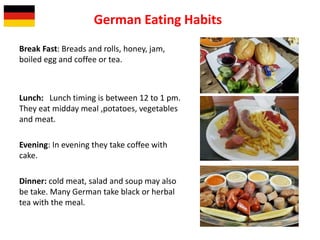
German Eating Habits
Break Fast: Breads and rolls, honey, jam,
boiled egg and coffee or tea.
Lunch: Lunch timing is between 12 to 1 pm.
They eat midday meal ,potatoes, vegetables
and meat.
Evening: In evening they take coffee with
cake.
Dinner: cold meat, salad and soup may also
be take. Many German take black or herbal
tea with the meal.
Dining Etiquette
If you are invited to a German's house:
• Arrive on time as punctuality indicates proper
planning.
• Never arrive early.
• Remain standing until invited to say sit down.
You may be shown to a particular seat
• Do not rest your elbows on the table.
• Finish everything on your plate.
German Etiquette and Customs
Muhammad Faheem Akhtar
Business Etiquette
Relationships & Communications
• German do not need a personal relationship
in order to do business.
• They will be interested in your academic
credentials and the amount of time your
company has been in business.
• Germans do not have an open-door policy.
People work with their office door closed.
Knock and wait to be invited in before
entering.
• German Communication is formal.
• Germans will be direct to the point of
bluntness.
Business Meeting Etiquette
• Appointments are mandatory and should be made
1 to 2 weeks in advance.
• If you write to schedule an appointment, the
letter should be written in German.
• Punctuality is taken extremely seriously. If you
expect to be delayed, telephone immediately and
offer an explanation. It is extremely rude to cancel
a meeting at the last minute.
• Meetings are generally formal.
• Initial meetings are used to get to know each
other. They allow your German colleagues to
determine if you are trustworthy
Business Etiquette
Business Meeting Etiquette
• Maintain direct eye contact while speaking.
• At the end of a meeting, some Germans signal
their approval by rapping their knuckles on the
tabletop.
• There is a strict protocol to follow when entering a
room:
• The eldest or highest ranking person enters the
room first.
• Men enter before women, if their age and status
are roughly equivalent.
Business Etiquette
Business Negotiation
• There is a rigid protocol to be followed, do not
sit until invited told where to sit.
• Germans are detail- oriented and want to
understand everything before coming to an
agreement.
• Business is hierarchical. Decision-making is
held at the top of the company.
• Once a decision is made, it will not be changed.
Business Etiquette
Dress Etiquette
• Business dress is understated, formal and
conservative.
• Men should wear dark colored, conservative
business suits.
• Women should wear either business suits or
conservative dresses.
• Do not wear ostentatious jewellery or
accessories
Business Etiquette
germany

germany

  • 1.
    Group Members Syed TaimurAshfaq Saira Bibi Muhammad Faheem Akhtar
  • 2.
    Germany Location: Germany islocated in Central Europe and neighbor of Germany is Austria, Belgium, Denmark, Luxembourg, France, Netherlands, Poland and Switzerland. Capital: Berlin Population: More than 82 million in which Germany 91.5%, Turkish 2.4% and others are 6.1% Currency: Euro Religion: Christianity 62%, Muslims 2 % , not affiliated with any religion 30%, and others 8%. Government: Federal Public National Game: Football Working Day: Monday to Friday, 8 hour per day Language: German Life Expectancy: Male: 79 , Female 82 years.
  • 3.
    German Society andCulture A Planning Culture • In many respects, German can be considered the master of planning. This is a culture that prizes forward thinking and knowing what they will be doing at a specific time on a specific day. • Once a proper way to perform a task is discovered, there is no need to think of doing it any other way. • Work and personal lives are rigidly divided. • There is a proper time for every activity. When the business day ends, you are expected to leave the office. If you remain after normal closing, it indicated that you did not plan your day properly
  • 4.
    The German Home •Germans feel very comfortable in their home. They keep their home clean at all times, with everything in its appointed place. • Only close friends and relatives are welcomed in their home.so it is the one place where more informal communication may occur. • It is that common areas such as sidewalks, corridors and steps be kept clean at all times. German Society and Culture
  • 5.
  • 6.
    Meeting Etiquette • Greetingare formal. A quick, firm handshake is the traditional greeting. • Titles are very important and denoted respect. Use a person’s title and their surname. • In general, wait for your host or hostess to introduce you to a group. • When entering a room, shake hands with everyone individually, including children. German Society and Culture
  • 7.
    Gift Giving Etiquette •If you are invited to a German’s house bring a gift such as chocolates or flowers. • Yellow and Tea Roses are always well received • Do not give carnations as they symbolize mourning. • Do not give lilies as they are used at funerals. German Etiquette and Customs
  • 8.
    German Eating Habits BreakFast: Breads and rolls, honey, jam, boiled egg and coffee or tea. Lunch: Lunch timing is between 12 to 1 pm. They eat midday meal ,potatoes, vegetables and meat. Evening: In evening they take coffee with cake. Dinner: cold meat, salad and soup may also be take. Many German take black or herbal tea with the meal.
  • 9.
    Dining Etiquette If youare invited to a German's house: • Arrive on time as punctuality indicates proper planning. • Never arrive early. • Remain standing until invited to say sit down. You may be shown to a particular seat • Do not rest your elbows on the table. • Finish everything on your plate. German Etiquette and Customs
  • 10.
  • 11.
    Business Etiquette Relationships &Communications • German do not need a personal relationship in order to do business. • They will be interested in your academic credentials and the amount of time your company has been in business. • Germans do not have an open-door policy. People work with their office door closed. Knock and wait to be invited in before entering. • German Communication is formal. • Germans will be direct to the point of bluntness.
  • 12.
    Business Meeting Etiquette •Appointments are mandatory and should be made 1 to 2 weeks in advance. • If you write to schedule an appointment, the letter should be written in German. • Punctuality is taken extremely seriously. If you expect to be delayed, telephone immediately and offer an explanation. It is extremely rude to cancel a meeting at the last minute. • Meetings are generally formal. • Initial meetings are used to get to know each other. They allow your German colleagues to determine if you are trustworthy Business Etiquette
  • 13.
    Business Meeting Etiquette •Maintain direct eye contact while speaking. • At the end of a meeting, some Germans signal their approval by rapping their knuckles on the tabletop. • There is a strict protocol to follow when entering a room: • The eldest or highest ranking person enters the room first. • Men enter before women, if their age and status are roughly equivalent. Business Etiquette
  • 14.
    Business Negotiation • Thereis a rigid protocol to be followed, do not sit until invited told where to sit. • Germans are detail- oriented and want to understand everything before coming to an agreement. • Business is hierarchical. Decision-making is held at the top of the company. • Once a decision is made, it will not be changed. Business Etiquette
  • 15.
    Dress Etiquette • Businessdress is understated, formal and conservative. • Men should wear dark colored, conservative business suits. • Women should wear either business suits or conservative dresses. • Do not wear ostentatious jewellery or accessories Business Etiquette