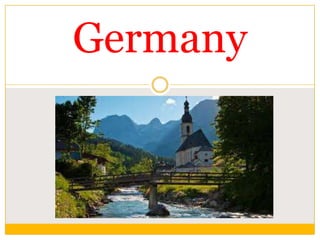
Germany
Disclaimer
 Disclaimer: None of the information is my own,

sources are listed at the end. This is just a
PowerPoint I created by compiling information from
other sites. I am not claiming the information as my
own. The purpose of this PowerPoint is to provide
information about different cultures and learn more
about the world around us.


Enjoy!
Introduction
 Capital: Berlin
 Government: Federal republic

 Make up
 91.2 percent German
 2.4 percent Turkish
 6.1 percent other (Greek, Italian, Polish, Russian, SerboCroatian)
 Language
 German is the official language




95 percent population speaks German as first language

Also Danish, Turkish, Kurdish
General Information
 Europe‟s largest economy and second largest

population
 Geography




Environment Issues: coal-burning, air pollution, acid rain,
Baltic sea p0llution, damaging forests
Natural Resources: coal, lignite, natural gas, iron ore, cooper,
nickel, uranium, potash, salt, construction materials, timber

 Germans are very direct, personal emotions aren‟t

spoken


Direct  sign of respect and part of the search for correctness

 Seem arrogant, but are prideful of accomplishments
General Information (cont.)
 Lack of humor in business settings
 Time and place for everything
 Don‟t respond to/aren‟t aware of indirect hints and nonverbal
signals
 Consistency and reliability are important for

Germans
Economy
 Fifth largest economy in world
 Has highly skilled labor force
 Exports
 Machinery, vehicles, chemicals, household equipment,
computer and electronics, pharmaceuticals, metals, textiles,
rubber, plastic products
 Export partners: France, UK, Netherlands, US, Austria, Italy,
China, Switzerland, Poland
 Imports
 Machinery, data processing equipment, vehicles, chemicals, oil
and gas, metals, electric equipment, pharmaceuticals,
agricultural products
 Import partners: Netherlands, France, China, Belgium, Italy,
UK, Austria, Russia
Communications
 Advanced telecommunication systems
 Germany has a mix of private and public TV and

radio station
 National and regional compete with more than 400
private owned stations
 More than 90 percent have cable or satellite TV
German People & Society
 99 percent literacy rate

 5.5 percent unemployment
 Government
 Has 16 stadts (states)
 Gained independence Jan. 18, 1871
 Oct. 3 is unity day
 Weimar Constitution – amended many times, last time in 2012
 Civil Law legal system
 Must be 18 to vote
Branches of Government
 Executive
 Chief of State - President (figure head)
 Head of government – Chancellor (has the power)
 Cabinet – Appointed by president with recommendation of the
chancellor
 Elections:
President elected for five year term by Federal Convention
including members of Federal Parliament and equal number of
delegates
 Chancellor elected by absolute majority of Federal Parliament for
four year term

Branches of Government (cont.)
 Legislative


Bicameral consists of Federal Council and Federal Parliament
Federal Council (Bundesrat) – State gov‟t sits in Council, each has
three to six votes depending on population
 Federal Parliament (Bundestag) – Members elected by popular vote
for four year term
 Party must win five percent of national vote or three direct
members to get proportional representation


 Judicial


Federal Court of Justice
Consists of 127 judges including court president, VP, presiding judges,
other judges
 Organized into 25 and divided into 12 civil panels, five criminal panel,
eight special panel
 Federal Constitutional Court has two Senates divided into three
chambers with a chairmen and eight members

Branches of Government (cont.)
 Federal Court of Justice judges selected by Judges Election

Committee
o Consists of Secretaries of Justice from 16 States and 16 members

appointed by Federal Parliament
o Judges appointed by President and serve until 65 years old
o Federal Constitutional Court judge appointed for 12 year terms,
must retire by age 68
Government (cont.)
 Political parties
 Green Party
 Christian Democratic Union (CDU)
 Christian Social Union (CSU)
 Free Democratic Party (FDP)
 Left Party
 Social Democratic Party (SDP)
 National symbol: Golden Eagle
 National anthem: Das Leid der Deutschen
German People (cont.)
 Generally value order, privacy and punctuality
 Are thrifty, hardworking and industrious
 Respect perfectionism in all areas of life
 Don‟t admit inadequacy
 Don‟t shout or be loud
 Don‟t put feet on furniture
 Don‟t lose your temper publicly (shows weakness)
 Compliment carefully and sparingly
 Shows weakness
 May correct your behavior
 Social duty
General Information
 Most aspects of German living/working defined and

regulated by structure






Many laws, rules, procedures
Rules allow people to know expectations so they can plan
accordingly
Live structured and ordered life
Planning  security

 Once proper way of doing task is discovered they

don‟t do it another way
Spaces
 Germans take pride in their homes
 Keep it neat and tidy
 Home is where individualism shines
 Only close friends and relatives invited to someone‟s

home  more informal communication occurring
 Common areas must be kept clean
 Don‟t ask for a tour of guests home
Names and Titles
 Use last name and title

 Use „Sie‟ when addressing people
 Never use titles incorrectly or never fail to use them
 If unsure use a higher title
 Two titles shouldn‟t be used at the same time
 If a person has more than one, use the higher ranking one
Business Practices
 Introduction




Be on time – showing up late is insulting, can ruin reputation
Use titles and surnames – tend to stick to roles rigidly
Shake hands – Germans shake hands with everyone before and after
meeting, start with most senior person and work down





Keep it firm and brief to convey confidence and reliability

Dress conservatively
Don‟t mix personal with business – keep small talk light
Don‟t‟ talk about home life, politics or religion
 Never discuss income EVER








Knock before you enter room
Keep your distance, personal space matters, don‟t touch
Say what you mean – be direct and factual
Plan ahead – they hate surprises
Wish everyone „Guten Appetit‟ before eating
Business (cont.)
 Send company profiles to establish credibility
 Rank is extremely important in business

 First meeting usually to see reliability and to establish







trust
Arrive prepared, avoid surprises
English business cards are acceptable
Germans are competitive
Value privacy
Everything should be backed up by facts, figures, tables,
charts, etc.
Don‟t call a German at home unless it‟s an emergency
Business (cont.)
 Master planners, prizes forward thinking, know what

they will be doing on specific time on specific day



Think thoroughly, examine with detail
Careful planning  security

 Prescribed business rules, low degree of flexibility and

spontaneity in attitudes and values
 Don‟t like surprises, sudden changes in business
transactions even if it improves outcome aren‟t welcome
 Business viewed as serious and don‟t appreciate humor
in business context
 Don‟t care to be complimented
Business (cont.)
 Work and personal life strictly divided
 Proper time and place for activity
 Individualistic
 Unethical behavior will diminish future business

negotiations
 Meeting etiquette


Greetings are formal




Titles are important





Firm, quick handshake
Say Herr or Frau before title & surname

Wait for host/hostess to introduce you to group
Shake hands w/ everyone (including kids) when entering room
Business (cont.)
 Don‟t need personal relationship to do business
 Interested in academic credentials and years of

experience
 Display great deference to people in authority, so
understand your level relative to their own
 Don‟t have open door policy, work with doors closed


Knock and wait before entering rooms

 Communication is formal

 Don‟t use hyperbole
 Germans are direct and blunt
 Expect a lot of written communication
 Like to have records of decisions/discussions
Business Values
 Formality/Inflexibility



Arrive on time, greet politely, stick to agenda
Negotiations, contracts, etc., approved by management and take their time to carefully review
(Germans are detail oriented)

 Professionalism





Always address with title
Care about credentials
Professionalism commands respect
Logical and forward moving

 Work ethic



Projects move at slower pace b/c of thorough, detail-oriented people
Don‟t take risks, always meet deadlines

 Blunt



Want to get straight to the point
Not subtle, are critically honest and assertive

 Fair/loyalty




Meant what they say
Don‟t pressure them after an open answer
Compromise during deadlock
Business Meeting
 Appointments mandatory
 Should be made one to two weeks in advance

 Letters addressed to top person in functional area
 Include name and business title
 Meetings are formal
 If you expect to be delayed, call immediately and

offer explanation


Cancelling last minute could jeopardize reputation

 Meetings adhere to strict agendas
 Includes start and end times
 Maintain proper eye contact when speaking
Business Meeting (cont.)
 At end of meeting some Germans may rap knuckles

on tabletop
 Strict protocol to follow when entering room



Highest ranking enters first and so on
Men enter before women if age and status are equal

 Don‟t shake hands with one hand in pocket
Business Negotiation
 Don‟t sit until invited to sit and told where to sit
 Meetings adhere to strict agendas
 Treat process with formality
 Germans prefer to get down to business and engage

in briefest small talk
 Germans are interested in credentials
 Contracts should be strictly followed
 Be patient, Germans are detail-oriented and want to
understand every innuendo before coming to an
agreement
Business Negotiation (cont.)
 Business is hierarchical
 Decision-making is held at top of company
 Final decisions translated in rigorous,

comprehensive action steps
 Avoid confrontational behavior or high-pressure
tactics
 Once decision is made, it won‟t be changed
Dining Etiquette
 Arrive on time, don‟t arrive early or it shows poor

planning and NEVER arrive late unless otherwise
noted
 Send handwritten thank you note the day after for
hospitality
 Remain standing until asked to sit down


They may assign you a seat

 Hold fork with left hand, knife with right

 Don‟t eat until host said „Guten Appetit‟
 Wait for host to place napkin on lap before doing so
 Don‟t rest elbows on table
Dining Etiquette (cont.)
 Don‟t cut lettuce, fold it
 Cut as much of your food as you can

 Finish what‟s on your plate
 Use hands to break apart rolls
 When finished place fork and knife parallel across

right side of plate with fork over knife
 Restaurant setting:



Address waiter “Herr Ober”
Address waitress “Fraulein”

 Business breakfast are arranged, but lunch is

preferred
Dining/Entertainment
 Business entertaining usually done in restaurants
 Lunch with business colleagues involve social conversations
 Don‟t discuss business during lunch/dinner unless host
initiates
 Spouses not included in business dinner
 Don‟t drink until host drinks
 When toasting, hold glass at step, clink glass with people
around you and say „Prosit‟ and take a drink
 Then look into eyes of someone at table, lift glass and set on
table
 Guest of honor seated to left of host if it‟s a man, to

the right if a woman
Dining/Entertainment (cont.)
 Keep hands on table
 Hands should NEVER be on lap
 Keep elbows Off the table
 Use knife and fork to eat sandwiches and fruits
 Whatever doesn‟t need a knife shouldn‟t be touched with knife
 Use fish knife to cut fish
 Don‟t smoke until dinner is finished and coffee is

served – ask permission before you do
 Germans don‟t stay long after dinner


Honored guests supposed to make first move to leave
Punctuality
 Germans compartmentalize into controlled units
 Time is carefully managed
 Schedules must be respected aka DO NOT Be Late!
 Transportation leave and arrive on time, projects are

carefully scheduled and organizational charts are
detailed
 Being late even a minute can offend people
Gift Giving
 Gift giving not common and often inappropriate
 Focus more on business at hand than formalities/rituals
 More social occasions, gift giving is customary
 Guidelines for gifts
 Small, good quality, but not too expensive
 When invited to German home bring gift of flowers, vine,
chocolate or small gift from home country
 Flowers should be given in uneven numbers and unwrapped








Don‟t give 13 of anything

Don‟t give red roses because it‟s associated with romance
Don‟t give carnations because it‟s associated with mourning
Lilies are used at funerals, so avoid those
Open gifts when you receive them
Business Dress Code
 Dress neatly and conservatively – never ostentatious
 General code:
 Casual/sloppy attire is frowned upon
 Men should wear dark colored conservative business suits with
solid tie and white shirt
 Women should wear dark suits and white blouses or
conservative dresses
Don‟t remove jacket until German colleague does
 Don‟t wear heavy makeup or flashy jewelry/accessories

Sources
 www.thelocal.de/gallerie/news/1773
 www.businessculture.org/western-europe/business




culture-in-germany/business-etiquette-in-germany/
www.kwintessential.co.uk/resources/globaletiquette/germany-country-profile.html
www.ediplomat.com/np/cultural_etiquette.ce_de.htm
www.cia.gov/library/publications/the-worldfactbook/geos/gm.html
www.ediplomat.com/np/cultural_etiquette/ce_de.htm

Germany

  • 1.
  • 2.
    Disclaimer  Disclaimer: Noneof the information is my own, sources are listed at the end. This is just a PowerPoint I created by compiling information from other sites. I am not claiming the information as my own. The purpose of this PowerPoint is to provide information about different cultures and learn more about the world around us.  Enjoy!
  • 3.
    Introduction  Capital: Berlin Government: Federal republic  Make up  91.2 percent German  2.4 percent Turkish  6.1 percent other (Greek, Italian, Polish, Russian, SerboCroatian)  Language  German is the official language   95 percent population speaks German as first language Also Danish, Turkish, Kurdish
  • 4.
    General Information  Europe‟slargest economy and second largest population  Geography   Environment Issues: coal-burning, air pollution, acid rain, Baltic sea p0llution, damaging forests Natural Resources: coal, lignite, natural gas, iron ore, cooper, nickel, uranium, potash, salt, construction materials, timber  Germans are very direct, personal emotions aren‟t spoken  Direct  sign of respect and part of the search for correctness  Seem arrogant, but are prideful of accomplishments
  • 5.
    General Information (cont.) Lack of humor in business settings  Time and place for everything  Don‟t respond to/aren‟t aware of indirect hints and nonverbal signals  Consistency and reliability are important for Germans
  • 6.
    Economy  Fifth largesteconomy in world  Has highly skilled labor force  Exports  Machinery, vehicles, chemicals, household equipment, computer and electronics, pharmaceuticals, metals, textiles, rubber, plastic products  Export partners: France, UK, Netherlands, US, Austria, Italy, China, Switzerland, Poland  Imports  Machinery, data processing equipment, vehicles, chemicals, oil and gas, metals, electric equipment, pharmaceuticals, agricultural products  Import partners: Netherlands, France, China, Belgium, Italy, UK, Austria, Russia
  • 7.
    Communications  Advanced telecommunicationsystems  Germany has a mix of private and public TV and radio station  National and regional compete with more than 400 private owned stations  More than 90 percent have cable or satellite TV
  • 8.
    German People &Society  99 percent literacy rate  5.5 percent unemployment  Government  Has 16 stadts (states)  Gained independence Jan. 18, 1871  Oct. 3 is unity day  Weimar Constitution – amended many times, last time in 2012  Civil Law legal system  Must be 18 to vote
  • 9.
    Branches of Government Executive  Chief of State - President (figure head)  Head of government – Chancellor (has the power)  Cabinet – Appointed by president with recommendation of the chancellor  Elections: President elected for five year term by Federal Convention including members of Federal Parliament and equal number of delegates  Chancellor elected by absolute majority of Federal Parliament for four year term 
  • 10.
    Branches of Government(cont.)  Legislative  Bicameral consists of Federal Council and Federal Parliament Federal Council (Bundesrat) – State gov‟t sits in Council, each has three to six votes depending on population  Federal Parliament (Bundestag) – Members elected by popular vote for four year term  Party must win five percent of national vote or three direct members to get proportional representation   Judicial  Federal Court of Justice Consists of 127 judges including court president, VP, presiding judges, other judges  Organized into 25 and divided into 12 civil panels, five criminal panel, eight special panel  Federal Constitutional Court has two Senates divided into three chambers with a chairmen and eight members 
  • 11.
    Branches of Government(cont.)  Federal Court of Justice judges selected by Judges Election Committee o Consists of Secretaries of Justice from 16 States and 16 members appointed by Federal Parliament o Judges appointed by President and serve until 65 years old o Federal Constitutional Court judge appointed for 12 year terms, must retire by age 68
  • 12.
    Government (cont.)  Politicalparties  Green Party  Christian Democratic Union (CDU)  Christian Social Union (CSU)  Free Democratic Party (FDP)  Left Party  Social Democratic Party (SDP)  National symbol: Golden Eagle  National anthem: Das Leid der Deutschen
  • 13.
    German People (cont.) Generally value order, privacy and punctuality  Are thrifty, hardworking and industrious  Respect perfectionism in all areas of life  Don‟t admit inadequacy  Don‟t shout or be loud  Don‟t put feet on furniture  Don‟t lose your temper publicly (shows weakness)  Compliment carefully and sparingly  Shows weakness  May correct your behavior  Social duty
  • 14.
    General Information  Mostaspects of German living/working defined and regulated by structure     Many laws, rules, procedures Rules allow people to know expectations so they can plan accordingly Live structured and ordered life Planning  security  Once proper way of doing task is discovered they don‟t do it another way
  • 15.
    Spaces  Germans takepride in their homes  Keep it neat and tidy  Home is where individualism shines  Only close friends and relatives invited to someone‟s home  more informal communication occurring  Common areas must be kept clean  Don‟t ask for a tour of guests home
  • 16.
    Names and Titles Use last name and title  Use „Sie‟ when addressing people  Never use titles incorrectly or never fail to use them  If unsure use a higher title  Two titles shouldn‟t be used at the same time  If a person has more than one, use the higher ranking one
  • 17.
    Business Practices  Introduction    Beon time – showing up late is insulting, can ruin reputation Use titles and surnames – tend to stick to roles rigidly Shake hands – Germans shake hands with everyone before and after meeting, start with most senior person and work down    Keep it firm and brief to convey confidence and reliability Dress conservatively Don‟t mix personal with business – keep small talk light Don‟t‟ talk about home life, politics or religion  Never discuss income EVER       Knock before you enter room Keep your distance, personal space matters, don‟t touch Say what you mean – be direct and factual Plan ahead – they hate surprises Wish everyone „Guten Appetit‟ before eating
  • 18.
    Business (cont.)  Sendcompany profiles to establish credibility  Rank is extremely important in business  First meeting usually to see reliability and to establish       trust Arrive prepared, avoid surprises English business cards are acceptable Germans are competitive Value privacy Everything should be backed up by facts, figures, tables, charts, etc. Don‟t call a German at home unless it‟s an emergency
  • 19.
    Business (cont.)  Masterplanners, prizes forward thinking, know what they will be doing on specific time on specific day   Think thoroughly, examine with detail Careful planning  security  Prescribed business rules, low degree of flexibility and spontaneity in attitudes and values  Don‟t like surprises, sudden changes in business transactions even if it improves outcome aren‟t welcome  Business viewed as serious and don‟t appreciate humor in business context  Don‟t care to be complimented
  • 20.
    Business (cont.)  Workand personal life strictly divided  Proper time and place for activity  Individualistic  Unethical behavior will diminish future business negotiations  Meeting etiquette  Greetings are formal   Titles are important    Firm, quick handshake Say Herr or Frau before title & surname Wait for host/hostess to introduce you to group Shake hands w/ everyone (including kids) when entering room
  • 21.
    Business (cont.)  Don‟tneed personal relationship to do business  Interested in academic credentials and years of experience  Display great deference to people in authority, so understand your level relative to their own  Don‟t have open door policy, work with doors closed  Knock and wait before entering rooms  Communication is formal  Don‟t use hyperbole  Germans are direct and blunt  Expect a lot of written communication  Like to have records of decisions/discussions
  • 22.
    Business Values  Formality/Inflexibility   Arriveon time, greet politely, stick to agenda Negotiations, contracts, etc., approved by management and take their time to carefully review (Germans are detail oriented)  Professionalism     Always address with title Care about credentials Professionalism commands respect Logical and forward moving  Work ethic   Projects move at slower pace b/c of thorough, detail-oriented people Don‟t take risks, always meet deadlines  Blunt   Want to get straight to the point Not subtle, are critically honest and assertive  Fair/loyalty    Meant what they say Don‟t pressure them after an open answer Compromise during deadlock
  • 23.
    Business Meeting  Appointmentsmandatory  Should be made one to two weeks in advance  Letters addressed to top person in functional area  Include name and business title  Meetings are formal  If you expect to be delayed, call immediately and offer explanation  Cancelling last minute could jeopardize reputation  Meetings adhere to strict agendas  Includes start and end times  Maintain proper eye contact when speaking
  • 24.
    Business Meeting (cont.) At end of meeting some Germans may rap knuckles on tabletop  Strict protocol to follow when entering room   Highest ranking enters first and so on Men enter before women if age and status are equal  Don‟t shake hands with one hand in pocket
  • 25.
    Business Negotiation  Don‟tsit until invited to sit and told where to sit  Meetings adhere to strict agendas  Treat process with formality  Germans prefer to get down to business and engage in briefest small talk  Germans are interested in credentials  Contracts should be strictly followed  Be patient, Germans are detail-oriented and want to understand every innuendo before coming to an agreement
  • 26.
    Business Negotiation (cont.) Business is hierarchical  Decision-making is held at top of company  Final decisions translated in rigorous, comprehensive action steps  Avoid confrontational behavior or high-pressure tactics  Once decision is made, it won‟t be changed
  • 27.
    Dining Etiquette  Arriveon time, don‟t arrive early or it shows poor planning and NEVER arrive late unless otherwise noted  Send handwritten thank you note the day after for hospitality  Remain standing until asked to sit down  They may assign you a seat  Hold fork with left hand, knife with right  Don‟t eat until host said „Guten Appetit‟  Wait for host to place napkin on lap before doing so  Don‟t rest elbows on table
  • 28.
    Dining Etiquette (cont.) Don‟t cut lettuce, fold it  Cut as much of your food as you can  Finish what‟s on your plate  Use hands to break apart rolls  When finished place fork and knife parallel across right side of plate with fork over knife  Restaurant setting:   Address waiter “Herr Ober” Address waitress “Fraulein”  Business breakfast are arranged, but lunch is preferred
  • 29.
    Dining/Entertainment  Business entertainingusually done in restaurants  Lunch with business colleagues involve social conversations  Don‟t discuss business during lunch/dinner unless host initiates  Spouses not included in business dinner  Don‟t drink until host drinks  When toasting, hold glass at step, clink glass with people around you and say „Prosit‟ and take a drink  Then look into eyes of someone at table, lift glass and set on table  Guest of honor seated to left of host if it‟s a man, to the right if a woman
  • 30.
    Dining/Entertainment (cont.)  Keephands on table  Hands should NEVER be on lap  Keep elbows Off the table  Use knife and fork to eat sandwiches and fruits  Whatever doesn‟t need a knife shouldn‟t be touched with knife  Use fish knife to cut fish  Don‟t smoke until dinner is finished and coffee is served – ask permission before you do  Germans don‟t stay long after dinner  Honored guests supposed to make first move to leave
  • 31.
    Punctuality  Germans compartmentalizeinto controlled units  Time is carefully managed  Schedules must be respected aka DO NOT Be Late!  Transportation leave and arrive on time, projects are carefully scheduled and organizational charts are detailed  Being late even a minute can offend people
  • 32.
    Gift Giving  Giftgiving not common and often inappropriate  Focus more on business at hand than formalities/rituals  More social occasions, gift giving is customary  Guidelines for gifts  Small, good quality, but not too expensive  When invited to German home bring gift of flowers, vine, chocolate or small gift from home country  Flowers should be given in uneven numbers and unwrapped      Don‟t give 13 of anything Don‟t give red roses because it‟s associated with romance Don‟t give carnations because it‟s associated with mourning Lilies are used at funerals, so avoid those Open gifts when you receive them
  • 33.
    Business Dress Code Dress neatly and conservatively – never ostentatious  General code:  Casual/sloppy attire is frowned upon  Men should wear dark colored conservative business suits with solid tie and white shirt  Women should wear dark suits and white blouses or conservative dresses Don‟t remove jacket until German colleague does  Don‟t wear heavy makeup or flashy jewelry/accessories 
  • 34.