0
Centre for Maritime Studies
@ Flensburg University of Applied Sciences
www.maritimes-zentrum.de
FUAS
1
German-Finnish
Maritime Industry Cooperation
Joint development of next-generation technologies
Prof. Dr.-Ing. HOLGER WATTER
www.holgerwatter.wordpress.com
Content
1. Maritime Cluster Northern Germany (MCN)
2. European Research Support and Funding
3. The Maritime Industry in Germany
4. The Maritime Industry in Finland
5. Conclusions
6. Contact Information
7. List of References
3
1. Maritime Cluster Northern Germany (MCN)
Cross-state Network of the Maritime Industry
Key Facts
▪ founded in 2011 as a cross-state
network
▪ registered association since 2017
▪ 5 Northern German states:
Bremen, Hamburg, Lower-Saxony,
Mecklenburg-West-Pomerania
and Schleswig-Holstein
▪ more than 290 members from
maritime business, science and
politics
5
Focus Industries of the MCN
▪ Shipbuilding
▪ Maritime suppliers
▪ Deep sea technology
▪ Maritime services
▪ Science, research and
education
▪ Shipping industry
▪ Port companies
maritime tourism
maritimejournalism
maritime
health care
maritime
artandculture
,
marine
portlogistics
shipbuilding
maritime
suppliers
deep sea
technology
maritime
services
science,
research &
education
Source: „Nord/LB (2009): Maritime Industrie in der Metropolregion Hamburg,
Hannover“ – adjusted graphic
6
Goals / Main Objectives
▪ Increasing the competitiveness of the companies
▪ Supporting technology transfer between science and economy
▪ Development of cooperation and innovative projects and
support of the technological competence
▪ Increasing the regional creation of value in Northern Germany
▪ Development of new jobs and securing of existing jobs
▪ Improving the visibility of the maritime competencies
▪ Establishment and further development of the Maritime Cluster
7
Tools and Instruments
Networking the worlds of business, science and politics
Rich and diversified range of events
Interdisciplinary specialist groups
Innovations and projects
Training and further education
Public relations for members
8
Events
Maritime basic training
„An Bord bei …“
– members visit
members
MEER
KONTAKTE –
business fair
Bar Camp – open space for
ideas and innovations
9
Publications
Study: Perspectives of 3D printing for the
maritime economy in Northern Germany
- current state of 3D printing with developments,
challenges, best practices in the maritime sector
- internationally as well as with a focus on Hamburg
and Northern Germany
Interface Management Offshore Wind
- Guideline about the interfaces in offshore-
windprojects
- Cooperation with the Renewable Energy Cluster
10
Publications
Maritime Year Book
Perspectives of the maritime
industry in Schleswig-Holstein,
including
▪ Digitalisation: Transformation
of ships and cargo chains
▪ Ports: The planned national
LNG terminal in Brunsbüttel
11
Interdisciplinary Specialist Groups
▪ Source of valuable information
▪ Idea exchange
▪ Project and cooperation ignition
▪ Events
8 Specialist Groups:
Human Resources & Qualification // Maritime Offshore
Wind Sector // Maritime Law // Maritime Information- and
Communication Systems // Ship Efficiency // Underwater
Communications // Yacht and Boat Building // Cluster
Networking
12
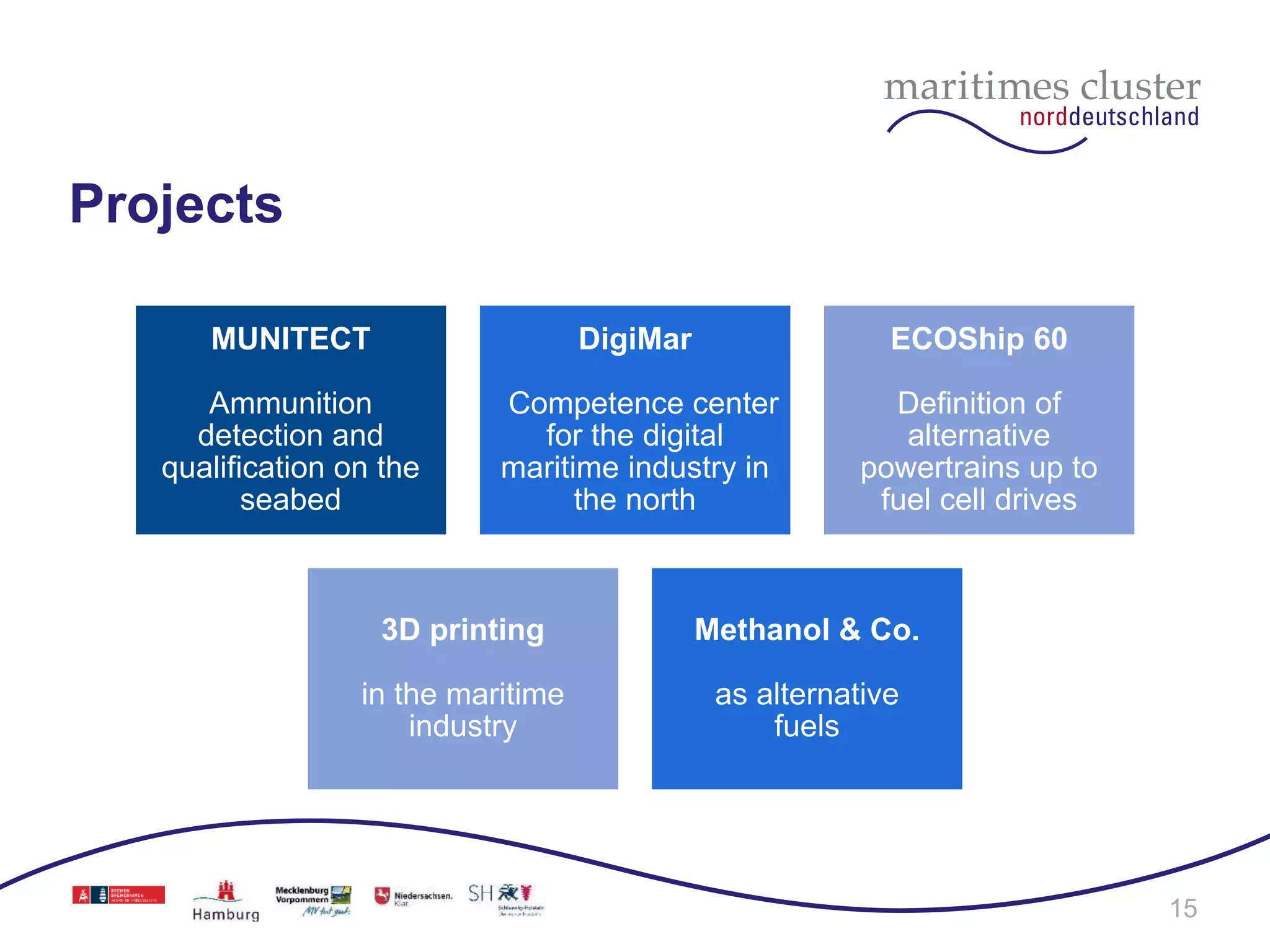
Projects
MUNITECT
Ammunition
detection and
qualification on the
seabed
DigiMar
Competence center
for the digital
maritime industry in
the north
ECOShip 60
Definition of
alternative
powertrains up to
fuel cell drives
3D printing
in the maritime
industry
Methanol & Co.
as alternative
fuels
15
2. European Research
Funding and Support
European Research Programm
Baltic Sea
Region
Interreg
National Research Programm
Finnish German
regional
MCN
….
European Research Funding
Horizon 2020
▪ Biggest EU Research and Innovation programme with
nearly €80 billion of funding over seven years (2014-2020)
▪ Three priorities:
Excellent
science
Networking
and mobility
of scientists
Industrial
leadership
Support of
research and
development
in companies
Societal
challenges
Research on
complex
social
challenges
17
European Research Support
▪ Realization of a European research area through
coordination of national research programmes
▪ Member States are developing a common strategic
research agenda for key issues of the future
Initiatives/Networks
▪ JPI – Joint Programming Initiatives
▪ ERA-Nets
▪ KIC – Knowledge and Information Communities
18
European Research on Sustainable Shipping
European Sustainable Shipping Forum (ESSF)
▪ Established by a European Commission decision in 2013
▪ Group of experts on maritime transport sustainability
▪ Vision: Promote clean, competitive and quality shipping
without compromising safety
▪ Task: assist the Commission in implementing the
Union‘s activities and programmes aimed at fostering
sustainable maritime transport
19
European Research on Sustainable Shipping
European Sustainable Shipping Forum (ESSF)
Sub-groups
LNG
Exhaust Gas
Cleaning
Systems
(EGCS –
‚scrubbers‘)
S-Directive
(sulphur)
Port
Reception
Facilities
Shipping MRV
(verification
and
accreditation)
20
3. The Maritime Industry
in Germany
The Maritime Industry in Germany
▪ One of the most important sectors of the German economy
▪ Estimately up to €50 billion turnover per year
▪ Up to 400,000 jobs directly or indirectly dependent
▪ Sector is not limited to the key sites on the North Sea and
Baltic Sea coasts
22
The Maritime Industry in Germany
The maritime industry and
its value chains
Ship-
building
Marine
Technology
– Offshore oil and gas
– Maritime safety and
security
– Marine mineral
resources
– Marine energy
– Marine autonomous
technology systems
Shipping Ports
Offshore
wind
energy
23
National Masterplan Maritime
Technologies (NMMT)
▪ Main goal: consolidate Germany as a high-tech location for
maritime technologies
▪ Achieve technological excellence and market leadership
▪ Increase competitiveness and global market share
▪ Development of key technologies to ensure a long-term
supply of energy and raw materials from the sea
▪ Sustainable economic use and protection of the oceans
▪ A global oriented policy approach in order to face a better
coordination of economic and ecologic aspects as well as
social issues
24
NMMT
Activity Areas
▪ Pilot projects as well as lighthouse, demonstration and
reference projects
▪ Strengthening the capacity for innovation in the maritime
sector
▪ Developing new market opportunities
▪ Networking and specialist events
▪ Strengthen training and development of skilled workers
▪ Framework/Improving political environment
▪ Improve branch image and public perception
▪ Implementation
25
Maritime Agenda 2025
Federal Government Areas of action and maritime
industry policy objectives
Consolidate and expand technological leadership
Strengthen international competitiveness
Consolidate competitiveness of German ports, expand
infrastructure and secure Germany‘s leading position as
a logistics hub
26
Maritime Agenda 2025
Shape maritime transport sustainability – strengthen
climate & environmental protection & nature conservation
Contribute to energy transition using maritime
technologies
Maritime 4.0 – use the opportunities of digitalisation
Strengthen Germany‘s maritime expertise
Develop industrial capabilities in naval and coastguard
shipbuildung
Play an active role in shaping the EU‘s Blue Growth
Strategy
27
4. The Maritime Industry
in Finland
The Maritime Industry in Finland
Maritime
Cluster
Shipping
Companies Other shipping
related
businesses
Ports
Port operators,
other actors in
portsClassification,
finance and
insurance
Public
Sector
Sea
Construction
Offshore
production of
renewable
energies
Marine
Industry
30
Strategic Research Agenda for the
Finnish Maritime Cluster
Future of the Finnish Maritime Cluster is seen to be
directed by
▪ Application of new energy sources
▪ Sustainable business models
▪ Usage of marine resources
▪ International regulation changes
▪ Digitalization and automation
31
Strategic Research Agenda for the
Finnish Maritime Cluster
▪ Development of cross-cutting technologies in the
areas of
Energy, environment and sustainability
Intelligent ship, systems and solutions
Digitisation and shipbuilding 4.0
32
Strategic Research Agenda for the
Finnish Maritime Cluster
▪ Focus on specific market segments and product areas
Cruise ships and ferries
Arctic technology
Offshore technology
33
5. Conclusions
Conclusions
▪ Finnish and German research cooperations can be
fostered through
- European research areas / platforms
- European funding
▪ Similar priorities in the maritime sector of both countries
provide links for cooperation, especially in the areas of
digitalisation as well as energy and sustainability
36
Draft proposal
37
01/2018
Maritime Business Day
+
Business Meetings
Helsinki
09/2018
SMM Hamburg
02/2018
MCN Booth at Navigate 2018
Turku
03/2018
05/2018
Round Table
Kiel
Business Breakfast
Hamburg
MCN BarCamp
10/201806/2018
Business Breakfast
Hamburg
38
Acknowledgment
www.jpsc.global/
Thanks for your attention
39

German-Finnish maritime co-operation, joint development of next-generation technologies

  • 1.
  • 2.
    Centre for MaritimeStudies @ Flensburg University of Applied Sciences www.maritimes-zentrum.de FUAS 1
  • 3.
    German-Finnish Maritime Industry Cooperation Jointdevelopment of next-generation technologies Prof. Dr.-Ing. HOLGER WATTER www.holgerwatter.wordpress.com
  • 4.
    Content 1. Maritime ClusterNorthern Germany (MCN) 2. European Research Support and Funding 3. The Maritime Industry in Germany 4. The Maritime Industry in Finland 5. Conclusions 6. Contact Information 7. List of References 3
  • 5.
    1. Maritime ClusterNorthern Germany (MCN) Cross-state Network of the Maritime Industry
  • 6.
    Key Facts ▪ foundedin 2011 as a cross-state network ▪ registered association since 2017 ▪ 5 Northern German states: Bremen, Hamburg, Lower-Saxony, Mecklenburg-West-Pomerania and Schleswig-Holstein ▪ more than 290 members from maritime business, science and politics 5
  • 7.
    Focus Industries ofthe MCN ▪ Shipbuilding ▪ Maritime suppliers ▪ Deep sea technology ▪ Maritime services ▪ Science, research and education ▪ Shipping industry ▪ Port companies maritime tourism maritimejournalism maritime health care maritime artandculture , marine portlogistics shipbuilding maritime suppliers deep sea technology maritime services science, research & education Source: „Nord/LB (2009): Maritime Industrie in der Metropolregion Hamburg, Hannover“ – adjusted graphic 6
  • 8.
    Goals / MainObjectives ▪ Increasing the competitiveness of the companies ▪ Supporting technology transfer between science and economy ▪ Development of cooperation and innovative projects and support of the technological competence ▪ Increasing the regional creation of value in Northern Germany ▪ Development of new jobs and securing of existing jobs ▪ Improving the visibility of the maritime competencies ▪ Establishment and further development of the Maritime Cluster 7
  • 9.
    Tools and Instruments Networkingthe worlds of business, science and politics Rich and diversified range of events Interdisciplinary specialist groups Innovations and projects Training and further education Public relations for members 8
  • 10.
    Events Maritime basic training „AnBord bei …“ – members visit members MEER KONTAKTE – business fair Bar Camp – open space for ideas and innovations 9
  • 11.
    Publications Study: Perspectives of3D printing for the maritime economy in Northern Germany - current state of 3D printing with developments, challenges, best practices in the maritime sector - internationally as well as with a focus on Hamburg and Northern Germany Interface Management Offshore Wind - Guideline about the interfaces in offshore- windprojects - Cooperation with the Renewable Energy Cluster 10
  • 12.
    Publications Maritime Year Book Perspectivesof the maritime industry in Schleswig-Holstein, including ▪ Digitalisation: Transformation of ships and cargo chains ▪ Ports: The planned national LNG terminal in Brunsbüttel 11
  • 13.
    Interdisciplinary Specialist Groups ▪Source of valuable information ▪ Idea exchange ▪ Project and cooperation ignition ▪ Events 8 Specialist Groups: Human Resources & Qualification // Maritime Offshore Wind Sector // Maritime Law // Maritime Information- and Communication Systems // Ship Efficiency // Underwater Communications // Yacht and Boat Building // Cluster Networking 12
  • 14.
    Projects MUNITECT Ammunition detection and qualification onthe seabed DigiMar Competence center for the digital maritime industry in the north ECOShip 60 Definition of alternative powertrains up to fuel cell drives 3D printing in the maritime industry Methanol & Co. as alternative fuels 15
  • 15.
    2. European Research Fundingand Support European Research Programm Baltic Sea Region Interreg National Research Programm Finnish German regional MCN ….
  • 16.
    European Research Funding Horizon2020 ▪ Biggest EU Research and Innovation programme with nearly €80 billion of funding over seven years (2014-2020) ▪ Three priorities: Excellent science Networking and mobility of scientists Industrial leadership Support of research and development in companies Societal challenges Research on complex social challenges 17
  • 17.
    European Research Support ▪Realization of a European research area through coordination of national research programmes ▪ Member States are developing a common strategic research agenda for key issues of the future Initiatives/Networks ▪ JPI – Joint Programming Initiatives ▪ ERA-Nets ▪ KIC – Knowledge and Information Communities 18
  • 18.
    European Research onSustainable Shipping European Sustainable Shipping Forum (ESSF) ▪ Established by a European Commission decision in 2013 ▪ Group of experts on maritime transport sustainability ▪ Vision: Promote clean, competitive and quality shipping without compromising safety ▪ Task: assist the Commission in implementing the Union‘s activities and programmes aimed at fostering sustainable maritime transport 19
  • 19.
    European Research onSustainable Shipping European Sustainable Shipping Forum (ESSF) Sub-groups LNG Exhaust Gas Cleaning Systems (EGCS – ‚scrubbers‘) S-Directive (sulphur) Port Reception Facilities Shipping MRV (verification and accreditation) 20
  • 20.
    3. The MaritimeIndustry in Germany
  • 21.
    The Maritime Industryin Germany ▪ One of the most important sectors of the German economy ▪ Estimately up to €50 billion turnover per year ▪ Up to 400,000 jobs directly or indirectly dependent ▪ Sector is not limited to the key sites on the North Sea and Baltic Sea coasts 22
  • 22.
    The Maritime Industryin Germany The maritime industry and its value chains Ship- building Marine Technology – Offshore oil and gas – Maritime safety and security – Marine mineral resources – Marine energy – Marine autonomous technology systems Shipping Ports Offshore wind energy 23
  • 23.
    National Masterplan Maritime Technologies(NMMT) ▪ Main goal: consolidate Germany as a high-tech location for maritime technologies ▪ Achieve technological excellence and market leadership ▪ Increase competitiveness and global market share ▪ Development of key technologies to ensure a long-term supply of energy and raw materials from the sea ▪ Sustainable economic use and protection of the oceans ▪ A global oriented policy approach in order to face a better coordination of economic and ecologic aspects as well as social issues 24
  • 24.
    NMMT Activity Areas ▪ Pilotprojects as well as lighthouse, demonstration and reference projects ▪ Strengthening the capacity for innovation in the maritime sector ▪ Developing new market opportunities ▪ Networking and specialist events ▪ Strengthen training and development of skilled workers ▪ Framework/Improving political environment ▪ Improve branch image and public perception ▪ Implementation 25
  • 25.
    Maritime Agenda 2025 FederalGovernment Areas of action and maritime industry policy objectives Consolidate and expand technological leadership Strengthen international competitiveness Consolidate competitiveness of German ports, expand infrastructure and secure Germany‘s leading position as a logistics hub 26
  • 26.
    Maritime Agenda 2025 Shapemaritime transport sustainability – strengthen climate & environmental protection & nature conservation Contribute to energy transition using maritime technologies Maritime 4.0 – use the opportunities of digitalisation Strengthen Germany‘s maritime expertise Develop industrial capabilities in naval and coastguard shipbuildung Play an active role in shaping the EU‘s Blue Growth Strategy 27
  • 27.
    4. The MaritimeIndustry in Finland
  • 28.
    The Maritime Industryin Finland Maritime Cluster Shipping Companies Other shipping related businesses Ports Port operators, other actors in portsClassification, finance and insurance Public Sector Sea Construction Offshore production of renewable energies Marine Industry 30
  • 29.
    Strategic Research Agendafor the Finnish Maritime Cluster Future of the Finnish Maritime Cluster is seen to be directed by ▪ Application of new energy sources ▪ Sustainable business models ▪ Usage of marine resources ▪ International regulation changes ▪ Digitalization and automation 31
  • 30.
    Strategic Research Agendafor the Finnish Maritime Cluster ▪ Development of cross-cutting technologies in the areas of Energy, environment and sustainability Intelligent ship, systems and solutions Digitisation and shipbuilding 4.0 32
  • 31.
    Strategic Research Agendafor the Finnish Maritime Cluster ▪ Focus on specific market segments and product areas Cruise ships and ferries Arctic technology Offshore technology 33
  • 32.
  • 33.
    Conclusions ▪ Finnish andGerman research cooperations can be fostered through - European research areas / platforms - European funding ▪ Similar priorities in the maritime sector of both countries provide links for cooperation, especially in the areas of digitalisation as well as energy and sustainability 36
  • 34.
    Draft proposal 37 01/2018 Maritime BusinessDay + Business Meetings Helsinki 09/2018 SMM Hamburg 02/2018 MCN Booth at Navigate 2018 Turku 03/2018 05/2018 Round Table Kiel Business Breakfast Hamburg MCN BarCamp 10/201806/2018 Business Breakfast Hamburg
  • 35.
  • 36.
    Thanks for yourattention 39