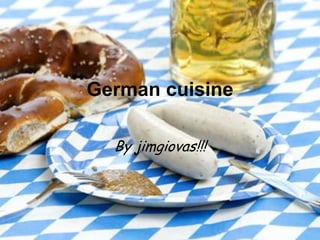
German cuisine

  By jimgiovas!!!
Staple foods

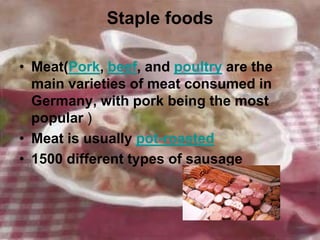
• Meat(Pork, beef, and poultry are the
  main varieties of meat consumed in
  Germany, with pork being the most
  popular )
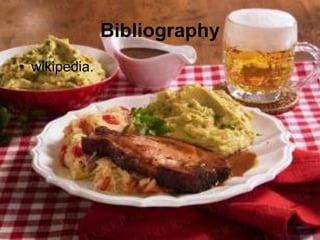
• Meat is usually pot-roasted
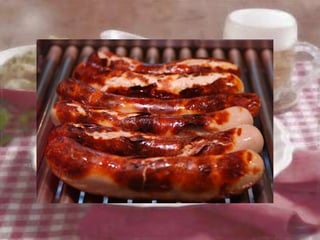
• 1500 different types of sausage
• Fish(Trout , pike, carp, and European perch
  are the most common freshwater fish on the
  German menu )
• Vegetables(Carrots, turnips, spinach, peas,
  beans, broccoli and many types of cabbage
  are very common )
• Fried onions are a common addition to many
  meat dishes throughout the country
• Asparagus, is a common side dish or may be
  prepared as a main dish.
Side dishes

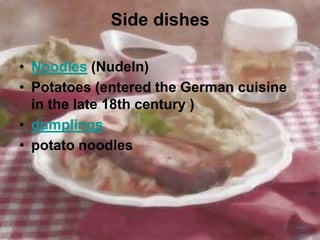
• Noodles (Nudeln)
• Potatoes (entered the German cuisine
  in the late 18th century )
• dumplings
• potato noodles
Spices and condiments

• the most popular herbs are traditionally
  parsley, thyme, laurel, chives, black
  pepper (used in small amounts), juniper
  berries , caraway, cardamom, anise
  seed, cinnamon , basil, sage, oregano,
  and hot chili peppers
Desserts

• A wide variety of cakes and tarts are served
  throughout the country, most commonly
  made with fresh fruit
• Cheesecake is also very popular, often made
  with quark.
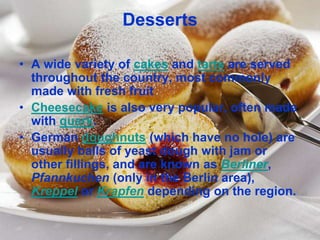
• German doughnuts (which have no hole) are
  usually balls of yeast dough with jam or
  other fillings, and are known as Berliner,
  Pfannkuchen (only in the Berlin area),
  Kreppel or Krapfen depending on the region.
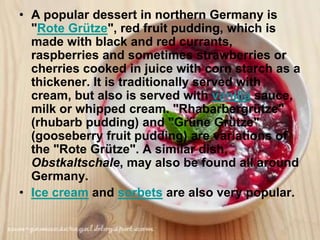
• A popular dessert in northern Germany is
  "Rote Grütze", red fruit pudding, which is
  made with black and red currants,
  raspberries and sometimes strawberries or
  cherries cooked in juice with corn starch as a
  thickener. It is traditionally served with
  cream, but also is served with vanilla sauce,
  milk or whipped cream. "Rhabarbergrütze"
  (rhubarb pudding) and "Grüne Grütze"
  (gooseberry fruit pudding) are variations of
  the "Rote Grütze". A similar dish,
  Obstkaltschale, may also be found all around
  Germany.
• Ice cream and sorbets are also very popular.
Bread

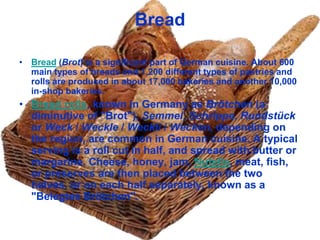
• Bread (Brot) is a significant part of German cuisine. About 600
  main types of breads and 1,200 different types of pastries and
  rolls are produced in about 17,000 bakeries and another 10,000
  in-shop bakeries.
• Bread rolls, known in Germany as Brötchen (a
  diminutive of "Brot"), Semmel, Schrippe, Rundstück
  or Weck / Weckle / Weckli / Wecken, depending on
  the region, are common in German cuisine. A typical
  serving is a roll cut in half, and spread with butter or
  margarine. Cheese, honey, jam, Nutella, meat, fish,
  or preserves are then placed between the two
  halves, or on each half separately, known as a
  "Belegtes Brötchen".
Germany's most popular breads
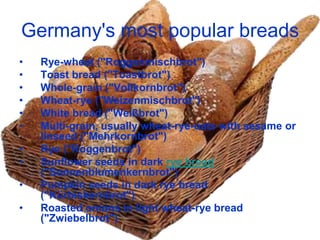
•   Rye-wheat ("Roggenmischbrot")
•   Toast bread ("Toastbrot")
•   Whole-grain ("Vollkornbrot")
•   Wheat-rye ("Weizenmischbrot")
•   White bread ("Weißbrot")
•   Multi-grain, usually wheat-rye-oats with sesame or
    linseed ("Mehrkornbrot")
•   Rye ("Roggenbrot")
•   Sunflower seeds in dark rye bread
    ("Sonnenblumenkernbrot")
•   Pumpkin seeds in dark rye bread
    ("Kürbiskernbrot")
•   Roasted onions in light wheat-rye bread
    ("Zwiebelbrot")
Drinks

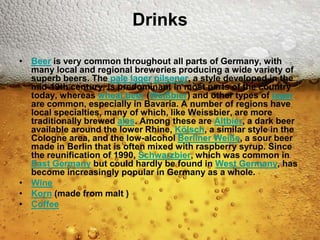
• Beer is very common throughout all parts of Germany, with
  many local and regional breweries producing a wide variety of
  superb beers. The pale lager pilsener, a style developed in the
  mid-19th century, is predominant in most parts of the country
  today, whereas wheat beer (Weißbier) and other types of lager
  are common, especially in Bavaria. A number of regions have
  local specialties, many of which, like Weissbier, are more
  traditionally brewed ales. Among these are Altbier, a dark beer
  available around the lower Rhine, Kölsch, a similar style in the
  Cologne area, and the low-alcohol Berliner Weiße, a sour beer
  made in Berlin that is often mixed with raspberry syrup. Since
  the reunification of 1990, Schwarzbier, which was common in
  East Germany but could hardly be found in West Germany, has
  become increasingly popular in Germany as a whole.
• Wine
• Korn (made from malt )
• Coffee
Bibliography
• wikipedia.
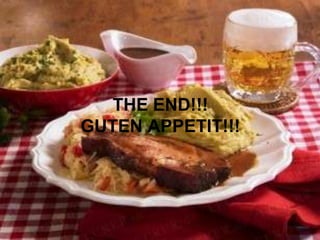
THE END!!!
GUTEN APPETIT!!!

German.cuisine

  • 1.
    German cuisine By jimgiovas!!!
  • 2.
    Staple foods • Meat(Pork,beef, and poultry are the main varieties of meat consumed in Germany, with pork being the most popular ) • Meat is usually pot-roasted • 1500 different types of sausage
  • 3.
    • Fish(Trout ,pike, carp, and European perch are the most common freshwater fish on the German menu ) • Vegetables(Carrots, turnips, spinach, peas, beans, broccoli and many types of cabbage are very common ) • Fried onions are a common addition to many meat dishes throughout the country • Asparagus, is a common side dish or may be prepared as a main dish.
  • 4.
    Side dishes • Noodles(Nudeln) • Potatoes (entered the German cuisine in the late 18th century ) • dumplings • potato noodles
  • 5.
    Spices and condiments •the most popular herbs are traditionally parsley, thyme, laurel, chives, black pepper (used in small amounts), juniper berries , caraway, cardamom, anise seed, cinnamon , basil, sage, oregano, and hot chili peppers
  • 6.
    Desserts • A widevariety of cakes and tarts are served throughout the country, most commonly made with fresh fruit • Cheesecake is also very popular, often made with quark. • German doughnuts (which have no hole) are usually balls of yeast dough with jam or other fillings, and are known as Berliner, Pfannkuchen (only in the Berlin area), Kreppel or Krapfen depending on the region.
  • 7.
    • A populardessert in northern Germany is "Rote Grütze", red fruit pudding, which is made with black and red currants, raspberries and sometimes strawberries or cherries cooked in juice with corn starch as a thickener. It is traditionally served with cream, but also is served with vanilla sauce, milk or whipped cream. "Rhabarbergrütze" (rhubarb pudding) and "Grüne Grütze" (gooseberry fruit pudding) are variations of the "Rote Grütze". A similar dish, Obstkaltschale, may also be found all around Germany. • Ice cream and sorbets are also very popular.
  • 8.
    Bread • Bread (Brot)is a significant part of German cuisine. About 600 main types of breads and 1,200 different types of pastries and rolls are produced in about 17,000 bakeries and another 10,000 in-shop bakeries. • Bread rolls, known in Germany as Brötchen (a diminutive of "Brot"), Semmel, Schrippe, Rundstück or Weck / Weckle / Weckli / Wecken, depending on the region, are common in German cuisine. A typical serving is a roll cut in half, and spread with butter or margarine. Cheese, honey, jam, Nutella, meat, fish, or preserves are then placed between the two halves, or on each half separately, known as a "Belegtes Brötchen".
  • 9.
    Germany's most popularbreads • Rye-wheat ("Roggenmischbrot") • Toast bread ("Toastbrot") • Whole-grain ("Vollkornbrot") • Wheat-rye ("Weizenmischbrot") • White bread ("Weißbrot") • Multi-grain, usually wheat-rye-oats with sesame or linseed ("Mehrkornbrot") • Rye ("Roggenbrot") • Sunflower seeds in dark rye bread ("Sonnenblumenkernbrot") • Pumpkin seeds in dark rye bread ("Kürbiskernbrot") • Roasted onions in light wheat-rye bread ("Zwiebelbrot")
  • 10.
    Drinks • Beer isvery common throughout all parts of Germany, with many local and regional breweries producing a wide variety of superb beers. The pale lager pilsener, a style developed in the mid-19th century, is predominant in most parts of the country today, whereas wheat beer (Weißbier) and other types of lager are common, especially in Bavaria. A number of regions have local specialties, many of which, like Weissbier, are more traditionally brewed ales. Among these are Altbier, a dark beer available around the lower Rhine, Kölsch, a similar style in the Cologne area, and the low-alcohol Berliner Weiße, a sour beer made in Berlin that is often mixed with raspberry syrup. Since the reunification of 1990, Schwarzbier, which was common in East Germany but could hardly be found in West Germany, has become increasingly popular in Germany as a whole. • Wine • Korn (made from malt ) • Coffee
  • 11.
  • 14.