Typical dishes in
Germany
commons.wikimedia.org
The three regional German cuisine zones
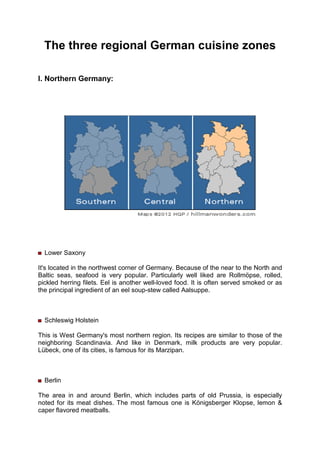
I. Northern Germany:
Lower Saxony
It's located in the northwest corner of Germany. Because of the near to the North and
Baltic seas, seafood is very popular. Particularly well liked are Rollmöpse, rolled,
pickled herring filets. Eel is another well-loved food. It is often served smoked or as
the principal ingredient of an eel soup-stew called Aalsuppe.
Schleswig Holstein
This is West Germany's most northern region. Its recipes are similar to those of the
neighboring Scandinavia. And like in Denmark, milk products are very popular.
Lübeck, one of its cities, is famous for its Marzipan.
Berlin
The area in and around Berlin, which includes parts of old Prussia, is especially
noted for its meat dishes. The most famous one is Königsberger Klopse, lemon &
caper flavored meatballs.
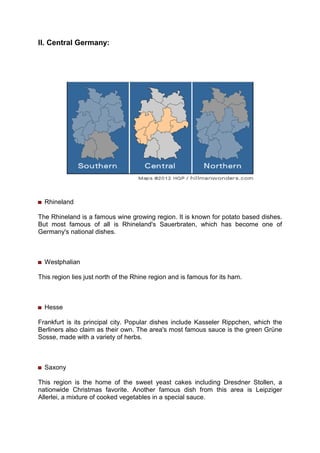
II. Central Germany:
Rhineland
The Rhineland is a famous wine growing region. It is known for potato based dishes.
But most famous of all is Rhineland's Sauerbraten, which has become one of
Germany's national dishes.
Westphalian
This region lies just north of the Rhine region and is famous for its ham.
Hesse
Frankfurt is its principal city. Popular dishes include Kasseler Rippchen, which the
Berliners also claim as their own. The area's most famous sauce is the green Grüne
Sosse, made with a variety of herbs.
Saxony
This region is the home of the sweet yeast cakes including Dresdner Stollen, a
nationwide Christmas favorite. Another famous dish from this area is Leipziger
Allerlei, a mixture of cooked vegetables in a special sauce.
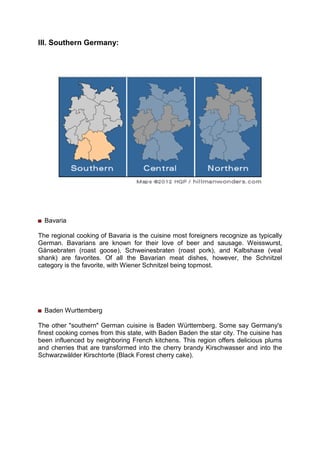
III. Southern Germany:
Bavaria
The regional cooking of Bavaria is the cuisine most foreigners recognize as typically
German. Bavarians are known for their love of beer and sausage. Weisswurst,
Gänsebraten (roast goose), Schweinesbraten (roast pork), and Kalbshaxe (veal
shank) are favorites. Of all the Bavarian meat dishes, however, the Schnitzel
category is the favorite, with Wiener Schnitzel being topmost.
Baden Wurttemberg
The other "southern" German cuisine is Baden Württemberg. Some say Germany's
finest cooking comes from this state, with Baden Baden the star city. The cuisine has
been influenced by neighboring French kitchens. This region offers delicious plums
and cherries that are transformed into the cherry brandy Kirschwasser and into the
Schwarzwälder Kirschtorte (Black Forest cherry cake).
Culinary specialities of Lower-Saxony
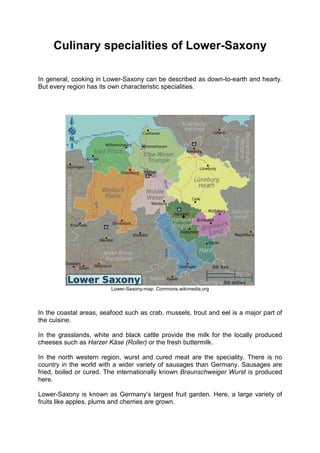
In general, cooking in Lower-Saxony can be described as down-to-earth and hearty.
But every region has its own characteristic specialities.
Lower-Saxony-map: Commons.wikimedia.org
In the coastal areas, seafood such as crab, mussels, trout and eel is a major part of
the cuisine.
In the grasslands, white and black cattle provide the milk for the locally produced
cheeses such as Harzer Käse (Roller) or the fresh buttermilk.
In the north western region, wurst and cured meat are the speciality. There is no
country in the world with a wider variety of sausages than Germany. Sausages are
fried, boiled or cured. The internationally known Braunschweiger Wurst is produced
here.
Lower-Saxony is known as Germany’s largest fruit garden. Here, a large variety of
fruits like apples, plums and cherries are grown.
Frisia is famous for its tea and a real tea culture has developed. This region alone
consumes one-fourth of Germany’s entire tea imports. Here, strongly brewed tea is
served with candies sugar and whipped cream in fine china.
Lower-Saxony is also the home of many breweries, some date back to the Middle
Ages. A local speciality is Bockbier.
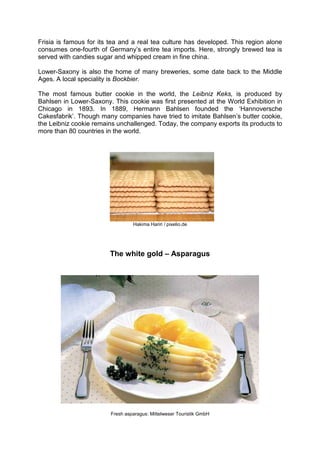
The most famous butter cookie in the world, the Leibniz Keks, is produced by
Bahlsen in Lower-Saxony. This cookie was first presented at the World Exhibition in
Chicago in 1893. In 1889, Hermann Bahlsen founded the ‘Hannoversche
Cakesfabrik’. Though many companies have tried to imitate Bahlsen’s butter cookie,
the Leibniz cookie remains unchallenged. Today, the company exports its products to
more than 80 countries in the world.
Hakima Hariri / pixelio.de
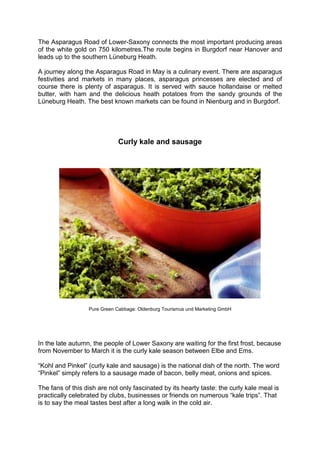
The white gold – Asparagus
Fresh asparagus: Mittelweser Touristik GmbH
The Asparagus Road of Lower-Saxony connects the most important producing areas
of the white gold on 750 kilometres.The route begins in Burgdorf near Hanover and
leads up to the southern Lüneburg Heath.
A journey along the Asparagus Road in May is a culinary event. There are asparagus
festivities and markets in many places, asparagus princesses are elected and of
course there is plenty of asparagus. It is served with sauce hollandaise or melted
butter, with ham and the delicious heath potatoes from the sandy grounds of the
Lüneburg Heath. The best known markets can be found in Nienburg and in Burgdorf.
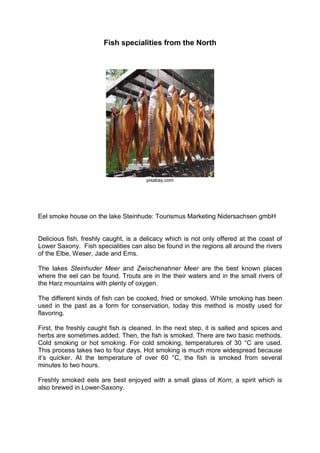
Curly kale and sausage
Pure Green Cabbage: Oldenburg Tourismus und Marketing GmbH
In the late autumn, the people of Lower Saxony are waiting for the first frost, because
from November to March it is the curly kale season between Elbe and Ems.
“Kohl and Pinkel” (curly kale and sausage) is the national dish of the north. The word
“Pinkel” simply refers to a sausage made of bacon, belly meat, onions and spices.
The fans of this dish are not only fascinated by its hearty taste: the curly kale meal is
practically celebrated by clubs, businesses or friends on numerous “kale trips”. That
is to say the meal tastes best after a long walk in the cold air.
Fish specialities from the North
pixabay.com
Eel smoke house on the lake Steinhude: Tourismus Marketing Nidersachsen gmbH
Delicious fish, freshly caught, is a delicacy which is not only offered at the coast of
Lower Saxony. Fish specialities can also be found in the regions all around the rivers
of the Elbe, Weser, Jade and Ems.
The lakes Steinhuder Meer and Zwischenahner Meer are the best known places
where the eel can be found. Trouts are in the their waters and in the small rivers of
the Harz mountains with plenty of oxygen.
The different kinds of fish can be cooked, fried or smoked. While smoking has been
used in the past as a form for conservation, today this method is mostly used for
flavoring.
First, the freshly caught fish is cleaned. In the next step, it is salted and spices and
herbs are sometimes added. Then, the fish is smoked. There are two basic methods.
Cold smoking or hot smoking. For cold smoking, temperatures of 30 °C are used.
This process takes two to four days. Hot smoking is much more widespread because
it’s quicker. At the temperature of over 60 °C, the fish is smoked from several
minutes to two hours.
Freshly smoked eels are best enjoyed with a small glass of Korn, a spirit which is
also brewed in Lower-Saxony.
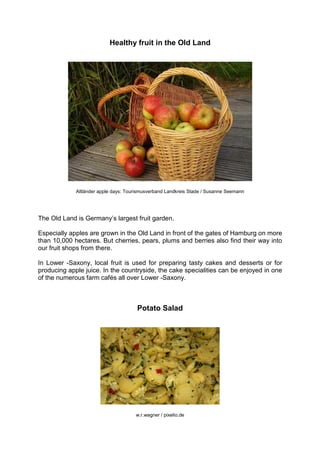
Healthy fruit in the Old Land
Altländer apple days: Tourismusverband Landkreis Stade / Susanne Seemann
The Old Land is Germany’s largest fruit garden.
Especially apples are grown in the Old Land in front of the gates of Hamburg on more
than 10,000 hectares. But cherries, pears, plums and berries also find their way into
our fruit shops from there.
In Lower -Saxony, local fruit is used for preparing tasty cakes and desserts or for
producing apple juice. In the countryside, the cake specialities can be enjoyed in one
of the numerous farm cafés all over Lower -Saxony.
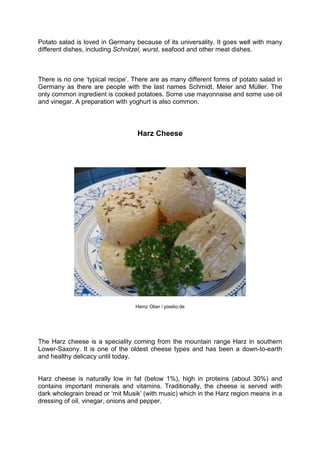
Potato Salad
w.r.wagner / pixelio.de
Potato salad is loved in Germany because of its universality. It goes well with many
different dishes, including Schnitzel, wurst, seafood and other meat dishes.
There is no one ‘typical recipe’. There are as many different forms of potato salad in
Germany as there are people with the last names Schmidt, Meier and Müller. The
only common ingredient is cooked potatoes. Some use mayonnaise and some use oil
and vinegar. A preparation with yoghurt is also common.
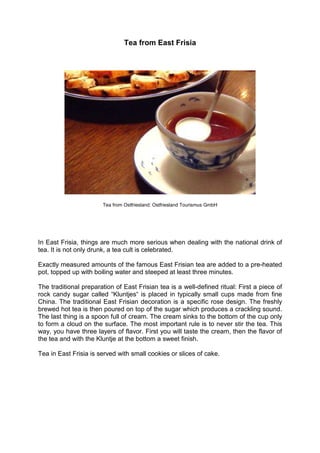
Harz Cheese
Heinz Ober / pixelio.de
The Harz cheese is a speciality coming from the mountain range Harz in southern
Lower-Saxony. It is one of the oldest cheese types and has been a down-to-earth
and healthy delicacy until today.
Harz cheese is naturally low in fat (below 1%), high in proteins (about 30%) and
contains important minerals and vitamins. Traditionally, the cheese is served with
dark wholegrain bread or ‘mit Musik’ (with music) which in the Harz region means in a
dressing of oil, vinegar, onions and pepper.
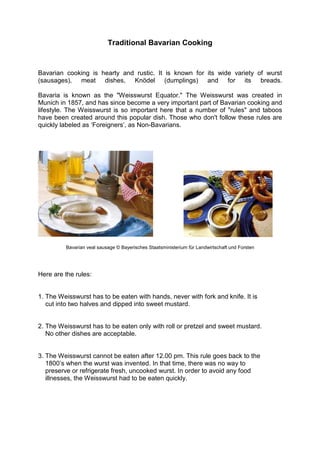
Tea from East Frisia
Tea from Ostfriesland: Ostfriesland Tourismus GmbH
In East Frisia, things are much more serious when dealing with the national drink of
tea. It is not only drunk, a tea cult is celebrated.
Exactly measured amounts of the famous East Frisian tea are added to a pre-heated
pot, topped up with boiling water and steeped at least three minutes.
The traditional preparation of East Frisian tea is a well-defined ritual: First a piece of
rock candy sugar called “Kluntjes“ is placed in typically small cups made from fine
China. The traditional East Frisian decoration is a specific rose design. The freshly
brewed hot tea is then poured on top of the sugar which produces a crackling sound.
The last thing is a spoon full of cream. The cream sinks to the bottom of the cup only
to form a cloud on the surface. The most important rule is to never stir the tea. This
way, you have three layers of flavor. First you will taste the cream, then the flavor of
the tea and with the Kluntje at the bottom a sweet finish.
Tea in East Frisia is served with small cookies or slices of cake.
Traditional Bavarian Cooking
Bavarian cooking is hearty and rustic. It is known for its wide variety of wurst
(sausages), meat dishes, Knödel (dumplings) and for its breads.
Bavaria is known as the "Weisswurst Equator." The Weisswurst was created in
Munich in 1857, and has since become a very important part of Bavarian cooking and
lifestyle. The Weisswurst is so important here that a number of "rules" and taboos
have been created around this popular dish. Those who don't follow these rules are
quickly labeled as ‘Foreigners’, as Non-Bavarians.
Bavarian veal sausage © Bayerisches Staatsministerium für Landwirtschaft und Forsten
Here are the rules:
1. The Weisswurst has to be eaten with hands, never with fork and knife. It is
cut into two halves and dipped into sweet mustard.
2. The Weisswurst has to be eaten only with roll or pretzel and sweet mustard.
No other dishes are acceptable.
3. The Weisswurst cannot be eaten after 12.00 pm. This rule goes back to the
1800’s when the wurst was invented. In that time, there was no way to
preserve or refrigerate fresh, uncooked wurst. In order to avoid any food
illnesses, the Weisswurst had to be eaten quickly.
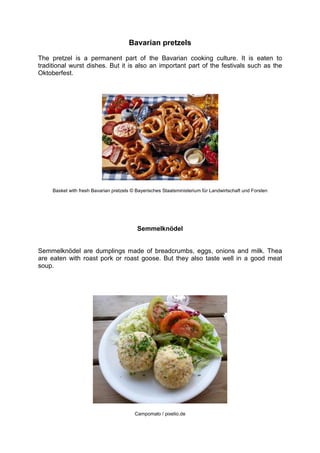
Bavarian pretzels
The pretzel is a permanent part of the Bavarian cooking culture. It is eaten to
traditional wurst dishes. But it is also an important part of the festivals such as the
Oktoberfest.
Basket with fresh Bavarian pretzels © Bayerisches Staatsministerium für Landwirtschaft und Forsten
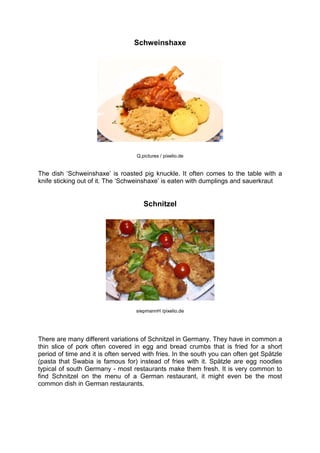
Semmelknödel
Semmelknödel are dumplings made of breadcrumbs, eggs, onions and milk. Thea
are eaten with roast pork or roast goose. But they also taste well in a good meat
soup.
Campomalo / pixelio.de
Schweinshaxe
Q.pictures / pixelio.de
The dish ‘Schweinshaxe’ is roasted pig knuckle. It often comes to the table with a
knife sticking out of it. The ‘Schweinshaxe’ is eaten with dumplings and sauerkraut
Schnitzel
siepmannH /pixelio.de
There are many different variations of Schnitzel in Germany. They have in common a
thin slice of pork often covered in egg and bread crumbs that is fried for a short
period of time and it is often served with fries. In the south you can often get Spätzle
(pasta that Swabia is famous for) instead of fries with it. Spätzle are egg noodles
typical of south Germany - most restaurants make them fresh. It is very common to
find Schnitzel on the menu of a German restaurant, it might even be the most
common dish in German restaurants.

1.1.1 Typical dishes in Germany

  • 1.
  • 2.
    The three regionalGerman cuisine zones I. Northern Germany: Lower Saxony It's located in the northwest corner of Germany. Because of the near to the North and Baltic seas, seafood is very popular. Particularly well liked are Rollmöpse, rolled, pickled herring filets. Eel is another well-loved food. It is often served smoked or as the principal ingredient of an eel soup-stew called Aalsuppe. Schleswig Holstein This is West Germany's most northern region. Its recipes are similar to those of the neighboring Scandinavia. And like in Denmark, milk products are very popular. Lübeck, one of its cities, is famous for its Marzipan. Berlin The area in and around Berlin, which includes parts of old Prussia, is especially noted for its meat dishes. The most famous one is Königsberger Klopse, lemon & caper flavored meatballs.
  • 3.
    II. Central Germany: Rhineland TheRhineland is a famous wine growing region. It is known for potato based dishes. But most famous of all is Rhineland's Sauerbraten, which has become one of Germany's national dishes. Westphalian This region lies just north of the Rhine region and is famous for its ham. Hesse Frankfurt is its principal city. Popular dishes include Kasseler Rippchen, which the Berliners also claim as their own. The area's most famous sauce is the green Grüne Sosse, made with a variety of herbs. Saxony This region is the home of the sweet yeast cakes including Dresdner Stollen, a nationwide Christmas favorite. Another famous dish from this area is Leipziger Allerlei, a mixture of cooked vegetables in a special sauce.
  • 4.
    III. Southern Germany: Bavaria Theregional cooking of Bavaria is the cuisine most foreigners recognize as typically German. Bavarians are known for their love of beer and sausage. Weisswurst, Gänsebraten (roast goose), Schweinesbraten (roast pork), and Kalbshaxe (veal shank) are favorites. Of all the Bavarian meat dishes, however, the Schnitzel category is the favorite, with Wiener Schnitzel being topmost. Baden Wurttemberg The other "southern" German cuisine is Baden Württemberg. Some say Germany's finest cooking comes from this state, with Baden Baden the star city. The cuisine has been influenced by neighboring French kitchens. This region offers delicious plums and cherries that are transformed into the cherry brandy Kirschwasser and into the Schwarzwälder Kirschtorte (Black Forest cherry cake).
  • 5.
    Culinary specialities ofLower-Saxony In general, cooking in Lower-Saxony can be described as down-to-earth and hearty. But every region has its own characteristic specialities. Lower-Saxony-map: Commons.wikimedia.org In the coastal areas, seafood such as crab, mussels, trout and eel is a major part of the cuisine. In the grasslands, white and black cattle provide the milk for the locally produced cheeses such as Harzer Käse (Roller) or the fresh buttermilk. In the north western region, wurst and cured meat are the speciality. There is no country in the world with a wider variety of sausages than Germany. Sausages are fried, boiled or cured. The internationally known Braunschweiger Wurst is produced here. Lower-Saxony is known as Germany’s largest fruit garden. Here, a large variety of fruits like apples, plums and cherries are grown.
  • 6.
    Frisia is famousfor its tea and a real tea culture has developed. This region alone consumes one-fourth of Germany’s entire tea imports. Here, strongly brewed tea is served with candies sugar and whipped cream in fine china. Lower-Saxony is also the home of many breweries, some date back to the Middle Ages. A local speciality is Bockbier. The most famous butter cookie in the world, the Leibniz Keks, is produced by Bahlsen in Lower-Saxony. This cookie was first presented at the World Exhibition in Chicago in 1893. In 1889, Hermann Bahlsen founded the ‘Hannoversche Cakesfabrik’. Though many companies have tried to imitate Bahlsen’s butter cookie, the Leibniz cookie remains unchallenged. Today, the company exports its products to more than 80 countries in the world. Hakima Hariri / pixelio.de The white gold – Asparagus Fresh asparagus: Mittelweser Touristik GmbH
  • 7.
    The Asparagus Roadof Lower-Saxony connects the most important producing areas of the white gold on 750 kilometres.The route begins in Burgdorf near Hanover and leads up to the southern Lüneburg Heath. A journey along the Asparagus Road in May is a culinary event. There are asparagus festivities and markets in many places, asparagus princesses are elected and of course there is plenty of asparagus. It is served with sauce hollandaise or melted butter, with ham and the delicious heath potatoes from the sandy grounds of the Lüneburg Heath. The best known markets can be found in Nienburg and in Burgdorf. Curly kale and sausage Pure Green Cabbage: Oldenburg Tourismus und Marketing GmbH In the late autumn, the people of Lower Saxony are waiting for the first frost, because from November to March it is the curly kale season between Elbe and Ems. “Kohl and Pinkel” (curly kale and sausage) is the national dish of the north. The word “Pinkel” simply refers to a sausage made of bacon, belly meat, onions and spices. The fans of this dish are not only fascinated by its hearty taste: the curly kale meal is practically celebrated by clubs, businesses or friends on numerous “kale trips”. That is to say the meal tastes best after a long walk in the cold air.
  • 8.
    Fish specialities fromthe North pixabay.com Eel smoke house on the lake Steinhude: Tourismus Marketing Nidersachsen gmbH Delicious fish, freshly caught, is a delicacy which is not only offered at the coast of Lower Saxony. Fish specialities can also be found in the regions all around the rivers of the Elbe, Weser, Jade and Ems. The lakes Steinhuder Meer and Zwischenahner Meer are the best known places where the eel can be found. Trouts are in the their waters and in the small rivers of the Harz mountains with plenty of oxygen. The different kinds of fish can be cooked, fried or smoked. While smoking has been used in the past as a form for conservation, today this method is mostly used for flavoring. First, the freshly caught fish is cleaned. In the next step, it is salted and spices and herbs are sometimes added. Then, the fish is smoked. There are two basic methods. Cold smoking or hot smoking. For cold smoking, temperatures of 30 °C are used. This process takes two to four days. Hot smoking is much more widespread because it’s quicker. At the temperature of over 60 °C, the fish is smoked from several minutes to two hours. Freshly smoked eels are best enjoyed with a small glass of Korn, a spirit which is also brewed in Lower-Saxony.
  • 9.
    Healthy fruit inthe Old Land Altländer apple days: Tourismusverband Landkreis Stade / Susanne Seemann The Old Land is Germany’s largest fruit garden. Especially apples are grown in the Old Land in front of the gates of Hamburg on more than 10,000 hectares. But cherries, pears, plums and berries also find their way into our fruit shops from there. In Lower -Saxony, local fruit is used for preparing tasty cakes and desserts or for producing apple juice. In the countryside, the cake specialities can be enjoyed in one of the numerous farm cafés all over Lower -Saxony. Potato Salad w.r.wagner / pixelio.de
  • 10.
    Potato salad isloved in Germany because of its universality. It goes well with many different dishes, including Schnitzel, wurst, seafood and other meat dishes. There is no one ‘typical recipe’. There are as many different forms of potato salad in Germany as there are people with the last names Schmidt, Meier and Müller. The only common ingredient is cooked potatoes. Some use mayonnaise and some use oil and vinegar. A preparation with yoghurt is also common. Harz Cheese Heinz Ober / pixelio.de The Harz cheese is a speciality coming from the mountain range Harz in southern Lower-Saxony. It is one of the oldest cheese types and has been a down-to-earth and healthy delicacy until today. Harz cheese is naturally low in fat (below 1%), high in proteins (about 30%) and contains important minerals and vitamins. Traditionally, the cheese is served with dark wholegrain bread or ‘mit Musik’ (with music) which in the Harz region means in a dressing of oil, vinegar, onions and pepper.
  • 11.
    Tea from EastFrisia Tea from Ostfriesland: Ostfriesland Tourismus GmbH In East Frisia, things are much more serious when dealing with the national drink of tea. It is not only drunk, a tea cult is celebrated. Exactly measured amounts of the famous East Frisian tea are added to a pre-heated pot, topped up with boiling water and steeped at least three minutes. The traditional preparation of East Frisian tea is a well-defined ritual: First a piece of rock candy sugar called “Kluntjes“ is placed in typically small cups made from fine China. The traditional East Frisian decoration is a specific rose design. The freshly brewed hot tea is then poured on top of the sugar which produces a crackling sound. The last thing is a spoon full of cream. The cream sinks to the bottom of the cup only to form a cloud on the surface. The most important rule is to never stir the tea. This way, you have three layers of flavor. First you will taste the cream, then the flavor of the tea and with the Kluntje at the bottom a sweet finish. Tea in East Frisia is served with small cookies or slices of cake.
  • 12.
    Traditional Bavarian Cooking Bavariancooking is hearty and rustic. It is known for its wide variety of wurst (sausages), meat dishes, Knödel (dumplings) and for its breads. Bavaria is known as the "Weisswurst Equator." The Weisswurst was created in Munich in 1857, and has since become a very important part of Bavarian cooking and lifestyle. The Weisswurst is so important here that a number of "rules" and taboos have been created around this popular dish. Those who don't follow these rules are quickly labeled as ‘Foreigners’, as Non-Bavarians. Bavarian veal sausage © Bayerisches Staatsministerium für Landwirtschaft und Forsten Here are the rules: 1. The Weisswurst has to be eaten with hands, never with fork and knife. It is cut into two halves and dipped into sweet mustard. 2. The Weisswurst has to be eaten only with roll or pretzel and sweet mustard. No other dishes are acceptable. 3. The Weisswurst cannot be eaten after 12.00 pm. This rule goes back to the 1800’s when the wurst was invented. In that time, there was no way to preserve or refrigerate fresh, uncooked wurst. In order to avoid any food illnesses, the Weisswurst had to be eaten quickly.
  • 13.
    Bavarian pretzels The pretzelis a permanent part of the Bavarian cooking culture. It is eaten to traditional wurst dishes. But it is also an important part of the festivals such as the Oktoberfest. Basket with fresh Bavarian pretzels © Bayerisches Staatsministerium für Landwirtschaft und Forsten Semmelknödel Semmelknödel are dumplings made of breadcrumbs, eggs, onions and milk. Thea are eaten with roast pork or roast goose. But they also taste well in a good meat soup. Campomalo / pixelio.de
  • 14.
    Schweinshaxe Q.pictures / pixelio.de Thedish ‘Schweinshaxe’ is roasted pig knuckle. It often comes to the table with a knife sticking out of it. The ‘Schweinshaxe’ is eaten with dumplings and sauerkraut Schnitzel siepmannH /pixelio.de There are many different variations of Schnitzel in Germany. They have in common a thin slice of pork often covered in egg and bread crumbs that is fried for a short period of time and it is often served with fries. In the south you can often get Spätzle (pasta that Swabia is famous for) instead of fries with it. Spätzle are egg noodles typical of south Germany - most restaurants make them fresh. It is very common to find Schnitzel on the menu of a German restaurant, it might even be the most common dish in German restaurants.