Chapter 1
Introduction to
Organizational
Behavior

1-1

©2005 Prentice Hall
Chapter Objectives
 Define organizational behavior and explain
how and why it determines the
effectiveness of an organization
 Appreciate why the study of organizational
behavior improves a person’s ability to
understand and respond to events that
take place in a work setting
 Differentiate between the three levels at
which organizational behavior is examined

1-2

©2005 Prentice Hall
Chapter Objectives
 Appreciate the way changes in an
organization’s external environment
continually create challenges for
organizational behavior
 Describe the four main kinds of forces in
the environment that post the most
opportunities and problems for
organizations today

1-3

©2005 Prentice Hall
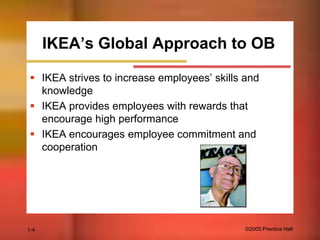
IKEA’s Global Approach to OB
 IKEA strives to increase employees’ skills and
knowledge
 IKEA provides employees with rewards that
encourage high performance
 IKEA encourages employee commitment and
cooperation

1-4

©2005 Prentice Hall
What is an Organization?
 An organization is a collection of people
who work together to achieve individual and
organizational goals
– Individual goals
– Organizational goals

1-5

©2005 Prentice Hall
What is Organizational Behavior?
 Organizational behavior (OB): the study of
factors that have an impact on how people
and groups act, think, feel, and respond to
work and organizations, and how
organizations respond to their environments

1-6

©2005 Prentice Hall
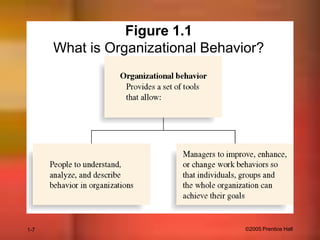
Figure 1.1
What is Organizational Behavior?

Insert Figure 1.1 here

1-7

©2005 Prentice Hall
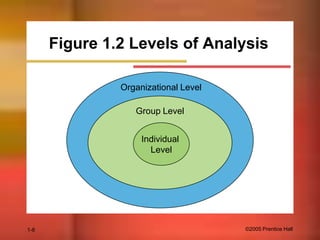
Figure 1.2 Levels of Analysis
Organizational Level
Group Level

Individual
Level

1-8

©2005 Prentice Hall
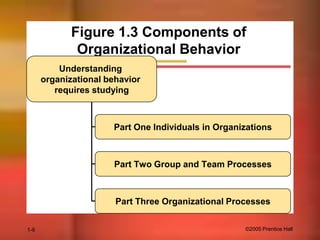
Figure 1.3 Components of
Organizational Behavior
Understanding
organizational behavior
requires studying

Part One Individuals in Organizations

Part Two Group and Team Processes

Part Three Organizational Processes
1-9

©2005 Prentice Hall
What is Management?
 Management is the process of planning,
organizing, leading, and controlling an
organization’s human, financial, material,
and other resources to increase its
effectiveness

1-10

©2005 Prentice Hall
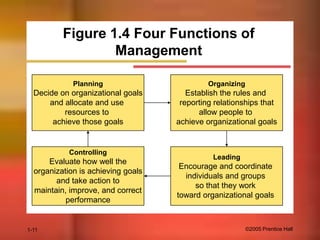
Figure 1.4 Four Functions of
Management
Planning

Organizing

Decide on organizational goals
and allocate and use
resources to
achieve those goals

Establish the rules and
reporting relationships that
allow people to
achieve organizational goals

Controlling

Evaluate how well the
organization is achieving goals
and take action to
maintain, improve, and correct
performance

1-11

Leading

Encourage and coordinate
individuals and groups
so that they work
toward organizational goals

©2005 Prentice Hall
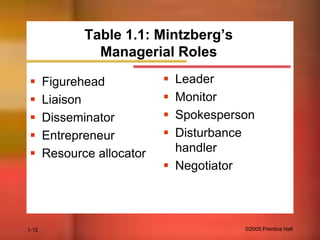
Table 1.1: Mintzberg’s
Managerial Roles






1-12

Figurehead
Liaison
Disseminator
Entrepreneur
Resource allocator






Leader
Monitor
Spokesperson
Disturbance
handler
 Negotiator

©2005 Prentice Hall
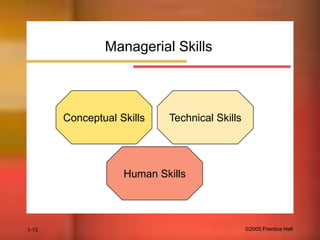
Managerial Skills

Conceptual Skills

Technical Skills

Human Skills

1-13

©2005 Prentice Hall
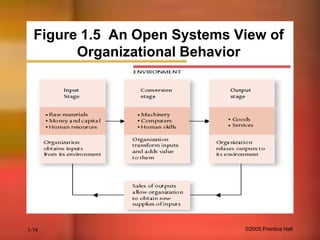
Figure 1.5 An Open Systems View of
Organizational Behavior

1-14

©2005 Prentice Hall
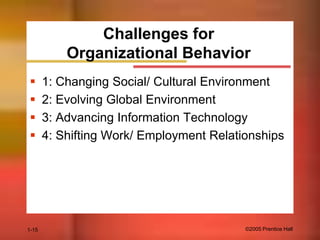
Challenges for
Organizational Behavior





1-15

1: Changing Social/ Cultural Environment
2: Evolving Global Environment
3: Advancing Information Technology
4: Shifting Work/ Employment Relationships

©2005 Prentice Hall
Changing Social and Cultural
Environment
 National culture
 Organizational ethics and well-being
 Diverse work force

1-16

©2005 Prentice Hall
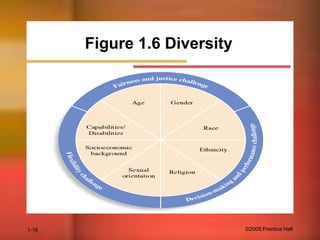
Diversity Challenges
 Fairness and Justice
 Decision-Making and Performance
 Flexibility

1-17

©2005 Prentice Hall
Figure 1.6 Diversity

1-18

©2005 Prentice Hall
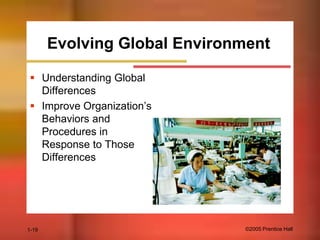
Evolving Global Environment
 Understanding Global
Differences
 Improve Organization’s
Behaviors and
Procedures in
Response to Those
Differences

1-19

©2005 Prentice Hall
Advancing Information
Technology








1-20

Information
Knowledge
Information Technology
Organizational Learning
Intranets
Creativity
Innovation

©2005 Prentice Hall
Shifting Work/ Employment
Relationships





1-21

Downsizing
Empowerment and Self-Managed Teams
Contingent Workers
Outsourcing

©2005 Prentice Hall
Appendix 1A: A Short History of
Organizational Behavior





1-22

F.W. Taylor and Scientific Management
Mary Parker Follett
Hawthorne Studies
Theory X and Y

©2005 Prentice Hall
F.W. Taylor and
Scientific Management
 Scientific management: the systematic
study of relationships between people and
tasks for the purpose of redesigning the
work process to increase efficiency
 The amount of and effort each employee
expends to produce a unit of output can be
reduced by increasing specialization and the
division of labor

1-23

©2005 Prentice Hall
Four Principles of
Scientific Management
 1. Study the way employees perform their
tasks, gather informal job knowledge that
employees possess, and experiment with
ways of improving the way tasks are
performed
 2. Codify the new methods of performing
tasks into written rules and standard
operating procedures

1-24

©2005 Prentice Hall
Four Principles of
Scientific Management_2
 3. Carefully select employees so that they
possess skills and abilities that match the
needs of the task, and train them to perform
the task according to the established rules
and procedures
 4. Establish an acceptable level of
performance for a task, and then develop a
pay system that provides a reward for
performance above the acceptable level
1-25

©2005 Prentice Hall
Mary Parker Follett
 Management must consider the human side
 Employees should be involved in job
analysis
 Person with the knowledge should be in
control of the work process regardless of
position
 Cross-functioning teams used to accomplish
projects
1-26

©2005 Prentice Hall
The Hawthorne Studies
 Hawthorne Works of the Western Electric
Company; 1924-1932
 Initiated as an attempt to investigate how
characteristics of the work setting affect
employee fatigue and performance (i.e.,
lighting)
 Found that productivity increased regardless
of whether illumination was raised or
lowered
1-27

©2005 Prentice Hall
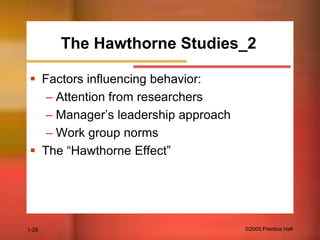
The Hawthorne Studies_2
 Factors influencing behavior:
– Attention from researchers
– Manager’s leadership approach
– Work group norms
 The “Hawthorne Effect”

1-28

©2005 Prentice Hall
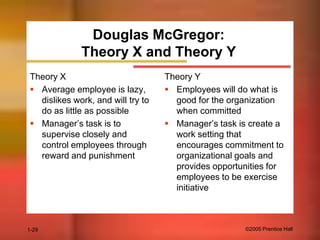
Douglas McGregor:
Theory X and Theory Y
Theory X
 Average employee is lazy,
dislikes work, and will try to
do as little as possible
 Manager’s task is to
supervise closely and
control employees through
reward and punishment

1-29

Theory Y
 Employees will do what is
good for the organization
when committed
 Manager’s task is create a
work setting that
encourages commitment to
organizational goals and
provides opportunities for
employees to be exercise
initiative

©2005 Prentice Hall

Georgejoneschap1

  • 1.
  • 2.
    Chapter Objectives  Defineorganizational behavior and explain how and why it determines the effectiveness of an organization  Appreciate why the study of organizational behavior improves a person’s ability to understand and respond to events that take place in a work setting  Differentiate between the three levels at which organizational behavior is examined 1-2 ©2005 Prentice Hall
  • 3.
    Chapter Objectives  Appreciatethe way changes in an organization’s external environment continually create challenges for organizational behavior  Describe the four main kinds of forces in the environment that post the most opportunities and problems for organizations today 1-3 ©2005 Prentice Hall
  • 4.
    IKEA’s Global Approachto OB  IKEA strives to increase employees’ skills and knowledge  IKEA provides employees with rewards that encourage high performance  IKEA encourages employee commitment and cooperation 1-4 ©2005 Prentice Hall
  • 5.
    What is anOrganization?  An organization is a collection of people who work together to achieve individual and organizational goals – Individual goals – Organizational goals 1-5 ©2005 Prentice Hall
  • 6.
    What is OrganizationalBehavior?  Organizational behavior (OB): the study of factors that have an impact on how people and groups act, think, feel, and respond to work and organizations, and how organizations respond to their environments 1-6 ©2005 Prentice Hall
  • 7.
    Figure 1.1 What isOrganizational Behavior? Insert Figure 1.1 here 1-7 ©2005 Prentice Hall
  • 8.
    Figure 1.2 Levelsof Analysis Organizational Level Group Level Individual Level 1-8 ©2005 Prentice Hall
  • 9.
    Figure 1.3 Componentsof Organizational Behavior Understanding organizational behavior requires studying Part One Individuals in Organizations Part Two Group and Team Processes Part Three Organizational Processes 1-9 ©2005 Prentice Hall
  • 10.
    What is Management? Management is the process of planning, organizing, leading, and controlling an organization’s human, financial, material, and other resources to increase its effectiveness 1-10 ©2005 Prentice Hall
  • 11.
    Figure 1.4 FourFunctions of Management Planning Organizing Decide on organizational goals and allocate and use resources to achieve those goals Establish the rules and reporting relationships that allow people to achieve organizational goals Controlling Evaluate how well the organization is achieving goals and take action to maintain, improve, and correct performance 1-11 Leading Encourage and coordinate individuals and groups so that they work toward organizational goals ©2005 Prentice Hall
  • 12.
    Table 1.1: Mintzberg’s ManagerialRoles      1-12 Figurehead Liaison Disseminator Entrepreneur Resource allocator     Leader Monitor Spokesperson Disturbance handler  Negotiator ©2005 Prentice Hall
  • 13.
    Managerial Skills Conceptual Skills TechnicalSkills Human Skills 1-13 ©2005 Prentice Hall
  • 14.
    Figure 1.5 AnOpen Systems View of Organizational Behavior 1-14 ©2005 Prentice Hall
  • 15.
    Challenges for Organizational Behavior     1-15 1:Changing Social/ Cultural Environment 2: Evolving Global Environment 3: Advancing Information Technology 4: Shifting Work/ Employment Relationships ©2005 Prentice Hall
  • 16.
    Changing Social andCultural Environment  National culture  Organizational ethics and well-being  Diverse work force 1-16 ©2005 Prentice Hall
  • 17.
    Diversity Challenges  Fairnessand Justice  Decision-Making and Performance  Flexibility 1-17 ©2005 Prentice Hall
  • 18.
  • 19.
    Evolving Global Environment Understanding Global Differences  Improve Organization’s Behaviors and Procedures in Response to Those Differences 1-19 ©2005 Prentice Hall
  • 20.
  • 21.
    Shifting Work/ Employment Relationships     1-21 Downsizing Empowermentand Self-Managed Teams Contingent Workers Outsourcing ©2005 Prentice Hall
  • 22.
    Appendix 1A: AShort History of Organizational Behavior     1-22 F.W. Taylor and Scientific Management Mary Parker Follett Hawthorne Studies Theory X and Y ©2005 Prentice Hall
  • 23.
    F.W. Taylor and ScientificManagement  Scientific management: the systematic study of relationships between people and tasks for the purpose of redesigning the work process to increase efficiency  The amount of and effort each employee expends to produce a unit of output can be reduced by increasing specialization and the division of labor 1-23 ©2005 Prentice Hall
  • 24.
    Four Principles of ScientificManagement  1. Study the way employees perform their tasks, gather informal job knowledge that employees possess, and experiment with ways of improving the way tasks are performed  2. Codify the new methods of performing tasks into written rules and standard operating procedures 1-24 ©2005 Prentice Hall
  • 25.
    Four Principles of ScientificManagement_2  3. Carefully select employees so that they possess skills and abilities that match the needs of the task, and train them to perform the task according to the established rules and procedures  4. Establish an acceptable level of performance for a task, and then develop a pay system that provides a reward for performance above the acceptable level 1-25 ©2005 Prentice Hall
  • 26.
    Mary Parker Follett Management must consider the human side  Employees should be involved in job analysis  Person with the knowledge should be in control of the work process regardless of position  Cross-functioning teams used to accomplish projects 1-26 ©2005 Prentice Hall
  • 27.
    The Hawthorne Studies Hawthorne Works of the Western Electric Company; 1924-1932  Initiated as an attempt to investigate how characteristics of the work setting affect employee fatigue and performance (i.e., lighting)  Found that productivity increased regardless of whether illumination was raised or lowered 1-27 ©2005 Prentice Hall
  • 28.
    The Hawthorne Studies_2 Factors influencing behavior: – Attention from researchers – Manager’s leadership approach – Work group norms  The “Hawthorne Effect” 1-28 ©2005 Prentice Hall
  • 29.
    Douglas McGregor: Theory Xand Theory Y Theory X  Average employee is lazy, dislikes work, and will try to do as little as possible  Manager’s task is to supervise closely and control employees through reward and punishment 1-29 Theory Y  Employees will do what is good for the organization when committed  Manager’s task is create a work setting that encourages commitment to organizational goals and provides opportunities for employees to be exercise initiative ©2005 Prentice Hall