ORGANIZATIONAL BEHAVIOR
S T E P H E N P. R O B B I N S
W W W . P R E N H A L L . C O M / R O B B I N S
T E N T H E D I T I O N
© 2003 Prentice Hall Inc. All rights reserved. PowerPoint Presentation by Charlie Cook
¿Qué es el
Comportamiento
Organizacional?
© 2003 Prentice Hall Inc.
All rights reserved. 1–2
Qué hacen los administradoresQué hacen los administradores
Managerial Activities
• Make decisions
• Allocate resources
• Direct activities of others
to attain goals
Managerial Activities
• Make decisions
• Allocate resources
• Direct activities of others
to attain goals
© 2003 Prentice Hall Inc.
All rights reserved. 1–3
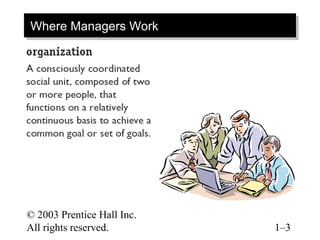
Where Managers WorkWhere Managers Work
© 2003 Prentice Hall Inc.
All rights reserved. 1–4
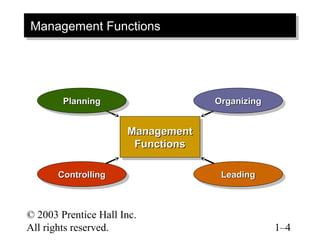
Management FunctionsManagement Functions
ManagementManagement
FunctionsFunctions
ManagementManagement
FunctionsFunctions
PlanningPlanningPlanningPlanning OrganizingOrganizingOrganizingOrganizing
LeadingLeadingLeadingLeadingControllingControllingControllingControlling
© 2003 Prentice Hall Inc.
All rights reserved. 1–5
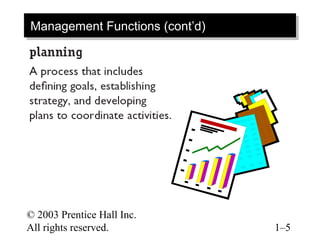
Management Functions (cont’d)Management Functions (cont’d)
© 2003 Prentice Hall Inc.
All rights reserved. 1–6
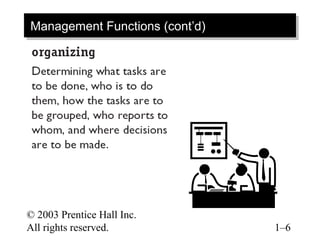
Management Functions (cont’d)Management Functions (cont’d)
© 2003 Prentice Hall Inc.
All rights reserved. 1–7
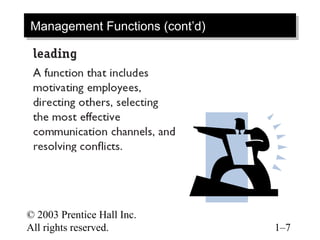
Management Functions (cont’d)Management Functions (cont’d)
© 2003 Prentice Hall Inc.
All rights reserved. 1–8
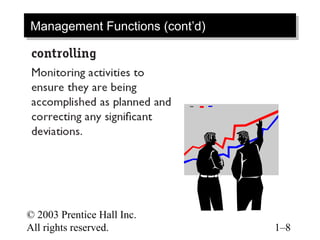
Management Functions (cont’d)Management Functions (cont’d)
© 2003 Prentice Hall Inc.
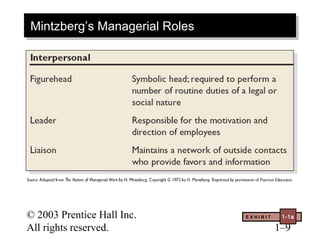
All rights reserved. 1–9
E X H I B I T 1-1a
Mintzberg’s Managerial RolesMintzberg’s Managerial Roles
© 2003 Prentice Hall Inc.
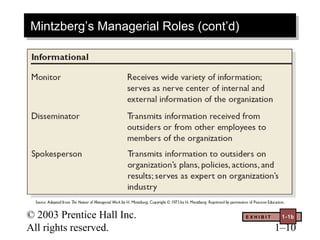
All rights reserved. 1–10
E X H I B I T 1-1b
Mintzberg’s Managerial Roles (cont’d)Mintzberg’s Managerial Roles (cont’d)
© 2003 Prentice Hall Inc.
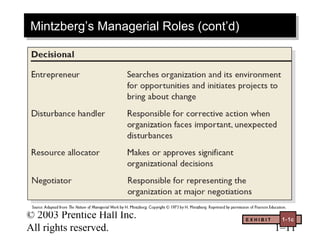
All rights reserved. 1–11
E X H I B I T 1-1c
Mintzberg’s Managerial Roles (cont’d)Mintzberg’s Managerial Roles (cont’d)
© 2003 Prentice Hall Inc.
All rights reserved. 1–12
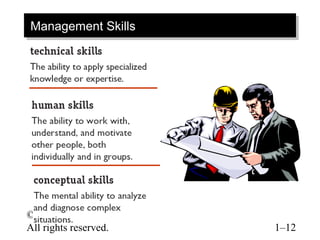
Management SkillsManagement Skills
© 2003 Prentice Hall Inc.
All rights reserved. 1–13
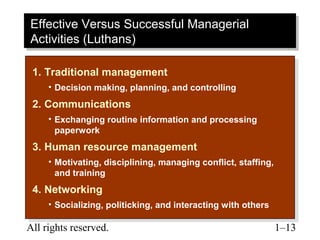
Effective Versus Successful Managerial
Activities (Luthans)
Effective Versus Successful Managerial
Activities (Luthans)
1. Traditional management
• Decision making, planning, and controlling
2. Communications
• Exchanging routine information and processing
paperwork
3. Human resource management
• Motivating, disciplining, managing conflict, staffing,
and training
4. Networking
• Socializing, politicking, and interacting with others
1. Traditional management
• Decision making, planning, and controlling
2. Communications
• Exchanging routine information and processing
paperwork
3. Human resource management
• Motivating, disciplining, managing conflict, staffing,
and training
4. Networking
• Socializing, politicking, and interacting with others
© 2003 Prentice Hall Inc.
All rights reserved. 1–14
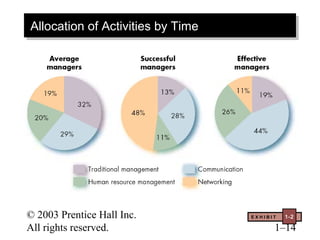
E X H I B I T 1-2
Allocation of Activities by TimeAllocation of Activities by Time
© 2003 Prentice Hall Inc.
All rights reserved. 1–15
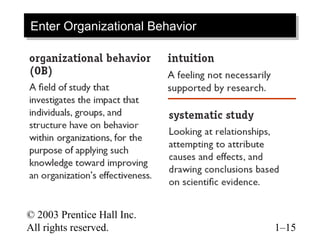
Enter Organizational BehaviorEnter Organizational Behavior
© 2003 Prentice Hall Inc.
All rights reserved. 1–16
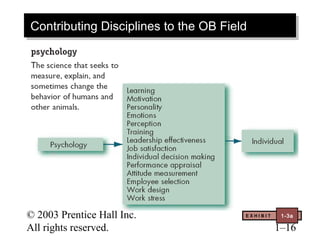
Contributing Disciplines to the OB FieldContributing Disciplines to the OB Field
E X H I B I T 1-3a
© 2003 Prentice Hall Inc.
All rights reserved. 1–17
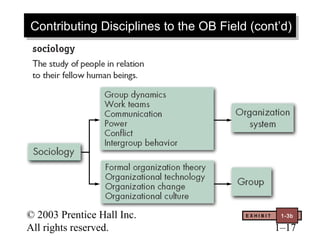
Contributing Disciplines to the OB Field (cont’d)Contributing Disciplines to the OB Field (cont’d)
E X H I B I T 1-3b
© 2003 Prentice Hall Inc.
All rights reserved. 1–18
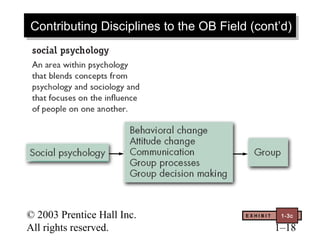
Contributing Disciplines to the OB Field (cont’d)Contributing Disciplines to the OB Field (cont’d)
E X H I B I T 1-3c
© 2003 Prentice Hall Inc.
All rights reserved. 1–19
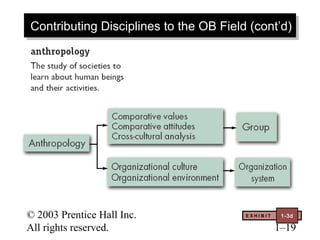
Contributing Disciplines to the OB Field (cont’d)Contributing Disciplines to the OB Field (cont’d)
E X H I B I T 1-3d
© 2003 Prentice Hall Inc.
All rights reserved. 1–20
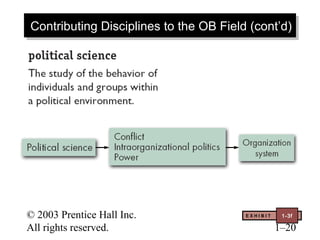
Contributing Disciplines to the OB Field (cont’d)Contributing Disciplines to the OB Field (cont’d)
E X H I B I T 1-3f
© 2003 Prentice Hall Inc.
All rights reserved. 1–21
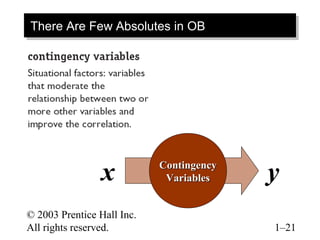
There Are Few Absolutes in OBThere Are Few Absolutes in OB
ContingencyContingency
VariablesVariablesx y
© 2003 Prentice Hall Inc.
All rights reserved. 1–22
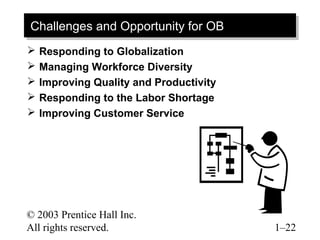
Challenges and Opportunity for OBChallenges and Opportunity for OB
 Responding to Globalization
 Managing Workforce Diversity
 Improving Quality and Productivity
 Responding to the Labor Shortage
 Improving Customer Service
© 2003 Prentice Hall Inc.
All rights reserved. 1–23
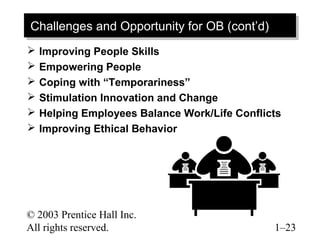
Challenges and Opportunity for OB (cont’d)Challenges and Opportunity for OB (cont’d)
 Improving People Skills
 Empowering People
 Coping with “Temporariness”
 Stimulation Innovation and Change
 Helping Employees Balance Work/Life Conflicts
 Improving Ethical Behavior
© 2003 Prentice Hall Inc.
All rights reserved. 1–24
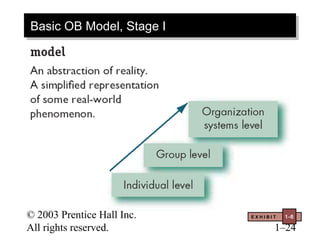
E X H I B I T 1-6
Basic OB Model, Stage IBasic OB Model, Stage I
© 2003 Prentice Hall Inc.
All rights reserved. 1–25
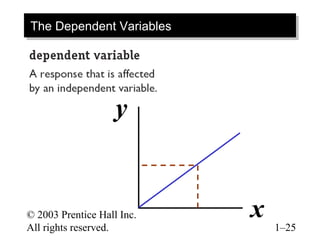
The Dependent VariablesThe Dependent Variables
x
y
© 2003 Prentice Hall Inc.
All rights reserved. 1–26
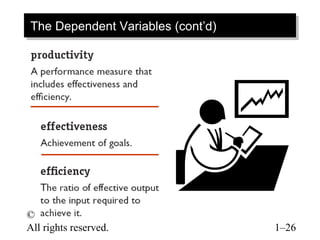
The Dependent Variables (cont’d)The Dependent Variables (cont’d)
© 2003 Prentice Hall Inc.
All rights reserved. 1–27
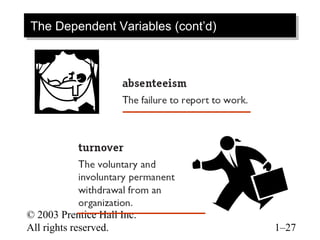
The Dependent Variables (cont’d)The Dependent Variables (cont’d)
© 2003 Prentice Hall Inc.
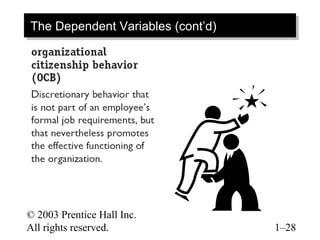
All rights reserved. 1–28
The Dependent Variables (cont’d)The Dependent Variables (cont’d)
© 2003 Prentice Hall Inc.
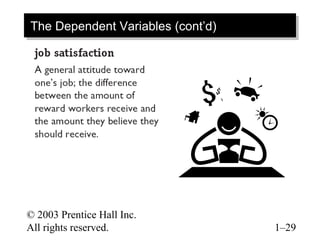
All rights reserved. 1–29
The Dependent Variables (cont’d)The Dependent Variables (cont’d)
© 2003 Prentice Hall Inc.
All rights reserved. 1–30
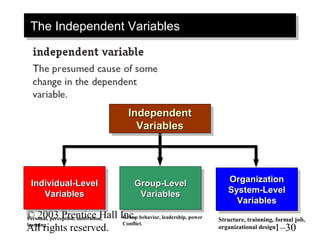
The Independent VariablesThe Independent Variables
IndependentIndependent
VariablesVariables
IndependentIndependent
VariablesVariables
Individual-LevelIndividual-Level
VariablesVariables
Individual-LevelIndividual-Level
VariablesVariables
OrganizationOrganization
System-LevelSystem-Level
VariablesVariables
OrganizationOrganization
System-LevelSystem-Level
VariablesVariables
Group-LevelGroup-Level
VariablesVariables
Group-LevelGroup-Level
VariablesVariables
Personal, perception, motivation,
learning
Group behavior, leadership, power
Conflict.
Structure, trainning, formal job,
organizational design

Qué es el CO

  • 1.
    ORGANIZATIONAL BEHAVIOR S TE P H E N P. R O B B I N S W W W . P R E N H A L L . C O M / R O B B I N S T E N T H E D I T I O N © 2003 Prentice Hall Inc. All rights reserved. PowerPoint Presentation by Charlie Cook ¿Qué es el Comportamiento Organizacional?
  • 2.
    © 2003 PrenticeHall Inc. All rights reserved. 1–2 Qué hacen los administradoresQué hacen los administradores Managerial Activities • Make decisions • Allocate resources • Direct activities of others to attain goals Managerial Activities • Make decisions • Allocate resources • Direct activities of others to attain goals
  • 3.
    © 2003 PrenticeHall Inc. All rights reserved. 1–3 Where Managers WorkWhere Managers Work
  • 4.
    © 2003 PrenticeHall Inc. All rights reserved. 1–4 Management FunctionsManagement Functions ManagementManagement FunctionsFunctions ManagementManagement FunctionsFunctions PlanningPlanningPlanningPlanning OrganizingOrganizingOrganizingOrganizing LeadingLeadingLeadingLeadingControllingControllingControllingControlling
  • 5.
    © 2003 PrenticeHall Inc. All rights reserved. 1–5 Management Functions (cont’d)Management Functions (cont’d)
  • 6.
    © 2003 PrenticeHall Inc. All rights reserved. 1–6 Management Functions (cont’d)Management Functions (cont’d)
  • 7.
    © 2003 PrenticeHall Inc. All rights reserved. 1–7 Management Functions (cont’d)Management Functions (cont’d)
  • 8.
    © 2003 PrenticeHall Inc. All rights reserved. 1–8 Management Functions (cont’d)Management Functions (cont’d)
  • 9.
    © 2003 PrenticeHall Inc. All rights reserved. 1–9 E X H I B I T 1-1a Mintzberg’s Managerial RolesMintzberg’s Managerial Roles
  • 10.
    © 2003 PrenticeHall Inc. All rights reserved. 1–10 E X H I B I T 1-1b Mintzberg’s Managerial Roles (cont’d)Mintzberg’s Managerial Roles (cont’d)
  • 11.
    © 2003 PrenticeHall Inc. All rights reserved. 1–11 E X H I B I T 1-1c Mintzberg’s Managerial Roles (cont’d)Mintzberg’s Managerial Roles (cont’d)
  • 12.
    © 2003 PrenticeHall Inc. All rights reserved. 1–12 Management SkillsManagement Skills
  • 13.
    © 2003 PrenticeHall Inc. All rights reserved. 1–13 Effective Versus Successful Managerial Activities (Luthans) Effective Versus Successful Managerial Activities (Luthans) 1. Traditional management • Decision making, planning, and controlling 2. Communications • Exchanging routine information and processing paperwork 3. Human resource management • Motivating, disciplining, managing conflict, staffing, and training 4. Networking • Socializing, politicking, and interacting with others 1. Traditional management • Decision making, planning, and controlling 2. Communications • Exchanging routine information and processing paperwork 3. Human resource management • Motivating, disciplining, managing conflict, staffing, and training 4. Networking • Socializing, politicking, and interacting with others
  • 14.
    © 2003 PrenticeHall Inc. All rights reserved. 1–14 E X H I B I T 1-2 Allocation of Activities by TimeAllocation of Activities by Time
  • 15.
    © 2003 PrenticeHall Inc. All rights reserved. 1–15 Enter Organizational BehaviorEnter Organizational Behavior
  • 16.
    © 2003 PrenticeHall Inc. All rights reserved. 1–16 Contributing Disciplines to the OB FieldContributing Disciplines to the OB Field E X H I B I T 1-3a
  • 17.
    © 2003 PrenticeHall Inc. All rights reserved. 1–17 Contributing Disciplines to the OB Field (cont’d)Contributing Disciplines to the OB Field (cont’d) E X H I B I T 1-3b
  • 18.
    © 2003 PrenticeHall Inc. All rights reserved. 1–18 Contributing Disciplines to the OB Field (cont’d)Contributing Disciplines to the OB Field (cont’d) E X H I B I T 1-3c
  • 19.
    © 2003 PrenticeHall Inc. All rights reserved. 1–19 Contributing Disciplines to the OB Field (cont’d)Contributing Disciplines to the OB Field (cont’d) E X H I B I T 1-3d
  • 20.
    © 2003 PrenticeHall Inc. All rights reserved. 1–20 Contributing Disciplines to the OB Field (cont’d)Contributing Disciplines to the OB Field (cont’d) E X H I B I T 1-3f
  • 21.
    © 2003 PrenticeHall Inc. All rights reserved. 1–21 There Are Few Absolutes in OBThere Are Few Absolutes in OB ContingencyContingency VariablesVariablesx y
  • 22.
    © 2003 PrenticeHall Inc. All rights reserved. 1–22 Challenges and Opportunity for OBChallenges and Opportunity for OB  Responding to Globalization  Managing Workforce Diversity  Improving Quality and Productivity  Responding to the Labor Shortage  Improving Customer Service
  • 23.
    © 2003 PrenticeHall Inc. All rights reserved. 1–23 Challenges and Opportunity for OB (cont’d)Challenges and Opportunity for OB (cont’d)  Improving People Skills  Empowering People  Coping with “Temporariness”  Stimulation Innovation and Change  Helping Employees Balance Work/Life Conflicts  Improving Ethical Behavior
  • 24.
    © 2003 PrenticeHall Inc. All rights reserved. 1–24 E X H I B I T 1-6 Basic OB Model, Stage IBasic OB Model, Stage I
  • 25.
    © 2003 PrenticeHall Inc. All rights reserved. 1–25 The Dependent VariablesThe Dependent Variables x y
  • 26.
    © 2003 PrenticeHall Inc. All rights reserved. 1–26 The Dependent Variables (cont’d)The Dependent Variables (cont’d)
  • 27.
    © 2003 PrenticeHall Inc. All rights reserved. 1–27 The Dependent Variables (cont’d)The Dependent Variables (cont’d)
  • 28.
    © 2003 PrenticeHall Inc. All rights reserved. 1–28 The Dependent Variables (cont’d)The Dependent Variables (cont’d)
  • 29.
    © 2003 PrenticeHall Inc. All rights reserved. 1–29 The Dependent Variables (cont’d)The Dependent Variables (cont’d)
  • 30.
    © 2003 PrenticeHall Inc. All rights reserved. 1–30 The Independent VariablesThe Independent Variables IndependentIndependent VariablesVariables IndependentIndependent VariablesVariables Individual-LevelIndividual-Level VariablesVariables Individual-LevelIndividual-Level VariablesVariables OrganizationOrganization System-LevelSystem-Level VariablesVariables OrganizationOrganization System-LevelSystem-Level VariablesVariables Group-LevelGroup-Level VariablesVariables Group-LevelGroup-Level VariablesVariables Personal, perception, motivation, learning Group behavior, leadership, power Conflict. Structure, trainning, formal job, organizational design