Data.gov:  Semantic Web,  Linked Data,  and Social Media George Thomas, GTRA June 2010
This Presentation From the Web of Docs to a Web of Data Common and Domain Specific Vocabularies URI Schemes Federation and Integration via Interlinking Vocabularies Social Metadata and Data On Freebase Using Semantic MediaWiki + Halo
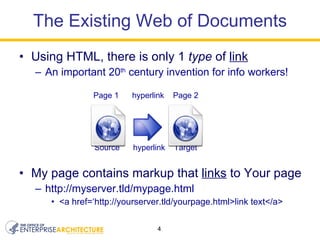
Using HTML, there is only 1  type  of  link An important 20 th  century invention for info workers!   Page 1  hyperlink  Page 2 Source  hyperlink  Target My page contains markup that  links  to Your page http://myserver.tld/mypage.html  <a href=‘http://yourserver.tld/yourpage.html>link text</a> The Existing Web of Documents
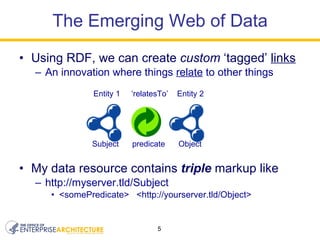
Using RDF, we can create  custom  ‘tagged’  links An innovation where things  relate  to other things   Entity 1  ‘relatesTo’  Entity 2 Subject  predicate  Object My data resource contains  triple  markup like http://myserver.tld/Subject  <somePredicate>  <http://yourserver.tld/Object>  The Emerging Web of Data
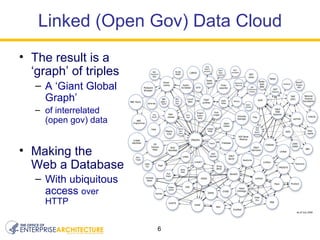
The result is a ‘graph’ of triples A ‘Giant Global Graph’  of interrelated (open gov) data Making the  Web a Database With ubiquitous access  over HTTP Linked (Open Gov) Data Cloud
Use URI’s as names for things conneg: user agent preference (HTML, RDF/XML, etc.) Use HTTP URI’s so that people can look up those names Via HTTP GET, ‘dereferencing’  When someone looks up a URI, provide useful information, using the standards (RDF and SPARQL) Include links to other URI’s so that they can discover more things ‘ traversing the data graph’ Linked Data Design Principles source
This Presentation From the Web of Docs to a Web of Data Common and Domain Specific Vocabularies Triples URI Schemes Federation and Integration via Interlinking Vocabularies Social Metadata and Data On Freebase Using Semantic MediaWiki + Halo
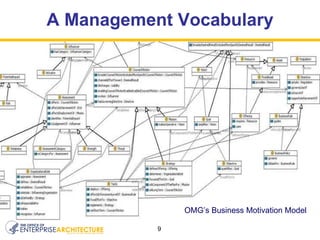
A Management Vocabulary OMG’s Business Motivation Model
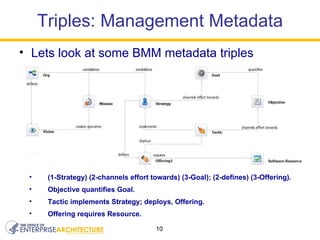
(1-Strategy) (2-channels effort towards) (3-Goal); (2-defines) (3-Offering). Objective quantifies Goal. Tactic implements Strategy; deploys, Offering.  Offering requires Resource.  Lets look at some BMM metadata triples Triples: Management Metadata
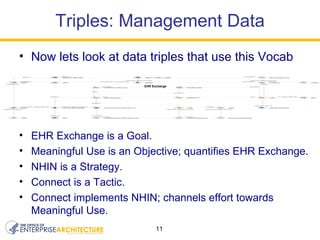
Now lets look at data triples that use this Vocab EHR Exchange is a Goal. Meaningful Use is an Objective; quantifies EHR Exchange. NHIN is a Strategy. Connect is a Tactic. Connect implements NHIN; channels effort towards Meaningful Use. EHR Exchange Triples: Management Data
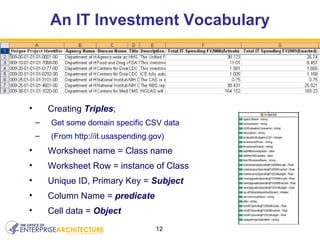
An IT Investment Vocabulary Creating  Triples ; Get some domain specific CSV data  (From http://it.usaspending.gov) Worksheet name = Class name Worksheet Row = instance of Class Unique ID, Primary Key =  Subject Column Name =  predicate Cell data =  Object
This Presentation From the Web of Docs to a Web of Data Common and Domain Specific Vocabularies URI Schemes Federation and Integration via Interlinking Vocabularies Social Metadata and Data On Freebase Using Semantic MediaWiki + Halo
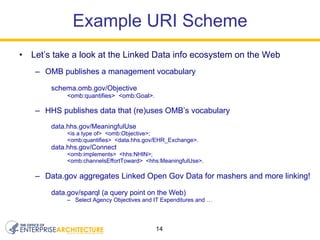
Let’s take a look at the Linked Data info ecosystem on the Web OMB publishes a management vocabulary schema.omb.gov/Objective <omb:quantifies>  <omb:Goal>. HHS publishes data that (re)uses OMB’s vocabulary data.hhs.gov/MeaningfulUse  <is a type of>  <omb:Objective>; <omb:quantifies>  <data.hhs.gov/EHR_Exchange>. data.hhs.gov/Connect <omb:implements>  <hhs:NHIN>; <omb:channelsEffortToward>  <hhs:MeaningfulUse>. Data.gov aggregates Linked Open Gov Data for mashers and more linking! data.gov/sparql (a query point on the Web) Select Agency Objectives and IT Expenditures and …  Example URI Scheme
This Presentation From the Web of Docs to a Web of Data Common and Domain Specific Vocabularies URI Schemes Federation and Integration via Interlinking Vocabularies Social Metadata and Data On Freebase Using Semantic MediaWiki + Halo
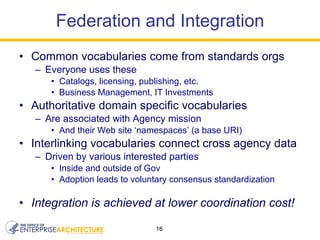
Common vocabularies come from standards orgs Everyone uses these Catalogs, licensing, publishing, etc. Business Management, IT Investments Authoritative domain specific vocabularies Are associated with Agency mission  And their Web site ‘namespaces’ (a base URI) Interlinking vocabularies connect cross agency data Driven by various interested parties Inside and outside of Gov Adoption leads to voluntary consensus standardization Integration is achieved at lower coordination cost! Federation and Integration
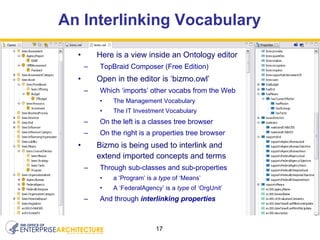
An Interlinking Vocabulary Here is a view inside an Ontology editor TopBraid Composer (Free Edition) Open in the editor is ‘bizmo.owl’ Which ‘imports’ other vocabs from the Web The Management Vocabulary The IT Investment Vocabulary On the left is a classes tree browser On the right is a properties tree browser Bizmo is being used to interlink and extend imported concepts and terms Through sub-classes and sub-properties a ‘Program’ is a  type  of ‘Means’ A ‘FederalAgency’ is a  type  of ‘OrgUnit’ And through  interlinking properties
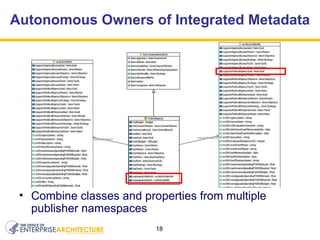
Autonomous Owners of Integrated Metadata Combine classes and properties from multiple publisher namespaces
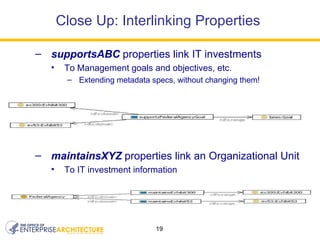
supportsABC  properties link IT investments To Management goals and objectives, etc. Extending metadata specs, without changing them! maintainsXYZ  properties link an Organizational Unit To IT investment information Close Up: Interlinking Properties
This Presentation From the Web of Docs to a Web of Data Common and Domain Specific Vocabularies URI Schemes Federation and Integration via Interlinking Vocabularies Social Metadata and Data On Freebase Using Semantic MediaWiki + Halo
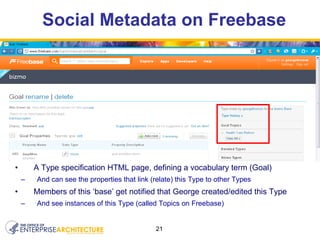
Social Metadata on Freebase A Type specification HTML page, defining a vocabulary term (Goal)  And can see the properties that link (relate) this Type to other Types Members of this ‘base’ get notified that George created/edited this Type And see instances of this Type (called Topics on Freebase)
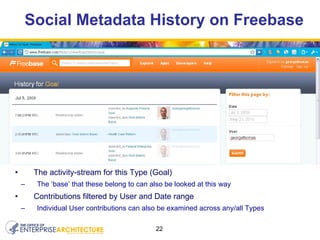
Social Metadata History on Freebase The activity-stream for this Type (Goal) The ‘base’ that these belong to can also be looked at this way Contributions filtered by User and Date range Individual User contributions can also be examined across any/all Types
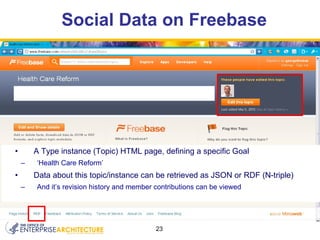
Social Data on Freebase A Type instance (Topic) HTML page, defining a specific Goal ‘ Health Care Reform’ Data about this topic/instance can be retrieved as JSON or RDF (N-triple) And it’s revision history and member contributions can be viewed
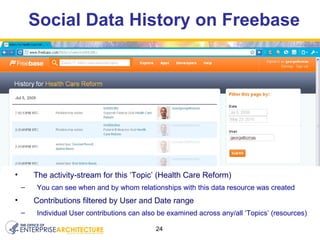
Social Data History on Freebase The activity-stream for this ‘Topic’ (Health Care Reform) You can see when and by whom relationships with this data resource was created Contributions filtered by User and Date range Individual User contributions can also be examined across any/all ‘Topics’ (resources)
This Presentation From the Web of Docs to a Web of Data Common and Domain Specific Vocabularies URI Schemes Federation and Integration via Interlinking Vocabularies Social Metadata and Data On Freebase Using Semantic MediaWiki + Halo
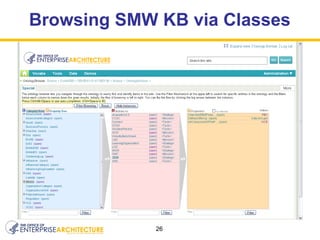
Browsing SMW KB via Classes
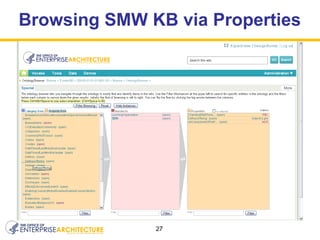
Browsing SMW KB via Properties
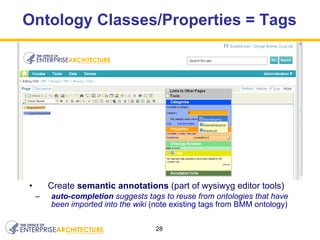
Ontology Classes/Properties = Tags Create  semantic annotations  (part of wysiwyg editor tools) auto-completion  suggests tags to reuse from ontologies that have been imported into the wiki  (note existing tags from BMM ontology)
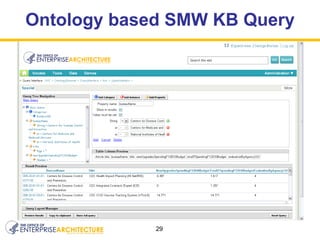
Ontology based SMW KB Query
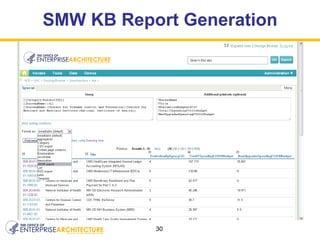
SMW KB Report Generation
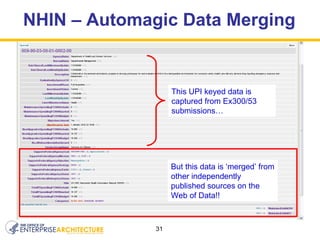
NHIN – Automagic Data Merging This UPI keyed data is captured from Ex300/53 submissions… But this data is ‘merged’ from other independently published sources on the Web of Data!!
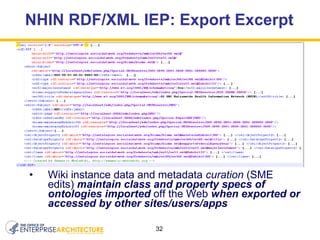
NHIN RDF/XML IEP: Export Excerpt Wiki instance data and metadata  curation  (SME edits)  maintain class and property specs of ontologies imported  off the Web  when exported or accessed by other sites/users/apps
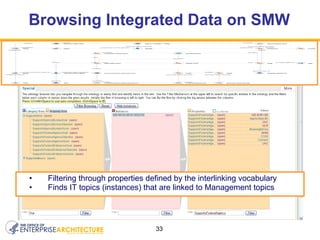
Browsing Integrated Data on SMW Filtering through properties defined by the interlinking vocabulary Finds IT topics (instances) that are linked to Management topics
Conclusion Data.gov is today: One of the largest sets of Open Government RDF data on the Web Data.gov tomorrow will explore: Focus on common, domain specific and interlinking vocabularies, and corresponding URI schemes And treat those vocabularies and their instance data as Social media objects on the Social Web Questions?
Thanks For Your Time! Contact me: http://xri.net/=george.thomas About me: HHS Enterprise Architect CTO Council, member Innovation Council, member Federal CIO Council  Architecture and Infrastructure Committee (AIC), Services Subcommittee co-chair Cloud Computing Advisory Committee (CCAC), member W3C eGov IG, Invited Expert OMG GovDTF, Steering Committee member Graduate School, SOA Faculty Instructor

George thomas gtra2010

  • 1.
    Data.gov: SemanticWeb, Linked Data, and Social Media George Thomas, GTRA June 2010
  • 2.
    This Presentation Fromthe Web of Docs to a Web of Data Common and Domain Specific Vocabularies URI Schemes Federation and Integration via Interlinking Vocabularies Social Metadata and Data On Freebase Using Semantic MediaWiki + Halo
  • 3.
    This Presentation Fromthe Web of Docs to a Web of Data Common and Domain Specific Vocabularies URI Schemes Federation and Integration via Interlinking Vocabularies Social Metadata and Data On Freebase Using Semantic MediaWiki + Halo
  • 4.
    Using HTML, thereis only 1 type of link An important 20 th century invention for info workers! Page 1 hyperlink Page 2 Source hyperlink Target My page contains markup that links to Your page http://myserver.tld/mypage.html <a href=‘http://yourserver.tld/yourpage.html>link text</a> The Existing Web of Documents
  • 5.
    Using RDF, wecan create custom ‘tagged’ links An innovation where things relate to other things Entity 1 ‘relatesTo’ Entity 2 Subject predicate Object My data resource contains triple markup like http://myserver.tld/Subject <somePredicate> <http://yourserver.tld/Object> The Emerging Web of Data
  • 6.
    The result isa ‘graph’ of triples A ‘Giant Global Graph’ of interrelated (open gov) data Making the Web a Database With ubiquitous access over HTTP Linked (Open Gov) Data Cloud
  • 7.
    Use URI’s as namesfor things conneg: user agent preference (HTML, RDF/XML, etc.) Use HTTP URI’s so that people can look up those names Via HTTP GET, ‘dereferencing’ When someone looks up a URI, provide useful information, using the standards (RDF and SPARQL) Include links to other URI’s so that they can discover more things ‘ traversing the data graph’ Linked Data Design Principles source
  • 8.
    This Presentation Fromthe Web of Docs to a Web of Data Common and Domain Specific Vocabularies Triples URI Schemes Federation and Integration via Interlinking Vocabularies Social Metadata and Data On Freebase Using Semantic MediaWiki + Halo
  • 9.
    A Management VocabularyOMG’s Business Motivation Model
  • 10.
    (1-Strategy) (2-channels efforttowards) (3-Goal); (2-defines) (3-Offering). Objective quantifies Goal. Tactic implements Strategy; deploys, Offering. Offering requires Resource. Lets look at some BMM metadata triples Triples: Management Metadata
  • 11.
    Now lets lookat data triples that use this Vocab EHR Exchange is a Goal. Meaningful Use is an Objective; quantifies EHR Exchange. NHIN is a Strategy. Connect is a Tactic. Connect implements NHIN; channels effort towards Meaningful Use. EHR Exchange Triples: Management Data
  • 12.
    An IT InvestmentVocabulary Creating Triples ; Get some domain specific CSV data (From http://it.usaspending.gov) Worksheet name = Class name Worksheet Row = instance of Class Unique ID, Primary Key = Subject Column Name = predicate Cell data = Object
  • 13.
    This Presentation Fromthe Web of Docs to a Web of Data Common and Domain Specific Vocabularies URI Schemes Federation and Integration via Interlinking Vocabularies Social Metadata and Data On Freebase Using Semantic MediaWiki + Halo
  • 14.
    Let’s take alook at the Linked Data info ecosystem on the Web OMB publishes a management vocabulary schema.omb.gov/Objective <omb:quantifies> <omb:Goal>. HHS publishes data that (re)uses OMB’s vocabulary data.hhs.gov/MeaningfulUse <is a type of> <omb:Objective>; <omb:quantifies> <data.hhs.gov/EHR_Exchange>. data.hhs.gov/Connect <omb:implements> <hhs:NHIN>; <omb:channelsEffortToward> <hhs:MeaningfulUse>. Data.gov aggregates Linked Open Gov Data for mashers and more linking! data.gov/sparql (a query point on the Web) Select Agency Objectives and IT Expenditures and … Example URI Scheme
  • 15.
    This Presentation Fromthe Web of Docs to a Web of Data Common and Domain Specific Vocabularies URI Schemes Federation and Integration via Interlinking Vocabularies Social Metadata and Data On Freebase Using Semantic MediaWiki + Halo
  • 16.
    Common vocabularies comefrom standards orgs Everyone uses these Catalogs, licensing, publishing, etc. Business Management, IT Investments Authoritative domain specific vocabularies Are associated with Agency mission And their Web site ‘namespaces’ (a base URI) Interlinking vocabularies connect cross agency data Driven by various interested parties Inside and outside of Gov Adoption leads to voluntary consensus standardization Integration is achieved at lower coordination cost! Federation and Integration
  • 17.
    An Interlinking VocabularyHere is a view inside an Ontology editor TopBraid Composer (Free Edition) Open in the editor is ‘bizmo.owl’ Which ‘imports’ other vocabs from the Web The Management Vocabulary The IT Investment Vocabulary On the left is a classes tree browser On the right is a properties tree browser Bizmo is being used to interlink and extend imported concepts and terms Through sub-classes and sub-properties a ‘Program’ is a type of ‘Means’ A ‘FederalAgency’ is a type of ‘OrgUnit’ And through interlinking properties
  • 18.
    Autonomous Owners ofIntegrated Metadata Combine classes and properties from multiple publisher namespaces
  • 19.
    supportsABC propertieslink IT investments To Management goals and objectives, etc. Extending metadata specs, without changing them! maintainsXYZ properties link an Organizational Unit To IT investment information Close Up: Interlinking Properties
  • 20.
    This Presentation Fromthe Web of Docs to a Web of Data Common and Domain Specific Vocabularies URI Schemes Federation and Integration via Interlinking Vocabularies Social Metadata and Data On Freebase Using Semantic MediaWiki + Halo
  • 21.
    Social Metadata onFreebase A Type specification HTML page, defining a vocabulary term (Goal) And can see the properties that link (relate) this Type to other Types Members of this ‘base’ get notified that George created/edited this Type And see instances of this Type (called Topics on Freebase)
  • 22.
    Social Metadata Historyon Freebase The activity-stream for this Type (Goal) The ‘base’ that these belong to can also be looked at this way Contributions filtered by User and Date range Individual User contributions can also be examined across any/all Types
  • 23.
    Social Data onFreebase A Type instance (Topic) HTML page, defining a specific Goal ‘ Health Care Reform’ Data about this topic/instance can be retrieved as JSON or RDF (N-triple) And it’s revision history and member contributions can be viewed
  • 24.
    Social Data Historyon Freebase The activity-stream for this ‘Topic’ (Health Care Reform) You can see when and by whom relationships with this data resource was created Contributions filtered by User and Date range Individual User contributions can also be examined across any/all ‘Topics’ (resources)
  • 25.
    This Presentation Fromthe Web of Docs to a Web of Data Common and Domain Specific Vocabularies URI Schemes Federation and Integration via Interlinking Vocabularies Social Metadata and Data On Freebase Using Semantic MediaWiki + Halo
  • 26.
    Browsing SMW KBvia Classes
  • 27.
    Browsing SMW KBvia Properties
  • 28.
    Ontology Classes/Properties =Tags Create semantic annotations (part of wysiwyg editor tools) auto-completion suggests tags to reuse from ontologies that have been imported into the wiki (note existing tags from BMM ontology)
  • 29.
  • 30.
    SMW KB ReportGeneration
  • 31.
    NHIN – AutomagicData Merging This UPI keyed data is captured from Ex300/53 submissions… But this data is ‘merged’ from other independently published sources on the Web of Data!!
  • 32.
    NHIN RDF/XML IEP:Export Excerpt Wiki instance data and metadata curation (SME edits) maintain class and property specs of ontologies imported off the Web when exported or accessed by other sites/users/apps
  • 33.
    Browsing Integrated Dataon SMW Filtering through properties defined by the interlinking vocabulary Finds IT topics (instances) that are linked to Management topics
  • 34.
    Conclusion Data.gov istoday: One of the largest sets of Open Government RDF data on the Web Data.gov tomorrow will explore: Focus on common, domain specific and interlinking vocabularies, and corresponding URI schemes And treat those vocabularies and their instance data as Social media objects on the Social Web Questions?
  • 35.
    Thanks For YourTime! Contact me: http://xri.net/=george.thomas About me: HHS Enterprise Architect CTO Council, member Innovation Council, member Federal CIO Council Architecture and Infrastructure Committee (AIC), Services Subcommittee co-chair Cloud Computing Advisory Committee (CCAC), member W3C eGov IG, Invited Expert OMG GovDTF, Steering Committee member Graduate School, SOA Faculty Instructor