Data.gov:  Web, Data Web, Social Data Web [email_address] 7/22/2010 #health2stat
The Web is evolving… From a Web of Linked Documents, To a Web of Linked Data!
OK… What does that mean? Bear with me for a quick overview -
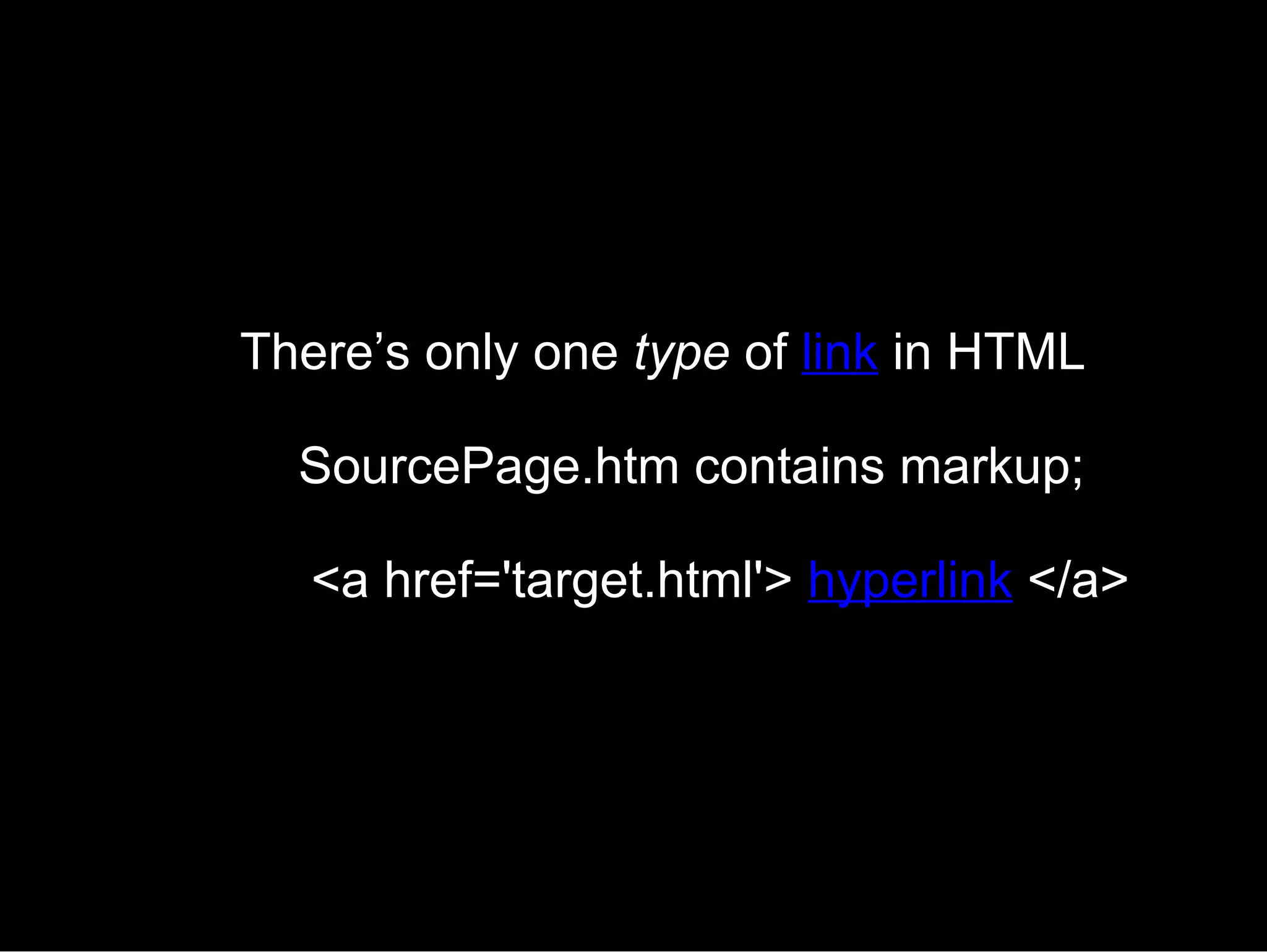
There’s only one  type  of  link  in HTML SourcePage.htm contains markup; <a href='target.html'>  hyperlink   </a>
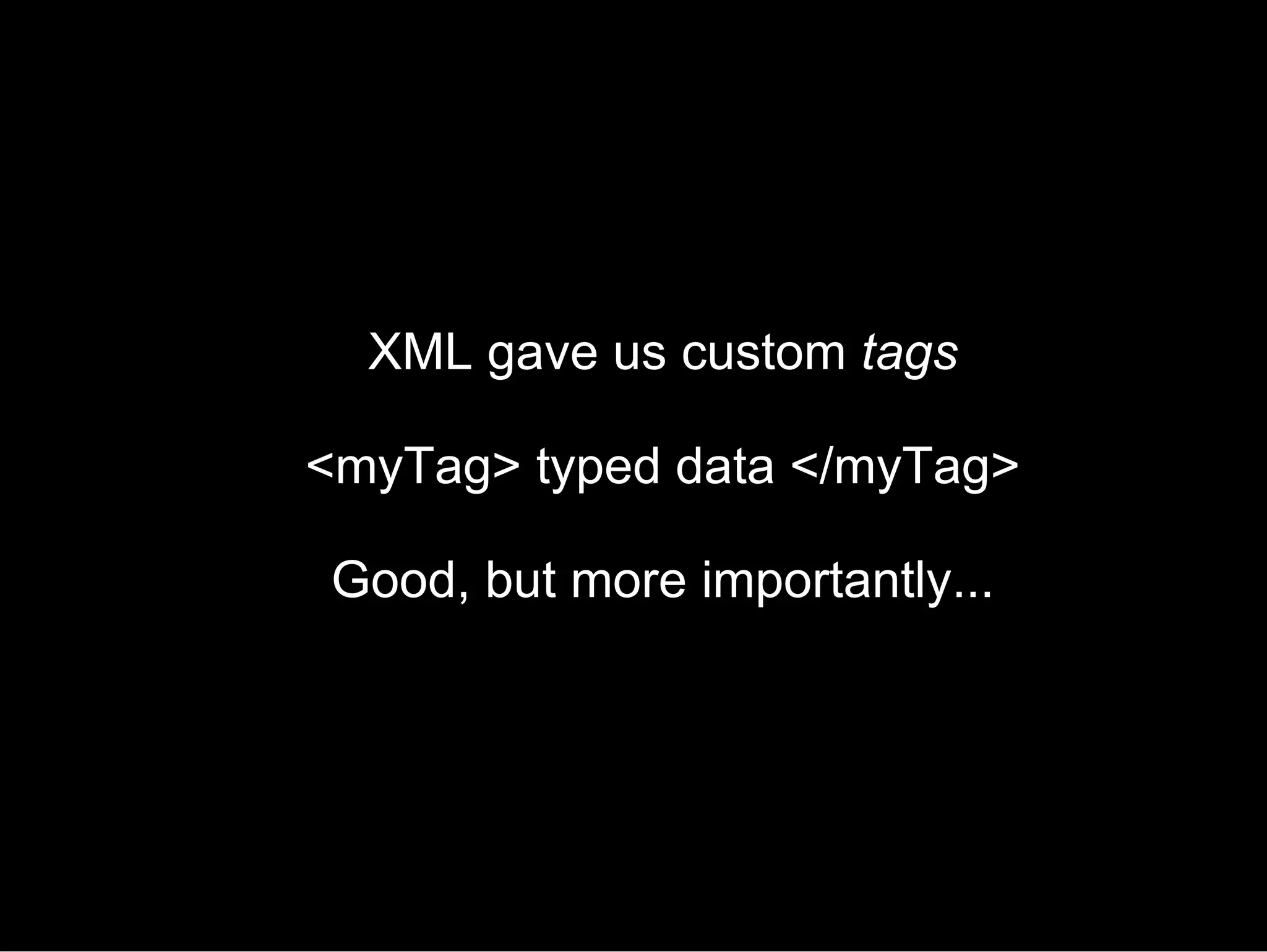
XML gave us custom  tags <myTag> typed data </myTag> Good, but more importantly...
The Architecture of the Web (one of the most important and successful inventions of the 20 th  Century!) is  REST ful (Info) Resource Representations (URI’s vs URL’s), Uniform Interface (CRUD via HTTP methods), server Resource and client App state (via links)...
Web + Data = Data Web The Data Web (aka Web of Data) is an innovation that extends the existing Web of Documents Beginning with the Resource Description Framework ( RDF ) Which is a Web based  data modeling language
RDF  gives us  custom link types : node <arc> node thing <relationship> thing topic <property> topic entity <attribute> value subject <predicate> object the grammar of  ‘triples’
HTTP GET ’dereferences’ RDF  triples  in multiple serialization (.htm, .rdf, .json) formats So, the URI http://agency.gov/Subject has a URL  representation  that returns <http://my.org/predicate>  <http://your.com/Object>
Grammar needs  vocabularies ... Vocabularies can be  metadata : Objective quantifies Goal So  http://standards.org/vocab/Objective  returns; <quantifies>   <http://standards.org/vocab/Goal>
Instance   data  (re)uses vocabularies: Meaningful Use 'is a' (type of) Objective http://onc.hhs.gov/Meaningful_Use <type>  <http://standards.org/Objective> EHR Exchange 'is a' (type of) Goal http://onc.hhs.gov/EHR_Exchange <type>  <http://standards.org/Goal>
OK… Now we’ve introduced to the  what , but -  WHY  should we do this  Linked (Open Gov) Data  stuff?
We can (automatically)  infer  things like;  Meaningful Use quantifies EHR Exchange We can traverse (via apps and browsers) the data graph with  no apriori domain knowledge … We/others just make  links  to correlate disparately owned/managed/published data across distinct (some say federated) domains…
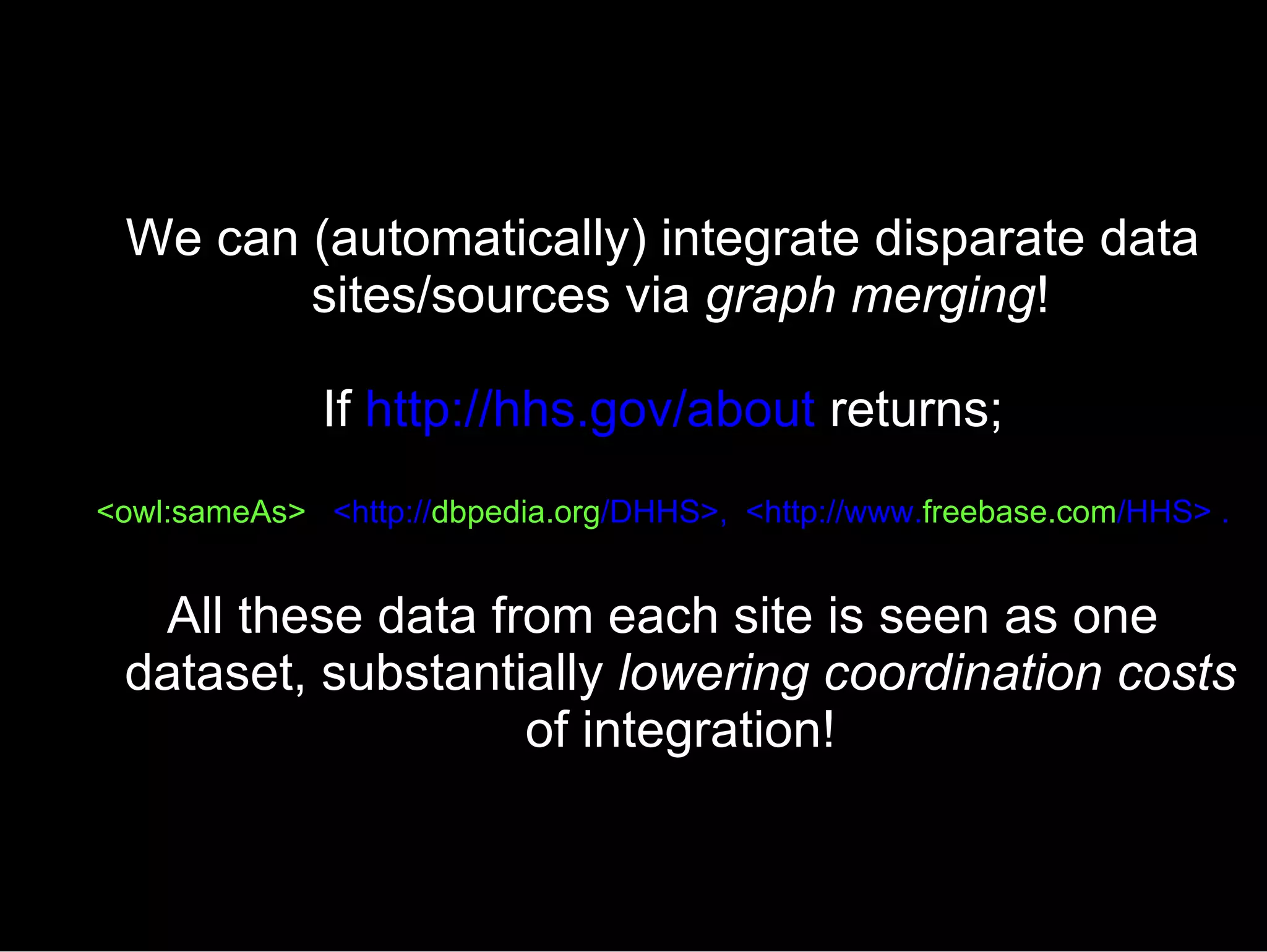
We can (automatically) integrate disparate data sites/sources via  graph merging ! If  http://hhs.gov/about  returns; <owl:sameAs>  <http:// dbpedia.org /DHHS>,  <http://www. freebase.com /HHS> . All these data from each site is seen as one dataset, substantially  lowering coordination costs  of integration!
Who is doing this in Industry? Google, Facebook, Yahoo NY Times, Newsweek Best Buy, … What about Government Agencies? Library of Congress Subject Headings http://id.loc.gov – pace setting example!
So what about Data.gov? (Homepage: ‘Linking Open Government Data’) Data.gov PMO SemWeb and Linked Data Team Collaboration with tw.rpi.edu – SemWeb inventors Federal CIOC-AIC Data Architecture Subcommittee Open Government Vocabulary WG
How about at HHS? NLM: UMLS ‘SPARQL endpoint’ http://mor.nlm.nih.gov/sparql CMS: Data.gov PMO SemWeb Team members CMS Dashboard vocabulary WIP CHDI: vocabularies and URI schemes
Rich  linking  scenarios to explore; What are successful community intervention tactics to combat childhood obesity? For these geographic health stats, what evidence based provider payment/performance trends emerge? What other Gov data is relevant? Is there something in the air or water?
Web + Data = Data Web;  Data Web + Social = Social Data Web!  Consider the metadata creation (domain SME’s) and instance data curation (info workers) as objects of social collaboration.  Activity-stream history feeds, viral expert networking (etc.) will all contribute to  enhanced data quality .  Think structured data wikis, where tags are suggested and come from SME designed ontologies (vocabularies) instead of user-generated folksonomies.
What can YOU do? Get involved with the Data.gov PMO and/or the FCIOC-AIC-DAS-OGV-WG! (Come to DC Semantic Web meetups too...) Contact me   THANKS!!!

Gt health2stat 7-22-2010

  • 1.
    Data.gov: Web,Data Web, Social Data Web [email_address] 7/22/2010 #health2stat
  • 2.
    The Web isevolving… From a Web of Linked Documents, To a Web of Linked Data!
  • 3.
    OK… What doesthat mean? Bear with me for a quick overview -
  • 4.
    There’s only one type of link in HTML SourcePage.htm contains markup; <a href='target.html'> hyperlink </a>
  • 5.
    XML gave uscustom tags <myTag> typed data </myTag> Good, but more importantly...
  • 6.
    The Architecture ofthe Web (one of the most important and successful inventions of the 20 th Century!) is REST ful (Info) Resource Representations (URI’s vs URL’s), Uniform Interface (CRUD via HTTP methods), server Resource and client App state (via links)...
  • 7.
    Web + Data= Data Web The Data Web (aka Web of Data) is an innovation that extends the existing Web of Documents Beginning with the Resource Description Framework ( RDF ) Which is a Web based data modeling language
  • 8.
    RDF givesus custom link types : node <arc> node thing <relationship> thing topic <property> topic entity <attribute> value subject <predicate> object the grammar of ‘triples’
  • 9.
    HTTP GET ’dereferences’RDF triples in multiple serialization (.htm, .rdf, .json) formats So, the URI http://agency.gov/Subject has a URL representation that returns <http://my.org/predicate> <http://your.com/Object>
  • 10.
    Grammar needs vocabularies ... Vocabularies can be metadata : Objective quantifies Goal So http://standards.org/vocab/Objective returns; <quantifies> <http://standards.org/vocab/Goal>
  • 11.
    Instance data (re)uses vocabularies: Meaningful Use 'is a' (type of) Objective http://onc.hhs.gov/Meaningful_Use <type> <http://standards.org/Objective> EHR Exchange 'is a' (type of) Goal http://onc.hhs.gov/EHR_Exchange <type> <http://standards.org/Goal>
  • 12.
    OK… Now we’veintroduced to the what , but - WHY should we do this Linked (Open Gov) Data stuff?
  • 13.
    We can (automatically) infer things like; Meaningful Use quantifies EHR Exchange We can traverse (via apps and browsers) the data graph with no apriori domain knowledge … We/others just make links to correlate disparately owned/managed/published data across distinct (some say federated) domains…
  • 14.
    We can (automatically)integrate disparate data sites/sources via graph merging ! If http://hhs.gov/about returns; <owl:sameAs> <http:// dbpedia.org /DHHS>, <http://www. freebase.com /HHS> . All these data from each site is seen as one dataset, substantially lowering coordination costs of integration!
  • 15.
    Who is doingthis in Industry? Google, Facebook, Yahoo NY Times, Newsweek Best Buy, … What about Government Agencies? Library of Congress Subject Headings http://id.loc.gov – pace setting example!
  • 16.
    So what aboutData.gov? (Homepage: ‘Linking Open Government Data’) Data.gov PMO SemWeb and Linked Data Team Collaboration with tw.rpi.edu – SemWeb inventors Federal CIOC-AIC Data Architecture Subcommittee Open Government Vocabulary WG
  • 17.
    How about atHHS? NLM: UMLS ‘SPARQL endpoint’ http://mor.nlm.nih.gov/sparql CMS: Data.gov PMO SemWeb Team members CMS Dashboard vocabulary WIP CHDI: vocabularies and URI schemes
  • 18.
    Rich linking scenarios to explore; What are successful community intervention tactics to combat childhood obesity? For these geographic health stats, what evidence based provider payment/performance trends emerge? What other Gov data is relevant? Is there something in the air or water?
  • 19.
    Web + Data= Data Web; Data Web + Social = Social Data Web! Consider the metadata creation (domain SME’s) and instance data curation (info workers) as objects of social collaboration. Activity-stream history feeds, viral expert networking (etc.) will all contribute to enhanced data quality . Think structured data wikis, where tags are suggested and come from SME designed ontologies (vocabularies) instead of user-generated folksonomies.
  • 20.
    What can YOUdo? Get involved with the Data.gov PMO and/or the FCIOC-AIC-DAS-OGV-WG! (Come to DC Semantic Web meetups too...) Contact me  THANKS!!!