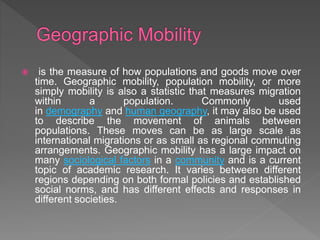
 is the measure of how populations and goods move over
time. Geographic mobility, population mobility, or more
simply mobility is also a statistic that measures migration
within a population. Commonly used
in demography and human geography, it may also be used
to describe the movement of animals between
populations. These moves can be as large scale as
international migrations or as small as regional commuting
arrangements. Geographic mobility has a large impact on
many sociological factors in a community and is a current
topic of academic research. It varies between different
regions depending on both formal policies and established
social norms, and has different effects and responses in
different societies.
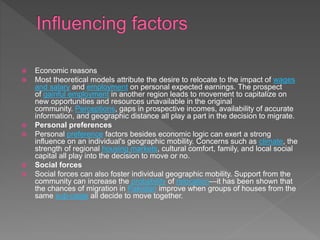
 Economic reasons
 Most theoretical models attribute the desire to relocate to the impact of wages
and salary and employment on personal expected earnings. The prospect
of gainful employment in another region leads to movement to capitalize on
new opportunities and resources unavailable in the original
community. Perceptions, gaps in prospective incomes, availability of accurate
information, and geographic distance all play a part in the decision to migrate.
 Personal preferences
 Personal preference factors besides economic logic can exert a strong
influence on an individual's geographic mobility. Concerns such as climate, the
strength of regional housing markets, cultural comfort, family, and local social
capital all play into the decision to move or no.
 Social forces
 Social forces can also foster individual geographic mobility. Support from the
community can increase the probability of relocation—it has been shown that
the chances of migration in Pakistan improve when groups of houses from the
same sub-caste all decide to move together.
 Labor supply
 Geographical mobility of labor allows the labor supply to respond to
regional disparities, limiting economic inefficiencies. Low labor
mobility quickly leads to inequality between static economic regions
and a misappropriation of labor resources
 Resource allocation
 Labor mobility theoretically leads to a more balanced
and economically efficient distribution of jobs and resources overall.
Individual employees can better match their skills to potential jobs on
the open job market
 Remittances
 Geographic mobility allows for remittances from distant family
members back to support local needs. Loans and transfers can flow
back from migrated members of a community to sustain those who
remain behind


 Empowerment
 Participation
 Transportation access
 Increased geographic mobility can offer new
opportunities to previously isolated groups.
In Pakistan increasing mobility allows families
the chance to strengthen family ties by sending
children to traditional homes or expand
educational opportunities with options to
attend urban schools.[13] Additional economic
freedom bolstered by additional capital from
remittances can allow children to stay in school
longer without having to worry about supporting
the core family
 Cultural exchange
 Increased geographic mobility increases the
depth and quality of cultural exchange between
communities.[4] Travel and cooperation bring
people together across cultural divides and
facilitate the trade of customs and ideas. New
community members bring unique talents and
skills that can improve overall services and
bring additional opportunity to an area
 Social networks
 Increasing long range personal mobility tends to lead to
geographic expansion of an individual's support network.
Long distance connections require more time to visit and
minimizes the occurrence of unplanned social interaction.
Increased mobility can decrease an individual's
attachment to a local community and weaken local support
networks. People often turn to information technology to
maintain connections across distance, strengthening
distance relationships and allowing people to pursue
career opportunities despite geographic distance from a
partner.

Geographic mobility

  • 2.
     is themeasure of how populations and goods move over time. Geographic mobility, population mobility, or more simply mobility is also a statistic that measures migration within a population. Commonly used in demography and human geography, it may also be used to describe the movement of animals between populations. These moves can be as large scale as international migrations or as small as regional commuting arrangements. Geographic mobility has a large impact on many sociological factors in a community and is a current topic of academic research. It varies between different regions depending on both formal policies and established social norms, and has different effects and responses in different societies.
  • 3.
     Economic reasons Most theoretical models attribute the desire to relocate to the impact of wages and salary and employment on personal expected earnings. The prospect of gainful employment in another region leads to movement to capitalize on new opportunities and resources unavailable in the original community. Perceptions, gaps in prospective incomes, availability of accurate information, and geographic distance all play a part in the decision to migrate.  Personal preferences  Personal preference factors besides economic logic can exert a strong influence on an individual's geographic mobility. Concerns such as climate, the strength of regional housing markets, cultural comfort, family, and local social capital all play into the decision to move or no.  Social forces  Social forces can also foster individual geographic mobility. Support from the community can increase the probability of relocation—it has been shown that the chances of migration in Pakistan improve when groups of houses from the same sub-caste all decide to move together.
  • 4.
     Labor supply Geographical mobility of labor allows the labor supply to respond to regional disparities, limiting economic inefficiencies. Low labor mobility quickly leads to inequality between static economic regions and a misappropriation of labor resources  Resource allocation  Labor mobility theoretically leads to a more balanced and economically efficient distribution of jobs and resources overall. Individual employees can better match their skills to potential jobs on the open job market  Remittances  Geographic mobility allows for remittances from distant family members back to support local needs. Loans and transfers can flow back from migrated members of a community to sustain those who remain behind  
  • 5.
  • 6.
     Increased geographicmobility can offer new opportunities to previously isolated groups. In Pakistan increasing mobility allows families the chance to strengthen family ties by sending children to traditional homes or expand educational opportunities with options to attend urban schools.[13] Additional economic freedom bolstered by additional capital from remittances can allow children to stay in school longer without having to worry about supporting the core family
  • 7.
     Cultural exchange Increased geographic mobility increases the depth and quality of cultural exchange between communities.[4] Travel and cooperation bring people together across cultural divides and facilitate the trade of customs and ideas. New community members bring unique talents and skills that can improve overall services and bring additional opportunity to an area
  • 8.
     Social networks Increasing long range personal mobility tends to lead to geographic expansion of an individual's support network. Long distance connections require more time to visit and minimizes the occurrence of unplanned social interaction. Increased mobility can decrease an individual's attachment to a local community and weaken local support networks. People often turn to information technology to maintain connections across distance, strengthening distance relationships and allowing people to pursue career opportunities despite geographic distance from a partner.