Geographic Data Uncertainty
“ Uncertainties in Spatial Decisions”
S.M.J.S.Samarasinghe
Senior Superintendent of Surveys
Survey Department of Sri Lanka.
IIntroduction
Problem Synthesis
Perspectives in Uncertainty
Model of Decision Making Process
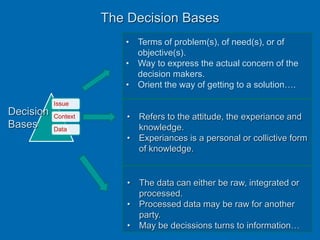
Decision Bases
Decision Phases
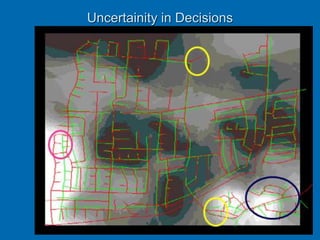
Uncertainties in Decisions
Uncertainty and Ethics
Risk Management in Decision Making
Conclusion
Content…
Introduction
 There are thousands of ways to measure the position,
shape, orientation and size of phenomena or objects.
 Data uncertainty varies spatially and over time.
 Ambiguity of concepts (semantics, geometry)
 Poorly known resolution and precision
 Lack of up-to-dateness and timeliness
 Incompleteness
 Low level of processing………
Every time data are reused or
transformed,
Decisions are taken place in
several steps and,
additional uncertinities are
introduced.…
Problem Synthisis
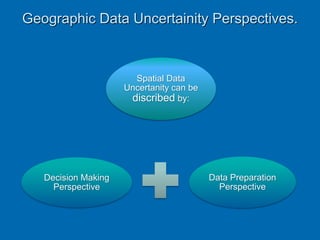
Decision Making
Perspective
Data Preparation
Perspective
Spatial Data
Uncertanity can be
discribed by:
Geographic Data Uncertainity Perspectives.
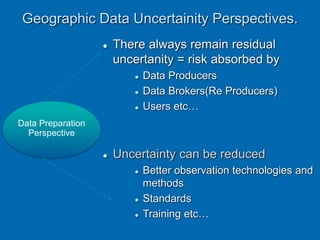
 There always remain residual
uncertanity = risk absorbed by
 Data Producers
 Data Brokers(Re Producers)
 Users etc…
 Uncertainty can be reduced
 Better observation technologies and
methods
 Standards
 Training etc…
Data Preparation
Perspective
Geographic Data Uncertainity Perspectives.
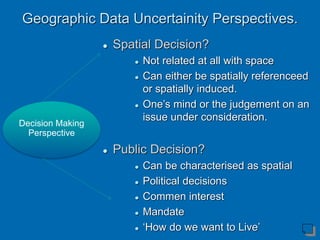
 Spatial Decision?
 Not related at all with space
 Can either be spatially referenceed
or spatially induced.
 One’s mind or the judgement on an
issue under consideration.
 Public Decision?
 Can be characterised as spatial
 Political decisions
 Commen interest
 Mandate
 ‘How do we want to Live’
Decision Making
Perspective
Geographic Data Uncertainity Perspectives.
A Model of the Decision Making Process
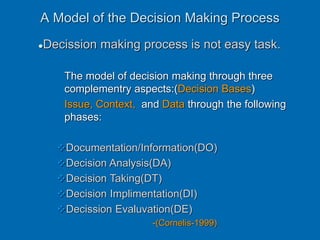
Decission making process is not easy task.
The model of decision making through three
complementry aspects:(Decision Bases)
Issue, Context, and Data through the following
phases:
Documentation/Information(DO)
Decision Analysis(DA)
Decision Taking(DT)
Decision Implimentation(DI)
Decission Evaluvation(DE)
-(Cornelis-1999)
The Decision Bases
Issue
Context
Data
• Terms of problem(s), of need(s), or of
objective(s).
• Way to express the actual concern of the
decision makers.
• Orient the way of getting to a solution….
• Refers to the attitude, the experiance and
knowledge.
• Experiances is a personal or collictive form
of knowledge.
• The data can either be raw, integrated or
processed.
• Processed data may be raw for another
party.
• May be decissions turns to information…
Decision
Bases
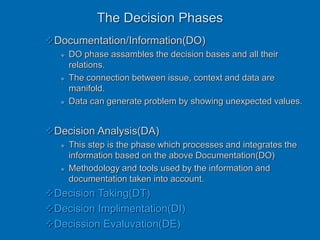
The Decision Phases
Documentation/Information(DO)
 DO phase assambles the decision bases and all their
relations.
 The connection between issue, context and data are
manifold.
 Data can generate problem by showing unexpected values.
Decision Analysis(DA)
 This step is the phase which processes and integrates the
information based on the above Documentation(DO)
 Methodology and tools used by the information and
documentation taken into account.
Decision Taking(DT)
Decision Implimentation(DI)
Decission Evaluvation(DE)
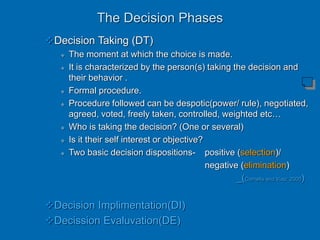
The Decision Phases
Decision Taking (DT)
 The moment at which the choice is made.
 It is characterized by the person(s) taking the decision and
their behavior .
 Formal procedure.
 Procedure followed can be despotic(power/ rule), negotiated,
agreed, voted, freely taken, controlled, weighted etc…
 Who is taking the decision? (One or several)
 Is it their self interest or objective?
 Two basic decision dispositions- positive (selection)/
negative (elimination)
_(Cornelis and Viau: 2000)
Decision Implimentation(DI)
Decission Evaluvation(DE)
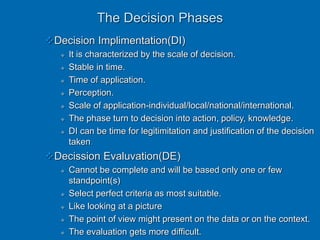
The Decision Phases
Decision Implimentation(DI)
 It is characterized by the scale of decision.
 Stable in time.
 Time of application.
 Perception.
 Scale of application-individual/local/national/international.
 The phase turn to decision into action, policy, knowledge.
 DI can be time for legitimitation and justification of the decision
taken.
Decission Evaluvation(DE)
 Cannot be complete and will be based only one or few
standpoint(s)
 Select perfect criteria as most suitable.
 Like looking at a picture
 The point of view might present on the data or on the context.
 The evaluation gets more difficult.
Uncertainity in Decisions
Uncertianity come along the entire decisional
proces and different stages.
 Uncertainity in Documentation/Info (DO) phase
 This level the uncertainities concerning data are the
most investigated ones.
 Two types of Uncertainities can be identified:
• Link to the data itself
• Link to the processing of the data.
• Decisiomn Makers transpose demand of the
community into problems, objectives and needs.
• This process introduced uncertainities due to
interpreatation and perceptions on the policy makers.
• This interpretation is based on their moral values and
then introduced uncertainity of values.
 Uncertainity in Decision Analysis(DA) phase
Uncertainity in Decisions
Uncertainity in Decision Analysis(DA) phase
 Uncertainity in method choice
 Unfinished list of options for decision analysis
 Uncertainity originates from the definition of the common
interest.
 Results may be partially or totally opposed to each other.
 DA uncertainities falls in what is called « Uncertanity of
reliance »
 Three degree of « Uncertanity of reliance »
Experts are recognised but disagree
Expert are not identified
Expert should be relied on(no question).
Uncertainity in Decision Taking(DT) phase
Uncertainity in Decision Implimentation(DI) phase.
Uncertainity in Decisions
Uncertainity in Decision Taking(DT) phase
 We called rules answering the questions.
 Who, in which way?
 On which accuracy, in which period?
 Uncertainity due to decision taking procedure and nature of
human beings.
 Pressure implies on decision takers
 Uncertainty for the spokesman of a group
 In DT phase, most uncertainties turn into public decisions.
Uncertainity in Decision Implimentation(DI) phase
Uncertainity in Decission Evaluvation(DE) phase.
Uncertainity in Decisions
Uncertainity in Decision Implimentation(DI) phase.
 Usually Policy-Makes are not the ones carrying out the
decision.
 Decision interpretation leads to the uncertainty.
 We called “ uncertainty of interpretation “.
 Transmission of decision might be destroyed by
system.(information system, operation system, decision
system, complex system)-(Donnay 1996).
 The “temporal uncertainties of interpretation” originates while
the time of implementation phase.
Uncertainity in Decission Evaluvation(DE) phase.
Uncertainity in Decisions
Uncertainity in Decission Evaluvation(DE) phase.
 Two Phases
Belief Uncertainty and
Methodology uncertainty
 What is evaluated is not what has to be evaluated
 Again evaluation involving decision…….(uncertainty of
knowledge, values, reliance, demarcation, interpretation etc.)
Mistakes are the portals of discovery. by James Joyce
Uncertainity in Decisions
Data Uncertainty and Ethics
• From an ethics point of view:
• Poor quality data should not be used for sensitive
applications where it poses a risk of harm
• Need appropriate safeguards to avoid the harm, and to
provide effective warnings
• Codes of ethics influence « Good Practices »
• Ex. professionals must care about individuals and
environment
• « Professional misconduct » is typically set out in
regulations
• Ex. Negligence, failure to report or remedy to a
danger, to protect people
Data Uncertainty and Ethics
Data Uncertainty: today’s approaches
Ethics-related issue
• Professional bodies have codes of ethics contained in
regulations.
• These regulations are enacted by governments.
• Professionals’ primary duty is to the public welfare
• Data uncertainty issues end up in the hands of legal
systems,
• but they begin in the hands of Systems designers/
Decision makers.
• Good practices require to understand clearly data quality
requirements and fitness-for-use.
Data Uncertainty: today’s approaches
Ethics-related issue
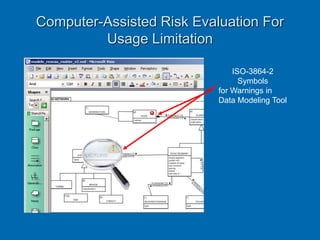
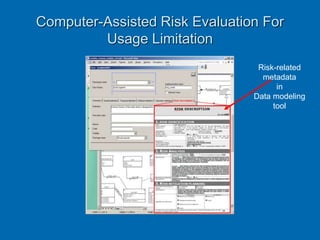
Computer-Assisted Risk Evaluation For
Usage Limitation
ISO-3864-2
Symbols
for Warnings in
Data Modeling Tool
Risk-related
metadata
in
Data modeling
tool
Computer-Assisted Risk Evaluation For
Usage Limitation
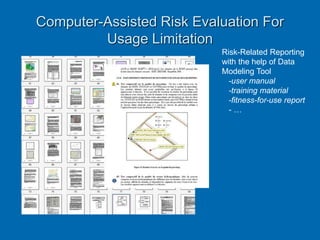
Risk-Related Reporting
with the help of Data
Modeling Tool
-user manual
-training material
-fitness-for-use report
- …
Computer-Assisted Risk Evaluation For
Usage Limitation
Conclution
“ There are some things that you know to be true,
and others that you know to be false;
yet, despite this extensive knowledge that you have, there
remain many things whose truth or falsity is not known to you.
We say that you are uncertain about them.
You are uncertain, to varying degrees, about everything in the future; much of the past is hidden from you;
and there is a lot of the present about which you do not have full information.
Uncertainty is everywhere and you cannot escape from it. “
Dennis Lindley,
Understanding Uncertainty (2006)
My most sincere gratitude goes to:
ITC
The Netherlands
Nuffic
The Netherlands
University of K.N.Toosi
Tehran, Iran
Survey Department
Sri Lanka
Govt. of The Netherlands Govt. Of Iran
Govt. of Sri Lanka
Thank you for your attention!
Questions.?
• Quuestion_1
• What are the 5 steps in decision taking process.?
• Quuestion_2
• Describe ethics in good practice.?
• Quuestion_3
• List out the uncertanities in decision Analysis process
Questions.?
• Answer _1
The model of decision making through three complementry
aspects:(Decision Bases) Issue, Context, and Data through
the following phases:
Documentation/Information(DO)
Decision Analysis(DA)
Decision Taking(DT)
Decision Implimentation(DI)
Decission Evaluvation(DE)
Questions.?
• Answer _2
• Data Uncertainty and Ethics
• Poor quality data should not be used for sensitive applications
where it poses a risk of harm
• Need appropriate safeguards to avoid the harm, and to provide
effective warnings
• Codes of ethics Ex. professionals must care about individuals
and environment
• Professional misconduct, is typically set out in regulations(Ex.
Negligence, failure to report or remedy to a danger, to protect
people)
• Good practices require understanding clearly data quality
requirements and fitness-for-use.
Questions.?
• Answer_3
Uncertainity in Decision Analysis(DA) phase
 Uncertainity in method choice
 Unfinished list of options for decision analysis
 Uncertainity originates from the definition of the common
interest.
 Results may be partially or totally opposed to each other
 DA uncertainities falls in what is called « Uncertanity of
reliance »
 Three degree of « Uncertanity of reliance »
Experts are recognised but disagree
Expert are not identified
Expert should be relied on(no question).

Geographic data uncertainty

  • 1.
    Geographic Data Uncertainty “Uncertainties in Spatial Decisions” S.M.J.S.Samarasinghe Senior Superintendent of Surveys Survey Department of Sri Lanka.
  • 2.
    IIntroduction Problem Synthesis Perspectives inUncertainty Model of Decision Making Process Decision Bases Decision Phases Uncertainties in Decisions Uncertainty and Ethics Risk Management in Decision Making Conclusion Content…
  • 3.
    Introduction  There arethousands of ways to measure the position, shape, orientation and size of phenomena or objects.  Data uncertainty varies spatially and over time.  Ambiguity of concepts (semantics, geometry)  Poorly known resolution and precision  Lack of up-to-dateness and timeliness  Incompleteness  Low level of processing………
  • 4.
    Every time dataare reused or transformed, Decisions are taken place in several steps and, additional uncertinities are introduced.… Problem Synthisis
  • 5.
    Decision Making Perspective Data Preparation Perspective SpatialData Uncertanity can be discribed by: Geographic Data Uncertainity Perspectives.
  • 6.
     There alwaysremain residual uncertanity = risk absorbed by  Data Producers  Data Brokers(Re Producers)  Users etc…  Uncertainty can be reduced  Better observation technologies and methods  Standards  Training etc… Data Preparation Perspective Geographic Data Uncertainity Perspectives.
  • 7.
     Spatial Decision? Not related at all with space  Can either be spatially referenceed or spatially induced.  One’s mind or the judgement on an issue under consideration.  Public Decision?  Can be characterised as spatial  Political decisions  Commen interest  Mandate  ‘How do we want to Live’ Decision Making Perspective Geographic Data Uncertainity Perspectives.
  • 8.
    A Model ofthe Decision Making Process Decission making process is not easy task. The model of decision making through three complementry aspects:(Decision Bases) Issue, Context, and Data through the following phases: Documentation/Information(DO) Decision Analysis(DA) Decision Taking(DT) Decision Implimentation(DI) Decission Evaluvation(DE) -(Cornelis-1999)
  • 9.
    The Decision Bases Issue Context Data •Terms of problem(s), of need(s), or of objective(s). • Way to express the actual concern of the decision makers. • Orient the way of getting to a solution…. • Refers to the attitude, the experiance and knowledge. • Experiances is a personal or collictive form of knowledge. • The data can either be raw, integrated or processed. • Processed data may be raw for another party. • May be decissions turns to information… Decision Bases
  • 10.
    The Decision Phases Documentation/Information(DO) DO phase assambles the decision bases and all their relations.  The connection between issue, context and data are manifold.  Data can generate problem by showing unexpected values. Decision Analysis(DA)  This step is the phase which processes and integrates the information based on the above Documentation(DO)  Methodology and tools used by the information and documentation taken into account. Decision Taking(DT) Decision Implimentation(DI) Decission Evaluvation(DE)
  • 11.
    The Decision Phases DecisionTaking (DT)  The moment at which the choice is made.  It is characterized by the person(s) taking the decision and their behavior .  Formal procedure.  Procedure followed can be despotic(power/ rule), negotiated, agreed, voted, freely taken, controlled, weighted etc…  Who is taking the decision? (One or several)  Is it their self interest or objective?  Two basic decision dispositions- positive (selection)/ negative (elimination) _(Cornelis and Viau: 2000) Decision Implimentation(DI) Decission Evaluvation(DE)
  • 12.
    The Decision Phases DecisionImplimentation(DI)  It is characterized by the scale of decision.  Stable in time.  Time of application.  Perception.  Scale of application-individual/local/national/international.  The phase turn to decision into action, policy, knowledge.  DI can be time for legitimitation and justification of the decision taken. Decission Evaluvation(DE)  Cannot be complete and will be based only one or few standpoint(s)  Select perfect criteria as most suitable.  Like looking at a picture  The point of view might present on the data or on the context.  The evaluation gets more difficult.
  • 13.
    Uncertainity in Decisions Uncertianitycome along the entire decisional proces and different stages.  Uncertainity in Documentation/Info (DO) phase  This level the uncertainities concerning data are the most investigated ones.  Two types of Uncertainities can be identified: • Link to the data itself • Link to the processing of the data. • Decisiomn Makers transpose demand of the community into problems, objectives and needs. • This process introduced uncertainities due to interpreatation and perceptions on the policy makers. • This interpretation is based on their moral values and then introduced uncertainity of values.  Uncertainity in Decision Analysis(DA) phase
  • 14.
    Uncertainity in Decisions Uncertainityin Decision Analysis(DA) phase  Uncertainity in method choice  Unfinished list of options for decision analysis  Uncertainity originates from the definition of the common interest.  Results may be partially or totally opposed to each other.  DA uncertainities falls in what is called « Uncertanity of reliance »  Three degree of « Uncertanity of reliance » Experts are recognised but disagree Expert are not identified Expert should be relied on(no question). Uncertainity in Decision Taking(DT) phase Uncertainity in Decision Implimentation(DI) phase.
  • 15.
    Uncertainity in Decisions Uncertainityin Decision Taking(DT) phase  We called rules answering the questions.  Who, in which way?  On which accuracy, in which period?  Uncertainity due to decision taking procedure and nature of human beings.  Pressure implies on decision takers  Uncertainty for the spokesman of a group  In DT phase, most uncertainties turn into public decisions. Uncertainity in Decision Implimentation(DI) phase Uncertainity in Decission Evaluvation(DE) phase.
  • 16.
    Uncertainity in Decisions Uncertainityin Decision Implimentation(DI) phase.  Usually Policy-Makes are not the ones carrying out the decision.  Decision interpretation leads to the uncertainty.  We called “ uncertainty of interpretation “.  Transmission of decision might be destroyed by system.(information system, operation system, decision system, complex system)-(Donnay 1996).  The “temporal uncertainties of interpretation” originates while the time of implementation phase. Uncertainity in Decission Evaluvation(DE) phase.
  • 17.
    Uncertainity in Decisions Uncertainityin Decission Evaluvation(DE) phase.  Two Phases Belief Uncertainty and Methodology uncertainty  What is evaluated is not what has to be evaluated  Again evaluation involving decision…….(uncertainty of knowledge, values, reliance, demarcation, interpretation etc.) Mistakes are the portals of discovery. by James Joyce
  • 18.
  • 19.
    Data Uncertainty andEthics • From an ethics point of view: • Poor quality data should not be used for sensitive applications where it poses a risk of harm • Need appropriate safeguards to avoid the harm, and to provide effective warnings
  • 20.
    • Codes ofethics influence « Good Practices » • Ex. professionals must care about individuals and environment • « Professional misconduct » is typically set out in regulations • Ex. Negligence, failure to report or remedy to a danger, to protect people Data Uncertainty and Ethics
  • 21.
    Data Uncertainty: today’sapproaches Ethics-related issue • Professional bodies have codes of ethics contained in regulations. • These regulations are enacted by governments. • Professionals’ primary duty is to the public welfare
  • 22.
    • Data uncertaintyissues end up in the hands of legal systems, • but they begin in the hands of Systems designers/ Decision makers. • Good practices require to understand clearly data quality requirements and fitness-for-use. Data Uncertainty: today’s approaches Ethics-related issue
  • 23.
    Computer-Assisted Risk EvaluationFor Usage Limitation ISO-3864-2 Symbols for Warnings in Data Modeling Tool
  • 24.
  • 25.
    Risk-Related Reporting with thehelp of Data Modeling Tool -user manual -training material -fitness-for-use report - … Computer-Assisted Risk Evaluation For Usage Limitation
  • 26.
    Conclution “ There aresome things that you know to be true, and others that you know to be false; yet, despite this extensive knowledge that you have, there remain many things whose truth or falsity is not known to you. We say that you are uncertain about them. You are uncertain, to varying degrees, about everything in the future; much of the past is hidden from you; and there is a lot of the present about which you do not have full information. Uncertainty is everywhere and you cannot escape from it. “ Dennis Lindley, Understanding Uncertainty (2006)
  • 27.
    My most sinceregratitude goes to: ITC The Netherlands Nuffic The Netherlands University of K.N.Toosi Tehran, Iran Survey Department Sri Lanka Govt. of The Netherlands Govt. Of Iran Govt. of Sri Lanka Thank you for your attention!
  • 28.
    Questions.? • Quuestion_1 • Whatare the 5 steps in decision taking process.? • Quuestion_2 • Describe ethics in good practice.? • Quuestion_3 • List out the uncertanities in decision Analysis process
  • 29.
    Questions.? • Answer _1 Themodel of decision making through three complementry aspects:(Decision Bases) Issue, Context, and Data through the following phases: Documentation/Information(DO) Decision Analysis(DA) Decision Taking(DT) Decision Implimentation(DI) Decission Evaluvation(DE)
  • 30.
    Questions.? • Answer _2 •Data Uncertainty and Ethics • Poor quality data should not be used for sensitive applications where it poses a risk of harm • Need appropriate safeguards to avoid the harm, and to provide effective warnings • Codes of ethics Ex. professionals must care about individuals and environment • Professional misconduct, is typically set out in regulations(Ex. Negligence, failure to report or remedy to a danger, to protect people) • Good practices require understanding clearly data quality requirements and fitness-for-use.
  • 31.
    Questions.? • Answer_3 Uncertainity inDecision Analysis(DA) phase  Uncertainity in method choice  Unfinished list of options for decision analysis  Uncertainity originates from the definition of the common interest.  Results may be partially or totally opposed to each other  DA uncertainities falls in what is called « Uncertanity of reliance »  Three degree of « Uncertanity of reliance » Experts are recognised but disagree Expert are not identified Expert should be relied on(no question).

Editor's Notes

  • #2 Introduce yourself and course. Joke: Decision Making under Uncertainty. What does that mean? Explain why you are excited to teach this class and why the students should be as well. Admit that you monitor forum to know what students are talking about. Career tracks: Affects them all. Give examples. Talk about sabermetrics. Here are some topics that have been discussed on forum this year: Do right wing dictators bequeath a longer legacy of democratic freedom and economic opportunity? Which IR/PS career track is more likely to lead to jobs? What is the impact of taking QM3 on IR/PS starting salaries? Does the percentage of fluent foreign language speakers affect a U.S. embassy’s performance? Who gives more to charity? Political liberals or conservatives? Are U.S. troops in Iraq primarily drawn from lower-income strata and minorities? What is more important for success in the NCAA basketball tournament? A high-scoring offense or a point guard not prone to errors?
  • #3 Introduce yourself and course. Joke: Decision Making under Uncertainty. What does that mean? Explain why you are excited to teach this class and why the students should be as well. Admit that you monitor forum to know what students are talking about. Career tracks: Affects them all. Give examples. Talk about sabermetrics. Here are some topics that have been discussed on forum this year: Do right wing dictators bequeath a longer legacy of democratic freedom and economic opportunity? Which IR/PS career track is more likely to lead to jobs? What is the impact of taking QM3 on IR/PS starting salaries? Does the percentage of fluent foreign language speakers affect a U.S. embassy’s performance? Who gives more to charity? Political liberals or conservatives? Are U.S. troops in Iraq primarily drawn from lower-income strata and minorities? What is more important for success in the NCAA basketball tournament? A high-scoring offense or a point guard not prone to errors?
  • #14 data itself-/positional, conscptual, attribute Processing/visualization, interpretation/ modelling