Victor Chibueze Ijeoma, rhim.
chibuezeijeoma@gmail.com
Health Data Analyst,
FCT Hospitals Management Board,
Abuja, Nigeria.
DATA-BASED PROBLEM
SOLVING & DECISION-MAKING
IN HOSPITAL MANAGEMENT.
Learning Objectives
By the end of this session, participants should be able to:
1. Identify and Apply the Tools of Healthcare Problem Solving
2. Appreciate the Value of Data in Hospital Management’s Decision-Making
Process.
3. Generate, Analyze, Document and Present Hospital Data for Use in
Problem Solving and Decision-Making.
4. Suggest ways of Improving Data Collection, Analysis and Reporting at
the facility levels.
1. What Do We Mean By “Problem Solving”?
2. What About “Decision-Making”?
3. So, What Then Is “Data-Based Decision-Making”?
4. What Are Some of the Important Hospital Data We Need For
Decision-Making?
5. Group Work: Generation & Analysis of Data and Decision-Making
Based on Results.
6. How Do We Improve Data Collection and Analysis at our Hospitals?
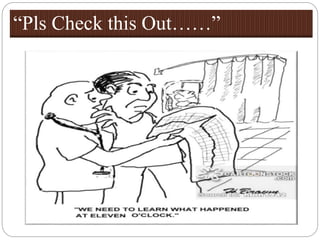
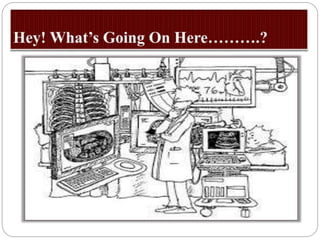
“Pls Check this Out……”
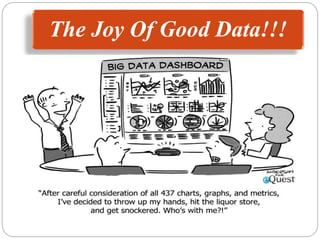
The Joy Of Good Data!!!
Let’s Go to Work…………….
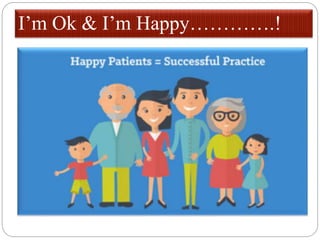
I’m Ok & I’m Happy………….!
Yeah! And I’m Happy Too………….!
And the Hospital Is Happy As Well!
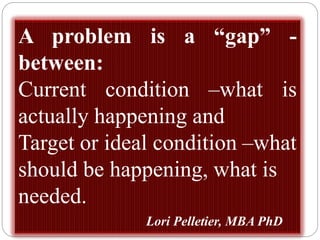
A problem is a “gap” -
between:
Current condition –what is
actually happening and
Target or ideal condition –what
should be happening, what is
needed.
Lori Pelletier, MBA PhD
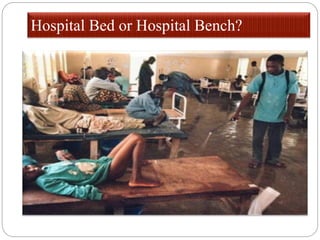
Hospital Bed or Hospital Bench?
“Problem Solving”! What Do We Mean?
 The process of working through details of an unwanted or
harmful situation to arrive at a solution.
 The process of finding solutions to difficult or complex issues.
 Problem solving involves goal-directed thinking and action in
situations for which no routine solutions exist. The problem
solver has a more or less well defined goal, but it is not
immediately obvious how to reach it. The incongruence of goals
and admissible operators constitutes a problem. The
understanding of the problem situation and its step-by-step
transformation, based on planning and reasoning, constitute the
process of problem solving.
Better Still….
Stages of Problem Solving
 Problem Identification:
 detecting and recognizing that there is a problem; identifying the
nature of the problem; defining the problem.
 Problem Structuring:
 a period of observation, careful inspection, fact-finding and
developing a clear picture of the problem.
 Seeking Possible Solutions:
 generate a range of possible courses of action, but with little attempt
to evaluate them at this stage.
 Choosing the Best Possible Solution:
 involves careful analysis of the different possible courses of action
and then selecting the best solution for implementation.
Stages of Problem Solving, Cont’d
 Solution Implementation:
 Implementation means acting on the chosen solution. During
implementation more problems may arise especially if
identification or structuring of the original problem was not
carried out fully and effectively.
 Monitoring &Seeking Feedback:
 The last stage involves reviewing the outcomes of problem
solving over a period of time and seeking feedback as to the
success of the outcomes of the chosen solution.
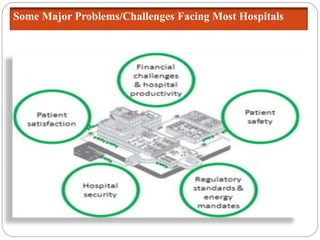
Some Major Problems/Challenges Facing Most Hospitals
Other Problems/Challenges include:
How to:
1. Improve Care and Outcomes
2. Reduce Medical Errors & Maintain Patient Safety
3. Reduce Patient Waiting Time
4. Improve Patient Satisfaction
5. Introduce New Medical Specialties
6. Recruit, Train & Retain Human Resources for Health
7. Meet Governments’ Regulations/Accreditation Standards.
8. Minimise Cost of Care Delivery, Cut Down Wastages and
Improve Hospital Revenue.
9. Acquire/Upgrade tools/devices/materials
10. Acquire/Switch to New Technologies, etc, etc.
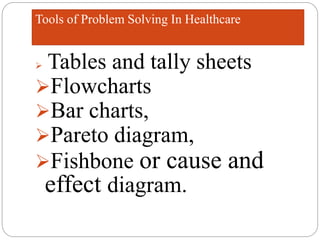
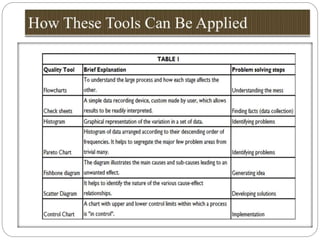
Tools of Problem Solving In Healthcare
 Tables and tally sheets
Flowcharts
Bar charts,
Pareto diagram,
Fishbone or cause and
effect diagram.
The Most Constant
Independent Variable
in All Healthcare
Problem Solving Tools
is DATA!!!
Decision-Making
In general, the decision making process helps hospital managers and
administrators solve hospital’s problems/challenges by examining
alternative choices and deciding on the best route of action to
take.
Using a step-by-step approach is an efficient way to make
thoughtful, informed decisions that will have a positive impact on
the hospital’s short- and long-term goals.
Better Still….
Decision making is a mechanism
for making choices at each step
of the problem-solving process.
Decision making is part of
problem solving, and decision
making occurs at every step of
the problem-solving process.
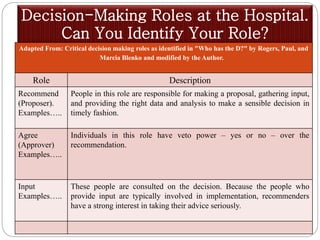
Decision-Making Roles at the Hospital.
Can You Identify Your Role?
Adapted From: Critical decision making roles as identified in "Who has the D?" by Rogers, Paul, and
Marcia Blenko and modified by the Author.
Role Description
Recommend
(Proposer).
Examples…..
People in this role are responsible for making a proposal, gathering input,
and providing the right data and analysis to make a sensible decision in
timely fashion.
Agree
(Approver)
Examples…..
Individuals in this role have veto power – yes or no – over the
recommendation.
Input
Examples…..
These people are consulted on the decision. Because the people who
provide input are typically involved in implementation, recommenders
have a strong interest in taking their advice seriously.
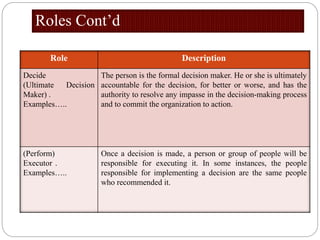
Roles Cont’d
Role Description
Decide
(Ultimate Decision
Maker) .
Examples…..
The person is the formal decision maker. He or she is ultimately
accountable for the decision, for better or worse, and has the
authority to resolve any impasse in the decision-making process
and to commit the organization to action.
(Perform)
Executor .
Examples…..
Once a decision is made, a person or group of people will be
responsible for executing it. In some instances, the people
responsible for implementing a decision are the same people
who recommended it.
So, Where Do You Belong
To?
What Are Your Roles in the
Decision-Making Process of
Your Hospitals?
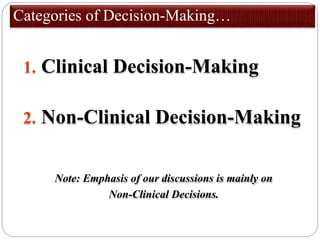
Categories of Decision-Making…
1. Clinical Decision-Making
2. Non-Clinical Decision-Making
Note: Emphasis of our discussions is mainly on
Non-Clinical Decisions.
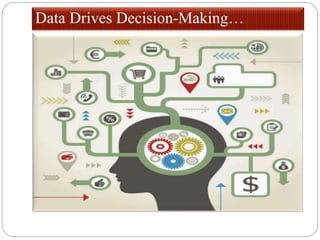
Data Drives Decision-Making…
Data-Based Decision-Making…
Data-Based Decision Making (DBDM) is a
mechanism for making choices at each step of
problem-solving process based on verifiable
facts and figures (Data). The success of the
data-based approach is reliant upon the quality
of the data gathered and the effectiveness of its
analysis and interpretation.
For Data to properly support Decision-
Making, it has to be qualitative.
5 Important Elements of Data Quality
include:
1. Accuracy
2. Completeness
3. Consistency
4. Uniqueness (Relevance), and
5. Timeliness.
Issues to consider…..
 It has been estimated that up to 5% of data found
in (Hospitals) are of poor quality (Redman, 2001)
 The average perceived cost of poor data quality is
as high as 10% of an Hospital’s revenues
(Malcom, 1998).
Yet, Hospitals can not do without Data since
Planning and delivery of services rely heavily on
data from clinical, administrative and
management sources.
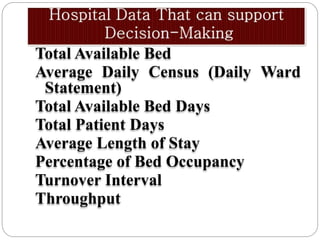
Total Available Bed
Average Daily Census (Daily Ward
Statement)
Total Available Bed Days
Total Patient Days
Average Length of Stay
Percentage of Bed Occupancy
Turnover Interval
Throughput
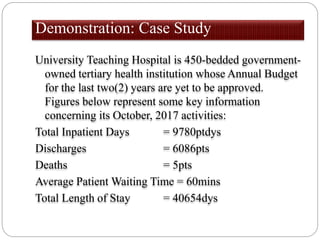
Demonstration: Case Study
University Teaching Hospital is 450-bedded government-
owned tertiary health institution whose Annual Budget
for the last two(2) years are yet to be approved.
Figures below represent some key information
concerning its October, 2017 activities:
Total Inpatient Days = 9780ptdys
Discharges = 6086pts
Deaths = 5pts
Average Patient Waiting Time = 60mins
Total Length of Stay = 40654dys
1. Average Length of Stay for the month.
2. Percentage of Bed Occupancy
3. Turnover
4. Turnover Interval
What Are the Implications of these Results?
What Areas Can You Make Recommendations to the
Hospital Management?
What Are Your Recommendations?
How Do We Improve Data
Collection and Analysis at our
Hospitals?
Data based problem solving & decision making in hospital mgt

Data based problem solving & decision making in hospital mgt

  • 1.
    Victor Chibueze Ijeoma,rhim. chibuezeijeoma@gmail.com Health Data Analyst, FCT Hospitals Management Board, Abuja, Nigeria. DATA-BASED PROBLEM SOLVING & DECISION-MAKING IN HOSPITAL MANAGEMENT.
  • 2.
    Learning Objectives By theend of this session, participants should be able to: 1. Identify and Apply the Tools of Healthcare Problem Solving 2. Appreciate the Value of Data in Hospital Management’s Decision-Making Process. 3. Generate, Analyze, Document and Present Hospital Data for Use in Problem Solving and Decision-Making. 4. Suggest ways of Improving Data Collection, Analysis and Reporting at the facility levels.
  • 3.
    1. What DoWe Mean By “Problem Solving”? 2. What About “Decision-Making”? 3. So, What Then Is “Data-Based Decision-Making”? 4. What Are Some of the Important Hospital Data We Need For Decision-Making? 5. Group Work: Generation & Analysis of Data and Decision-Making Based on Results. 6. How Do We Improve Data Collection and Analysis at our Hospitals?
  • 4.
    “Pls Check thisOut……”
  • 5.
    The Joy OfGood Data!!!
  • 7.
    Let’s Go toWork…………….
  • 8.
    I’m Ok &I’m Happy………….!
  • 9.
    Yeah! And I’mHappy Too………….!
  • 10.
    And the HospitalIs Happy As Well!
  • 13.
    A problem isa “gap” - between: Current condition –what is actually happening and Target or ideal condition –what should be happening, what is needed. Lori Pelletier, MBA PhD
  • 15.
    Hospital Bed orHospital Bench?
  • 16.
    “Problem Solving”! WhatDo We Mean?  The process of working through details of an unwanted or harmful situation to arrive at a solution.  The process of finding solutions to difficult or complex issues.  Problem solving involves goal-directed thinking and action in situations for which no routine solutions exist. The problem solver has a more or less well defined goal, but it is not immediately obvious how to reach it. The incongruence of goals and admissible operators constitutes a problem. The understanding of the problem situation and its step-by-step transformation, based on planning and reasoning, constitute the process of problem solving.
  • 17.
  • 18.
    Stages of ProblemSolving  Problem Identification:  detecting and recognizing that there is a problem; identifying the nature of the problem; defining the problem.  Problem Structuring:  a period of observation, careful inspection, fact-finding and developing a clear picture of the problem.  Seeking Possible Solutions:  generate a range of possible courses of action, but with little attempt to evaluate them at this stage.  Choosing the Best Possible Solution:  involves careful analysis of the different possible courses of action and then selecting the best solution for implementation.
  • 19.
    Stages of ProblemSolving, Cont’d  Solution Implementation:  Implementation means acting on the chosen solution. During implementation more problems may arise especially if identification or structuring of the original problem was not carried out fully and effectively.  Monitoring &Seeking Feedback:  The last stage involves reviewing the outcomes of problem solving over a period of time and seeking feedback as to the success of the outcomes of the chosen solution.
  • 20.
    Some Major Problems/ChallengesFacing Most Hospitals
  • 21.
    Other Problems/Challenges include: Howto: 1. Improve Care and Outcomes 2. Reduce Medical Errors & Maintain Patient Safety 3. Reduce Patient Waiting Time 4. Improve Patient Satisfaction 5. Introduce New Medical Specialties 6. Recruit, Train & Retain Human Resources for Health 7. Meet Governments’ Regulations/Accreditation Standards. 8. Minimise Cost of Care Delivery, Cut Down Wastages and Improve Hospital Revenue. 9. Acquire/Upgrade tools/devices/materials 10. Acquire/Switch to New Technologies, etc, etc.
  • 22.
    Tools of ProblemSolving In Healthcare  Tables and tally sheets Flowcharts Bar charts, Pareto diagram, Fishbone or cause and effect diagram.
  • 24.
    The Most Constant IndependentVariable in All Healthcare Problem Solving Tools is DATA!!!
  • 25.
    Decision-Making In general, thedecision making process helps hospital managers and administrators solve hospital’s problems/challenges by examining alternative choices and deciding on the best route of action to take. Using a step-by-step approach is an efficient way to make thoughtful, informed decisions that will have a positive impact on the hospital’s short- and long-term goals.
  • 26.
    Better Still…. Decision makingis a mechanism for making choices at each step of the problem-solving process.
  • 27.
    Decision making ispart of problem solving, and decision making occurs at every step of the problem-solving process.
  • 28.
    Decision-Making Roles atthe Hospital. Can You Identify Your Role? Adapted From: Critical decision making roles as identified in "Who has the D?" by Rogers, Paul, and Marcia Blenko and modified by the Author. Role Description Recommend (Proposer). Examples….. People in this role are responsible for making a proposal, gathering input, and providing the right data and analysis to make a sensible decision in timely fashion. Agree (Approver) Examples….. Individuals in this role have veto power – yes or no – over the recommendation. Input Examples….. These people are consulted on the decision. Because the people who provide input are typically involved in implementation, recommenders have a strong interest in taking their advice seriously.
  • 29.
    Roles Cont’d Role Description Decide (UltimateDecision Maker) . Examples….. The person is the formal decision maker. He or she is ultimately accountable for the decision, for better or worse, and has the authority to resolve any impasse in the decision-making process and to commit the organization to action. (Perform) Executor . Examples….. Once a decision is made, a person or group of people will be responsible for executing it. In some instances, the people responsible for implementing a decision are the same people who recommended it.
  • 30.
    So, Where DoYou Belong To? What Are Your Roles in the Decision-Making Process of Your Hospitals?
  • 31.
    Categories of Decision-Making… 1.Clinical Decision-Making 2. Non-Clinical Decision-Making Note: Emphasis of our discussions is mainly on Non-Clinical Decisions.
  • 32.
  • 33.
    Data-Based Decision-Making… Data-Based DecisionMaking (DBDM) is a mechanism for making choices at each step of problem-solving process based on verifiable facts and figures (Data). The success of the data-based approach is reliant upon the quality of the data gathered and the effectiveness of its analysis and interpretation.
  • 34.
    For Data toproperly support Decision- Making, it has to be qualitative. 5 Important Elements of Data Quality include: 1. Accuracy 2. Completeness 3. Consistency 4. Uniqueness (Relevance), and 5. Timeliness.
  • 35.
    Issues to consider….. It has been estimated that up to 5% of data found in (Hospitals) are of poor quality (Redman, 2001)  The average perceived cost of poor data quality is as high as 10% of an Hospital’s revenues (Malcom, 1998). Yet, Hospitals can not do without Data since Planning and delivery of services rely heavily on data from clinical, administrative and management sources.
  • 36.
    Total Available Bed AverageDaily Census (Daily Ward Statement) Total Available Bed Days Total Patient Days Average Length of Stay Percentage of Bed Occupancy Turnover Interval Throughput
  • 37.
    Demonstration: Case Study UniversityTeaching Hospital is 450-bedded government- owned tertiary health institution whose Annual Budget for the last two(2) years are yet to be approved. Figures below represent some key information concerning its October, 2017 activities: Total Inpatient Days = 9780ptdys Discharges = 6086pts Deaths = 5pts Average Patient Waiting Time = 60mins Total Length of Stay = 40654dys
  • 38.
    1. Average Lengthof Stay for the month. 2. Percentage of Bed Occupancy 3. Turnover 4. Turnover Interval What Are the Implications of these Results? What Areas Can You Make Recommendations to the Hospital Management? What Are Your Recommendations?
  • 39.
    How Do WeImprove Data Collection and Analysis at our Hospitals?

Editor's Notes

  • #2 This topic is part of Three-Lecture Series presented by Victor Chibueze Ijeoma on the general theme: Total Project Management of Healthcare Projects/Organisations organized by Supreme Management Training & Consultancy Services Ltd for Medical Directors of General Hospitals and Directors in the Nassarawa State Hospitals Management Board; between 30th Oct. to 3rd Nov; 2017, at Kini Hotels.