Geocaching
The Digital Treasure Hunt


 By Cheryl LeJune and Carol Edwards


                                      1
What is Geocaching?

Geocaching is a real-world outdoor treasure
                  real-
hunting game. Players try to locate hidden
containers, called geocaches, using GPS-
                                     GPS-
enabled devices and then share their
experiences online.

Geocaching is enjoyed by people from all age
groups, with a strong sense of community and
support for the environment.
                                              2
What is Geocaching?
What is geocaching?

  Low-impact outdoor activity for GPS
  Low-
  users of all ages

  GPS = Global Positioning System


                                        4
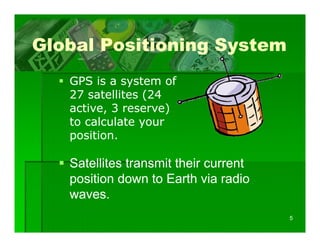
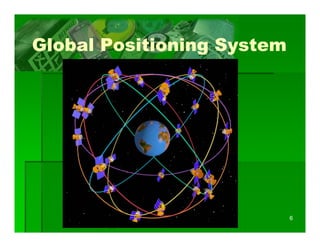
Global Positioning System
   GPS i a system of
        is            f
   27 satellites (24
   active, 3 reserve)
   active
   to calculate your
   position.

   Satellites transmit their current
   position down to Earth via radio
   waves.
                                       5
Global Positioning System


                            6
GPS receiver

  Receives signals from GPS
  satellites.
  Determines latitude and longitude
  of your current p
     y            position on the
  Earth's surface.


                                      7
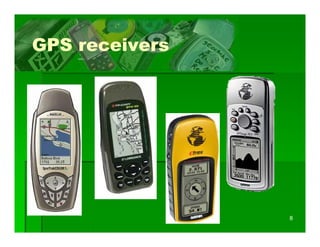
GPS receivers


                8
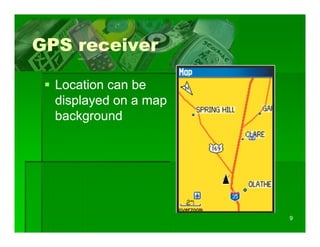
GPS receiver

  Location can be
  displayed on a map
  background


                       9
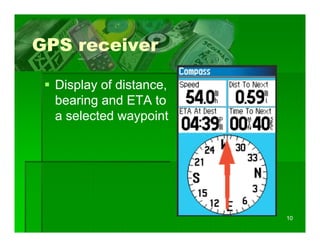
GPS receiver

  Display of distance,
  bearing and ETA to
  a selected waypoint


                         10
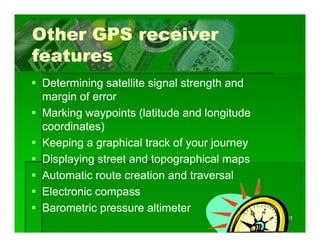
Other GPS receiver
features
Determining satellite signal strength and
margin of error
Marking waypoints (latitude and longitude
coordinates)
Keeping a graphical t k of your j
K    i          hi l track f       journey
Displaying street and topographical maps
Automatic route creation and traversal
Electronic compass
Barometric pressure altimeter
                                             11
Uses for GPS receivers
 Hiking d backpacking
 Hiki and b k        ki
 Canoeing and marine navigation
 Hunting and fishing
 Bird watchingg
 Search and rescue
 Exercise progress tracking
 Traveling via car, motorcycle, bicycle
 Geocaching
                                          12
What is geocaching?

  Outdoor adventure game for GPS
  users of all ages.

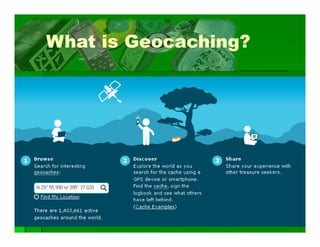
  The basic idea is to set up caches
                            p
  (hidden containers) and share the
  locations (latitude/longitude) of these
  caches on the internet.
     h        h


                                            13
What is geocaching?

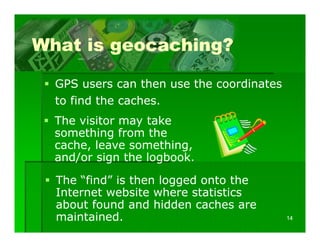
  GPS users can then use the coordinates
  to find the caches.
  The visitor may take
  something from the
            g
  cache, leave something,
  and/or sign the logbook.

  The “find” is then logged onto the
  Internet website where statistics
  about found and hidden caches are
   b tf      d    d hidd      h
  maintained.                              14
What s
What’s the point?
 It may sound simple, b t many
             d i l but
 caches are well hidden.
 Many require searching and
 experience to find.
 Only a few geocaches are
 accidentally found by non-
            y        y non-
 geocachers.

                                 15
What s
What’s the point?

 Sometimes just getting to the cache
 area can be a big part of the
 adventure.
 It's one thing to see the latitude and
              g
 longitude plotted on a map, but it can
 be quite a task to figure out how to
      q               g
 get from here to there.

                                          16
What s
What’s the point?

Geocaching can be thought of in two
 parts:
 The journey to reach the cache area.
 The challenge of actually finding the
 cache container.
Both can be equally rewarding
                    rewarding.


                                         17
Misconceptions about
geocaching


 “Geocaches are buried.”
 “G     h       b i d”
 FACT: Geocaches are
 not allowed to be buried
 in the ground.
                            18
Misconceptions about
geocaching

 “Geocaches are litter or
 abandoned property.”
 FACT: Geocaches are
 not litter or abandoned
   t litt       b d    d
 property.
 property
                            19
Misconceptions about
geocaching
 “Geocaching will damage the
 land.
 land ”
 FACT: Geocaching foot traffic
                     g
 is similar to hiking, trail
 walking, or bird watching.
        g,                   g
 Most caches are placed near
                 p
 trails.                         20
How Did It Get Started?
 On May 1 2000 the GPS signal
        1, 2000,
 degradation called Select Availability
 ( )
 (SA) was removed.
 The change allowed GPS units
 owned by civilians to be more
 accurate – to within 20 feet or
 better.
 On May 3rd, 2000 someone hid a cache
 in Oregon and posted the coordinates
 on the Internet. I became the first
     h I          It b        h fi
 geocache.                                21
How Did It Get Started?

  Jeremy Irish, the owner of the
  Geocaching.com website, expanded the
  idea and named it “Geocaching”.
                     “Geocaching”.
  Geocaching is now in all 50
  states and more than 200
   t t     d      th
  countries.
  Geocaching.com is by far
  the #1 website for
  geocachers.
  geocachers
                                         22
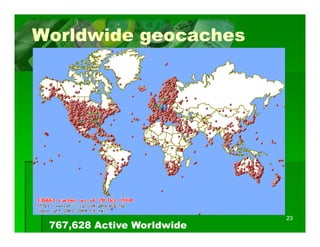
Worldwide geocaches


                            23
 767,628 Active Worldwide
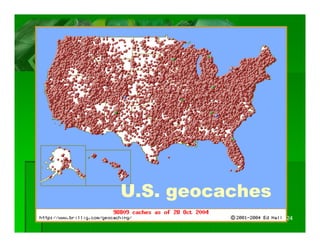
U.S. geocaches
                 24
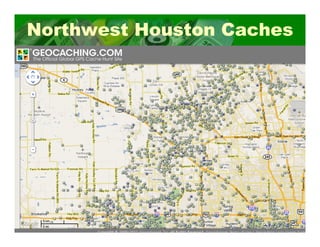
Northwest Houston Caches


                       25
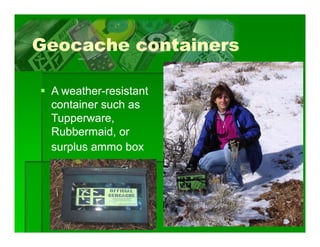
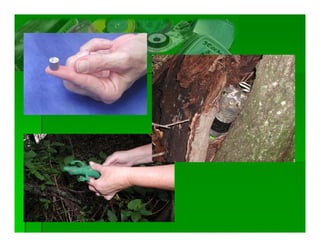
Geocache containers

 A weather-resistant
   weather-
 container such as
 Tupperware,
 Rubbermaid, or
 surplus ammo box


                       26
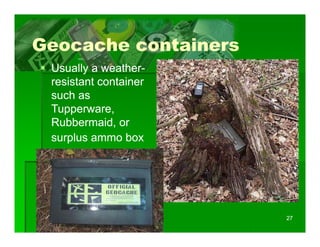
Geocache containers
 Usually a weather-
            weather-
 resistant container
 such as
 Tupperware,
 Tupperware
 Rubbermaid, or
 surplus ammo box


                       27
What s
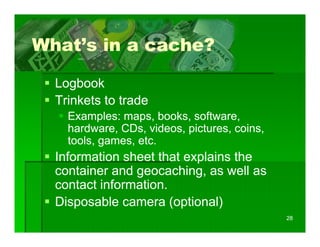
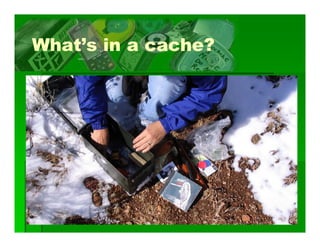
What’s in a cache?

  Logbook
  Trinkets to trade
    Examples: maps, books, software,
    hardware, CDs, videos, pictures, coins,
    tools, games, etc.
    tools games etc
  Information sheet that explains the
  container and geocaching as well as
                geocaching,
  contact information.
  Disposable camera (optional)
                                              28
What s
What’s in a cache?


                     29
What are the rules?
Cache contents
 No food
 No weapons (knives ammunition
               (knives, ammunition,
 explosives)
 No drugs or alcohol
 No adult materials
 No solicitations (business, religious,
 political)
                                          34
Who enforces the rules?

 Geocaching.com
  Controls listing of g
                 g geocaches worldwide on its
  website.
  Caches are approved by volunteer reviewers.
  Reviewers do not visit the geocache in person
  as part of the approval process.
  Reviewers view the online description,
  coordinates, topo maps, proximity to other
  caches, compliance with k
     h           li     ith known park rules.
                                     k l
                                              35
Cache In Trash Out

 Cache In Trash Out (CITO) is an ongoing
 environmental initiative supported by the
                            pp       y
 worldwide geocaching community.

 Since 2002, geocachers have been dedicated
 to cleaning up parks and other cache-friendly
 places around the world Through these
                     world.
 volunteer efforts, we help preserve the natural
 beauty of our outdoor resources!
                                                   36
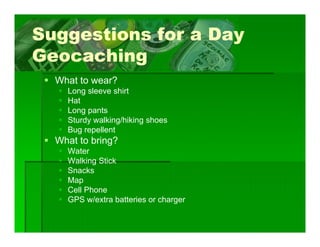
Suggestions for a Day
Geocaching
  What
  Wh to wear?
            ?
    Long sleeve shirt
    Hat
    Long pants
    L        t
    Sturdy walking/hiking shoes
    Bug repellent
  What to bring?
    Water
    Walking Stick
    Snacks
    Map
    Cell Phone
    GPS w/extra batteries or charger

Geocaching fall2011

  • 1.
    Geocaching The Digital TreasureHunt By Cheryl LeJune and Carol Edwards 1
  • 2.
    What is Geocaching? Geocachingis a real-world outdoor treasure real- hunting game. Players try to locate hidden containers, called geocaches, using GPS- GPS- enabled devices and then share their experiences online. Geocaching is enjoyed by people from all age groups, with a strong sense of community and support for the environment. 2
  • 3.
  • 4.
    What is geocaching? Low-impact outdoor activity for GPS Low- users of all ages GPS = Global Positioning System 4
  • 5.
    Global Positioning System GPS i a system of is f 27 satellites (24 active, 3 reserve) active to calculate your position. Satellites transmit their current position down to Earth via radio waves. 5
  • 6.
  • 7.
    GPS receiver Receives signals from GPS satellites. Determines latitude and longitude of your current p y position on the Earth's surface. 7
  • 8.
  • 9.
    GPS receiver Location can be displayed on a map background 9
  • 10.
    GPS receiver Display of distance, bearing and ETA to a selected waypoint 10
  • 11.
    Other GPS receiver features Determiningsatellite signal strength and margin of error Marking waypoints (latitude and longitude coordinates) Keeping a graphical t k of your j K i hi l track f journey Displaying street and topographical maps Automatic route creation and traversal Electronic compass Barometric pressure altimeter 11
  • 12.
    Uses for GPSreceivers Hiking d backpacking Hiki and b k ki Canoeing and marine navigation Hunting and fishing Bird watchingg Search and rescue Exercise progress tracking Traveling via car, motorcycle, bicycle Geocaching 12
  • 13.
    What is geocaching? Outdoor adventure game for GPS users of all ages. The basic idea is to set up caches p (hidden containers) and share the locations (latitude/longitude) of these caches on the internet. h h 13
  • 14.
    What is geocaching? GPS users can then use the coordinates to find the caches. The visitor may take something from the g cache, leave something, and/or sign the logbook. The “find” is then logged onto the Internet website where statistics about found and hidden caches are b tf d d hidd h maintained. 14
  • 15.
    What s What’s thepoint? It may sound simple, b t many d i l but caches are well hidden. Many require searching and experience to find. Only a few geocaches are accidentally found by non- y y non- geocachers. 15
  • 16.
    What s What’s thepoint? Sometimes just getting to the cache area can be a big part of the adventure. It's one thing to see the latitude and g longitude plotted on a map, but it can be quite a task to figure out how to q g get from here to there. 16
  • 17.
    What s What’s thepoint? Geocaching can be thought of in two parts: The journey to reach the cache area. The challenge of actually finding the cache container. Both can be equally rewarding rewarding. 17
  • 18.
    Misconceptions about geocaching “Geocachesare buried.” “G h b i d” FACT: Geocaches are not allowed to be buried in the ground. 18
  • 19.
    Misconceptions about geocaching “Geocachesare litter or abandoned property.” FACT: Geocaches are not litter or abandoned t litt b d d property. property 19
  • 20.
    Misconceptions about geocaching “Geocachingwill damage the land. land ” FACT: Geocaching foot traffic g is similar to hiking, trail walking, or bird watching. g, g Most caches are placed near p trails. 20
  • 21.
    How Did ItGet Started? On May 1 2000 the GPS signal 1, 2000, degradation called Select Availability ( ) (SA) was removed. The change allowed GPS units owned by civilians to be more accurate – to within 20 feet or better. On May 3rd, 2000 someone hid a cache in Oregon and posted the coordinates on the Internet. I became the first h I It b h fi geocache. 21
  • 22.
    How Did ItGet Started? Jeremy Irish, the owner of the Geocaching.com website, expanded the idea and named it “Geocaching”. “Geocaching”. Geocaching is now in all 50 states and more than 200 t t d th countries. Geocaching.com is by far the #1 website for geocachers. geocachers 22
  • 23.
    Worldwide geocaches 23 767,628 Active Worldwide
  • 24.
  • 25.
  • 26.
    Geocache containers Aweather-resistant weather- container such as Tupperware, Rubbermaid, or surplus ammo box 26
  • 27.
    Geocache containers Usuallya weather- weather- resistant container such as Tupperware, Tupperware Rubbermaid, or surplus ammo box 27
  • 28.
    What s What’s ina cache? Logbook Trinkets to trade Examples: maps, books, software, hardware, CDs, videos, pictures, coins, tools, games, etc. tools games etc Information sheet that explains the container and geocaching as well as geocaching, contact information. Disposable camera (optional) 28
  • 29.
    What s What’s ina cache? 29
  • 34.
    What are therules? Cache contents No food No weapons (knives ammunition (knives, ammunition, explosives) No drugs or alcohol No adult materials No solicitations (business, religious, political) 34
  • 35.
    Who enforces therules? Geocaching.com Controls listing of g g geocaches worldwide on its website. Caches are approved by volunteer reviewers. Reviewers do not visit the geocache in person as part of the approval process. Reviewers view the online description, coordinates, topo maps, proximity to other caches, compliance with k h li ith known park rules. k l 35
  • 36.
    Cache In TrashOut Cache In Trash Out (CITO) is an ongoing environmental initiative supported by the pp y worldwide geocaching community. Since 2002, geocachers have been dedicated to cleaning up parks and other cache-friendly places around the world Through these world. volunteer efforts, we help preserve the natural beauty of our outdoor resources! 36
  • 37.
    Suggestions for aDay Geocaching What Wh to wear? ? Long sleeve shirt Hat Long pants L t Sturdy walking/hiking shoes Bug repellent What to bring? Water Walking Stick Snacks Map Cell Phone GPS w/extra batteries or charger