GenServer in Action
 Elixir Club 11

Ternopil, 2018
Elixir Process
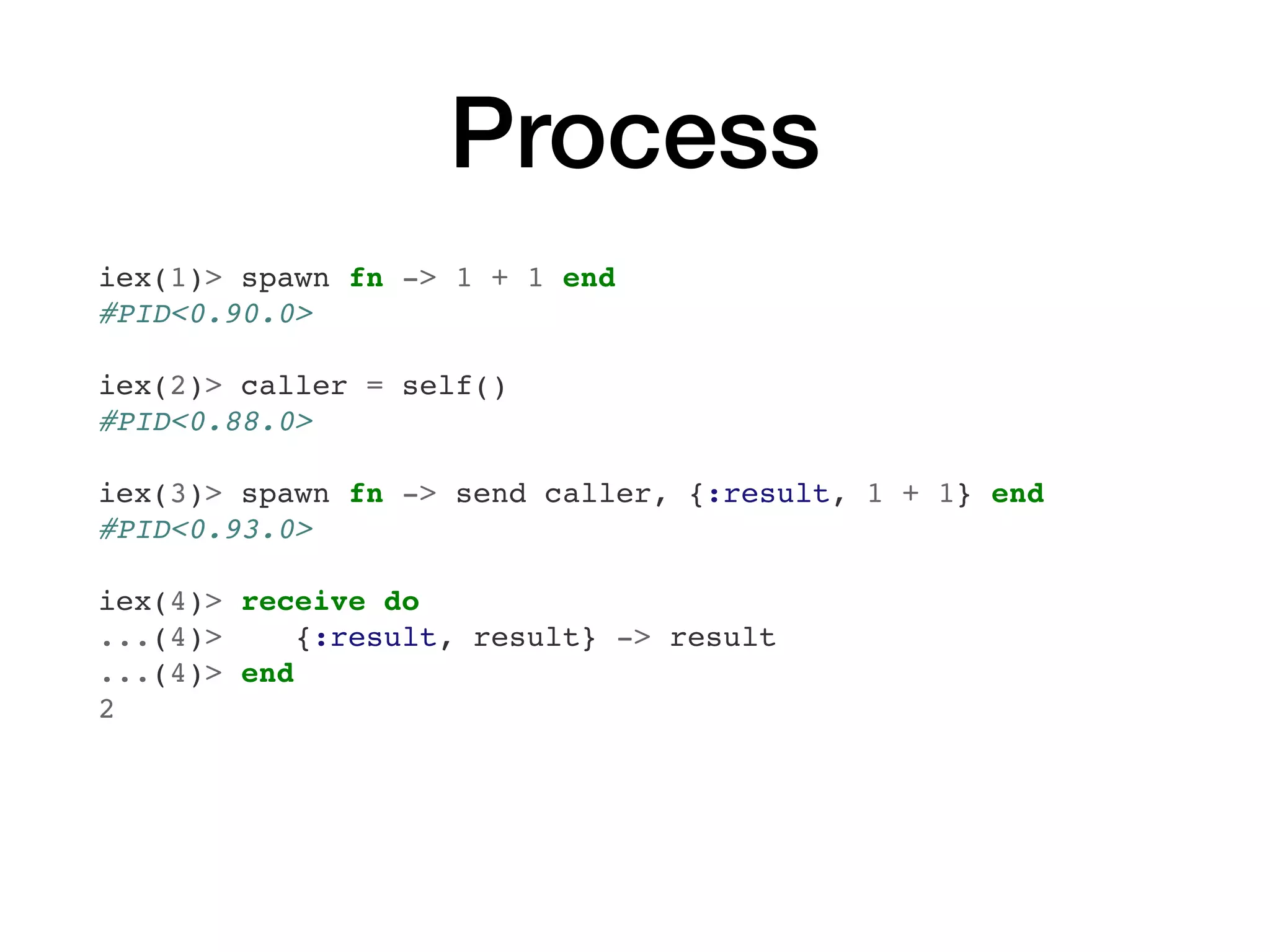
Process
iex(1)> spawn fn -> 1 + 1 end
#PID<0.90.0>
iex(2)> caller = self()
#PID<0.88.0>
iex(3)> spawn fn -> send caller, {:result, 1 + 1} end
#PID<0.93.0>
iex(4)> receive do
...(4)> {:result, result} -> result
...(4)> end
2
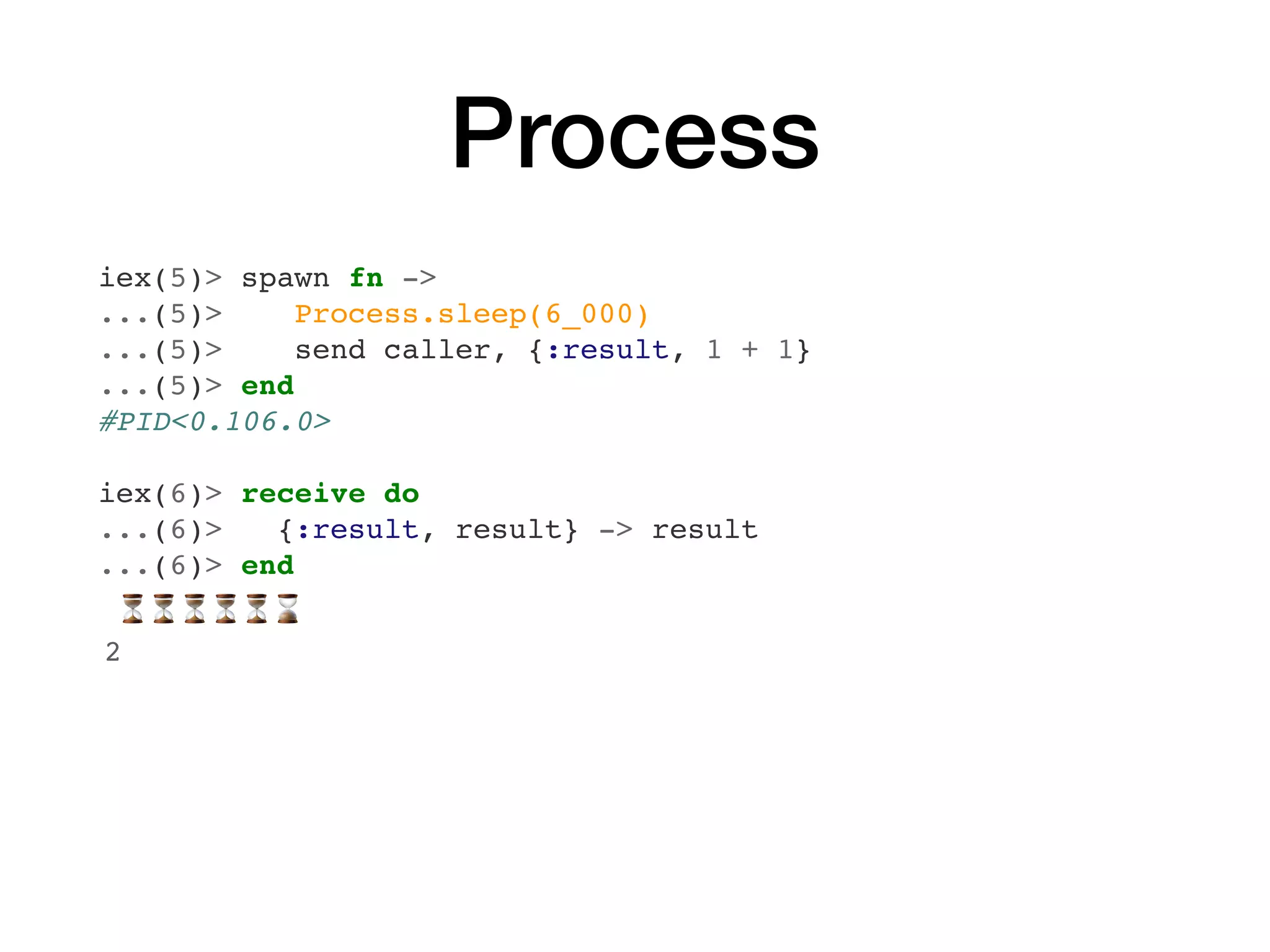
Process
iex(5)> spawn fn ->
...(5)> Process.sleep(6_000)
...(5)> send caller, {:result, 1 + 1}
...(5)> end
#PID<0.106.0>
iex(6)> receive do
...(6)> {:result, result} -> result
...(6)> end
⏳⏳⏳⏳⏳⌛
2
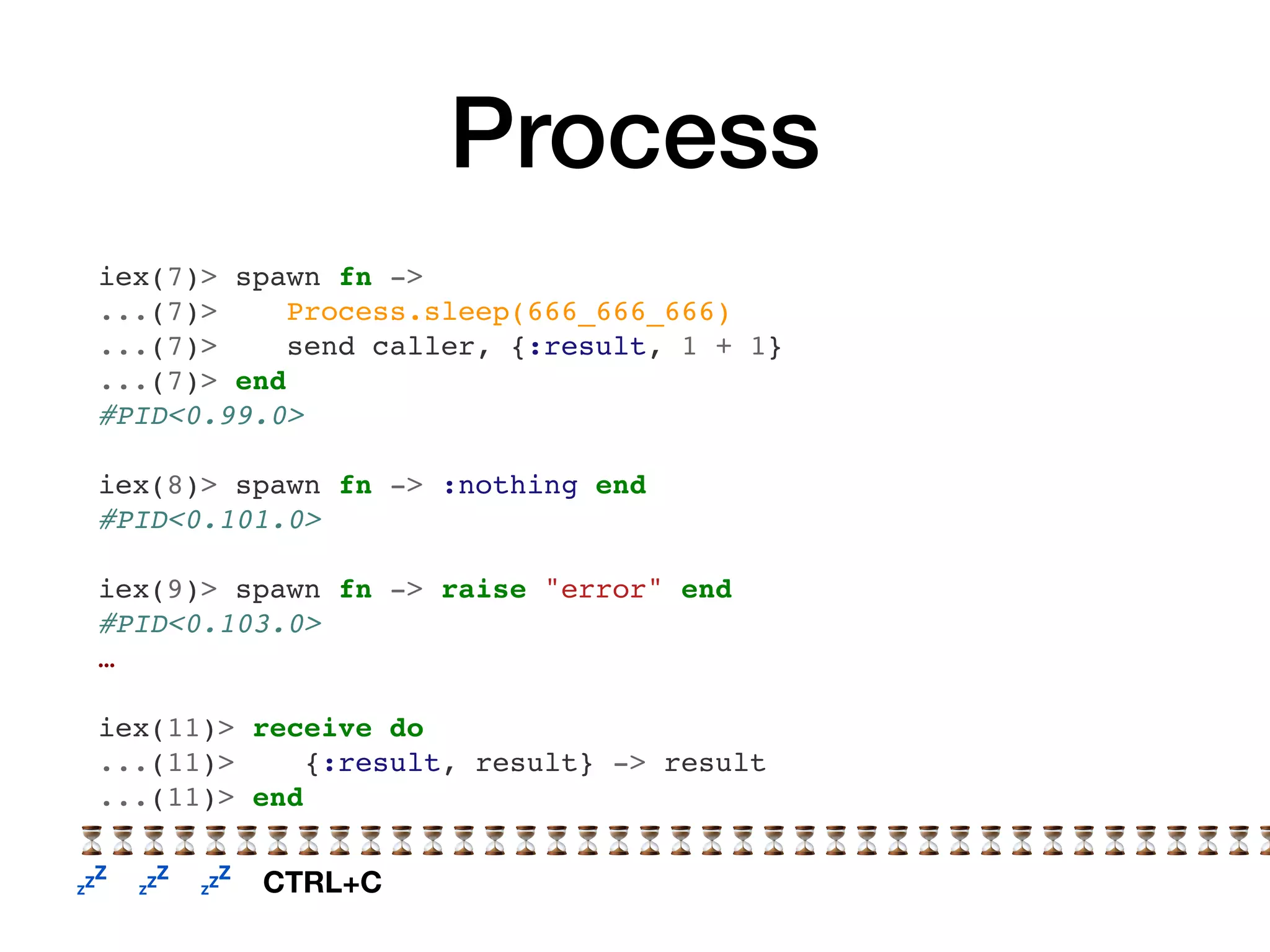
Process
iex(7)> spawn fn ->
...(7)> Process.sleep(666_666_666)
...(7)> send caller, {:result, 1 + 1}
...(7)> end
#PID<0.99.0>
iex(8)> spawn fn -> :nothing end
#PID<0.101.0>
iex(9)> spawn fn -> raise "error" end
#PID<0.103.0>
…
iex(11)> receive do
...(11)> {:result, result} -> result
...(11)> end
⏳⏳⏳⏳⏳⏳⏳⏳⏳⏳⏳⏳⏳⏳⏳⏳⏳⏳⏳⏳⏳⏳⏳⏳⏳⏳⏳⏳⏳⏳⏳⏳⏳⏳⏳⏳⏳⏳⏳
💤 💤 💤 CTRL+C
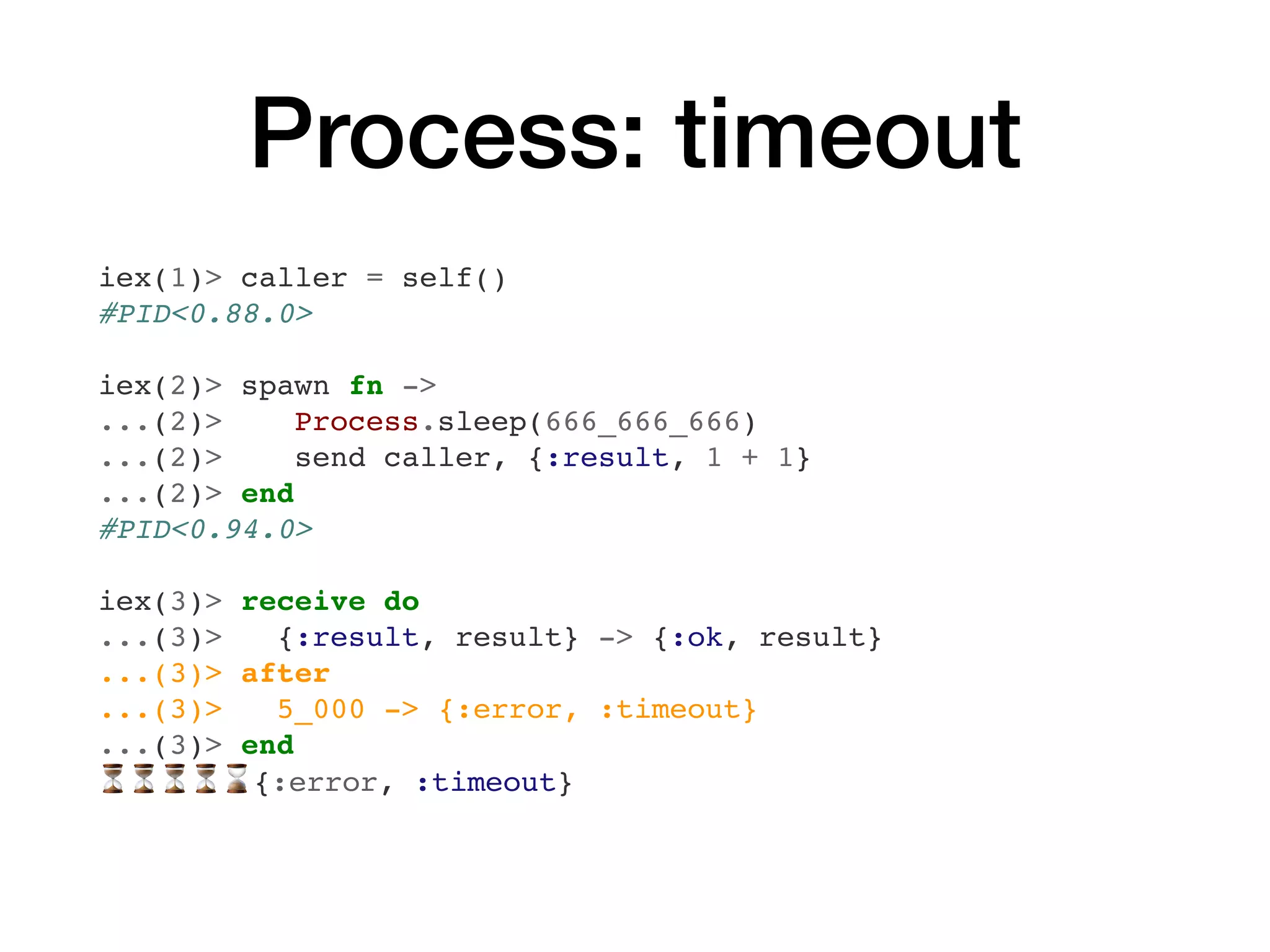
Process: timeout
iex(1)> caller = self()
#PID<0.88.0>
iex(2)> spawn fn ->
...(2)> Process.sleep(666_666_666)
...(2)> send caller, {:result, 1 + 1}
...(2)> end
#PID<0.94.0>
iex(3)> receive do
...(3)> {:result, result} -> {:ok, result}
...(3)> after
...(3)> 5_000 -> {:error, :timeout}
...(3)> end
⏳⏳⏳⏳⌛{:error, :timeout}
Process: message queue
iex(4)> send self(), {:message, 1}
iex(5)> send self(), {:another_message, 1}
iex(6)> send self(), {:message, 2}
iex(7)> send self(), {:another_message, 2}
iex(8)> send self(), {:message, 3}
iex(9)> send self(), {:another_message, 3}
iex(10)> Process.info(self(), :messages)
{:messages,
[
message: 1,
another_message: 1,
message: 2,
another_message: 2,
message: 3,
another_message: 3
]}
Process: message queue
{:messages,
[
message: 1,
another_message: 10,
message: 2,
another_message: 20,
message: 3,
another_message: 30
]}
iex(11)> receive do {:another_message, n} -> n end
10
iex(12)> receive do {:another_message, n} -> n end
20
iex(13)> Process.info(self(), :messages)
{:messages, [message: 1, message: 2, message: 3, another_message: 30]}
iex(14)> receive do {:message, n} -> n end
1
iex(15)> Process.info(self(), :messages)
{:messages, [message: 2, message: 3, another_message: 30]}
iex(16)> receive do {:something, n} -> n after 0 -> :no_matching_message end
:no_matching_message
When to use
processes?
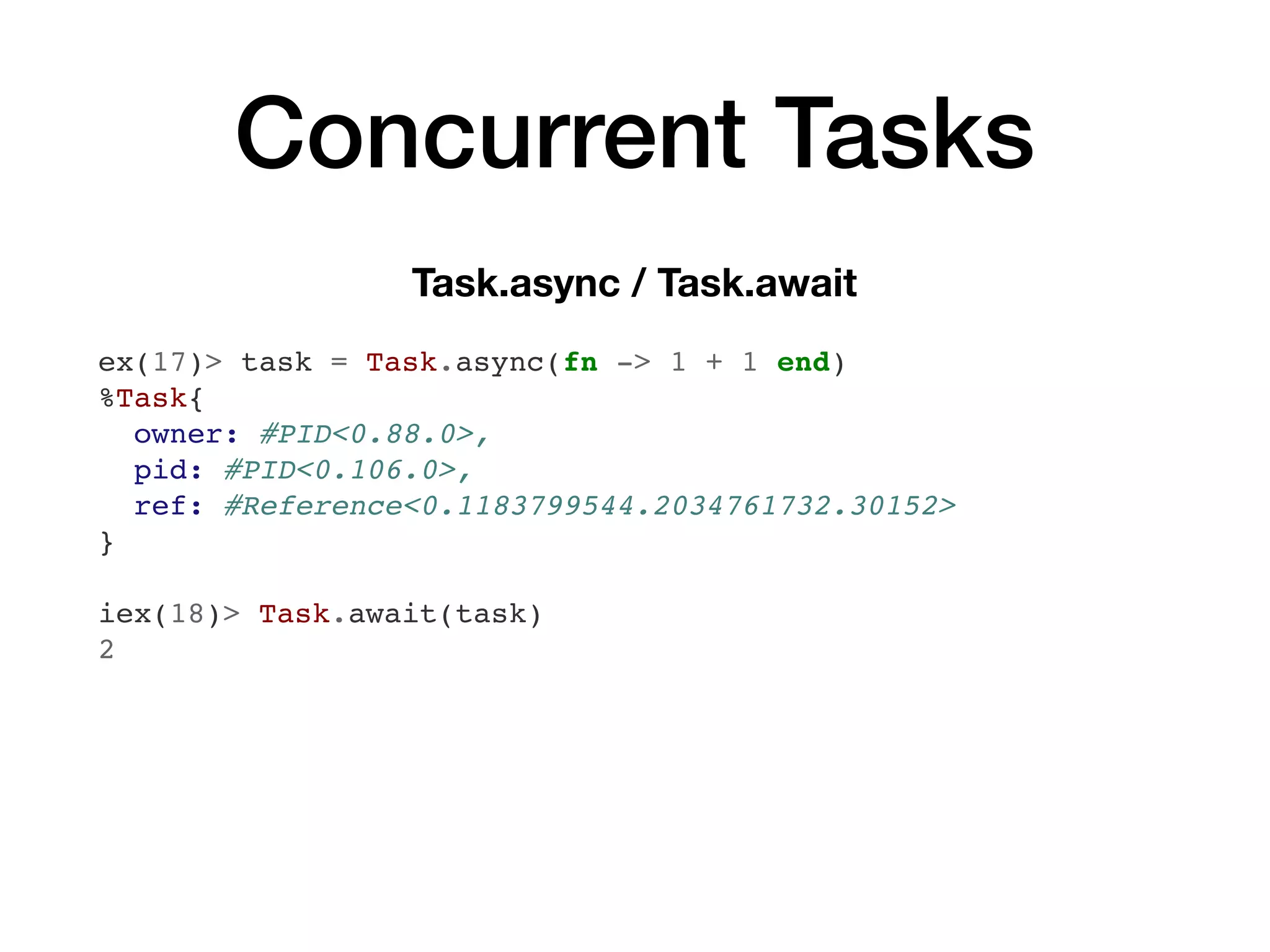
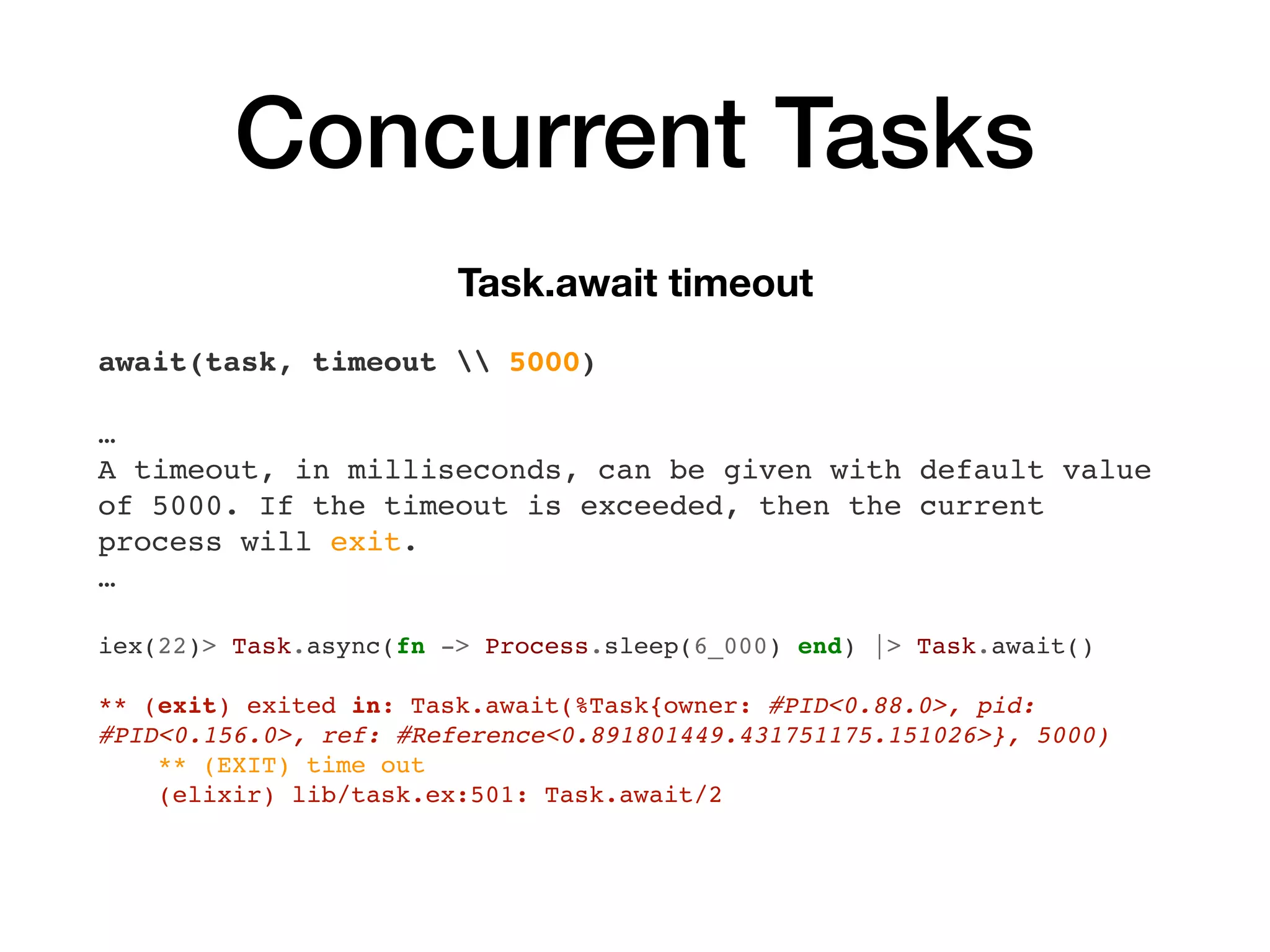
Concurrent Tasks
Task.async / Task.await
ex(17)> task = Task.async(fn -> 1 + 1 end)
%Task{
owner: #PID<0.88.0>,
pid: #PID<0.106.0>,
ref: #Reference<0.1183799544.2034761732.30152>
}
iex(18)> Task.await(task)
2
Concurrent Tasks
Task.async / Task.await
iex(19)> tasks = Enum.map(1..10, &Task.async(fn ->
...(19)> Process.sleep(3_000)
...(19)> &1 * 100
...(19)> end))
[…]
iex(20)> Process.sleep(5_000)
:ok
iex(21)> Enum.map(tasks, &Task.await(&1))
[100, 200, 300, 400, 500, 600, 700, 800, 900, 1000]
Concurrent Tasks
Task.await timeout
await(task, timeout  5000)
…
A timeout, in milliseconds, can be given with default value
of 5000. If the timeout is exceeded, then the current
process will exit.
…
iex(22)> Task.async(fn -> Process.sleep(6_000) end) |> Task.await()
** (exit) exited in: Task.await(%Task{owner: #PID<0.88.0>, pid:
#PID<0.156.0>, ref: #Reference<0.891801449.431751175.151026>}, 5000)
** (EXIT) time out
(elixir) lib/task.ex:501: Task.await/2
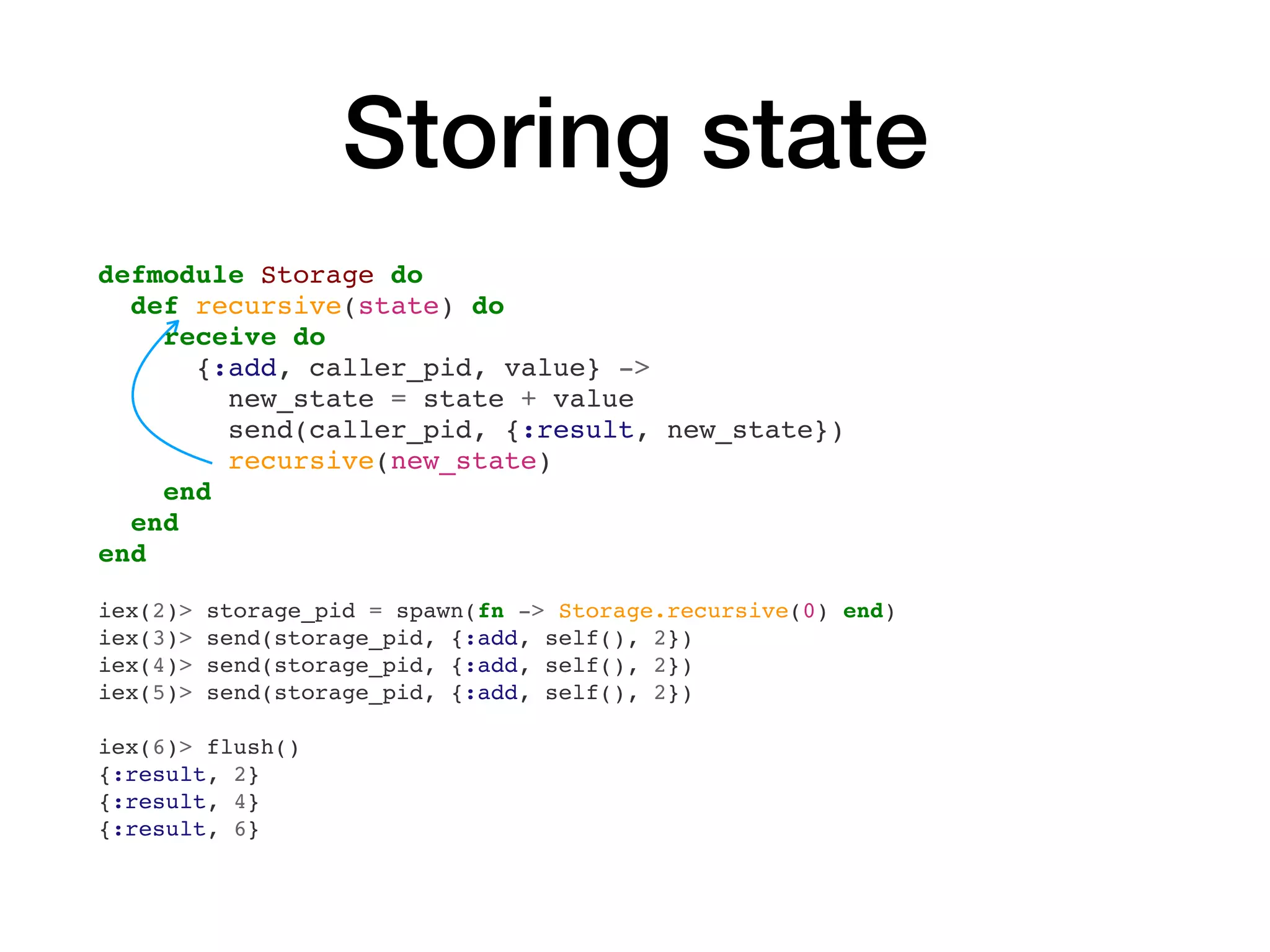
Storing state
defmodule Storage do
def recursive(state) do
receive do
{:add, caller_pid, value} ->
new_state = state + value
send(caller_pid, {:result, new_state})
recursive(new_state)
end
end
end
iex(2)> storage_pid = spawn(fn -> Storage.recursive(0) end)
iex(3)> send(storage_pid, {:add, self(), 2})
iex(4)> send(storage_pid, {:add, self(), 2})
iex(5)> send(storage_pid, {:add, self(), 2})
iex(6)> flush()
{:result, 2}
{:result, 4}
{:result, 6}
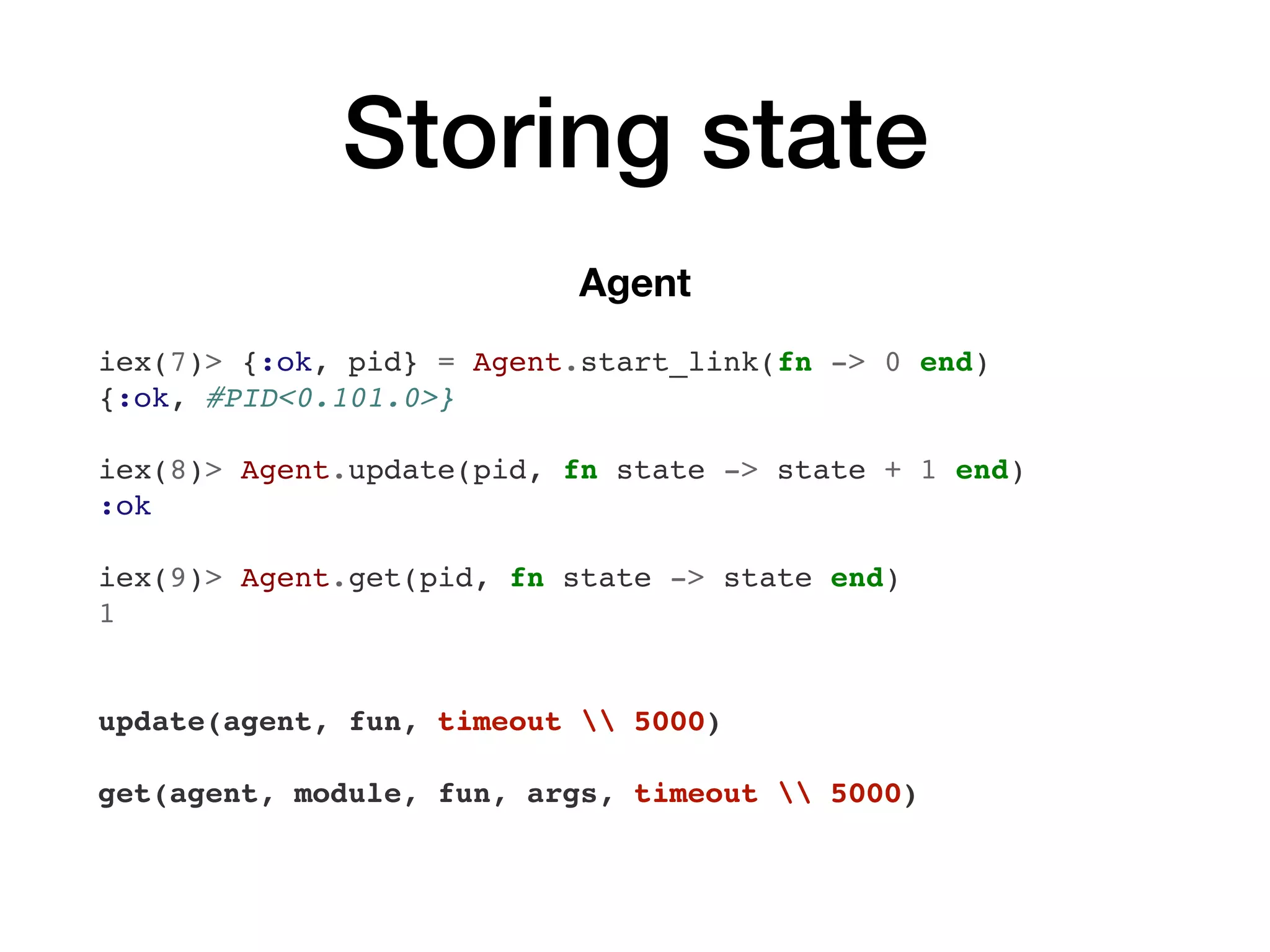
Storing state
Agent
iex(7)> {:ok, pid} = Agent.start_link(fn -> 0 end)
{:ok, #PID<0.101.0>}
iex(8)> Agent.update(pid, fn state -> state + 1 end)
:ok
iex(9)> Agent.get(pid, fn state -> state end)
1
update(agent, fun, timeout  5000)
get(agent, module, fun, args, timeout  5000)
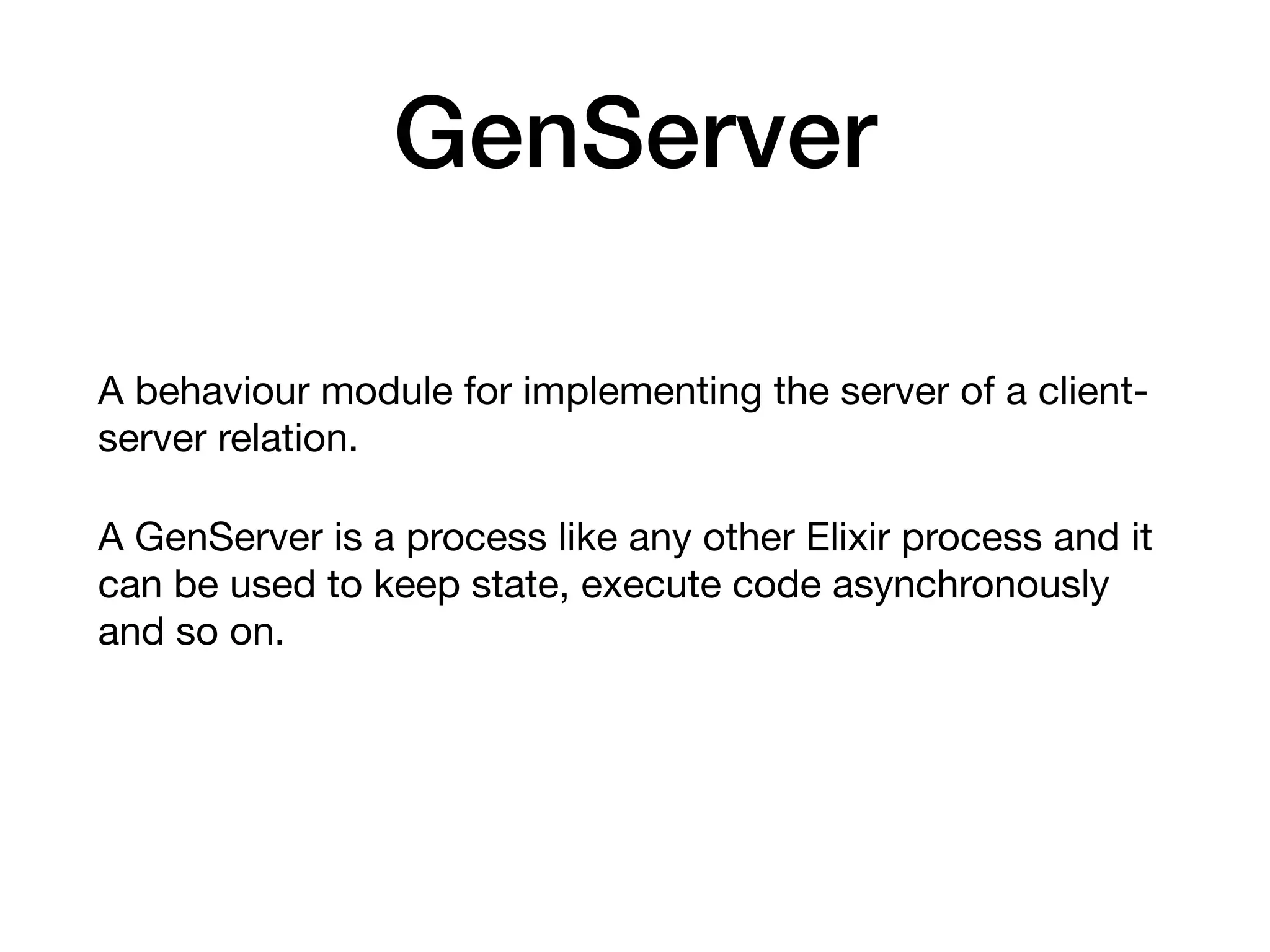
GenServer
GenServer
A behaviour module for implementing the server of a client-
server relation.

A GenServer is a process like any other Elixir process and it
can be used to keep state, execute code asynchronously
and so on. 
GenServer
defmodule Stack do
use GenServer
# Client
def start_link(default) do
GenServer.start_link(__MODULE__, default)
end
def push(pid, item) do
GenServer.cast(pid, {:push, item})
end
def pop(pid) do
GenServer.call(pid, :pop)
end
# Server (callbacks)
def handle_call(:pop, _from, [h | t]) do
{:reply, h, t}
end
def handle_cast({:push, item}, state) do
{:noreply, [item | state]}
end
end
GenServer
defmodule Stack do
use GenServer
# Client
def start_link(default) do
GenServer.start_link(__MODULE__, default)
end
def push(pid, item) do
GenServer.cast(pid, {:push, item})
end
def pop(pid) do
GenServer.call(pid, :pop)
end
# Server (callbacks)
def handle_call(:pop, _from, [h | t]) do
{:reply, h, t}
end
def handle_cast({:push, item}, state) do
{:noreply, [item | state]}
end
end
Executed in caller process
GenServer
defmodule Stack do
use GenServer
# Client
def start_link(default) do
GenServer.start_link(__MODULE__, default)
end
def push(pid, item) do
GenServer.cast(pid, {:push, item})
end
def pop(pid) do
GenServer.call(pid, :pop)
end
# Server (callbacks)
def handle_call(:pop, _from, [h | t]) do
{:reply, h, t}
end
def handle_cast({:push, item}, state) do
{:noreply, [item | state]}
end
end
Executed in server process
GenServer: timeout
call(server, request, timeout  5000)
def push(pid, item) do
GenServer.cast(pid, {:push, item})
end
def pop(pid) do
GenServer.call(pid, :pop)
end
# Server (callbacks)
@impl true
def handle_call(:pop, _from, [h | t]) do
Process.sleep(30_000)
{:reply, h, t}
end
@impl true
def handle_cast({:push, item}, state) do
{:noreply, [item | state]}
end
Executed in caller process
Executed in server process
GenServer: timeout
iex(2)> {:ok, pid} = Stack.start_link([])
{:ok, #PID<0.95.0>}
iex(3)> Enum.each(1..5, &Stack.push(pid, &1))
:ok
ex(4)> Stack.pop(pid)
** (exit) exited in: GenServer.call(#PID<0.95.0>, :pop, 5000)
** (EXIT) time out
(elixir) lib/gen_server.ex:836: GenServer.call/3
iex(4)> Stack.pop(pid)
** (exit) exited in: GenServer.call(#PID<0.95.0>, :pop, 5000)
** (EXIT) time out
(elixir) lib/gen_server.ex:836: GenServer.call/3
iex(4)> Stack.pop(pid)
** (exit) exited in: GenServer.call(#PID<0.95.0>, :pop, 5000)
** (EXIT) time out
(elixir) lib/gen_server.ex:836: GenServer.call/3
iex(4)> Stack.pop(pid)
** (exit) exited in: GenServer.call(#PID<0.95.0>, :pop, 5000)
** (EXIT) time out
(elixir) lib/gen_server.ex:836: GenServer.call/3
iex(4)> Process.info(pid, :messages)
{:messages,
[
{:"$gen_call", {#PID<0.88.0>, #Reference<0.3022523149.3093823489.83754>},
:pop},
{:"$gen_call", {#PID<0.88.0>, #Reference<0.3022523149.3093823489.83774>},
:pop},
{:"$gen_call", {#PID<0.88.0>, #Reference<0.3022523149.3093823489.83794>},
:pop}
]}
Executed in caller process
Executed in server process
GenServer: timeout
ex(5)> Process.info(pid, :messages)
{:messages,
[
{:"$gen_call", {#PID<0.88.0>,
#Reference<0.3022523149.3093823489.83794>},
:pop}
]}
ex(6)> Process.info(pid, :messages)
{:messages, []}
iex(7)> flush()
{#Reference<0.3022523149.3093823489.83730>, 5}
{#Reference<0.3022523149.3093823489.83754>, 4}
{#Reference<0.3022523149.3093823489.83774>, 3}
{#Reference<0.3022523149.3093823489.83794>, 2}
:ok
Digital Signature
Microservice
Digital Signature Microservice
• Microservice - part of the Ukrainian eHealth system
infrastructure

• Digital signature validation 

• Ukrainian standard DSTU 4145-2002

• Integration with proprietary C library via NIF
Digital Signature Microservice
Digital Signature
Microservice
NIF
Proprietary
DSTU
4145-2002
LIB
Digitally signed
content
< 5s
Decoded content
Signer info
Signature validation
Certificates
OSCP Server
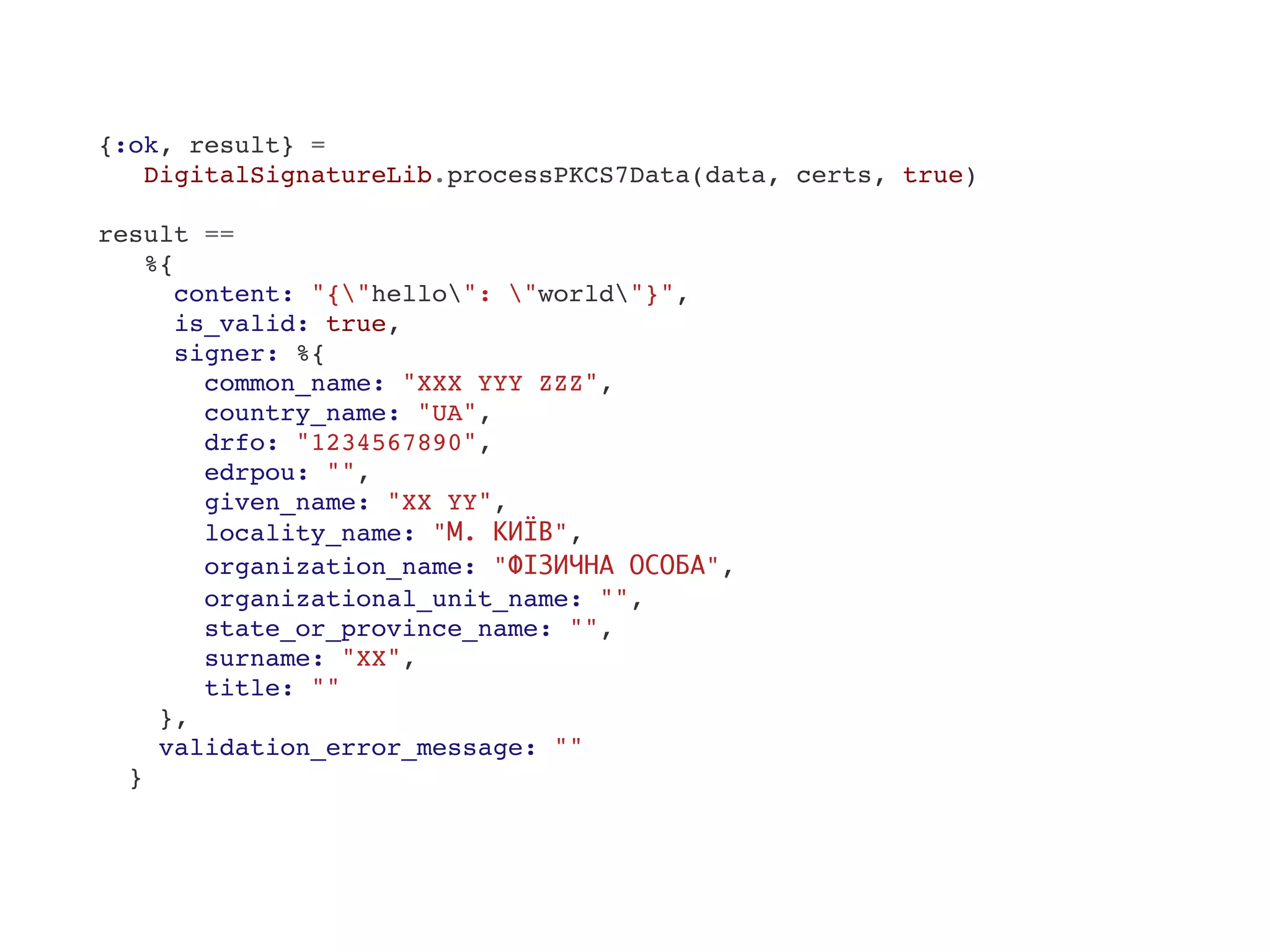
{:ok, result} =
DigitalSignatureLib.processPKCS7Data(data, certs, true)
result ==
%{
content: "{"hello": "world"}",
is_valid: true,
signer: %{
common_name: "XXX YYY ZZZ",
country_name: "UA",
drfo: "1234567890",
edrpou: "",
given_name: "XX YY",
locality_name: "М. КИЇВ",
organization_name: "ФІЗИЧНА ОСОБА",
organizational_unit_name: "",
state_or_province_name: "",
surname: "XX",
title: ""
},
validation_error_message: ""
}
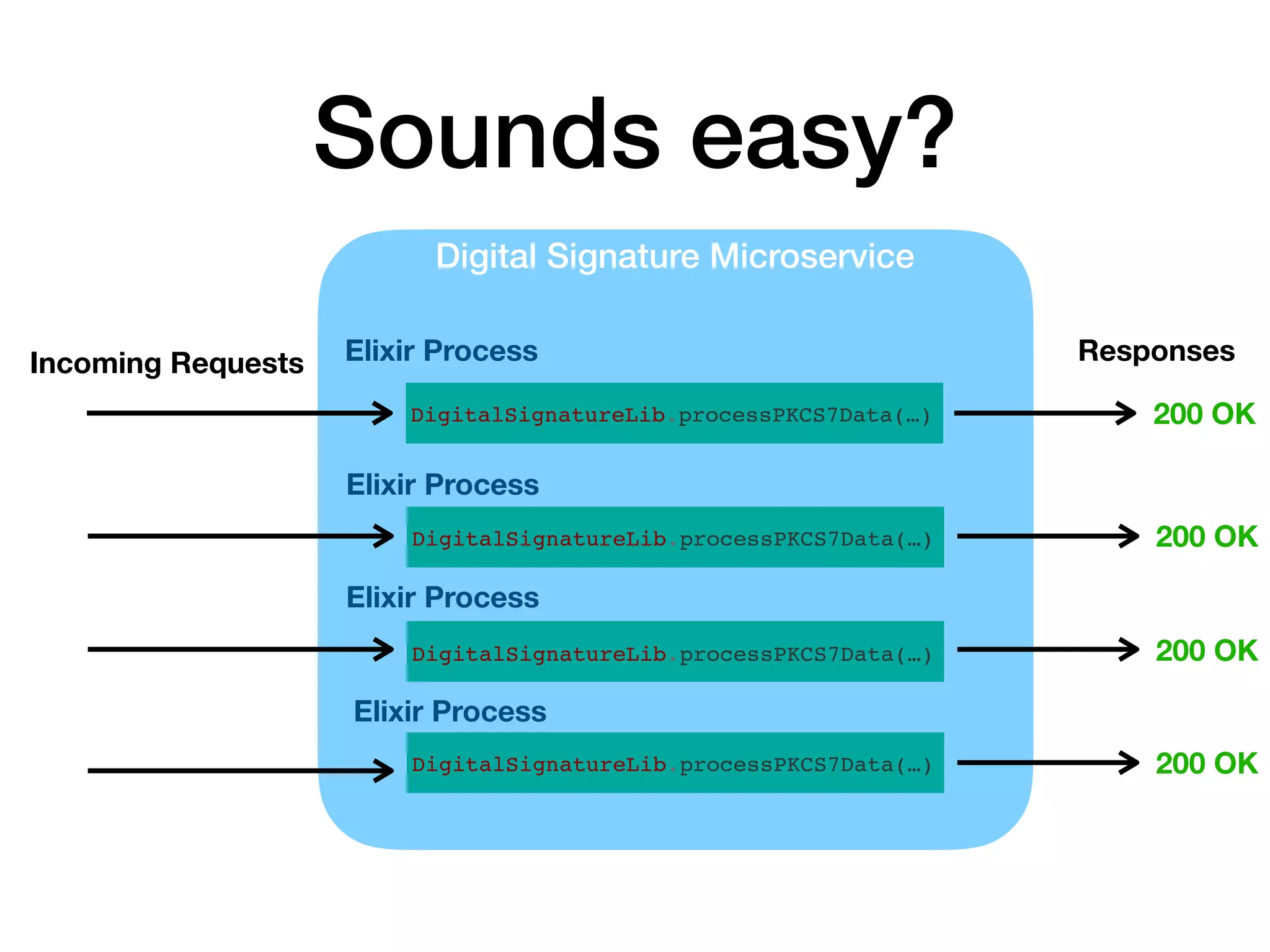
Sounds easy?
Digital Signature Microservice
DigitalSignatureLib.processPKCS7Data(…)
Elixir Process
Elixir Process
Elixir Process
Elixir Process
Incoming Requests
200 OK
200 OK
200 OK
200 OK
Responses
Problem 1: concurrency
tasks =
Enum.map(1..25, fn _ ->
Task.async(fn ->
DigitalSignatureLib.processPKCS7Data(data, certs, true)
end)
end)
Enum.map(tasks, fn task ->
{:ok, result} = Task.await(task, 30000)
IO.inspect(result)
end)
%{
content: ***
}
%{
content: ***
}
%{
content: ***
}
%{
content: ***
}
*** Error in `/usr/local/lib/erlang/erts-9.3.3/bin/beam.smp': double free or corruption (fasttop): 0x00007f88e401d060 ***
======= Backtrace: =========
/lib/x86_64-linux-gnu/libc.so.6(+0x70bfb)[0x7f8962452bfb]
/lib/x86_64-linux-gnu/libc.so.6(+0x76fc6)[0x7f8962458fc6]
/lib/x86_64-linux-gnu/libc.so.6(+0x7780e)[0x7f896245980e]
/usr/local/lib/libUACryptoQ.so.1(_ZN9DataBlockaSERKS_+0x3c)[0x7f88a7bd785c]
/usr/local/lib/libUACryptoQ.so.1(_ZN4DataaSERKS_+0x11)[0x7f88a7bd6771]
/usr/local/lib/libUACryptoQ.so.1(_ZN7DataSet3NewERK4Data+0x3c)[0x7f88a7bd81cc]
/usr/local/lib/libUACryptoQ.so.1(_ZNK3UAC16ObjectIdentifier10EncodeBodyEv+0x1fc)[0x7f88a7bf238c]
/usr/local/lib/libUACryptoQ.so.1(_ZNK3UAC5Token6EncodeEv+0x46)[0x7f88a7bef236]
/usr/local/lib/libUACryptoQ.so.1(_ZNK3UAC11ObjectToken10EncodeBodyEv+0x17)[0x7f88a7bef3c7]
/usr/local/lib/libUACryptoQ.so.1(_ZNK3UAC5Token6EncodeEv+0x46)[0x7f88a7bef236]
/usr/local/lib/libUACryptoQ.so.1(_ZNK3UAC11Constructed10EncodeBodyEv+0x45)[0x7f88a7be97d5]
/usr/local/lib/libUACryptoQ.so.1(_ZNK3UAC11Constructed6EncodeEv+0x39)[0x7f88a7bec089]
/usr/local/lib/libUACryptoQ.so.1(_ZNK3UAC11Constructed10EncodeBodyEv+0x45)[0x7f88a7be97d5]
/usr/local/lib/libUACryptoQ.so.1(_ZNK3UAC11Constructed6EncodeEv+0x39)[0x7f88a7bec089]
/usr/local/lib/libUACryptoQ.so.1(_ZNK3UAC10CMSContent6EncodeEv+0x95)[0x7f88a7c0a2d5]
/usr/local/lib/libUACryptoQ.so.1(_ZNK3UAC11ObjectToken10EncodeBodyEv+0x3a)[0x7f88a7bef3ea]
/usr/local/lib/libUACryptoQ.so.1(_ZNK3UAC5Token6EncodeEv+0x46)[0x7f88a7bef236]
/usr/local/lib/libUACryptoQ.so.1(_ZNK3UAC11Constructed10EncodeBodyEv+0x45)[0x7f88a7be97d5]
/usr/local/lib/libUACryptoQ.so.1(_ZNK3UAC11Constructed6EncodeEv+0x39)[0x7f88a7bec089]
/usr/local/lib/libUACryptoQ.so.1(_ZNK3UAC10CMSContent6EncodeEv+0x95)[0x7f88a7c0a2d5]
/usr/local/lib/libUACryptoQ.so.1(_ZNK3UAC11ObjectToken10EncodeBodyEv+0x3a)[0x7f88a7bef3ea]
/usr/local/lib/libUACryptoQ.so.1(_ZNK3UAC5Token6EncodeEv+0x46)[0x7f88a7bef236]
/usr/local/lib/libUACryptoQ.so.1(_ZNK3UAC11Constructed10EncodeBodyEv+0x45)[0x7f88a7be97d5]
/usr/local/lib/libUACryptoQ.so.1(_ZNK3UAC11Constructed6EncodeEv+0x39)[0x7f88a7bec089]
/usr/local/lib/libUACryptoQ.so.1(_ZNK3UAC17ObjectWithContent6EncodeEv+0x1b)[0x7f88a7be946b]
/usr/local/lib/libUACryptoQ.so.1(_ZNK3UAC11ObjectToken10EncodeBodyEv+0x3a)[0x7f88a7bef3ea]
/usr/local/lib/libUACryptoQ.so.1(_ZNK3UAC5Token6EncodeEv+0x46)[0x7f88a7bef236]
/usr/local/lib/libUACryptoQ.so.1(_ZNK3UAC11Constructed10EncodeBodyEv+0x45)[0x7f88a7be97d5]
/usr/local/lib/libUACryptoQ.so.1(_ZNK3UAC11Constructed6EncodeEv+0x39)[0x7f88a7bec089]
/usr/local/lib/libUACryptoQ.so.1(_ZN3UAC13CMSSignedData15VerifySignatureEPNS_11CertificateEP11_UAC_STREAM+0x9f5)[0x7f88a7c12965]
/usr/local/lib/libUACryptoQ.so.1(UAC_SignedDataVerify+0x2ba)[0x7f88a7c4ff1a]
/home/digital_signature.lib/_build/test/lib/digital_signature_lib/priv/digital_signature_lib_nif.so(Check+0x3c5)[0x7f891c0fc7f5]
/home/digital_signature.lib/_build/test/lib/digital_signature_lib/priv/digital_signature_lib_nif.so(+0x2bac)[0x7f891c0fbbac]
/usr/local/lib/erlang/erts-9.3.3/bin/beam.smp(erts_call_dirty_nif+0x19c)[0x5ce04c]
/usr/local/lib/erlang/erts-9.3.3/bin/beam.smp(erts_dirty_process_main+0x209)[0x445949]
/usr/local/lib/erlang/erts-9.3.3/bin/beam.smp[0x4f4a4d]
/usr/local/lib/erlang/erts-9.3.3/bin/beam.smp[0x675985]
/lib/x86_64-linux-gnu/libpthread.so.0(+0x7494)[0x7f8962990494]
/lib/x86_64-linux-gnu/libc.so.6(clone+0x3f)[0x7f89624caacf]
======= Memory map: ========
00400000-0073b000 r-xp 00000000 08:01 2376229 /usr/local/lib/erlang/erts-9.3.3/bin/beam.smp
0093a000-0093b000 r--p 0033a000 08:01 2376229 /usr/local/lib/erlang/erts-9.3.3/bin/beam.smp
0093b000-00956000 rw-p 0033b000 08:01 2376229 /usr/local/lib/erlang/erts-9.3.3/bin/beam.smp
00956000-0097d000 rw-p 00000000 00:00 0
0231e000-02349000 rw-p 00000000 00:00 0 [heap]
Problem 1 solution: Gen Server
...
use GenServer
# Callbacks
...
def handle_call({:process_signed_content, signed_content, check}, _from,
{certs_cache_ttl, certs}) do
check = unless is_boolean(check), do: true
processing_result = do_process_signed_content(signed_content, certs, check,
SignedData.new())
{:reply, processing_result, {certs_cache_ttl, certs}}
end
...
# Client
...
def process_signed_content(signed_content, check) do
GenServer.call(__MODULE__, {:process_signed_content, signed_content, check})
end
Problem 1 solution: Gen Server
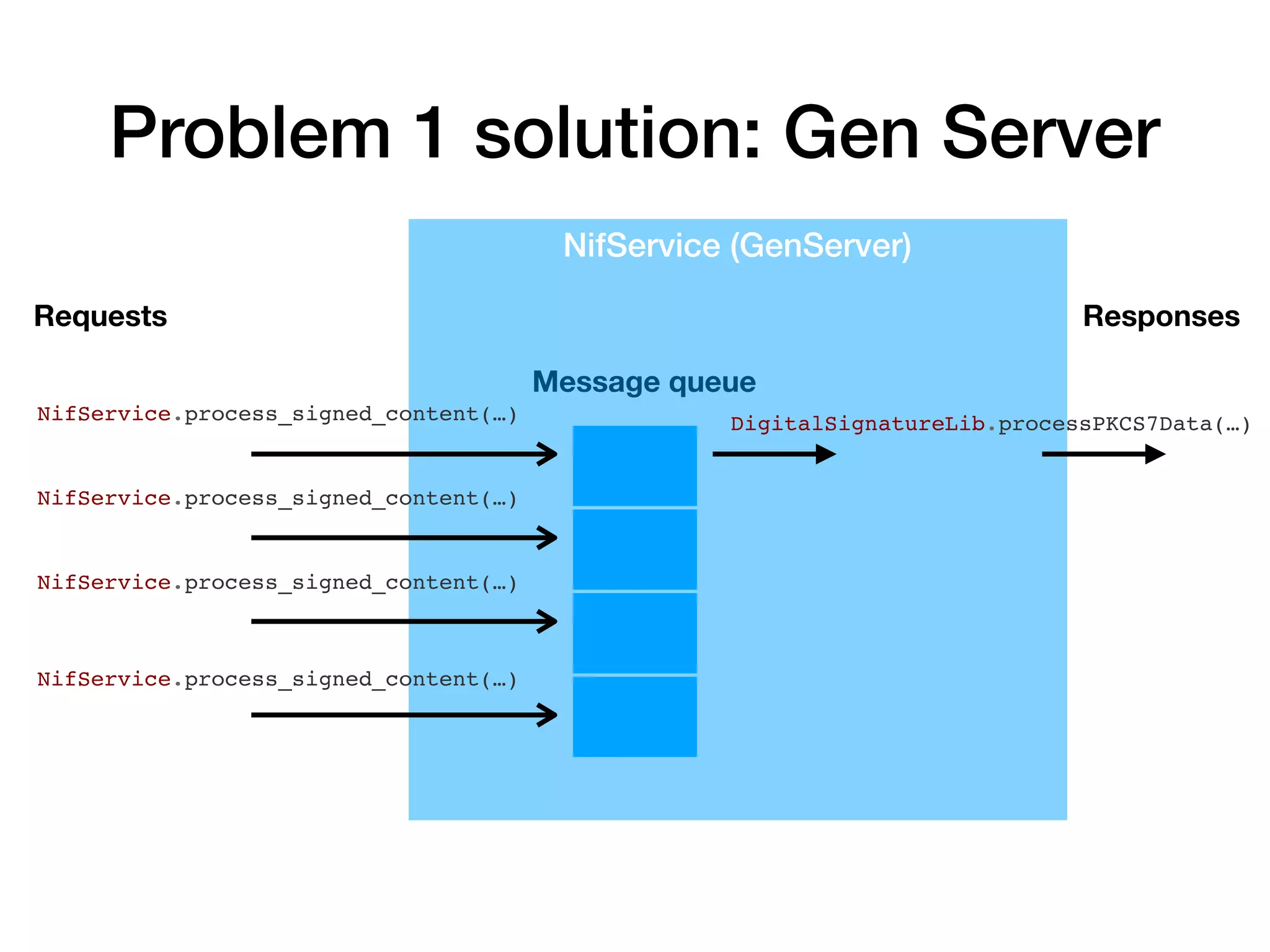
NifService (GenServer)
NifService.process_signed_content(…)
Requests
Message queue
DigitalSignatureLib.processPKCS7Data(…)
Responses
Problem 2: timeouts
NifService (GenServer)
Multiple concurrent
requests (processes)
2s
2s
2s
2s
Message queue
Sequential
responses
200 OK
2s
200 OK
4s
500 Error
5s
500 Error
5s
call(server, request, timeout  5000)
** (EXIT) time out
** (EXIT) time out
Problem 2: timeouts
NifService (GenServer)
Multiple concurrent
requests (processes)
2s
2s
Message queue
Sequential
responses
call(server, request, timeout  5000)
2s
2s
500 Error
5s
500 Error
5s
Problem 2 solution: architecture
DS
DS
DS
DS DS
DS
DS
DS
Load
Balancer
Reduce pressure on individual MS
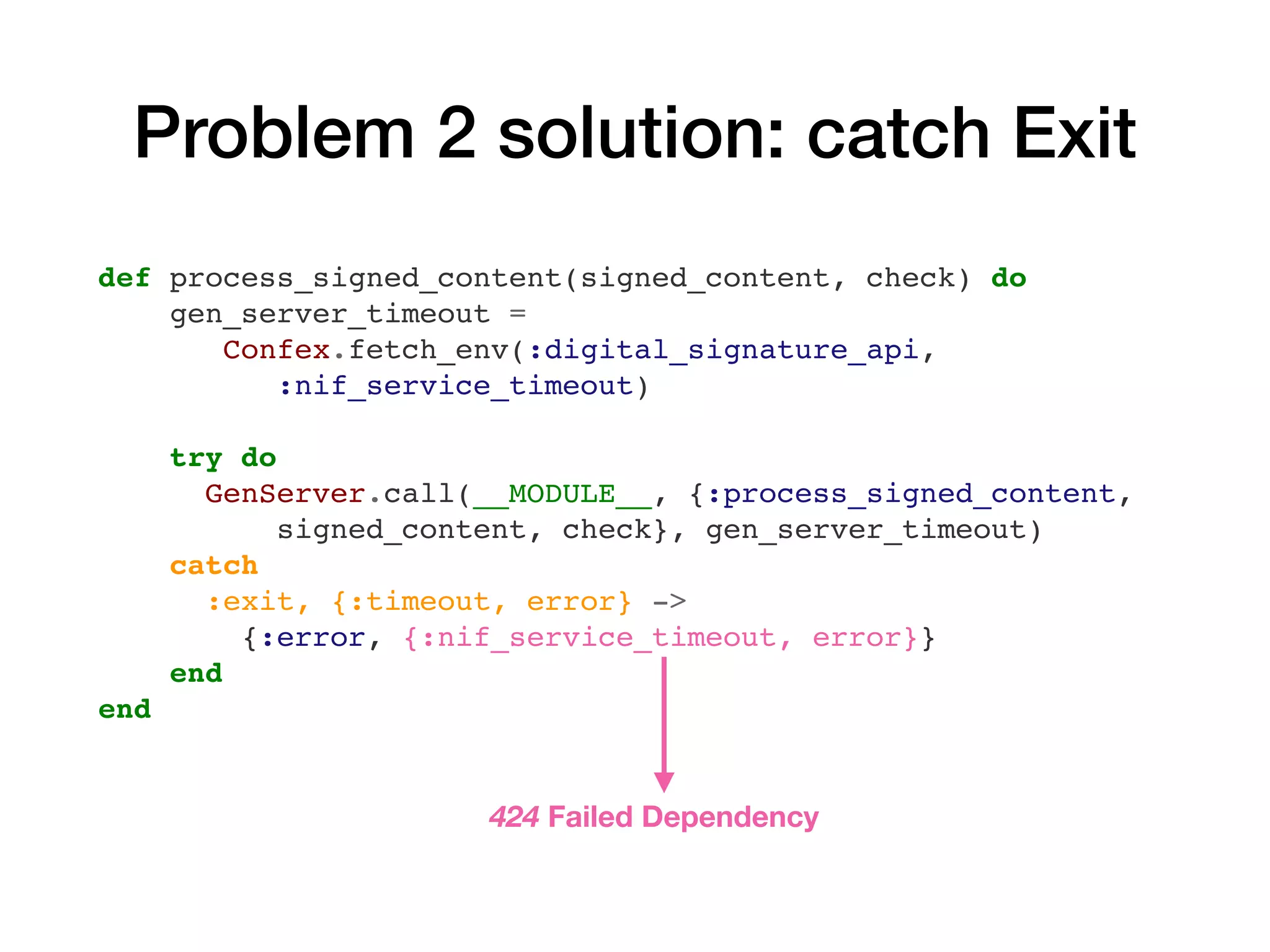
Problem 2 solution: catch Exit
def process_signed_content(signed_content, check) do
gen_server_timeout =
Confex.fetch_env(:digital_signature_api,
:nif_service_timeout)
try do
GenServer.call(__MODULE__, {:process_signed_content,
signed_content, check}, gen_server_timeout)
catch
:exit, {:timeout, error} ->
{:error, {:nif_service_timeout, error}}
end
end
424 Failed Dependency
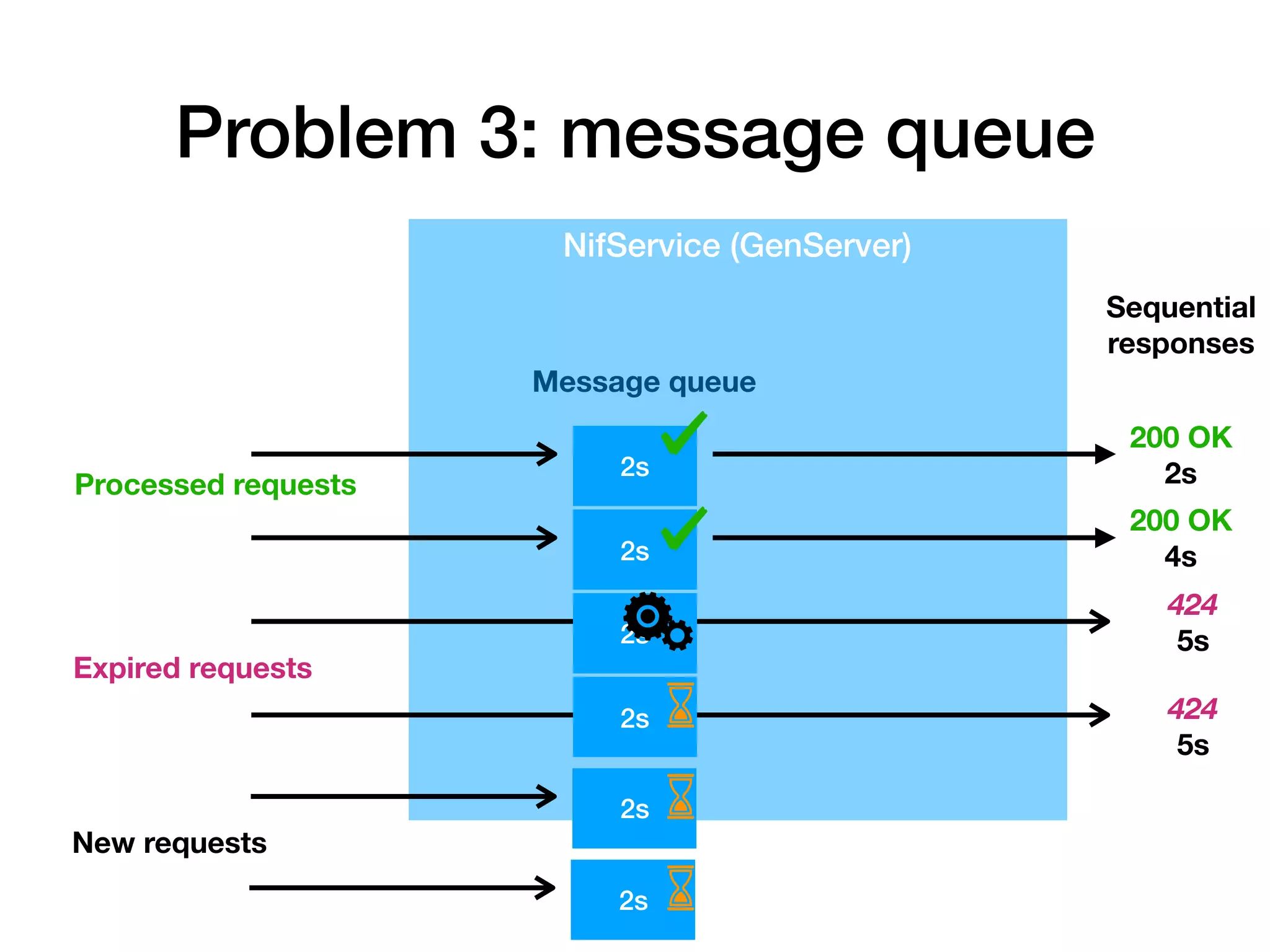
Problem 3: message queue
NifService (GenServer)
Processed requests
2s
2s
2s
2s
Message queue
Sequential
responses
200 OK
2s
200 OK
4s
424
5s
424
5s
2s
2s
Expired requests
New requests
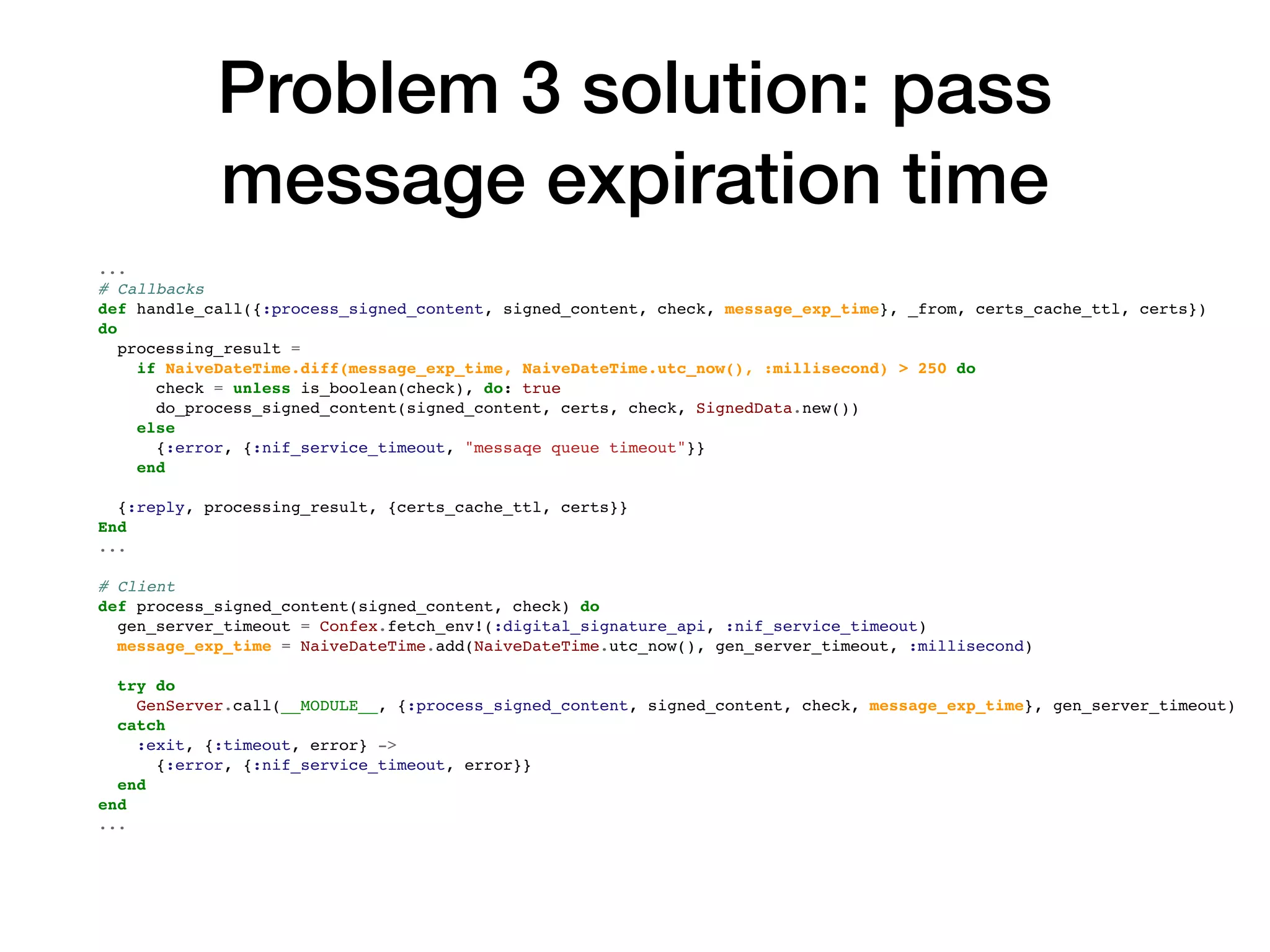
Problem 3 solution: pass
message expiration time
...
# Callbacks
def handle_call({:process_signed_content, signed_content, check, message_exp_time}, _from, certs_cache_ttl, certs})
do
processing_result =
if NaiveDateTime.diff(message_exp_time, NaiveDateTime.utc_now(), :millisecond) > 250 do
check = unless is_boolean(check), do: true
do_process_signed_content(signed_content, certs, check, SignedData.new())
else
{:error, {:nif_service_timeout, "messaqe queue timeout"}}
end
{:reply, processing_result, {certs_cache_ttl, certs}}
End
...
# Client
def process_signed_content(signed_content, check) do
gen_server_timeout = Confex.fetch_env!(:digital_signature_api, :nif_service_timeout)
message_exp_time = NaiveDateTime.add(NaiveDateTime.utc_now(), gen_server_timeout, :millisecond)
try do
GenServer.call(__MODULE__, {:process_signed_content, signed_content, check, message_exp_time}, gen_server_timeout)
catch
:exit, {:timeout, error} ->
{:error, {:nif_service_timeout, error}}
end
end
...
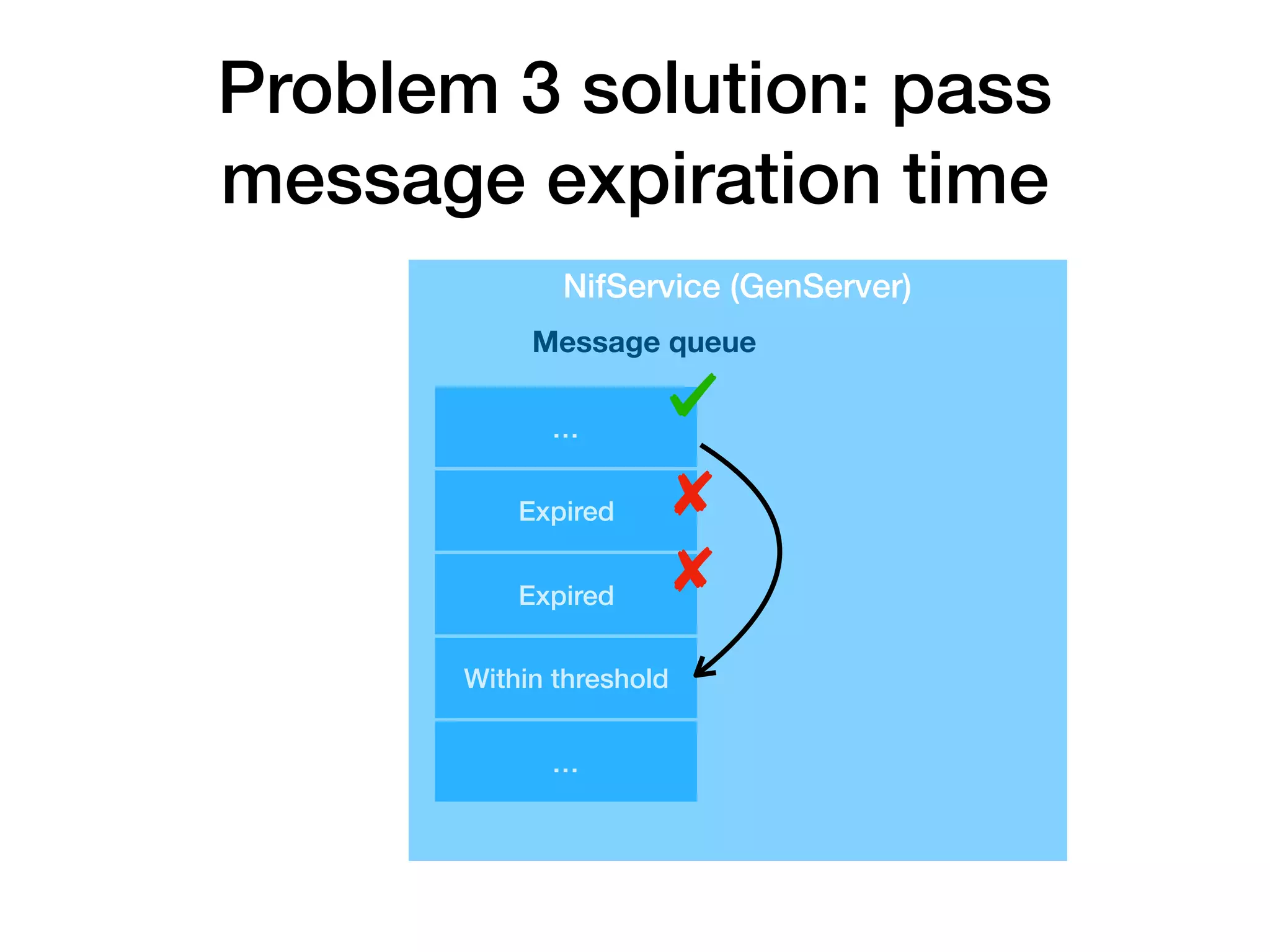
Problem 3 solution: pass
message expiration time
NifService (GenServer)
…
Expired
Expired
Within threshold
Message queue
…
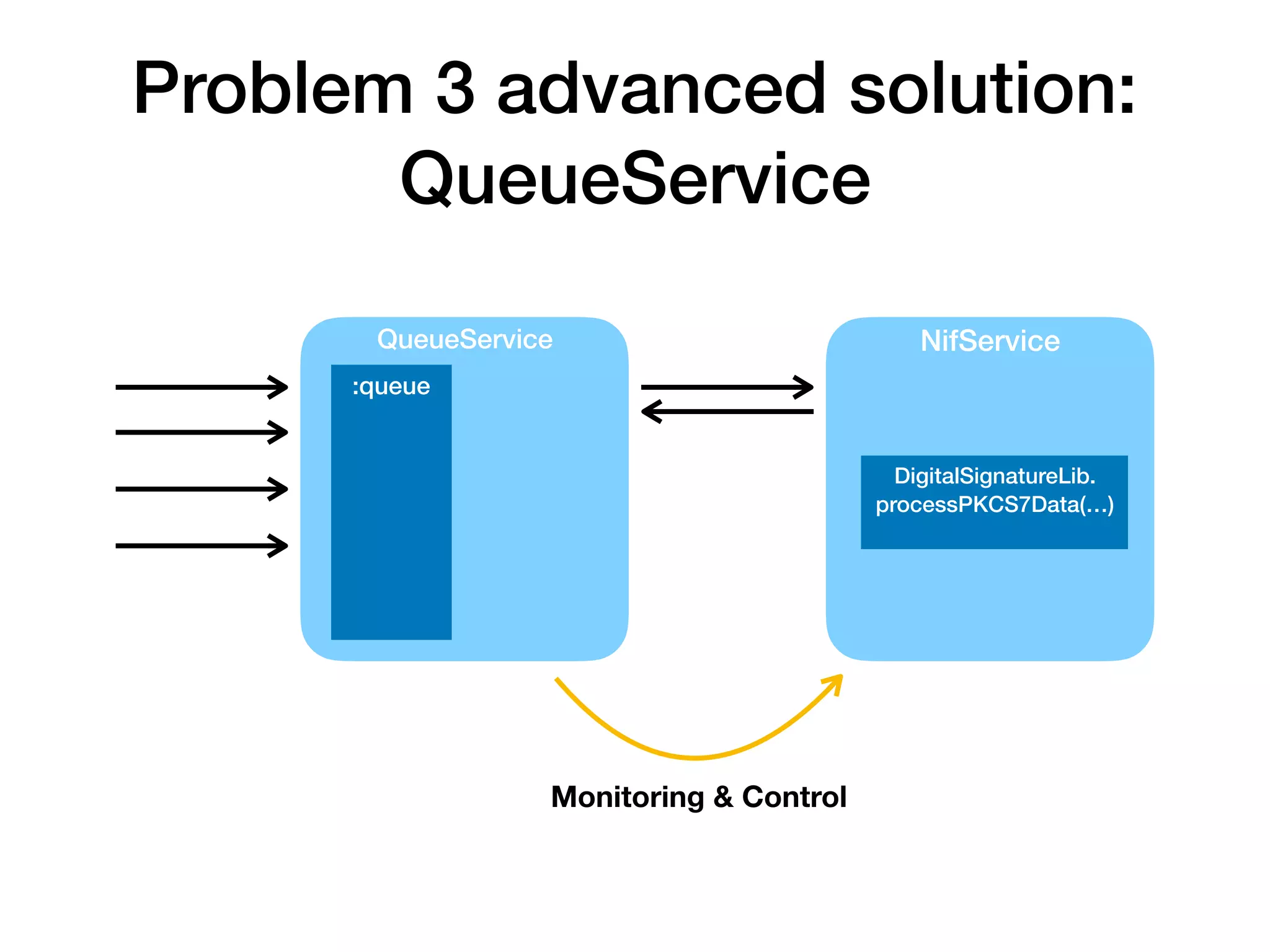
Problem 3 advanced solution:
QueueService
NifService
DigitalSignatureLib.
processPKCS7Data(…)
QueueService
:queue
Monitoring & Control
Memory management
Binary terms which are larger than 64 bytes are not stored in a process private
heap. 

They are called Refc Binary (Reference Counted Binary) and are stored in a
large Shared Heap which is accessible by all processes who have the pointer
of that Refc Binaries. 

That pointer is called ProcBin and is stored in a process private heap.

The GC for the shared heap is reference counting.

Collecting those Refc messages depends on collecting of all ProcBin objects
even ones that are inside the middleware process. 

Unfortunately because ProcBins are just a pointer hence they are so cheap
and it could take so long to happen a GC inside the middleware process.
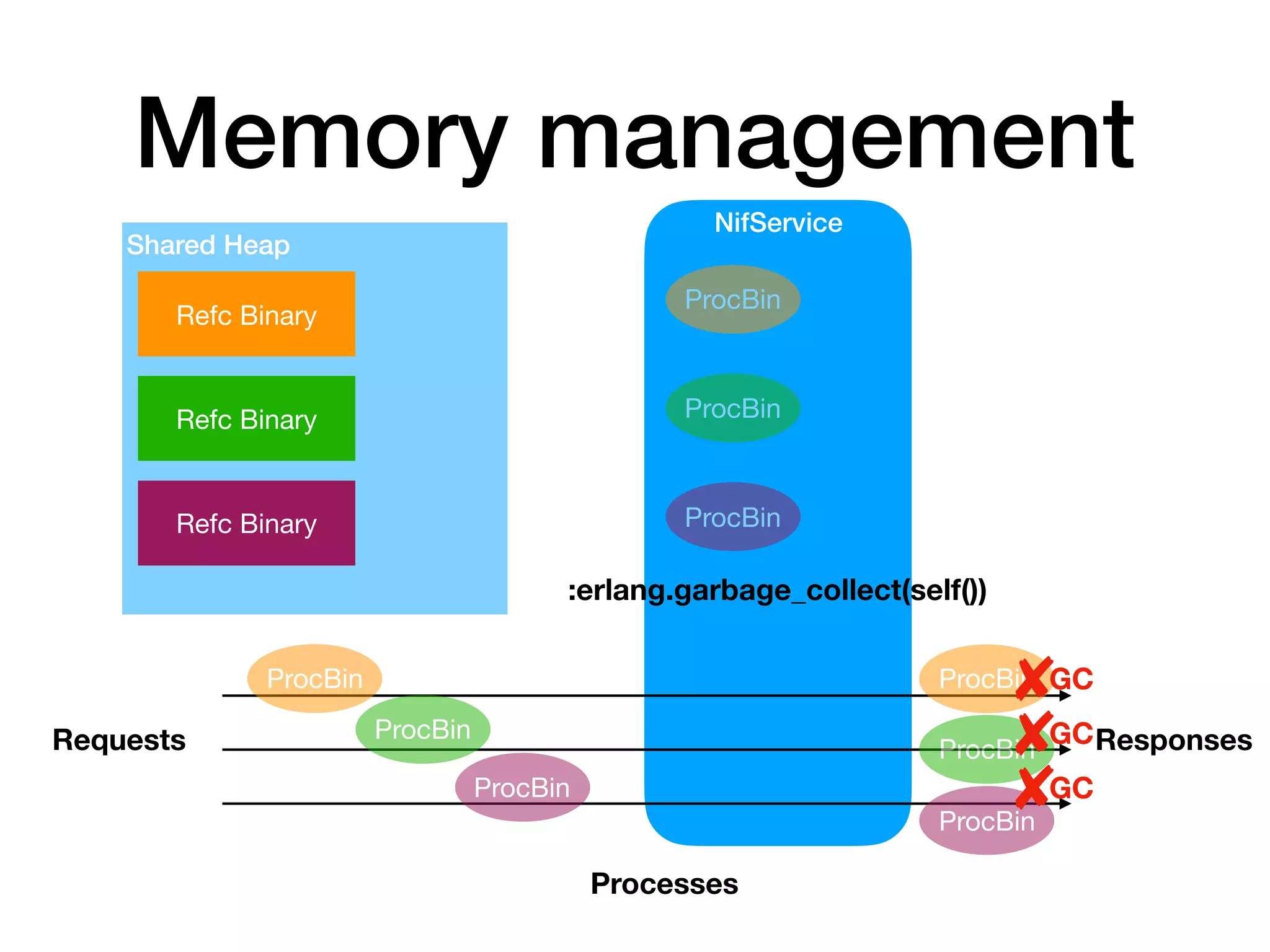
NifService
Memory management
Shared Heap
Refc Binary
Refc Binary
Refc Binary
Requests Responses
ProcBin
ProcBin
ProcBin
ProcBin
ProcBin
ProcBin
ProcBin
ProcBin
ProcBin
GC
GC
GC
:erlang.garbage_collect(self())
Processes
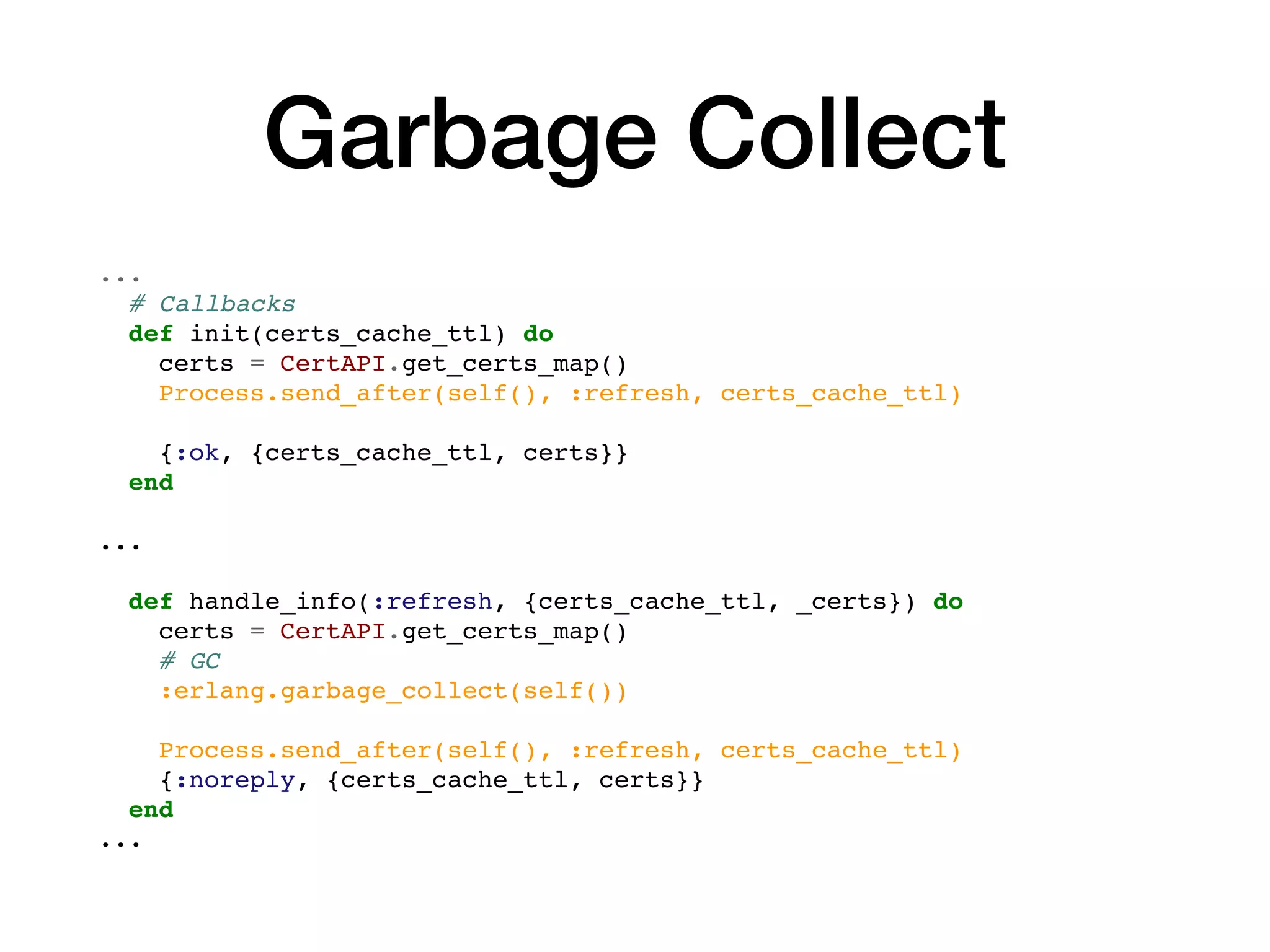
Garbage Collect
...
# Callbacks
def init(certs_cache_ttl) do
certs = CertAPI.get_certs_map()
Process.send_after(self(), :refresh, certs_cache_ttl)
{:ok, {certs_cache_ttl, certs}}
end
...
def handle_info(:refresh, {certs_cache_ttl, _certs}) do
certs = CertAPI.get_certs_map()
# GC
:erlang.garbage_collect(self())
Process.send_after(self(), :refresh, certs_cache_ttl)
{:noreply, {certs_cache_ttl, certs}}
end
...
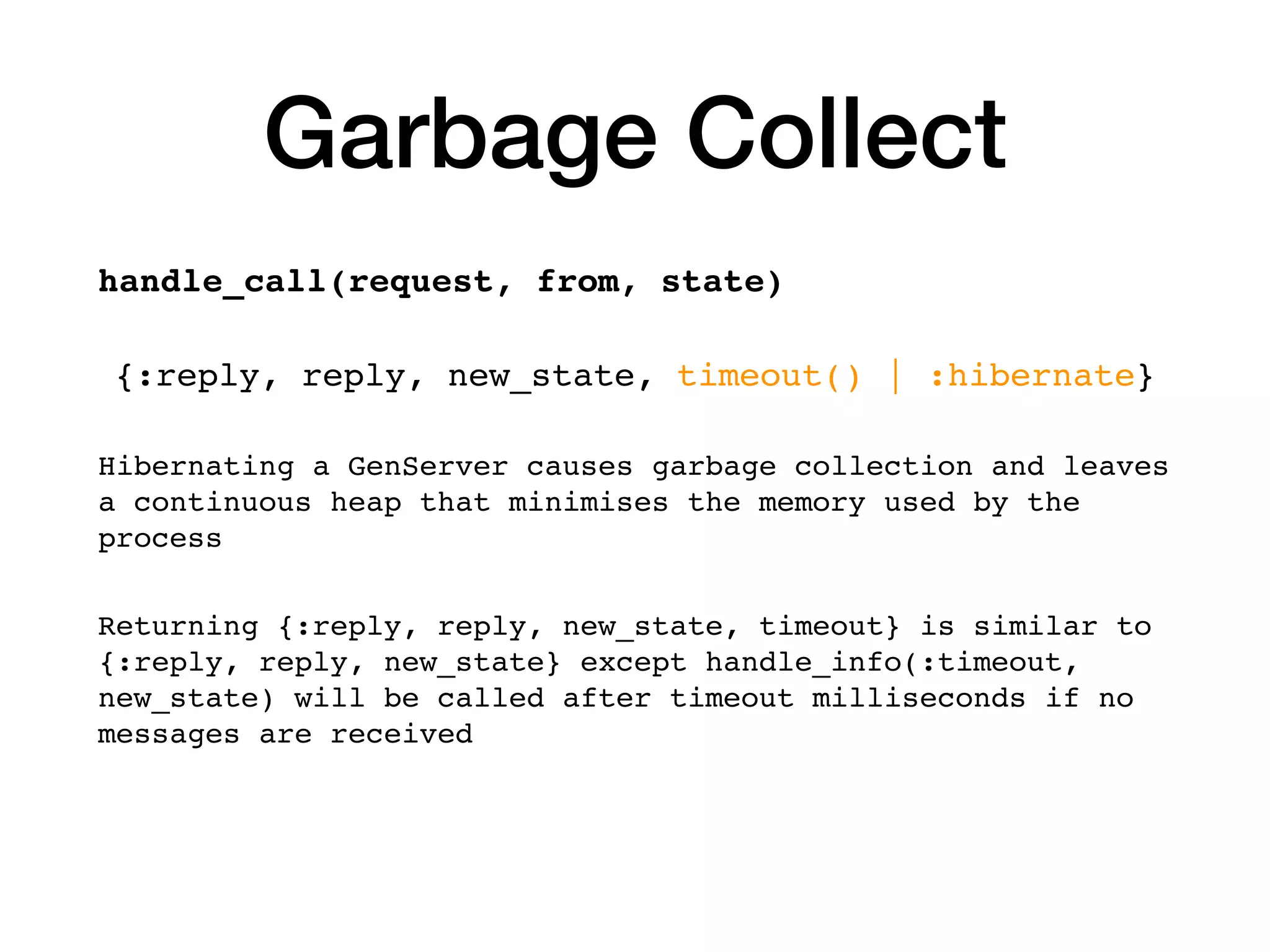
Garbage Collect
handle_call(request, from, state)
{:reply, reply, new_state, timeout() | :hibernate}
Hibernating a GenServer causes garbage collection and leaves
a continuous heap that minimises the memory used by the
process
Returning {:reply, reply, new_state, timeout} is similar to
{:reply, reply, new_state} except handle_info(:timeout,
new_state) will be called after timeout milliseconds if no
messages are received
Useful links
Saša Jurić "Elixir in Action, Second Edition”
https://www.manning.com/books/elixir-in-action-second-edition

Andrea Leopardi - Concurrent and Resilient Connections to Outside the
BEAM (ElixirConfEU 2016)
https://www.youtube.com/watch?time_continue=1884&v=U1Ry7STEFiY

GenServer call time-outs
https://cultivatehq.com/posts/genserver-call-timeouts/

Elixir Memory - Not Quite Free
https://stephenbussey.com/2018/05/09/elixir-memory-not-quite-free.html

Erlang Garbage Collection Details and Why It Matters
https://hamidreza-s.github.io/erlang%20garbage%20collection%20memory%20layout%20soft%20realtime/
2015/08/24/erlang-garbage-collection-details-and-why-it-matters.html
Thank You
Yurii Bodarev

https://github.com/ybod
Questions?

GenServer in action

  • 1.
    GenServer in Action  ElixirClub 11 Ternopil, 2018
  • 2.
  • 3.
    Process iex(1)> spawn fn-> 1 + 1 end #PID<0.90.0> iex(2)> caller = self() #PID<0.88.0> iex(3)> spawn fn -> send caller, {:result, 1 + 1} end #PID<0.93.0> iex(4)> receive do ...(4)> {:result, result} -> result ...(4)> end 2
  • 4.
    Process iex(5)> spawn fn-> ...(5)> Process.sleep(6_000) ...(5)> send caller, {:result, 1 + 1} ...(5)> end #PID<0.106.0> iex(6)> receive do ...(6)> {:result, result} -> result ...(6)> end ⏳⏳⏳⏳⏳⌛ 2
  • 5.
    Process iex(7)> spawn fn-> ...(7)> Process.sleep(666_666_666) ...(7)> send caller, {:result, 1 + 1} ...(7)> end #PID<0.99.0> iex(8)> spawn fn -> :nothing end #PID<0.101.0> iex(9)> spawn fn -> raise "error" end #PID<0.103.0> … iex(11)> receive do ...(11)> {:result, result} -> result ...(11)> end ⏳⏳⏳⏳⏳⏳⏳⏳⏳⏳⏳⏳⏳⏳⏳⏳⏳⏳⏳⏳⏳⏳⏳⏳⏳⏳⏳⏳⏳⏳⏳⏳⏳⏳⏳⏳⏳⏳⏳ 💤 💤 💤 CTRL+C
  • 6.
    Process: timeout iex(1)> caller= self() #PID<0.88.0> iex(2)> spawn fn -> ...(2)> Process.sleep(666_666_666) ...(2)> send caller, {:result, 1 + 1} ...(2)> end #PID<0.94.0> iex(3)> receive do ...(3)> {:result, result} -> {:ok, result} ...(3)> after ...(3)> 5_000 -> {:error, :timeout} ...(3)> end ⏳⏳⏳⏳⌛{:error, :timeout}
  • 7.
    Process: message queue iex(4)>send self(), {:message, 1} iex(5)> send self(), {:another_message, 1} iex(6)> send self(), {:message, 2} iex(7)> send self(), {:another_message, 2} iex(8)> send self(), {:message, 3} iex(9)> send self(), {:another_message, 3} iex(10)> Process.info(self(), :messages) {:messages, [ message: 1, another_message: 1, message: 2, another_message: 2, message: 3, another_message: 3 ]}
  • 8.
    Process: message queue {:messages, [ message:1, another_message: 10, message: 2, another_message: 20, message: 3, another_message: 30 ]} iex(11)> receive do {:another_message, n} -> n end 10 iex(12)> receive do {:another_message, n} -> n end 20 iex(13)> Process.info(self(), :messages) {:messages, [message: 1, message: 2, message: 3, another_message: 30]} iex(14)> receive do {:message, n} -> n end 1 iex(15)> Process.info(self(), :messages) {:messages, [message: 2, message: 3, another_message: 30]} iex(16)> receive do {:something, n} -> n after 0 -> :no_matching_message end :no_matching_message
  • 9.
  • 10.
    Concurrent Tasks Task.async /Task.await ex(17)> task = Task.async(fn -> 1 + 1 end) %Task{ owner: #PID<0.88.0>, pid: #PID<0.106.0>, ref: #Reference<0.1183799544.2034761732.30152> } iex(18)> Task.await(task) 2
  • 11.
    Concurrent Tasks Task.async /Task.await iex(19)> tasks = Enum.map(1..10, &Task.async(fn -> ...(19)> Process.sleep(3_000) ...(19)> &1 * 100 ...(19)> end)) […] iex(20)> Process.sleep(5_000) :ok iex(21)> Enum.map(tasks, &Task.await(&1)) [100, 200, 300, 400, 500, 600, 700, 800, 900, 1000]
  • 12.
    Concurrent Tasks Task.await timeout await(task,timeout 5000) … A timeout, in milliseconds, can be given with default value of 5000. If the timeout is exceeded, then the current process will exit. … iex(22)> Task.async(fn -> Process.sleep(6_000) end) |> Task.await() ** (exit) exited in: Task.await(%Task{owner: #PID<0.88.0>, pid: #PID<0.156.0>, ref: #Reference<0.891801449.431751175.151026>}, 5000) ** (EXIT) time out (elixir) lib/task.ex:501: Task.await/2
  • 13.
    Storing state defmodule Storage do defrecursive(state) do receive do {:add, caller_pid, value} -> new_state = state + value send(caller_pid, {:result, new_state}) recursive(new_state) end end end iex(2)> storage_pid = spawn(fn -> Storage.recursive(0) end) iex(3)> send(storage_pid, {:add, self(), 2}) iex(4)> send(storage_pid, {:add, self(), 2}) iex(5)> send(storage_pid, {:add, self(), 2}) iex(6)> flush() {:result, 2} {:result, 4} {:result, 6}
  • 14.
    Storing state Agent iex(7)> {:ok, pid}= Agent.start_link(fn -> 0 end) {:ok, #PID<0.101.0>} iex(8)> Agent.update(pid, fn state -> state + 1 end) :ok iex(9)> Agent.get(pid, fn state -> state end) 1 update(agent, fun, timeout 5000) get(agent, module, fun, args, timeout 5000)
  • 15.
  • 16.
    GenServer A behaviour modulefor implementing the server of a client- server relation. A GenServer is a process like any other Elixir process and it can be used to keep state, execute code asynchronously and so on. 
  • 17.
    GenServer defmodule Stack do useGenServer # Client def start_link(default) do GenServer.start_link(__MODULE__, default) end def push(pid, item) do GenServer.cast(pid, {:push, item}) end def pop(pid) do GenServer.call(pid, :pop) end # Server (callbacks) def handle_call(:pop, _from, [h | t]) do {:reply, h, t} end def handle_cast({:push, item}, state) do {:noreply, [item | state]} end end
  • 18.
    GenServer defmodule Stack do useGenServer # Client def start_link(default) do GenServer.start_link(__MODULE__, default) end def push(pid, item) do GenServer.cast(pid, {:push, item}) end def pop(pid) do GenServer.call(pid, :pop) end # Server (callbacks) def handle_call(:pop, _from, [h | t]) do {:reply, h, t} end def handle_cast({:push, item}, state) do {:noreply, [item | state]} end end Executed in caller process
  • 19.
    GenServer defmodule Stack do useGenServer # Client def start_link(default) do GenServer.start_link(__MODULE__, default) end def push(pid, item) do GenServer.cast(pid, {:push, item}) end def pop(pid) do GenServer.call(pid, :pop) end # Server (callbacks) def handle_call(:pop, _from, [h | t]) do {:reply, h, t} end def handle_cast({:push, item}, state) do {:noreply, [item | state]} end end Executed in server process
  • 20.
    GenServer: timeout call(server, request,timeout 5000) def push(pid, item) do GenServer.cast(pid, {:push, item}) end def pop(pid) do GenServer.call(pid, :pop) end # Server (callbacks) @impl true def handle_call(:pop, _from, [h | t]) do Process.sleep(30_000) {:reply, h, t} end @impl true def handle_cast({:push, item}, state) do {:noreply, [item | state]} end Executed in caller process Executed in server process
  • 21.
    GenServer: timeout iex(2)> {:ok,pid} = Stack.start_link([]) {:ok, #PID<0.95.0>} iex(3)> Enum.each(1..5, &Stack.push(pid, &1)) :ok ex(4)> Stack.pop(pid) ** (exit) exited in: GenServer.call(#PID<0.95.0>, :pop, 5000) ** (EXIT) time out (elixir) lib/gen_server.ex:836: GenServer.call/3 iex(4)> Stack.pop(pid) ** (exit) exited in: GenServer.call(#PID<0.95.0>, :pop, 5000) ** (EXIT) time out (elixir) lib/gen_server.ex:836: GenServer.call/3 iex(4)> Stack.pop(pid) ** (exit) exited in: GenServer.call(#PID<0.95.0>, :pop, 5000) ** (EXIT) time out (elixir) lib/gen_server.ex:836: GenServer.call/3 iex(4)> Stack.pop(pid) ** (exit) exited in: GenServer.call(#PID<0.95.0>, :pop, 5000) ** (EXIT) time out (elixir) lib/gen_server.ex:836: GenServer.call/3 iex(4)> Process.info(pid, :messages) {:messages, [ {:"$gen_call", {#PID<0.88.0>, #Reference<0.3022523149.3093823489.83754>}, :pop}, {:"$gen_call", {#PID<0.88.0>, #Reference<0.3022523149.3093823489.83774>}, :pop}, {:"$gen_call", {#PID<0.88.0>, #Reference<0.3022523149.3093823489.83794>}, :pop} ]} Executed in caller process Executed in server process
  • 22.
    GenServer: timeout ex(5)> Process.info(pid,:messages) {:messages, [ {:"$gen_call", {#PID<0.88.0>, #Reference<0.3022523149.3093823489.83794>}, :pop} ]} ex(6)> Process.info(pid, :messages) {:messages, []} iex(7)> flush() {#Reference<0.3022523149.3093823489.83730>, 5} {#Reference<0.3022523149.3093823489.83754>, 4} {#Reference<0.3022523149.3093823489.83774>, 3} {#Reference<0.3022523149.3093823489.83794>, 2} :ok
  • 23.
  • 24.
    Digital Signature Microservice •Microservice - part of the Ukrainian eHealth system infrastructure • Digital signature validation • Ukrainian standard DSTU 4145-2002 • Integration with proprietary C library via NIF
  • 25.
    Digital Signature Microservice DigitalSignature Microservice NIF Proprietary DSTU 4145-2002 LIB Digitally signed content < 5s Decoded content Signer info Signature validation Certificates OSCP Server
  • 26.
    {:ok, result} = DigitalSignatureLib.processPKCS7Data(data,certs, true) result == %{ content: "{"hello": "world"}", is_valid: true, signer: %{ common_name: "XXX YYY ZZZ", country_name: "UA", drfo: "1234567890", edrpou: "", given_name: "XX YY", locality_name: "М. КИЇВ", organization_name: "ФІЗИЧНА ОСОБА", organizational_unit_name: "", state_or_province_name: "", surname: "XX", title: "" }, validation_error_message: "" }
  • 27.
    Sounds easy? Digital SignatureMicroservice DigitalSignatureLib.processPKCS7Data(…) DigitalSignatureLib.processPKCS7Data(…) DigitalSignatureLib.processPKCS7Data(…) DigitalSignatureLib.processPKCS7Data(…) Elixir Process Elixir Process Elixir Process Elixir Process Incoming Requests 200 OK 200 OK 200 OK 200 OK Responses
  • 29.
    Problem 1: concurrency tasks= Enum.map(1..25, fn _ -> Task.async(fn -> DigitalSignatureLib.processPKCS7Data(data, certs, true) end) end) Enum.map(tasks, fn task -> {:ok, result} = Task.await(task, 30000) IO.inspect(result) end)
  • 30.
    %{ content: *** } %{ content: *** } %{ content:*** } %{ content: *** } *** Error in `/usr/local/lib/erlang/erts-9.3.3/bin/beam.smp': double free or corruption (fasttop): 0x00007f88e401d060 *** ======= Backtrace: ========= /lib/x86_64-linux-gnu/libc.so.6(+0x70bfb)[0x7f8962452bfb] /lib/x86_64-linux-gnu/libc.so.6(+0x76fc6)[0x7f8962458fc6] /lib/x86_64-linux-gnu/libc.so.6(+0x7780e)[0x7f896245980e] /usr/local/lib/libUACryptoQ.so.1(_ZN9DataBlockaSERKS_+0x3c)[0x7f88a7bd785c] /usr/local/lib/libUACryptoQ.so.1(_ZN4DataaSERKS_+0x11)[0x7f88a7bd6771] /usr/local/lib/libUACryptoQ.so.1(_ZN7DataSet3NewERK4Data+0x3c)[0x7f88a7bd81cc] /usr/local/lib/libUACryptoQ.so.1(_ZNK3UAC16ObjectIdentifier10EncodeBodyEv+0x1fc)[0x7f88a7bf238c] /usr/local/lib/libUACryptoQ.so.1(_ZNK3UAC5Token6EncodeEv+0x46)[0x7f88a7bef236] /usr/local/lib/libUACryptoQ.so.1(_ZNK3UAC11ObjectToken10EncodeBodyEv+0x17)[0x7f88a7bef3c7] /usr/local/lib/libUACryptoQ.so.1(_ZNK3UAC5Token6EncodeEv+0x46)[0x7f88a7bef236] /usr/local/lib/libUACryptoQ.so.1(_ZNK3UAC11Constructed10EncodeBodyEv+0x45)[0x7f88a7be97d5] /usr/local/lib/libUACryptoQ.so.1(_ZNK3UAC11Constructed6EncodeEv+0x39)[0x7f88a7bec089] /usr/local/lib/libUACryptoQ.so.1(_ZNK3UAC11Constructed10EncodeBodyEv+0x45)[0x7f88a7be97d5] /usr/local/lib/libUACryptoQ.so.1(_ZNK3UAC11Constructed6EncodeEv+0x39)[0x7f88a7bec089] /usr/local/lib/libUACryptoQ.so.1(_ZNK3UAC10CMSContent6EncodeEv+0x95)[0x7f88a7c0a2d5] /usr/local/lib/libUACryptoQ.so.1(_ZNK3UAC11ObjectToken10EncodeBodyEv+0x3a)[0x7f88a7bef3ea] /usr/local/lib/libUACryptoQ.so.1(_ZNK3UAC5Token6EncodeEv+0x46)[0x7f88a7bef236] /usr/local/lib/libUACryptoQ.so.1(_ZNK3UAC11Constructed10EncodeBodyEv+0x45)[0x7f88a7be97d5] /usr/local/lib/libUACryptoQ.so.1(_ZNK3UAC11Constructed6EncodeEv+0x39)[0x7f88a7bec089] /usr/local/lib/libUACryptoQ.so.1(_ZNK3UAC10CMSContent6EncodeEv+0x95)[0x7f88a7c0a2d5] /usr/local/lib/libUACryptoQ.so.1(_ZNK3UAC11ObjectToken10EncodeBodyEv+0x3a)[0x7f88a7bef3ea] /usr/local/lib/libUACryptoQ.so.1(_ZNK3UAC5Token6EncodeEv+0x46)[0x7f88a7bef236] /usr/local/lib/libUACryptoQ.so.1(_ZNK3UAC11Constructed10EncodeBodyEv+0x45)[0x7f88a7be97d5] /usr/local/lib/libUACryptoQ.so.1(_ZNK3UAC11Constructed6EncodeEv+0x39)[0x7f88a7bec089] /usr/local/lib/libUACryptoQ.so.1(_ZNK3UAC17ObjectWithContent6EncodeEv+0x1b)[0x7f88a7be946b] /usr/local/lib/libUACryptoQ.so.1(_ZNK3UAC11ObjectToken10EncodeBodyEv+0x3a)[0x7f88a7bef3ea] /usr/local/lib/libUACryptoQ.so.1(_ZNK3UAC5Token6EncodeEv+0x46)[0x7f88a7bef236] /usr/local/lib/libUACryptoQ.so.1(_ZNK3UAC11Constructed10EncodeBodyEv+0x45)[0x7f88a7be97d5] /usr/local/lib/libUACryptoQ.so.1(_ZNK3UAC11Constructed6EncodeEv+0x39)[0x7f88a7bec089] /usr/local/lib/libUACryptoQ.so.1(_ZN3UAC13CMSSignedData15VerifySignatureEPNS_11CertificateEP11_UAC_STREAM+0x9f5)[0x7f88a7c12965] /usr/local/lib/libUACryptoQ.so.1(UAC_SignedDataVerify+0x2ba)[0x7f88a7c4ff1a] /home/digital_signature.lib/_build/test/lib/digital_signature_lib/priv/digital_signature_lib_nif.so(Check+0x3c5)[0x7f891c0fc7f5] /home/digital_signature.lib/_build/test/lib/digital_signature_lib/priv/digital_signature_lib_nif.so(+0x2bac)[0x7f891c0fbbac] /usr/local/lib/erlang/erts-9.3.3/bin/beam.smp(erts_call_dirty_nif+0x19c)[0x5ce04c] /usr/local/lib/erlang/erts-9.3.3/bin/beam.smp(erts_dirty_process_main+0x209)[0x445949] /usr/local/lib/erlang/erts-9.3.3/bin/beam.smp[0x4f4a4d] /usr/local/lib/erlang/erts-9.3.3/bin/beam.smp[0x675985] /lib/x86_64-linux-gnu/libpthread.so.0(+0x7494)[0x7f8962990494] /lib/x86_64-linux-gnu/libc.so.6(clone+0x3f)[0x7f89624caacf] ======= Memory map: ======== 00400000-0073b000 r-xp 00000000 08:01 2376229 /usr/local/lib/erlang/erts-9.3.3/bin/beam.smp 0093a000-0093b000 r--p 0033a000 08:01 2376229 /usr/local/lib/erlang/erts-9.3.3/bin/beam.smp 0093b000-00956000 rw-p 0033b000 08:01 2376229 /usr/local/lib/erlang/erts-9.3.3/bin/beam.smp 00956000-0097d000 rw-p 00000000 00:00 0 0231e000-02349000 rw-p 00000000 00:00 0 [heap]
  • 31.
    Problem 1 solution:Gen Server ... use GenServer # Callbacks ... def handle_call({:process_signed_content, signed_content, check}, _from, {certs_cache_ttl, certs}) do check = unless is_boolean(check), do: true processing_result = do_process_signed_content(signed_content, certs, check, SignedData.new()) {:reply, processing_result, {certs_cache_ttl, certs}} end ... # Client ... def process_signed_content(signed_content, check) do GenServer.call(__MODULE__, {:process_signed_content, signed_content, check}) end
  • 32.
    Problem 1 solution:Gen Server NifService (GenServer) NifService.process_signed_content(…) NifService.process_signed_content(…) NifService.process_signed_content(…) NifService.process_signed_content(…) Requests Message queue DigitalSignatureLib.processPKCS7Data(…) Responses
  • 33.
    Problem 2: timeouts NifService(GenServer) Multiple concurrent requests (processes) 2s 2s 2s 2s Message queue Sequential responses 200 OK 2s 200 OK 4s 500 Error 5s 500 Error 5s call(server, request, timeout 5000) ** (EXIT) time out ** (EXIT) time out
  • 34.
    Problem 2: timeouts NifService(GenServer) Multiple concurrent requests (processes) 2s 2s Message queue Sequential responses call(server, request, timeout 5000) 2s 2s 500 Error 5s 500 Error 5s
  • 35.
    Problem 2 solution:architecture DS DS DS DS DS DS DS DS Load Balancer Reduce pressure on individual MS
  • 36.
    Problem 2 solution:catch Exit def process_signed_content(signed_content, check) do gen_server_timeout = Confex.fetch_env(:digital_signature_api, :nif_service_timeout) try do GenServer.call(__MODULE__, {:process_signed_content, signed_content, check}, gen_server_timeout) catch :exit, {:timeout, error} -> {:error, {:nif_service_timeout, error}} end end 424 Failed Dependency
  • 37.
    Problem 3: messagequeue NifService (GenServer) Processed requests 2s 2s 2s 2s Message queue Sequential responses 200 OK 2s 200 OK 4s 424 5s 424 5s 2s 2s Expired requests New requests
  • 38.
    Problem 3 solution:pass message expiration time ... # Callbacks def handle_call({:process_signed_content, signed_content, check, message_exp_time}, _from, certs_cache_ttl, certs}) do processing_result = if NaiveDateTime.diff(message_exp_time, NaiveDateTime.utc_now(), :millisecond) > 250 do check = unless is_boolean(check), do: true do_process_signed_content(signed_content, certs, check, SignedData.new()) else {:error, {:nif_service_timeout, "messaqe queue timeout"}} end {:reply, processing_result, {certs_cache_ttl, certs}} End ... # Client def process_signed_content(signed_content, check) do gen_server_timeout = Confex.fetch_env!(:digital_signature_api, :nif_service_timeout) message_exp_time = NaiveDateTime.add(NaiveDateTime.utc_now(), gen_server_timeout, :millisecond) try do GenServer.call(__MODULE__, {:process_signed_content, signed_content, check, message_exp_time}, gen_server_timeout) catch :exit, {:timeout, error} -> {:error, {:nif_service_timeout, error}} end end ...
  • 39.
    Problem 3 solution:pass message expiration time NifService (GenServer) … Expired Expired Within threshold Message queue …
  • 40.
    Problem 3 advancedsolution: QueueService NifService DigitalSignatureLib. processPKCS7Data(…) QueueService :queue Monitoring & Control
  • 42.
    Memory management Binary termswhich are larger than 64 bytes are not stored in a process private heap. They are called Refc Binary (Reference Counted Binary) and are stored in a large Shared Heap which is accessible by all processes who have the pointer of that Refc Binaries. That pointer is called ProcBin and is stored in a process private heap. The GC for the shared heap is reference counting. Collecting those Refc messages depends on collecting of all ProcBin objects even ones that are inside the middleware process. Unfortunately because ProcBins are just a pointer hence they are so cheap and it could take so long to happen a GC inside the middleware process.
  • 43.
    NifService Memory management Shared Heap RefcBinary Refc Binary Refc Binary Requests Responses ProcBin ProcBin ProcBin ProcBin ProcBin ProcBin ProcBin ProcBin ProcBin GC GC GC :erlang.garbage_collect(self()) Processes
  • 44.
    Garbage Collect ... # Callbacks definit(certs_cache_ttl) do certs = CertAPI.get_certs_map() Process.send_after(self(), :refresh, certs_cache_ttl) {:ok, {certs_cache_ttl, certs}} end ... def handle_info(:refresh, {certs_cache_ttl, _certs}) do certs = CertAPI.get_certs_map() # GC :erlang.garbage_collect(self()) Process.send_after(self(), :refresh, certs_cache_ttl) {:noreply, {certs_cache_ttl, certs}} end ...
  • 45.
    Garbage Collect handle_call(request, from,state) {:reply, reply, new_state, timeout() | :hibernate} Hibernating a GenServer causes garbage collection and leaves a continuous heap that minimises the memory used by the process Returning {:reply, reply, new_state, timeout} is similar to {:reply, reply, new_state} except handle_info(:timeout, new_state) will be called after timeout milliseconds if no messages are received
  • 46.
    Useful links Saša Jurić"Elixir in Action, Second Edition” https://www.manning.com/books/elixir-in-action-second-edition Andrea Leopardi - Concurrent and Resilient Connections to Outside the BEAM (ElixirConfEU 2016) https://www.youtube.com/watch?time_continue=1884&v=U1Ry7STEFiY GenServer call time-outs https://cultivatehq.com/posts/genserver-call-timeouts/ Elixir Memory - Not Quite Free https://stephenbussey.com/2018/05/09/elixir-memory-not-quite-free.html Erlang Garbage Collection Details and Why It Matters https://hamidreza-s.github.io/erlang%20garbage%20collection%20memory%20layout%20soft%20realtime/ 2015/08/24/erlang-garbage-collection-details-and-why-it-matters.html
  • 47.
  • 48.