Genre Research
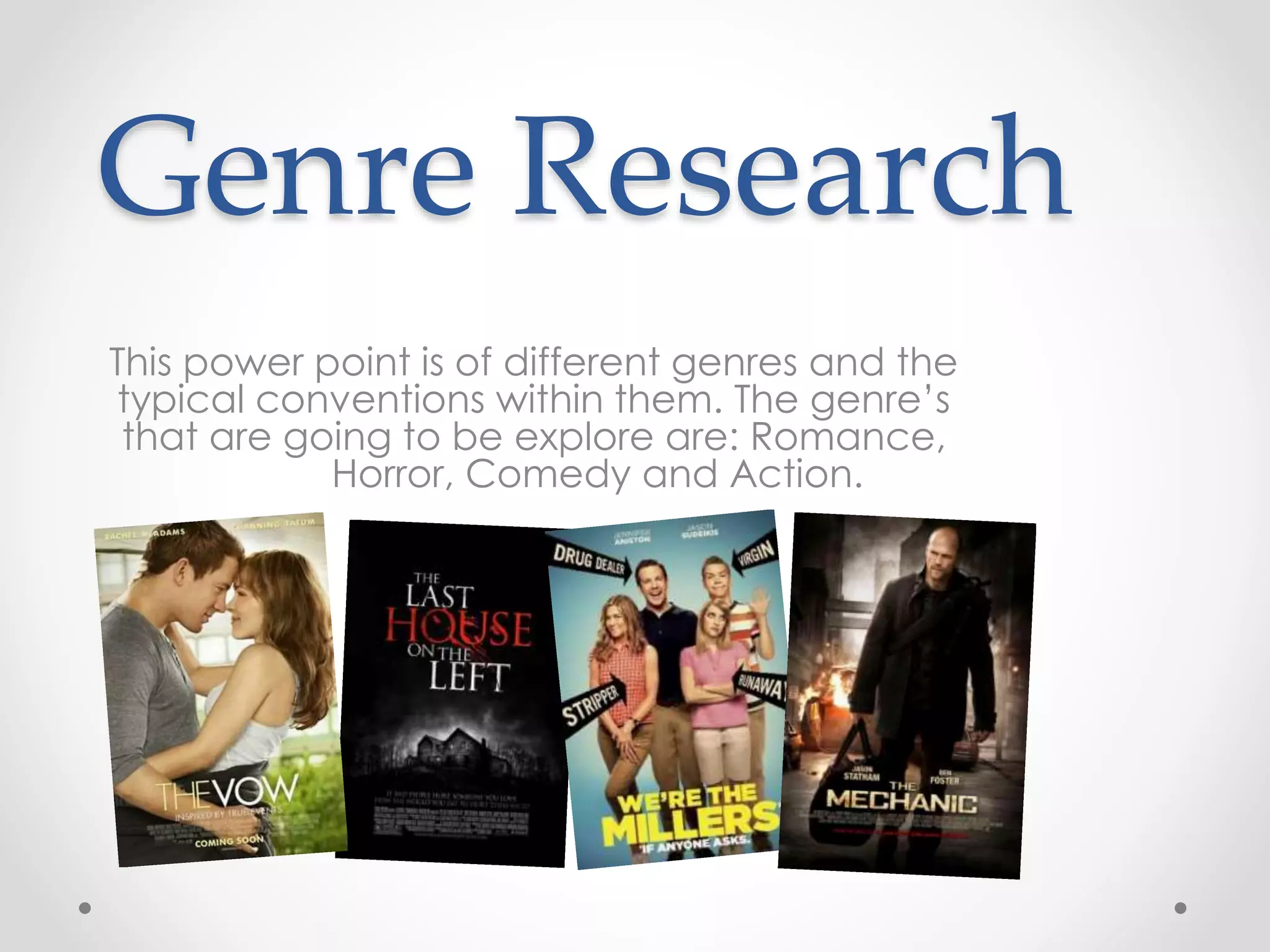
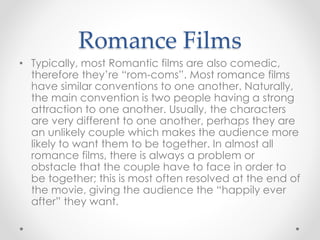
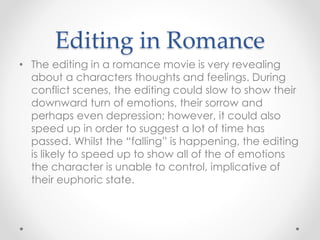
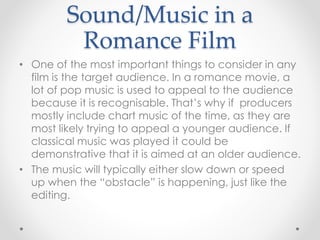
This power point is of different genres and the
typical conventions within them. The genre’s
that are going to be explore are: Romance,
Horror, Comedy and Action.
Romance Films
• Typically, most Romantic films are also comedic,
therefore they’re “rom-coms”. Most romance films
have similar conventions to one another. Naturally,
the main convention is two people having a strong
attraction to one another. Usually, the characters
are very different to one another, perhaps they are
an unlikely couple which makes the audience more
likely to want them to be together. In almost all
romance films, there is always a problem or
obstacle that the couple have to face in order to
be together; this is most often resolved at the end of
the movie, giving the audience the “happily ever
after” they want.
Editing in Romance
• The editing in a romance movie is very revealing
about a characters thoughts and feelings. During
conflict scenes, the editing could slow to show their
downward turn of emotions, their sorrow and
perhaps even depression; however, it could also
speed up in order to suggest a lot of time has
passed. Whilst the “falling” is happening, the editing
is likely to speed up to show all of the of emotions
the character is unable to control, implicative of
their euphoric state.
Sound/Music in a
Romance Film
• One of the most important things to consider in any
film is the target audience. In a romance movie, a
lot of pop music is used to appeal to the audience
because it is recognisable. That’s why if producers
mostly include chart music of the time, as they are
most likely trying to appeal a younger audience. If
classical music was played it could be
demonstrative that it is aimed at an older audience.
• The music will typically either slow down or speed
up when the “obstacle” is happening, just like the
editing.
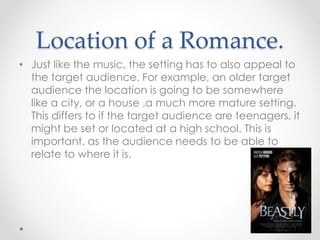
Location of a Romance.
• Just like the music, the setting has to also appeal to
the target audience. For example, an older target
audience the location is going to be somewhere
like a city, or a house ,a much more mature setting.
This differs to if the target audience are teenagers, it
might be set or located at a high school. This is
important, as the audience needs to be able to
relate to where it is.
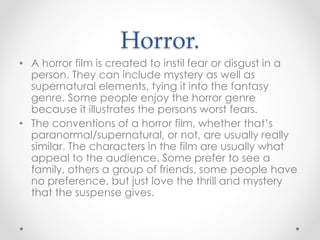
Horror.
• A horror film is created to instil fear or disgust in a
person. They can include mystery as well as
supernatural elements, tying it into the fantasy
genre. Some people enjoy the horror genre
because it illustrates the persons worst fears.
• The conventions of a horror film, whether that’s
paranormal/supernatural, or not, are usually really
similar. The characters in the film are usually what
appeal to the audience. Some prefer to see a
family, others a group of friends, some people have
no preference, but just love the thrill and mystery
that the suspense gives.
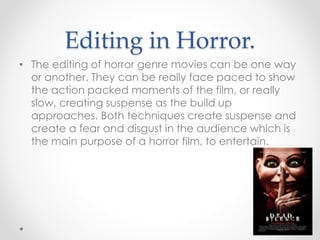
Editing in Horror.
• The editing of horror genre movies can be one way
or another. They can be really face paced to show
the action packed moments of the film, or really
slow, creating suspense as the build up
approaches. Both techniques create suspense and
create a fear and disgust in the audience which is
the main purpose of a horror film, to entertain.
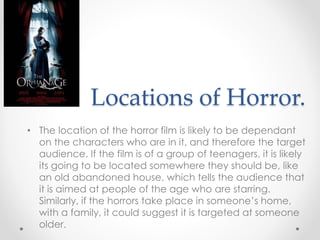
Locations of Horror.
• The location of the horror film is likely to be dependant
on the characters who are in it, and therefore the target
audience. If the film is of a group of teenagers, it is likely
its going to be located somewhere they should be, like
an old abandoned house, which tells the audience that
it is aimed at people of the age who are starring.
Similarly, if the horrors take place in someone’s home,
with a family, it could suggest it is targeted at someone
older.
Comedy
• Comedy films have a much broader audience than
most, as everyone likes to laugh. The kind of comedy in
the film is what determines who the audience and what
age they are. Comedy films can have several sub-
genres/ be hybrid comedies. For example, Action-
comedy; this includes a lot of action and the comedy
can either come from the stars lines, jokes or
mannerisms, or stunts gone wrong which have an effect
on the audience. Another example is comedy-horror,
this is a lot of slapstick humour (Over exaggerated/
boisterous actions which come across as funny)
• The purpose of a comedy film is to make people laugh,
this could be making everyday things humorous or thing
which are a bit out of the ordinary.
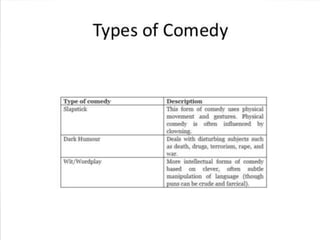
Types of comedy
Editing
• There are several things that factor into whether the
audience finds something funny, and a lot of this had to
do with the editing.
• The first, is timing, the timing has to be just right in order
for something to be funny, ironic or even relevant to the
story line.
• The second is the camera angles, the shots used have to
be as effective as what is actually being said or done.
This leads onto another point:
• The third point is the ‘illusion of Spontaneity’, when the
audience is watching, they don’t pay attention to close
details, so it’s seen as accidental like its happened on
the spot, manipulation of camera angles , mise-en-
scene and sound help to do this.
• Lighting is usually bright or natural light to make it more
realistic.
Sound/ Music in Comedy
Diegetic sound is any sound presented as originated
from source within the film's world:
• voices of characters
• sounds made by objects in the story
• music represented as coming from instruments in the story
space ( = source music)
Non-diegetic sound is represented as coming from
the a source outside story space.
• narrator's commentary
• sound effects which is added for the dramatic effect
• mood music.
• Diegetic sound is used to make the audience
laugh, jokes/ what the stars say.
• Non-diegetic sound is used to put emphasis on a
certain scene.
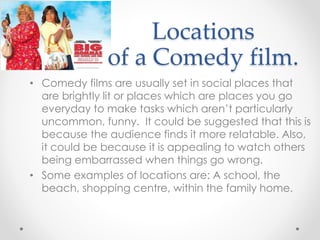
Locations
of a Comedy film.
• Comedy films are usually set in social places that
are brightly lit or places which are places you go
everyday to make tasks which aren’t particularly
uncommon, funny. It could be suggested that this is
because the audience finds it more relatable. Also,
it could be because it is appealing to watch others
being embarrassed when things go wrong.
• Some examples of locations are: A school, the
beach, shopping centre, within the family home.
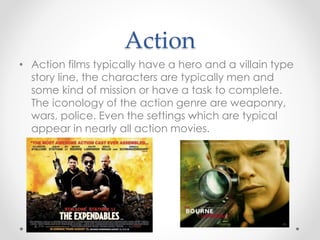
Action
• Action films typically have a hero and a villain type
story line, the characters are typically men and
some kind of mission or have a task to complete.
The iconology of the action genre are weaponry,
wars, police. Even the settings which are typical
appear in nearly all action movies.
Sound in Action Film.
• In an action movie, there are a lot of fast paced
action which is usually quite intense for the
audience to watch, making them like they can’t
wait to see what happens next. The type of music
which you would expect to see in an action film
would be fast paces, hard, intense music which
accompanies what happening on screen. The
sound used is going to be both diegetic sound and
non-diegetic sound, the music and speech to
continue the story line.
• Non- diegetic sound would be used quite
predominantly in an action film because it would
be used to emphasis certain sounds and points.
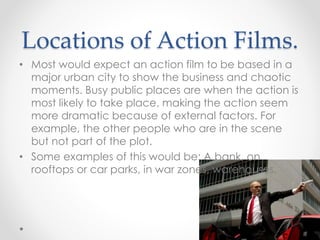
Locations of Action Films.
• Most would expect an action film to be based in a
major urban city to show the business and chaotic
moments. Busy public places are when the action is
most likely to take place, making the action seem
more dramatic because of external factors. For
example, the other people who are in the scene
but not part of the plot.
• Some examples of this would be: A bank, on
rooftops or car parks, in war zones, warehouses.

Genre Research

  • 1.
    Genre Research This powerpoint is of different genres and the typical conventions within them. The genre’s that are going to be explore are: Romance, Horror, Comedy and Action.
  • 2.
    Romance Films • Typically,most Romantic films are also comedic, therefore they’re “rom-coms”. Most romance films have similar conventions to one another. Naturally, the main convention is two people having a strong attraction to one another. Usually, the characters are very different to one another, perhaps they are an unlikely couple which makes the audience more likely to want them to be together. In almost all romance films, there is always a problem or obstacle that the couple have to face in order to be together; this is most often resolved at the end of the movie, giving the audience the “happily ever after” they want.
  • 3.
    Editing in Romance •The editing in a romance movie is very revealing about a characters thoughts and feelings. During conflict scenes, the editing could slow to show their downward turn of emotions, their sorrow and perhaps even depression; however, it could also speed up in order to suggest a lot of time has passed. Whilst the “falling” is happening, the editing is likely to speed up to show all of the of emotions the character is unable to control, implicative of their euphoric state.
  • 4.
    Sound/Music in a RomanceFilm • One of the most important things to consider in any film is the target audience. In a romance movie, a lot of pop music is used to appeal to the audience because it is recognisable. That’s why if producers mostly include chart music of the time, as they are most likely trying to appeal a younger audience. If classical music was played it could be demonstrative that it is aimed at an older audience. • The music will typically either slow down or speed up when the “obstacle” is happening, just like the editing.
  • 5.
    Location of aRomance. • Just like the music, the setting has to also appeal to the target audience. For example, an older target audience the location is going to be somewhere like a city, or a house ,a much more mature setting. This differs to if the target audience are teenagers, it might be set or located at a high school. This is important, as the audience needs to be able to relate to where it is.
  • 6.
    Horror. • A horrorfilm is created to instil fear or disgust in a person. They can include mystery as well as supernatural elements, tying it into the fantasy genre. Some people enjoy the horror genre because it illustrates the persons worst fears. • The conventions of a horror film, whether that’s paranormal/supernatural, or not, are usually really similar. The characters in the film are usually what appeal to the audience. Some prefer to see a family, others a group of friends, some people have no preference, but just love the thrill and mystery that the suspense gives.
  • 7.
    Editing in Horror. •The editing of horror genre movies can be one way or another. They can be really face paced to show the action packed moments of the film, or really slow, creating suspense as the build up approaches. Both techniques create suspense and create a fear and disgust in the audience which is the main purpose of a horror film, to entertain.
  • 8.
    Locations of Horror. •The location of the horror film is likely to be dependant on the characters who are in it, and therefore the target audience. If the film is of a group of teenagers, it is likely its going to be located somewhere they should be, like an old abandoned house, which tells the audience that it is aimed at people of the age who are starring. Similarly, if the horrors take place in someone’s home, with a family, it could suggest it is targeted at someone older.
  • 9.
    Comedy • Comedy filmshave a much broader audience than most, as everyone likes to laugh. The kind of comedy in the film is what determines who the audience and what age they are. Comedy films can have several sub- genres/ be hybrid comedies. For example, Action- comedy; this includes a lot of action and the comedy can either come from the stars lines, jokes or mannerisms, or stunts gone wrong which have an effect on the audience. Another example is comedy-horror, this is a lot of slapstick humour (Over exaggerated/ boisterous actions which come across as funny) • The purpose of a comedy film is to make people laugh, this could be making everyday things humorous or thing which are a bit out of the ordinary.
  • 10.
  • 11.
    Editing • There areseveral things that factor into whether the audience finds something funny, and a lot of this had to do with the editing. • The first, is timing, the timing has to be just right in order for something to be funny, ironic or even relevant to the story line. • The second is the camera angles, the shots used have to be as effective as what is actually being said or done. This leads onto another point: • The third point is the ‘illusion of Spontaneity’, when the audience is watching, they don’t pay attention to close details, so it’s seen as accidental like its happened on the spot, manipulation of camera angles , mise-en- scene and sound help to do this. • Lighting is usually bright or natural light to make it more realistic.
  • 12.
    Sound/ Music inComedy Diegetic sound is any sound presented as originated from source within the film's world: • voices of characters • sounds made by objects in the story • music represented as coming from instruments in the story space ( = source music) Non-diegetic sound is represented as coming from the a source outside story space. • narrator's commentary • sound effects which is added for the dramatic effect • mood music. • Diegetic sound is used to make the audience laugh, jokes/ what the stars say. • Non-diegetic sound is used to put emphasis on a certain scene.
  • 13.
    Locations of a Comedyfilm. • Comedy films are usually set in social places that are brightly lit or places which are places you go everyday to make tasks which aren’t particularly uncommon, funny. It could be suggested that this is because the audience finds it more relatable. Also, it could be because it is appealing to watch others being embarrassed when things go wrong. • Some examples of locations are: A school, the beach, shopping centre, within the family home.
  • 14.
    Action • Action filmstypically have a hero and a villain type story line, the characters are typically men and some kind of mission or have a task to complete. The iconology of the action genre are weaponry, wars, police. Even the settings which are typical appear in nearly all action movies.
  • 15.
    Sound in ActionFilm. • In an action movie, there are a lot of fast paced action which is usually quite intense for the audience to watch, making them like they can’t wait to see what happens next. The type of music which you would expect to see in an action film would be fast paces, hard, intense music which accompanies what happening on screen. The sound used is going to be both diegetic sound and non-diegetic sound, the music and speech to continue the story line. • Non- diegetic sound would be used quite predominantly in an action film because it would be used to emphasis certain sounds and points.
  • 16.
    Locations of ActionFilms. • Most would expect an action film to be based in a major urban city to show the business and chaotic moments. Busy public places are when the action is most likely to take place, making the action seem more dramatic because of external factors. For example, the other people who are in the scene but not part of the plot. • Some examples of this would be: A bank, on rooftops or car parks, in war zones, warehouses.