Question 1 – Does your media
product comply with
stereotypical features of similar
products?
ED CHAMBERS – GROUP 4
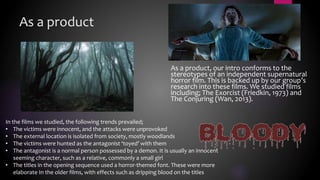
As a product
As a product, our intro conforms to the
stereotypes of an independent supernatural
horror film. This is backed up by our group’s
research into these films. We studied films
including; The Exorcist (Friedkin, 1973) and
The Conjuring (Wan, 2013).
In the films we studied, the following trends prevailed;
• The victims were innocent, and the attacks were unprovoked
• The external location is isolated from society, mostly woodlands
• The victims were hunted as the antagonist ‘toyed’ with them
• The antagonist is a normal person possessed by a demon. It is usually an innocent
seeming character, such as a relative, commonly a small girl
• The titles in the opening sequence used a horror-themed font. These were more
elaborate In the older films, with effects such as dripping blood on the titles
Characters
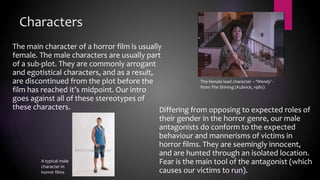
The main character of a horror film is usually
female. The male characters are usually part
of a sub-plot. They are commonly arrogant
and egotistical characters, and as a result,
are discontinued from the plot before the
film has reached it’s midpoint. Our intro
goes against all of these stereotypes of
these characters. Differing from opposing to expected roles of
their gender in the horror genre, our male
antagonists do conform to the expected
behaviour and mannerisms of victims in
horror films. They are seemingly innocent,
and are hunted through an isolated location.
Fear is the main tool of the antagonist (which
causes our victims to run).
The female lead character – ‘Wendy’ -
from The Shining (Kubrick, 1980)
A typical male
character in
horror films
Characters (continued)
The young girl in our intro follows all stereotypes for a
female antagonist in the supernatural horror genre. She
is mysterious, as her face is not shown in any shot. She
seems to be uncaring of her appearance, and the effect
of her environment. She is seemingly possessed, and is
therefore not performing acts of horror by choice, or
consciously. The childish connotations of our character
include a white dress and long hair. These are
accompanied with others such as nursery rhymes in films
that we have examined.
The female lead antagonist – ‘Regan’ –
From The Exorcist (Friedkin, 1974)
A typical stereotype for a female antagonist in a
supernatural horror film – society’s dominant
ideological view.
Plot
Our plot conforms with the general trend of low-budget supernatural horror
films. Independent production companies do not have the budget for special
effects, and neither did we, so the lack of special effects is something that was an
advantage for us in terms of conforming to stereotypes. The lack of special
effects motivates the plot.
The victims were seemingly innocent, and the antagonist performed an
unprovoked act of violence upon them. This establishes that the antagonist has
no motive, and therefore is ‘evil’. This also creates a sense of enigma around the
antagonist, with questions varying from their desired achievements to their
identity.
Sound
 We used sound in two main ways to elaborate on ideas seen on
screen
 We used diegetic sound effects such as white noise to highlight
the fact that the young girl is of supernatural nature. These were
often used in conjunction with the intercutting between the two
lines of action, creating the effect that the shots of the little girl
were ‘interfering’ with the shots of the two teenagers
 We also used diegetic crescendo sounds to build tension. Both of
these methods help create a tense atmosphere throughout our
piece
 Non-diegetic sound was not used to create tension, but to
convey connotations of the two male characters. Dialogue was
used to establish their middle class accents
Mise-en-scene
 The main factor of our mise-en-scene that conforms to the stereotype of
horror films is the external location. Woodland areas are classically used in
nearly all types of horror, and in particular, supernatural
 The effect created by the woods is due to the fact that it is an isolated
location, meaning that the victims do not have help through contact with
society. It is also due to the fact that the antagonist is more comfortable in this
location, and is able to hunt their victims with ease
 The costume of the young girl is iconic with the supernatural genre. The plain
white dress accompanied with messy long hair (usually wet) is a combination
seen in most supernatural horrors with a plot based around possession.
Camera work
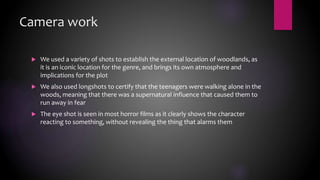
 We used a variety of shots to establish the external location of woodlands, as
it is an iconic location for the genre, and brings its own atmosphere and
implications for the plot
 We also used longshots to certify that the teenagers were walking alone in the
woods, meaning that there was a supernatural influence that caused them to
run away in fear
 The eye shot is seen in most horror films as it clearly shows the character
reacting to something, without revealing the thing that alarms them
Editing
 Editing was used to greatly signify the fact that there was a supernatural
element in our intro
 It is iconic of supernatural films to have shots flicker between each other, and
to have white noise when the antagonist’s presence is felt
 The use of jump cuts is an iconic tool to represent a supernatural element, as it
shows the fast passing of time, but not in the way that we usually experience
it, having a sub-conscious implication that a supernatural event has just been
witnessed
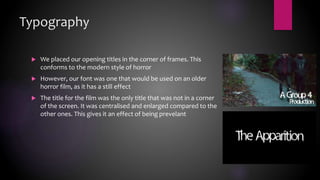
Typography
 We placed our opening titles in the corner of frames. This
conforms to the modern style of horror
 However, our font was one that would be used on an older
horror film, as it has a still effect
 The title for the film was the only title that was not in a corner
of the screen. It was centralised and enlarged compared to the
other ones. This gives it an effect of being prevelant
Colour and Visual Techniques
 We used a contrast of colours between the location of the two teenagers and
the young girl to signify multiple differences
 The light difference I the two locations shows the time difference, and makes
the audience wander how these two events are related, engaging their focus
for the rest of the film
 The dark location of the woodlands implies that it is more hostile as a location

Question 1

  • 1.
    Question 1 –Does your media product comply with stereotypical features of similar products? ED CHAMBERS – GROUP 4
  • 2.
    As a product Asa product, our intro conforms to the stereotypes of an independent supernatural horror film. This is backed up by our group’s research into these films. We studied films including; The Exorcist (Friedkin, 1973) and The Conjuring (Wan, 2013). In the films we studied, the following trends prevailed; • The victims were innocent, and the attacks were unprovoked • The external location is isolated from society, mostly woodlands • The victims were hunted as the antagonist ‘toyed’ with them • The antagonist is a normal person possessed by a demon. It is usually an innocent seeming character, such as a relative, commonly a small girl • The titles in the opening sequence used a horror-themed font. These were more elaborate In the older films, with effects such as dripping blood on the titles
  • 3.
    Characters The main characterof a horror film is usually female. The male characters are usually part of a sub-plot. They are commonly arrogant and egotistical characters, and as a result, are discontinued from the plot before the film has reached it’s midpoint. Our intro goes against all of these stereotypes of these characters. Differing from opposing to expected roles of their gender in the horror genre, our male antagonists do conform to the expected behaviour and mannerisms of victims in horror films. They are seemingly innocent, and are hunted through an isolated location. Fear is the main tool of the antagonist (which causes our victims to run). The female lead character – ‘Wendy’ - from The Shining (Kubrick, 1980) A typical male character in horror films
  • 4.
    Characters (continued) The younggirl in our intro follows all stereotypes for a female antagonist in the supernatural horror genre. She is mysterious, as her face is not shown in any shot. She seems to be uncaring of her appearance, and the effect of her environment. She is seemingly possessed, and is therefore not performing acts of horror by choice, or consciously. The childish connotations of our character include a white dress and long hair. These are accompanied with others such as nursery rhymes in films that we have examined. The female lead antagonist – ‘Regan’ – From The Exorcist (Friedkin, 1974) A typical stereotype for a female antagonist in a supernatural horror film – society’s dominant ideological view.
  • 5.
    Plot Our plot conformswith the general trend of low-budget supernatural horror films. Independent production companies do not have the budget for special effects, and neither did we, so the lack of special effects is something that was an advantage for us in terms of conforming to stereotypes. The lack of special effects motivates the plot. The victims were seemingly innocent, and the antagonist performed an unprovoked act of violence upon them. This establishes that the antagonist has no motive, and therefore is ‘evil’. This also creates a sense of enigma around the antagonist, with questions varying from their desired achievements to their identity.
  • 6.
    Sound  We usedsound in two main ways to elaborate on ideas seen on screen  We used diegetic sound effects such as white noise to highlight the fact that the young girl is of supernatural nature. These were often used in conjunction with the intercutting between the two lines of action, creating the effect that the shots of the little girl were ‘interfering’ with the shots of the two teenagers  We also used diegetic crescendo sounds to build tension. Both of these methods help create a tense atmosphere throughout our piece  Non-diegetic sound was not used to create tension, but to convey connotations of the two male characters. Dialogue was used to establish their middle class accents
  • 7.
    Mise-en-scene  The mainfactor of our mise-en-scene that conforms to the stereotype of horror films is the external location. Woodland areas are classically used in nearly all types of horror, and in particular, supernatural  The effect created by the woods is due to the fact that it is an isolated location, meaning that the victims do not have help through contact with society. It is also due to the fact that the antagonist is more comfortable in this location, and is able to hunt their victims with ease  The costume of the young girl is iconic with the supernatural genre. The plain white dress accompanied with messy long hair (usually wet) is a combination seen in most supernatural horrors with a plot based around possession.
  • 8.
    Camera work  Weused a variety of shots to establish the external location of woodlands, as it is an iconic location for the genre, and brings its own atmosphere and implications for the plot  We also used longshots to certify that the teenagers were walking alone in the woods, meaning that there was a supernatural influence that caused them to run away in fear  The eye shot is seen in most horror films as it clearly shows the character reacting to something, without revealing the thing that alarms them
  • 9.
    Editing  Editing wasused to greatly signify the fact that there was a supernatural element in our intro  It is iconic of supernatural films to have shots flicker between each other, and to have white noise when the antagonist’s presence is felt  The use of jump cuts is an iconic tool to represent a supernatural element, as it shows the fast passing of time, but not in the way that we usually experience it, having a sub-conscious implication that a supernatural event has just been witnessed
  • 10.
    Typography  We placedour opening titles in the corner of frames. This conforms to the modern style of horror  However, our font was one that would be used on an older horror film, as it has a still effect  The title for the film was the only title that was not in a corner of the screen. It was centralised and enlarged compared to the other ones. This gives it an effect of being prevelant
  • 11.
    Colour and VisualTechniques  We used a contrast of colours between the location of the two teenagers and the young girl to signify multiple differences  The light difference I the two locations shows the time difference, and makes the audience wander how these two events are related, engaging their focus for the rest of the film  The dark location of the woodlands implies that it is more hostile as a location