ANALYSIS OF
TRAILERS
By Ivana, Ramarna and Georgia
Saw the stereotypical iconography, some of these are:
Saw uses
         1; Iconography
• Setting- dark isolated, dirty old bathroom. Immediately the
  audience recognises that it is a horror film. The use of cages
  and barbed wire implies that people are helpless and it is
  playing on peoples fears of being alone/trapped.
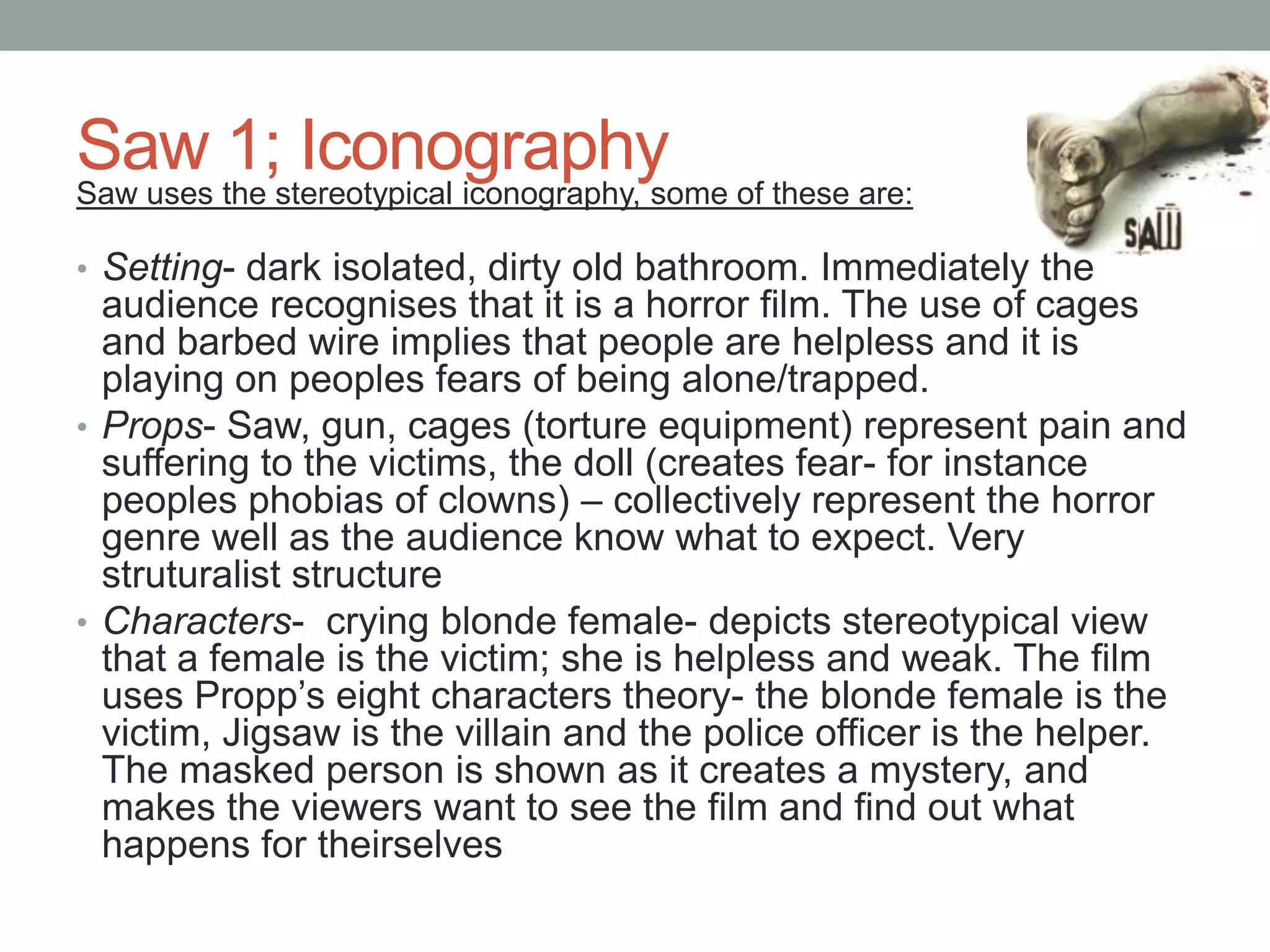
• Props- Saw, gun, cages (torture equipment) represent pain and
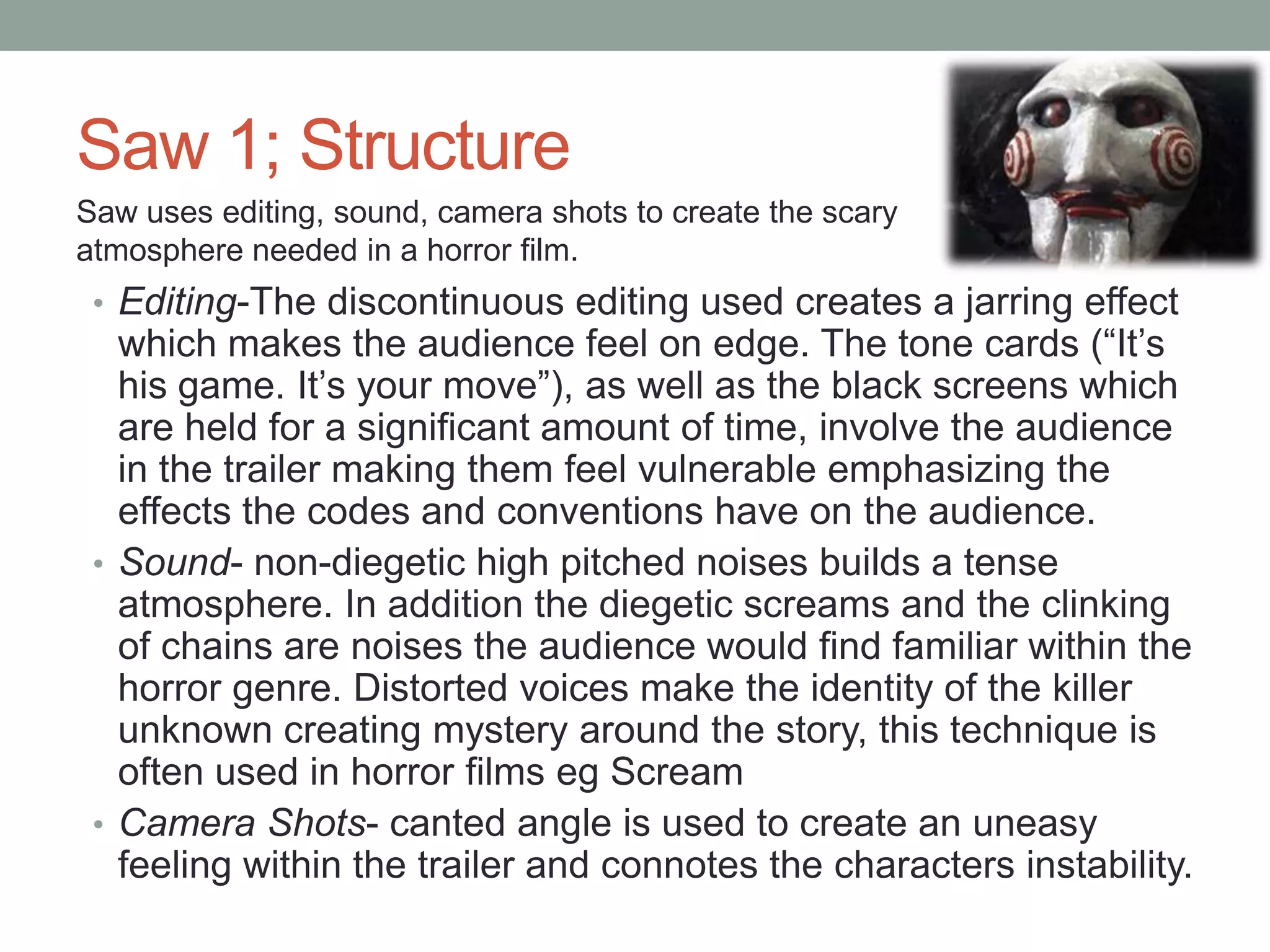
  suffering to the victims, the doll (creates fear- for instance
  peoples phobias of clowns) – collectively represent the horror
  genre well as the audience know what to expect. Very
  struturalist structure
• Characters- crying blonde female- depicts stereotypical view
  that a female is the victim; she is helpless and weak. The film
  uses Propp‟s eight characters theory- the blonde female is the
  victim, Jigsaw is the villain and the police officer is the helper.
  The masked person is shown as it creates a mystery, and
  makes the viewers want to see the film and find out what
  happens for theirselves
Saw 1; Structure
Saw uses editing, sound, camera shots to create the scary
atmosphere needed in a horror film.
 • Editing-The discontinuous editing used creates a jarring effect
   which makes the audience feel on edge. The tone cards (“It‟s
   his game. It‟s your move”), as well as the black screens which
   are held for a significant amount of time, involve the audience
   in the trailer making them feel vulnerable emphasizing the
   effects the codes and conventions have on the audience.
 • Sound- non-diegetic high pitched noises builds a tense
   atmosphere. In addition the diegetic screams and the clinking
   of chains are noises the audience would find familiar within the
   horror genre. Distorted voices make the identity of the killer
   unknown creating mystery around the story, this technique is
   often used in horror films eg Scream
 • Camera Shots- canted angle is used to create an uneasy
   feeling within the trailer and connotes the characters instability.
Primal; Todorov‟s Theory
Primal uses the stereotypical iconography, some of these are:

• Establishing shot used to show isolated hills, the group of boys and
    girls on a road trip. Todorov‟s theory of narrative can be applied here
    as it is the moment of equilibrium: everything is calm and fine for
    about 9 seconds and then the sound bridge carries on to the moment
    of disequilibrium (as soon as they step out of the car- they are not
    safe)
•   The tone cards „distant journey‟ imply they are alone and the
    audience are aware they are vulnerable
•   Fast pace music at around 21 seconds; dark setting in a „ancient
    passage‟ – the tone cards get closer together and the fast pace music
    work together to create fear in the audience
•   Tone cards such as „once it gets inside‟ and the sound effect of a
    zombie/monster purr with jump constant jump cuts connotes the idea
    that it is like a predator is pouncing on its prey (hence the name:
    Primal)
•   The non diegetic sound of heavy breathing is a stereotypical
    paradigm used in many horror films; the audience are made to feel a
    part of the trailer and relate to the emotions of the characters
Primal; Structure
Primal uses editing, sound, camera shots to create the scary atmosphere needed in
a horror film.
• Editing- the discontinuous editing ADD STUFF HERE


• Sound; heart beats, purrs of monster/zombie ADD STUFF HERE
    AND MAYBE IF SOME PICTURES FIT ON ANY SLIDES
•   Theory of binary opposites: Good v Evil- Levi Strauss’ idea can be
    mirrored in this film as there is obvious conflict between the humans
    and the zombie/monster
•   Camera Shots: canted angle, low and high angle. High angle
    represents the blonde girl as being seen low and helpless as she is
    the promiscuous girl (structuralist idea)
•   Intertextual refrences; there is a similar part to ‘The Exorcist’ when the
    blonde victim is possessed – gives postmodern impression
•   Mise en scene: props- torches, video camera in the car on the road
    trip: to video everything that occurs (stereotypical approach)

Analysis of Horror Trailers

  • 1.
    ANALYSIS OF TRAILERS By Ivana,Ramarna and Georgia
  • 2.
    Saw the stereotypicaliconography, some of these are: Saw uses 1; Iconography • Setting- dark isolated, dirty old bathroom. Immediately the audience recognises that it is a horror film. The use of cages and barbed wire implies that people are helpless and it is playing on peoples fears of being alone/trapped. • Props- Saw, gun, cages (torture equipment) represent pain and suffering to the victims, the doll (creates fear- for instance peoples phobias of clowns) – collectively represent the horror genre well as the audience know what to expect. Very struturalist structure • Characters- crying blonde female- depicts stereotypical view that a female is the victim; she is helpless and weak. The film uses Propp‟s eight characters theory- the blonde female is the victim, Jigsaw is the villain and the police officer is the helper. The masked person is shown as it creates a mystery, and makes the viewers want to see the film and find out what happens for theirselves
  • 3.
    Saw 1; Structure Sawuses editing, sound, camera shots to create the scary atmosphere needed in a horror film. • Editing-The discontinuous editing used creates a jarring effect which makes the audience feel on edge. The tone cards (“It‟s his game. It‟s your move”), as well as the black screens which are held for a significant amount of time, involve the audience in the trailer making them feel vulnerable emphasizing the effects the codes and conventions have on the audience. • Sound- non-diegetic high pitched noises builds a tense atmosphere. In addition the diegetic screams and the clinking of chains are noises the audience would find familiar within the horror genre. Distorted voices make the identity of the killer unknown creating mystery around the story, this technique is often used in horror films eg Scream • Camera Shots- canted angle is used to create an uneasy feeling within the trailer and connotes the characters instability.
  • 4.
    Primal; Todorov‟s Theory Primaluses the stereotypical iconography, some of these are: • Establishing shot used to show isolated hills, the group of boys and girls on a road trip. Todorov‟s theory of narrative can be applied here as it is the moment of equilibrium: everything is calm and fine for about 9 seconds and then the sound bridge carries on to the moment of disequilibrium (as soon as they step out of the car- they are not safe) • The tone cards „distant journey‟ imply they are alone and the audience are aware they are vulnerable • Fast pace music at around 21 seconds; dark setting in a „ancient passage‟ – the tone cards get closer together and the fast pace music work together to create fear in the audience • Tone cards such as „once it gets inside‟ and the sound effect of a zombie/monster purr with jump constant jump cuts connotes the idea that it is like a predator is pouncing on its prey (hence the name: Primal) • The non diegetic sound of heavy breathing is a stereotypical paradigm used in many horror films; the audience are made to feel a part of the trailer and relate to the emotions of the characters
  • 5.
    Primal; Structure Primal usesediting, sound, camera shots to create the scary atmosphere needed in a horror film. • Editing- the discontinuous editing ADD STUFF HERE • Sound; heart beats, purrs of monster/zombie ADD STUFF HERE AND MAYBE IF SOME PICTURES FIT ON ANY SLIDES • Theory of binary opposites: Good v Evil- Levi Strauss’ idea can be mirrored in this film as there is obvious conflict between the humans and the zombie/monster • Camera Shots: canted angle, low and high angle. High angle represents the blonde girl as being seen low and helpless as she is the promiscuous girl (structuralist idea) • Intertextual refrences; there is a similar part to ‘The Exorcist’ when the blonde victim is possessed – gives postmodern impression • Mise en scene: props- torches, video camera in the car on the road trip: to video everything that occurs (stereotypical approach)