Genomic, transcriptomic &
proteomics approaches to
improve drought tolerance
of Poppy(Papaver somniferum.L)
Biotechnology Centre
Department of Genetics & Special Plant production
Papaver somniferum.L (Opium poppy)
~ Herbaceous annual, bienninal and short lived perennial plants.
Narcotics (opium)
Alkaloids
(thebaine, Papaverine)
Poppy seeds
(Oil, Butter, Bakery
products,cosmetics)
Ornamental
(Plants, Flowers)
Stress - a disadvantageous influence on the plant exerted by an external factor.
Disadvantageous = reduced growth & reproduction
(sometimes also reduced process rates, e.g. photosynthesis)
Growth
after
1
month
High T Low T
Stress tolerance - the ability to maintain functioning when exposed to a wide range of conditions.
Usually a relative term based on comparisons among species or genotypes of their responses to
different levels of some factor (temp., moisture, etc.).
Growth
after
1
month
Adequate water Limited water
RED has a greater stress tolerance than BLUE
Why Drought Stress ????
According to an UN assessment, water shortages have tripled over
the past 50 years; high water scarcity and rise of 4-4.5℃ in mean
temperature by year 2030 have been predicted (Environment
Outlook to 2030 report).
Czech Republic climate projections till the year 2050 depict – (a)
high intern-annual rainfall variability, (b) declines in summer and
winter precipitation totals, and, (b) increase in autumn
precipitation (MZP CZ 2015).
To identify role of protein targets during drought stress using
transcriptomic and proteomics approaches.
To monitor the expression of respective genes in poppy plants.
To validate these targets in poppy plants by CRISPR/Cas9 technology.
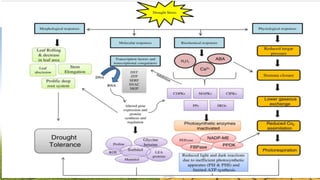
Signal Perception &
Transcriptional control
Proteins conferring
protection to the plant cells.
Ion homeostasis
MAPK’s, APETALA2,
HSF, CBF/DREB,
WRKY, bZIP, NAC,
MYB/ MYC,
Cys2/His2 zinc-finger
motifs
LEA, HSP,
Osmoprotectants,
Antioxidant enzymes.
Aquaporins and ion
transporters
Munns and Tester,
2008; Surekha et al.,
2015 Bray, 1997;
Umezawa et al., 2006
Zhu, 2001, Surekha et al.,
2014 and 2015
Bray, 1997; Surekha et al.,
2015
Genes responsive for drought stress
Gene Function Reference
P5CS Δ1-pyrroline-5-carboxylate
synthase
Abiotic stress verified in
transgenic plants
Hong Zhou et al., 2016;
Thippeswamy et al., 2010;
Hassan et al., 2015
P5CR Δ1-pyrroline-5-carboxylate
reductase
species- and stress-specific
differences
Cao Li, 2015
SDD1 stomatal density and
distribution 1
Decrease stomatal density Yoo et al., 2010; Wang et al.,
2016
EPF1 epidermal patterning
factor 1
optimizes transpiration and
water use efficiency
Hughes et al., 2017
MLP-43 major latex protein Defensive responses in
biotic and abiotic level
Zhang et al., 2018, Wang et al.,
2016
Drought associated genes for transcriptomic analysis
1)Poppy cultivation and artificial drought.
2)To analyze the Relative water content (RWC).
3)To analyze the Proline content from leaves (Spectrophotometric analysis).
4)RNA isolation and transcriptomic study (RT-qPCR).
5)Protein isolation and proteomic study (SPR).
6)Validation of the identified Gene targets (CRISPR/CAS9).
Genomic, transcriptomic & proteomics approaches to - Copy.pptx

Genomic, transcriptomic & proteomics approaches to - Copy.pptx

  • 1.
    Genomic, transcriptomic & proteomicsapproaches to improve drought tolerance of Poppy(Papaver somniferum.L)
  • 2.
    Biotechnology Centre Department ofGenetics & Special Plant production Papaver somniferum.L (Opium poppy) ~ Herbaceous annual, bienninal and short lived perennial plants. Narcotics (opium) Alkaloids (thebaine, Papaverine) Poppy seeds (Oil, Butter, Bakery products,cosmetics) Ornamental (Plants, Flowers)
  • 3.
    Stress - adisadvantageous influence on the plant exerted by an external factor. Disadvantageous = reduced growth & reproduction (sometimes also reduced process rates, e.g. photosynthesis) Growth after 1 month High T Low T
  • 4.
    Stress tolerance -the ability to maintain functioning when exposed to a wide range of conditions. Usually a relative term based on comparisons among species or genotypes of their responses to different levels of some factor (temp., moisture, etc.). Growth after 1 month Adequate water Limited water RED has a greater stress tolerance than BLUE
  • 5.
    Why Drought Stress???? According to an UN assessment, water shortages have tripled over the past 50 years; high water scarcity and rise of 4-4.5℃ in mean temperature by year 2030 have been predicted (Environment Outlook to 2030 report). Czech Republic climate projections till the year 2050 depict – (a) high intern-annual rainfall variability, (b) declines in summer and winter precipitation totals, and, (b) increase in autumn precipitation (MZP CZ 2015).
  • 6.
    To identify roleof protein targets during drought stress using transcriptomic and proteomics approaches. To monitor the expression of respective genes in poppy plants. To validate these targets in poppy plants by CRISPR/Cas9 technology.
  • 7.
    Signal Perception & Transcriptionalcontrol Proteins conferring protection to the plant cells. Ion homeostasis MAPK’s, APETALA2, HSF, CBF/DREB, WRKY, bZIP, NAC, MYB/ MYC, Cys2/His2 zinc-finger motifs LEA, HSP, Osmoprotectants, Antioxidant enzymes. Aquaporins and ion transporters Munns and Tester, 2008; Surekha et al., 2015 Bray, 1997; Umezawa et al., 2006 Zhu, 2001, Surekha et al., 2014 and 2015 Bray, 1997; Surekha et al., 2015 Genes responsive for drought stress
  • 8.
    Gene Function Reference P5CSΔ1-pyrroline-5-carboxylate synthase Abiotic stress verified in transgenic plants Hong Zhou et al., 2016; Thippeswamy et al., 2010; Hassan et al., 2015 P5CR Δ1-pyrroline-5-carboxylate reductase species- and stress-specific differences Cao Li, 2015 SDD1 stomatal density and distribution 1 Decrease stomatal density Yoo et al., 2010; Wang et al., 2016 EPF1 epidermal patterning factor 1 optimizes transpiration and water use efficiency Hughes et al., 2017 MLP-43 major latex protein Defensive responses in biotic and abiotic level Zhang et al., 2018, Wang et al., 2016 Drought associated genes for transcriptomic analysis
  • 9.
    1)Poppy cultivation andartificial drought. 2)To analyze the Relative water content (RWC). 3)To analyze the Proline content from leaves (Spectrophotometric analysis). 4)RNA isolation and transcriptomic study (RT-qPCR). 5)Protein isolation and proteomic study (SPR). 6)Validation of the identified Gene targets (CRISPR/CAS9).