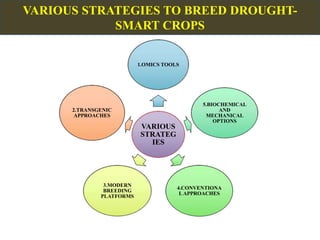
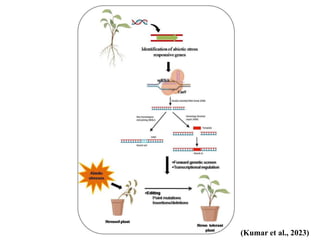
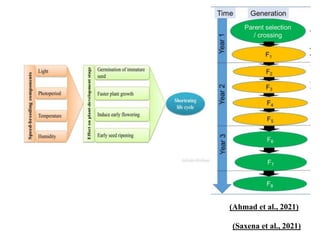
The document outlines strategies for developing drought-smart future crops. It discusses omics tools like genomics, transcriptomics, proteomics, and metabolomics that can be used to identify genes and pathways related to drought tolerance. Transgenic approaches like genetic engineering can introduce drought tolerance genes. Conventional breeding and speed breeding can combine traits from parental lines. Integrating these modern techniques with traditional methods like agronomic practices can help develop crops with improved drought resistance and yield stability under water scarcity. A case study identifies genomic loci, genes and transcription factors in maize affecting seminal root length under drought. Future work may combine genome editing, phenomics and speed breeding to rapidly deliver climate-smart crops.