OCT 2014
2
I. History of the Method
II. What are Genius Forecasting, Intuition and Vision
III. How to do it
How to find those of insight
How to stimulate your own insight
IV. Strengths and Weaknesses of the Method
Table of Contents
3
Leaders today and throughout history relied on advice from wise
ones with great insight.
Probably the most famous lineage of genius forecasters was the
Greek Oracle tradition in Delphi.
Imagination is more important than knowledge.
-Albert Einstein
History Genius Forecasting
4
Genius forecasting, intuition and visioning are all connected with
somehow foreseeing and visualizing futures.
These methods recognize the importance of imagination.
History Genius Forecasting
Imagination is more important than knowledge.
-Albert Einstein
5
Genius forecasting is an unspecified set of processes used by
geniuses to arrive at statements about the future.
Imagination is more important than knowledge.
-Albert Einstein
What is Genius Forecasting?
Section 2
Genius Forecasting
6
The terms intuition or gut feeling are used when it would be far
too complex to explain how one came to some insight about
future possibilities.
Imagination is more important than knowledge.
-Albert Einstein
What is Intuition?
Section 2
Intuition
Intuition may be the only useful source of information to forecast
behavior of a chaotic system.
7
A vision is a statement of the preferred future that an
organization or community wants to create.
Imagination is more important than knowledge.
-Albert Einstein
What is Vision?
Section 2
Vision
Visions of the future are the stimulus to change the present.
8
If you believe that those of great vision are born, not made by an
education or the mastery of mental techniques, then the question
of how to do genius forecasting becomes:
how can you find such people and their vision?
How to do it
Section 3
How to find those of insight
Everybody is a genius. But if you judge a fish by its ability to climb a tree, it will live its whole life believing that it is stupid.
-Albert Einstein
9
Prediction Markets.
How to do it
Section 3
How to find those of insight
Everybody is a genius. But if you judge a fish by its ability to climb a tree, it will live its whole life believing that it is stupid.
-Albert Einstein
10
Search literature and Internet.
How to do it
Section 3
How to find those of insight
Everybody is a genius. But if you judge a fish by its ability to climb a tree, it will live its whole life believing that it is stupid.
-Albert Einstein
11
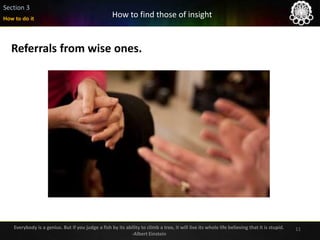
Referrals from wise ones.
How to do it
Section 3
How to find those of insight
Everybody is a genius. But if you judge a fish by its ability to climb a tree, it will live its whole life believing that it is stupid.
-Albert Einstein
12
Recommendations from institutions, organizations, and
directories.
How to do it
Section 3
How to find those of insight
Everybody is a genius. But if you judge a fish by its ability to climb a tree, it will live its whole life believing that it is stupid.
-Albert Einstein
13
Observations at conferences and other gatherings of
creative people.
How to do it
Section 3
How to find those of insight
Everybody is a genius. But if you judge a fish by its ability to climb a tree, it will live its whole life believing that it is stupid.
-Albert Einstein
14
Hold contests for genius forecasting and vision.
How to do it
Section 3
How to find those of insight
Everybody is a genius. But if you judge a fish by its ability to climb a tree, it will live its whole life believing that it is stupid.
-Albert Einstein
15
Follow current events.
How to do it
Section 3
How to find those of insight
Genius is one percent inspiration, ninety-nine percent perspiration.
-Thomas A. Edison
16
Access public Delphis through newspapers, radio,
and/or television.
How to do it
Section 3
How to find those of insight
Genius is one percent inspiration, ninety-nine percent perspiration.
-Thomas A. Edison
17
If you believe subjective forecasting can be learned, then
the question of how to do it becomes:
what are the methods identified in the literature and
used by futurists.
How to do it
Section 3
How to stimulate your own insight
Genius is one percent inspiration, ninety-nine percent perspiration.
-Thomas A. Edison
18
Reading diverse material.
How to do it
Section 3
How to stimulate your own insight
Genius is one percent inspiration, ninety-nine percent perspiration.
-Thomas A. Edison
19
Guessing.
How to do it
Section 3
How to stimulate your own insight
Genius is one percent inspiration, ninety-nine percent perspiration.
-Thomas A. Edison
20
Opposite Acting and Thinking.
How to do it
Section 3
How to stimulate your own insight
We can’t solve problems by using the same kind of thinking we used when we created them.
-Albert Einstein
21
Simulation and Games.
How to do it
Section 3
How to stimulate your own insight
We can’t solve problems by using the same kind of thinking we used when we created them.
-Albert Einstein
22
Meditation.
How to do it
Section 3
How to stimulate your own insight
We can’t solve problems by using the same kind of thinking we used when we created them.
-Albert Einstein
23
Perceptual exercises, dreams and thought experiments.
How to do it
Section 3
How to stimulate your own insight
We can’t solve problems by using the same kind of thinking we used when we created them.
-Albert Einstein
24
Extra dimensionality.
How to do it
Section 3
How to stimulate your own insight
We can’t solve problems by using the same kind of thinking we used when we created them.
-Albert Einstein
25
Internships.
How to do it
Section 3
How to stimulate your own insight
We can’t solve problems by using the same kind of thinking we used when we created them.
-Albert Einstein
26
It cuts time and costs.
Strengths and Weakness of the Method
Section 4
STRENGHTS
We can’t solve problems by using the same kind of thinking we used when we created them.
-Albert Einstein
27
How do you find a reliable genius?
Strengths and Weaknesses of the Method
Section 4
WEAKNESSES
How can you know a genius forecast is good or not?
We can’t solve problems by using the same kind of thinking we used when we created them.
-Albert Einstein
THE END

Genius Forecasting

  • 1.
  • 2.
    2 I. History ofthe Method II. What are Genius Forecasting, Intuition and Vision III. How to do it How to find those of insight How to stimulate your own insight IV. Strengths and Weaknesses of the Method Table of Contents
  • 3.
    3 Leaders today andthroughout history relied on advice from wise ones with great insight. Probably the most famous lineage of genius forecasters was the Greek Oracle tradition in Delphi. Imagination is more important than knowledge. -Albert Einstein History Genius Forecasting
  • 4.
    4 Genius forecasting, intuitionand visioning are all connected with somehow foreseeing and visualizing futures. These methods recognize the importance of imagination. History Genius Forecasting Imagination is more important than knowledge. -Albert Einstein
  • 5.
    5 Genius forecasting isan unspecified set of processes used by geniuses to arrive at statements about the future. Imagination is more important than knowledge. -Albert Einstein What is Genius Forecasting? Section 2 Genius Forecasting
  • 6.
    6 The terms intuitionor gut feeling are used when it would be far too complex to explain how one came to some insight about future possibilities. Imagination is more important than knowledge. -Albert Einstein What is Intuition? Section 2 Intuition Intuition may be the only useful source of information to forecast behavior of a chaotic system.
  • 7.
    7 A vision isa statement of the preferred future that an organization or community wants to create. Imagination is more important than knowledge. -Albert Einstein What is Vision? Section 2 Vision Visions of the future are the stimulus to change the present.
  • 8.
    8 If you believethat those of great vision are born, not made by an education or the mastery of mental techniques, then the question of how to do genius forecasting becomes: how can you find such people and their vision? How to do it Section 3 How to find those of insight Everybody is a genius. But if you judge a fish by its ability to climb a tree, it will live its whole life believing that it is stupid. -Albert Einstein
  • 9.
    9 Prediction Markets. How todo it Section 3 How to find those of insight Everybody is a genius. But if you judge a fish by its ability to climb a tree, it will live its whole life believing that it is stupid. -Albert Einstein
  • 10.
    10 Search literature andInternet. How to do it Section 3 How to find those of insight Everybody is a genius. But if you judge a fish by its ability to climb a tree, it will live its whole life believing that it is stupid. -Albert Einstein
  • 11.
    11 Referrals from wiseones. How to do it Section 3 How to find those of insight Everybody is a genius. But if you judge a fish by its ability to climb a tree, it will live its whole life believing that it is stupid. -Albert Einstein
  • 12.
    12 Recommendations from institutions,organizations, and directories. How to do it Section 3 How to find those of insight Everybody is a genius. But if you judge a fish by its ability to climb a tree, it will live its whole life believing that it is stupid. -Albert Einstein
  • 13.
    13 Observations at conferencesand other gatherings of creative people. How to do it Section 3 How to find those of insight Everybody is a genius. But if you judge a fish by its ability to climb a tree, it will live its whole life believing that it is stupid. -Albert Einstein
  • 14.
    14 Hold contests forgenius forecasting and vision. How to do it Section 3 How to find those of insight Everybody is a genius. But if you judge a fish by its ability to climb a tree, it will live its whole life believing that it is stupid. -Albert Einstein
  • 15.
    15 Follow current events. Howto do it Section 3 How to find those of insight Genius is one percent inspiration, ninety-nine percent perspiration. -Thomas A. Edison
  • 16.
    16 Access public Delphisthrough newspapers, radio, and/or television. How to do it Section 3 How to find those of insight Genius is one percent inspiration, ninety-nine percent perspiration. -Thomas A. Edison
  • 17.
    17 If you believesubjective forecasting can be learned, then the question of how to do it becomes: what are the methods identified in the literature and used by futurists. How to do it Section 3 How to stimulate your own insight Genius is one percent inspiration, ninety-nine percent perspiration. -Thomas A. Edison
  • 18.
    18 Reading diverse material. Howto do it Section 3 How to stimulate your own insight Genius is one percent inspiration, ninety-nine percent perspiration. -Thomas A. Edison
  • 19.
    19 Guessing. How to doit Section 3 How to stimulate your own insight Genius is one percent inspiration, ninety-nine percent perspiration. -Thomas A. Edison
  • 20.
    20 Opposite Acting andThinking. How to do it Section 3 How to stimulate your own insight We can’t solve problems by using the same kind of thinking we used when we created them. -Albert Einstein
  • 21.
    21 Simulation and Games. Howto do it Section 3 How to stimulate your own insight We can’t solve problems by using the same kind of thinking we used when we created them. -Albert Einstein
  • 22.
    22 Meditation. How to doit Section 3 How to stimulate your own insight We can’t solve problems by using the same kind of thinking we used when we created them. -Albert Einstein
  • 23.
    23 Perceptual exercises, dreamsand thought experiments. How to do it Section 3 How to stimulate your own insight We can’t solve problems by using the same kind of thinking we used when we created them. -Albert Einstein
  • 24.
    24 Extra dimensionality. How todo it Section 3 How to stimulate your own insight We can’t solve problems by using the same kind of thinking we used when we created them. -Albert Einstein
  • 25.
    25 Internships. How to doit Section 3 How to stimulate your own insight We can’t solve problems by using the same kind of thinking we used when we created them. -Albert Einstein
  • 26.
    26 It cuts timeand costs. Strengths and Weakness of the Method Section 4 STRENGHTS We can’t solve problems by using the same kind of thinking we used when we created them. -Albert Einstein
  • 27.
    27 How do youfind a reliable genius? Strengths and Weaknesses of the Method Section 4 WEAKNESSES How can you know a genius forecast is good or not? We can’t solve problems by using the same kind of thinking we used when we created them. -Albert Einstein
  • 28.

Editor's Notes

  • #4 Alexander the Great sought council from Aristotle, Rameses from Moses, and George Washington from Benjamin Franklin. The pronouncements of these trusted advisors about the future would be called genius forecasting by today's futurists. an oracle was a person or agency considered to interface wise counsel or prophetic predictions or precognition of the future, inspired by the gods. As such it is a form of divination.
  • #6 Not all statements about the future by geniuses are genius forecasts, only those pronouncements in their areas of expertise for which they have proven insight. Genius forecasts can also come from people whose IQ is less than genius, but who have proven to have great insight in some specialty.
  • #10 Visit prediction markets and see if it is possible to ascertain who guesses the most accurately about what. Prediction market consulting comp Prediction markets (also known as predictive markets, information markets, decision markets, idea futures, event derivatives, or virtual markets) are speculative markets created for the purpose of making predictions. The current market prices can then be interpreted as predictions of the probability of the event or the expected value of the parameter. For example, a prediction market security might reward a dollar if a particular candidate is elected, such that an individual who thinks the candidate had a 70% chance of being elected should be willing to pay up to 70 cents for such a security. People who buy low and sell high are rewarded for improving the market prediction, while those who buy high and sell low are punished for degrading the market prediction. Evidence so far suggests that prediction markets are at least as accurate as other institutions predicting the same events with a similar pool of participants anies are available on-line that can create such markets for special assignments like finding the best genius forecasters. The most famous prediction markets are the election forecasting markets run by the University of Iowa (Berg, Forsythe, Nelson and Rietz, 2001), but prediction markets have also been used to forecast movie revenues, corporate sales, project completion, economic indicators and Saddam Hussein’s demise Betting has probably been part of society’s way of dealing with uncertain futures since money and history began; prediction markets simply organize these activities into precise and generally interesting questions about future uncertainties. There are three main types of contracts. First, in a ―winner-take-all‖ contract, the contract costsnsome amount $p and pays off, say, $1 if and only if a specific event occurs, like a particular candidate winning an election. The price on a winner-take-all market represents the market’s expectation of the probability that an event will occur
  • #11 Literature and Internet searches (including science fiction) can also be useful. The most creative and subjective work tends not to get into print as quickly or easily as it does into computer conferences, electronic journals, e-mail lists, blogs, and virtual worlds and games. Hence, searching these sources for genius forecasters should also be considered.
  • #12 Another approach is to ask the wisest ones you know whom they would recommend and continue asking those recommended the same question in turn until a pattern of respected recommendations and referrals occurs.
  • #13 A similar approach can start with recommendations from professional organizations relevant to the area of interest and review of the short résumés in their directories.
  • #14 Observation at conferences and other gatherings of creative people is not only useful to identify the genius forecasters but also to see how others react to them. Many who have made important forecasts were ignored.
  • #15 Contests could offer a prize to the forecast with the greatest insight and usefulness. The Mitchell Prize from the Club of Rome stimulated and attracted visions from many futurists and scholars over the years. A contest could be held for the most important future vision and forecast for the year 2025 that could be acted on today by the current leadership. مثا ایده بازار که در دانشگاه داره برگزار میشه، سامسونگ مسابقه گذاشته بود توی شریف
  • #16 Follow current events to learn whose advice and forecasts showed more insight over time.
  • #17 Public Delphis (explained in the "Participatory Methods" chapter in this series) could invite the general public to send in their view of the future. These submissions could be condensed in a newspaper column, inviting further comments from the readers as a second round of the public Delphi questionnaire. Such a newspaper column could be a repeating questionnaire, collecting and feeding back subjective forecasting from the public and the public's reactions to such future vision.
  • #19 READING and SCANNING DIVERSE SOURCES.
  • #20 A simple way to do this is to keep track of one's guesses, review periodically, determine why guesses are right some times, and why some are not. When guesses are wrong – ask what was wrong in the assumptions or mental model of how the world works, that led to the wrong guess? When guesses are right - what was right with the assumptions or mental models that led to the right guess. And then modify the assumptions and the mental models of the world. Self-correcting false assumptions should improve guessing.
  • #21 Doing opposite of the usual.
  • #22 Participating in simulations and games. As long as organized armies existed, war games helped train soldiers to meet various possible situations they might encounter. Leonardo da Vinci‘s work with wings attached to a person is an early recorded instance of a simulation.
  • #23 Solitary and guided meditation and visioning exercises
  • #24 PERCEPTUAL EXERCISE, DREAMS, FEELYSIS, and THOUGHT EXPERIMENTS. ادراکی = PERCEPTUAL مسیر=trajectory Thought experiments were used by Albert Einstein. He imagined being a photon traveling at the speed of light through the universe. Suddenly he noticed that his trajectory was bending or curving relative to mass.
  • #25 extradimensional point of view by altering normal brain function and can help guide the future planning of the community. The Dutch used the telescope from a tower to see what ship was coming into port and what it was carrying; they would know, in advance of anyone else in the seaport, what to buy and sell before the ship entered the port. Early warning satellites in the earth's orbit and the crow‟s-nest on ships are other examples of extradimensionality to alter normal perception and gain insight.
  • #26 Interning with those of great insight and vision.
  • #27 One key value of genius forecasting is that it cuts time and costs. It is much easier and less costly to collect genius forecasts than it is to build a computer model.
  • #28 Someone just being right before does not mean they will be right again. How do you know when to trust your intuition? What if two genius forecasters contradict? How do you know whose judgment to follow?