LANGUAGE LEARNING
MATERIALS
DEVELOPMENT
Ethel De Leon - Abao, LPT, EdD
Rivika C. Alda, LPT, EdD
Remedios C. Bacus, LPT, PhD
Course Description:
This course engages the pre-service English teachers in the selection,
development, production, and evaluation of variety of language
teaching and learning resources based on the identified K to 12
learning competencies. Through these activities, they are able to
demonstrate content knowledge on the principles and procedures of
language materials development. Students show competence in
employing innovative strategies on the design and development of
contextualized and localized instructional materials that provide
opportunities for meaningful, purposeful language use thereby
facilitate language learning and teaching.
Intro
What is LLM?
• Language Learning Materials Development is the
process of creating, choosing, adapting, and organizing
materials that helps students learn and use a language
effectively.
• It means making or improving learning tools (like
textbooks, worksheets, activities, videos, or games) so that
students can understand, practice, and use a language in
real life.
Intro
Step - by- Step
1. Know the learners - understand the students’ age, level,
needs, interests, and culture.
2. Set a clear goal - decide what students should be able to
do (for example: speak politely, write a paragraph, understand
a story).
3. Choose or create materials - prepare lessons, activities,
texts, or tasks that match the goal.
4. Make it meaningful - use real-life situations (school,
home, community, daily conversations).
Intro
Step - by- Step
5. Make it interactive - include activities like role-plays,
group work, games, and discussions.
6. Check and improve - see if the materials work well, then
revise if needed.
Intro
Examples
• Textbooks
• Worksheets
• Flashcards
• Dialogues and stories
• Videos and audio recordings
• Games and role-play activities
Intro
Why LLM is important?
Can you share your answer.
Intro
Why LLM is important?
• Makes lessons interesting and engaging
• Helps learners understand better
• Encourages communication, not memorization
• Matches the learners’ level and needs
• Supports effective teachinng
Intro
Activity:
Warm-Up (Opinion & Experience Questions:
1. What language learning materials have helped you learn best
before? Why?
2. Which do you prefer more: textbooks, worksheets, videos, or
games? Explain your choice.
3. Have you ever found a language lesson boring because of the
materials used? What was missing?
4. Do you think teachers should always follow the textbook
exactly? Why or why not?
5. How do language materials affect your motivation to learn a
language?
Intro
Unit 1: Introduction to
Material Development
Learning Outcomes:
a. deepen understanding on the essence of instructional materials
towards a successful instructional delivery
b. develop instructional materials which are appropriate, relevant,
and appealing;
c. evaluate instructional materials based on the criteria set and
d. demonstrate the ability to adapt purposeful instructional materials
Intro
• Communication is a survival resource. In this era of
massive advancement in information, science,
technology, you need to be equipped with a wide
array of scaffolds that can help facilitate active
engagement with different kinds of environment in
order for you to survive in this globally competitive
world.
Intro
• Nunan (1992) states that teaching materials are often the
most substantial and observable component of pedagogy.
• This premise leads to the idea that in language learning
activities, oftentimes teachers consider learning materials
as fundamental elements towards the attainment of the
expected competencies as they support meaningful
teaching and learning.
• Edge (1993) stated that materials exist in order to support
learning/teaching, so they should be designed to suit the
people and the processes involved.
Intro
• This course is two - pronged.
• This ushers you to the essentials of language learning
materials development as this will equip you in the
preparation of a meaningful language teaching and
learning.
• In this process, you are guided that as you become
professional teachers, you don’t only pay attention to the
competencies or outcomes, topics and assessment
measures but you have to give equal value on the
instructional materials as these enhance students’ learning.
Intro
• Language learning materials development is the systematic
process of designing, creating, and evaluating tools (like
textbooks, apps, videos) that help people learn a new
language, focusing on effective instruction, learner
engagement, and providing authentic language exposure for
real-world communication. It's a field within applied
linguistics that bridges theory and practice, producing
resources from classroom worksheets to online platforms,
ensuring they meet learners' needs and support language
acquisition.
Key Aspects:
• Definition: Creating resources (print, audio, visual, digital)
for language teaching and learning.
• Process: Involves designing, implementing, and evaluating
materials for effectiveness.
• Types: Includes authentic (real-world) materials like
podcasts, and artificial (created for teaching) materials like
worksheets.
• Goal: To provide learners with meaningful input and
opportunities for communicative output, making learning
relevant and engaging.
Examples of Materials
Print: Textbooks, workbooks, flashcards, activity sheets.
Audio/Visual: Podcasts, videos, songs, movies,
educational TV.
Digital/Online: E-books, apps, websites, interactive
modules.
Principles of Development
Learner-Centered: Materials should be relevant, build
confidence, and cater to different learning styles.
Authenticity: Exposing learners to real language use is
crucial for motivation and comprehension.
Engagement: Encouraging intellectual, emotional, and
aesthetic involvement.
Communicative Focus: Providing chances to use the
language for real purposes, not just controlled practice.
Usage Examples:
Classroom: Teachers adapting a textbook chapter with
local examples or creating a new activity based on a news
article.
Commercial: Publishers creating a series of digital
language learning apps for mobile devices.
Self-Study: Learners using authentic YouTube videos or
language exchange platforms.
Examples of Language Learning Materials (LLM) in a
classroom setting:
1. Role - Play Dialogue (Speaking & Listening)
Example: Ordering food in a school canteen. Students practice
dialogues in pairs and create their own conversations.
2. Grammar Worksheet (Grammar)
Example: Subject - verb agreement worksheet with
identification, completion, and sentence writing tasks.
3. Picture - Based Vocabulary Cards (Vocabulary)
Example: Flashcards showing classroom objects. Students match
words, say meanings, and form sentences.
4. Short Reading Text with Activities (Reading)
Example: A short story about daily routines followed by
comprehension and discussion questions.
5. Listening Audio with Tasks (Listening)
Example: Audio conversation where students listen for details
and answer questions.
6. Language Game (Integrated Skills)
Example: Word bingo or sentence - building games done in
groups to encourage interaction.
7. Teacher - Made Visual Chart (Reference Material)
Example: Parts of speech chart displayed in class for easy
reference.
Summary:
• Language Learning Materials help make lessons meaningful,
engaging, and learner - centered. They support communication,
practice, and real - life language use in the classroom.
Essence of Instructional
Materials
General Overview
• Instructional materials refer to those alternative channels of
communication, which a classroom teacher can use to
concretize a concept during teaching and learning process.
Before a teacher can design or produce an instructional
material, he has to know what these instructional materials are,
their advantage and disadvantage, characteristics, limitations,
etc. the essence of producing instructional materials, is to
facilitate the teaching learning process. (Amodioha, 2009)
Essence of Instructional
Materials
General Overview
• An instructional material is any systematic description of the
teachniques and excercises to be used in the classroom
teaching. (Brown, 1995)
• They are didactic material things which are supposed to make
learning and teaching possible. (Obanya, 1989)
Essence of Instructional
Materials
General Overview
• They are human and non - human materials and facilities that
can be used to ease, encourage, improve and promote teaching
and learning activities. They are defined as resources that
organize and support instruction, such as textbooks, tasks and
supplementary materials.” (Remilliard and Heck 2014)
Essence of Instructional
Materials
General Overview
• Teaching aids are objects (such as a book, picture or map)
or devices (such as DVD or computer) used by a teacher
to enhance or enliven classroom instruction. (Shukla,
2018)
Essence of Instructional
Materials
General Overview
• The role of materials (particularly textbook) in language
teaching as a resource - for presentation materials;
activities for learners’ practive and communicative
interaction; for learners on grammar, vocabulary,
pronunciation stimulation and ideas for classroom
activities; a support for less experienced teachers.
(Cunningsworth as cited in Richards, 2003)
Essence of Instructional
Materials
General Overview
• It is worthy to note that in order to make instructional activities
effective, the teachers’ corresponding instructional materials need to be
well-thought-of, appropriate and responsive to the varying needs of
students.
• In other words without them, learning becomes theoritical and not
practical.
• In support, instructional materials are the tangible, non-tangible; print
or non - print devices which lead the students to become lifelong
learning skills who are critical and creative thinkers.
Kick off
Based on your experience, how do you
distinguish a plain material from an
instructional material?
01
02 What instructional materials have you
been frequently exposed to?
One cannot teach
without
instructional
materials.
The aforementioned ideas of experts have given you a description of
instructional materials for language learning. As you decipher its
elements, do the following:
1. Read the following statements carefully then beside each, mark
wether or not you agree with it. Beside your response indicate the
corresponding reason.
One cannot teach
without
instructional
materials.
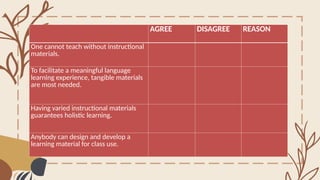
AGREE DISAGREE REASON
One cannot teach without instructional
materials.
To facilitate a meaningful language
learning experience, tangible materials
are most needed.
Having varied instructional materials
guarantees holistic learning.
Anybody can design and develop a
learning material for class use.
1. Use your first name as a acronym. Beside
each letter, write a word or phrase describing
an instructional material for language
learning.
Bring Home Activity
1. Watch the video clip and choose one type of
instructional material shown which you think
complements your style of teaching and explain why.
Diff. Instructional Materials and Tools
https://www.youtube.com/watch?v=XWTqWASEpug
Assignment:
2. Word Rally in a Pie: Write at least 5 words that
represent your idea of an instructional material. After,
combine them into an encompassing statement that
describes and instructional material.
Assignment:
5 words: Visual, Interactive, Informative, Relevant,
Purposeful
Encompassing statement: An instructional material is
a purposeful and relevant learning tool that uses
visual and interactive elements to effectively deliver
information.
Assignment:
Write Your Topic
or Idea
Chapter 1
Presentations are communication tools that can be used as lectures, speeches,
reports, demonstrations and more. Mostly presented before an audience, it serves
a variety of purposes. Presentations are communication tools that can be used as
lectures, speeches, reports, demonstrations and more.
Presentations are communication tools that can be used as lectures, speeches,
reports, demonstrations and more. Mostly presented before an audience, it serves
a variety of purposes. Presentations are communication tools that can be used as
lectures, speeches, reports, demonstrations and more.
Write Your
Subtopic
Presentations are communication tools that can be used as lectures,
speeches, reports, demonstrations and more. Mostly presented before an
audience, it serves a variety of purposes. Presentations are communication
tools that can be used as lectures, speeches, reports, demonstrations and
more.
Write Your Subtopic
Add a main point
Presentations are communication tools
that can be used as lectures, speeches,
reports, demonstrations and more.
01
Add a main point
Presentations are communication tools
that can be used as lectures, speeches,
reports, demonstrations and more.
02
Add a main point
Presentations are communication tools
that can be used as lectures, speeches,
reports, demonstrations and more.
03
Add a main point
Presentations are communication tools
that can be used as lectures, speeches,
reports, demonstrations and more.
04
01
02 04
03
Write Your Topic
or Idea
Chapter 2
Presentations are communication tools that can be used as lectures, speeches,
reports, demonstrations and more. Mostly presented before an audience, it serves
a variety of purposes. Presentations are communication tools that can be used as
lectures, speeches, reports, demonstrations and more.
Presentations are communication tools that can be used as lectures,
speeches, reports, demonstrations and more.
Write Your Subtopic
Add a main point
Presentations are communication
tools that can be used as lectures,
speeches, reports, demonstrations
and more. Mostly presented before
an audience, it serves a variety of
purposes. Presentations are
communication tools that can be
used as lectures, speeches, reports,
demonstrations and more.
Presentations are communication
tools that can be used as lectures,
speeches, reports, demonstrations
and more. Mostly presented before
an audience, it serves a variety of
purposes. Presentations are
communication tools that can be
used as lectures, speeches, reports,
demonstrations and more.
Add a main point
Title Of Steps Page
1
Add a main point
Presentations are
communication tools that
can be used as lectures,
speeches, reports,
demonstrations and more.
Presentations are
communication tools that
can be used as lectures,
speeches, reports,
demonstrations and more.
2
Add a main point
Presentations are
communication tools that
can be used as lectures,
speeches, reports,
demonstrations and more.
Presentations are
communication tools that
can be used as lectures,
speeches, reports,
demonstrations and more.
3
Add a main point
Presentations are
communication tools that
can be used as lectures,
speeches, reports,
demonstrations and more.
Presentations are
communication tools that
can be used as lectures,
speeches, reports,
demonstrations and more.
4
Add a main point
Presentations are
communication tools that
can be used as lectures,
speeches, reports,
demonstrations and more.
Presentations are
communication tools that
can be used as lectures,
speeches, reports,
demonstrations and more.
Write Your Topic
or Idea
Chapter 3
Presentations are communication tools that can be used as lectures, speeches,
reports, demonstrations and more. Mostly presented before an audience, it serves
a variety of purposes. Presentations are communication tools that can be used as
lectures, speeches, reports, demonstrations and more.
Presentations are communication tools that can be used as lectures, speeches,
reports, demonstrations and more. Mostly presented before an audience, it serves
a variety of purposes. Presentations are communication tools that can be used as
lectures, speeches, reports, demonstrations and more.
Write Your Subtopic
Add a main point Add a main point
Presentations are communication tools that can be used as lectures,
speeches, reports, demonstrations and more.
Write Your Subtopic
Presentations are communication tools that can be used as lectures,
speeches, reports, demonstrations and more.
Item Names Feature Feature Feature Feature
Item
Item
Item
Chapter 4
Write Your Topic
or Idea
Presentations are communication tools that can be used as lectures,
speeches, reports, demonstrations and more. Mostly presented before an
audience, it serves a variety of purposes. Presentations are communication
tools that can be used as lectures, speeches, reports, demonstrations and
more.
Title Of Photo Page
Presentations are communication tools that can be used as lectures,
speeches, reports, demonstrations and more.

Title Of Photo Page
Presentations are communication tools that can be used as lectures,
speeches, reports, demonstrations and more.
Group Result
Presentations are
communication tools that
can be used as lectures,
speeches, reports,
demonstrations and more.
Mostly presented before an
audience, it serves a variety
of purposes.
Result 1
Presentations are
communication tools that
can be used as lectures,
speeches, reports,
demonstrations and more.
Mostly presented before an
audience, it serves a variety
of purposes.
Result 2
Presentations are
communication tools that
can be used as lectures,
speeches, reports,
demonstrations and more.
Mostly presented before an
audience, it serves a variety
of purposes.
Result 3
Conclusion
Presentations are communication tools that can be used as lectures, speeches,
reports, demonstrations and more. Mostly presented before an audience, it serves
a variety of purposes. Presentations are communication tools that can be used as
lectures, speeches, reports, demonstrations and more.
Presentations are communication tools that can be used as lectures, speeches,
reports, demonstrations and more. Mostly presented before an audience, it serves
a variety of purposes. Presentations are communication tools that can be used as
lectures, speeches, reports, demonstrations and more.

THANK YOU
By Group Fauget

Language, Learning, Materials Development - (BSED 2).pptx

  • 1.
    LANGUAGE LEARNING MATERIALS DEVELOPMENT Ethel DeLeon - Abao, LPT, EdD Rivika C. Alda, LPT, EdD Remedios C. Bacus, LPT, PhD
  • 2.
    Course Description: This courseengages the pre-service English teachers in the selection, development, production, and evaluation of variety of language teaching and learning resources based on the identified K to 12 learning competencies. Through these activities, they are able to demonstrate content knowledge on the principles and procedures of language materials development. Students show competence in employing innovative strategies on the design and development of contextualized and localized instructional materials that provide opportunities for meaningful, purposeful language use thereby facilitate language learning and teaching. Intro
  • 3.
    What is LLM? •Language Learning Materials Development is the process of creating, choosing, adapting, and organizing materials that helps students learn and use a language effectively. • It means making or improving learning tools (like textbooks, worksheets, activities, videos, or games) so that students can understand, practice, and use a language in real life. Intro
  • 4.
    Step - by-Step 1. Know the learners - understand the students’ age, level, needs, interests, and culture. 2. Set a clear goal - decide what students should be able to do (for example: speak politely, write a paragraph, understand a story). 3. Choose or create materials - prepare lessons, activities, texts, or tasks that match the goal. 4. Make it meaningful - use real-life situations (school, home, community, daily conversations). Intro
  • 5.
    Step - by-Step 5. Make it interactive - include activities like role-plays, group work, games, and discussions. 6. Check and improve - see if the materials work well, then revise if needed. Intro
  • 6.
    Examples • Textbooks • Worksheets •Flashcards • Dialogues and stories • Videos and audio recordings • Games and role-play activities Intro
  • 7.
    Why LLM isimportant? Can you share your answer. Intro
  • 8.
    Why LLM isimportant? • Makes lessons interesting and engaging • Helps learners understand better • Encourages communication, not memorization • Matches the learners’ level and needs • Supports effective teachinng Intro
  • 9.
    Activity: Warm-Up (Opinion &Experience Questions: 1. What language learning materials have helped you learn best before? Why? 2. Which do you prefer more: textbooks, worksheets, videos, or games? Explain your choice. 3. Have you ever found a language lesson boring because of the materials used? What was missing? 4. Do you think teachers should always follow the textbook exactly? Why or why not? 5. How do language materials affect your motivation to learn a language? Intro
  • 10.
    Unit 1: Introductionto Material Development Learning Outcomes: a. deepen understanding on the essence of instructional materials towards a successful instructional delivery b. develop instructional materials which are appropriate, relevant, and appealing; c. evaluate instructional materials based on the criteria set and d. demonstrate the ability to adapt purposeful instructional materials Intro
  • 11.
    • Communication isa survival resource. In this era of massive advancement in information, science, technology, you need to be equipped with a wide array of scaffolds that can help facilitate active engagement with different kinds of environment in order for you to survive in this globally competitive world. Intro
  • 12.
    • Nunan (1992)states that teaching materials are often the most substantial and observable component of pedagogy. • This premise leads to the idea that in language learning activities, oftentimes teachers consider learning materials as fundamental elements towards the attainment of the expected competencies as they support meaningful teaching and learning. • Edge (1993) stated that materials exist in order to support learning/teaching, so they should be designed to suit the people and the processes involved. Intro
  • 13.
    • This courseis two - pronged. • This ushers you to the essentials of language learning materials development as this will equip you in the preparation of a meaningful language teaching and learning. • In this process, you are guided that as you become professional teachers, you don’t only pay attention to the competencies or outcomes, topics and assessment measures but you have to give equal value on the instructional materials as these enhance students’ learning. Intro
  • 14.
    • Language learningmaterials development is the systematic process of designing, creating, and evaluating tools (like textbooks, apps, videos) that help people learn a new language, focusing on effective instruction, learner engagement, and providing authentic language exposure for real-world communication. It's a field within applied linguistics that bridges theory and practice, producing resources from classroom worksheets to online platforms, ensuring they meet learners' needs and support language acquisition.
  • 15.
    Key Aspects: • Definition:Creating resources (print, audio, visual, digital) for language teaching and learning. • Process: Involves designing, implementing, and evaluating materials for effectiveness. • Types: Includes authentic (real-world) materials like podcasts, and artificial (created for teaching) materials like worksheets. • Goal: To provide learners with meaningful input and opportunities for communicative output, making learning relevant and engaging.
  • 16.
    Examples of Materials Print:Textbooks, workbooks, flashcards, activity sheets. Audio/Visual: Podcasts, videos, songs, movies, educational TV. Digital/Online: E-books, apps, websites, interactive modules.
  • 17.
    Principles of Development Learner-Centered:Materials should be relevant, build confidence, and cater to different learning styles. Authenticity: Exposing learners to real language use is crucial for motivation and comprehension. Engagement: Encouraging intellectual, emotional, and aesthetic involvement. Communicative Focus: Providing chances to use the language for real purposes, not just controlled practice.
  • 18.
    Usage Examples: Classroom: Teachersadapting a textbook chapter with local examples or creating a new activity based on a news article. Commercial: Publishers creating a series of digital language learning apps for mobile devices. Self-Study: Learners using authentic YouTube videos or language exchange platforms.
  • 19.
    Examples of LanguageLearning Materials (LLM) in a classroom setting: 1. Role - Play Dialogue (Speaking & Listening) Example: Ordering food in a school canteen. Students practice dialogues in pairs and create their own conversations. 2. Grammar Worksheet (Grammar) Example: Subject - verb agreement worksheet with identification, completion, and sentence writing tasks.
  • 20.
    3. Picture -Based Vocabulary Cards (Vocabulary) Example: Flashcards showing classroom objects. Students match words, say meanings, and form sentences. 4. Short Reading Text with Activities (Reading) Example: A short story about daily routines followed by comprehension and discussion questions. 5. Listening Audio with Tasks (Listening) Example: Audio conversation where students listen for details and answer questions.
  • 21.
    6. Language Game(Integrated Skills) Example: Word bingo or sentence - building games done in groups to encourage interaction. 7. Teacher - Made Visual Chart (Reference Material) Example: Parts of speech chart displayed in class for easy reference.
  • 22.
    Summary: • Language LearningMaterials help make lessons meaningful, engaging, and learner - centered. They support communication, practice, and real - life language use in the classroom.
  • 23.
    Essence of Instructional Materials GeneralOverview • Instructional materials refer to those alternative channels of communication, which a classroom teacher can use to concretize a concept during teaching and learning process. Before a teacher can design or produce an instructional material, he has to know what these instructional materials are, their advantage and disadvantage, characteristics, limitations, etc. the essence of producing instructional materials, is to facilitate the teaching learning process. (Amodioha, 2009)
  • 24.
    Essence of Instructional Materials GeneralOverview • An instructional material is any systematic description of the teachniques and excercises to be used in the classroom teaching. (Brown, 1995) • They are didactic material things which are supposed to make learning and teaching possible. (Obanya, 1989)
  • 25.
    Essence of Instructional Materials GeneralOverview • They are human and non - human materials and facilities that can be used to ease, encourage, improve and promote teaching and learning activities. They are defined as resources that organize and support instruction, such as textbooks, tasks and supplementary materials.” (Remilliard and Heck 2014)
  • 26.
    Essence of Instructional Materials GeneralOverview • Teaching aids are objects (such as a book, picture or map) or devices (such as DVD or computer) used by a teacher to enhance or enliven classroom instruction. (Shukla, 2018)
  • 27.
    Essence of Instructional Materials GeneralOverview • The role of materials (particularly textbook) in language teaching as a resource - for presentation materials; activities for learners’ practive and communicative interaction; for learners on grammar, vocabulary, pronunciation stimulation and ideas for classroom activities; a support for less experienced teachers. (Cunningsworth as cited in Richards, 2003)
  • 28.
    Essence of Instructional Materials GeneralOverview • It is worthy to note that in order to make instructional activities effective, the teachers’ corresponding instructional materials need to be well-thought-of, appropriate and responsive to the varying needs of students. • In other words without them, learning becomes theoritical and not practical. • In support, instructional materials are the tangible, non-tangible; print or non - print devices which lead the students to become lifelong learning skills who are critical and creative thinkers.
  • 29.
    Kick off Based onyour experience, how do you distinguish a plain material from an instructional material? 01 02 What instructional materials have you been frequently exposed to?
  • 30.
    One cannot teach without instructional materials. Theaforementioned ideas of experts have given you a description of instructional materials for language learning. As you decipher its elements, do the following: 1. Read the following statements carefully then beside each, mark wether or not you agree with it. Beside your response indicate the corresponding reason.
  • 31.
    One cannot teach without instructional materials. AGREEDISAGREE REASON One cannot teach without instructional materials. To facilitate a meaningful language learning experience, tangible materials are most needed. Having varied instructional materials guarantees holistic learning. Anybody can design and develop a learning material for class use.
  • 32.
    1. Use yourfirst name as a acronym. Beside each letter, write a word or phrase describing an instructional material for language learning. Bring Home Activity
  • 33.
    1. Watch thevideo clip and choose one type of instructional material shown which you think complements your style of teaching and explain why. Diff. Instructional Materials and Tools https://www.youtube.com/watch?v=XWTqWASEpug Assignment:
  • 34.
    2. Word Rallyin a Pie: Write at least 5 words that represent your idea of an instructional material. After, combine them into an encompassing statement that describes and instructional material. Assignment:
  • 35.
    5 words: Visual,Interactive, Informative, Relevant, Purposeful Encompassing statement: An instructional material is a purposeful and relevant learning tool that uses visual and interactive elements to effectively deliver information. Assignment:
  • 36.
    Write Your Topic orIdea Chapter 1 Presentations are communication tools that can be used as lectures, speeches, reports, demonstrations and more. Mostly presented before an audience, it serves a variety of purposes. Presentations are communication tools that can be used as lectures, speeches, reports, demonstrations and more. Presentations are communication tools that can be used as lectures, speeches, reports, demonstrations and more. Mostly presented before an audience, it serves a variety of purposes. Presentations are communication tools that can be used as lectures, speeches, reports, demonstrations and more.

  • 37.
    Write Your Subtopic Presentations arecommunication tools that can be used as lectures, speeches, reports, demonstrations and more. Mostly presented before an audience, it serves a variety of purposes. Presentations are communication tools that can be used as lectures, speeches, reports, demonstrations and more.

  • 38.
    Write Your Subtopic Adda main point Presentations are communication tools that can be used as lectures, speeches, reports, demonstrations and more. 01 Add a main point Presentations are communication tools that can be used as lectures, speeches, reports, demonstrations and more. 02 Add a main point Presentations are communication tools that can be used as lectures, speeches, reports, demonstrations and more. 03 Add a main point Presentations are communication tools that can be used as lectures, speeches, reports, demonstrations and more. 04 01 02 04 03


  • 39.
    Write Your Topic orIdea Chapter 2 Presentations are communication tools that can be used as lectures, speeches, reports, demonstrations and more. Mostly presented before an audience, it serves a variety of purposes. Presentations are communication tools that can be used as lectures, speeches, reports, demonstrations and more. Presentations are communication tools that can be used as lectures, speeches, reports, demonstrations and more.
  • 40.
    Write Your Subtopic Adda main point Presentations are communication tools that can be used as lectures, speeches, reports, demonstrations and more. Mostly presented before an audience, it serves a variety of purposes. Presentations are communication tools that can be used as lectures, speeches, reports, demonstrations and more. Presentations are communication tools that can be used as lectures, speeches, reports, demonstrations and more. Mostly presented before an audience, it serves a variety of purposes. Presentations are communication tools that can be used as lectures, speeches, reports, demonstrations and more. Add a main point
  • 41.
    Title Of StepsPage 1 Add a main point Presentations are communication tools that can be used as lectures, speeches, reports, demonstrations and more. Presentations are communication tools that can be used as lectures, speeches, reports, demonstrations and more. 2 Add a main point Presentations are communication tools that can be used as lectures, speeches, reports, demonstrations and more. Presentations are communication tools that can be used as lectures, speeches, reports, demonstrations and more. 3 Add a main point Presentations are communication tools that can be used as lectures, speeches, reports, demonstrations and more. Presentations are communication tools that can be used as lectures, speeches, reports, demonstrations and more. 4 Add a main point Presentations are communication tools that can be used as lectures, speeches, reports, demonstrations and more. Presentations are communication tools that can be used as lectures, speeches, reports, demonstrations and more.
  • 42.
    Write Your Topic orIdea Chapter 3 Presentations are communication tools that can be used as lectures, speeches, reports, demonstrations and more. Mostly presented before an audience, it serves a variety of purposes. Presentations are communication tools that can be used as lectures, speeches, reports, demonstrations and more. Presentations are communication tools that can be used as lectures, speeches, reports, demonstrations and more. Mostly presented before an audience, it serves a variety of purposes. Presentations are communication tools that can be used as lectures, speeches, reports, demonstrations and more.
  • 43.
    Write Your Subtopic Adda main point Add a main point Add a main point Add a main point Presentations are communication tools that can be used as lectures, speeches, reports, demonstrations and more.
  • 44.
    Write Your Subtopic Presentationsare communication tools that can be used as lectures, speeches, reports, demonstrations and more. Item Names Feature Feature Feature Feature Item Item Item
  • 45.
    Chapter 4 Write YourTopic or Idea Presentations are communication tools that can be used as lectures, speeches, reports, demonstrations and more. Mostly presented before an audience, it serves a variety of purposes. Presentations are communication tools that can be used as lectures, speeches, reports, demonstrations and more.
  • 46.
    Title Of PhotoPage Presentations are communication tools that can be used as lectures, speeches, reports, demonstrations and more.
  • 47.
    Title Of PhotoPage Presentations are communication tools that can be used as lectures, speeches, reports, demonstrations and more.
  • 48.
    Group Result Presentations are communicationtools that can be used as lectures, speeches, reports, demonstrations and more. Mostly presented before an audience, it serves a variety of purposes. Result 1 Presentations are communication tools that can be used as lectures, speeches, reports, demonstrations and more. Mostly presented before an audience, it serves a variety of purposes. Result 2 Presentations are communication tools that can be used as lectures, speeches, reports, demonstrations and more. Mostly presented before an audience, it serves a variety of purposes. Result 3
  • 49.
    Conclusion Presentations are communicationtools that can be used as lectures, speeches, reports, demonstrations and more. Mostly presented before an audience, it serves a variety of purposes. Presentations are communication tools that can be used as lectures, speeches, reports, demonstrations and more. Presentations are communication tools that can be used as lectures, speeches, reports, demonstrations and more. Mostly presented before an audience, it serves a variety of purposes. Presentations are communication tools that can be used as lectures, speeches, reports, demonstrations and more.
  • 50.