Waves
Waves
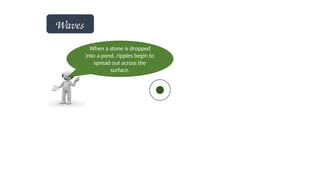
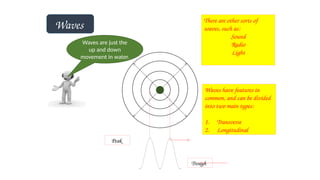
When a stone is dropped
into a pond, ripples begin to
spread out across the
surface.
Waves
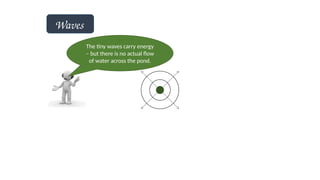
The tiny waves carry energy
– but there is no actual flow
of water across the pond.
Waves
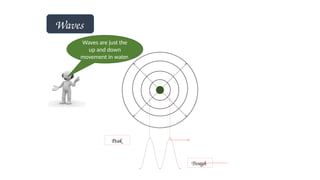
Waves are just the
up and down
movement in water.
Peak
Trough
Waves
Waves are just the
up and down
movement in water.
Peak
Trough
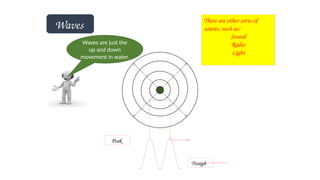
There are other sorts of
waves, such as:
Sound
Radio
Light
Waves
Waves are just the
up and down
movement in water.
Peak
Trough
There are other sorts of
waves, such as:
Sound
Radio
Light
Waves have features in
common, and can be divided
into two main types:
1. Transverse
2. Longitudinal
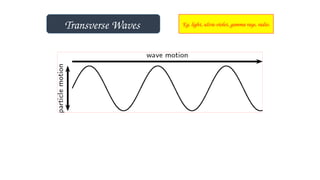
Transverse Waves Eg. light, ultra-violet, gamma rays, radio.
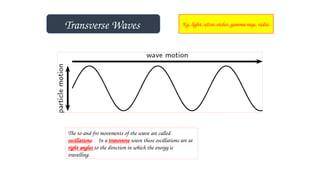
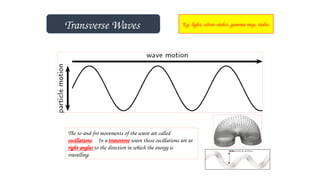
The to-and-fro movements of the wave are called
oscillations. In a transverse wave these oscillations are at
right angles to the direction in which the energy is
travelling.
Transverse Waves Eg. light, ultra-violet, gamma rays, radio.
The to-and-fro movements of the wave are called
oscillations. In a transverse wave these oscillations are at
right angles to the direction in which the energy is
travelling.
Transverse Waves Eg. light, ultra-violet, gamma rays, radio.
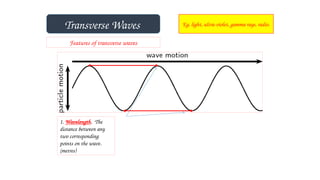
Features of transverse waves
1. Wavelength. The
distance between any
two corresponding
points on the wave.
(metres)
Transverse Waves Eg. light, ultra-violet, gamma rays, radio.
Features of transverse waves
1. Wavelength. The
distance between any
two corresponding
points on the wave.
(metres)
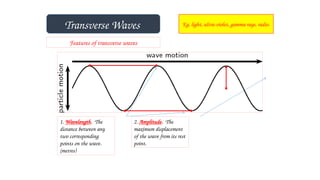
2. Amplitude. The
maximum displacement
of the wave from its rest
point.
Transverse Waves Eg. light, ultra-violet, gamma rays, radio.
Features of transverse waves
1. Wavelength. The
distance between any
two corresponding
points on the wave.
(metres)
2. Amplitude. The
maximum displacement
of the wave from its rest
point.
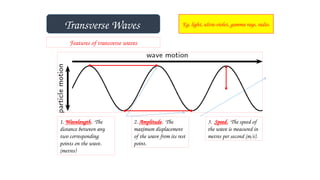
3. Speed. The speed of
the wave is measured in
metres per second (m/s).
Transverse Waves Eg. light, ultra-violet, gamma rays, radio.
Features of transverse waves
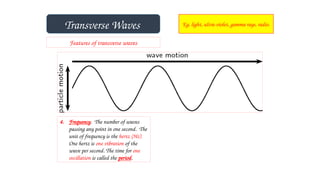
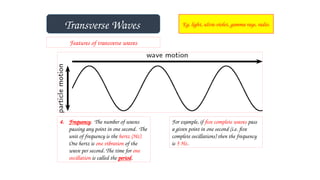
4. Frequency. The number of waves
passing any point in one second. The
unit of frequency is the hertz (Hz).
One hertz is one vibration of the
wave per second. The time for one
oscillation is called the period.
Transverse Waves Eg. light, ultra-violet, gamma rays, radio.
Features of transverse waves
4. Frequency. The number of waves
passing any point in one second. The
unit of frequency is the hertz (Hz).
One hertz is one vibration of the
wave per second. The time for one
oscillation is called the period.
For example, if five complete waves pass
a given point in one second (i.e. five
complete oscillations) then the frequency
is 5 Hz.
Transverse Waves Eg. light, ultra-violet, gamma rays, radio.
Features of transverse waves
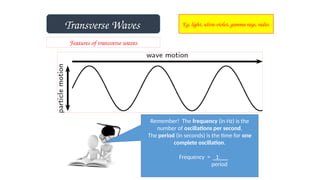
Remember! The frequency (in Hz) is the
number of oscillations per second.
The period (in seconds) is the time for one
complete oscillation.
Frequency = 1
period
Transverse Waves Eg. light, ultra-violet, gamma rays, radio.
The wave equation
Linking together
speed,
frequency and
wavelength.
Transverse Waves Eg. light, ultra-violet, gamma rays, radio.
The wave equation
Linking together
speed,
frequency and
wavelength.
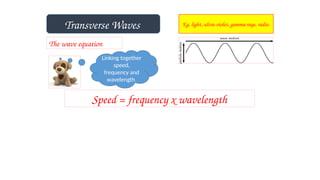
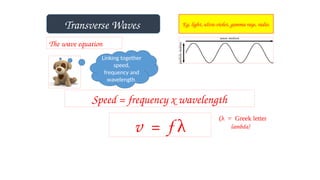
Speed = frequency x wavelength
Transverse Waves Eg. light, ultra-violet, gamma rays, radio.
The wave equation
Linking together
speed,
frequency and
wavelength.
Speed = frequency x wavelength
v = f λ
(λ = Greek letter
lambda)
Transverse Waves Eg. light, ultra-violet, gamma rays, radio.
The wave equation
Linking together
speed,
frequency and
wavelength.
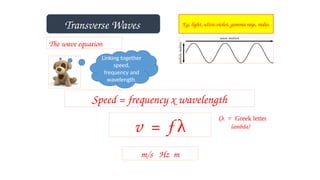
Speed = frequency x wavelength
v = f λ
(λ = Greek letter
lambda)
m/s Hz m
Transverse Waves Eg. light, ultra-violet, gamma rays, radio.
The wave equation
Linking together
speed,
frequency and
wavelength.
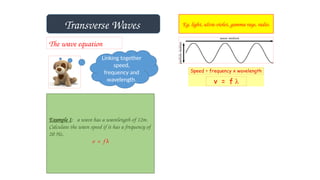
Example 1: a wave has a wavelength of 12m.
Calculate the wave speed if it has a frequency of
20 Hz.
v = f λ
Transverse Waves Eg. light, ultra-violet, gamma rays, radio.
The wave equation
Linking together
speed,
frequency and
wavelength.
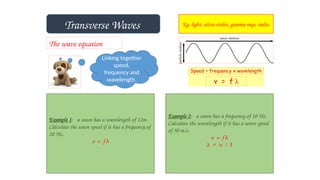
Example 1: a wave has a wavelength of 12m.
Calculate the wave speed if it has a frequency of
20 Hz.
v = f λ
Example 2: a wave has a frequency of 10 Hz.
Calculate the wavelength if it has a wave speed
of 50 m/s.
v = f λ
λ = v / f
waves_31_jan_2akakakakakkakakka024.pptx.pdf

waves_31_jan_2akakakakakkakakka024.pptx.pdf

  • 1.
  • 2.
    Waves When a stoneis dropped into a pond, ripples begin to spread out across the surface.
  • 3.
    Waves The tiny wavescarry energy – but there is no actual flow of water across the pond.
  • 4.
    Waves Waves are justthe up and down movement in water. Peak Trough
  • 5.
    Waves Waves are justthe up and down movement in water. Peak Trough There are other sorts of waves, such as: Sound Radio Light
  • 6.
    Waves Waves are justthe up and down movement in water. Peak Trough There are other sorts of waves, such as: Sound Radio Light Waves have features in common, and can be divided into two main types: 1. Transverse 2. Longitudinal
  • 7.
    Transverse Waves Eg.light, ultra-violet, gamma rays, radio.
  • 8.
    Transverse Waves Eg.light, ultra-violet, gamma rays, radio. The to-and-fro movements of the wave are called oscillations. In a transverse wave these oscillations are at right angles to the direction in which the energy is travelling.
  • 9.
    Transverse Waves Eg.light, ultra-violet, gamma rays, radio. The to-and-fro movements of the wave are called oscillations. In a transverse wave these oscillations are at right angles to the direction in which the energy is travelling.
  • 10.
    Transverse Waves Eg.light, ultra-violet, gamma rays, radio. Features of transverse waves 1. Wavelength. The distance between any two corresponding points on the wave. (metres)
  • 11.
    Transverse Waves Eg.light, ultra-violet, gamma rays, radio. Features of transverse waves 1. Wavelength. The distance between any two corresponding points on the wave. (metres) 2. Amplitude. The maximum displacement of the wave from its rest point.
  • 12.
    Transverse Waves Eg.light, ultra-violet, gamma rays, radio. Features of transverse waves 1. Wavelength. The distance between any two corresponding points on the wave. (metres) 2. Amplitude. The maximum displacement of the wave from its rest point. 3. Speed. The speed of the wave is measured in metres per second (m/s).
  • 13.
    Transverse Waves Eg.light, ultra-violet, gamma rays, radio. Features of transverse waves 4. Frequency. The number of waves passing any point in one second. The unit of frequency is the hertz (Hz). One hertz is one vibration of the wave per second. The time for one oscillation is called the period.
  • 14.
    Transverse Waves Eg.light, ultra-violet, gamma rays, radio. Features of transverse waves 4. Frequency. The number of waves passing any point in one second. The unit of frequency is the hertz (Hz). One hertz is one vibration of the wave per second. The time for one oscillation is called the period. For example, if five complete waves pass a given point in one second (i.e. five complete oscillations) then the frequency is 5 Hz.
  • 15.
    Transverse Waves Eg.light, ultra-violet, gamma rays, radio. Features of transverse waves Remember! The frequency (in Hz) is the number of oscillations per second. The period (in seconds) is the time for one complete oscillation. Frequency = 1 period
  • 16.
    Transverse Waves Eg.light, ultra-violet, gamma rays, radio. The wave equation Linking together speed, frequency and wavelength.
  • 17.
    Transverse Waves Eg.light, ultra-violet, gamma rays, radio. The wave equation Linking together speed, frequency and wavelength. Speed = frequency x wavelength
  • 18.
    Transverse Waves Eg.light, ultra-violet, gamma rays, radio. The wave equation Linking together speed, frequency and wavelength. Speed = frequency x wavelength v = f λ (λ = Greek letter lambda)
  • 19.
    Transverse Waves Eg.light, ultra-violet, gamma rays, radio. The wave equation Linking together speed, frequency and wavelength. Speed = frequency x wavelength v = f λ (λ = Greek letter lambda) m/s Hz m
  • 20.
    Transverse Waves Eg.light, ultra-violet, gamma rays, radio. The wave equation Linking together speed, frequency and wavelength. Example 1: a wave has a wavelength of 12m. Calculate the wave speed if it has a frequency of 20 Hz. v = f λ
  • 21.
    Transverse Waves Eg.light, ultra-violet, gamma rays, radio. The wave equation Linking together speed, frequency and wavelength. Example 1: a wave has a wavelength of 12m. Calculate the wave speed if it has a frequency of 20 Hz. v = f λ Example 2: a wave has a frequency of 10 Hz. Calculate the wavelength if it has a wave speed of 50 m/s. v = f λ λ = v / f