GENERAL
SPECTROSCOPY
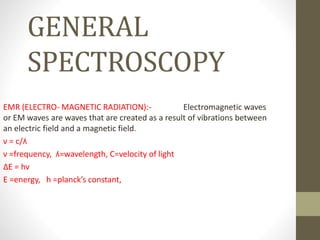
EMR (ELECTRO- MAGNETIC RADIATION):- Electromagnetic waves
or EM waves are waves that are created as a result of vibrations between
an electric field and a magnetic field.
ν = c/ʎ
v =frequency, ʎ=wavelength, C=velocity of light
ΔE = hv
E =energy, h =planck’s constant,
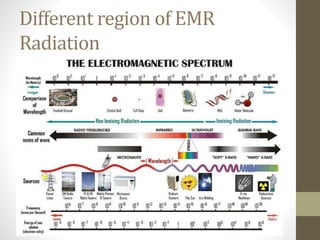
Different region of EMR
Radiation
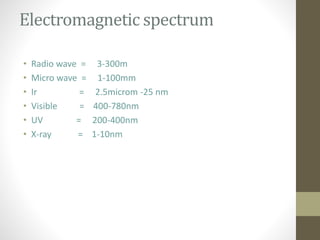
Electromagnetic spectrum
• Radio wave = 3-300m
• Micro wave = 1-100mm
• Ir = 2.5microm -25 nm
• Visible = 400-780nm
• UV = 200-400nm
• X-ray = 1-10nm
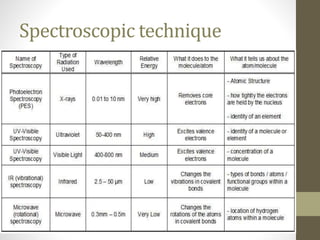
Spectroscopic technique
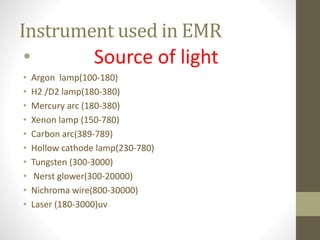
Instrument used in EMR
• Source of light
• Argon lamp(100-180)
• H2 /D2 lamp(180-380)
• Mercury arc (180-380)
• Xenon lamp (150-780)
• Carbon arc(389-789)
• Hollow cathode lamp(230-780)
• Tungsten (300-3000)
• Nerst glower(300-20000)
• Nichroma wire(800-30000)
• Laser (180-3000)uv
Detector
• Photon
• Thermal
• Photographic plate
• Photoconductor
• Photomultiplier
• Thermocouple
• Phototube
• Golaycell
• Silicon oxide
• Charge transfer detector
• Pyroelectric cell
Cell material
• Fused silica/quarz-180nm-2.5microm(Uvnear IR)
• Corex/silicate glass-230nm-2.5microm(uv near ir)
• NACL:2.5microm-25 microm (MID IR)
• KBR:over entire spectrum
• Zn,Se:1microm-50microm(Near mid far IR)
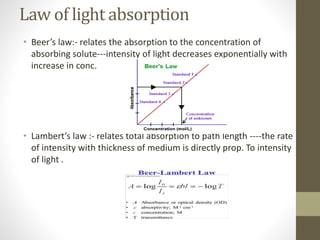
Law of light absorption
• Beer’s law:- relates the absorption to the concentration of
absorbing solute---intensity of light decreases exponentially with
increase in conc.
• Lambert’s law :- relates total absorption to path length ----the rate
of intensity with thickness of medium is directly prop. To intensity
of light .

General spectroscopy

  • 1.
    GENERAL SPECTROSCOPY EMR (ELECTRO- MAGNETICRADIATION):- Electromagnetic waves or EM waves are waves that are created as a result of vibrations between an electric field and a magnetic field. ν = c/ʎ v =frequency, ʎ=wavelength, C=velocity of light ΔE = hv E =energy, h =planck’s constant,
  • 2.
    Different region ofEMR Radiation
  • 3.
    Electromagnetic spectrum • Radiowave = 3-300m • Micro wave = 1-100mm • Ir = 2.5microm -25 nm • Visible = 400-780nm • UV = 200-400nm • X-ray = 1-10nm
  • 4.
  • 5.
    Instrument used inEMR • Source of light • Argon lamp(100-180) • H2 /D2 lamp(180-380) • Mercury arc (180-380) • Xenon lamp (150-780) • Carbon arc(389-789) • Hollow cathode lamp(230-780) • Tungsten (300-3000) • Nerst glower(300-20000) • Nichroma wire(800-30000) • Laser (180-3000)uv
  • 6.
    Detector • Photon • Thermal •Photographic plate • Photoconductor • Photomultiplier • Thermocouple • Phototube • Golaycell • Silicon oxide • Charge transfer detector • Pyroelectric cell
  • 7.
    Cell material • Fusedsilica/quarz-180nm-2.5microm(Uvnear IR) • Corex/silicate glass-230nm-2.5microm(uv near ir) • NACL:2.5microm-25 microm (MID IR) • KBR:over entire spectrum • Zn,Se:1microm-50microm(Near mid far IR)
  • 8.
    Law of lightabsorption • Beer’s law:- relates the absorption to the concentration of absorbing solute---intensity of light decreases exponentially with increase in conc. • Lambert’s law :- relates total absorption to path length ----the rate of intensity with thickness of medium is directly prop. To intensity of light .