Topic : 04 , Gene Libraries
Index
1. Gene library
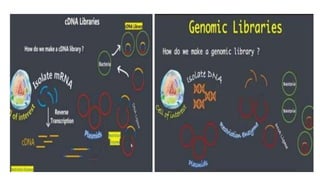
2. Types of gene library
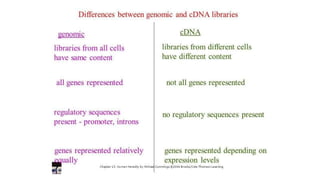
3. Difference between genomic and cDNA library
4. Requirments of genomic library
5. partial RE digestion
6. Screening
Gene library
•Large collection of DNA fragments cloned from a specific organism, tissue, organ
or cell type. Collectively, the clones may represent the complete genomic sequence
of the organism.
Types of gene library
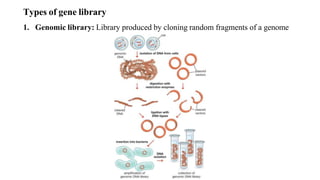
1. Genomic library: Library produced by cloning random fragments of a genome
Types of gene library
1. Genomic library: Library produced by cloning random fragments of a genome
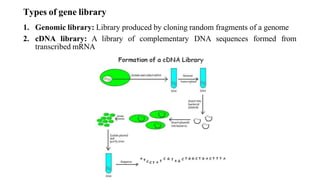
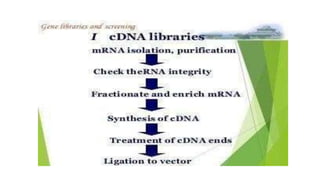
2. cDNA library: A library of complementary DNA sequences formed from
transcribed mRNA
Requirements of genomic libraries
1. Size of the library: Must contain a certain number of recombinant to ensure the
presence of a particular sequence
2. Genomic DNA: Fragmented randomly by physical shearing or restriction
enzyme digestion to give a size range appropriate for the chosen vector.
Sometimes, combination of restriction enzymes used to partially digest the DNA
3. Vectors: Plasmid, bacteriophage, cosmid etc. are used. Choice of vector depends
on the genome size. Ligated by T4 DNA ligase
Partial RE digestion of DNA
•Digestion with RE for different times/different concentration
•Larger the size of the fragments, the less number of clones required
Screening
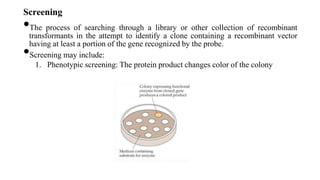
•The process of searching through a library or other collection of recombinant
transformants in the attempt to identify a clone containing a recombinant vector
having at least a portion of the gene recognized by the probe.
•Screening may include:
1. Phenotypic screening: The protein product changes color of the colony
Screening
•The process of searching through a library or other collection of recombinant
transformants in the attempt to identify a clone containing a recombinant vector
having at least a portion of the gene recognized by the probe.
•Screening may include:
1. Phenotypic screening: The protein product changes color of the colony
2. Antibiotic resistance: Gene encodes resistance to antibiotic
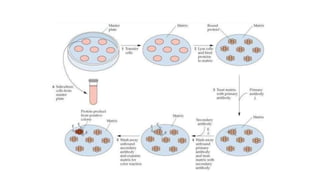
3. Immunoscreening: Using antibody (Ab) that can recognize the protein
produced by the gene
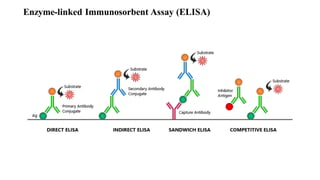
Enzyme-linked Immunosorbent Assay (ELISA)
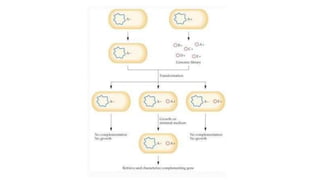
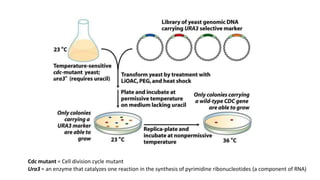
Screening by functional complementation
•Requires a strain unable to produce the desired product/show desired function
•Cloned DNA will contain the gene for the product
•Selection for restoration of lost product
Cdc mutant = Cell division cycle mutant
Ura3 = an enzyme that catalyzes one reaction in the synthesis of pyrimidine ribonucleotides (a component of RNA)
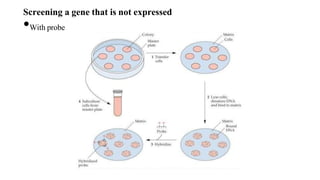
Screening a gene that is not expressed
•With probe
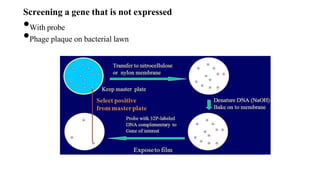
Screening a gene that is not expressed
•With probe
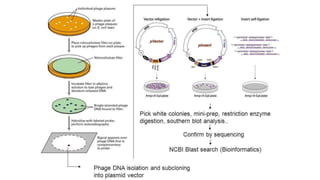
•Phage plaque on bacterial lawn
gene library

gene library

  • 1.
    Topic : 04, Gene Libraries
  • 2.
    Index 1. Gene library 2.Types of gene library 3. Difference between genomic and cDNA library 4. Requirments of genomic library 5. partial RE digestion 6. Screening
  • 4.
    Gene library •Large collectionof DNA fragments cloned from a specific organism, tissue, organ or cell type. Collectively, the clones may represent the complete genomic sequence of the organism.
  • 5.
    Types of genelibrary 1. Genomic library: Library produced by cloning random fragments of a genome
  • 6.
    Types of genelibrary 1. Genomic library: Library produced by cloning random fragments of a genome 2. cDNA library: A library of complementary DNA sequences formed from transcribed mRNA
  • 10.
    Requirements of genomiclibraries 1. Size of the library: Must contain a certain number of recombinant to ensure the presence of a particular sequence 2. Genomic DNA: Fragmented randomly by physical shearing or restriction enzyme digestion to give a size range appropriate for the chosen vector. Sometimes, combination of restriction enzymes used to partially digest the DNA 3. Vectors: Plasmid, bacteriophage, cosmid etc. are used. Choice of vector depends on the genome size. Ligated by T4 DNA ligase
  • 11.
    Partial RE digestionof DNA •Digestion with RE for different times/different concentration •Larger the size of the fragments, the less number of clones required
  • 12.
    Screening •The process ofsearching through a library or other collection of recombinant transformants in the attempt to identify a clone containing a recombinant vector having at least a portion of the gene recognized by the probe. •Screening may include: 1. Phenotypic screening: The protein product changes color of the colony
  • 13.
    Screening •The process ofsearching through a library or other collection of recombinant transformants in the attempt to identify a clone containing a recombinant vector having at least a portion of the gene recognized by the probe. •Screening may include: 1. Phenotypic screening: The protein product changes color of the colony 2. Antibiotic resistance: Gene encodes resistance to antibiotic 3. Immunoscreening: Using antibody (Ab) that can recognize the protein produced by the gene
  • 14.
  • 16.
    Screening by functionalcomplementation •Requires a strain unable to produce the desired product/show desired function •Cloned DNA will contain the gene for the product •Selection for restoration of lost product
  • 18.
    Cdc mutant =Cell division cycle mutant Ura3 = an enzyme that catalyzes one reaction in the synthesis of pyrimidine ribonucleotides (a component of RNA)
  • 19.
    Screening a genethat is not expressed •With probe
  • 20.
    Screening a genethat is not expressed •With probe •Phage plaque on bacterial lawn