GENE CLONING STEPS
Selection of Vector for cloning
Purification of DNA
Manipulation of Purified DNA
Introduction of DNA into living cells
MANIPULATION OF DNA
 DNA can be shortened, lengthened, copied into RNA or new DNA molecules and modified
 DNA Manipulative techniques used are
1. Cutting
2. Joining
 These techniques make use of purified enzymes
 Manipulations are carried out in test tube
 Provide foundations for
1. Gene Cloning
2. Studying DNA Biochemistry
3. Studies of gene expression
DNA MANIPULATIVE ENZYMES
1. NUCLEASES (cut, shorten or degrade nucleic acids)
2. LIGASES (join nucleic acids)
3. POLYMERASES (make copies of molecules)
4. DNA MODIFYING ENZYMES (remove or add chemical groups)
1. NUCLEASES
Degrade DNA molecules by breaking the phosphodiester bonds
linking nucleotides in DNA strand.
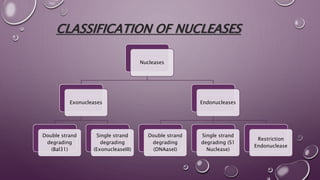
CLASSIFICATION OF NUCLEASES
Nucleases
Exonucleases
Double strand
degrading
(Bal31)
Single strand
degrading
(ExonucleaseIII)
Endonucleases
Double strand
degrading
(DNAaseI)
Single strand
degrading (S1
Nuclease)
Restriction
Endonuclease
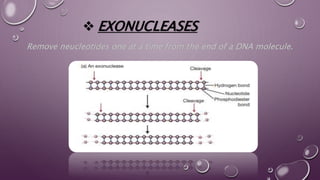
 EXONUCLEASES
Remove neucleotides one at a time from the end of a DNA molecule.
BAL31
 Purified from the bacterium Alteromonas espejiana
 removes nucleotides from both strands of a double-stranded molecule
 EXONUCLEASE III
 Purified from E. coli
 degrade just one strand of a double-stranded molecule, leaving
single-stranded DNA as the product
 ENDONUCLEASES
Break internal phosphodiester bonds within a DNA molecule
S1 ENDONUCLEASE
Purified from the fungus Aspergillus oryzae and only cleaves single strands
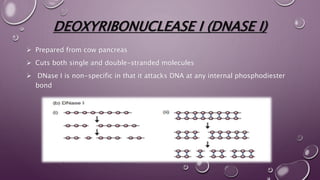
DEOXYRIBONUCLEASE I (DNASE I)
 Prepared from cow pancreas
 Cuts both single and double-stranded molecules
 DNase I is non-specific in that it attacks DNA at any internal phosphodiester
bond
RESTRICTION ENDONUCLEASES
 Special group of enzymes
 Cleave double-stranded DNA only at a limited number of specific
recognition sites
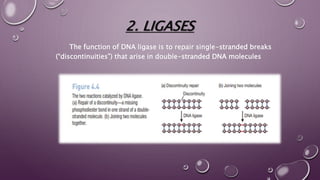
2. LIGASES
The function of DNA ligase is to repair single-stranded breaks
(“discontinuities”) that arise in double-stranded DNA molecules
3. POLYMERASES
DNA polymerases are enzymes that synthesize a new strand of DNA complementary
to
an existing DNA or RNA template.
 Most polymerases can function only if the template possesses a double-stranded
region that acts as a primer for initiation of polymerization.
 Four types of DNA polymerase are used routinely in genetic engineering.
 DNA POLYMERASE I
 Prepared from E. coli.
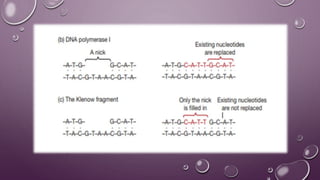
 This enzyme attaches to a short single-stranded region (or nick) in a mainly
double-stranded DNA molecule, and then synthesizes a completely new
strand, degrading the existing strand as it proceeds
 DNA polymerase has dual activity—DNA polymerization and DNA degradation.
KLENOW FRAGMENT
 The polymerase and nuclease activities of DNA polymerase I are controlled by
different parts of the enzyme molecule.
 The nuclease activity is contained in the first 323 amino acids of the
polypeptide, so removal of this segment leaves a modified enzyme that retains
the polymerase function but is unable to degrade DNA.
 This modified enzyme, called the Klenow fragment, can still synthesize a
complementary DNA strand on a single-stranded template, but as it has no
nuclease activity it cannot continue the synthesis once the nick is filled in.
 Major application of these polymerases is in DNA sequencing
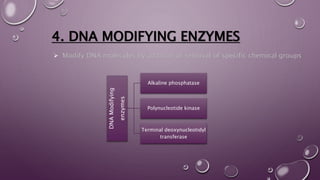
4. DNA MODIFYING ENZYMES
 Modify DNA molecules by addition or removal of specific chemical groups
DNAModifying
enzymes
Alkaline phosphatase
Polynucleotide kinase
Terminal deoxynucleotidyl
transferase
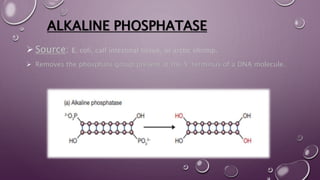
ALKALINE PHOSPHATASE
 Source: E. coli, calf intestinal tissue, or arctic shrimp.
 Removes the phosphate group present at the 5′ terminus of a DNA molecule.
POLYNUCLEOTIDE KINASE
 Source: E. coli infected with T4 phage.
 Adding phosphate groups onto free 5′ termini.
TERMINAL DEOXYNUCLEOTIDYL
TRANSFERASE
 Source: Calf thymus tissue.
 Adds one or more deoxyribonucleotides onto the 3′ terminus of a DNA
molecule.

Gene cloning steps

  • 1.
    GENE CLONING STEPS Selectionof Vector for cloning Purification of DNA Manipulation of Purified DNA Introduction of DNA into living cells
  • 2.
    MANIPULATION OF DNA DNA can be shortened, lengthened, copied into RNA or new DNA molecules and modified  DNA Manipulative techniques used are 1. Cutting 2. Joining  These techniques make use of purified enzymes  Manipulations are carried out in test tube  Provide foundations for 1. Gene Cloning 2. Studying DNA Biochemistry 3. Studies of gene expression
  • 3.
    DNA MANIPULATIVE ENZYMES 1.NUCLEASES (cut, shorten or degrade nucleic acids) 2. LIGASES (join nucleic acids) 3. POLYMERASES (make copies of molecules) 4. DNA MODIFYING ENZYMES (remove or add chemical groups)
  • 4.
    1. NUCLEASES Degrade DNAmolecules by breaking the phosphodiester bonds linking nucleotides in DNA strand.
  • 5.
    CLASSIFICATION OF NUCLEASES Nucleases Exonucleases Doublestrand degrading (Bal31) Single strand degrading (ExonucleaseIII) Endonucleases Double strand degrading (DNAaseI) Single strand degrading (S1 Nuclease) Restriction Endonuclease
  • 6.
     EXONUCLEASES Remove neucleotidesone at a time from the end of a DNA molecule.
  • 7.
    BAL31  Purified fromthe bacterium Alteromonas espejiana  removes nucleotides from both strands of a double-stranded molecule
  • 8.
     EXONUCLEASE III Purified from E. coli  degrade just one strand of a double-stranded molecule, leaving single-stranded DNA as the product
  • 9.
     ENDONUCLEASES Break internalphosphodiester bonds within a DNA molecule
  • 10.
    S1 ENDONUCLEASE Purified fromthe fungus Aspergillus oryzae and only cleaves single strands
  • 11.
    DEOXYRIBONUCLEASE I (DNASEI)  Prepared from cow pancreas  Cuts both single and double-stranded molecules  DNase I is non-specific in that it attacks DNA at any internal phosphodiester bond
  • 12.
    RESTRICTION ENDONUCLEASES  Specialgroup of enzymes  Cleave double-stranded DNA only at a limited number of specific recognition sites
  • 13.
    2. LIGASES The functionof DNA ligase is to repair single-stranded breaks (“discontinuities”) that arise in double-stranded DNA molecules
  • 14.
    3. POLYMERASES DNA polymerasesare enzymes that synthesize a new strand of DNA complementary to an existing DNA or RNA template.  Most polymerases can function only if the template possesses a double-stranded region that acts as a primer for initiation of polymerization.  Four types of DNA polymerase are used routinely in genetic engineering.
  • 15.
     DNA POLYMERASEI  Prepared from E. coli.  This enzyme attaches to a short single-stranded region (or nick) in a mainly double-stranded DNA molecule, and then synthesizes a completely new strand, degrading the existing strand as it proceeds  DNA polymerase has dual activity—DNA polymerization and DNA degradation.
  • 16.
    KLENOW FRAGMENT  Thepolymerase and nuclease activities of DNA polymerase I are controlled by different parts of the enzyme molecule.  The nuclease activity is contained in the first 323 amino acids of the polypeptide, so removal of this segment leaves a modified enzyme that retains the polymerase function but is unable to degrade DNA.  This modified enzyme, called the Klenow fragment, can still synthesize a complementary DNA strand on a single-stranded template, but as it has no nuclease activity it cannot continue the synthesis once the nick is filled in.  Major application of these polymerases is in DNA sequencing
  • 18.
    4. DNA MODIFYINGENZYMES  Modify DNA molecules by addition or removal of specific chemical groups DNAModifying enzymes Alkaline phosphatase Polynucleotide kinase Terminal deoxynucleotidyl transferase
  • 19.
    ALKALINE PHOSPHATASE  Source:E. coli, calf intestinal tissue, or arctic shrimp.  Removes the phosphate group present at the 5′ terminus of a DNA molecule.
  • 20.
    POLYNUCLEOTIDE KINASE  Source:E. coli infected with T4 phage.  Adding phosphate groups onto free 5′ termini.
  • 21.
    TERMINAL DEOXYNUCLEOTIDYL TRANSFERASE  Source:Calf thymus tissue.  Adds one or more deoxyribonucleotides onto the 3′ terminus of a DNA molecule.