GENDER
SENSITIZATI
ON Dr Amardeep Singh
School of Commerce
Manav Rachna
International Institute of
Research and Studies
Sex and
Gender
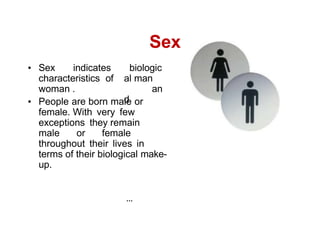
Sex indicates
characteristics of
woman .
biologic
al man
an
d
People are born male or
female. With very few
exceptions they remain
male or female
throughout their lives in
terms of their biological make-
up.
Sex
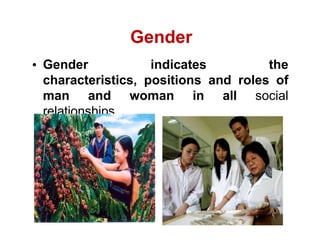
Gender indicates the
characteristics, positions and roles of
man and woman in all social
relationships.
Gender
Gender and Sex
"Sex" refers to the biological and
physiological characteristics that define men
and women.
"Gender" refers to the socially constructed
roles, behaviours, activities, and attributes
that a given society considers appropriate
for men and women.
To put it another way:
"Male" and "female" are sex categories,
while "masculine" and "feminine"
are gender categories.
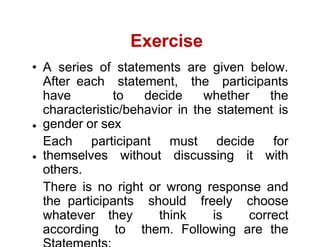
Exercise
A series of statements are given below.
After each statement, the participants
have to decide whether the
characteristic/behavior in the statement is
gender or sex
Each participant must decide for
themselves without discussing it with
others.
There is no right or wrong response and
the participants should freely choose
whatever they think is correct
according to them. Following are the
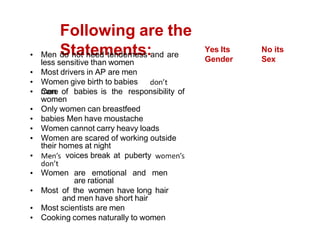
Following are the
Statements:
Men do not need tenderness and are
less sensitive than women
Most drivers in AP are men
Women give birth to babies
men
Care of babies is the responsibility of
women
Only women can breastfeed
babies Men have moustache
Women cannot carry heavy loads
Women are scared of working outside
their homes at night
voices break at puberty
Women are emotional and men
are rational
Most of the women have long hair
and men have short hair
Most scientists are men
Cooking comes naturally to women
Yes Its
Gender
No its
Sex
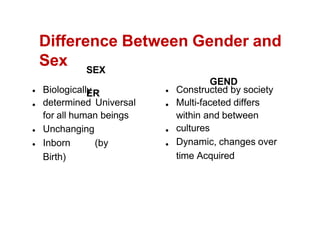
Difference Between Gender and
Sex SEX
GEND
ER Constructed by society
Multi-faceted differs
within and between
cultures
Dynamic, changes over
time Acquired
Biologically
determined Universal
for all human beings
Unchanging
Inborn (by
Birth)
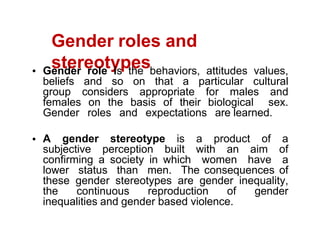
Gender roles and
stereotypes
Gender role is the behaviors, attitudes values,
beliefs and so on that a particular cultural
group considers appropriate for males and
females on the basis of their biological sex.
Gender roles and expectations are learned.
A gender stereotype is a product of a
subjective perception built with an aim of
confirming a society in which women have a
lower status than men. The consequences of
these gender stereotypes are gender inequality,
the continuous reproduction of gender
inequalities and gender based violence.
Gender Roles
Men have greater body mass and strength
and are better equipped for hunting,
warfare, and land clearing.
Women do tasks that are compatible
with pregnancy, breastfeeding, and
child care.
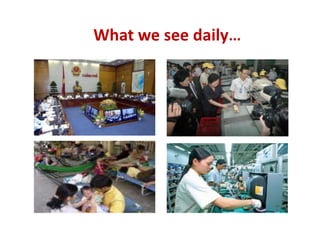
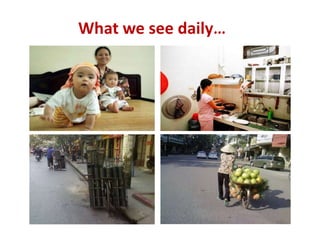
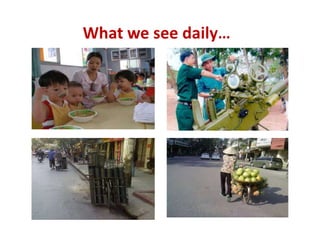
Those pictures refer to sex or gender?
Gender
What do they talk about men and women?
Their job/ what they do
Quick quizz
Refer to the activities that men and women
actually do; can be changed at a time, conditions
and situations.
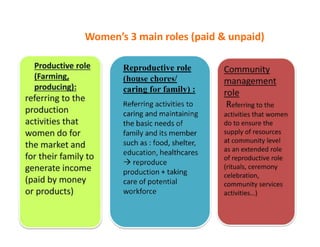
Productive roles: refers to the work of generating
income that men and women do, to make products or
services as well as process raw materials to get income.
Reproductive roles: refers to the childbirth and other
related activities, that most of the time is spent for taking
care of the family members and community, searching
fuel and water, preparing food, taking care of the child,
education and taking care of the seniors, which are
almost unpaid.
Gender
roles
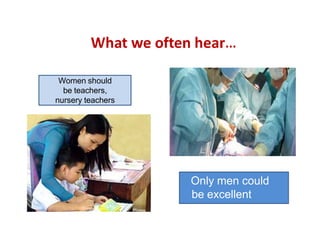
Only men could
be excellent
surgeons
Women should
be teachers,
nursery teachers
is negative and partial attitude
acknowledgement and assessment of the
characteristics, position, role and capacity of
man or woman.
Are viewpoints from others assuming that
men or women are able to do or should do,
unable to do or should not do something
Gender stereotype
In some families:
Girls cant pursue higher education/ should not be
invested in
- they are very tiny and
worthless jobs
Girls can not inherit;
In some workplaces:
Male workers should take the heavy and hazadours
jobs ( according to the list of prohibited female
workers)
those women lower wage
What do those saying
mean?
Those sayings are just prejudice or
already become specific actions?
Questio
n
is negative and partial attitude
acknowledgement and assessment of the
characteristics, position, role and capacity of
man or woman.
Are viewpoints from others assuming that
men or women are able to do or should do,
unable to do or should not do something
Gender stereotype
In some families:
Girls cant pursue higher education/ should not be
invested in
- they are very tiny and
worthless jobs
Girls can not inherit;
In some workplaces:
Male workers should take the heavy and hazadours
jobs ( according to the list of prohibited female
workers)
those women lower wage
What do those saying
mean?
Those sayings are just prejudice or
already become specific actions?
Questio
n
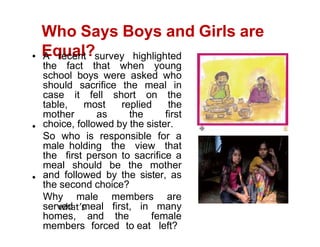
Who Says Boys and Girls are
Equal?
A recent survey highlighted
the fact that when young
school boys were asked who
should sacrifice the meal in
case it fell short on the
table, most replied the
mother as the first
choice, followed by the sister.
So who is responsible for a
male holding the view that
the first person to sacrifice a
meal should be the mother
and followed by the sister, as
the second choice?
Why male members are
served meal first, in many
homes, and the female
members forced to eat left?
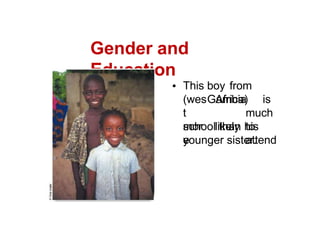
Gender and
Education
This boy from
Gambia
(wes
t
mor
e
Africa) is
much
likely to
attend
school than his
younger sister.
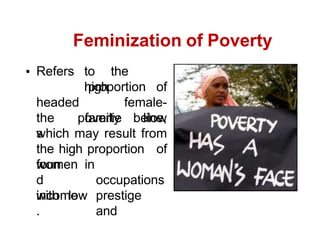
Feminization of Poverty
Refers to the
high
headed
familie
s
proportion of
female-
below
the poverty line,
which may result from
the high proportion of
women
foun
d
with
in
occupations
low prestige
and
income
.
Exploitation Caused By Gender
Ideology
Male gender bias
A preference found in some societies for
sons rather than daughters.
Female infanticide
The killing of female
children Nutritional
deprivation
A form of child abuse involving withholding
food; can retard learning, physical
development, or social adjustment.
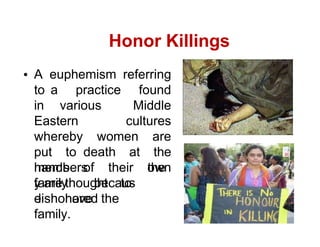
Honor Killings
A euphemism referring
to a practice found
in various Middle
Eastern cultures
whereby women are
put to death at the
hands of their own
family
members
becaus
e
the
y are thought to
have
dishonored the
family.
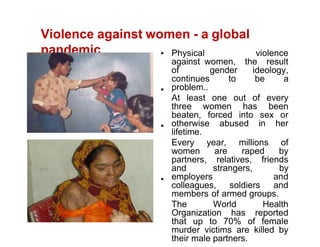
Violence against women - a global
pandemic Physical violence
against women, the result
of gender ideology,
continues to be a
problem..
At least one out of every
three women has been
beaten, forced into sex or
otherwise abused in her
lifetime.
Every year, millions of
women are raped by
partners, relatives, friends
and strangers, by
employers and
colleagues, soldiers and
members of armed groups.
The World Health
Organization has reported
that up to 70% of female
murder victims are killed by
their male partners.
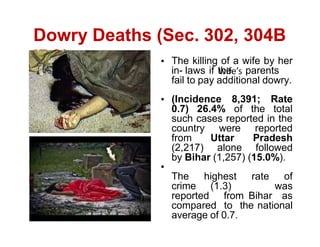
Dowry Deaths (Sec. 302, 304B
IPC) The killing of a wife by her
in- laws if the parents
fail to pay additional dowry.
(Incidence 8,391; Rate
0.7) 26.4% of the total
such cases reported in the
country were reported
from Uttar Pradesh
(2,217) alone followed
by Bihar (1,257) (15.0%).
The highest rate of
crime (1.3) was
reported from Bihar as
compared to the national
average of 0.7.
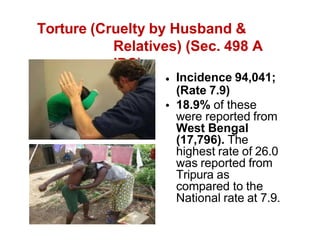
Torture (Cruelty by Husband &
Relatives) (Sec. 498 A
IPC)
Incidence 94,041;
(Rate 7.9)
18.9% of these
were reported from
West Bengal
(17,796). The
highest rate of 26.0
was reported from
Tripura as
compared to the
National rate at 7.9.
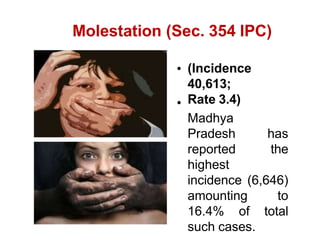
Molestation (Sec. 354 IPC)
(Incidence
40,613;
Rate 3.4)
Madhya
Pradesh has
reported the
highest
incidence (6,646)
amounting to
16.4% of total
such cases.
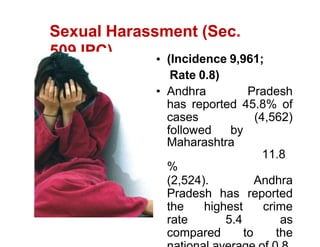
Sexual Harassment (Sec.
509 IPC) (Incidence 9,961;
Rate 0.8)
Andhra Pradesh
has reported 45.8% of
cases (4,562)
followed by
Maharashtra
11.8
%
(2,524). Andhra
Pradesh has reported
the highest crime
rate 5.4 as
compared to the
Importation of Girls (Sec. 366-B
IPC)
(Incidence 36)
36 cases
were
year
201
0
reported during the
as
compared to 48
cases in the
previous year
(2009).
Immoral Traffic (Prevention)
Act
(Incidence 2,499;
Rate 0.2)
22.7% (567)
cases were
reported from
Tamil Nadu
and
Andhra
accounte
d
Prades
h
for
21.9%
(548).
Gender
Issues
WHAT IS A GENDER
ISSUE?
A problem that arises from your being
a man or a woman
Hinders the
attainment
satisfying life
A concern of everyone
of a full
and
FAMIL
Y
Domestic
violence Multiple
burden
Family abandonment by
husband Financial abuse
Household chores assigned to
women
Incest
INDIVIDUAL
Lack of GAD awareness
Passivity/resistance to
change
Lack of awareness on reproductive
rights Low self worth
HEALTH & NUTRITION
Lack of info on Family
Planning/reproductive health
Low level of men participation in health
concerns Lack of health facilities for women
Women are prone to infectious
diseases Lack of social services
Low nutritional level of women
Responsibility of birth control lies on
women
SOCIO-CULTURAL
Commodification of women/ prostitution
Women considered as sex objects · Double-
standard of morality
Stereotyping in media, educational
system Rape
Sexual
harassment/abuse
Domestic violence
Cultural subjugation
Poor education of women
GAD awareness for students &
teachers Women viewed as the
weaker sex
Poor social life of women
Education
Low level of literacy among women
Number of girl students is considerable lower than
the number of boy students.
Even girls who do enrol in school may have
irregular attendance due to other demands on
them, and the fact that their education may not be
prioritised.
Girls are more likely to repeat years, to drop out
early and to fail in key subjects, and in most
countries girls are less likely to complete the
transition to secondary schooling
Increase in girl child labour
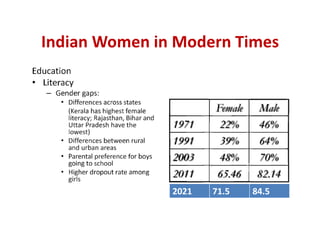
2021 71.5 84.5
Indian Women in Modern
Times
Education
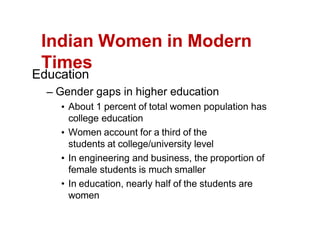
Gender gaps in higher education
About 1 percent of total women population has
college education
Women account for a third of the
students at college/university level
In engineering and business, the proportion of
female students is much smaller
In education, nearly half of the students are
women
Indian Women in Modern
Times
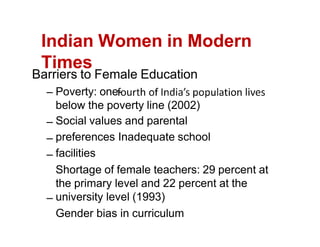
Barriers to Female Education
Poverty: one-
below the poverty line (2002)
Social values and parental
preferences Inadequate school
facilities
Shortage of female teachers: 29 percent at
the primary level and 22 percent at the
university level (1993)
Gender bias in curriculum
Indian Women in Modern
Times
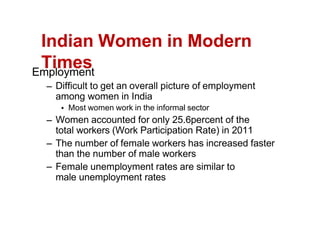
Employment
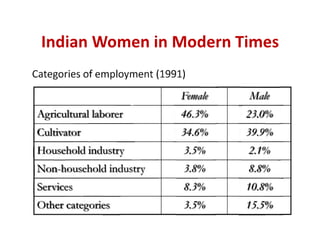
Difficult to get an overall picture of employment
among women in India
Most women work in the informal sector
Women accounted for only 25.6percent of the
total workers (Work Participation Rate) in 2011
The number of female workers has increased faster
than the number of male workers
Female unemployment rates are similar to
male unemployment rates
Indian Women in Modern
Times
Barriers to Female Employment
Cultural Restrictions
Hierarchical society (caste system)
Purdah system: the veiling and seclusion of women
Discrimination at Workplace
More prevalent in fields where male competition is
high Less prevalent in fields where competition is
low
Lack of employment opportunities
Indian Women in Modern
Times
Empowerment
Social Empowerment
Education
There is no direct relationship between education
and work force participation; but may affect their
participation in household decision making
Economic Independence:
Economic independence does not imply
significant improvement in social standing
Culture and tradition play an important role
A small fraction has opened up towards Western
values
Indian Women in Modern
Times
Economic
Empowerment
Property Rights
Patriarchal society
Economic Decision
Making
In the
household In
businesses
Indian Women in Modern
Times
Political Empowerment
Representation in democratic institutions
Government reservations policy for women:
the constitutional amendment of 1990s
The current Lok Sabha has 63 out of 543, or
11.6% women
ECONOM
IC
Unemployment/limited opportunities for
women Child Labor
Employment preferences for
women Child trafficking/slavery
Lack of credit programs for women
Women not given managerial positions
Increase burden of women due to
poverty Women's work are unseen
Insufficient funds and other
resources Inequality of fund
allocation
LEGAL/ADMIN/GOV'T
Ignorance on laws affecting women
Lack of trained personnel to handle
rape, VAW, incest
Insensitivity of judges, police
Justice system grinds
slowly Lack of focal
persons
Lack of gender planning
Poor dissemination of GAD issues
POLITICAL
Subordination from politicians/ authorities
Lack of awareness/participation of
women in decision-making
Limited participation of women in
electoral process
Gender and the legal
system
Response of Police
Personnel to increasing
Violence against Women
The police response to violence
against women continues to be grossly
inadequate and inappropriate
The cult of masculinity prevalent in
the department makes the police
officers hold some stereotypes about
violence against women
Indifferent
attitude/behaviour
towards women
The general public including women come in
contact with the policemen primarily at the police
station and lower levels.
Generally speaking, the main problems faced
by the women are indifferent and rude
behaviour of the policemen, their unhelpful
attitude and reluctance to register crime on
their complaints and lack of any promptitude
on their part to redress their grievances.
Most of them even demand bribe for taking any
action. There are also large scale complaints of
molestation of women by the policemen.
Some Stereotypes about
sexual
violence/harassment
Rape is victim-precipitated. Women ask for
rape/sexual violence by provocative mode of dress
and behaviour or by going out after dark or going to
shady and lonely places. onl
y
Women subconsciously desire
rape and when they
are caught.
Rape cannot occur if a woman resists.
place is at home. If they go out, they must
take what comes their way.
Sexual harassment at work place and eve-teasing
are fun and women enjoy it.
Male sexuality is an uncontrollable force. W omen
should not arouse it.
Standard police
response
contemplated only after a value judgement
as
Initial complaint is disbelieved and action
is
to
whether the woman is deserving of appropriate
police response.
Victim is discouraged from pursuing complaint.
Intensive bullying, callous interrogation and
aggressive and sexist questioning.
Medical examination is delayed and conducted in
unpleasant and threatening surroundings.
Victim is not supplied with basic information about
her legitimate rights and support services available
to her.
Stereotypes governing domestic
violence
Familyis a private place where men have
some legitimate rights.
Husband has a marital right to discipline his
wife. Women are irrational, nagging and
provoke men.
Only the poor/uneducated/alcoholicmales
are violent towards their wives.
Women who deviate from feminine roles of
mother and wife warrant discipline.
Standard Police
Response
Trivialisation
De-criminalization and illegitimization of domestic violence.
Non-intervention and advising the victims to seek remedies in
a civil court.
Acting as peacemakerand mediator and letting off the
male offender with mild, informal threats
Need for police to behave in a gender sensitive manner in
dealing with violence against women.
Because of the several social factors, women are more
afraid of crimes than men and fear of crime extends well
beyond the women who have themselves been victims.
Further, because of several socioeconomic factors, women
victims are differently placed than their male counterparts. In
view of the above, there is need for police to act in a gender
sensitive manner in all cases relating to violence against
women.
Response of Judges
There have been instances when
insensitive remarks were made in the
judgements about the character and
background of victims of rape and
other sexual crimes and rather
misplaced lenience shown for the accused.
The Supreme Court has taken due
note of many such instances, but there
is need to eliminate such objectionable
remarks.
High Profile
cases
On the other hand, we are stunned to read reports of sexual
exploitation of young girls by those at the highest echelons of their
profession including
Two retired judges of the Supreme Court, (earlier a Delhi High Court
Judge, who had to resign on charges of sexual misdemeanour
and corrupt practices in 2003) . The latest being the reported
resignation of an additional district judge, Gwalior, because of her
alleged sexual harassment by the administrative judge of the
Jabalpur High Court;
A minister each from Haryana and Rajasthan;
Former Director Generals of Police, Haryana (molestation of a 13
year-old- girl) and Punjab (misbehavior with a senior IAS woman
officer having sexual overtones) the latest being the alleged
sexual exploitation of a female model in Mumbai by a DIG of Police;
an all-powerful editor-in-chief of a well-known media channel, known
for sting operations exposing high and mighty; a self-proclaimed
septuagenarian godman with lakhs of followers and another self-
proclaimed young godman operating in south India.
Gender Bias in Media
Globalisation, Opening of markets and
the comodification of women
Change in the structure of Indian media -
increase in advertising, revenue, cut throat
competition between multinational companies
and the direct targeting on women &
children as consumers through T.V.
programmes.
Gender bias in print and visual
media Misrepresentation of
women
Misleading
Advertisements
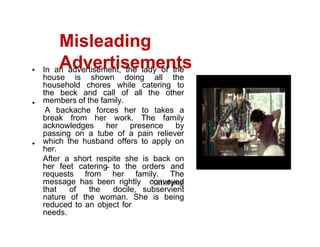
In an advertisement, the lady of the
house is shown doing all the
household chores while catering to
the beck and call of all the other
members of the family.
A backache forces her to takes a
break from her work. The family
acknowledges her presence by
passing on a tube of a pain reliever
which the husband offers to apply on
her.
After a short respite she is back on
her feet catering to the orders and
requests from her family. The
message has been rightly conveyed
that of the docile, subservient
nature of the woman. She is being
reduced to an object for
needs.
Poor portrayal of Women
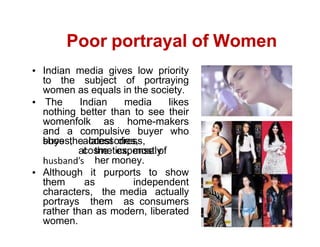
Indian media gives low priority
to the subject of portraying
women as equals in the society.
The Indian media likes
nothing better than to see their
womenfolk as home-makers
and a compulsive buyer who
buys the latest dress,
shoes, accessories,
cosmetics, mostly
at the expense of
her money.
Although it purports to show
them as independent
characters, the media actually
portrays them as consumers
rather than as modern, liberated
women.
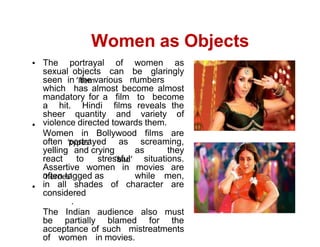
Women as Objects
The portrayal of women as
sexual objects can be glaringly
seen in the various numbers
which has almost become almost
mandatory for a film to become
a hit. Hindi films reveals the
sheer quantity and variety of
violence directed towards them.
Women in Bollywood films are
often portrayed as screaming,
yelling and crying as they
react to stressful situations.
Assertive women in movies are
often tagged as while men,
in all shades of character are
considered
.
The Indian audience also must
be partially blamed for the
acceptance of such mistreatments
of women in movies.
Differential treatment of
Women
Even in interviews, there is differential treatment for women.
Men giving interviews are often made to elaborate on their work
and their marital status or their dress sense remains irrelevant.
Women achievers on the other hand are subject to irrelevant
and distasteful queries - details of her looks, her private life and
such trivia as her fondness for beautiful sarees, her decision
to stay single or otherwise is scrutinized.
According to the media, a successful woman somehow is a
feminist. When Phoolan Devi was once interviewed, she was first
shown serving food to her husband.
Men give most of opinion on exit polls during elections. They
were also the ones whose opinions mattered the most on
the issue of reservation of seats for women in Panchayats.
Women, whose future they were deciding, sat as silent
spectators.
Differential treatment of
Women
Media influences the social image and the self-image of
women. Media affects the choices they make, what they eat
and what they wear. It influences their behavioral attitude,
their learning process, and ultimately what they become.
Media has clearly discouraged the emergence of a new
confident, assertive woman. Such differential media treatment
increases their isolation, disempowers them, weakens them.
They remain unheard, unrepresented and incommunicable.
The portrayal of woman in the print media is quite degrading
more often than not depicting her as commercial
commodity. It is necessary that public should be motivated
and sensitized to the issue of criminalization, politicization,
and commercialization of women vis-à-vis their projection in
the media in a healthy manner
Media to do away with
stereotyping
Advertisements, they say reflects the prevailing
trends in the society.
A UNESCO report lists the words women are
described in the media: glamorous sex kitten,
the sainted mother, the devious witch, the hard-faced
corporate and political climber.
The report of 2009, fears that given the current
rate at which stereotyping of women take place, it
would take another 75 years to achieve gender
equality in the media!
Gender sensitization of the Indian has to be made
on a priority basis. Mere reporting of facts and figures
would not help in bridging gender differences. It
should play a proactive role in inculcating gender
sensitivity and ensure that women are not depicted in
poor light.
Gender
Sensitization
What is Gender
Sensitization?
Gender sensitization refers to the
modification of behaviour by raising awareness
of gender equality concerns.
Gender sensitizing "is about changing behavior
and instilling empathy into the views that we
hold about our own and the other gender.
It helps people in "examining their personal
attitudes and beliefs and questioning the 'realities'
they thought they know.
Gender sensitization is about making people
aware of the need to bring about a quantum
change in our mindset which sees man as
the bread winner and woman as the house
keeper.
Why Gender
Sensitization?
Gender sensitivity helps to generate respect for
the individual regardless of sex.
Gender sensitivity is not about pitting women
against men. On the contrary , education
that is gender sensitive benefits members of
both sexes.
It helps them determine which assumptions in
matters of gender are valid and which are
stereotyped generalizations.
Gender awareness requires not only intellectual
effort but also sensitivity and open mindedness. It
opens up the widest possible range of life
options for both women and men.
Why Is Gender Sensitivity
Training at Workplace is
Important?
The contemporary workplace is very diverse
and is becoming more so every day.
Employees need to understand, be sensitive,
and be able to adapt to the various needs,
concerns, and characteristics of a multitude of
different people including women.
Gender Sensitivity training will help
employees to personally cultivate good
interpersonal relationships with members of
their team and help facilitate respective and
productive group relations among team members.
It helps to develop a cordial and amiable
working environment where there is mutual
respect and trust between the sexes, without
sexual innuendoes and obstructive chauvinism to
mar the atmosphere.
Objective Gender Sensitivity
Training
The primary objective of gender
sensitivity training is to educate you
and the other participants about the
needs and concerns of women for more
constructive behavior that will be
beneficial to you and everyone else in the
organization.
It helps an individual by providing insight
into your behavior and helps you
develop corrective emotional and
behavioral actions.
Moral Values should start from
home
A society can only be progressive if we
recognize that it comprises both male and female
members of equal value This is not an issue of who
plays what role. Roles can differ
from society to society but what is universal is the fact
that both males and females have equal relevance
and all our decisions and actions that influence our
lives must be in the backdrop of gender equality.
It is time we opened ourselves to introspection
and recognize the fact that we are a gender biased
society, at all levels, and that we must begin to focus
on the values of gender parity in our homes.
This is where the first step to being a progressive
citizen begins. There can be no better place for moral
and ethical education than home and the best student
for the same is a child, for he or she is completely
open to learning what is taught and practiced at home.
Importance of Gender
sensitization
Gender sensitivity helps to generate respect for
individual irrespective of sex
It also indicates the many challenges that remain in order to
close gender gaps, promote equality in education,
employment and other spheres of work and family
According to modern trends, men and women are equally
active players in the family, community, and national affairs.
Women must be recognized as representing half of the
world's most precious resources called human beings.
Employers should commit to equal employment
opportunity at workplace and management should not
distinguish people on the on the basis of sex. For all
management purposes, both men and women are gifted with
the ability to work with diligence
Managements must sensitize employees for gender
sensitivity to prevent or minimize issues connected with
sexual harassment that is illegal and train employees to be
more vocal and how to say no to such advances firmly
What is Sexual
Harassment?
Sexual harassment occurs when a woman
despite having clearly indicated her disinterest,
is pressured into tolerating or accepting
undesirable sexual advances by someone who
is in a position of power over her and is able
to harm her interests if she declines to tolerate
these advances.
If a boss or a colleague repeatedly makes
sexual propositions to a woman employee day
after day, with or without any physical
overtures, despite her repeatedly indicating
that she finds his advances offensive, he
can be rightly accused of sexual
harassment.
Sexual Harassment at
Workplace
Although such extreme conditions are
not prevalent in government offices,
cases of sexual harassment have been
reported time and again.
measurestaken by the
government
Job security , conduct rules and other
have
gone a long way in curbing sexual
harassment in workplaces meant
for government employees
Steps taken to curb sexual
harassment
Conduct unbecoming of a government
servant New provisions in conduct rules
Case of Vishakha v/s State of Jaipur
Supreme court guidelines issued in
1997-the basis of new provisions in CCS
(Conduct) Rules.
Rule 3 (C) of CCS Rules
Rule 3(C) concerns the prohibition of sexual
harassment of working women
Enjoins the Government servant
not to indulge in any act of sexual harassment of
any women in the workplace
in-charge of a workplace to take appropriate steps
to prevent sexual harassment to any woman at
such work
Sexual Harassment at
Workplace - Provisions in
CCS (Conduct Rules)
Sexual harassment defined to
include such
unwelcome sexually determined
behaviour (whether directly or by
implication) as:
physical contact and advances;
a demand or request for sexual favours;
sexually coloured
remarks; showing
pornography;
any other unwelcome physical, verbal or
non- verbal conduct of sexual nature.
Steps to be taken by the
Employer
Duty of the employer to prevent or deter
the commission of acts of sexual
harassment and to provide for the
resolution, settlement or prosecution of
acts of sexual harassment
Criminal proceedings to be initiated
in appropriate cases
Where such conduct amounts to
misconduct, appropriate disciplinary action
to be initiated by the employer
Gender Sensitisation Introduction-1.pptx

Gender Sensitisation Introduction-1.pptx

  • 1.
    GENDER SENSITIZATI ON Dr AmardeepSingh School of Commerce Manav Rachna International Institute of Research and Studies
  • 2.
  • 3.
    Sex indicates characteristics of woman. biologic al man an d People are born male or female. With very few exceptions they remain male or female throughout their lives in terms of their biological make- up. Sex
  • 4.
    Gender indicates the characteristics,positions and roles of man and woman in all social relationships. Gender
  • 5.
    Gender and Sex "Sex"refers to the biological and physiological characteristics that define men and women. "Gender" refers to the socially constructed roles, behaviours, activities, and attributes that a given society considers appropriate for men and women. To put it another way: "Male" and "female" are sex categories, while "masculine" and "feminine" are gender categories.
  • 6.
    Exercise A series ofstatements are given below. After each statement, the participants have to decide whether the characteristic/behavior in the statement is gender or sex Each participant must decide for themselves without discussing it with others. There is no right or wrong response and the participants should freely choose whatever they think is correct according to them. Following are the
  • 7.
    Following are the Statements: Mendo not need tenderness and are less sensitive than women Most drivers in AP are men Women give birth to babies men Care of babies is the responsibility of women Only women can breastfeed babies Men have moustache Women cannot carry heavy loads Women are scared of working outside their homes at night voices break at puberty Women are emotional and men are rational Most of the women have long hair and men have short hair Most scientists are men Cooking comes naturally to women Yes Its Gender No its Sex
  • 8.
    Difference Between Genderand Sex SEX GEND ER Constructed by society Multi-faceted differs within and between cultures Dynamic, changes over time Acquired Biologically determined Universal for all human beings Unchanging Inborn (by Birth)
  • 9.
    Gender roles and stereotypes Genderrole is the behaviors, attitudes values, beliefs and so on that a particular cultural group considers appropriate for males and females on the basis of their biological sex. Gender roles and expectations are learned. A gender stereotype is a product of a subjective perception built with an aim of confirming a society in which women have a lower status than men. The consequences of these gender stereotypes are gender inequality, the continuous reproduction of gender inequalities and gender based violence.
  • 10.
    Gender Roles Men havegreater body mass and strength and are better equipped for hunting, warfare, and land clearing. Women do tasks that are compatible with pregnancy, breastfeeding, and child care.
  • 14.
    Those pictures referto sex or gender? Gender What do they talk about men and women? Their job/ what they do Quick quizz
  • 15.
    Refer to theactivities that men and women actually do; can be changed at a time, conditions and situations. Productive roles: refers to the work of generating income that men and women do, to make products or services as well as process raw materials to get income. Reproductive roles: refers to the childbirth and other related activities, that most of the time is spent for taking care of the family members and community, searching fuel and water, preparing food, taking care of the child, education and taking care of the seniors, which are almost unpaid. Gender roles
  • 17.
    Only men could beexcellent surgeons Women should be teachers, nursery teachers
  • 18.
    is negative andpartial attitude acknowledgement and assessment of the characteristics, position, role and capacity of man or woman. Are viewpoints from others assuming that men or women are able to do or should do, unable to do or should not do something Gender stereotype
  • 19.
    In some families: Girlscant pursue higher education/ should not be invested in - they are very tiny and worthless jobs Girls can not inherit; In some workplaces: Male workers should take the heavy and hazadours jobs ( according to the list of prohibited female workers) those women lower wage What do those saying mean?
  • 20.
    Those sayings arejust prejudice or already become specific actions? Questio n
  • 21.
    is negative andpartial attitude acknowledgement and assessment of the characteristics, position, role and capacity of man or woman. Are viewpoints from others assuming that men or women are able to do or should do, unable to do or should not do something Gender stereotype
  • 22.
    In some families: Girlscant pursue higher education/ should not be invested in - they are very tiny and worthless jobs Girls can not inherit; In some workplaces: Male workers should take the heavy and hazadours jobs ( according to the list of prohibited female workers) those women lower wage What do those saying mean?
  • 23.
    Those sayings arejust prejudice or already become specific actions? Questio n
  • 24.
    Who Says Boysand Girls are Equal? A recent survey highlighted the fact that when young school boys were asked who should sacrifice the meal in case it fell short on the table, most replied the mother as the first choice, followed by the sister. So who is responsible for a male holding the view that the first person to sacrifice a meal should be the mother and followed by the sister, as the second choice? Why male members are served meal first, in many homes, and the female members forced to eat left?
  • 25.
    Gender and Education This boyfrom Gambia (wes t mor e Africa) is much likely to attend school than his younger sister.
  • 26.
    Feminization of Poverty Refersto the high headed familie s proportion of female- below the poverty line, which may result from the high proportion of women foun d with in occupations low prestige and income .
  • 27.
    Exploitation Caused ByGender Ideology Male gender bias A preference found in some societies for sons rather than daughters. Female infanticide The killing of female children Nutritional deprivation A form of child abuse involving withholding food; can retard learning, physical development, or social adjustment.
  • 28.
    Honor Killings A euphemismreferring to a practice found in various Middle Eastern cultures whereby women are put to death at the hands of their own family members becaus e the y are thought to have dishonored the family.
  • 29.
    Violence against women- a global pandemic Physical violence against women, the result of gender ideology, continues to be a problem.. At least one out of every three women has been beaten, forced into sex or otherwise abused in her lifetime. Every year, millions of women are raped by partners, relatives, friends and strangers, by employers and colleagues, soldiers and members of armed groups. The World Health Organization has reported that up to 70% of female murder victims are killed by their male partners.
  • 30.
    Dowry Deaths (Sec.302, 304B IPC) The killing of a wife by her in- laws if the parents fail to pay additional dowry. (Incidence 8,391; Rate 0.7) 26.4% of the total such cases reported in the country were reported from Uttar Pradesh (2,217) alone followed by Bihar (1,257) (15.0%). The highest rate of crime (1.3) was reported from Bihar as compared to the national average of 0.7.
  • 31.
    Torture (Cruelty byHusband & Relatives) (Sec. 498 A IPC) Incidence 94,041; (Rate 7.9) 18.9% of these were reported from West Bengal (17,796). The highest rate of 26.0 was reported from Tripura as compared to the National rate at 7.9.
  • 32.
    Molestation (Sec. 354IPC) (Incidence 40,613; Rate 3.4) Madhya Pradesh has reported the highest incidence (6,646) amounting to 16.4% of total such cases.
  • 33.
    Sexual Harassment (Sec. 509IPC) (Incidence 9,961; Rate 0.8) Andhra Pradesh has reported 45.8% of cases (4,562) followed by Maharashtra 11.8 % (2,524). Andhra Pradesh has reported the highest crime rate 5.4 as compared to the
  • 34.
    Importation of Girls(Sec. 366-B IPC) (Incidence 36) 36 cases were year 201 0 reported during the as compared to 48 cases in the previous year (2009).
  • 35.
    Immoral Traffic (Prevention) Act (Incidence2,499; Rate 0.2) 22.7% (567) cases were reported from Tamil Nadu and Andhra accounte d Prades h for 21.9% (548).
  • 36.
  • 37.
    WHAT IS AGENDER ISSUE? A problem that arises from your being a man or a woman Hinders the attainment satisfying life A concern of everyone of a full and
  • 38.
    FAMIL Y Domestic violence Multiple burden Family abandonmentby husband Financial abuse Household chores assigned to women Incest
  • 39.
    INDIVIDUAL Lack of GADawareness Passivity/resistance to change Lack of awareness on reproductive rights Low self worth
  • 40.
    HEALTH & NUTRITION Lackof info on Family Planning/reproductive health Low level of men participation in health concerns Lack of health facilities for women Women are prone to infectious diseases Lack of social services Low nutritional level of women Responsibility of birth control lies on women
  • 41.
    SOCIO-CULTURAL Commodification of women/prostitution Women considered as sex objects · Double- standard of morality Stereotyping in media, educational system Rape Sexual harassment/abuse Domestic violence Cultural subjugation Poor education of women GAD awareness for students & teachers Women viewed as the weaker sex Poor social life of women
  • 42.
    Education Low level ofliteracy among women Number of girl students is considerable lower than the number of boy students. Even girls who do enrol in school may have irregular attendance due to other demands on them, and the fact that their education may not be prioritised. Girls are more likely to repeat years, to drop out early and to fail in key subjects, and in most countries girls are less likely to complete the transition to secondary schooling Increase in girl child labour
  • 43.
  • 44.
    Indian Women inModern Times Education Gender gaps in higher education About 1 percent of total women population has college education Women account for a third of the students at college/university level In engineering and business, the proportion of female students is much smaller In education, nearly half of the students are women
  • 45.
    Indian Women inModern Times Barriers to Female Education Poverty: one- below the poverty line (2002) Social values and parental preferences Inadequate school facilities Shortage of female teachers: 29 percent at the primary level and 22 percent at the university level (1993) Gender bias in curriculum
  • 46.
    Indian Women inModern Times Employment Difficult to get an overall picture of employment among women in India Most women work in the informal sector Women accounted for only 25.6percent of the total workers (Work Participation Rate) in 2011 The number of female workers has increased faster than the number of male workers Female unemployment rates are similar to male unemployment rates
  • 48.
    Indian Women inModern Times Barriers to Female Employment Cultural Restrictions Hierarchical society (caste system) Purdah system: the veiling and seclusion of women Discrimination at Workplace More prevalent in fields where male competition is high Less prevalent in fields where competition is low Lack of employment opportunities
  • 49.
    Indian Women inModern Times Empowerment Social Empowerment Education There is no direct relationship between education and work force participation; but may affect their participation in household decision making Economic Independence: Economic independence does not imply significant improvement in social standing Culture and tradition play an important role A small fraction has opened up towards Western values
  • 50.
    Indian Women inModern Times Economic Empowerment Property Rights Patriarchal society Economic Decision Making In the household In businesses
  • 51.
    Indian Women inModern Times Political Empowerment Representation in democratic institutions Government reservations policy for women: the constitutional amendment of 1990s The current Lok Sabha has 63 out of 543, or 11.6% women
  • 52.
    ECONOM IC Unemployment/limited opportunities for womenChild Labor Employment preferences for women Child trafficking/slavery Lack of credit programs for women Women not given managerial positions Increase burden of women due to poverty Women's work are unseen Insufficient funds and other resources Inequality of fund allocation
  • 53.
    LEGAL/ADMIN/GOV'T Ignorance on lawsaffecting women Lack of trained personnel to handle rape, VAW, incest Insensitivity of judges, police Justice system grinds slowly Lack of focal persons Lack of gender planning Poor dissemination of GAD issues
  • 54.
    POLITICAL Subordination from politicians/authorities Lack of awareness/participation of women in decision-making Limited participation of women in electoral process
  • 55.
    Gender and thelegal system
  • 56.
    Response of Police Personnelto increasing Violence against Women The police response to violence against women continues to be grossly inadequate and inappropriate The cult of masculinity prevalent in the department makes the police officers hold some stereotypes about violence against women
  • 57.
    Indifferent attitude/behaviour towards women The generalpublic including women come in contact with the policemen primarily at the police station and lower levels. Generally speaking, the main problems faced by the women are indifferent and rude behaviour of the policemen, their unhelpful attitude and reluctance to register crime on their complaints and lack of any promptitude on their part to redress their grievances. Most of them even demand bribe for taking any action. There are also large scale complaints of molestation of women by the policemen.
  • 58.
    Some Stereotypes about sexual violence/harassment Rapeis victim-precipitated. Women ask for rape/sexual violence by provocative mode of dress and behaviour or by going out after dark or going to shady and lonely places. onl y Women subconsciously desire rape and when they are caught. Rape cannot occur if a woman resists. place is at home. If they go out, they must take what comes their way. Sexual harassment at work place and eve-teasing are fun and women enjoy it. Male sexuality is an uncontrollable force. W omen should not arouse it.
  • 59.
    Standard police response contemplated onlyafter a value judgement as Initial complaint is disbelieved and action is to whether the woman is deserving of appropriate police response. Victim is discouraged from pursuing complaint. Intensive bullying, callous interrogation and aggressive and sexist questioning. Medical examination is delayed and conducted in unpleasant and threatening surroundings. Victim is not supplied with basic information about her legitimate rights and support services available to her.
  • 60.
    Stereotypes governing domestic violence Familyisa private place where men have some legitimate rights. Husband has a marital right to discipline his wife. Women are irrational, nagging and provoke men. Only the poor/uneducated/alcoholicmales are violent towards their wives. Women who deviate from feminine roles of mother and wife warrant discipline.
  • 61.
    Standard Police Response Trivialisation De-criminalization andillegitimization of domestic violence. Non-intervention and advising the victims to seek remedies in a civil court. Acting as peacemakerand mediator and letting off the male offender with mild, informal threats Need for police to behave in a gender sensitive manner in dealing with violence against women. Because of the several social factors, women are more afraid of crimes than men and fear of crime extends well beyond the women who have themselves been victims. Further, because of several socioeconomic factors, women victims are differently placed than their male counterparts. In view of the above, there is need for police to act in a gender sensitive manner in all cases relating to violence against women.
  • 62.
    Response of Judges Therehave been instances when insensitive remarks were made in the judgements about the character and background of victims of rape and other sexual crimes and rather misplaced lenience shown for the accused. The Supreme Court has taken due note of many such instances, but there is need to eliminate such objectionable remarks.
  • 63.
    High Profile cases On theother hand, we are stunned to read reports of sexual exploitation of young girls by those at the highest echelons of their profession including Two retired judges of the Supreme Court, (earlier a Delhi High Court Judge, who had to resign on charges of sexual misdemeanour and corrupt practices in 2003) . The latest being the reported resignation of an additional district judge, Gwalior, because of her alleged sexual harassment by the administrative judge of the Jabalpur High Court; A minister each from Haryana and Rajasthan; Former Director Generals of Police, Haryana (molestation of a 13 year-old- girl) and Punjab (misbehavior with a senior IAS woman officer having sexual overtones) the latest being the alleged sexual exploitation of a female model in Mumbai by a DIG of Police; an all-powerful editor-in-chief of a well-known media channel, known for sting operations exposing high and mighty; a self-proclaimed septuagenarian godman with lakhs of followers and another self- proclaimed young godman operating in south India.
  • 64.
    Gender Bias inMedia Globalisation, Opening of markets and the comodification of women Change in the structure of Indian media - increase in advertising, revenue, cut throat competition between multinational companies and the direct targeting on women & children as consumers through T.V. programmes. Gender bias in print and visual media Misrepresentation of women
  • 65.
    Misleading Advertisements In an advertisement,the lady of the house is shown doing all the household chores while catering to the beck and call of all the other members of the family. A backache forces her to takes a break from her work. The family acknowledges her presence by passing on a tube of a pain reliever which the husband offers to apply on her. After a short respite she is back on her feet catering to the orders and requests from her family. The message has been rightly conveyed that of the docile, subservient nature of the woman. She is being reduced to an object for needs.
  • 66.
    Poor portrayal ofWomen Indian media gives low priority to the subject of portraying women as equals in the society. The Indian media likes nothing better than to see their womenfolk as home-makers and a compulsive buyer who buys the latest dress, shoes, accessories, cosmetics, mostly at the expense of her money. Although it purports to show them as independent characters, the media actually portrays them as consumers rather than as modern, liberated women.
  • 67.
    Women as Objects Theportrayal of women as sexual objects can be glaringly seen in the various numbers which has almost become almost mandatory for a film to become a hit. Hindi films reveals the sheer quantity and variety of violence directed towards them. Women in Bollywood films are often portrayed as screaming, yelling and crying as they react to stressful situations. Assertive women in movies are often tagged as while men, in all shades of character are considered . The Indian audience also must be partially blamed for the acceptance of such mistreatments of women in movies.
  • 68.
    Differential treatment of Women Evenin interviews, there is differential treatment for women. Men giving interviews are often made to elaborate on their work and their marital status or their dress sense remains irrelevant. Women achievers on the other hand are subject to irrelevant and distasteful queries - details of her looks, her private life and such trivia as her fondness for beautiful sarees, her decision to stay single or otherwise is scrutinized. According to the media, a successful woman somehow is a feminist. When Phoolan Devi was once interviewed, she was first shown serving food to her husband. Men give most of opinion on exit polls during elections. They were also the ones whose opinions mattered the most on the issue of reservation of seats for women in Panchayats. Women, whose future they were deciding, sat as silent spectators.
  • 69.
    Differential treatment of Women Mediainfluences the social image and the self-image of women. Media affects the choices they make, what they eat and what they wear. It influences their behavioral attitude, their learning process, and ultimately what they become. Media has clearly discouraged the emergence of a new confident, assertive woman. Such differential media treatment increases their isolation, disempowers them, weakens them. They remain unheard, unrepresented and incommunicable. The portrayal of woman in the print media is quite degrading more often than not depicting her as commercial commodity. It is necessary that public should be motivated and sensitized to the issue of criminalization, politicization, and commercialization of women vis-à-vis their projection in the media in a healthy manner
  • 70.
    Media to doaway with stereotyping Advertisements, they say reflects the prevailing trends in the society. A UNESCO report lists the words women are described in the media: glamorous sex kitten, the sainted mother, the devious witch, the hard-faced corporate and political climber. The report of 2009, fears that given the current rate at which stereotyping of women take place, it would take another 75 years to achieve gender equality in the media! Gender sensitization of the Indian has to be made on a priority basis. Mere reporting of facts and figures would not help in bridging gender differences. It should play a proactive role in inculcating gender sensitivity and ensure that women are not depicted in poor light.
  • 71.
  • 72.
    What is Gender Sensitization? Gendersensitization refers to the modification of behaviour by raising awareness of gender equality concerns. Gender sensitizing "is about changing behavior and instilling empathy into the views that we hold about our own and the other gender. It helps people in "examining their personal attitudes and beliefs and questioning the 'realities' they thought they know. Gender sensitization is about making people aware of the need to bring about a quantum change in our mindset which sees man as the bread winner and woman as the house keeper.
  • 73.
    Why Gender Sensitization? Gender sensitivityhelps to generate respect for the individual regardless of sex. Gender sensitivity is not about pitting women against men. On the contrary , education that is gender sensitive benefits members of both sexes. It helps them determine which assumptions in matters of gender are valid and which are stereotyped generalizations. Gender awareness requires not only intellectual effort but also sensitivity and open mindedness. It opens up the widest possible range of life options for both women and men.
  • 74.
    Why Is GenderSensitivity Training at Workplace is Important? The contemporary workplace is very diverse and is becoming more so every day. Employees need to understand, be sensitive, and be able to adapt to the various needs, concerns, and characteristics of a multitude of different people including women. Gender Sensitivity training will help employees to personally cultivate good interpersonal relationships with members of their team and help facilitate respective and productive group relations among team members. It helps to develop a cordial and amiable working environment where there is mutual respect and trust between the sexes, without sexual innuendoes and obstructive chauvinism to mar the atmosphere.
  • 75.
    Objective Gender Sensitivity Training Theprimary objective of gender sensitivity training is to educate you and the other participants about the needs and concerns of women for more constructive behavior that will be beneficial to you and everyone else in the organization. It helps an individual by providing insight into your behavior and helps you develop corrective emotional and behavioral actions.
  • 76.
    Moral Values shouldstart from home A society can only be progressive if we recognize that it comprises both male and female members of equal value This is not an issue of who plays what role. Roles can differ from society to society but what is universal is the fact that both males and females have equal relevance and all our decisions and actions that influence our lives must be in the backdrop of gender equality. It is time we opened ourselves to introspection and recognize the fact that we are a gender biased society, at all levels, and that we must begin to focus on the values of gender parity in our homes. This is where the first step to being a progressive citizen begins. There can be no better place for moral and ethical education than home and the best student for the same is a child, for he or she is completely open to learning what is taught and practiced at home.
  • 77.
    Importance of Gender sensitization Gendersensitivity helps to generate respect for individual irrespective of sex It also indicates the many challenges that remain in order to close gender gaps, promote equality in education, employment and other spheres of work and family According to modern trends, men and women are equally active players in the family, community, and national affairs. Women must be recognized as representing half of the world's most precious resources called human beings. Employers should commit to equal employment opportunity at workplace and management should not distinguish people on the on the basis of sex. For all management purposes, both men and women are gifted with the ability to work with diligence Managements must sensitize employees for gender sensitivity to prevent or minimize issues connected with sexual harassment that is illegal and train employees to be more vocal and how to say no to such advances firmly
  • 78.
    What is Sexual Harassment? Sexualharassment occurs when a woman despite having clearly indicated her disinterest, is pressured into tolerating or accepting undesirable sexual advances by someone who is in a position of power over her and is able to harm her interests if she declines to tolerate these advances. If a boss or a colleague repeatedly makes sexual propositions to a woman employee day after day, with or without any physical overtures, despite her repeatedly indicating that she finds his advances offensive, he can be rightly accused of sexual harassment.
  • 79.
    Sexual Harassment at Workplace Althoughsuch extreme conditions are not prevalent in government offices, cases of sexual harassment have been reported time and again. measurestaken by the government Job security , conduct rules and other have gone a long way in curbing sexual harassment in workplaces meant for government employees
  • 80.
    Steps taken tocurb sexual harassment Conduct unbecoming of a government servant New provisions in conduct rules Case of Vishakha v/s State of Jaipur Supreme court guidelines issued in 1997-the basis of new provisions in CCS (Conduct) Rules.
  • 81.
    Rule 3 (C)of CCS Rules Rule 3(C) concerns the prohibition of sexual harassment of working women Enjoins the Government servant not to indulge in any act of sexual harassment of any women in the workplace in-charge of a workplace to take appropriate steps to prevent sexual harassment to any woman at such work
  • 82.
    Sexual Harassment at Workplace- Provisions in CCS (Conduct Rules) Sexual harassment defined to include such unwelcome sexually determined behaviour (whether directly or by implication) as: physical contact and advances; a demand or request for sexual favours; sexually coloured remarks; showing pornography; any other unwelcome physical, verbal or non- verbal conduct of sexual nature.
  • 83.
    Steps to betaken by the Employer Duty of the employer to prevent or deter the commission of acts of sexual harassment and to provide for the resolution, settlement or prosecution of acts of sexual harassment Criminal proceedings to be initiated in appropriate cases Where such conduct amounts to misconduct, appropriate disciplinary action to be initiated by the employer