Agenda
1
2
3
4
5
Welcome & Introduction– Sandra Andraka, UNDP FACS Community
Recap of Course 1 & 2 – Patricia Kristjanson, World Bank Folur Global Platform
Gender & Value Chain Issues and Opportunities – Erika Valerio, FAO
Focus on increasing women’s participation in value chains – Sara M. Seavey & Jyoti Dar, IFC
6
FOLUR Country Project Examples – Agustela Nini-Pavli, UNDP
Insights on relevant gender-related activities for value chains and farmer support in FOLUR Country Projects
– Wiene Andriyana, UNDP Indonesia; Florencia Cicchini, CONECTA México; Léonie Niyonkuru, PRRPB Burundi
7 Wrap-up & Closure – Sandra Andraka, UNDP FACS Community
3.
Gender & Commodity
ValueChains
Mar, 2023
P. Kristjanson/ FOLUR Gender Lead, WB
Course 3, Gender Learning Program - Food Systems, Land Use
& Restoration (FOLUR) Impact Program
4.
Recap – Course1: Gender and Integrated
landscape/landuse management
UNDP (Andrea Aguilar) – Why consider gender equality in
ILM/Restoration projects? What gender inequalities exist;
different roles, experiences, rights, barriers facing women and
men and different social groups. Examine Social Landscapes!
Gender in ILM projects–Recognize; Address Inequalities;
Generate Opportunities
World Bank (Patti Kristjanson) – FOLUR Country Project
examples – Getting beyond REACH to BENEFIT, EMPOWER
and TRANSFORM
Project experiences: Edith Martinez, UNDP Honduras –
strengthening women’s coffee groups; linking to buyers
Juliana Gil Ortiz, UNDP – Costa Rica & Panama –
empowering women’s production units, biofactories led by
women
Ivy Lomotey – EPA, Ghana – women and youth empowered
in Community Resource Management Groups
Recap Course 2:Gender & Forest
Landscape Restoration
FLR: Planned processes that aim to regain
ecological integrity and enhance wellbeing in
deforested and degraded landscapes.
Issue: power imbalances often limit women’s and
Indigenous people’s participation in – and benefits
from – FLR processes and actions.
Decisions include what species to introduce in a
degraded landscape and what areas to prioritize for
restoration, for example.
Solution: inclusive participatory processes that
address the different interests of community
members, who rely on distinct tree species or
varieties and use their gender-specific skills to
manage and use them.
Basnett et al., 2017. CIFOR. Gender matters in
Forest Landscape Restoration: A framework for design
and evaluation - CIFOR Knowledge
7.
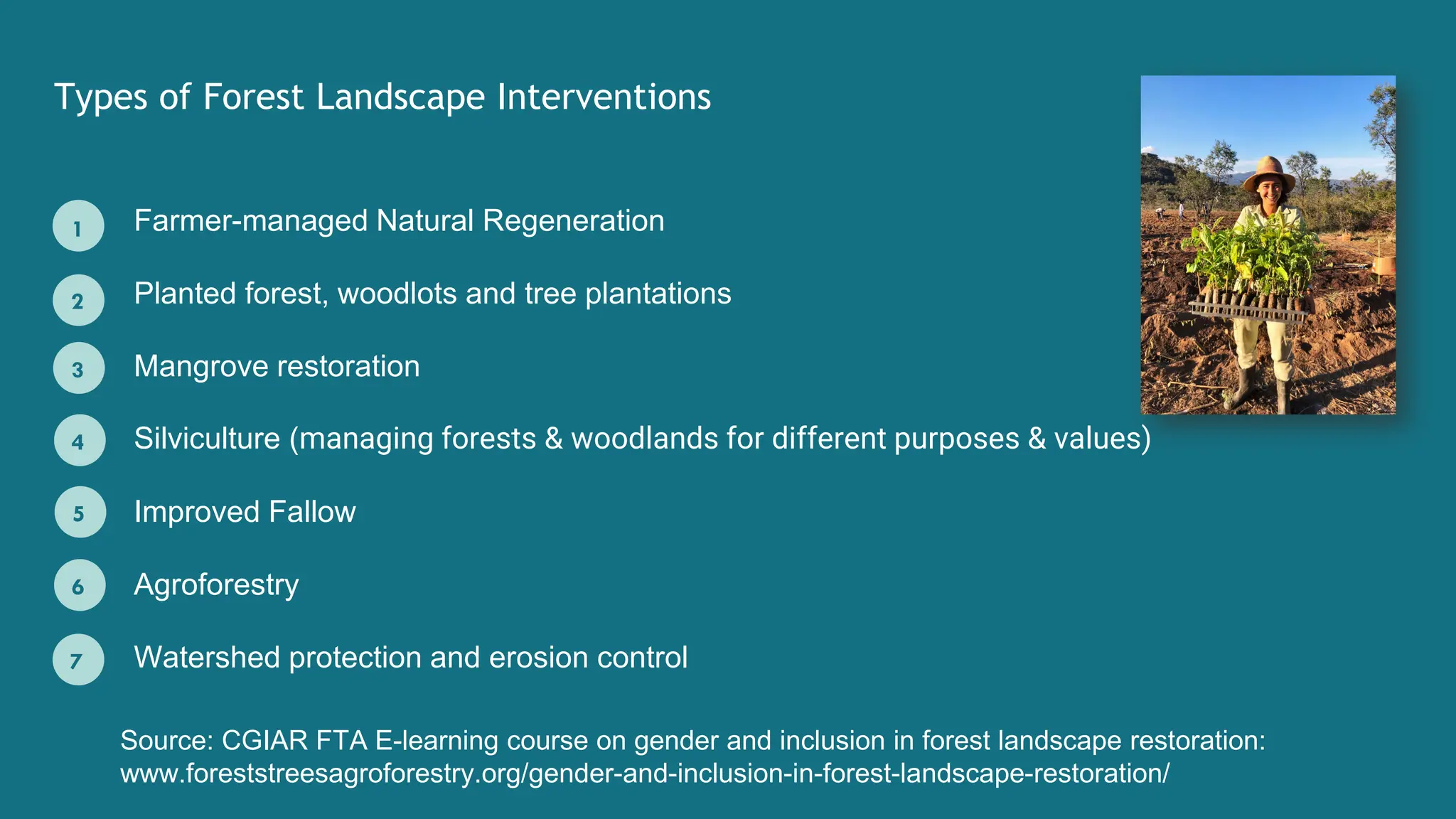
Types of ForestLandscape Interventions
1
2
3
4
Farmer-managed Natural Regeneration
Planted forest, woodlots and tree plantations
Mangrove restoration
Silviculture (managing forests & woodlands for different purposes & values)
Improved Fallow
Agroforestry
Watershed protection and erosion control
5
6
7
Source: CGIAR FTA E-learning course on gender and inclusion in forest landscape restoration:
www.foreststreesagroforestry.org/gender-and-inclusion-in-forest-landscape-restoration/
8.
Types of FLRactivities to Reach, Benefit, Empower
Awareness campaigns on women’s
forest rights and FLR project
benefits
Gender-specific FLR management
trainings
Inclusive, participatory community
FLR planning dialogues
Gender-focused review of all forest
laws, by-laws, policies
Direct restoration results-
based payments to women
Dedicated women’s fund for
forest-related
activities
Credit program targeted to
female-led forest and
agroforestry-related
enterprises
Forest/land agencies dedicate funds
for targeted technical and leadership
training to women involved in FLR
activities
Leadership training for women in
forest-related associations
Funds dedicated to innovative
communications efforts highlighting
women’s key role and best
practices for FLR
See: Gender in forest landscape projects: Actions and Indicators
www.progreen.info/knowledge/global-knowledge-program/gender
9.
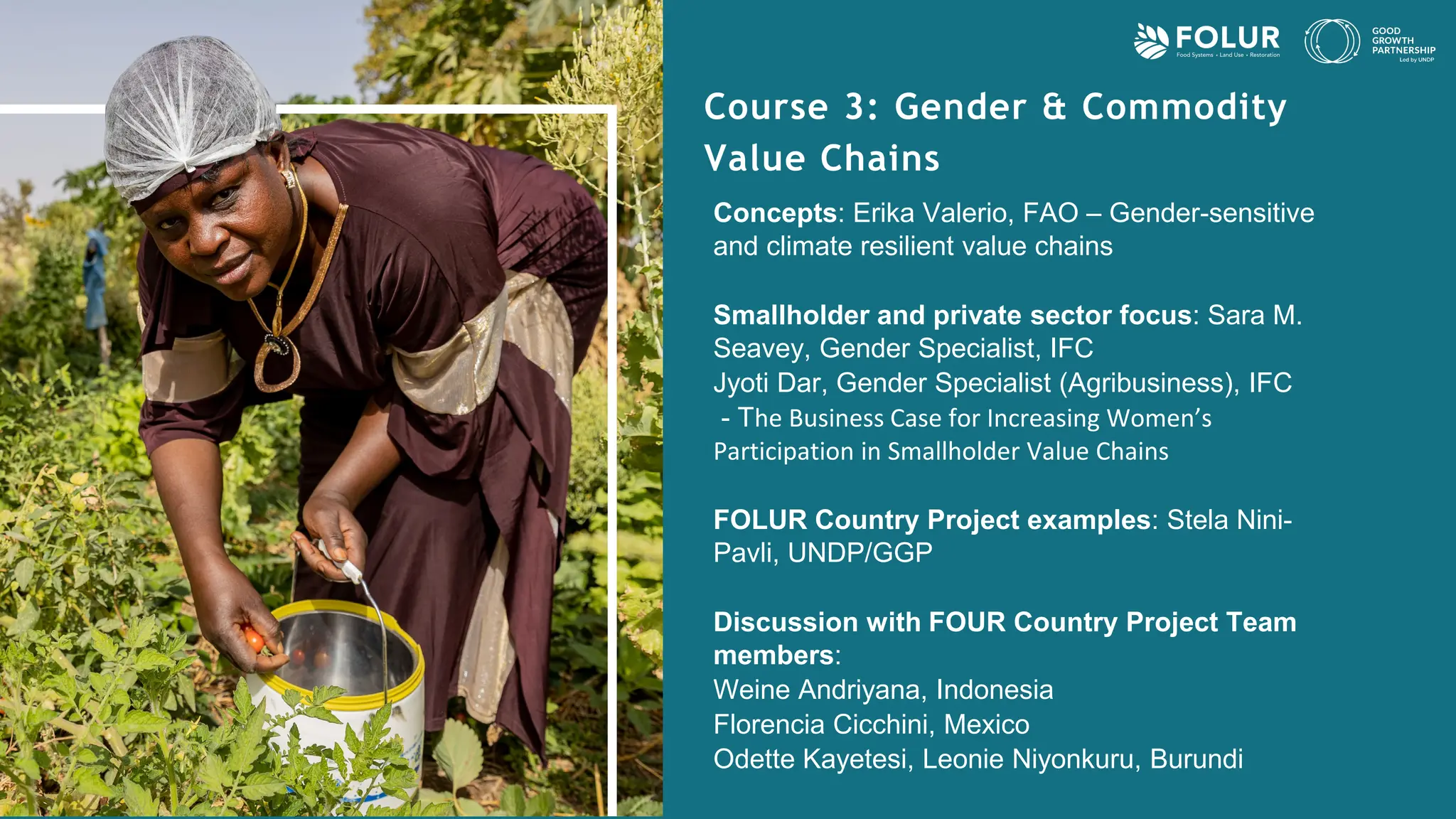
Course 3: Gender& Commodity
Value Chains
Concepts: Erika Valerio, FAO – Gender-sensitive
and climate resilient value chains
Smallholder and private sector focus: Sara M.
Seavey, Gender Specialist, IFC
Jyoti Dar, Gender Specialist (Agribusiness), IFC
- The Business Case for Increasing Women’s
Participation in Smallholder Value Chains
FOLUR Country Project examples: Stela Nini-
Pavli, UNDP/GGP
Discussion with FOUR Country Project Team
members:
Weine Andriyana, Indonesia
Florencia Cicchini, Mexico
Odette Kayetesi, Leonie Niyonkuru, Burundi
10.
Thank you!!!
Please feelfree to reach out with questions,
project examples & lessons to share:
pkristjanson@worldbank.org
11.
Gender & ValueChain
Issues and Opportunities
Concepts: Erika Valerio, Gender and Agri-food
Systems Specialist, Gender Team/ESP, FAO
Gender-sensitive and climate resilient value chains
Smallholder and private sector focus:
Sara M. Seavey, Gender Specialist, IFC
Jyoti Dar, Gender Specialist (Agribusiness), IFC
Increasing Women’s Participation in Smallholder Value
Chains
12.
Gender Sensitive andClimate
Resilient Value Chains
Gender, Social Inclusion and Protection
Erika Valerio, PhD
Gender and Agri-food Systems Specialist, Gender Team/ESP
13.
AGENDA
01 SUSTAINABLE VALUECHAIN AND
WOMEN’S INVOLVEMENT
02
FRAMEWORK ON
GENDER SENSITIVE AND CLIMATE
RESILIENT VALUE CHAINS
14.
FAO Gender sensitiveand climate resilient value chains
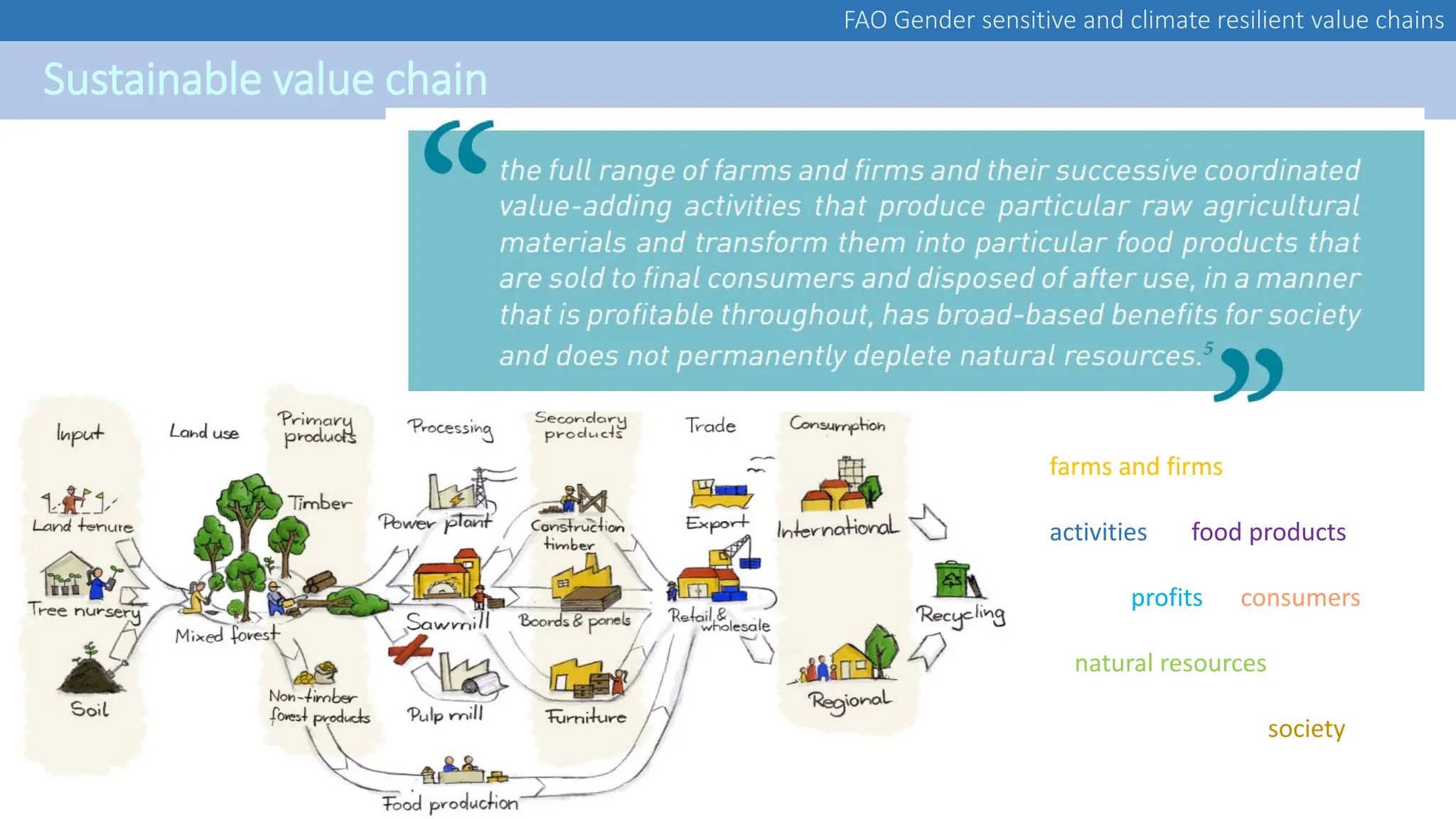
Sustainable value chain
farms and firms
activities food products
profits consumers
natural resources
society
15.
FAO Gender sensitiveand climate resilient value chains
Sustainability in Food Systems
COMPLEX SYSTEM - components
interrelate, overlap and affect
each other
16.
FAO Gender sensitiveand climate resilient value chains
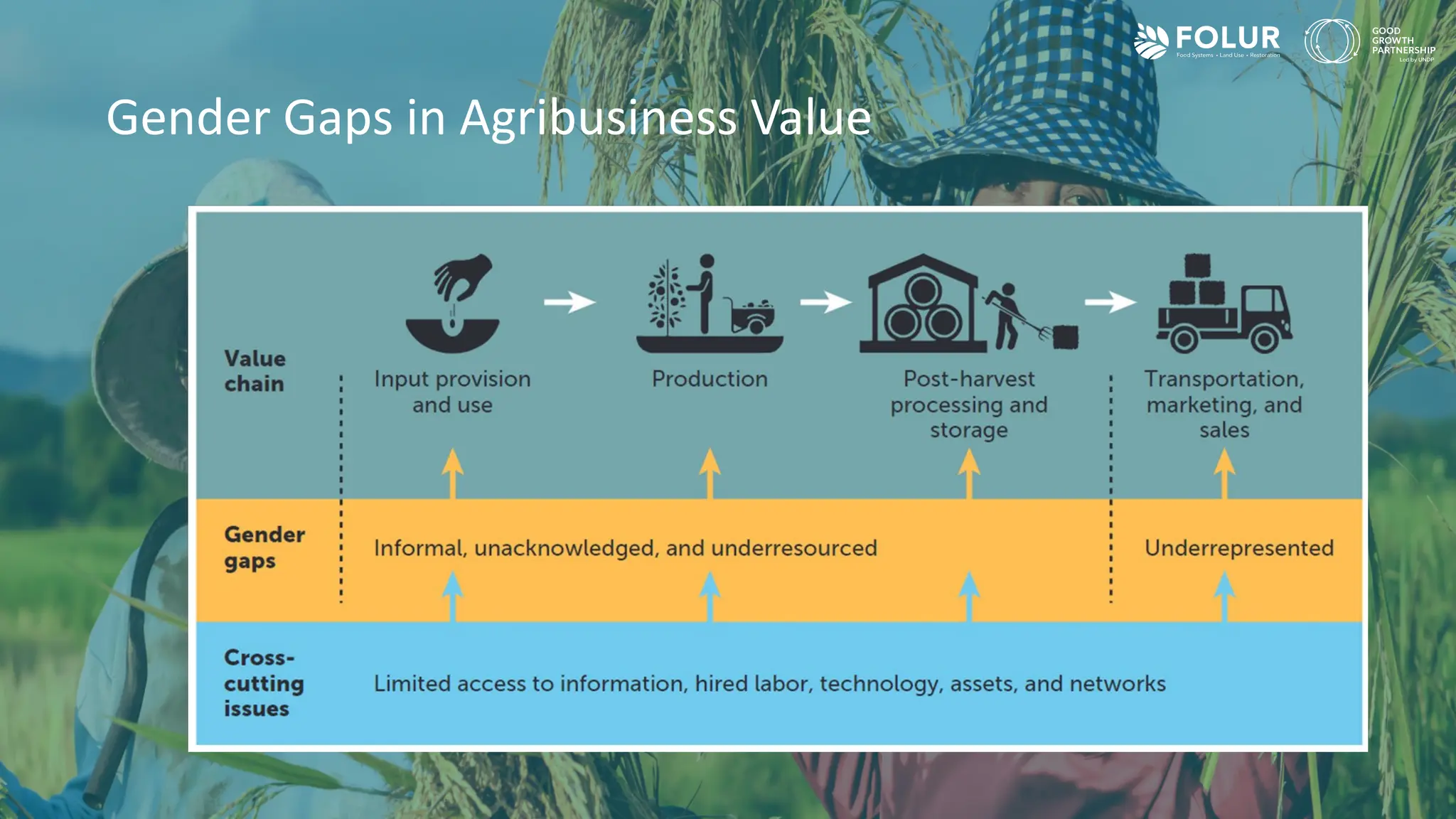
• Value chains have a gender structure; there are remarkable similarities
between regions and countries and, in general, women are concentrated
at the lower levels of the chain.
• Due to gender norms, men and women have clear and distinct roles and
activities, and their socio-economic status influences their power
relations.
• It should be remembered that gender roles are composed behaviors,
tasks and responsibilities that a society considers appropriate for men
and women, and represent a basis for the distribution of work, resources
and rights.
Role of women in value chains
17.
FAO Gender sensitiveand climate resilient value chains
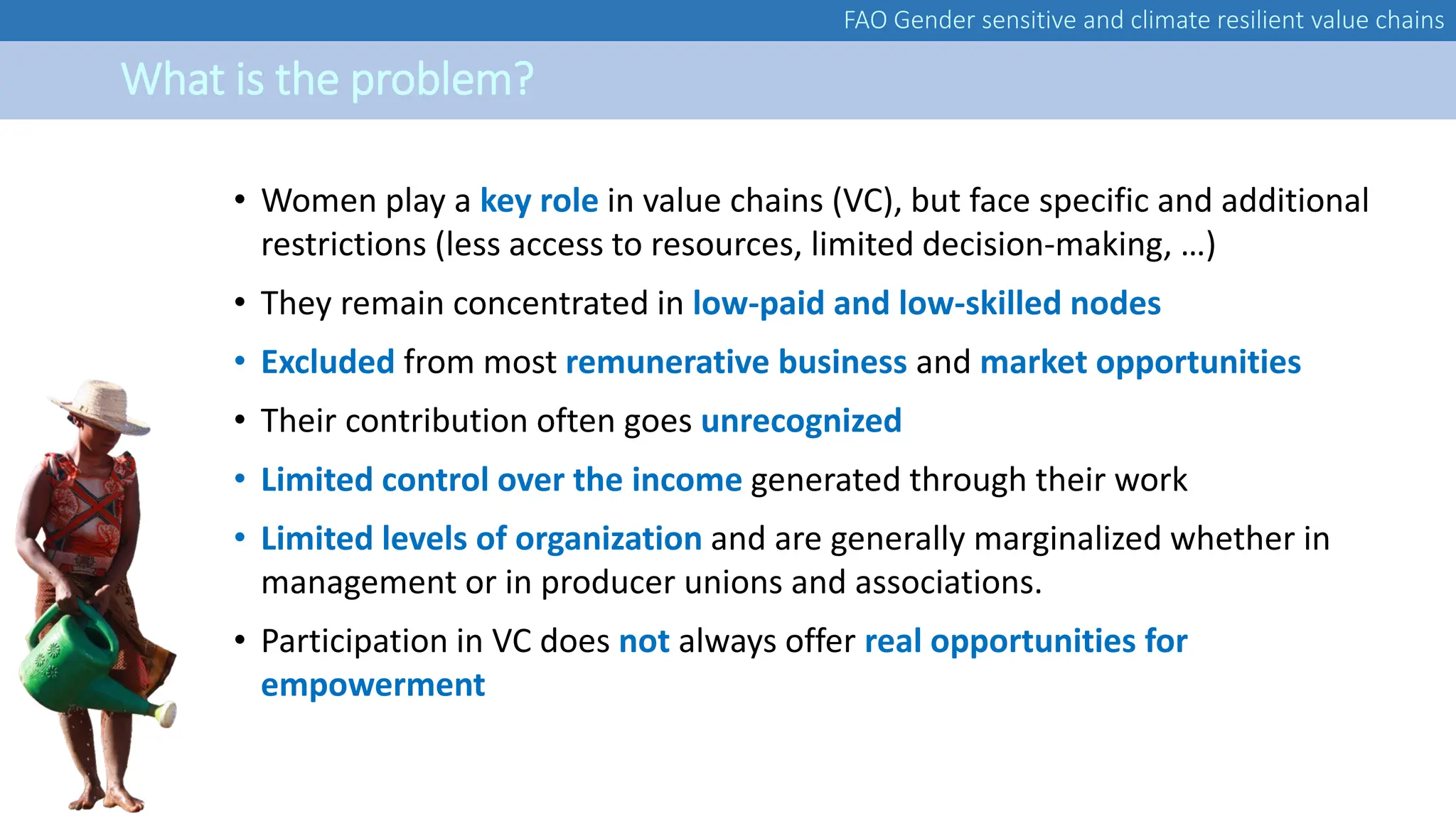
• Women play a key role in value chains (VC), but face specific and additional
restrictions (less access to resources, limited decision-making, …)
• They remain concentrated in low-paid and low-skilled nodes
• Excluded from most remunerative business and market opportunities
• Their contribution often goes unrecognized
• Limited control over the income generated through their work
• Limited levels of organization and are generally marginalized whether in
management or in producer unions and associations.
• Participation in VC does not always offer real opportunities for
empowerment
What is the problem?
18.
FAO Gender sensitiveand climate resilient value chains
What is the problem?
Failure to recognize the multiple roles assumed by
women along value chains, as well as the unpaid,
underpaid and unrecognized nature of their work,
often prevents them from fully realizing their
entrepreneurial potential and has consequences
for the efficiency and the productivity of value
chains
19.
FAO Gender sensitiveand climate resilient value chains
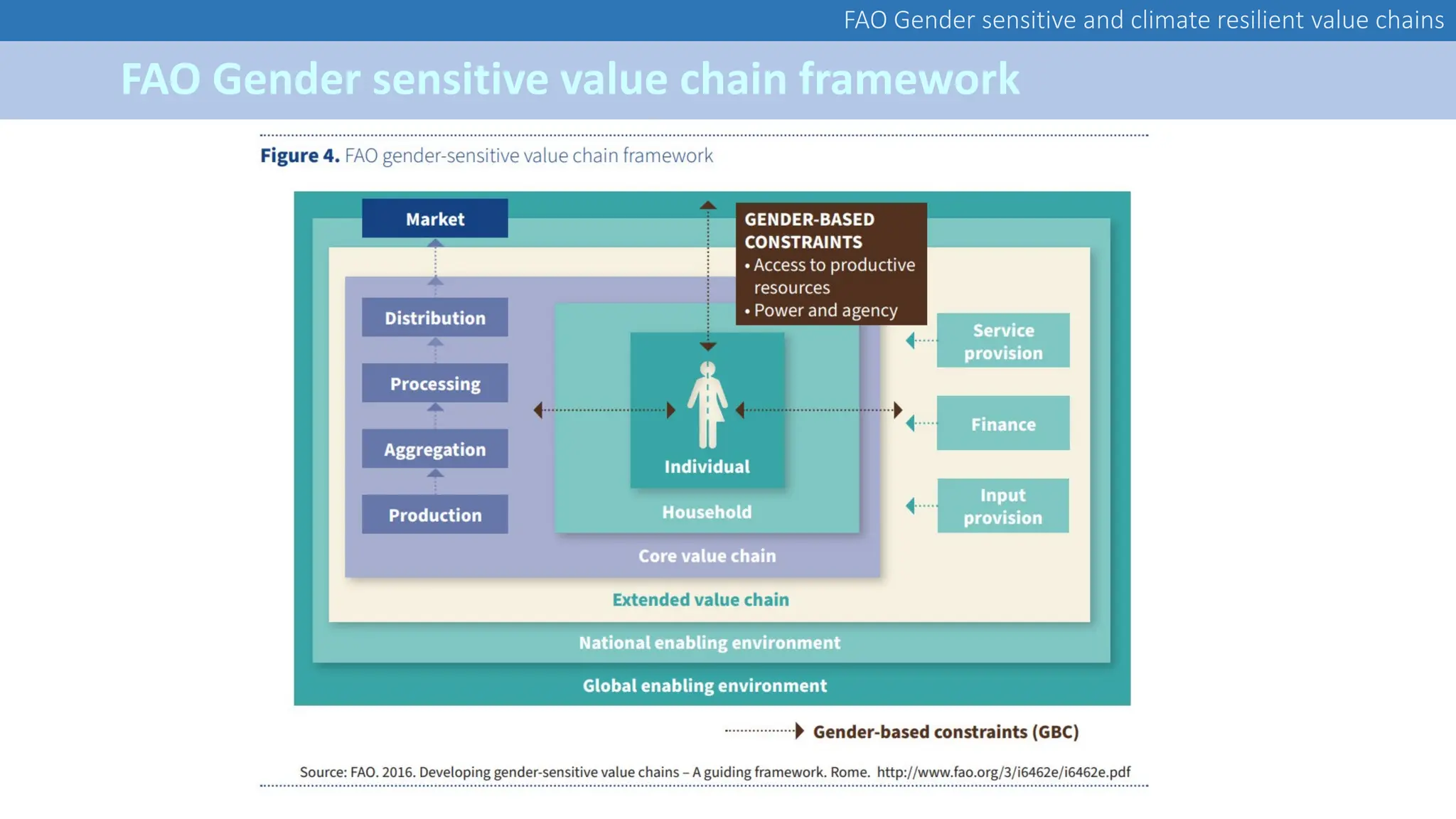
FAO Gender sensitive value chain framework
20.
FAO Gender sensitiveand climate resilient value chains
Gender analysis
The systematic attempt to identify key issues contributing to gender
inequalities, many of which also contribute to poor development outcomes
Allows to understand:
• the relationships between men and women
• their access to resources and decision making
• their activities
• their priorities, needs and
• the constraints they face relative to each other
21.
FAO Gender sensitiveand climate resilient value chains
Gender analysis
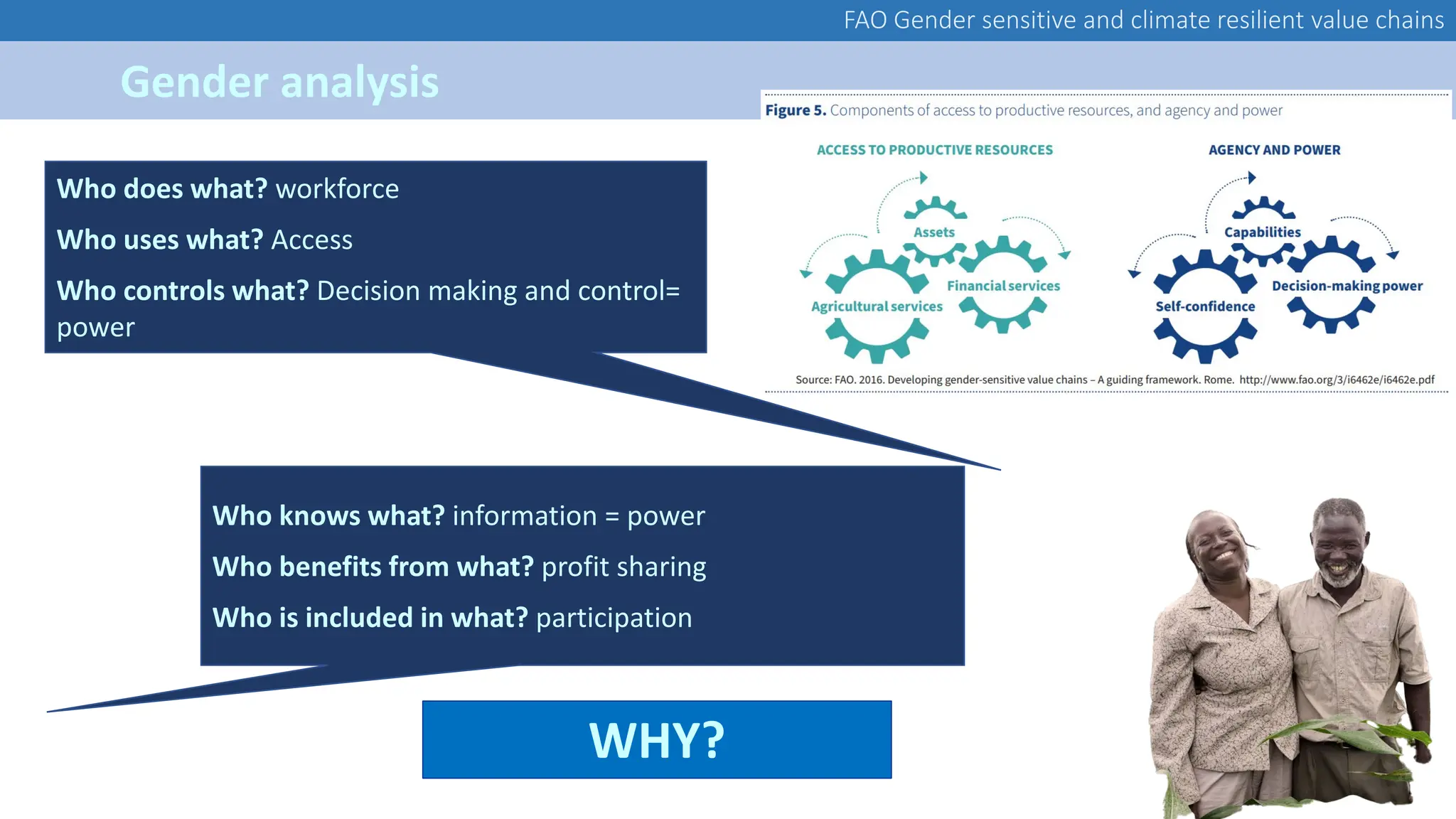
Who does what? workforce
Who uses what? Access
Who controls what? Decision making and control=
power
Who knows what? information = power
Who benefits from what? profit sharing
Who is included in what? participation
WHY?
22.
FAO Gender sensitiveand climate resilient value chains
Adaptation to climate change
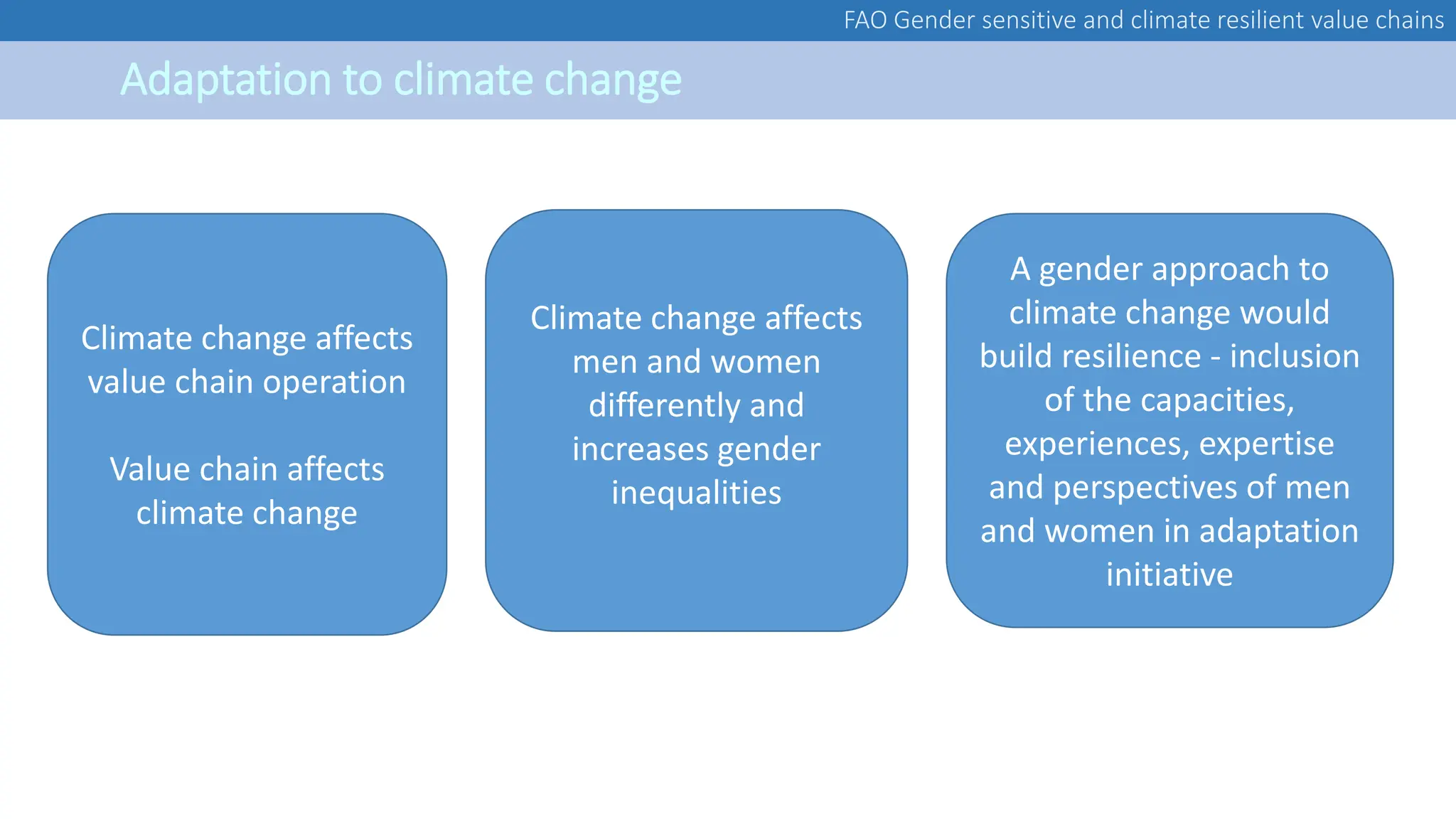
Climate change affects
value chain operation
Value chain affects
climate change
Climate change affects
men and women
differently and
increases gender
inequalities
A gender approach to
climate change would
build resilience - inclusion
of the capacities,
experiences, expertise
and perspectives of men
and women in adaptation
initiative
23.
FAO Gender sensitiveand climate resilient value chains
Translating the framework into action
FAO Gender sensitiveand climate resilient value chains
THANK YOU!
Erika.Valerio@fao.org
27.
INCREASING WOMEN’S
PARTICIPATION INSMALLHOLDER
VALUE CHAINS
Leading agricultural transformation through female
participation
3/21/2024 | Sara Seavey, Gender Specialist (Agribusiness), IFC
Jyoti Dar, Gender Specialist (Agribusiness), IFC
28.
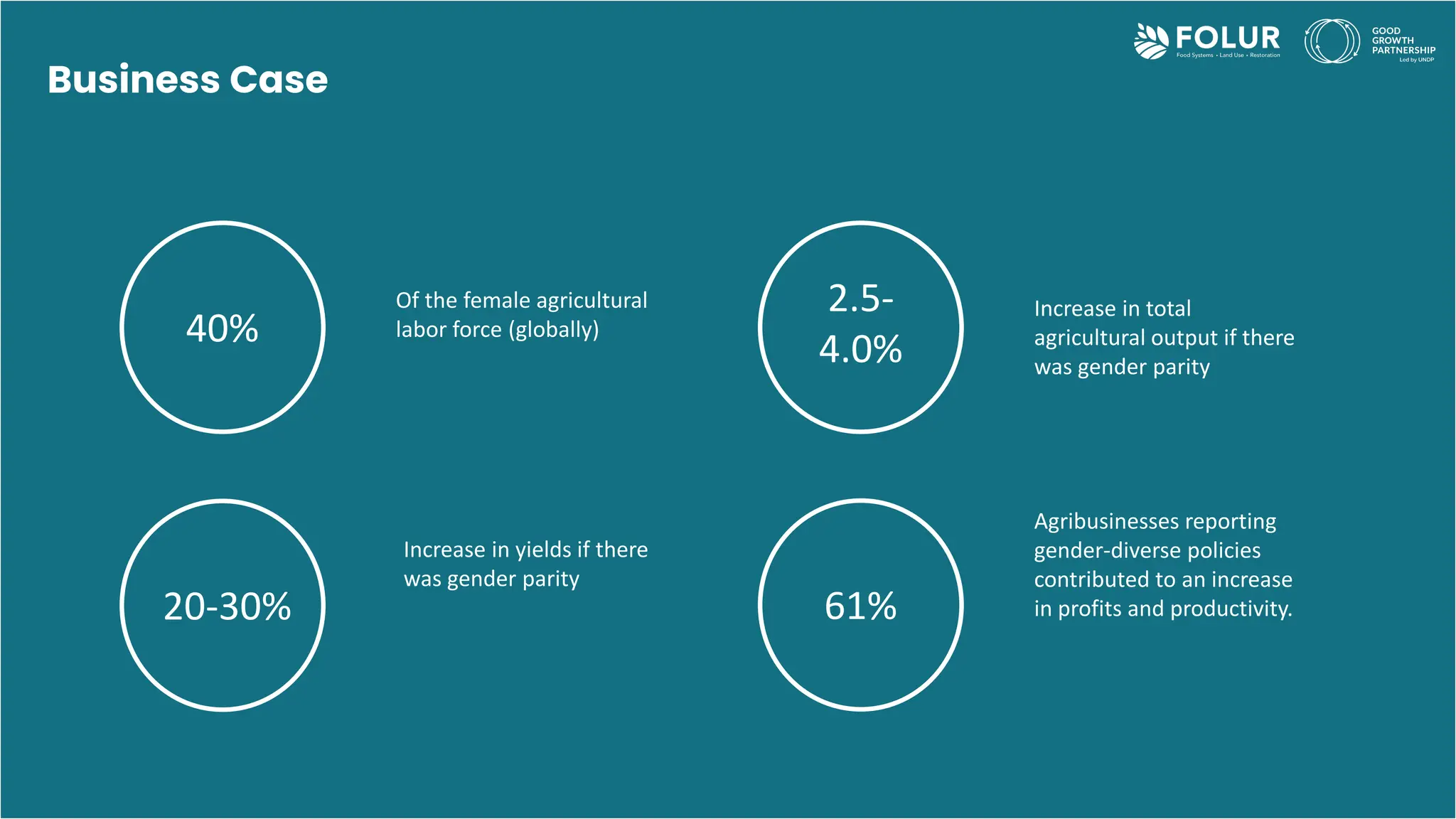
40%
2.5-
4.0%
61%
20-30%
Of the femaleagricultural
labor force (globally)
Increase in total
agricultural output if there
was gender parity
Agribusinesses reporting
gender-diverse policies
contributed to an increase
in profits and productivity.
Increase in yields if there
was gender parity
Business Case
• Improve Accessto Training and Extension Services
• Improve Access to Financial Services and Literacy
• Improve Women’s Access to Leadership and Decision-
Making Positions
• Improve Access to Technology and Inputs
• Psychological Safety: Address Childcare and Gender-
Based Violence
• Resources and training to partners to prevent gender-
based violence
• Sex-disaggregated indicators and gender-inclusive indices
should be used to measure women’s economic
empowerment (WEAI)
Gender-Smart Agri Solutions
33.
• Number offemale farmers reached (directly and indirectly)
• Number of female smallholder farmers reached
• Number of employees participating in training (disaggregated by sex)
• Number of extension agents recruited (disaggregated by sex)
• Number of suppliers and distributors in the company’s value chain
(disaggregated by sex)
• Number of agreements signed between farmers and off-takers per
year (disaggregated by sex)
• Number of women participants in workshops, training events,
seminars, conferences, and so forth
• Amount of savings achieved for women farmers or cooperatives
• Number of participants in gender-based violence and harassment
training (disaggregated by sex)
• Number of gender-based violence policies or procedures
implemented
• Number of persons accessing childcare services (disaggregated by sex)
• Percentage of group leadership positions held by women
• Number and/or percentage of women farmers using fertilizer and
other inputs
Illustrative list of Gender-Related Performance Indicators
34.
DCM Shriram |Untapping the Potential of
the Sugarcane Sector
Sugarcane yield increase
Women farmers trained in sugarcane production
Resulted in women farmers being introduced to mechanization, a 70% decrease in distance traveled by local farmers to
access agri-inputs, increasing farmers’ efficiency and productivity and increasing yields of sugarcane by 40%.
Women dairy farmers trained – CSA Dairy Gender Initiative
Women entrepreneurs trained- CSA Seed Nursery Management
through the mobile van-based training. The project hired female trainers to hold training sessions for women farmers.
25%
11K
and a reduction in the price of farming by training women farmers
100
to promote dairy as a business activity in a region where milk production was only for household consumption. Under
the project, milk production and sales revenue of milk have gone up by 5% to 10%.
17K
35.
Title
Sunita procured 833seed
nursery trays and
developed 50K high-
quality seedlings, of which
she sold 35K seedlings
across six farmers covering
4.5 acres of land.
“My family and I used to buy seedlings
from middlemen at a high price. Now we
sell them directly to the farmers, and they
are better quality. I would like to grow
more seedlings and build my business”
Sunita, Sugarcane Entrepreneur
Publications
DCM Shriram | Untapping the Potential of the Sugarcane Sector
FOLUR Country Project
examples
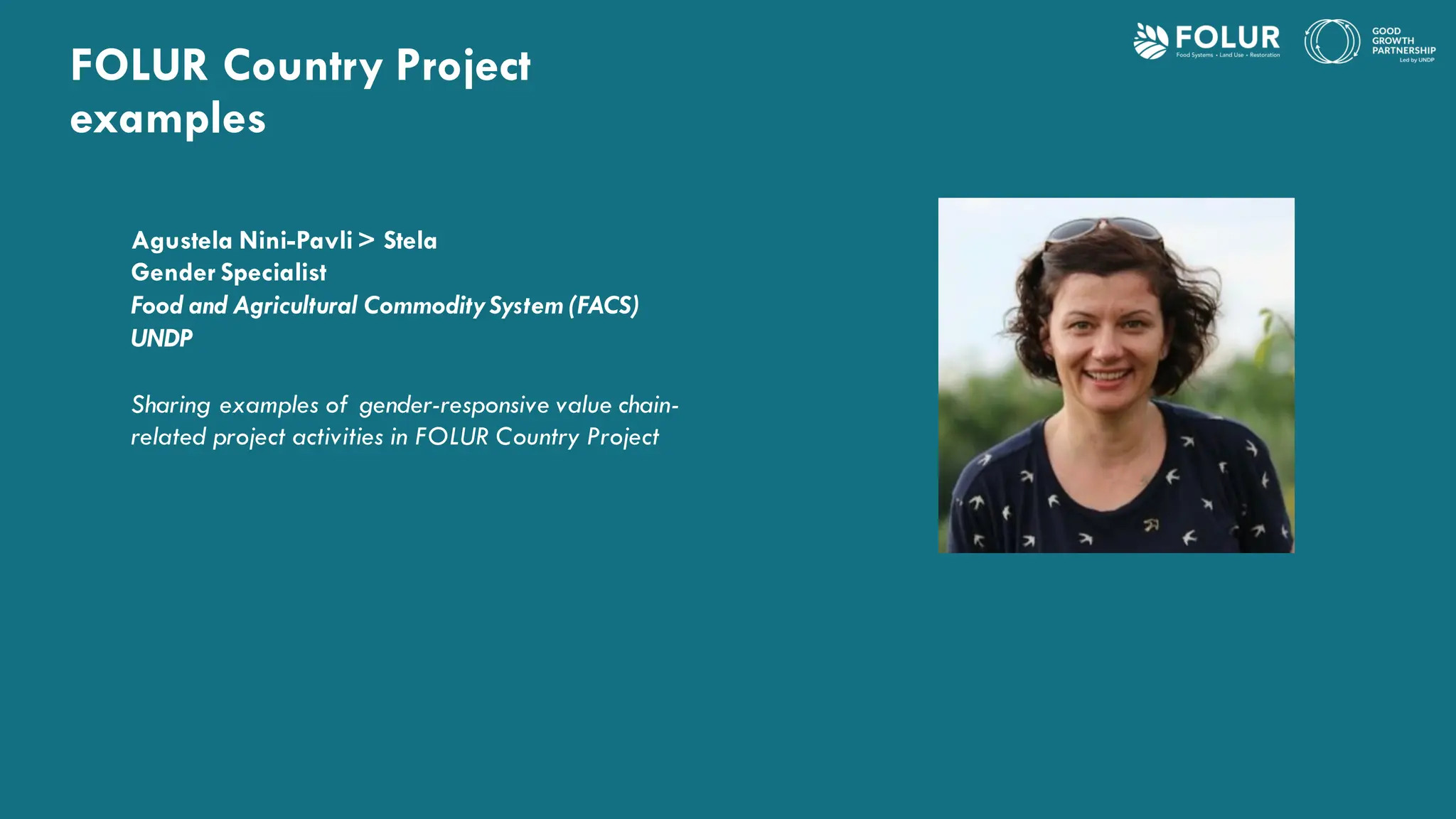
AgustelaNini-Pavli > Stela
Gender Specialist
Food and Agricultural Commodity System (FACS)
UNDP
Sharing examples of gender-responsive value chain-
related project activities in FOLUR Country Project
39.
FOLUR Country ProjectExamples
Based on Learning through Sharing Report:
Desk research on FOLUR Country Projects’
Documents (GGP/UNDP)
40.
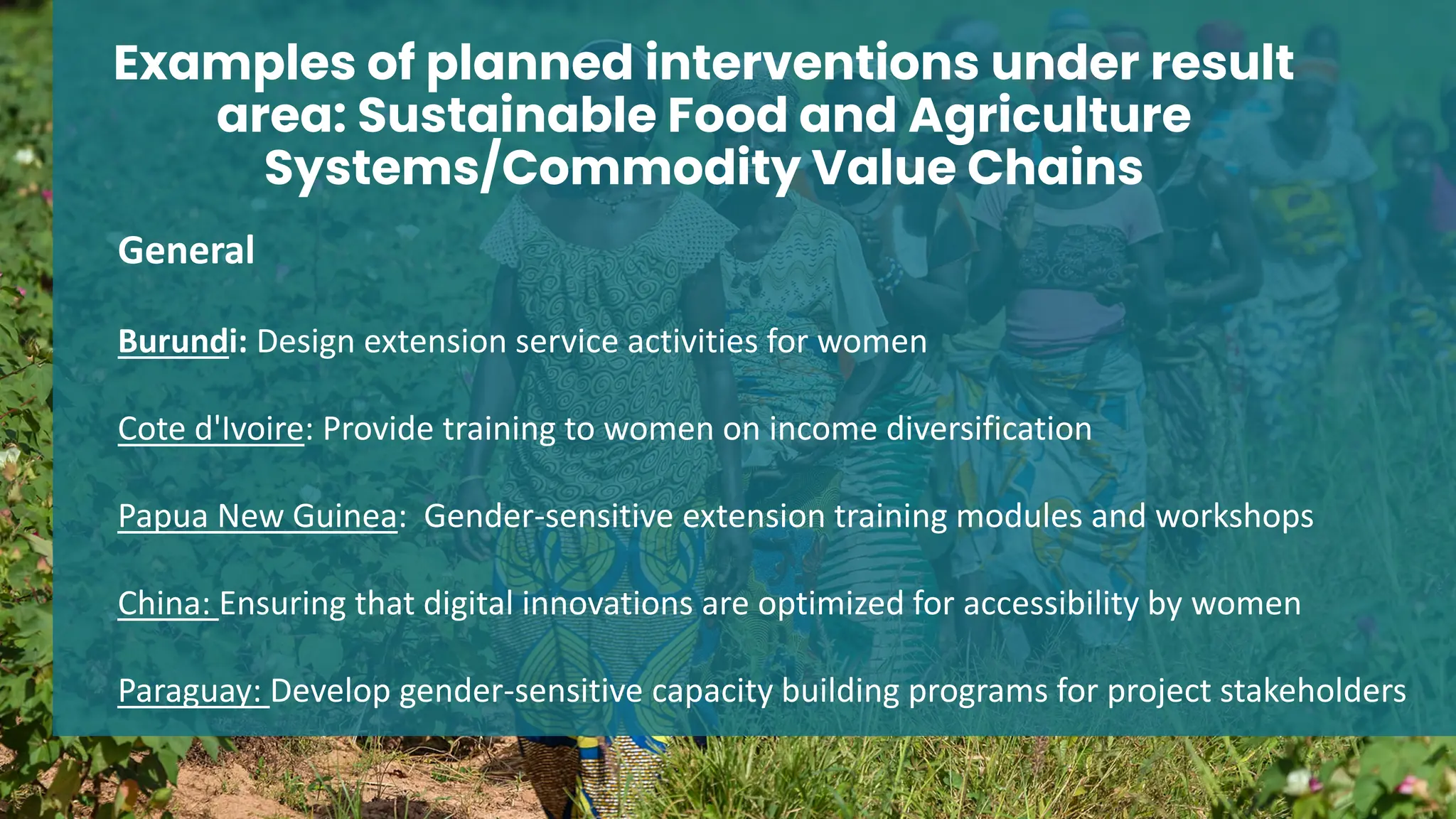
Examples of plannedinterventions under result
area: Sustainable Food and Agriculture
Systems/Commodity Value Chains
General
Burundi: Design extension service activities for women
Cote d'Ivoire: Provide training to women on income diversification
Papua New Guinea: Gender-sensitive extension training modules and workshops
China: Ensuring that digital innovations are optimized for accessibility by women
Paraguay: Develop gender-sensitive capacity building programs for project stakeholders
41.
Examples of plannedinterventions
Specific VC-Gender Activities
China:
• Supporting women’s enterprises and women-led cooperatives (Under the WB-
Hubei sub-project, the target is ensuring at least 21 of the 50 farmer
cooperatives are managed by women or have a significant share of women
members)
Paraguay:
• Select farms led by women for pilot training under Farmer Support activities;
• Strengthen existing Platform of Women Leaders of the Sustainable Commodity
Chain, particularly by supporting the design and implementation of an action
plan
-
42.
Examples of plannedinterventions
Specific VC-Gender Activities
Liberia:
• Develop a gender sensitive M&E system to report on women participation
Ghana :
• Support for provision of post-harvest storage facilities, including knowledge for
better management and reduction in productivity loss
• Targeted training programs for women farmers on Village Savings and Loans
scheme (VSLA)
• Introduction of a gender-sensitive grievance redress mechanism
Indonesia, Mexico and Burundi: in following discussion
43.
Potential gender-responsive activities
•Processes/engagements that bring together buyers and sellers (especially women
sellers)
• Women’s agribusiness leadership training
• Financial management training of women’s savings groups
• Working with financial and private sector actors to design women-targeted
instruments (e.g. credit that doesn’t require land ownership for collateral)
• Approaches/tools (e.g. Gender Action Learning System- GALS - IFAD-fprojects) that
assess intra-household gender dynamics
• Certifications/standards that measure and independently verify social/women’s
progress/benefits (e.g. W+ Standard: wplus.org)
44.
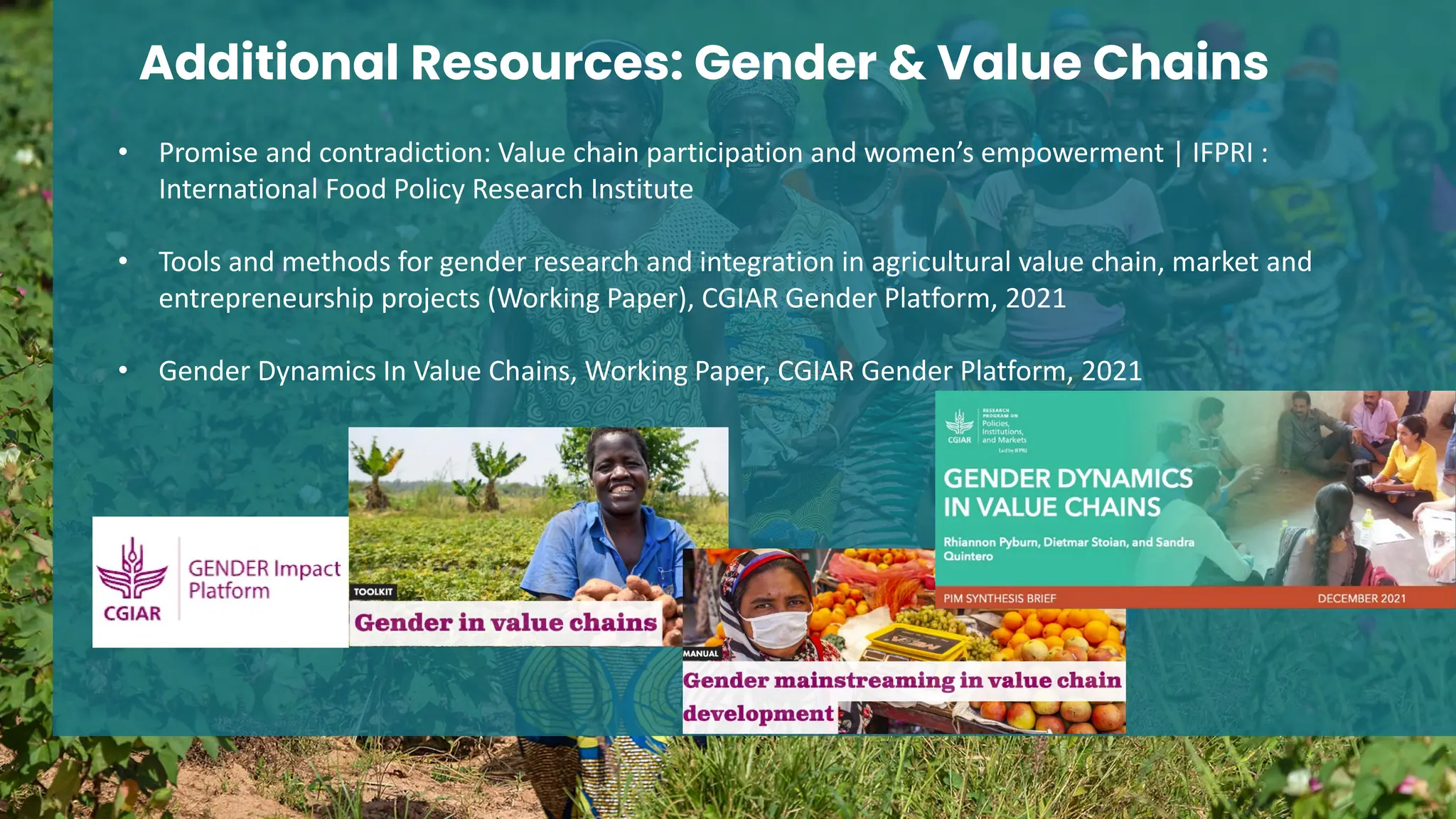
Additional Resources: Gender& Value Chains
• Promise and contradiction: Value chain participation and women’s empowerment | IFPRI :
International Food Policy Research Institute
• Tools and methods for gender research and integration in agricultural value chain, market and
entrepreneurship projects (Working Paper), CGIAR Gender Platform, 2021
• Gender Dynamics In Value Chains, Working Paper, CGIAR Gender Platform, 2021
45.
Reminder
Resource Guide onGender Equality for FOLUR
https://www.undp.org/facs/publications/resource-guide-gender-equality-
folur
• Compilation of resources developed by FOLUR
partners on gender equality and FOLUR work areas:
ILM, Restoration and Value Chains
• Brief Conceptual Framework on gender integration in
FOLUR projects
46.
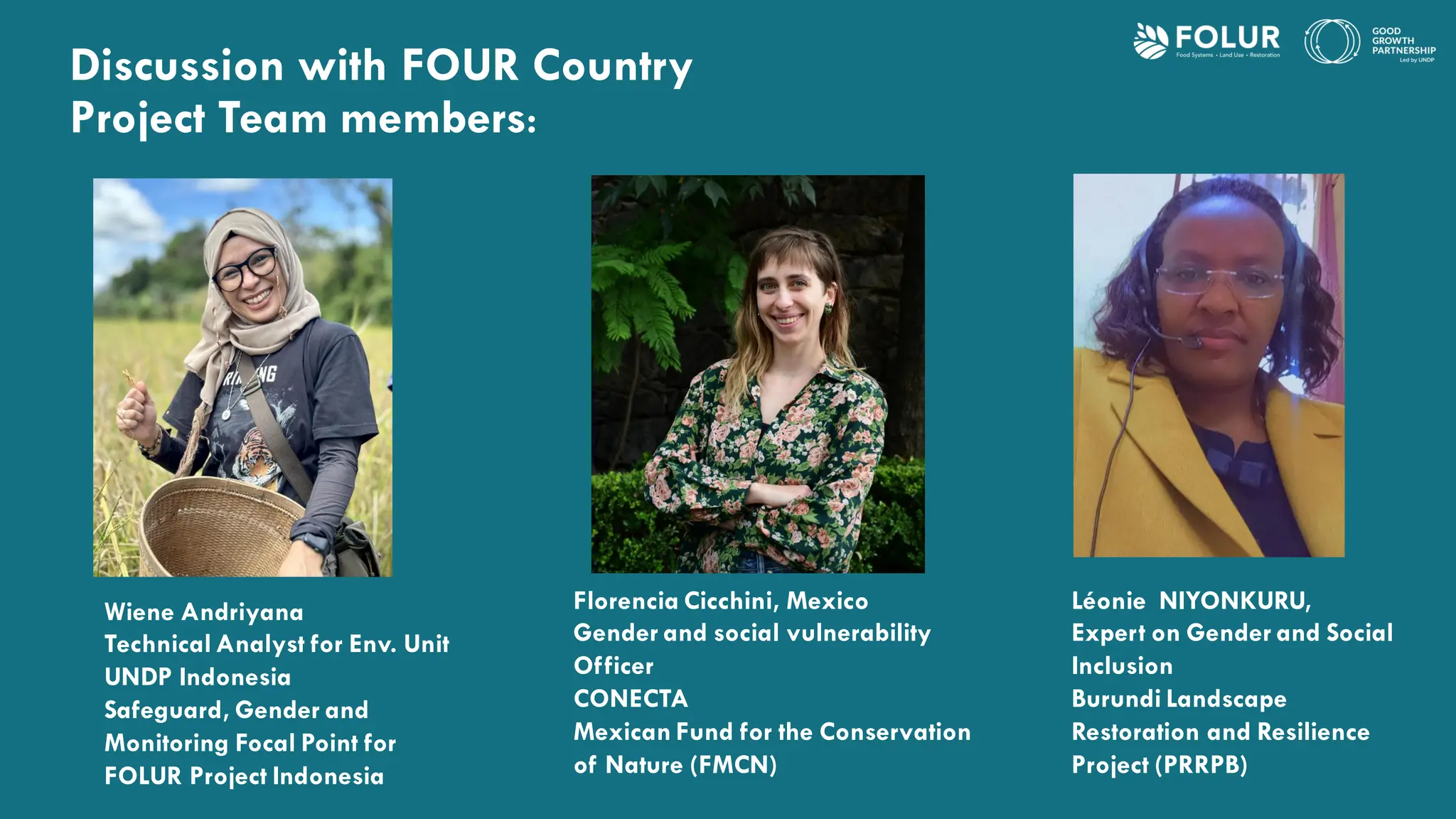
Discussion with FOURCountry
Project Team members:
Wiene Andriyana
Technical Analyst for Env. Unit
UNDP Indonesia
Safeguard, Gender and
Monitoring Focal Point for
FOLUR Project Indonesia
Florencia Cicchini, Mexico
Gender and social vulnerability
Officer
CONECTA
Mexican Fund for the Conservation
of Nature (FMCN)
Léonie NIYONKURU,
Expert on Gender and Social
Inclusion
Burundi Landscape
Restoration and Resilience
Project (PRRPB)
47.
Advancing gender
in sustainablevalue
chain
Sharing from Indonesia Country Project
Wiene Andriyana
Technical Analyst for Env. Unit UNDP Indonesia
Safeguard, Gender and Monitoring Focal Point for
FOLUR Project Indonesia
Gender-sensitive commodity valuechain and gender
consideration in support investments
Burundi Landscape Restoration and Resilience Project
(PRRPB)
52.
What is aValue Chain?
Value chain: Set of actors and activities that take a basic
agricultural product from the production stage in the field to its final
consumption;
Goal: Tool for formulating a successful strategy
Agricultural production factors:
✓ Earth;
✓ Work;
✓ Capital (human and financial)
✓ Information/Communication
✓ Natural resources
53.
PRRPB and thedevelopment of the gender-sensitive value
chain
❑ The PRRPB's commitment to action on gender equality and equity in order to
reduce poverty and ensure food security:
Objective: To achieve at least 51% female beneficiaries for all project
interventions;
❑ The PRRPB has a gender strategy and a specialist in gender and social
inclusion;
❑ It provides training/awareness-raising to households on gender issues using the
Gender Action Learning System (GALS) approach so that these households
have:
➢ A shared vision for agricultural production;
➢ Joint household planning;
➢ Balanced sharing of roles and responsibilities within the household, reducing
the burden on women;
➢ Concerted family decision-making;
➢ Boosting self-esteem/self-confidence
54.
PRRPB and thedevelopment of gender-sensitive VC (continued)
❑ Supports and promotes women's land rights in the land certification
process: 70% of land certificates produced in the project area bear
women's names
❑ Access to inputs:
✓ Distribution of organic manure and fertilisers to farmers
✓ Cattle as an essential source of manure and income
✓ Granting good quality seeds
✓ Training/awareness-raising through CEP
Women beneficiaries of inputs: At least 51
55.
PRRPB and thedevelopment of gender-sensitive VC
(continued)
Access to training, information and knowledge
➢ Works with a community mobilisation NGO with gender expertise;
➢ Estimated representation of over 51% of women in training and as
workers, thereby increasing their income;
➢ Good representation of women on river basin management
committees;
➢ Good representation of young people and indigenous peoples in
community consultations
56.
Production support
ThePRRPB works with organisations specialising in agriculture (FAO),
with qualified human capital to support producers;
Provision of training/awareness-raising through the CEP for the
majority of women;
Protecting the land by supporting and promoting sustainable farming
practices that increase production;
Support for savings and credit groups in the intervention hills and
around protected areas to ensure easy access to income
57.
Production support (continued)
➢Out of 47 groups supported, 16 were Batwa groups
➢ More than 60% of women are members of these groups
➢ Provides small-scale farmers with training, technical support,
investment and inputs to enable large-scale adoption of
innovative land restoration and management technologies. More
than 50% of the beneficiaries of this support are women;
➢ Support for access to cattle as an essential source of manure, to
improve productivity, using the "cattle solidarity chain"
mechanism. More than 50% of cattle beneficiaries are women