Gender equality in China: progress,
challenges, and future strategy
Zheng, Zhenzhen
Institute of Population and Labor Economics
Chinese Academy of Social Sciences
2 March 2014 Mpumalanga, South Africa
Outline
• Promoting gender equality in China: a review
• Progress and current status
– Efforts for a supportive policy and social environment
– Health
– Education
– Economic participation
– Political participation
• Gaps and challenges
• National strategies
Promoting gender equality in China: a review
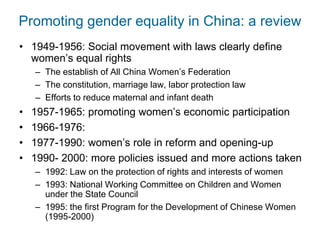
• 1949-1956: Social movement with laws clearly define
women’s equal rights
– The establish of All China Women’s Federation
– The constitution, marriage law, labor protection law
– Efforts to reduce maternal and infant death
• 1957-1965: promoting women’s economic participation
• 1966-1976:
• 1977-1990: women’s role in reform and opening-up
• 1990- 2000: more policies issued and more actions taken
– 1992: Law on the protection of rights and interests of women
– 1993: National Working Committee on Children and Women
under the State Council
– 1995: the first Program for the Development of Chinese Women
(1995-2000)
Important progress in the 21st century
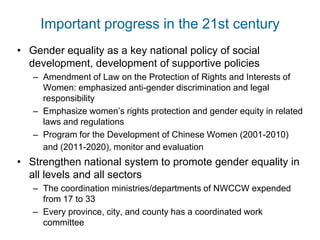
• Gender equality as a key national policy of social
development, development of supportive policies
– Amendment of Law on the Protection of Rights and Interests of
Women: emphasized anti-gender discrimination and legal
responsibility
– Emphasize women’s rights protection and gender equity in related
laws and regulations
– Program for the Development of Chinese Women (2001-2010)
and (2011-2020), monitor and evaluation
• Strengthen national system to promote gender equality in
all levels and all sectors
– The coordination ministries/departments of NWCCW expended
from 17 to 33
– Every province, city, and county has a coordinated work
committee
Important progress in the 21st century
• Gender mainstreaming and gender equality advocacy for a
more supportive social-cultural environment
– High rank advocacy
– Collaborating with media, more news and reports to advocate
– The role of CSOs: monitor media on stereotype or discriminative
reports about women, analysis and intervention
– More international collaboration, communication and exchange
• Key projects
– Fight against gender-based violence: change common views from
ignorance to pay attention, gender sensitive and anti gender-based
domestic violence training in legal system and health system,
preparation for development of law
– “Care for girls” Campaign: promote non-discriminating concepts to
change the traditional views of weighting more on boys than girls,
call for awareness on harmful practices that discriminate girls, and
raising girls’ status in a family
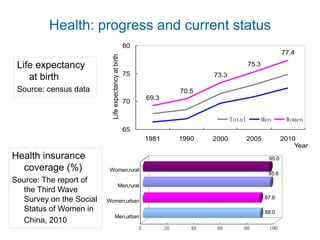
Health: progress and current status
Life expectancy
at birth
Source: census data
69.3
70.5
73.3
75.3
77.4
65
70
75
80
1981 1990 2000 2005 2010
Year
Lifeexpectancyatbirth
Total Men Women
Health insurance
coverage (%)
Source: The report of
the Third Wave
Survey on the Social
Status of Women in
China, 2010
88.0
87.6
95.6
95.0
0 20 40 60 80 100
Men,urban
Women,urban
Men,rural
Women,rural
50
100
150
200
250
300
350
15 20 25 30 35 40 45
High school
College
University
Post-graduate
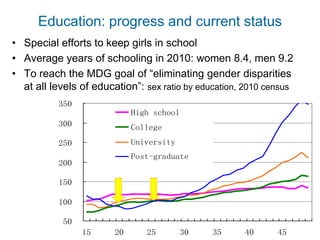
Education: progress and current status
• Special efforts to keep girls in school
• Average years of schooling in 2010: women 8.4, men 9.2
• To reach the MDG goal of “eliminating gender disparities
at all levels of education”: sex ratio by education, 2010 census
Labor participation: progress and current status
• Women make 46% of employed labor
• More women work in education, culture, health, sports,
commercial and retail, and service
• An increasing number of women work in new
emerging and high-tech industry
• Training for women provided by government and
women’s organizations
• Improvement in occupational protection for women
– A high coverage of maternal insurance for urban employees,
from 26% in 2000 to 95% in 2010
– More enterprises implemented “Regulation on Occupational
Protection of Women Employees”, from 34.9% in 2005 to
54.9% in 2010
Current status: findings from the Third Wave
Survey on the Social Status of Women (2010)
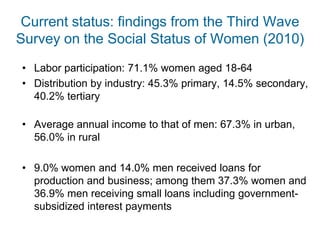
• Labor participation: 71.1% women aged 18-64
• Distribution by industry: 45.3% primary, 14.5% secondary,
40.2% tertiary
• Average annual income to that of men: 67.3% in urban,
56.0% in rural
• 9.0% women and 14.0% men received loans for
production and business; among them 37.3% women and
36.9% men receiving small loans including government-
subsidized interest payments
More social interventions
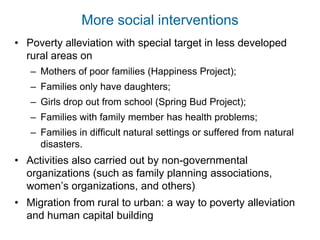
• Poverty alleviation with special target in less developed
rural areas on
– Mothers of poor families (Happiness Project);
– Families only have daughters;
– Girls drop out from school (Spring Bud Project);
– Families with family member has health problems;
– Families in difficult natural settings or suffered from natural
disasters.
• Activities also carried out by non-governmental
organizations (such as family planning associations,
women’s organizations, and others)
• Migration from rural to urban: a way to poverty alleviation
and human capital building
Political participation
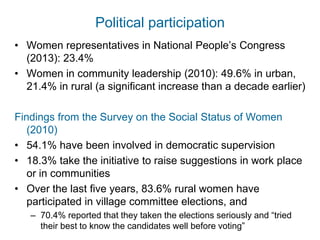
• Women representatives in National People’s Congress
(2013): 23.4%
• Women in community leadership (2010): 49.6% in urban,
21.4% in rural (a significant increase than a decade earlier)
Findings from the Survey on the Social Status of Women
(2010)
• 54.1% have been involved in democratic supervision
• 18.3% take the initiative to raise suggestions in work place
or in communities
• Over the last five years, 83.6% rural women have
participated in village committee elections, and
– 70.4% reported that they taken the elections seriously and “tried
their best to know the candidates well before voting”
Gaps and challenges
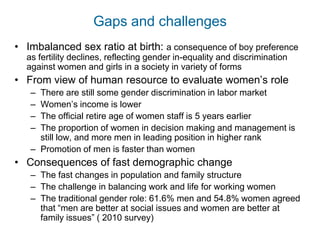
• Imbalanced sex ratio at birth: a consequence of boy preference
as fertility declines, reflecting gender in-equality and discrimination
against women and girls in a society in variety of forms
• From view of human resource to evaluate women’s role
– There are still some gender discrimination in labor market
– Women’s income is lower
– The official retire age of women staff is 5 years earlier
– The proportion of women in decision making and management is
still low, and more men in leading position in higher rank
– Promotion of men is faster than women
• Consequences of fast demographic change
– The fast changes in population and family structure
– The challenge in balancing work and life for working women
– The traditional gender role: 61.6% men and 54.8% women agreed
that “men are better at social issues and women are better at
family issues” ( 2010 survey)
• Further gender mainstreaming in all areas; more resource
investment; improve gendered statistics, analysis, and
evaluation
• Eliminate gender in-equality, to address the root causes of
sex ratio imbalance problem, to improve the supportive
social and policy environment for development of women
and girls
• To promote women’s participation in decision making and
promote in high-rank position by more training and
improved policy
• Pay attention to possible consequences of demographic
change to women, be aware potential gender inequality
while response to demographic changes
National strategies for the next decade
Implementation, Monitor and evaluation on the major
indicators and strategies on women in
• Health
• Education
• Economy
• Decision making and management
• Social welfare
• Environment
• Legal protection
The Program for the Development of
Chinese Women (2011-2020)
Thank you

Gender equality in China: progress, challenges, and future strategy

  • 1.
    Gender equality inChina: progress, challenges, and future strategy Zheng, Zhenzhen Institute of Population and Labor Economics Chinese Academy of Social Sciences 2 March 2014 Mpumalanga, South Africa
  • 2.
    Outline • Promoting genderequality in China: a review • Progress and current status – Efforts for a supportive policy and social environment – Health – Education – Economic participation – Political participation • Gaps and challenges • National strategies
  • 3.
    Promoting gender equalityin China: a review • 1949-1956: Social movement with laws clearly define women’s equal rights – The establish of All China Women’s Federation – The constitution, marriage law, labor protection law – Efforts to reduce maternal and infant death • 1957-1965: promoting women’s economic participation • 1966-1976: • 1977-1990: women’s role in reform and opening-up • 1990- 2000: more policies issued and more actions taken – 1992: Law on the protection of rights and interests of women – 1993: National Working Committee on Children and Women under the State Council – 1995: the first Program for the Development of Chinese Women (1995-2000)
  • 4.
    Important progress inthe 21st century • Gender equality as a key national policy of social development, development of supportive policies – Amendment of Law on the Protection of Rights and Interests of Women: emphasized anti-gender discrimination and legal responsibility – Emphasize women’s rights protection and gender equity in related laws and regulations – Program for the Development of Chinese Women (2001-2010) and (2011-2020), monitor and evaluation • Strengthen national system to promote gender equality in all levels and all sectors – The coordination ministries/departments of NWCCW expended from 17 to 33 – Every province, city, and county has a coordinated work committee
  • 5.
    Important progress inthe 21st century • Gender mainstreaming and gender equality advocacy for a more supportive social-cultural environment – High rank advocacy – Collaborating with media, more news and reports to advocate – The role of CSOs: monitor media on stereotype or discriminative reports about women, analysis and intervention – More international collaboration, communication and exchange • Key projects – Fight against gender-based violence: change common views from ignorance to pay attention, gender sensitive and anti gender-based domestic violence training in legal system and health system, preparation for development of law – “Care for girls” Campaign: promote non-discriminating concepts to change the traditional views of weighting more on boys than girls, call for awareness on harmful practices that discriminate girls, and raising girls’ status in a family
  • 6.
    Health: progress andcurrent status Life expectancy at birth Source: census data 69.3 70.5 73.3 75.3 77.4 65 70 75 80 1981 1990 2000 2005 2010 Year Lifeexpectancyatbirth Total Men Women Health insurance coverage (%) Source: The report of the Third Wave Survey on the Social Status of Women in China, 2010 88.0 87.6 95.6 95.0 0 20 40 60 80 100 Men,urban Women,urban Men,rural Women,rural
  • 7.
    50 100 150 200 250 300 350 15 20 2530 35 40 45 High school College University Post-graduate Education: progress and current status • Special efforts to keep girls in school • Average years of schooling in 2010: women 8.4, men 9.2 • To reach the MDG goal of “eliminating gender disparities at all levels of education”: sex ratio by education, 2010 census
  • 8.
    Labor participation: progressand current status • Women make 46% of employed labor • More women work in education, culture, health, sports, commercial and retail, and service • An increasing number of women work in new emerging and high-tech industry • Training for women provided by government and women’s organizations • Improvement in occupational protection for women – A high coverage of maternal insurance for urban employees, from 26% in 2000 to 95% in 2010 – More enterprises implemented “Regulation on Occupational Protection of Women Employees”, from 34.9% in 2005 to 54.9% in 2010
  • 9.
    Current status: findingsfrom the Third Wave Survey on the Social Status of Women (2010) • Labor participation: 71.1% women aged 18-64 • Distribution by industry: 45.3% primary, 14.5% secondary, 40.2% tertiary • Average annual income to that of men: 67.3% in urban, 56.0% in rural • 9.0% women and 14.0% men received loans for production and business; among them 37.3% women and 36.9% men receiving small loans including government- subsidized interest payments
  • 10.
    More social interventions •Poverty alleviation with special target in less developed rural areas on – Mothers of poor families (Happiness Project); – Families only have daughters; – Girls drop out from school (Spring Bud Project); – Families with family member has health problems; – Families in difficult natural settings or suffered from natural disasters. • Activities also carried out by non-governmental organizations (such as family planning associations, women’s organizations, and others) • Migration from rural to urban: a way to poverty alleviation and human capital building
  • 11.
    Political participation • Womenrepresentatives in National People’s Congress (2013): 23.4% • Women in community leadership (2010): 49.6% in urban, 21.4% in rural (a significant increase than a decade earlier) Findings from the Survey on the Social Status of Women (2010) • 54.1% have been involved in democratic supervision • 18.3% take the initiative to raise suggestions in work place or in communities • Over the last five years, 83.6% rural women have participated in village committee elections, and – 70.4% reported that they taken the elections seriously and “tried their best to know the candidates well before voting”
  • 12.
    Gaps and challenges •Imbalanced sex ratio at birth: a consequence of boy preference as fertility declines, reflecting gender in-equality and discrimination against women and girls in a society in variety of forms • From view of human resource to evaluate women’s role – There are still some gender discrimination in labor market – Women’s income is lower – The official retire age of women staff is 5 years earlier – The proportion of women in decision making and management is still low, and more men in leading position in higher rank – Promotion of men is faster than women • Consequences of fast demographic change – The fast changes in population and family structure – The challenge in balancing work and life for working women – The traditional gender role: 61.6% men and 54.8% women agreed that “men are better at social issues and women are better at family issues” ( 2010 survey)
  • 13.
    • Further gendermainstreaming in all areas; more resource investment; improve gendered statistics, analysis, and evaluation • Eliminate gender in-equality, to address the root causes of sex ratio imbalance problem, to improve the supportive social and policy environment for development of women and girls • To promote women’s participation in decision making and promote in high-rank position by more training and improved policy • Pay attention to possible consequences of demographic change to women, be aware potential gender inequality while response to demographic changes National strategies for the next decade
  • 14.
    Implementation, Monitor andevaluation on the major indicators and strategies on women in • Health • Education • Economy • Decision making and management • Social welfare • Environment • Legal protection The Program for the Development of Chinese Women (2011-2020)
  • 15.