RELIGIOUS
DISCRIMINATION IN
THE WORKPLACE
What You Need To Know
“As an employee you should have at least a basic
understanding of the laws relating to religious discrimination
in the workplace so you may be able to identify a violation
of your rights should one occur.”
Richard Celler
Religious Discrimination in the Workplace: What You Need To Know floridaovertimelawyer.com
2
American has long been known as the “melting pot” because of the
diversity of people who live and work in the U.S. That diversity can be
measured by a variety of factors including ethnicity, national origin, and
religious affiliation. The desire for religious tolerance, in fact, was one of the
driving forces that led the original settlers to set sail across the Atlantic to
the “New World.” Today, religious freedom is an important aspectof life in
America and, as such, is heavily protected by law. Both state and federal
laws, for example, make it illegal to discriminate against an employee of the
basis of religion. What exactly does that mean though? As an employee
you should have at least a basic understanding of the laws relating to
religious discrimination in the workplace so you may be able to identify a
violation of your rights should one occur.
Religious Discrimination in the Workplace: What You Need To Know floridaovertimelawyer.com
3
TITLE VII OF THE CIVIL RIGHTS ACT OF 1964
During the “Civil Rights” decade of the 1960s,a landmark piece of
legislation was passed by the United States government known as the
“Civil Rights Act of 1964.” Title VII of the Civil Rights Act prohibits
discrimination in employmenton the basis of race, color, sex, national
origin, or religion. The prohibitions found in Title VII are broad, making it
illegal to discriminate in any aspectof employment,including hiring, firing,
pay, job assignments,promotions,layoff, training, fringe benefits,and any
other term or condition of employment.
THE FLORIDA CIVIL RIGHTS ACT
The Florida Civil Rights Act is effectivelythe state counterpart to the federal
Civil Rights Act of 1964.Like the federalversion, the Florida Civil Rights
Act, or FCRA,also prohibits discrimination in the workplace based on
number of traits or characteristics,including religion.
HOW IS “RELIGION” DEFINED?
In the non-legal context it may seem easy enough to define the word
“religion.” Most people think of a “religion” as a well-established, organized
faith with specificpractices and definite places of worship. As the term is
used in the Civil Rights Act, however, “religion” is broadly defined.Religion
certainly includes traditional, organized religions such as Christianity,
Judaism, Islam, Hinduism, and Buddhism; however, it may also include
unorthodox, non-traditional, and informal beliefs.Furthermore,religious
Religious Discrimination in the Workplace: What You Need To Know floridaovertimelawyer.com
4
beliefs need not be well established,common,or even held by numerous
people in order to be protected.
WHAT IS A “SINCERELY HELD RELIGIOUS BELIEF?”
Because employers are required to make accommodations forreligious
beliefs if they are “sincerelyheld” it is important to understand how the law
defines that term. Just as the word “religion” is broadly defined in Title VII
and the FCRA, so is the term “sincerelyheld religious beliefs.” In their
compliance manual, the Equal Opportunity EmploymentCommission,or
EEOC,has this to say about religious beliefs:
“Religiousbeliefs,practices,and observancesincludethose that are
theisticin nature,as well as non-theistic“moralor ethicalbeliefsas to
what is right and wrong which are sincerelyheld with the strength of
traditionalreligious views.” Religiousbeliefs can includeunique
views heldby a few or even one individual;however,mere personal
preferences are not religious beliefs.”
IS AN EMPLOYER REQUIRED TO ACCOMMODATE RELIGIOUS
PRACTICES?
In the United States, religious pluralism in the workforce is the norm in the
21stcentury. It is commonto have several very distinct religions
represented in even a relatively small workplace. This can create issues for
an employergiven the variety of differing religious practices found even
among mainstream religions. For example, Christians considerSunday to
Religious Discrimination in the Workplace: What You Need To Know floridaovertimelawyer.com
5
be the Sabbath, or day of rest, while Jews observe “Shabbat” from
sundown on Friday until the appearance of three stars in the sky on
Saturday night. Practitioners of Islam stop and pray several times a day as
part of their religion while the Amish abide by a very strict dress code.Any
of these religious beliefs or practices can conflictwith an employer’s
general practices or procedures in the workplace. The good news for
employees,however, is that a covered employeris required to make
reasonable accommodations forthe religious beliefs and practices of an
applicant or employee unless doing so would create and undue hardship
on the employer.
WHAT IS AN “UNDUE HARDSHIP?”
The “undue burden” caveat to the reasonable accommodations
requirement may, at first read, sound like the escape clause for an
employerto avoid accommodating an employee’sreligious beliefs or
practices;however, the term “undue hardship” has been interpreted
narrowly, in favor of employees, by the courts which is good news for
employees.The requested accommodationmust pose more than a minimal
burden on the employerfor the employerto refuse the request. If the
requestinvolves scheduling, an employermust allow co-workers to
voluntarily switch shifts or schedules in order to facilitate the request.
Examples that have been found to amount to an undue hardship include
accommodations that:
Violate a seniority system
Cause a lack of necessarystaffing
Religious Discrimination in the Workplace: What You Need To Know floridaovertimelawyer.com
6
Jeopardize security or health
Cost the employermore than a minimal amount
WHAT ARE SOME COMMON ACCOMMODATIONS?
Given the diversity of religions represented in the United States, and the
even broaderscope of religious practices associated with the various
religions found in the American workforce,the list of accommodations an
employercould be asked to make is virtually endless;however, the
following are examples of relatively commonrequests an employermay
receive based on religious beliefs and practices:
Being excused from the company dress code
Being allowed to stop and pray at specific times each day
Not working on Saturday, Sunday, or another specificday each week.
Not working on religious holidays
Not working on specificproducts in a factory (such as a Jehovah’s
Witness not wanting to work on the productionof weapons)
Being excused from a traditional prayer ceremonyheld at the
beginning of meetings
Religious Discrimination in the Workplace: What You Need To Know floridaovertimelawyer.com
7
WHAT CAN I DO IF MY EMPLOYER HAS VIOLATED
MYRIGHTS?
If you believe your current employer,or a prospective employer,has
violated your rights by discriminating against you on the basis of your
religious beliefs or practices you may have the basis for a state or federal
employmentdiscrimination lawsuit. Consult with an experienced Florida
employmentlaw attorney as soonas possible to discuss your legal options.
Florida Commissionon Human Relations, Chapter 760, Florida Statutes
EEOC,Religious Discrimination
EEOC,Facts about Religious Discrimination
EEOC,Compliance Manual Religious Discrimination
U.S. Departmentof Justice, Religious Discrimination in Employment
Religious Discrimination in the Workplace: What You Need To Know floridaovertimelawyer.com
8
About the Author
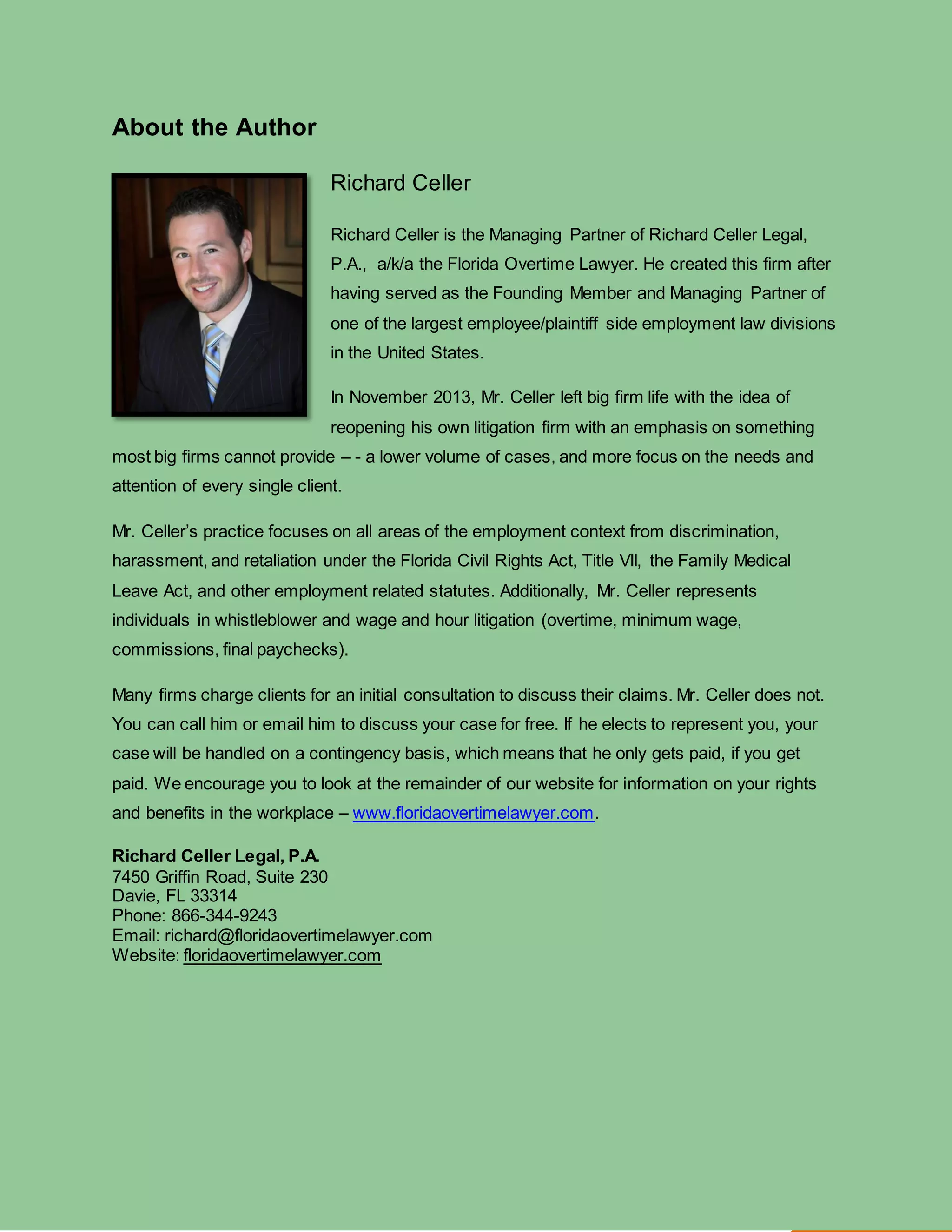
Richard Celler
Richard Celler is the Managing Partner of Richard Celler Legal,
P.A., a/k/a the Florida Overtime Lawyer. He created this firm after
having served as the Founding Member and Managing Partner of
one of the largest employee/plaintiff side employment law divisions
in the United States.
In November 2013, Mr. Celler left big firm life with the idea of
reopening his own litigation firm with an emphasis on something
most big firms cannot provide – - a lower volume of cases, and more focus on the needs and
attention of every single client.
Mr. Celler’s practice focuses on all areas of the employment context from discrimination,
harassment, and retaliation under the Florida Civil Rights Act, Title VII, the Family Medical
Leave Act, and other employment related statutes. Additionally, Mr. Celler represents
individuals in whistleblower and wage and hour litigation (overtime, minimum wage,
commissions, final paychecks).
Many firms charge clients for an initial consultation to discuss their claims. Mr. Celler does not.
You can call him or email him to discuss your case for free. If he elects to represent you, your
case will be handled on a contingency basis, which means that he only gets paid, if you get
paid. We encourage you to look at the remainder of our website for information on your rights
and benefits in the workplace – www.floridaovertimelawyer.com.
Richard Celler Legal, P.A.
7450 Griffin Road, Suite 230
Davie, FL 33314
Phone: 866-344-9243
Email: richard@floridaovertimelawyer.com
Website: floridaovertimelawyer.com

Religious Discrimination in the Workplace: What You Need to Know

  • 1.
    RELIGIOUS DISCRIMINATION IN THE WORKPLACE WhatYou Need To Know “As an employee you should have at least a basic understanding of the laws relating to religious discrimination in the workplace so you may be able to identify a violation of your rights should one occur.” Richard Celler
  • 2.
    Religious Discrimination inthe Workplace: What You Need To Know floridaovertimelawyer.com 2 American has long been known as the “melting pot” because of the diversity of people who live and work in the U.S. That diversity can be measured by a variety of factors including ethnicity, national origin, and religious affiliation. The desire for religious tolerance, in fact, was one of the driving forces that led the original settlers to set sail across the Atlantic to the “New World.” Today, religious freedom is an important aspectof life in America and, as such, is heavily protected by law. Both state and federal laws, for example, make it illegal to discriminate against an employee of the basis of religion. What exactly does that mean though? As an employee you should have at least a basic understanding of the laws relating to religious discrimination in the workplace so you may be able to identify a violation of your rights should one occur.
  • 3.
    Religious Discrimination inthe Workplace: What You Need To Know floridaovertimelawyer.com 3 TITLE VII OF THE CIVIL RIGHTS ACT OF 1964 During the “Civil Rights” decade of the 1960s,a landmark piece of legislation was passed by the United States government known as the “Civil Rights Act of 1964.” Title VII of the Civil Rights Act prohibits discrimination in employmenton the basis of race, color, sex, national origin, or religion. The prohibitions found in Title VII are broad, making it illegal to discriminate in any aspectof employment,including hiring, firing, pay, job assignments,promotions,layoff, training, fringe benefits,and any other term or condition of employment. THE FLORIDA CIVIL RIGHTS ACT The Florida Civil Rights Act is effectivelythe state counterpart to the federal Civil Rights Act of 1964.Like the federalversion, the Florida Civil Rights Act, or FCRA,also prohibits discrimination in the workplace based on number of traits or characteristics,including religion. HOW IS “RELIGION” DEFINED? In the non-legal context it may seem easy enough to define the word “religion.” Most people think of a “religion” as a well-established, organized faith with specificpractices and definite places of worship. As the term is used in the Civil Rights Act, however, “religion” is broadly defined.Religion certainly includes traditional, organized religions such as Christianity, Judaism, Islam, Hinduism, and Buddhism; however, it may also include unorthodox, non-traditional, and informal beliefs.Furthermore,religious
  • 4.
    Religious Discrimination inthe Workplace: What You Need To Know floridaovertimelawyer.com 4 beliefs need not be well established,common,or even held by numerous people in order to be protected. WHAT IS A “SINCERELY HELD RELIGIOUS BELIEF?” Because employers are required to make accommodations forreligious beliefs if they are “sincerelyheld” it is important to understand how the law defines that term. Just as the word “religion” is broadly defined in Title VII and the FCRA, so is the term “sincerelyheld religious beliefs.” In their compliance manual, the Equal Opportunity EmploymentCommission,or EEOC,has this to say about religious beliefs: “Religiousbeliefs,practices,and observancesincludethose that are theisticin nature,as well as non-theistic“moralor ethicalbeliefsas to what is right and wrong which are sincerelyheld with the strength of traditionalreligious views.” Religiousbeliefs can includeunique views heldby a few or even one individual;however,mere personal preferences are not religious beliefs.” IS AN EMPLOYER REQUIRED TO ACCOMMODATE RELIGIOUS PRACTICES? In the United States, religious pluralism in the workforce is the norm in the 21stcentury. It is commonto have several very distinct religions represented in even a relatively small workplace. This can create issues for an employergiven the variety of differing religious practices found even among mainstream religions. For example, Christians considerSunday to
  • 5.
    Religious Discrimination inthe Workplace: What You Need To Know floridaovertimelawyer.com 5 be the Sabbath, or day of rest, while Jews observe “Shabbat” from sundown on Friday until the appearance of three stars in the sky on Saturday night. Practitioners of Islam stop and pray several times a day as part of their religion while the Amish abide by a very strict dress code.Any of these religious beliefs or practices can conflictwith an employer’s general practices or procedures in the workplace. The good news for employees,however, is that a covered employeris required to make reasonable accommodations forthe religious beliefs and practices of an applicant or employee unless doing so would create and undue hardship on the employer. WHAT IS AN “UNDUE HARDSHIP?” The “undue burden” caveat to the reasonable accommodations requirement may, at first read, sound like the escape clause for an employerto avoid accommodating an employee’sreligious beliefs or practices;however, the term “undue hardship” has been interpreted narrowly, in favor of employees, by the courts which is good news for employees.The requested accommodationmust pose more than a minimal burden on the employerfor the employerto refuse the request. If the requestinvolves scheduling, an employermust allow co-workers to voluntarily switch shifts or schedules in order to facilitate the request. Examples that have been found to amount to an undue hardship include accommodations that: Violate a seniority system Cause a lack of necessarystaffing
  • 6.
    Religious Discrimination inthe Workplace: What You Need To Know floridaovertimelawyer.com 6 Jeopardize security or health Cost the employermore than a minimal amount WHAT ARE SOME COMMON ACCOMMODATIONS? Given the diversity of religions represented in the United States, and the even broaderscope of religious practices associated with the various religions found in the American workforce,the list of accommodations an employercould be asked to make is virtually endless;however, the following are examples of relatively commonrequests an employermay receive based on religious beliefs and practices: Being excused from the company dress code Being allowed to stop and pray at specific times each day Not working on Saturday, Sunday, or another specificday each week. Not working on religious holidays Not working on specificproducts in a factory (such as a Jehovah’s Witness not wanting to work on the productionof weapons) Being excused from a traditional prayer ceremonyheld at the beginning of meetings
  • 7.
    Religious Discrimination inthe Workplace: What You Need To Know floridaovertimelawyer.com 7 WHAT CAN I DO IF MY EMPLOYER HAS VIOLATED MYRIGHTS? If you believe your current employer,or a prospective employer,has violated your rights by discriminating against you on the basis of your religious beliefs or practices you may have the basis for a state or federal employmentdiscrimination lawsuit. Consult with an experienced Florida employmentlaw attorney as soonas possible to discuss your legal options. Florida Commissionon Human Relations, Chapter 760, Florida Statutes EEOC,Religious Discrimination EEOC,Facts about Religious Discrimination EEOC,Compliance Manual Religious Discrimination U.S. Departmentof Justice, Religious Discrimination in Employment
  • 8.
    Religious Discrimination inthe Workplace: What You Need To Know floridaovertimelawyer.com 8 About the Author Richard Celler Richard Celler is the Managing Partner of Richard Celler Legal, P.A., a/k/a the Florida Overtime Lawyer. He created this firm after having served as the Founding Member and Managing Partner of one of the largest employee/plaintiff side employment law divisions in the United States. In November 2013, Mr. Celler left big firm life with the idea of reopening his own litigation firm with an emphasis on something most big firms cannot provide – - a lower volume of cases, and more focus on the needs and attention of every single client. Mr. Celler’s practice focuses on all areas of the employment context from discrimination, harassment, and retaliation under the Florida Civil Rights Act, Title VII, the Family Medical Leave Act, and other employment related statutes. Additionally, Mr. Celler represents individuals in whistleblower and wage and hour litigation (overtime, minimum wage, commissions, final paychecks). Many firms charge clients for an initial consultation to discuss their claims. Mr. Celler does not. You can call him or email him to discuss your case for free. If he elects to represent you, your case will be handled on a contingency basis, which means that he only gets paid, if you get paid. We encourage you to look at the remainder of our website for information on your rights and benefits in the workplace – www.floridaovertimelawyer.com. Richard Celler Legal, P.A. 7450 Griffin Road, Suite 230 Davie, FL 33314 Phone: 866-344-9243 Email: richard@floridaovertimelawyer.com Website: floridaovertimelawyer.com