PEDIATRIC EMERGENCIES
Pediatric Emergencies
• Basic Approach to Pediatric Emergencies
  – Approaches to patient vary with age and nature
    of incident
  – Practice quick and specific questioning of the
    child
  – Key on your visual assessment
  – Begin your exam without instruments
  – Approach the child slowly and gently
Pediatric Emergencies
• Basic Approach (cont..)
  – Do not separate the child from the mother
    unnecessarily
  – Be honest and allow the child to determine the
    order of the exam
  – Avoid touching painful areas until the child’s
    confidence has been gained
Pediatric Emergencies
• Child’s response to emergencies
  – Primary response is fear
      •   Fear of being separated from parents
      •   Fear of being removed from home
      •   Fear of being hurt
      •   Fear of mutilation
      •   Fear of the unknown
   – Combat the fear with calm, honest approach
      • Be honest - tell them it will hurt if it will
      • Use approach language
Development Stages -
         Keys to Assessment
• Neonatal stage - birth to 1 month
  – Congenital problems and other illnesses often n
    noted
  – Personality development begins
  – Stares at faces and smiles
  – Easily comforted by mother and sometimes
    father
  – Rarely febrile, but if so, be cautious of
    meningitis
Development Stages -
           Keys to Assessment
• Approach to Neonates
  –   Keep child warm
  –   Observe skin color, tone and respiratory activity
  –   Absence of tears when crying indicates dehydration
  –   Auscultate the lungs early when child is quiet
  –   Have the child suck on a pacifier
  –   Have child remain on the mother’s lap
Development Stages -
         Keys to Assessment
• Ages 1-5 months - Characteristics
  – Birth weight doubles
  – Can follow movements with their eyes
  – Muscle control develops
  – History must be obtained from parents
• Approach
  – Keep child warm and comfortable
  – Have child remain in mother’s lap
  – Use a pacifier or a bottle
Development Stages -
          Keys to Assessment
• Ages 1-5 months - Common problems
  –   SIDS
  –   Vomiting and diarrhea/dehydration
  –   Meningitis
  –   Child abuse
  –   Household accidents
Development Stages -
         Keys to Assessment
• Ages 6-2 months - Characteristics
  – Ability to stand or walk with assistance
  – Very active and explore the world with their
    mouths
  – Stranger anxiety
  – Do not like lying supine
  – Cling to their mothers
Development Stages -
          Keys to Assessment
• Ages 6-12 months - Common problems
  –   Febrile seizures
  –   Vomiting and diarrhea/dehydration
  –   Bronchiolitis or croup
  –   Car accidents and falls
  –   Child abuse
  –   Ingestions and foreign body obstructions
  –   Meningitis
Development Stages -
        Keys to Assessment
• Ages 6-12 months - Approach
  – Examine the child in the mothers lap
  – Progress from toe to head
  – Allow the child to get used to you
Development Stages -
          Keys to Assessment
• Ages 1-3 years - Characteristics
  –   Motor development, always on the move
  –   Language development
  –   Child begins to stray from mother
  –   Child can be asked certain questions
  –   Accidents prevail
Development Stages -
          Keys to Assessment
• Ages 1-3 yrs - Common problems
  –   Auto accidents
  –   Vomiting and diarrhea
  –   Febrile seizures
  –   Croup, meningitis
  –   Foreign body obstruction
Development Stages -
          Keys to Assessment
• Ages 1-3 yrs - Approach
  –   Cautious approach to gain confidence
  –   Child may resist physical exam
  –   Avoid “no” answers
  –   Tell the child if something will hurt
Development Stages -
         Keys to Assessment
• Ages 3-5 years - Characteristics
  – Tremendous increase in motor development
  – Language is almost perfect but patients may not
    wish to talk
  – Afraid of monsters, strangers; fear of mutilation
  – Look to parent for comfort and protection
Development Stages -
           Keys to Assessment
• Ages 3-5 yrs - Common problems
  –   Croup, asthma, epiglottitis
  –   Ingestions, foreign bodies
  –   Auto accidents, burns
  –   Child abuse
  –   Drowning
  –   Meningitis, febrile seizures
Development Stages -
         Keys to Assessment
• Ages 3-5 yrs - Approach
  – Interview child first, have parents fill in gaps
  – Use doll or stuffed animal to assist in
    assessment
  – Allow child to hold & use equipment
  – Allow them to sit on your lap
  – Always explain what you are going to do
Development Stages -
          Keys to Assessment
• Ages 6-12 years - Characteristics
  – Active and carefree
  – Great growth, clumsiness
  – Personality changes
  – Strive for their parent’s attention
• Common problems
  – Drowning
  – Auto accidents, bicycle accidents
  – Fractures, falls, sporting injuries
Development Stages -
          Keys to Assessment
• Age 6-12 yrs - approach
  –   Interview the child first
  –   Protect their privacy
  –   Be honest and tell them what is wrong
  –   They may cover up information if they were
      disobeying
Development Stages -
         Keys to Assessment
• Ages 12-15 - Characteristics
  – Varied development
  – Concerned with body image and very
    independent
  – Peers are highly important, as is interest in
    opposite sex
Development Stages -
           Keys to Assessment
• Ages 12-15 - Common problems
  –   Mononucleosis
  –   Auto accidents, sports injuries
  –   Asthma
  –   Drug and alcohol abuse
  –   Sexual abuse, pregnancy
  –   Suicide gestures
Development Stages -
         Keys to Assessment
• Ages 12-15 - Approach
  – Interview the child away from parent
  – Pay attention to what they are not saying
Development Stages -
         Keys to Assessment
• Characteristics of Parents response to
  emergencies
  – Expect a grief reaction
  – Initial guilt, fear, anger, denial, shock and loss
    of control
  – Behavior likely to change during course of
    emergency
Development Stages -
           Keys to Assessment
• Parent Management
  –   Tell them your name and qualifications
  –   Acknowledge their fears and concerns
  –   Reassure them it is all right to feel as they do
  –   Redirect their energies - help you care for child
  –   Remain calm and in control
  –   Keep them informed as to what you are doing
  –   Don’t “talk down” to parents
  –   Assure parents that everything is being done
General Approach to
          Pediatric Assessment
• History
  –   Be direct and specific with child
  –   Focus on observed behavior
  –   Focus on what child and parents say
  –   Approach child gently, encourage cooperation
  –   Get down to visual level of child
  –   Use a soft voice and simple words
Physical Exam
• Avoid touching painful areas until
  confidence has been gained
• Begin exam without instruments
• Allow child to determine order of exam if
  practical
• Use the same format as adult physical exam
General Approach to
        Pediatric Assessment
• Physical Exam (cont.)
  – Special concerns
     • Fontanels should be inspected in infants
        –   Normal fontanels should be level with surface of the skull
            or slightly sunken and it may pulsate
        –   Abnormal fontanels
              • Tight and bulging (increased ICP from trauma or
                 meningitis)
              • Diminished or absent pulsation
              • Sunken if dehydrated
General Approach to
        Pediatric Assessment
• Special concerns (cont..)
  – GI Problems
     • Disturbances are common
     • Determine number of episodes of vomiting, amount
       and color of emesis
Pediatric Vital Signs
• Blood Pressure
  – Use right size cuff, one that is two-thirds the
    width of the upper arm
• Pulse
  – Brachial, carotid or radial depending on child
  – Monitor for 30 seconds
Pediatric Vital Signs
• Respirations
  –   Observe the rate before the child starts to cry
  –   Upper limit is 40 minus child’s age
  –   Identify respiratory pattern
  –   Look for retractions, nasal flaring, paradoxical
      chest movement
• Level of consciousness
  – Observe and record
Noninvasive Monitoring
• Prepare the child before using devices
  – Explain the device
  – Show the display and lights
  – Let child hear noises if devices makes them
• Pulse oximetry-particularly useful since so
  many childhood emergencies are
  respiratory
Pediatric Trauma
• Basics
  – Trauma is leading cause of death in children
  – Most common mechanisms-MVA, burns, drowning,
    falls, and firearms
  – Most commonly injured body areas-head, trunk,
    extremities
  – Steps much like those in adult trauma
      • Complete ABCDE’s of primary assessment
      • Correct life threatening conditions
      • Proceed to secondary assessment
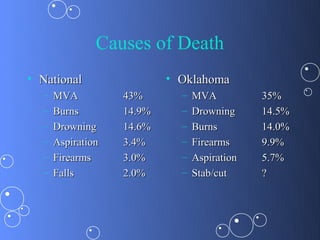
Causes of Death
• National                 • Oklahoma
  –   MVA          43%       –   MVA          35%
  –   Burns        14.9%     –   Drowning     14.5%
  –   Drowning     14.6%     –   Burns        14.0%
  –   Aspiration   3.4%      –   Firearms     9.9%
  –   Firearms     3.0%      –   Aspiration   5.7%
  –   Falls        2.0%      –   Stab/cut     ?
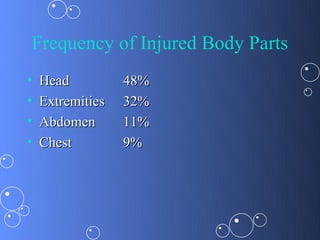
Frequency of Injured Body Parts
•   Head          48%
•   Extremities   32%
•   Abdomen       11%
•   Chest         9%
Pediatric Trauma
• Head, face, and neck injuries
  –   Children prone to head injuries
  –   Be alert for signs of child abuse
  –   Facial injuries common secondary to falls
  –   Always assume a spinal injury with head injury
Pediatric Trauma
• Chest and abdominal injuries
  – Second most common cause of pediatric trauma
    deaths
  – Most result from blunt trauma
  – Spleen is most commonly injured organ
  – Treat aggressively for shock in blunt abdominal
    injury
Pediatric Trauma
• Extremity injuries
  – Usually limited to fractures and lacerations
  – Most fractures are incomplete - bend, buckle,,
    and greenstick fractures
  – Watch for growth plate injuries
Pediatric Trauma
• Burns
  – Second leading cause of pediatric deaths
  – Scald burns are most common
  – Rule of nine is different for children
     • Each leg worth 13.5%
     • Head worth 18%
Pediatric Trauma
• Child abuse and neglect - Basics
  – Suspect if injuries inconsistent with history
  – Children at greater risk often seen as “special”
    and different
     •   Premature or twins
     •   Handicapped
     •   Uncommunicative (autistic)
     •   Boys or child of the “wrong” sex
Pediatric Trauma
• Child abuse and neglect - The child abuser
  – Usually a parent or someone in the role of
    parent
  – Usually spends much time with child
  – Usually abused as a child
Pediatric Trauma
• Sexual Abuse - Basics
  –   Can occur at any age
  –   Abuser is usually someone in family
  –   Can be someone the child trusts
  –   Stepchildren or adopted children at higher risk
• Paramedic actions
  –   Examine genitalia for serious injury only
  –   Avoid touching the child or disturbing clothing
  –   Provide caring support
Pediatric Trauma
• Triggers to high index of suspicion for child
  neglect
  –   Extreme malnutrition
  –   Multiple insect bites
  –   Long-standing skin infections
  –   Extreme lack of cleanliness
Pediatric Trauma
• Triggers to high index of suspicion for child
  abuse
  – Obvious fracture in child under 2 yrs old
  – Injuries in various stages of healing
  – More injuries than usually seen in children of
    same age
  – Injuries scattered on many areas of body
  – Bruises that suggest intentional infliction
  – Increased ICP in infant
Pediatric Trauma
• Triggers to high index of suspicion for child abuse
  (cont.)
   –   Suspected intra-abdominal trauma in child
   –   Injuries inconsistent with history
   –   Parent’s account vague or changes during interview
   –   Accusations that child injured himself intentionally
   –   Delay in seeking help
   –   Child dresses inappropriately for situation
Pediatric Trauma
• Management of potentially abused child
   –   Treat all injuries appropriately
   –   Protect the child from further abuse
   –   Notify the proper authorities
   –   Be objective while gaining information
   –   Be supportive and nonjudgmental of parents
   –   Don’t allow abuser to transport child to hospital
   –   Inform ED staff of suspicions of child abuse
   –   Document completely and thoroughly
Pediatric Medical Emergencies -
          Neurological
• Pediatric seizures - Common causes
   –   Fever, infections
   –   Hypoxia
   –   Idiopathic epilepsy
   –   Electrolyte disturbances
   –   Head trauma
   –   Hypoglycemia
   –   Toxic ingestion or exposure
   –   Tumors or CNS malformations
Pediatric Medical Emergencies -
          Neurological
• Febrile Seizures
   –   Result from a sudden increase in body temperature
   –   Most common between 6 months and 6 years
   –   Related to rate of increase, not degree of fever
   –   Recent onset of cold or fever often reported
   –   Patients must be transported to hospital
Pediatric Medical Emergencies -
          Neurological
• Assessment
  – Temperature - suspect febrile seizure if temp over 103
    degrees F
  – History of seizure
  – Description of seizure activity
  – Position and condition of child when found
  – Head injury, Respirations
  – History of diabetes, family history
  – Signs of dehydration
Pediatric Medical Emergencies -
          Neurological
• Management - Basic Steps
  – Protect seizing child
  – Manage the ABC’s, provide supplemental
    oxygen
  – Remove excess layers of clothing
  – IV of NS or LR TKO rate
  – Transport all seizure patients, support the
    parents
Pediatric Medical Emergencies -
          Neurological
• Management - If status epilepticus
  – IV of NS or LR TKO rate
  – Perform a Dextrostix <80 mg/dl give D25 2
    ml/kg IV/IO if child is less than 12
  – 12 or older give D50 1ml/kg IV
  – Contact Medical Control if long transport
Pediatric Medical Emergencies -
          Neurological
• Meningitis - Basics
  –   Infection of the meninges
  –   Can result from virus or bacteria
  –   More common in children than in adults
  –   Infection can be fatal if unrecognized and
      untreated
Meningitis
• Assessment
  –   History of recent illness
  –   Headache, stiff neck
  –   Child appears very ill
  –   Bulging fontanelles in infants
  –   Extreme discomfort in movement
Meningitis
• Management
  – Monitor ABC’s and vital signs
  – High flow O2, prepare to assist with
    ventilations
  – IV/IO of LR or NS
  – Fluid bolus of 20 ml/kg IV/IO push
     • Repeat if no improvement
  – Orotracheal intubation if child's condition
    warrants
Pediatric Medical Emergencies -
             Neurological
• Reye’s syndrome - Basics
  – “New” disease - Correlated with ASA use
   –   Peak incident in patients between 5-15 years
   –   Frequency higher in winter
   –   Higher frequency in suburban and rural population
   –   No single etiology identified
        •   Possibly toxic or metabolic problem
        •   Tends to occur during influenza B outbreaks
        •   Associated with chicken pox virus
        •   Correlation with use of aspirin use in children
Pediatric Medical Emergencies -
            Neurological
• Reye’s syndrome - Complications
  – Respiratory failure
  – Cardiac arrhythmias
  – Acute pancreatitis
Pediatric Medical Emergencies -
            Neurological
• Assessment - Reyes Syndrome
  –   Severe nausea & vomiting
  –   Hyperactivity or combative behavior
  –   Personality changes, irrational behavior
  –   Progression of restlessness, stupor, convulsions, coma
  –   Recent history of chicken pox in 10-20% of cases
  –   Recent upper respiratory infections or gastroenteritis
  –   Rapid deep respirations, may be irregular
  –   Pupils dilated & sluggish
  –   Signs of increased ICP
Pediatric Medical Emergencies -
            Neurological
• Reye’s syndrome - Management
  –   General and supportive
  –   Maintain ABC’s
  –   Administer supplemental oxygen
  –   Rapid transport
Child’s Airway vs.. Adults
• Smaller septum & nasal bridge is flat and flexible
• Vocal cords located at C3-4 versus C5-6 in adults
   – Contributes to aspiration if neck is hyperextended
• Narrowest at cricoid ring instead of vocal cords
• Airway diameter is 4 mm vs.. 20 mm in adult
• Tracheal rings more elastic & cartilaginous, can easily
  crimp off trachea
• More smooth muscle , makes airway more reactive or
  sensitive to foreign substances
5 Most Common Respiratory
               Emergencies
•   Asthma
•   Bronchiolitis
•   Croup
•   Epiglotitis
•   Foreign bodies
Asthma
• Pathophysiology
  – Chronic recurrent lower airway disease with episodic
    attacks of bronchial constriction
     • Precipitating factors include exercise, psychological stress,
       respiratory infections, and changes in weather & temperature
     • Occurs commonly during preschool years, but also presents as
       young as 1 year of age
  – Decrease size of child’s airway due to edema & mucus
    leads to further compromise
Asthma
• Assessment
  – History
     • When was last attack & how severe was it
     • Fever
     • Medications, treatments administered
  – Physical Exam
     • SOB, shallow, irregular respirations, increased or decreased
       respiratory rate
     • Pale, mottled, cyanotic, cherry red lips
     • Restless & scared
     • Inspiratory & expiratory wheezing, rhonchi
     • Tripod position
Asthma
• Management
  –   Assess & monitor ABC’s
  –   Big O’s (Humidified if possible)
  –   IV of LR or NS at a TKO rate
  –   Assist with prescribed medications
  –   Prepare for vomiting
  –   Pulse oximeter
  –   Intubate if airway management becomes difficult or
      fails
Bronchiolitis
• Basics
  – Respiratory infection of the bronchioles
  – Occurs in early childhood (younger than 1 yr)
  – Caused by viral infection
• Assessment/History
  –   Length of illness or fever
  –   has infant been seen by a doctor
  –   Taking any medications
  –   Any previous asthma attacks or other allergy problems
  –   How much fluid has the child been drinking
Bronchiolitis
• Signs & symptoms
  –   Acute respiratory distress
  –   Tachypnea
  –   May have intercostal and suprasternal retractions
  –   Cyanosis
  –   Fever & dry cough
  –   May have wheezes - inspiratory & expiratory
  –   Confused & anxious mental status
  –   Possible dehydration
Bronchiolitis
• Management
  –   Assess & maintain airway
  –   When appropriate let child pick POC
  –   Clear nasal passages if necessary
  –   Prepare to assist with ventilations
  –   IV LR or NS TKO rate
  –   Intubate if airway management becomes
      difficult or fails
Croup
• Basics
  –   Upper respiratory viral infection
  –   Occurs mostly among ages 6 months to 3 years
  –   More prevalent in fall and spring
  –   Edema develops, narrowing the airway lumen
  –   Severe cases may result in complete obstruction
Croup
• Assessment/History
  –   What treatment or meds have been given?
  –   How effective?
  –   Any difficulty swallowing?
  –   Drooling present?
  –   Has the child been ill?
  –   What symptoms are present & how have they changed?
Croup
• Physical exam
  –   Tachycardia, tachypnea
  –   Skin color - pale, cyanotic, mottled
  –   Decrease in activity or LOC
  –   Fever
  –   Breath sounds - wheezing, diminished breath sounds
  –   Stridor, barking cough, hoarse cry or voice
Croup
• Management
  – Assess & monitor ABC’s
  – High flow humidified O2; blow by if child won’t
    tolerate mask
  – Limit exam/handling to avoid agitation
  – Be prepared for respiratory arrest, assist ventilations
    and perform CPR as needed
  – Do not place instruments in mouth or throat
  – Rapid transport
Epiglotitis
• Basics
  –   Bacterial infection and inflammation of the epiglottis
  –   Usually occurs in children 3-6 years of age
  –   Can occur in infants, older children, & adults
  –   Swelling may cause complete airway obstruction
  –   True medical emergency
Epiglotitis
• Assessment/History
  – When did child become ill?
  – Has it suddenly worsened after a couple of days or
    hours?
  – Sore throat?
  – Will child swallow liquids or saliva?
  – Is drooling present?
  – High fever (102-103 degrees F)
  – Onset is usually sudden
Epiglotitis
• Signs & Symptoms
  –   May be sitting in Tripod position
  –   May be holding mouth open, with tongue protruding
  –   Muffled or hoarse cry
  –   Inspiratory stridor
  –   Tachycardia, tachypnea
  –   Pale, mottled, cyanotic skin
  –   Anxious, focused on breathing, lethargic
  –   Very sore throat
  –   Nasal flaring
  –   Look very sick with high fever
Epiglotitis

• Management
  – Assess & monitor ABC’s
  – Do not make child lie down
  – Do not manipulate airway
  – High flow humidified O2; blow by if child won’t
    tolerate mask
  – Limit exam/handling to avoid agitation
  – Be prepared for respiratory arrest, assist ventilations
    and perform CPR as needed
  – Contact medical control
Aspirated Foreign Body
• Basics
  – Common among the 1-3 age group who like to
    put everything in their mouths
  – Running or falling with objects in mouth
  – Inadequate chewing capabilities
  – Common items - gum, hot dogs, grapes and
    peanuts
Aspirated Foreign Body
• Assessment
  – Complete obstruction will present as apnea
  – Partial obstruction may present as labored
    breathing, retractions, and cyanosis
  – Objects can lodge in the lower or upper airways
    depending on size
  – Object may act as one-way valve allowing air
    in, but not out
Aspirated Foreign Body
• Management - Complete Obstruction
  – Attempt to clear using BLS techniques
  – Attempt removal with direct laryngoscopy and
    Magill forceps
  – Cricothyrotomy may be indicated
Aspirated Foreign Body
• Management - Partial obstruction
  –   Make child comfortable
  –   Administer humidified oxygen
  –   Encourage child to cough
  –   Have intubation equipment available
  –   Transport to hospital for removal with
      bronchoscope
Mild, Moderate, & Severe Dehydration

• History
  –   Previous seizures, when it began, how long
  –   Reason for seizure
  –   When were fluids last taken, how much, is it usual for
      the child
  –   Current fever or medical illness
  –   Behavior during seizure
  –   Last wet diaper
  –   Any vomiting or diarrhea
  –   Other medical problems
Mild, Moderate, & Severe Dehydration

• Physical Assessment/Signs & symptoms
  – Onset very abrupt
  – Sudden jerking of entire body, tenseness, then
    relaxation
  – LOC or confusion
  – Sudden jerking of one body part
  – Lip smacking, eye blinking, staring
  – Sleeping following seizure
Mild, Moderate, & Severe Dehydration

• Physical Assessment/ Vital signs
  – Capillary refill
  – Skin color
  – Alertness, activity level
Mild, Moderate, & Severe Dehydration

• Mild dehydration
  – Infants lose up to 5% of their body weight
  – Child lose up to 3-4% of their body weight
  – Physical signs of dehydration are barely visable
Mild, Moderate, & Severe Dehydration

• Moderate Dehydration
  – Infants lose up to 10% of their body weight
  – Children lose up to 6-8% of their body weight
  – Poor skin color & turgor, dry mucous
    membranes, decreased urine output & increased
    thirst, no tears
Mild, Moderate, & Severe Dehydration

• Severe Dehydration
  – Infants lose up to 15% of their body weight
  – Child lose up to 10-13% of their body weight
  – Danger of life-threatening hypovolemic shock
Mild, Moderate, & Severe Dehydration

• Management
  – If mild or moderate
     • Give fluids orally if there is no abdominal pain,
       vomiting or diarrhea and is alert
  – Severe
     •   High flow O2
     •   IV/IO with NS or LR
     •   Fluid bolus of 20 ml/kg IV/IO push
     •   Repeat fluid bolus if no improvement
Congenital Heart Disease
• Blood is permitted to mix in the 2
  circulatory pathways
  –   Primary cause of heart disease in children
  –   Various structures may be defective
  –   Hypoxemia usually results
Congenital Heart Disease
• History
  –   Name of defect to share with medical control
  –   Any meds taken routinely, were they taken today
  –   Any other home therapies (O2, feeding devices)
  –   Any recent illness or stress
  –   Child's color
  –   What kind of spell, how long did it last
  –   Ant treatment given
Congenital Heart Disease
• Signs & symptoms
  – Intercostal retractions, difficulty breathing, tachypnea,
    crackles or wheezing on auscultation
  – Tachycardia, cyanosis with some defects
  – Altered LOC, limpness of extremities, drowsiness
  – Cool moist skin, cyanosis, pallor
  – Tires easily, irritable if disturbed, underdeveloped for
    age
  – Uncontrollable crying, irritability
  – Severe breathing difficulty, progressive cyanosis
  – Loss of consciousness, seizure, cardiac arrest
Congenital Heart Disease
• Management
  –   Monitor ABC’s & vitals
  –   Maintain airway/administer high flow O2
  –   Assist ventilations as needed, intubate if needed
  –   Cyanotic spell, place in knee chest position
  –   Prepare to perform CPR
  –   Establish IV TKO if lengthy transport time is
      anticipated
Home High Technology Equipment

• Chronic & terminal illness
  – Respiratory & cardiac
     •   Premature infants
     •   Cystic Fibrosis
     •   Heart defects & post transplant patients
Home High Technology Equipment

•   Ventilators
•   Suction
•   Oxygen
•   Tracheostomy
•   IV pumps
•   Feeding pumps
Home High Technology Equipment

• Management
  – Support efforts of parents
  – Home equipment malfunction, attach child to
    yours
  – Monitor ABC’s & treat as patient’s condition
    warrants
  – Have hospital notify child’s physician if
    possible

geeeeeee

  • 1.
  • 2.
    Pediatric Emergencies • BasicApproach to Pediatric Emergencies – Approaches to patient vary with age and nature of incident – Practice quick and specific questioning of the child – Key on your visual assessment – Begin your exam without instruments – Approach the child slowly and gently
  • 3.
    Pediatric Emergencies • BasicApproach (cont..) – Do not separate the child from the mother unnecessarily – Be honest and allow the child to determine the order of the exam – Avoid touching painful areas until the child’s confidence has been gained
  • 4.
    Pediatric Emergencies • Child’sresponse to emergencies – Primary response is fear • Fear of being separated from parents • Fear of being removed from home • Fear of being hurt • Fear of mutilation • Fear of the unknown – Combat the fear with calm, honest approach • Be honest - tell them it will hurt if it will • Use approach language
  • 5.
    Development Stages - Keys to Assessment • Neonatal stage - birth to 1 month – Congenital problems and other illnesses often n noted – Personality development begins – Stares at faces and smiles – Easily comforted by mother and sometimes father – Rarely febrile, but if so, be cautious of meningitis
  • 6.
    Development Stages - Keys to Assessment • Approach to Neonates – Keep child warm – Observe skin color, tone and respiratory activity – Absence of tears when crying indicates dehydration – Auscultate the lungs early when child is quiet – Have the child suck on a pacifier – Have child remain on the mother’s lap
  • 7.
    Development Stages - Keys to Assessment • Ages 1-5 months - Characteristics – Birth weight doubles – Can follow movements with their eyes – Muscle control develops – History must be obtained from parents • Approach – Keep child warm and comfortable – Have child remain in mother’s lap – Use a pacifier or a bottle
  • 8.
    Development Stages - Keys to Assessment • Ages 1-5 months - Common problems – SIDS – Vomiting and diarrhea/dehydration – Meningitis – Child abuse – Household accidents
  • 9.
    Development Stages - Keys to Assessment • Ages 6-2 months - Characteristics – Ability to stand or walk with assistance – Very active and explore the world with their mouths – Stranger anxiety – Do not like lying supine – Cling to their mothers
  • 10.
    Development Stages - Keys to Assessment • Ages 6-12 months - Common problems – Febrile seizures – Vomiting and diarrhea/dehydration – Bronchiolitis or croup – Car accidents and falls – Child abuse – Ingestions and foreign body obstructions – Meningitis
  • 11.
    Development Stages - Keys to Assessment • Ages 6-12 months - Approach – Examine the child in the mothers lap – Progress from toe to head – Allow the child to get used to you
  • 12.
    Development Stages - Keys to Assessment • Ages 1-3 years - Characteristics – Motor development, always on the move – Language development – Child begins to stray from mother – Child can be asked certain questions – Accidents prevail
  • 13.
    Development Stages - Keys to Assessment • Ages 1-3 yrs - Common problems – Auto accidents – Vomiting and diarrhea – Febrile seizures – Croup, meningitis – Foreign body obstruction
  • 14.
    Development Stages - Keys to Assessment • Ages 1-3 yrs - Approach – Cautious approach to gain confidence – Child may resist physical exam – Avoid “no” answers – Tell the child if something will hurt
  • 15.
    Development Stages - Keys to Assessment • Ages 3-5 years - Characteristics – Tremendous increase in motor development – Language is almost perfect but patients may not wish to talk – Afraid of monsters, strangers; fear of mutilation – Look to parent for comfort and protection
  • 16.
    Development Stages - Keys to Assessment • Ages 3-5 yrs - Common problems – Croup, asthma, epiglottitis – Ingestions, foreign bodies – Auto accidents, burns – Child abuse – Drowning – Meningitis, febrile seizures
  • 17.
    Development Stages - Keys to Assessment • Ages 3-5 yrs - Approach – Interview child first, have parents fill in gaps – Use doll or stuffed animal to assist in assessment – Allow child to hold & use equipment – Allow them to sit on your lap – Always explain what you are going to do
  • 18.
    Development Stages - Keys to Assessment • Ages 6-12 years - Characteristics – Active and carefree – Great growth, clumsiness – Personality changes – Strive for their parent’s attention • Common problems – Drowning – Auto accidents, bicycle accidents – Fractures, falls, sporting injuries
  • 19.
    Development Stages - Keys to Assessment • Age 6-12 yrs - approach – Interview the child first – Protect their privacy – Be honest and tell them what is wrong – They may cover up information if they were disobeying
  • 20.
    Development Stages - Keys to Assessment • Ages 12-15 - Characteristics – Varied development – Concerned with body image and very independent – Peers are highly important, as is interest in opposite sex
  • 21.
    Development Stages - Keys to Assessment • Ages 12-15 - Common problems – Mononucleosis – Auto accidents, sports injuries – Asthma – Drug and alcohol abuse – Sexual abuse, pregnancy – Suicide gestures
  • 22.
    Development Stages - Keys to Assessment • Ages 12-15 - Approach – Interview the child away from parent – Pay attention to what they are not saying
  • 23.
    Development Stages - Keys to Assessment • Characteristics of Parents response to emergencies – Expect a grief reaction – Initial guilt, fear, anger, denial, shock and loss of control – Behavior likely to change during course of emergency
  • 24.
    Development Stages - Keys to Assessment • Parent Management – Tell them your name and qualifications – Acknowledge their fears and concerns – Reassure them it is all right to feel as they do – Redirect their energies - help you care for child – Remain calm and in control – Keep them informed as to what you are doing – Don’t “talk down” to parents – Assure parents that everything is being done
  • 25.
    General Approach to Pediatric Assessment • History – Be direct and specific with child – Focus on observed behavior – Focus on what child and parents say – Approach child gently, encourage cooperation – Get down to visual level of child – Use a soft voice and simple words
  • 26.
    Physical Exam • Avoidtouching painful areas until confidence has been gained • Begin exam without instruments • Allow child to determine order of exam if practical • Use the same format as adult physical exam
  • 27.
    General Approach to Pediatric Assessment • Physical Exam (cont.) – Special concerns • Fontanels should be inspected in infants – Normal fontanels should be level with surface of the skull or slightly sunken and it may pulsate – Abnormal fontanels • Tight and bulging (increased ICP from trauma or meningitis) • Diminished or absent pulsation • Sunken if dehydrated
  • 28.
    General Approach to Pediatric Assessment • Special concerns (cont..) – GI Problems • Disturbances are common • Determine number of episodes of vomiting, amount and color of emesis
  • 29.
    Pediatric Vital Signs •Blood Pressure – Use right size cuff, one that is two-thirds the width of the upper arm • Pulse – Brachial, carotid or radial depending on child – Monitor for 30 seconds
  • 30.
    Pediatric Vital Signs •Respirations – Observe the rate before the child starts to cry – Upper limit is 40 minus child’s age – Identify respiratory pattern – Look for retractions, nasal flaring, paradoxical chest movement • Level of consciousness – Observe and record
  • 31.
    Noninvasive Monitoring • Preparethe child before using devices – Explain the device – Show the display and lights – Let child hear noises if devices makes them • Pulse oximetry-particularly useful since so many childhood emergencies are respiratory
  • 32.
    Pediatric Trauma • Basics – Trauma is leading cause of death in children – Most common mechanisms-MVA, burns, drowning, falls, and firearms – Most commonly injured body areas-head, trunk, extremities – Steps much like those in adult trauma • Complete ABCDE’s of primary assessment • Correct life threatening conditions • Proceed to secondary assessment
  • 33.
    Causes of Death •National • Oklahoma – MVA 43% – MVA 35% – Burns 14.9% – Drowning 14.5% – Drowning 14.6% – Burns 14.0% – Aspiration 3.4% – Firearms 9.9% – Firearms 3.0% – Aspiration 5.7% – Falls 2.0% – Stab/cut ?
  • 34.
    Frequency of InjuredBody Parts • Head 48% • Extremities 32% • Abdomen 11% • Chest 9%
  • 35.
    Pediatric Trauma • Head,face, and neck injuries – Children prone to head injuries – Be alert for signs of child abuse – Facial injuries common secondary to falls – Always assume a spinal injury with head injury
  • 36.
    Pediatric Trauma • Chestand abdominal injuries – Second most common cause of pediatric trauma deaths – Most result from blunt trauma – Spleen is most commonly injured organ – Treat aggressively for shock in blunt abdominal injury
  • 37.
    Pediatric Trauma • Extremityinjuries – Usually limited to fractures and lacerations – Most fractures are incomplete - bend, buckle,, and greenstick fractures – Watch for growth plate injuries
  • 38.
    Pediatric Trauma • Burns – Second leading cause of pediatric deaths – Scald burns are most common – Rule of nine is different for children • Each leg worth 13.5% • Head worth 18%
  • 39.
    Pediatric Trauma • Childabuse and neglect - Basics – Suspect if injuries inconsistent with history – Children at greater risk often seen as “special” and different • Premature or twins • Handicapped • Uncommunicative (autistic) • Boys or child of the “wrong” sex
  • 40.
    Pediatric Trauma • Childabuse and neglect - The child abuser – Usually a parent or someone in the role of parent – Usually spends much time with child – Usually abused as a child
  • 41.
    Pediatric Trauma • SexualAbuse - Basics – Can occur at any age – Abuser is usually someone in family – Can be someone the child trusts – Stepchildren or adopted children at higher risk • Paramedic actions – Examine genitalia for serious injury only – Avoid touching the child or disturbing clothing – Provide caring support
  • 42.
    Pediatric Trauma • Triggersto high index of suspicion for child neglect – Extreme malnutrition – Multiple insect bites – Long-standing skin infections – Extreme lack of cleanliness
  • 43.
    Pediatric Trauma • Triggersto high index of suspicion for child abuse – Obvious fracture in child under 2 yrs old – Injuries in various stages of healing – More injuries than usually seen in children of same age – Injuries scattered on many areas of body – Bruises that suggest intentional infliction – Increased ICP in infant
  • 44.
    Pediatric Trauma • Triggersto high index of suspicion for child abuse (cont.) – Suspected intra-abdominal trauma in child – Injuries inconsistent with history – Parent’s account vague or changes during interview – Accusations that child injured himself intentionally – Delay in seeking help – Child dresses inappropriately for situation
  • 45.
    Pediatric Trauma • Managementof potentially abused child – Treat all injuries appropriately – Protect the child from further abuse – Notify the proper authorities – Be objective while gaining information – Be supportive and nonjudgmental of parents – Don’t allow abuser to transport child to hospital – Inform ED staff of suspicions of child abuse – Document completely and thoroughly
  • 46.
    Pediatric Medical Emergencies- Neurological • Pediatric seizures - Common causes – Fever, infections – Hypoxia – Idiopathic epilepsy – Electrolyte disturbances – Head trauma – Hypoglycemia – Toxic ingestion or exposure – Tumors or CNS malformations
  • 47.
    Pediatric Medical Emergencies- Neurological • Febrile Seizures – Result from a sudden increase in body temperature – Most common between 6 months and 6 years – Related to rate of increase, not degree of fever – Recent onset of cold or fever often reported – Patients must be transported to hospital
  • 48.
    Pediatric Medical Emergencies- Neurological • Assessment – Temperature - suspect febrile seizure if temp over 103 degrees F – History of seizure – Description of seizure activity – Position and condition of child when found – Head injury, Respirations – History of diabetes, family history – Signs of dehydration
  • 49.
    Pediatric Medical Emergencies- Neurological • Management - Basic Steps – Protect seizing child – Manage the ABC’s, provide supplemental oxygen – Remove excess layers of clothing – IV of NS or LR TKO rate – Transport all seizure patients, support the parents
  • 50.
    Pediatric Medical Emergencies- Neurological • Management - If status epilepticus – IV of NS or LR TKO rate – Perform a Dextrostix <80 mg/dl give D25 2 ml/kg IV/IO if child is less than 12 – 12 or older give D50 1ml/kg IV – Contact Medical Control if long transport
  • 51.
    Pediatric Medical Emergencies- Neurological • Meningitis - Basics – Infection of the meninges – Can result from virus or bacteria – More common in children than in adults – Infection can be fatal if unrecognized and untreated
  • 52.
    Meningitis • Assessment – History of recent illness – Headache, stiff neck – Child appears very ill – Bulging fontanelles in infants – Extreme discomfort in movement
  • 53.
    Meningitis • Management – Monitor ABC’s and vital signs – High flow O2, prepare to assist with ventilations – IV/IO of LR or NS – Fluid bolus of 20 ml/kg IV/IO push • Repeat if no improvement – Orotracheal intubation if child's condition warrants
  • 54.
    Pediatric Medical Emergencies- Neurological • Reye’s syndrome - Basics – “New” disease - Correlated with ASA use – Peak incident in patients between 5-15 years – Frequency higher in winter – Higher frequency in suburban and rural population – No single etiology identified • Possibly toxic or metabolic problem • Tends to occur during influenza B outbreaks • Associated with chicken pox virus • Correlation with use of aspirin use in children
  • 55.
    Pediatric Medical Emergencies- Neurological • Reye’s syndrome - Complications – Respiratory failure – Cardiac arrhythmias – Acute pancreatitis
  • 56.
    Pediatric Medical Emergencies- Neurological • Assessment - Reyes Syndrome – Severe nausea & vomiting – Hyperactivity or combative behavior – Personality changes, irrational behavior – Progression of restlessness, stupor, convulsions, coma – Recent history of chicken pox in 10-20% of cases – Recent upper respiratory infections or gastroenteritis – Rapid deep respirations, may be irregular – Pupils dilated & sluggish – Signs of increased ICP
  • 57.
    Pediatric Medical Emergencies- Neurological • Reye’s syndrome - Management – General and supportive – Maintain ABC’s – Administer supplemental oxygen – Rapid transport
  • 58.
    Child’s Airway vs..Adults • Smaller septum & nasal bridge is flat and flexible • Vocal cords located at C3-4 versus C5-6 in adults – Contributes to aspiration if neck is hyperextended • Narrowest at cricoid ring instead of vocal cords • Airway diameter is 4 mm vs.. 20 mm in adult • Tracheal rings more elastic & cartilaginous, can easily crimp off trachea • More smooth muscle , makes airway more reactive or sensitive to foreign substances
  • 59.
    5 Most CommonRespiratory Emergencies • Asthma • Bronchiolitis • Croup • Epiglotitis • Foreign bodies
  • 60.
    Asthma • Pathophysiology – Chronic recurrent lower airway disease with episodic attacks of bronchial constriction • Precipitating factors include exercise, psychological stress, respiratory infections, and changes in weather & temperature • Occurs commonly during preschool years, but also presents as young as 1 year of age – Decrease size of child’s airway due to edema & mucus leads to further compromise
  • 61.
    Asthma • Assessment – History • When was last attack & how severe was it • Fever • Medications, treatments administered – Physical Exam • SOB, shallow, irregular respirations, increased or decreased respiratory rate • Pale, mottled, cyanotic, cherry red lips • Restless & scared • Inspiratory & expiratory wheezing, rhonchi • Tripod position
  • 62.
    Asthma • Management – Assess & monitor ABC’s – Big O’s (Humidified if possible) – IV of LR or NS at a TKO rate – Assist with prescribed medications – Prepare for vomiting – Pulse oximeter – Intubate if airway management becomes difficult or fails
  • 63.
    Bronchiolitis • Basics – Respiratory infection of the bronchioles – Occurs in early childhood (younger than 1 yr) – Caused by viral infection • Assessment/History – Length of illness or fever – has infant been seen by a doctor – Taking any medications – Any previous asthma attacks or other allergy problems – How much fluid has the child been drinking
  • 64.
    Bronchiolitis • Signs &symptoms – Acute respiratory distress – Tachypnea – May have intercostal and suprasternal retractions – Cyanosis – Fever & dry cough – May have wheezes - inspiratory & expiratory – Confused & anxious mental status – Possible dehydration
  • 65.
    Bronchiolitis • Management – Assess & maintain airway – When appropriate let child pick POC – Clear nasal passages if necessary – Prepare to assist with ventilations – IV LR or NS TKO rate – Intubate if airway management becomes difficult or fails
  • 66.
    Croup • Basics – Upper respiratory viral infection – Occurs mostly among ages 6 months to 3 years – More prevalent in fall and spring – Edema develops, narrowing the airway lumen – Severe cases may result in complete obstruction
  • 67.
    Croup • Assessment/History – What treatment or meds have been given? – How effective? – Any difficulty swallowing? – Drooling present? – Has the child been ill? – What symptoms are present & how have they changed?
  • 68.
    Croup • Physical exam – Tachycardia, tachypnea – Skin color - pale, cyanotic, mottled – Decrease in activity or LOC – Fever – Breath sounds - wheezing, diminished breath sounds – Stridor, barking cough, hoarse cry or voice
  • 69.
    Croup • Management – Assess & monitor ABC’s – High flow humidified O2; blow by if child won’t tolerate mask – Limit exam/handling to avoid agitation – Be prepared for respiratory arrest, assist ventilations and perform CPR as needed – Do not place instruments in mouth or throat – Rapid transport
  • 70.
    Epiglotitis • Basics – Bacterial infection and inflammation of the epiglottis – Usually occurs in children 3-6 years of age – Can occur in infants, older children, & adults – Swelling may cause complete airway obstruction – True medical emergency
  • 71.
    Epiglotitis • Assessment/History – When did child become ill? – Has it suddenly worsened after a couple of days or hours? – Sore throat? – Will child swallow liquids or saliva? – Is drooling present? – High fever (102-103 degrees F) – Onset is usually sudden
  • 72.
    Epiglotitis • Signs &Symptoms – May be sitting in Tripod position – May be holding mouth open, with tongue protruding – Muffled or hoarse cry – Inspiratory stridor – Tachycardia, tachypnea – Pale, mottled, cyanotic skin – Anxious, focused on breathing, lethargic – Very sore throat – Nasal flaring – Look very sick with high fever
  • 73.
    Epiglotitis • Management – Assess & monitor ABC’s – Do not make child lie down – Do not manipulate airway – High flow humidified O2; blow by if child won’t tolerate mask – Limit exam/handling to avoid agitation – Be prepared for respiratory arrest, assist ventilations and perform CPR as needed – Contact medical control
  • 74.
    Aspirated Foreign Body •Basics – Common among the 1-3 age group who like to put everything in their mouths – Running or falling with objects in mouth – Inadequate chewing capabilities – Common items - gum, hot dogs, grapes and peanuts
  • 75.
    Aspirated Foreign Body •Assessment – Complete obstruction will present as apnea – Partial obstruction may present as labored breathing, retractions, and cyanosis – Objects can lodge in the lower or upper airways depending on size – Object may act as one-way valve allowing air in, but not out
  • 76.
    Aspirated Foreign Body •Management - Complete Obstruction – Attempt to clear using BLS techniques – Attempt removal with direct laryngoscopy and Magill forceps – Cricothyrotomy may be indicated
  • 77.
    Aspirated Foreign Body •Management - Partial obstruction – Make child comfortable – Administer humidified oxygen – Encourage child to cough – Have intubation equipment available – Transport to hospital for removal with bronchoscope
  • 78.
    Mild, Moderate, &Severe Dehydration • History – Previous seizures, when it began, how long – Reason for seizure – When were fluids last taken, how much, is it usual for the child – Current fever or medical illness – Behavior during seizure – Last wet diaper – Any vomiting or diarrhea – Other medical problems
  • 79.
    Mild, Moderate, &Severe Dehydration • Physical Assessment/Signs & symptoms – Onset very abrupt – Sudden jerking of entire body, tenseness, then relaxation – LOC or confusion – Sudden jerking of one body part – Lip smacking, eye blinking, staring – Sleeping following seizure
  • 80.
    Mild, Moderate, &Severe Dehydration • Physical Assessment/ Vital signs – Capillary refill – Skin color – Alertness, activity level
  • 81.
    Mild, Moderate, &Severe Dehydration • Mild dehydration – Infants lose up to 5% of their body weight – Child lose up to 3-4% of their body weight – Physical signs of dehydration are barely visable
  • 82.
    Mild, Moderate, &Severe Dehydration • Moderate Dehydration – Infants lose up to 10% of their body weight – Children lose up to 6-8% of their body weight – Poor skin color & turgor, dry mucous membranes, decreased urine output & increased thirst, no tears
  • 83.
    Mild, Moderate, &Severe Dehydration • Severe Dehydration – Infants lose up to 15% of their body weight – Child lose up to 10-13% of their body weight – Danger of life-threatening hypovolemic shock
  • 84.
    Mild, Moderate, &Severe Dehydration • Management – If mild or moderate • Give fluids orally if there is no abdominal pain, vomiting or diarrhea and is alert – Severe • High flow O2 • IV/IO with NS or LR • Fluid bolus of 20 ml/kg IV/IO push • Repeat fluid bolus if no improvement
  • 85.
    Congenital Heart Disease •Blood is permitted to mix in the 2 circulatory pathways – Primary cause of heart disease in children – Various structures may be defective – Hypoxemia usually results
  • 86.
    Congenital Heart Disease •History – Name of defect to share with medical control – Any meds taken routinely, were they taken today – Any other home therapies (O2, feeding devices) – Any recent illness or stress – Child's color – What kind of spell, how long did it last – Ant treatment given
  • 87.
    Congenital Heart Disease •Signs & symptoms – Intercostal retractions, difficulty breathing, tachypnea, crackles or wheezing on auscultation – Tachycardia, cyanosis with some defects – Altered LOC, limpness of extremities, drowsiness – Cool moist skin, cyanosis, pallor – Tires easily, irritable if disturbed, underdeveloped for age – Uncontrollable crying, irritability – Severe breathing difficulty, progressive cyanosis – Loss of consciousness, seizure, cardiac arrest
  • 88.
    Congenital Heart Disease •Management – Monitor ABC’s & vitals – Maintain airway/administer high flow O2 – Assist ventilations as needed, intubate if needed – Cyanotic spell, place in knee chest position – Prepare to perform CPR – Establish IV TKO if lengthy transport time is anticipated
  • 89.
    Home High TechnologyEquipment • Chronic & terminal illness – Respiratory & cardiac • Premature infants • Cystic Fibrosis • Heart defects & post transplant patients
  • 90.
    Home High TechnologyEquipment • Ventilators • Suction • Oxygen • Tracheostomy • IV pumps • Feeding pumps
  • 91.
    Home High TechnologyEquipment • Management – Support efforts of parents – Home equipment malfunction, attach child to yours – Monitor ABC’s & treat as patient’s condition warrants – Have hospital notify child’s physician if possible