GCSE   warm up Paper 1 6 th  June am 1hr 15 Paper 2 15 th  June pm 2 hrs
Remember To bring all necessary equipment including Calculator String To attempt ALL questions To watch time spent per question
Look…. at TIME At the start of the exam find the number of questions and the allocation of marks PLAN your time accordingly
Before you open the exam paper Read the information carefully on the front cover. Take notice of the instruction to use your  case studies  wherever possible
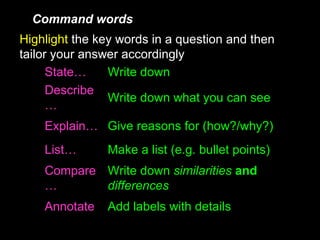
Command words Highlight   the key words in a question and then tailor your answer accordingly Write down what you can see Describe… Give reasons for (how?/why?) Explain… Add labels with details Annotate Write down  similarities   and   differences Compare… Make a list (e.g. bullet points) List… Write down State…
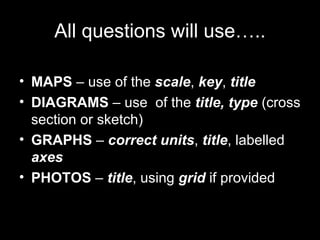
All questions will use….. MAPS  – use of the  scale ,  key ,  title DIAGRAMS   – use  of the  title, type  (cross section or sketch) GRAPHS   –  correct units ,  title , labelled  axes PHOTOS  –  title , using  grid  if provided .
Describe the pattern….. Think –  G eneral trend S pecific examples A nomalies GASP
Look at the NUMBER OF MARKS for each section of the question If it is a ‘ describe ’ question for 2 marks – make sure you do DESCRIBE (not explain) and try to make 2 distinct points If it is a 4 + marks it will be a  LEVEL ASSESSED  answer not a ‘point mark’  answer Remember ….. Level 1 BASIC Level 2 CLEAR Level 3 DETAILED ….. Use the correct Geographical terms, show you know your case studies.
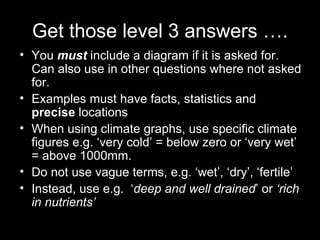
Get those level 3 answers …. You  must  include a diagram if it is asked for.  Can also use in other questions where not asked for. Examples must have facts, statistics and  precise  locations When using climate graphs, use specific climate figures e.g. ‘very cold’ = below zero or ‘very wet’ = above 1000mm. Do not use vague terms, e.g. ‘wet’, ‘dry’, ‘fertile’ Instead, use e.g.  ‘ deep and well drained ’ or  ‘rich in nutrients’
Watch that you answer all parts of a question Look out for plurals – solution s , physical factor s , example s Think ‘ so what ? ’ this will help you to make  linked statements so, because, therefore, this means that …
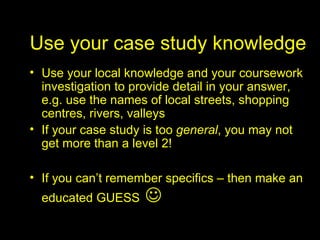
Use your case study knowledge Use your local knowledge and your coursework investigation to provide detail in your answer, e.g. use the names of local streets, shopping centres, rivers, valleys If your case study is too  general , you may not get more than a level 2! If you can’t remember specifics – then make an educated GUESS   
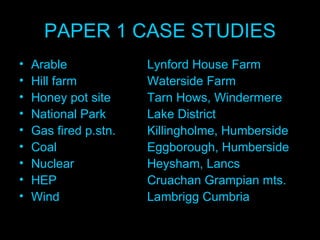
PAPER 1 CASE STUDIES Arable  Lynford House Farm Hill farm  Waterside Farm Honey pot site  Tarn Hows, Windermere  National Park  Lake District Gas fired p.stn. Killingholme, Humberside Coal  Eggborough, Humberside Nuclear  Heysham, Lancs HEP  Cruachan Grampian mts. Wind  Lambrigg Cumbria
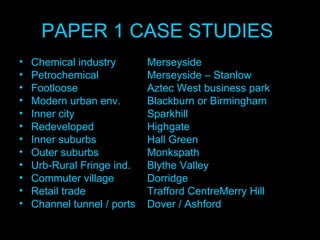
PAPER 1 CASE STUDIES  Chemical industry  Merseyside Petrochemical Merseyside – Stanlow Footloose Aztec West business park Modern urban env. Blackburn or Birmingham Inner city  Sparkhill Redeveloped  Highgate Inner suburbs  Hall Green Outer suburbs  Monkspath Urb-Rural Fringe ind.  Blythe Valley Commuter village  Dorridge Retail trade Trafford CentreMerry Hill Channel tunnel / ports Dover / Ashford
 

Gcse Paper 1 Final Tips

  • 1.
    GCSE warm up Paper 1 6 th June am 1hr 15 Paper 2 15 th June pm 2 hrs
  • 2.
    Remember To bringall necessary equipment including Calculator String To attempt ALL questions To watch time spent per question
  • 3.
    Look…. at TIMEAt the start of the exam find the number of questions and the allocation of marks PLAN your time accordingly
  • 4.
    Before you openthe exam paper Read the information carefully on the front cover. Take notice of the instruction to use your case studies wherever possible
  • 5.
    Command words Highlight the key words in a question and then tailor your answer accordingly Write down what you can see Describe… Give reasons for (how?/why?) Explain… Add labels with details Annotate Write down similarities and differences Compare… Make a list (e.g. bullet points) List… Write down State…
  • 6.
    All questions willuse….. MAPS – use of the scale , key , title DIAGRAMS – use of the title, type (cross section or sketch) GRAPHS – correct units , title , labelled axes PHOTOS – title , using grid if provided .
  • 7.
    Describe the pattern…..Think – G eneral trend S pecific examples A nomalies GASP
  • 8.
    Look at theNUMBER OF MARKS for each section of the question If it is a ‘ describe ’ question for 2 marks – make sure you do DESCRIBE (not explain) and try to make 2 distinct points If it is a 4 + marks it will be a LEVEL ASSESSED answer not a ‘point mark’ answer Remember ….. Level 1 BASIC Level 2 CLEAR Level 3 DETAILED ….. Use the correct Geographical terms, show you know your case studies.
  • 9.
    Get those level3 answers …. You must include a diagram if it is asked for. Can also use in other questions where not asked for. Examples must have facts, statistics and precise locations When using climate graphs, use specific climate figures e.g. ‘very cold’ = below zero or ‘very wet’ = above 1000mm. Do not use vague terms, e.g. ‘wet’, ‘dry’, ‘fertile’ Instead, use e.g. ‘ deep and well drained ’ or ‘rich in nutrients’
  • 10.
    Watch that youanswer all parts of a question Look out for plurals – solution s , physical factor s , example s Think ‘ so what ? ’ this will help you to make linked statements so, because, therefore, this means that …
  • 11.
    Use your casestudy knowledge Use your local knowledge and your coursework investigation to provide detail in your answer, e.g. use the names of local streets, shopping centres, rivers, valleys If your case study is too general , you may not get more than a level 2! If you can’t remember specifics – then make an educated GUESS 
  • 12.
    PAPER 1 CASESTUDIES Arable Lynford House Farm Hill farm Waterside Farm Honey pot site Tarn Hows, Windermere National Park Lake District Gas fired p.stn. Killingholme, Humberside Coal Eggborough, Humberside Nuclear Heysham, Lancs HEP Cruachan Grampian mts. Wind Lambrigg Cumbria
  • 13.
    PAPER 1 CASESTUDIES Chemical industry Merseyside Petrochemical Merseyside – Stanlow Footloose Aztec West business park Modern urban env. Blackburn or Birmingham Inner city Sparkhill Redeveloped Highgate Inner suburbs Hall Green Outer suburbs Monkspath Urb-Rural Fringe ind. Blythe Valley Commuter village Dorridge Retail trade Trafford CentreMerry Hill Channel tunnel / ports Dover / Ashford
  • 14.