GCSE GEOGRAPHY 2016
REVISION
Rivers and Coasts
Population
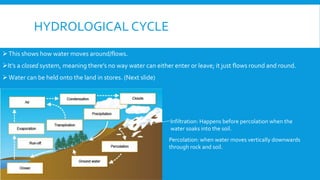
HYDROLOGICAL CYCLE
This shows how water moves around/flows.
It’s a closed system, meaning there’s no way water can either enter or leave; it just flows round and round.
Water can be held onto the land in stores. (Next slide)
Percolation: when water moves vertically downwards
through rock and soil.
Infiltration: Happens before percolation when the
water soaks into the soil.
STORES
Types of stores:
 Channel storage =Water is held in a river.
 Groundwater storage =Water is held in a rock or soil. A rock that stores water is
known as an aquifer.
 Interception storage =Water is taken in by plants.
Surface storage =Water is held by lakes, reservoirs and puddles
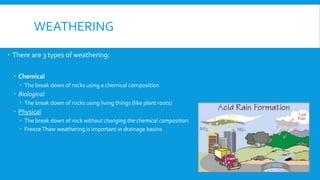
WEATHERING
 There are 3 types of weathering:
 Chemical
 The break down of rocks using a chemical composition
 Biological
 The break down of rocks using living things (like plant roots)
 Physical
 The break down of rock without changing the chemical composition.
 FreezeThaw weathering is important in drainage basins
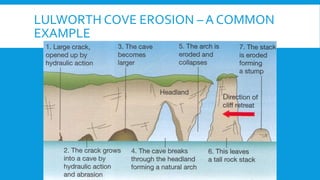
LULWORTH COVE EROSION – A COMMON
EXAMPLE
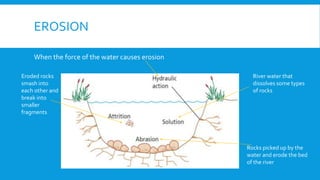
EROSION
When the force of the water causes erosion
Eroded rocks
smash into
each other and
break into
smaller
fragments
Rocks picked up by the
water and erode the bed
of the river
River water that
dissolves some types
of rocks
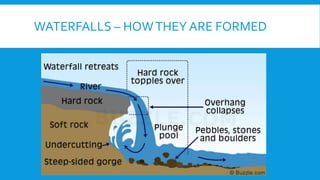
WATERFALLS – HOWTHEY ARE FORMED
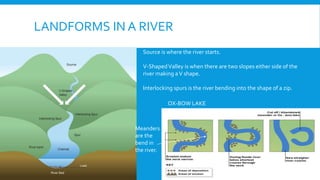
LANDFORMS IN A RIVER
Source is where the river starts.
V-ShapedValley is when there are two slopes either side of the
river making aV shape.
Interlocking spurs is the river bending into the shape of a zip.
OX-BOW LAKE
Meanders
are the
bend in
the river.
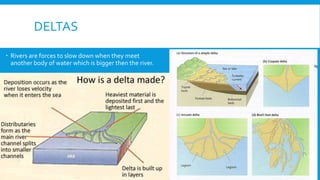
DELTAS
 Rivers are forces to slow down when they meet
another body of water which is bigger then the river.
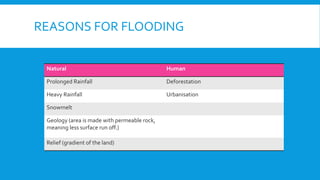
REASONS FOR FLOODING
Natural Human
Prolonged Rainfall Deforestation
Heavy Rainfall Urbanisation
Snowmelt
Geology (area is made with permeable rock,
meaning less surface run off.)
Relief (gradient of the land)
CASE STUDIES - BOSCASTLE
 August 2004
Cornwall, LEDC
Steep-sided valley (meaning increased surface run-off)
Lasted for 8 hours before everyone was evacuated
Tourist area (for holidays and fishing)
No deaths
 ‘3 meter wall’ of water
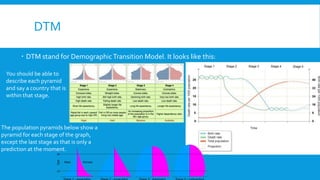
DTM
 DTM stand for DemographicTransition Model. It looks like this:
The population pyramids below show a
pyramid for each stage of the graph,
except the last stage as that is only a
prediction at the moment.
You should be able to
describe each pyramid
and say a country that is
within that stage.
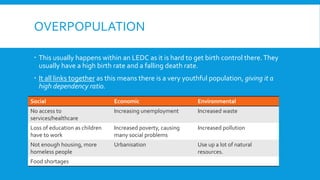
OVERPOPULATION
 This usually happens within an LEDC as it is hard to get birth control there.They
usually have a high birth rate and a falling death rate.
 It all links together as this means there is a very youthful population, giving it a
high dependency ratio.
Social Economic Environmental
No access to
services/healthcare
Increasing unemployment Increased waste
Loss of education as children
have to work
Increased poverty, causing
many social problems
Increased pollution
Not enough housing, more
homeless people
Urbanisation Use up a lot of natural
resources.
Food shortages
OVERPOPULATION
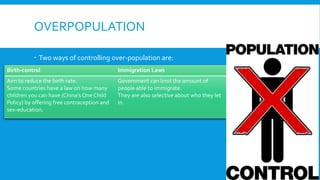
 Two ways of controlling over-population are:
Birth-control Immigration Laws
Aim to reduce the birth rate.
Some countries have a law on how many
children you can have (China’s One Child
Policy) by offering free contraception and
sex-education.
Government can limit the amount of
people able to immigrate.
They are also selective about who they let
in.
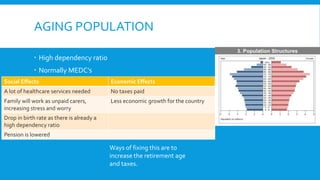
AGING POPULATION
 High dependency ratio
 Normally MEDC’s
Social Effects Economic Effects
A lot of healthcare services needed No taxes paid
Family will work as unpaid carers,
increasing stress and worry
Less economic growth for the country
Drop in birth rate as there is already a
high dependency ratio
Pension is lowered
Ways of fixing this are to
increase the retirement age
and taxes.
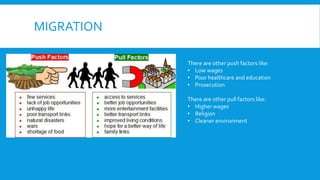
MIGRATION
There are other push factors like:
• Low wages
• Poor healthcare and education
• Prosecution
There are other pull factors like:
• Higher wages
• Religion
• Cleaner environment
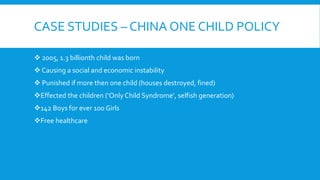
CASE STUDIES – CHINA ONE CHILD POLICY
 2005, 1.3 billionth child was born
 Causing a social and economic instability
 Punished if more then one child (houses destroyed, fined)
Effected the children (‘Only Child Syndrome’, selfish generation)
142 Boys for ever 100 Girls
Free healthcare
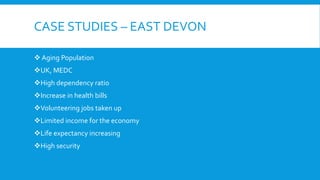
CASE STUDIES – EAST DEVON
 Aging Population
UK, MEDC
High dependency ratio
Increase in health bills
Volunteering jobs taken up
Limited income for the economy
Life expectancy increasing
High security
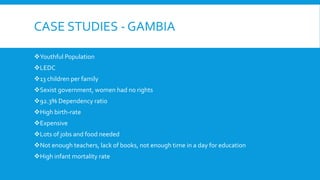
CASE STUDIES - GAMBIA
Youthful Population
LEDC
13 children per family
Sexist government, women had no rights
92.3% Dependency ratio
High birth-rate
Expensive
Lots of jobs and food needed
Not enough teachers, lack of books, not enough time in a day for education
High infant mortality rate
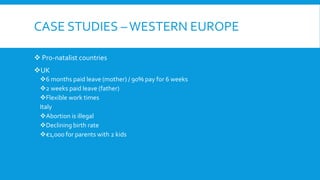
CASE STUDIES –WESTERN EUROPE
 Pro-natalist countries
UK
6 months paid leave (mother) / 90% pay for 6 weeks
2 weeks paid leave (father)
Flexible work times
Italy
Abortion is illegal
Declining birth rate
€1,000 for parents with 2 kids
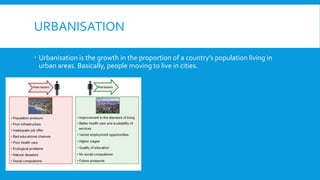
URBANISATION
 Urbanisation is the growth in the proportion of a country’s population living in
urban areas. Basically, people moving to live in cities.

GCSE Geography OCR 2016 Revision

  • 1.
  • 2.
    HYDROLOGICAL CYCLE This showshow water moves around/flows. It’s a closed system, meaning there’s no way water can either enter or leave; it just flows round and round. Water can be held onto the land in stores. (Next slide) Percolation: when water moves vertically downwards through rock and soil. Infiltration: Happens before percolation when the water soaks into the soil.
  • 3.
    STORES Types of stores: Channel storage =Water is held in a river.  Groundwater storage =Water is held in a rock or soil. A rock that stores water is known as an aquifer.  Interception storage =Water is taken in by plants. Surface storage =Water is held by lakes, reservoirs and puddles
  • 4.
    WEATHERING  There are3 types of weathering:  Chemical  The break down of rocks using a chemical composition  Biological  The break down of rocks using living things (like plant roots)  Physical  The break down of rock without changing the chemical composition.  FreezeThaw weathering is important in drainage basins
  • 5.
    LULWORTH COVE EROSION– A COMMON EXAMPLE
  • 6.
    EROSION When the forceof the water causes erosion Eroded rocks smash into each other and break into smaller fragments Rocks picked up by the water and erode the bed of the river River water that dissolves some types of rocks
  • 7.
  • 8.
    LANDFORMS IN ARIVER Source is where the river starts. V-ShapedValley is when there are two slopes either side of the river making aV shape. Interlocking spurs is the river bending into the shape of a zip. OX-BOW LAKE Meanders are the bend in the river.
  • 9.
    DELTAS  Rivers areforces to slow down when they meet another body of water which is bigger then the river.
  • 10.
    REASONS FOR FLOODING NaturalHuman Prolonged Rainfall Deforestation Heavy Rainfall Urbanisation Snowmelt Geology (area is made with permeable rock, meaning less surface run off.) Relief (gradient of the land)
  • 11.
    CASE STUDIES -BOSCASTLE  August 2004 Cornwall, LEDC Steep-sided valley (meaning increased surface run-off) Lasted for 8 hours before everyone was evacuated Tourist area (for holidays and fishing) No deaths  ‘3 meter wall’ of water
  • 12.
    DTM  DTM standfor DemographicTransition Model. It looks like this: The population pyramids below show a pyramid for each stage of the graph, except the last stage as that is only a prediction at the moment. You should be able to describe each pyramid and say a country that is within that stage.
  • 13.
    OVERPOPULATION  This usuallyhappens within an LEDC as it is hard to get birth control there.They usually have a high birth rate and a falling death rate.  It all links together as this means there is a very youthful population, giving it a high dependency ratio. Social Economic Environmental No access to services/healthcare Increasing unemployment Increased waste Loss of education as children have to work Increased poverty, causing many social problems Increased pollution Not enough housing, more homeless people Urbanisation Use up a lot of natural resources. Food shortages
  • 14.
    OVERPOPULATION  Two waysof controlling over-population are: Birth-control Immigration Laws Aim to reduce the birth rate. Some countries have a law on how many children you can have (China’s One Child Policy) by offering free contraception and sex-education. Government can limit the amount of people able to immigrate. They are also selective about who they let in.
  • 15.
    AGING POPULATION  Highdependency ratio  Normally MEDC’s Social Effects Economic Effects A lot of healthcare services needed No taxes paid Family will work as unpaid carers, increasing stress and worry Less economic growth for the country Drop in birth rate as there is already a high dependency ratio Pension is lowered Ways of fixing this are to increase the retirement age and taxes.
  • 16.
    MIGRATION There are otherpush factors like: • Low wages • Poor healthcare and education • Prosecution There are other pull factors like: • Higher wages • Religion • Cleaner environment
  • 17.
    CASE STUDIES –CHINA ONE CHILD POLICY  2005, 1.3 billionth child was born  Causing a social and economic instability  Punished if more then one child (houses destroyed, fined) Effected the children (‘Only Child Syndrome’, selfish generation) 142 Boys for ever 100 Girls Free healthcare
  • 18.
    CASE STUDIES –EAST DEVON  Aging Population UK, MEDC High dependency ratio Increase in health bills Volunteering jobs taken up Limited income for the economy Life expectancy increasing High security
  • 19.
    CASE STUDIES -GAMBIA Youthful Population LEDC 13 children per family Sexist government, women had no rights 92.3% Dependency ratio High birth-rate Expensive Lots of jobs and food needed Not enough teachers, lack of books, not enough time in a day for education High infant mortality rate
  • 20.
    CASE STUDIES –WESTERNEUROPE  Pro-natalist countries UK 6 months paid leave (mother) / 90% pay for 6 weeks 2 weeks paid leave (father) Flexible work times Italy Abortion is illegal Declining birth rate €1,000 for parents with 2 kids
  • 21.
    URBANISATION  Urbanisation isthe growth in the proportion of a country’s population living in urban areas. Basically, people moving to live in cities.