Water
Things to think about!
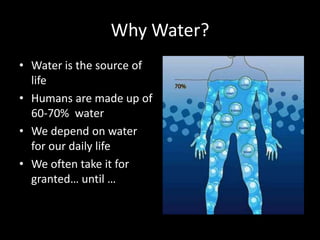
Why Water?
• Water is the source of
life
• Humans are made up of
60-70% water
• We depend on water
for our daily life
• We often take it for
granted… until …
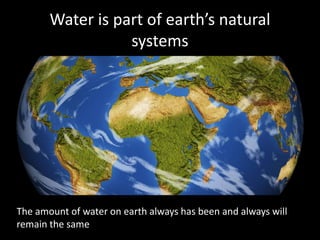
Water is part of earth’s natural
systems
The amount of water on earth always has been and always will
remain the same
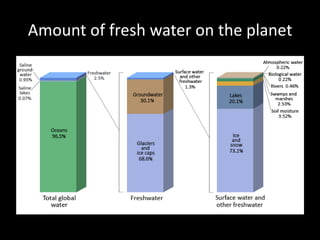
Amount of fresh water on the planet
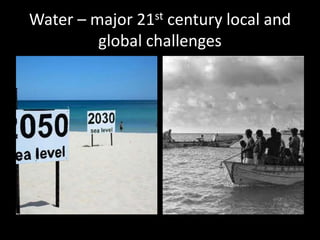
Water – major 21st century local and
global challenges
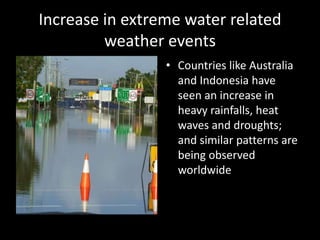
Increase in extreme water related
weather events
• Countries like Australia
and Indonesia have
seen an increase in
heavy rainfalls, heat
waves and droughts;
and similar patterns are
being observed
worldwide
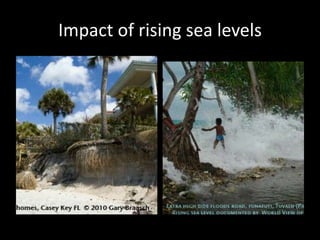
Impact of rising sea levels
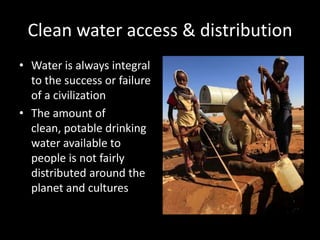
Clean water access & distribution
• Water is always integral
to the success or failure
of a civilization
• The amount of
clean, potable drinking
water available to
people is not fairly
distributed around the
planet and cultures
Overcoming issues – human
relationships and cooperation
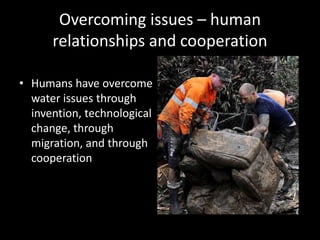
• Humans have overcome
water issues through
invention, technological
change, through
migration, and through
cooperation
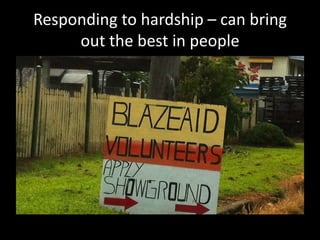
Responding to hardship – can bring
out the best in people
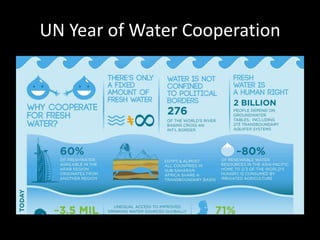
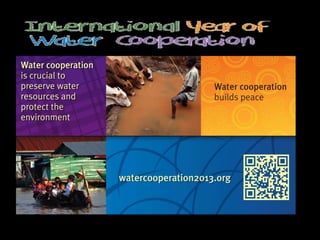
UN Year of Water Cooperation
Human relationships and cooperation
• Future of water use and
humanity’s future
• At the heart of drama
What can we do and what do we care about?
• People
• Place
• Planet

Water Matters

  • 1.
  • 2.
    Why Water? • Wateris the source of life • Humans are made up of 60-70% water • We depend on water for our daily life • We often take it for granted… until …
  • 3.
    Water is partof earth’s natural systems The amount of water on earth always has been and always will remain the same
  • 4.
    Amount of freshwater on the planet
  • 5.
    Water – major21st century local and global challenges
  • 6.
    Increase in extremewater related weather events • Countries like Australia and Indonesia have seen an increase in heavy rainfalls, heat waves and droughts; and similar patterns are being observed worldwide
  • 7.
    Impact of risingsea levels
  • 8.
    Clean water access& distribution • Water is always integral to the success or failure of a civilization • The amount of clean, potable drinking water available to people is not fairly distributed around the planet and cultures
  • 9.
    Overcoming issues –human relationships and cooperation • Humans have overcome water issues through invention, technological change, through migration, and through cooperation
  • 10.
    Responding to hardship– can bring out the best in people
  • 11.
    UN Year ofWater Cooperation
  • 13.
    Human relationships andcooperation • Future of water use and humanity’s future • At the heart of drama What can we do and what do we care about? • People • Place • Planet

Editor's Notes

  • #5 more than 70 percent of Earth is covered in water. The vast majority of the Earth's water resources are salt water, with only 2.5% being fresh water.
  • #7 . Historically, high-intensity storms have represented a small fraction of the total. That balance is shifting so we may have fewer storms, but more of them are catastrophic.. climate change is increasing the intensity and frequency of extreme weather and there's a high risk that heatwaves, fires, cyclones, heavy rainfall and drought will become even more intense and frequent in the coming decades.. billions of dollars are spent in reconstruction after natural disasters - the cost of the 2009 Black Saturday bushfires cost Victoria an estimated $4.4 billion; the 2010/11 Queensland floods over $5 billion
  • #8 In excess of 150 million people live within 1 metre of high tide level, and 250 million within 5 metres of high tide. Sea level rise by 2100 could be in the range of about one meter, or possibly more. This would impact on up to one in ten humans on the planet.For people living on low-lying islands such as Tuvalu, or the Maldives, where the highest point is only 2-3 metres above current sea levels, an extra 50 centimetres could see significant portions of their islands being washed away by erosion or covered by water. Many island nations will have their supplies of drinking water reduced because sea water will invade their freshwater sources.
  • #9 780 million people lack access to an improved water source; approximately one in nine peopleMore than 3.4 million people die each year from water, sanitation, and hygiene-related causes. Nearly all these deaths, 99 percent, occur in the developing world
  • #10 The Mud Army was a term being used by the media to descibe the volunteers that helped thousands of Brisbane residents prepare for and recover from the flooding from the Brisbane River (after the Toowoomba flash floods Mon 10 Jan 2011).  Like mud, the name just stuck. It has since been used to describe the groups of volunteers who have gathered to assist after other natural disasters, such as 2013 Qld floods (including Bundaberg)
  • #11 BlazeAid is a volunteer-based organisation that works with farmers and families in rural Australia after natural disasters such as fires and floods. Working alongside the rural families and farmers, our volunteers help to rebuild fences that have been damaged or destroyed. Formed after the devastation of the Black Saturday bushfires in Victoria on 8th February 2009, they have since assisted with flood and cyclone work in four states.