Government Engineering 
College, Bhavnagar 
Contributor in social welfare 
Prepared by: 
 GAURANG RANA(110210125102)
MAHATMA GANDHI 
1869-1948
Gandhi in South Africa: 1893- 1914 
• In South Africa, Gandhi faced 
discrimination directed at Indians. He 
was thrown off a train at 
Pietermaritzburg after refusing to 
move from the first class to a third 
class coach while holding a valid first 
class ticket. Traveling farther on by 
stagecoach he was beaten by a 
driver for refusing to travel on the foot 
board to make room for a European 
passenger. These events were a 
turning point in his life, awakening 
him to social injustice and influencing 
his subsequent social activism. 
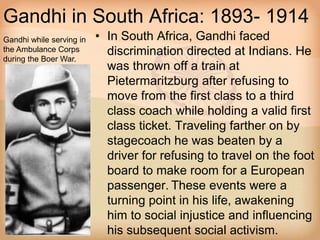
Gandhi while serving in 
the Ambulance Corps 
during the Boer War.
The South 
Africa Years 
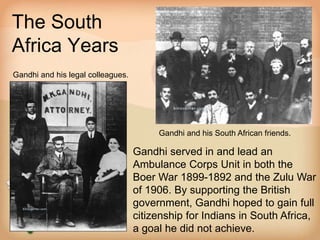
Gandhi and his legal colleagues. 
Gandhi and his South African friends. 
Gandhi served in and lead an 
Ambulance Corps Unit in both the 
Boer War 1899-1892 and the Zulu War 
of 1906. By supporting the British 
government, Gandhi hoped to gain full 
citizenship for Indians in South Africa, 
a goal he did not achieve.
Gandhi’s Tactics 
• Gandhi employed non-cooperation, 
non-violence and peaceful 
resistance as his "weapons" in the 
struggle against British. In Punjab, 
the Jallianwala Bagh massacre of 
civilians by British troops (also 
known as the Amritsar Massacre) 
caused deep trauma to the nation, 
leading to increased public anger 
and acts of violence. Gandhi 
criticized both the actions of the 
British Raj and the retaliatory 
violence of Indians. When he was 
arrested, he continued his non-violent 
protest through hunger 
strikes. 
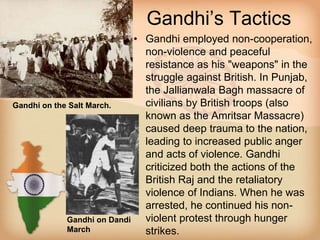
Gandhi on the Salt March. 
Gandhi on Dandi 
March
Imprisonment 
• Gandhi was arrested on 10 March 1922, tried 
for sedition, and sentenced to six years' 
imprisonment. He began his sentence on 18 
March 1922. He was released in February 1924 
for an appendicitis operation, having served 
only 2 years. Without Gandhi's uniting 
personality, the Indian National Congress 
began to splinter during his years in prison, 
splitting into two factions. Furthermore, 
cooperation among Hindus and Muslims, which 
had been strong at the height of the non-violence 
campaign, was breaking down. Gandhi 
attempted to bridge these differences through 
many means, including a three-week fast in the 
autumn of 1924, but with limited success. 
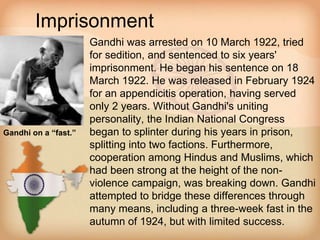
Gandhi on a “fast.”
Independence 
• When the moment of 
freedom came, on 15 
August 1947, Gandhi 
was nowhere to be seen 
in the capital, though 
Nehru and the entire 
Constituent Assembly 
were to salute him as 
the architect of Indian 
independence, as the 
'father of the nation'.
Gandhi’s response to threats 
• Gandhi, quite characteristically, refused additional 
security, and no one could defy his wish to be allowed to 
move around unhindered. In the early evening hours of 
30 January 1948, Gandhi met with India's Deputy Prime 
Minister and his close associate in the freedom struggle, 
Vallabhai Patel, and then proceeded to his prayers. 
Gandhi commenced his walk towards the garden where 
the prayer meeting was held. As he was about to mount 
the steps of the podium, Gandhi folded his hands and 
greeted his audience with a namaskar; at that moment, a 
young man came up to him and roughly pushed aside 
Manu. Nathuram Godse (a Brahmin Hindu) bent down in 
the gesture of an obeisance, took a revolver out of his 
pocket, and shot Gandhi three times in his chest.
Gaurang rana

Gaurang rana

  • 1.
    Government Engineering College,Bhavnagar Contributor in social welfare Prepared by:  GAURANG RANA(110210125102)
  • 2.
  • 3.
    Gandhi in SouthAfrica: 1893- 1914 • In South Africa, Gandhi faced discrimination directed at Indians. He was thrown off a train at Pietermaritzburg after refusing to move from the first class to a third class coach while holding a valid first class ticket. Traveling farther on by stagecoach he was beaten by a driver for refusing to travel on the foot board to make room for a European passenger. These events were a turning point in his life, awakening him to social injustice and influencing his subsequent social activism. Gandhi while serving in the Ambulance Corps during the Boer War.
  • 4.
    The South AfricaYears Gandhi and his legal colleagues. Gandhi and his South African friends. Gandhi served in and lead an Ambulance Corps Unit in both the Boer War 1899-1892 and the Zulu War of 1906. By supporting the British government, Gandhi hoped to gain full citizenship for Indians in South Africa, a goal he did not achieve.
  • 5.
    Gandhi’s Tactics •Gandhi employed non-cooperation, non-violence and peaceful resistance as his "weapons" in the struggle against British. In Punjab, the Jallianwala Bagh massacre of civilians by British troops (also known as the Amritsar Massacre) caused deep trauma to the nation, leading to increased public anger and acts of violence. Gandhi criticized both the actions of the British Raj and the retaliatory violence of Indians. When he was arrested, he continued his non-violent protest through hunger strikes. Gandhi on the Salt March. Gandhi on Dandi March
  • 6.
    Imprisonment • Gandhiwas arrested on 10 March 1922, tried for sedition, and sentenced to six years' imprisonment. He began his sentence on 18 March 1922. He was released in February 1924 for an appendicitis operation, having served only 2 years. Without Gandhi's uniting personality, the Indian National Congress began to splinter during his years in prison, splitting into two factions. Furthermore, cooperation among Hindus and Muslims, which had been strong at the height of the non-violence campaign, was breaking down. Gandhi attempted to bridge these differences through many means, including a three-week fast in the autumn of 1924, but with limited success. Gandhi on a “fast.”
  • 7.
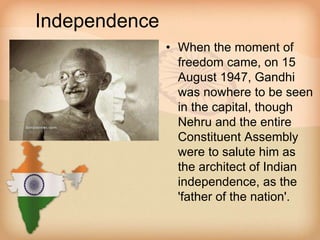
    Independence • Whenthe moment of freedom came, on 15 August 1947, Gandhi was nowhere to be seen in the capital, though Nehru and the entire Constituent Assembly were to salute him as the architect of Indian independence, as the 'father of the nation'.
  • 8.
    Gandhi’s response tothreats • Gandhi, quite characteristically, refused additional security, and no one could defy his wish to be allowed to move around unhindered. In the early evening hours of 30 January 1948, Gandhi met with India's Deputy Prime Minister and his close associate in the freedom struggle, Vallabhai Patel, and then proceeded to his prayers. Gandhi commenced his walk towards the garden where the prayer meeting was held. As he was about to mount the steps of the podium, Gandhi folded his hands and greeted his audience with a namaskar; at that moment, a young man came up to him and roughly pushed aside Manu. Nathuram Godse (a Brahmin Hindu) bent down in the gesture of an obeisance, took a revolver out of his pocket, and shot Gandhi three times in his chest.