UPPER
GASTROINTESTINAL
BLEEDING
OVERVIEW
 Gastrointestinal bleeding (GI bleed) also know as gastrointestinal
hemorrhage is all forms of bleeding in the GI tract from the mouth to
the to the rectum.
 GI bleeding is not a disease but a symptom of a disease.
 There are many possible causes of GI bleeding
 Can be classified into two:
 Upper GI bleed
 Lower GI bleed
 Upper GI bleeding is defined as bleeding derived from a source
proximal to the ligament of treitz
 It is 4times as common as bleeding from the lower GIT
Etiology and Pathophysiology
 Although the most serious loss of blood from the upper GI tract is characterized by a
sudden onset, insidious occult bleeding can also be a major problem.
 The severity of bleeding depends on whether the origin is venous, capillary, or
arterial. (Types of upper GI bleeding are presented in Table 42-20.)
 Bleeding from an arterial source is profuse, and the blood is bright red, indicating it
has not been in contact with gastric HCl acid secretion.
 In contrast, “coffee-ground” vomitus indicates that the blood has been in the stomach
for some time.
 A massive upper GI hemorrhage is a loss of more than 1500 mL of blood or 25% of
intravascular blood volume.
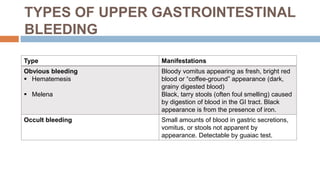
 Melena (black, tarry stools) indicates slow bleeding from an upper GI source.
 The longer the passage of blood through the intestines, the darker the stool color
because of the breakdown of hemoglobin and the release of iron.
 Regardless of the cause, if the balance of gastric acid secretion and mucosal defense
is disrupted, acid interacts with the epithelium to cause damage.
TYPES OF UPPER GASTROINTESTINAL
BLEEDING
Type Manifestations
Obvious bleeding
 Hematemesis
 Melena
Bloody vomitus appearing as fresh, bright red
blood or “coffee-ground” appearance (dark,
grainy digested blood)
Black, tarry stools (often foul smelling) caused
by digestion of blood in the GI tract. Black
appearance is from the presence of iron.
Occult bleeding Small amounts of blood in gastric secretions,
vomitus, or stools not apparent by
appearance. Detectable by guaiac test.
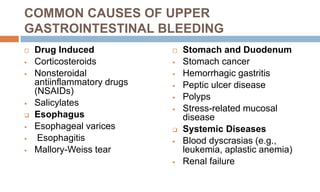
COMMON CAUSES OF UPPER
GASTROINTESTINAL BLEEDING
 Drug Induced
 Corticosteroids
 Nonsteroidal
antiinflammatory drugs
(NSAIDs)
 Salicylates
 Esophagus
 Esophageal varices
 Esophagitis
 Mallory-Weiss tear
 Stomach and Duodenum
 Stomach cancer
 Hemorrhagic gastritis
 Peptic ulcer disease
 Polyps
 Stress-related mucosal
disease
 Systemic Diseases
 Blood dyscrasias (e.g.,
leukemia, aplastic anemia)
 Renal failure
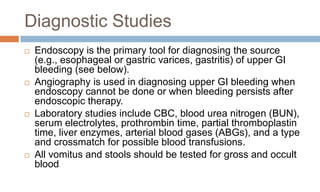
Diagnostic Studies
 Endoscopy is the primary tool for diagnosing the source
(e.g., esophageal or gastric varices, gastritis) of upper GI
bleeding (see below).
 Angiography is used in diagnosing upper GI bleeding when
endoscopy cannot be done or when bleeding persists after
endoscopic therapy.
 Laboratory studies include CBC, blood urea nitrogen (BUN),
serum electrolytes, prothrombin time, partial thromboplastin
time, liver enzymes, arterial blood gases (ABGs), and a type
and crossmatch for possible blood transfusions.
 All vomitus and stools should be tested for gross and occult
blood
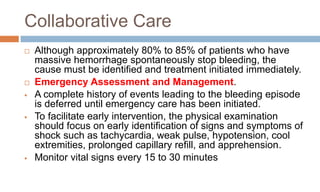
Collaborative Care
 Although approximately 80% to 85% of patients who have
massive hemorrhage spontaneously stop bleeding, the
cause must be identified and treatment initiated immediately.
 Emergency Assessment and Management.
 A complete history of events leading to the bleeding episode
is deferred until emergency care has been initiated.
 To facilitate early intervention, the physical examination
should focus on early identification of signs and symptoms of
shock such as tachycardia, weak pulse, hypotension, cool
extremities, prolonged capillary refill, and apprehension.
 Monitor vital signs every 15 to 30 minutes
Collaborative Care
 The patient is at risk for gut perforation and peritonitis, which may be
indicated by a tense, rigid, boardlike abdomen.
 Do a thorough abdominal examination, and note the presence or absence
of bowel sounds.
 IV lines, preferably two, with a 16- or 18-gauge needle are placed for fluid
and blood replacement. The type and amount of fluids infused are dictated
by physical and laboratory findings.
 Whole blood, packed RBCs, and fresh frozen plasma may be used for
replacement of volume in massive hemorrhage. (The use of blood
transfusions and volume expanders is discussed in Chapter 31.)
 Urine output is one of the best measures of vital organ perfusion.
Therefore an indwelling urinary catheter is inserted so that output can be
accurately assessed hourly.
Endoscopic Therapy
 The first-line management of upper GI bleeding is endoscopy and
endotherapy.
 Endoscopy performed within the first 24 hours of bleeding is important for
diagnosis and the determination of the need for surgical or radiologic
intervention.
 The goal of endoscopic hemostasis is to coagulate or thrombose the
bleeding vessel.
 Several techniques are used, including (1) thermal (heat) probe, (2)
multipolar and bipolar electrocoagulation probe, (3) argon plasma
coagulation (APC), and (4) neodymium:yttrium-aluminum-garnet (Nd:YAG)
laser.
 Multipolar electrocoagulation and thermal probe are the two most
commonly used procedures.
 The heat probe coagulates tissue by directly applying a heating element to
the bleeding site.
Surgical Therapy.
 Surgical intervention is indicated when bleeding
continues regardless of the therapy provided and when
the site of the bleeding has been identified.
 Surgical therapy may be necessary when the patient
continues to bleed after rapid transfusion of up to 2000
mL of whole blood or remains in shock after 24 hours.
 The site of the hemorrhage determines the choice of
operation.
 The mortality rates increase considerably in those over
60 years of age
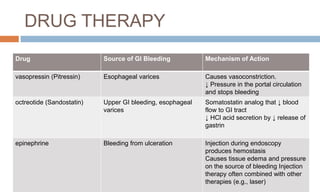
DRUG THERAPY
Drug Source of GI Bleeding Mechanism of Action
vasopressin (Pitressin) Esophageal varices Causes vasoconstriction.
↓ Pressure in the portal circulation
and stops bleeding
octreotide (Sandostatin) Upper GI bleeding, esophageal
varices
Somatostatin analog that ↓ blood
flow to GI tract
↓ HCl acid secretion by ↓ release of
gastrin
epinephrine Bleeding from ulceration Injection during endoscopy
produces hemostasis
Causes tissue edema and pressure
on the source of bleeding Injection
therapy often combined with other
therapies (e.g., laser)
NURSING MANAGEMENT UPPER
GASTROINTESTINAL BLEEDING
 NURSING ASSESSMENT
 NURSING DIAGNOSES
 PLANNING
 NURSING IMPLEMENTATION
 EVALUATION
DISORDERS OF THE BILIARY
TRACT
CHOLELITHIASIS AND
CHOLECYSTITIS
 The most common disorder of the biliary system is
cholelithiasis (stones in the gallbladder) (Fig. 44-14
and eFig. 44-3 on the website for this chapter).
 The stones may be lodged in the neck of the
gallbladder or in the cystic duct.
 Cholecystitis (inflammation of the gallbladder) is
usually associated with cholelithiasis.
 Cholecystitis may be acute or chronic.
 Cholelithiasis and cholecystitis usually occur together
CHOLELITHIASIS AND
CHOLECYSTITIS
 The incidence of cholelithiasis is higher in women, especially
multiparous women, and persons over 40 years of age.
 Post menopausal women on estrogen therapy are at somewhat
greater risk of having gallbladder disease than are women who
are taking birth control pills.
 Oral contraceptives affect cholesterol production and increase the
likelihood of gallbladder cholesterol saturation.
 Other factors that increase the occurrence of gallbladder disease
are a sedentary lifestyle, a familial tendency, and obesity. Obesity
causes increased secretion of cholesterol in bile.
 Gallbladder disease is more common in Asian Americans and
African Americans than in whites.
Etiology and Pathophysiology
 Cholelithiasis:
 The cause of gallstones is unknown. Cholelithiasis develops when the balance
that keeps cholesterol, bile salts, and calcium in solution is altered so that these
substances precipitate.
 Conditions that upset this balance include infection and disturbances in the
metabolism of cholesterol.
 In patients with cholelithiasis, the bile secreted by the liver is supersaturated with
cholesterol (lithogenic bile).
 The bile in the gallbladder also becomes supersaturated with cholesterol.
 When bile is supersaturated with cholesterol, precipitation of cholesterol occurs.
 Other components of bile that precipitate into stones are bile salts, bilirubin,
calcium, and protein.
 Mixed cholesterol stones, which are predominantly cholesterol, are the most
common gallstones
Etiology and Pathophysiology
 Changes in the composition of bile are probably significant in the
formation of gallstones.
 Stasis of bile leads to progression of the supersaturation and
changes in the chemical composition of the bile (biliary sludge).
 Immobility, pregnancy, and inflammatory or obstructive lesions of
the biliary system decrease bile flow.
 Hormonal factors during pregnancy may cause delayed emptying
of the gallbladder, resulting in stasis of bile.
 The stones may remain in the gallbladder or migrate to the cystic
duct or the common bile duct.
 They cause pain as they pass through the ducts, and they may
lodge in the ducts and produce an obstruction.
Etiology and Pathophysiology
 Cholecystitis:
 Cholecystitis is most commonly associated with obstruction caused by
gallstones or biliary sludge.
 Cholecystitis in the absence of obstruction (acalculous cholecystitis)
occurs most frequently in older adults and in patients who are critically ill.
 Acalculous cholecystitis is also associated with pro-longed immobility and
fasting, prolonged parenteral nutrition, and diabetes mellitus.
 Bacteria reaching the gallbladder via the vascular or lymphatic route, or
chemical irritants in the bile, can also produce cholecystitis.
 E. coli, streptococci, and salmonellae are common causative bacteria.
 Other etiologic factors include adhesions, neoplasms, anesthesia, and
opioids.
Clinical Manifestations
 Cholelithiasis may produce severe symptoms or none at all.
 Many patients have “silent cholelithiasis.” The severity of symptoms depends on
whether the stones are stationary or mobile and whether obstruction is present.
 When a stone is lodged in the ducts or when stones are moving through the ducts,
spasms may result.
 The gallbladder spasms occur in response to the stone. This sometimes produces
severe pain, which is termed biliary colic even though the pain is rarely colicky.
 The pain is more often steady. The pain can be excruciating and accompanied by
tachycardia, diaphoresis, and prostration.
 The severe pain may last up to an hour, and when it subsides, there is residual
tenderness in the right upper quadrant.
 The attacks of pain frequently occur 3 to 6 hours after a high-fat meal or when the
patient lies down.
 When total obstruction occurs, symptoms related to bile blockage are manifested
(see Table 44-20)
Clinical Manifestations
 Manifestations of cholecystitis vary from indigestion to moderate
to severe pain, fever, and jaundice.
 Initial symptoms of acute cholecystitis include indigestion and
pain and tenderness in the right upper quadrant, which may be
referred to the right shoulder and scapula.
 The pain may be acute and be accompanied by nausea and
vomiting, restlessness, and diaphoresis.
 Manifestations of inflammation include leukocytosis and fever.
 Physical findings include right upper quadrant tenderness and
abdominal rigidity.
 Manifestations of chronic cholecystitis include a history of fat
intolerance, dyspepsia, heartburn, and flatulence.
Complications.
 Complications of cholelithiasis and cholecystitis include:
 gangrenous cholecystitis,
 subphrenic abscess,
 pancreatitis,
 cholangitis (inflammation of biliary ducts),
 biliary cirrhosis,
 fistulas, and
 rupture of the gallbladder, which can produce bile peritonitis.
 In older patients and those with diabetes, gangrenous cholecystitis and
bile peritonitis are the most common complications of cholecystitis.
 Choledocholithiasis (stone in the common bile duct) may occur, producing
symptoms of obstruction.
Diagnostic Studies
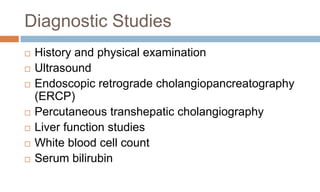
 History and physical examination
 Ultrasound
 Endoscopic retrograde cholangiopancreatography
(ERCP)
 Percutaneous transhepatic cholangiography
 Liver function studies
 White blood cell count
 Serum bilirubin
Collaborative Therapy
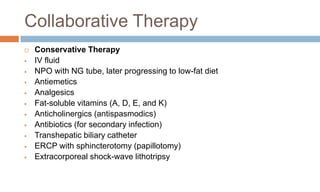
 Conservative Therapy
 IV fluid
 NPO with NG tube, later progressing to low-fat diet
 Antiemetics
 Analgesics
 Fat-soluble vitamins (A, D, E, and K)
 Anticholinergics (antispasmodics)
 Antibiotics (for secondary infection)
 Transhepatic biliary catheter
 ERCP with sphincterotomy (papillotomy)
 Extracorporeal shock-wave lithotripsy
Collaborative Therapy
 Dissolution Therapy
 ursodeoxycholic acid (ursodiol [Actigall])
 Surgical Therapy
 Laparoscopic cholecystectomy
 Incisional (open) cholecystectomy
NURSING MANAGEMENT
GALLBLADDER DISEASE
 NURSING ASSESSMENT
 Subjective Data
 Important Health Information
 Past health history: Obesity, multiparity, infection,
cancer, extensive fasting, pregnancy
 Medications: Estrogen or oral contraceptives
 Surgery or other treatments: Previous abdominal
surgery
NURSING MANAGEMENT
GALLBLADDER DISEASE
 Functional Health Patterns
 Health perception–health management: Positive family
history; sedentary lifestyle
 Nutritional-metabolic: Weight loss, anorexia;
indigestion, fat intolerance, nausea and vomiting,
dyspepsia; chills
 Elimination: Clay-colored stools, steatorrhea,
flatulence; dark urine
 Cognitive-perceptual: Moderate to severe pain in right
upper quadrant that may radiate to the back or
scapula; pruritus
NURSING MANAGEMENT
GALLBLADDER DISEASE
 Objective Data
 General: Fever, restlessness
 Integumentary: Jaundice, icteric sclera; diaphoresis
 Respiratory: Tachypnea, splinting during
respirations
 Cardiovascular: Tachycardia
 Gastrointestinal: Palpable gallbladder, abdominal
guarding and distention
NURSING MANAGEMENT
GALLBLADDER DISEASE
 NURSING DIAGNOSES
 Nursing diagnoses for the patient with gallbladder disease
treated surgically include, but are not limited to, the
following:
 • Acute pain related to surgical procedure
 • Ineffective self-health management related to lack of
knowledge of diet and postoperative management.
 PLANNING
 The overall goals are that the patient with gallbladder
disease will have (1) relief of pain and discomfort, (2) no
complications postoperatively, and (3) no recurrent attacks of
cholecystitis or cholelithiasis.
NURSING MANAGEMENT
GALLBLADDER DISEASE
 NURSING IMPLEMENTATION
 HEALTH PROMOTION:
 Be aware of predisposing factors for gallbladder disease in general health
screening.
 Teach patients from ethnic groups in which the disease is more common,
such as Native Americans, the initial manifestations and to see their health
care provider if these manifestations occur.
 ACUTE INTERVENTION.
 Nursing goals for the patient undergoing conservative therapy include
treating pain, relieving nausea and vomiting, providing comfort and
emotional support, maintaining fluid and electrolyte balance and nutrition,
making accurate assessments to ensure effective treatment, and
observing for complications.
NURSING MANAGEMENT
GALLBLADDER DISEASE
 EVALUATION
 The overall expected outcomes are that the patient
with gallbladder disease will:
 Appear comfortable and verbalize pain relief
 Verbalize knowledge of activity level and dietary
restrictions.

Gastrointestinal BLEEDING.pptx

  • 1.
  • 2.
    OVERVIEW  Gastrointestinal bleeding(GI bleed) also know as gastrointestinal hemorrhage is all forms of bleeding in the GI tract from the mouth to the to the rectum.  GI bleeding is not a disease but a symptom of a disease.  There are many possible causes of GI bleeding  Can be classified into two:  Upper GI bleed  Lower GI bleed  Upper GI bleeding is defined as bleeding derived from a source proximal to the ligament of treitz  It is 4times as common as bleeding from the lower GIT
  • 3.
    Etiology and Pathophysiology Although the most serious loss of blood from the upper GI tract is characterized by a sudden onset, insidious occult bleeding can also be a major problem.  The severity of bleeding depends on whether the origin is venous, capillary, or arterial. (Types of upper GI bleeding are presented in Table 42-20.)  Bleeding from an arterial source is profuse, and the blood is bright red, indicating it has not been in contact with gastric HCl acid secretion.  In contrast, “coffee-ground” vomitus indicates that the blood has been in the stomach for some time.  A massive upper GI hemorrhage is a loss of more than 1500 mL of blood or 25% of intravascular blood volume.  Melena (black, tarry stools) indicates slow bleeding from an upper GI source.  The longer the passage of blood through the intestines, the darker the stool color because of the breakdown of hemoglobin and the release of iron.  Regardless of the cause, if the balance of gastric acid secretion and mucosal defense is disrupted, acid interacts with the epithelium to cause damage.
  • 4.
    TYPES OF UPPERGASTROINTESTINAL BLEEDING Type Manifestations Obvious bleeding  Hematemesis  Melena Bloody vomitus appearing as fresh, bright red blood or “coffee-ground” appearance (dark, grainy digested blood) Black, tarry stools (often foul smelling) caused by digestion of blood in the GI tract. Black appearance is from the presence of iron. Occult bleeding Small amounts of blood in gastric secretions, vomitus, or stools not apparent by appearance. Detectable by guaiac test.
  • 5.
    COMMON CAUSES OFUPPER GASTROINTESTINAL BLEEDING  Drug Induced  Corticosteroids  Nonsteroidal antiinflammatory drugs (NSAIDs)  Salicylates  Esophagus  Esophageal varices  Esophagitis  Mallory-Weiss tear  Stomach and Duodenum  Stomach cancer  Hemorrhagic gastritis  Peptic ulcer disease  Polyps  Stress-related mucosal disease  Systemic Diseases  Blood dyscrasias (e.g., leukemia, aplastic anemia)  Renal failure
  • 6.
    Diagnostic Studies  Endoscopyis the primary tool for diagnosing the source (e.g., esophageal or gastric varices, gastritis) of upper GI bleeding (see below).  Angiography is used in diagnosing upper GI bleeding when endoscopy cannot be done or when bleeding persists after endoscopic therapy.  Laboratory studies include CBC, blood urea nitrogen (BUN), serum electrolytes, prothrombin time, partial thromboplastin time, liver enzymes, arterial blood gases (ABGs), and a type and crossmatch for possible blood transfusions.  All vomitus and stools should be tested for gross and occult blood
  • 7.
    Collaborative Care  Althoughapproximately 80% to 85% of patients who have massive hemorrhage spontaneously stop bleeding, the cause must be identified and treatment initiated immediately.  Emergency Assessment and Management.  A complete history of events leading to the bleeding episode is deferred until emergency care has been initiated.  To facilitate early intervention, the physical examination should focus on early identification of signs and symptoms of shock such as tachycardia, weak pulse, hypotension, cool extremities, prolonged capillary refill, and apprehension.  Monitor vital signs every 15 to 30 minutes
  • 8.
    Collaborative Care  Thepatient is at risk for gut perforation and peritonitis, which may be indicated by a tense, rigid, boardlike abdomen.  Do a thorough abdominal examination, and note the presence or absence of bowel sounds.  IV lines, preferably two, with a 16- or 18-gauge needle are placed for fluid and blood replacement. The type and amount of fluids infused are dictated by physical and laboratory findings.  Whole blood, packed RBCs, and fresh frozen plasma may be used for replacement of volume in massive hemorrhage. (The use of blood transfusions and volume expanders is discussed in Chapter 31.)  Urine output is one of the best measures of vital organ perfusion. Therefore an indwelling urinary catheter is inserted so that output can be accurately assessed hourly.
  • 9.
    Endoscopic Therapy  Thefirst-line management of upper GI bleeding is endoscopy and endotherapy.  Endoscopy performed within the first 24 hours of bleeding is important for diagnosis and the determination of the need for surgical or radiologic intervention.  The goal of endoscopic hemostasis is to coagulate or thrombose the bleeding vessel.  Several techniques are used, including (1) thermal (heat) probe, (2) multipolar and bipolar electrocoagulation probe, (3) argon plasma coagulation (APC), and (4) neodymium:yttrium-aluminum-garnet (Nd:YAG) laser.  Multipolar electrocoagulation and thermal probe are the two most commonly used procedures.  The heat probe coagulates tissue by directly applying a heating element to the bleeding site.
  • 10.
    Surgical Therapy.  Surgicalintervention is indicated when bleeding continues regardless of the therapy provided and when the site of the bleeding has been identified.  Surgical therapy may be necessary when the patient continues to bleed after rapid transfusion of up to 2000 mL of whole blood or remains in shock after 24 hours.  The site of the hemorrhage determines the choice of operation.  The mortality rates increase considerably in those over 60 years of age
  • 11.
    DRUG THERAPY Drug Sourceof GI Bleeding Mechanism of Action vasopressin (Pitressin) Esophageal varices Causes vasoconstriction. ↓ Pressure in the portal circulation and stops bleeding octreotide (Sandostatin) Upper GI bleeding, esophageal varices Somatostatin analog that ↓ blood flow to GI tract ↓ HCl acid secretion by ↓ release of gastrin epinephrine Bleeding from ulceration Injection during endoscopy produces hemostasis Causes tissue edema and pressure on the source of bleeding Injection therapy often combined with other therapies (e.g., laser)
  • 12.
    NURSING MANAGEMENT UPPER GASTROINTESTINALBLEEDING  NURSING ASSESSMENT  NURSING DIAGNOSES  PLANNING  NURSING IMPLEMENTATION  EVALUATION
  • 13.
    DISORDERS OF THEBILIARY TRACT
  • 14.
    CHOLELITHIASIS AND CHOLECYSTITIS  Themost common disorder of the biliary system is cholelithiasis (stones in the gallbladder) (Fig. 44-14 and eFig. 44-3 on the website for this chapter).  The stones may be lodged in the neck of the gallbladder or in the cystic duct.  Cholecystitis (inflammation of the gallbladder) is usually associated with cholelithiasis.  Cholecystitis may be acute or chronic.  Cholelithiasis and cholecystitis usually occur together
  • 15.
    CHOLELITHIASIS AND CHOLECYSTITIS  Theincidence of cholelithiasis is higher in women, especially multiparous women, and persons over 40 years of age.  Post menopausal women on estrogen therapy are at somewhat greater risk of having gallbladder disease than are women who are taking birth control pills.  Oral contraceptives affect cholesterol production and increase the likelihood of gallbladder cholesterol saturation.  Other factors that increase the occurrence of gallbladder disease are a sedentary lifestyle, a familial tendency, and obesity. Obesity causes increased secretion of cholesterol in bile.  Gallbladder disease is more common in Asian Americans and African Americans than in whites.
  • 16.
    Etiology and Pathophysiology Cholelithiasis:  The cause of gallstones is unknown. Cholelithiasis develops when the balance that keeps cholesterol, bile salts, and calcium in solution is altered so that these substances precipitate.  Conditions that upset this balance include infection and disturbances in the metabolism of cholesterol.  In patients with cholelithiasis, the bile secreted by the liver is supersaturated with cholesterol (lithogenic bile).  The bile in the gallbladder also becomes supersaturated with cholesterol.  When bile is supersaturated with cholesterol, precipitation of cholesterol occurs.  Other components of bile that precipitate into stones are bile salts, bilirubin, calcium, and protein.  Mixed cholesterol stones, which are predominantly cholesterol, are the most common gallstones
  • 17.
    Etiology and Pathophysiology Changes in the composition of bile are probably significant in the formation of gallstones.  Stasis of bile leads to progression of the supersaturation and changes in the chemical composition of the bile (biliary sludge).  Immobility, pregnancy, and inflammatory or obstructive lesions of the biliary system decrease bile flow.  Hormonal factors during pregnancy may cause delayed emptying of the gallbladder, resulting in stasis of bile.  The stones may remain in the gallbladder or migrate to the cystic duct or the common bile duct.  They cause pain as they pass through the ducts, and they may lodge in the ducts and produce an obstruction.
  • 18.
    Etiology and Pathophysiology Cholecystitis:  Cholecystitis is most commonly associated with obstruction caused by gallstones or biliary sludge.  Cholecystitis in the absence of obstruction (acalculous cholecystitis) occurs most frequently in older adults and in patients who are critically ill.  Acalculous cholecystitis is also associated with pro-longed immobility and fasting, prolonged parenteral nutrition, and diabetes mellitus.  Bacteria reaching the gallbladder via the vascular or lymphatic route, or chemical irritants in the bile, can also produce cholecystitis.  E. coli, streptococci, and salmonellae are common causative bacteria.  Other etiologic factors include adhesions, neoplasms, anesthesia, and opioids.
  • 19.
    Clinical Manifestations  Cholelithiasismay produce severe symptoms or none at all.  Many patients have “silent cholelithiasis.” The severity of symptoms depends on whether the stones are stationary or mobile and whether obstruction is present.  When a stone is lodged in the ducts or when stones are moving through the ducts, spasms may result.  The gallbladder spasms occur in response to the stone. This sometimes produces severe pain, which is termed biliary colic even though the pain is rarely colicky.  The pain is more often steady. The pain can be excruciating and accompanied by tachycardia, diaphoresis, and prostration.  The severe pain may last up to an hour, and when it subsides, there is residual tenderness in the right upper quadrant.  The attacks of pain frequently occur 3 to 6 hours after a high-fat meal or when the patient lies down.  When total obstruction occurs, symptoms related to bile blockage are manifested (see Table 44-20)
  • 20.
    Clinical Manifestations  Manifestationsof cholecystitis vary from indigestion to moderate to severe pain, fever, and jaundice.  Initial symptoms of acute cholecystitis include indigestion and pain and tenderness in the right upper quadrant, which may be referred to the right shoulder and scapula.  The pain may be acute and be accompanied by nausea and vomiting, restlessness, and diaphoresis.  Manifestations of inflammation include leukocytosis and fever.  Physical findings include right upper quadrant tenderness and abdominal rigidity.  Manifestations of chronic cholecystitis include a history of fat intolerance, dyspepsia, heartburn, and flatulence.
  • 21.
    Complications.  Complications ofcholelithiasis and cholecystitis include:  gangrenous cholecystitis,  subphrenic abscess,  pancreatitis,  cholangitis (inflammation of biliary ducts),  biliary cirrhosis,  fistulas, and  rupture of the gallbladder, which can produce bile peritonitis.  In older patients and those with diabetes, gangrenous cholecystitis and bile peritonitis are the most common complications of cholecystitis.  Choledocholithiasis (stone in the common bile duct) may occur, producing symptoms of obstruction.
  • 22.
    Diagnostic Studies  Historyand physical examination  Ultrasound  Endoscopic retrograde cholangiopancreatography (ERCP)  Percutaneous transhepatic cholangiography  Liver function studies  White blood cell count  Serum bilirubin
  • 23.
    Collaborative Therapy  ConservativeTherapy  IV fluid  NPO with NG tube, later progressing to low-fat diet  Antiemetics  Analgesics  Fat-soluble vitamins (A, D, E, and K)  Anticholinergics (antispasmodics)  Antibiotics (for secondary infection)  Transhepatic biliary catheter  ERCP with sphincterotomy (papillotomy)  Extracorporeal shock-wave lithotripsy
  • 24.
    Collaborative Therapy  DissolutionTherapy  ursodeoxycholic acid (ursodiol [Actigall])  Surgical Therapy  Laparoscopic cholecystectomy  Incisional (open) cholecystectomy
  • 25.
    NURSING MANAGEMENT GALLBLADDER DISEASE NURSING ASSESSMENT  Subjective Data  Important Health Information  Past health history: Obesity, multiparity, infection, cancer, extensive fasting, pregnancy  Medications: Estrogen or oral contraceptives  Surgery or other treatments: Previous abdominal surgery
  • 26.
    NURSING MANAGEMENT GALLBLADDER DISEASE Functional Health Patterns  Health perception–health management: Positive family history; sedentary lifestyle  Nutritional-metabolic: Weight loss, anorexia; indigestion, fat intolerance, nausea and vomiting, dyspepsia; chills  Elimination: Clay-colored stools, steatorrhea, flatulence; dark urine  Cognitive-perceptual: Moderate to severe pain in right upper quadrant that may radiate to the back or scapula; pruritus
  • 27.
    NURSING MANAGEMENT GALLBLADDER DISEASE Objective Data  General: Fever, restlessness  Integumentary: Jaundice, icteric sclera; diaphoresis  Respiratory: Tachypnea, splinting during respirations  Cardiovascular: Tachycardia  Gastrointestinal: Palpable gallbladder, abdominal guarding and distention
  • 28.
    NURSING MANAGEMENT GALLBLADDER DISEASE NURSING DIAGNOSES  Nursing diagnoses for the patient with gallbladder disease treated surgically include, but are not limited to, the following:  • Acute pain related to surgical procedure  • Ineffective self-health management related to lack of knowledge of diet and postoperative management.  PLANNING  The overall goals are that the patient with gallbladder disease will have (1) relief of pain and discomfort, (2) no complications postoperatively, and (3) no recurrent attacks of cholecystitis or cholelithiasis.
  • 29.
    NURSING MANAGEMENT GALLBLADDER DISEASE NURSING IMPLEMENTATION  HEALTH PROMOTION:  Be aware of predisposing factors for gallbladder disease in general health screening.  Teach patients from ethnic groups in which the disease is more common, such as Native Americans, the initial manifestations and to see their health care provider if these manifestations occur.  ACUTE INTERVENTION.  Nursing goals for the patient undergoing conservative therapy include treating pain, relieving nausea and vomiting, providing comfort and emotional support, maintaining fluid and electrolyte balance and nutrition, making accurate assessments to ensure effective treatment, and observing for complications.
  • 30.
    NURSING MANAGEMENT GALLBLADDER DISEASE EVALUATION  The overall expected outcomes are that the patient with gallbladder disease will:  Appear comfortable and verbalize pain relief  Verbalize knowledge of activity level and dietary restrictions.