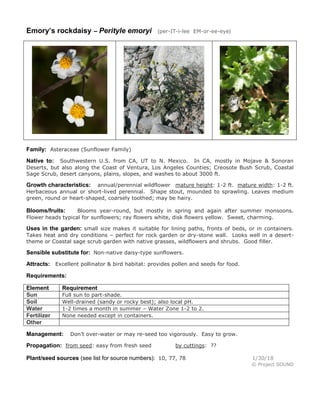
Emory’s rockdaisy – Perityle emoryi (per-IT-i-lee EM-or-ee-eye)
Family: Asteraceae (Sunflower Family)
Native to: Southwestern U.S. from CA, UT to N. Mexico. In CA, mostly in Mojave & Sonoran
Deserts, but also along the Coast of Ventura, Los Angeles Counties; Creosote Bush Scrub, Coastal
Sage Scrub, desert canyons, plains, slopes, and washes to about 3000 ft.
Growth characteristics: annual/perennial wildflower mature height: 1-2 ft. mature width: 1-2 ft.
Herbaceous annual or short-lived perennial. Shape stout, mounded to sprawling. Leaves medium
green, round or heart-shaped, coarsely toothed; may be hairy.
Blooms/fruits: Blooms year-round, but mostly in spring and again after summer monsoons.
Flower heads typical for sunflowers; ray flowers white, disk flowers yellow. Sweet, charming.
Uses in the garden: small size makes it suitable for lining paths, fronts of beds, or in containers.
Takes heat and dry conditions – perfect for rock garden or dry-stone wall. Looks well in a desert-
theme or Coastal sage scrub garden with native grasses, wildflowers and shrubs. Good filler.
Sensible substitute for: Non-native daisy-type sunflowers.
Attracts: Excellent pollinator & bird habitat: provides pollen and seeds for food.
Requirements:
Element Requirement
Sun Full sun to part-shade.
Soil Well-drained (sandy or rocky best); also local pH.
Water 1-2 times a month in summer – Water Zone 1-2 to 2.
Fertilizer None needed except in containers.
Other
Management: Don’t over-water or may re-seed too vigorously. Easy to grow.
Propagation: from seed: easy from fresh seed by cuttings: ??
Plant/seed sources (see list for source numbers): 10, 77, 78 1/30/18
© Project SOUND
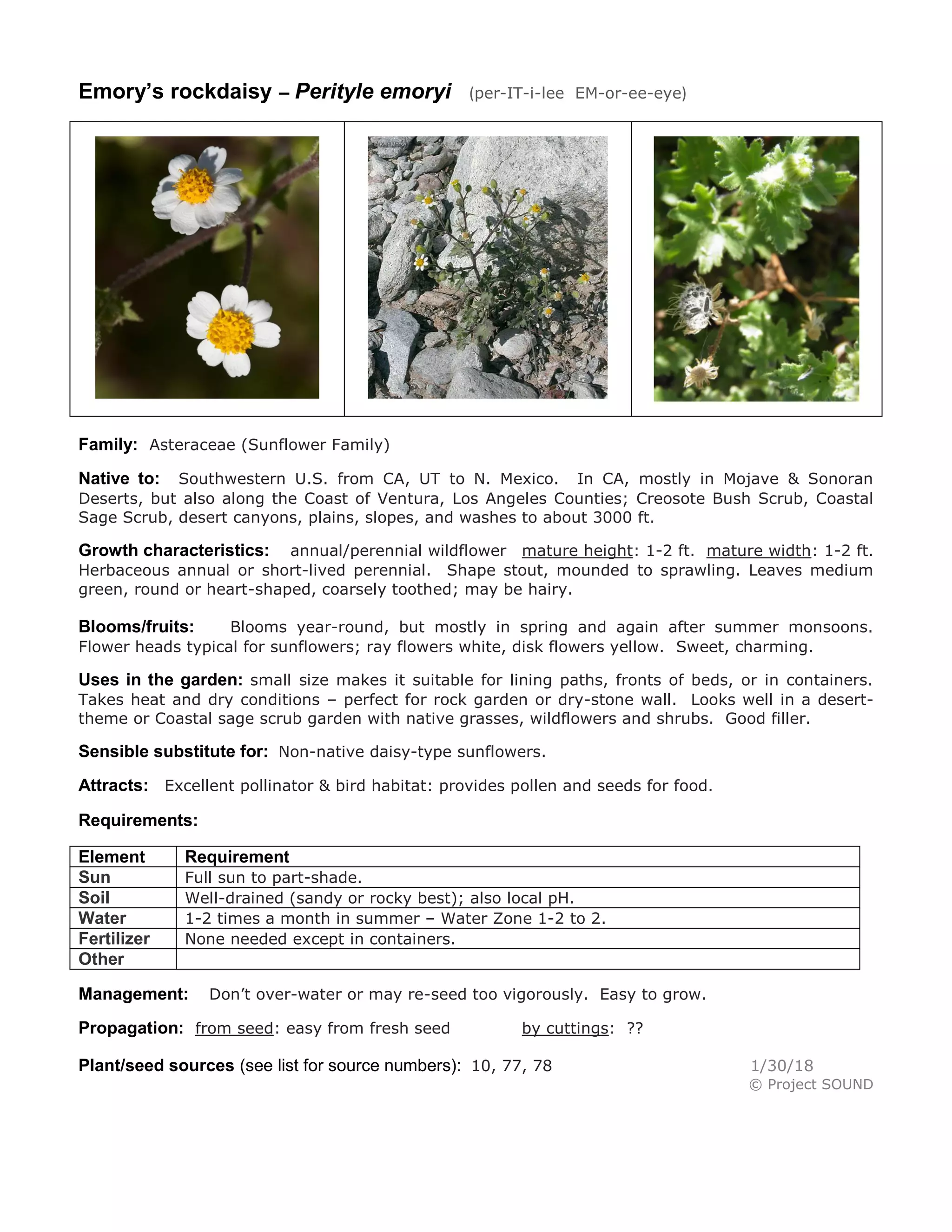
*Woolly bluestar – Amsonia tomentosa (am-SO-nee-uh toe-men-TOW-suh)
Family: Apocynaceae (Dogbane Family)
Native to: San Bernardino Mountains (n slope), s Desert Mountains, Sonoran Desert to w. TX and N.
Mexico; dry slopes, washes and flats, 2000'-5500', Creosote bush scrub, Joshua tree woodland,
Pinyon-Juniper Woodland. Can be abundant in favorable locations, esp. sandy or gravelly soils.
Growth characteristics: perennial/sub-shrub mature height: 1-2 ft. mature width: 2-5 ft.
Perennial from a woody stalk. Many erect to sprawling stems are either white-hairy or light green.
Leaves about 1 inch long, oval with pointed tip.
Blooms/fruits: Blooms after winter/spring rains – Mar-May. Flowers usually in clusters around
stout stems. Flowers tubular with 5 petals; white with purple or blue tint and yellow center. Very
pretty and different; insect pollinated.
Uses in the garden: Most often used in specialist and desert gardens, grown from seed. Mix with
its natural associates like Rabbitbush, Lepidospartum squamatum, the Desert-thorns (Lycium) and
desert grasses. Interesting container plant; would be elegant in a rock garden, too.
Sensible substitute for: Non-native perennials, including Amsonias.
Attracts: Excellent bird habitat: provides cover and seeds for food.
Requirements:
Element Requirement
Sun Full sun to part-shade.
Soil Well-drained – sandy or rocky best; any local pH.
Water Good winter water; occasional summer water OK (Water Zone 1-2, even 2).
Fertilizer None needed except in containers; ½ strength dose in winter.
Other Inorganic or no mulch best; light leaf mulch OK.
Management: Prune back old foliage as needed.
Propagation: from seed: sow fresh seed in fall; barely cover & keep moist by divisions: ?
Plant/seed sources (see list for source numbers): 48 1/29/18
* California native, but not native to Western Los Angeles County © Project SOUND
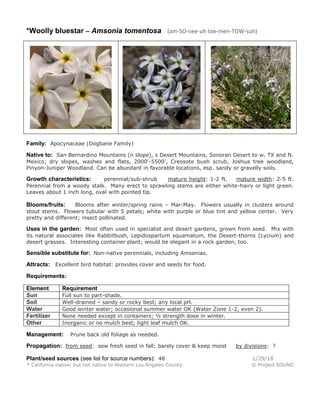
* Brittlebush – Encelia farinosa (en-SEE-lee-uh far-ee-NO-suh)
Family: Asteraceae (Sunflower Family)
Native to: Colorado, Sonoran & Mojave Deserts from CA to Utah, south to Mexico; on south-facing
rocky slopes, washes and flats in open oak woodlands, semidesert and desert grasslands, desert
scrub, and coastal sage scrub.
Growth characteristics: sub-shrub mature height: 3-5 ft. mature width: 3-5 ft.
Evergreen (with water) or drought-deciduous shrub from a woody, succulent base. Many-branched
with dense, rounded appearance. Leaves are simple, light green to velvety-white. Leaf size varies
considerably depending on water availability. Quick-growing. May be short-lived in the garden.
Foliage releases chemicals that inhibit the growth of other plants (allelopathy).
Blooms/fruits: Blooms primarily in spring (Mar-May), but may bloom sporadically depending on
rains. Flowers are typical yellow ‘sunflower’ heads on bare stalks above the foliage. Very showy in
bloom, when there may be hundreds of flower heads. Flowers are sweetly fragrant.
Uses in the garden: Often used for erosion control on slopes. Nice addition to the Silver Garden.
Excellent choice for desert-themed garden, rock garden, at the back of water-wise mixed beds.
Excellent choice for hot, dry gardens; does not do well near the coast (too foggy & damp).
Sensible substitute for: Non-native bush sunflowers.
Attracts: Excellent bird habitat: provides cover and seeds for food. Attracts many insect pollinators
including butterflies and native bees.
Requirements:
Element Requirement
Sun Full sun; fine with reflected heat.
Soil Sandy or rocky well-drained soils – does poorly on heavy clays; alkali soils fine.
Water Don’t over-water once established; Zone 1-2 best (water only during long dry
periods). Over-watered plants are leggy, brittle.
Fertilizer none
Other
Management: Prune spent flowerheads as desired. Cut back by at least ½ in fall to keep growth
compact. Plant roots resent moving, so plant out in place when young.
Propagation: from seed: in spring; soak seed in warm water for 1 hr. by cuttings: tip cuttings
Plant/seed sources (see list for source numbers): 1, 3, 6, 8, 10, 13, 14, 16, 21, 20, 24 12/1/08
* Native to CA but not to Western L.A. Co. © Project SOUND
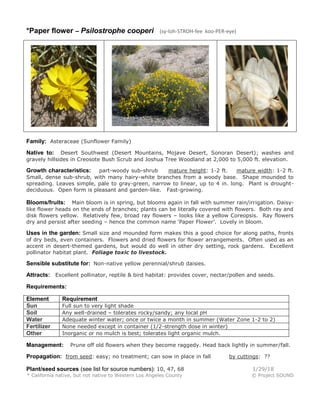
*Paper flower – Psilostrophe cooperi (sy-loh-STROH-fee koo-PER-eye)
Family: Asteraceae (Sunflower Family)
Native to: Desert Southwest (Desert Mountains, Mojave Desert, Sonoran Desert); washes and
gravely hillsides in Creosote Bush Scrub and Joshua Tree Woodland at 2,000 to 5,000 ft. elevation.
Growth characteristics: part-woody sub-shrub mature height: 1-2 ft. mature width: 1-2 ft.
Small, dense sub-shrub, with many hairy-white branches from a woody base. Shape mounded to
spreading. Leaves simple, pale to gray-green, narrow to linear, up to 4 in. long. Plant is drought-
deciduous. Open form is pleasant and garden-like. Fast-growing.
Blooms/fruits: Main bloom is in spring, but blooms again in fall with summer rain/irrigation. Daisy-
like flower heads on the ends of branches; plants can be literally covered with flowers. Both ray and
disk flowers yellow. Relatively few, broad ray flowers – looks like a yellow Coreopsis. Ray flowers
dry and persist after seeding – hence the common name ‘Paper Flower’. Lovely in bloom.
Uses in the garden: Small size and mounded form makes this a good choice for along paths, fronts
of dry beds, even containers. Flowers and dried flowers for flower arrangements. Often used as an
accent in desert-themed gardens, but would do well in other dry setting, rock gardens. Excellent
pollinator habitat plant. Foliage toxic to livestock.
Sensible substitute for: Non-native yellow perennial/shrub daisies.
Attracts: Excellent pollinator, reptile & bird habitat: provides cover, nectar/pollen and seeds.
Requirements:
Element Requirement
Sun Full sun to very light shade
Soil Any well-drained – tolerates rocky/sandy; any local pH
Water Adequate winter water; once or twice a month in summer (Water Zone 1-2 to 2)
Fertilizer None needed except in container (1/2-strength dose in winter)
Other Inorganic or no mulch is best; tolerates light organic mulch.
Management: Prune off old flowers when they become raggedy. Head back lightly in summer/fall.
Propagation: from seed: easy; no treatment; can sow in place in fall by cuttings: ??
Plant/seed sources (see list for source numbers): 10, 47, 68 1/29/18
* California native, but not native to Western Los Angeles County © Project SOUND
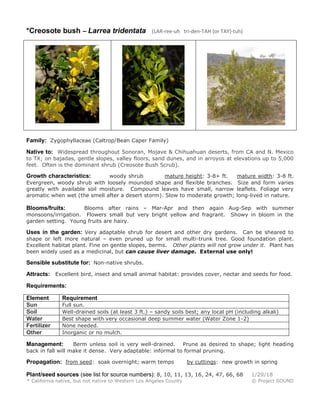
*Creosote bush – Larrea tridentata (LAR-ree-uh tri-den-TAH (or TAY)-tuh)
Family: Zygophyllaceae (Caltrop/Bean Caper Family)
Native to: Widespread throughout Sonoran, Mojave & Chihuahuan deserts, from CA and N. Mexico
to TX; on bajadas, gentle slopes, valley floors, sand dunes, and in arroyos at elevations up to 5,000
feet. Often is the dominant shrub (Creosote Bush Scrub).
Growth characteristics: woody shrub mature height: 3-8+ ft. mature width: 3-8 ft.
Evergreen, woody shrub with loosely mounded shape and flexible branches. Size and form varies
greatly with available soil moisture. Compound leaves have small, narrow leaflets. Foliage very
aromatic when wet (the smell after a desert storm). Slow to moderate growth; long-lived in nature.
Blooms/fruits: Blooms after rains – Mar-Apr and then again Aug-Sep with summer
monsoons/irrigation. Flowers small but very bright yellow and fragrant. Showy in bloom in the
garden setting. Young fruits are hairy.
Uses in the garden: Very adaptable shrub for desert and other dry gardens. Can be sheared to
shape or left more natural – even pruned up for small multi-trunk tree. Good foundation plant.
Excellent habitat plant. Fine on gentle slopes, berms. Other plants will not grow under it. Plant has
been widely used as a medicinal, but can cause liver damage. External use only!
Sensible substitute for: Non-native shrubs.
Attracts: Excellent bird, insect and small animal habitat: provides cover, nectar and seeds for food.
Requirements:
Element Requirement
Sun Full sun.
Soil Well-drained soils (at least 3 ft.) – sandy soils best; any local pH (including alkali)
Water Best shape with very occasional deep summer water (Water Zone 1-2)
Fertilizer None needed.
Other Inorganic or no mulch.
Management: Berm unless soil is very well-drained. Prune as desired to shape; light heading
back in fall will make it dense. Very adaptable: informal to formal pruning.
Propagation: from seed: soak overnight; warm temps by cuttings: new growth in spring
Plant/seed sources (see list for source numbers): 8, 10, 11, 13, 16, 24, 47, 66, 68 1/29/18
* California native, but not native to Western Los Angeles County © Project SOUND
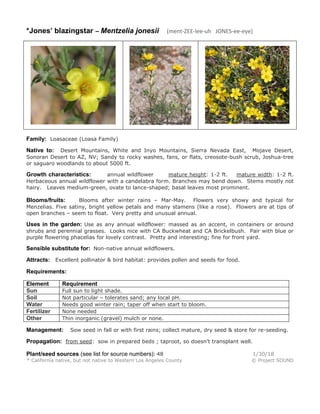
*Jones’ blazingstar – Mentzelia jonesii (ment-ZEE-lee-uh JONES-ee-eye)
Family: Loasaceae (Loasa Family)
Native to: Desert Mountains, White and Inyo Mountains, Sierra Nevada East, Mojave Desert,
Sonoran Desert to AZ, NV; Sandy to rocky washes, fans, or flats, creosote-bush scrub, Joshua-tree
or saguaro woodlands to about 5000 ft.
Growth characteristics: annual wildflower mature height: 1-2 ft. mature width: 1-2 ft.
Herbaceous annual wildflower with a candelabra form. Branches may bend down. Stems mostly not
hairy. Leaves medium-green, ovate to lance-shaped; basal leaves most prominent.
Blooms/fruits: Blooms after winter rains – Mar-May. Flowers very showy and typical for
Menzelias. Five satiny, bright yellow petals and many stamens (like a rose). Flowers are at tips of
open branches – seem to float. Very pretty and unusual annual.
Uses in the garden: Use as any annual wildflower: massed as an accent, in containers or around
shrubs and perennial grasses. Looks nice with CA Buckwheat and CA Brickelbush. Pair with blue or
purple flowering phacelias for lovely contrast. Pretty and interesting; fine for front yard.
Sensible substitute for: Non-native annual wildflowers.
Attracts: Excellent pollinator & bird habitat: provides pollen and seeds for food.
Requirements:
Element Requirement
Sun Full sun to light shade.
Soil Not particular – tolerates sand; any local pH.
Water Needs good winter rain; taper off when start to bloom.
Fertilizer None needed
Other Thin inorganic (gravel) mulch or none.
Management: Sow seed in fall or with first rains; collect mature, dry seed & store for re-seeding.
Propagation: from seed: sow in prepared beds ; taproot, so doesn’t transplant well.
Plant/seed sources (see list for source numbers): 48 1/30/18
* California native, but not native to Western Los Angeles County © Project SOUND
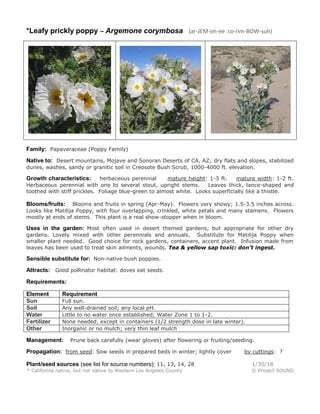
*Leafy prickly poppy – Argemone corymbosa (ar-JEM-on-ee co-rim-BOW-suh)
Family: Papaveraceae (Poppy Family)
Native to: Desert mountains, Mojave and Sonoran Deserts of CA, AZ; dry flats and slopes, stabilized
dunes, washes, sandy or granitic soil in Creosote Bush Scrub, 1000-4000 ft. elevation.
Growth characteristics: herbaceous perennial mature height: 1-3 ft. mature width: 1-2 ft.
Herbaceous perennial with one to several stout, upright stems. Leaves thick, lance-shaped and
toothed with stiff prickles. Foliage blue-green to almost white. Looks superficially like a thistle.
Blooms/fruits: Blooms and fruits in spring (Apr-May). Flowers very showy; 1.5-3.5 inches across.
Looks like Matilija Poppy, with four overlapping, crinkled, white petals and many stamens. Flowers
mostly at ends of stems. This plant is a real show-stopper when in bloom.
Uses in the garden: Most often used in desert themed gardens, but appropriate for other dry
gardens. Lovely mixed with other perennials and annuals. Substitute for Matilija Poppy when
smaller plant needed. Good choice for rock gardens, containers, accent plant. Infusion made from
leaves has been used to treat skin ailments, wounds. Tea & yellow sap toxic: don’t ingest.
Sensible substitute for: Non-native bush poppies.
Attracts: Good pollinator habitat: doves eat seeds.
Requirements:
Element Requirement
Sun Full sun.
Soil Any well-drained soil; any local pH.
Water Little to no water once established; Water Zone 1 to 1-2.
Fertilizer None needed, except in containers (1/2 strength dose in late winter).
Other Inorganic or no mulch; very thin leaf mulch
Management: Prune back carefully (wear gloves) after flowering or fruiting/seeding.
Propagation: from seed: Sow seeds in prepared beds in winter; lightly cover by cuttings: ?
Plant/seed sources (see list for source numbers): 11, 13, 14, 28 1/30/18
* California native, but not native to Western Los Angeles County © Project SOUND
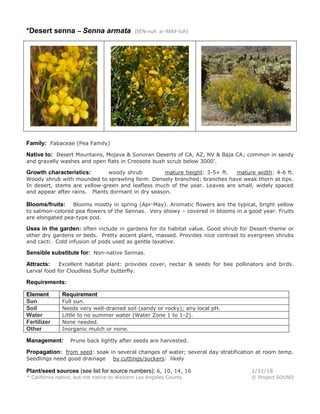
*Desert senna – Senna armata (SEN-nuh ar-MAY-tuh)
Family: Fabaceae (Pea Family)
Native to: Desert Mountains, Mojave & Sonoran Deserts of CA, AZ, NV & Baja CA; common in sandy
and gravelly washes and open flats in Creosote bush scrub below 3000'.
Growth characteristics: woody shrub mature height: 3-5+ ft. mature width: 4-6 ft.
Woody shrub with mounded to sprawling form. Densely branched; branches have weak thorn at tips.
In desert, stems are yellow-green and leafless much of the year. Leaves are small, widely spaced
and appear after rains. Plants dormant in dry season.
Blooms/fruits: Blooms mostly in spring (Apr-May). Aromatic flowers are the typical, bright yellow
to salmon-colored pea flowers of the Sennas. Very showy – covered in blooms in a good year. Fruits
are elongated pea-type pod.
Uses in the garden: often include in gardens for its habitat value. Good shrub for Desert-theme or
other dry gardens or beds. Pretty accent plant, massed. Provides nice contrast to evergreen shrubs
and cacti. Cold infusion of pods used as gentle laxative.
Sensible substitute for: Non-native Sennas.
Attracts: Excellent habitat plant: provides cover, nectar & seeds for bee pollinators and birds.
Larval food for Cloudless Sulfur butterfly.
Requirements:
Element Requirement
Sun Full sun.
Soil Needs very well-drained soil (sandy or rocky); any local pH.
Water Little to no summer water (Water Zone 1 to 1-2).
Fertilizer None needed.
Other Inorganic mulch or none.
Management: Prune back lightly after seeds are harvested.
Propagation: from seed: soak in several changes of water; several day stratification at room temp.
Seedlings need good drainage by cuttings/suckers: likely
Plant/seed sources (see list for source numbers): 6, 10, 14, 16 1/31/18
* California native, but not native to Western Los Angeles County © Project SOUND

Gardening sheets sonoran desert

  • 1.
    Emory’s rockdaisy –Perityle emoryi (per-IT-i-lee EM-or-ee-eye) Family: Asteraceae (Sunflower Family) Native to: Southwestern U.S. from CA, UT to N. Mexico. In CA, mostly in Mojave & Sonoran Deserts, but also along the Coast of Ventura, Los Angeles Counties; Creosote Bush Scrub, Coastal Sage Scrub, desert canyons, plains, slopes, and washes to about 3000 ft. Growth characteristics: annual/perennial wildflower mature height: 1-2 ft. mature width: 1-2 ft. Herbaceous annual or short-lived perennial. Shape stout, mounded to sprawling. Leaves medium green, round or heart-shaped, coarsely toothed; may be hairy. Blooms/fruits: Blooms year-round, but mostly in spring and again after summer monsoons. Flower heads typical for sunflowers; ray flowers white, disk flowers yellow. Sweet, charming. Uses in the garden: small size makes it suitable for lining paths, fronts of beds, or in containers. Takes heat and dry conditions – perfect for rock garden or dry-stone wall. Looks well in a desert- theme or Coastal sage scrub garden with native grasses, wildflowers and shrubs. Good filler. Sensible substitute for: Non-native daisy-type sunflowers. Attracts: Excellent pollinator & bird habitat: provides pollen and seeds for food. Requirements: Element Requirement Sun Full sun to part-shade. Soil Well-drained (sandy or rocky best); also local pH. Water 1-2 times a month in summer – Water Zone 1-2 to 2. Fertilizer None needed except in containers. Other Management: Don’t over-water or may re-seed too vigorously. Easy to grow. Propagation: from seed: easy from fresh seed by cuttings: ?? Plant/seed sources (see list for source numbers): 10, 77, 78 1/30/18 © Project SOUND
  • 2.
    *Woolly bluestar –Amsonia tomentosa (am-SO-nee-uh toe-men-TOW-suh) Family: Apocynaceae (Dogbane Family) Native to: San Bernardino Mountains (n slope), s Desert Mountains, Sonoran Desert to w. TX and N. Mexico; dry slopes, washes and flats, 2000'-5500', Creosote bush scrub, Joshua tree woodland, Pinyon-Juniper Woodland. Can be abundant in favorable locations, esp. sandy or gravelly soils. Growth characteristics: perennial/sub-shrub mature height: 1-2 ft. mature width: 2-5 ft. Perennial from a woody stalk. Many erect to sprawling stems are either white-hairy or light green. Leaves about 1 inch long, oval with pointed tip. Blooms/fruits: Blooms after winter/spring rains – Mar-May. Flowers usually in clusters around stout stems. Flowers tubular with 5 petals; white with purple or blue tint and yellow center. Very pretty and different; insect pollinated. Uses in the garden: Most often used in specialist and desert gardens, grown from seed. Mix with its natural associates like Rabbitbush, Lepidospartum squamatum, the Desert-thorns (Lycium) and desert grasses. Interesting container plant; would be elegant in a rock garden, too. Sensible substitute for: Non-native perennials, including Amsonias. Attracts: Excellent bird habitat: provides cover and seeds for food. Requirements: Element Requirement Sun Full sun to part-shade. Soil Well-drained – sandy or rocky best; any local pH. Water Good winter water; occasional summer water OK (Water Zone 1-2, even 2). Fertilizer None needed except in containers; ½ strength dose in winter. Other Inorganic or no mulch best; light leaf mulch OK. Management: Prune back old foliage as needed. Propagation: from seed: sow fresh seed in fall; barely cover & keep moist by divisions: ? Plant/seed sources (see list for source numbers): 48 1/29/18 * California native, but not native to Western Los Angeles County © Project SOUND
  • 3.
    * Brittlebush –Encelia farinosa (en-SEE-lee-uh far-ee-NO-suh) Family: Asteraceae (Sunflower Family) Native to: Colorado, Sonoran & Mojave Deserts from CA to Utah, south to Mexico; on south-facing rocky slopes, washes and flats in open oak woodlands, semidesert and desert grasslands, desert scrub, and coastal sage scrub. Growth characteristics: sub-shrub mature height: 3-5 ft. mature width: 3-5 ft. Evergreen (with water) or drought-deciduous shrub from a woody, succulent base. Many-branched with dense, rounded appearance. Leaves are simple, light green to velvety-white. Leaf size varies considerably depending on water availability. Quick-growing. May be short-lived in the garden. Foliage releases chemicals that inhibit the growth of other plants (allelopathy). Blooms/fruits: Blooms primarily in spring (Mar-May), but may bloom sporadically depending on rains. Flowers are typical yellow ‘sunflower’ heads on bare stalks above the foliage. Very showy in bloom, when there may be hundreds of flower heads. Flowers are sweetly fragrant. Uses in the garden: Often used for erosion control on slopes. Nice addition to the Silver Garden. Excellent choice for desert-themed garden, rock garden, at the back of water-wise mixed beds. Excellent choice for hot, dry gardens; does not do well near the coast (too foggy & damp). Sensible substitute for: Non-native bush sunflowers. Attracts: Excellent bird habitat: provides cover and seeds for food. Attracts many insect pollinators including butterflies and native bees. Requirements: Element Requirement Sun Full sun; fine with reflected heat. Soil Sandy or rocky well-drained soils – does poorly on heavy clays; alkali soils fine. Water Don’t over-water once established; Zone 1-2 best (water only during long dry periods). Over-watered plants are leggy, brittle. Fertilizer none Other Management: Prune spent flowerheads as desired. Cut back by at least ½ in fall to keep growth compact. Plant roots resent moving, so plant out in place when young. Propagation: from seed: in spring; soak seed in warm water for 1 hr. by cuttings: tip cuttings Plant/seed sources (see list for source numbers): 1, 3, 6, 8, 10, 13, 14, 16, 21, 20, 24 12/1/08 * Native to CA but not to Western L.A. Co. © Project SOUND
  • 4.
    *Paper flower –Psilostrophe cooperi (sy-loh-STROH-fee koo-PER-eye) Family: Asteraceae (Sunflower Family) Native to: Desert Southwest (Desert Mountains, Mojave Desert, Sonoran Desert); washes and gravely hillsides in Creosote Bush Scrub and Joshua Tree Woodland at 2,000 to 5,000 ft. elevation. Growth characteristics: part-woody sub-shrub mature height: 1-2 ft. mature width: 1-2 ft. Small, dense sub-shrub, with many hairy-white branches from a woody base. Shape mounded to spreading. Leaves simple, pale to gray-green, narrow to linear, up to 4 in. long. Plant is drought- deciduous. Open form is pleasant and garden-like. Fast-growing. Blooms/fruits: Main bloom is in spring, but blooms again in fall with summer rain/irrigation. Daisy- like flower heads on the ends of branches; plants can be literally covered with flowers. Both ray and disk flowers yellow. Relatively few, broad ray flowers – looks like a yellow Coreopsis. Ray flowers dry and persist after seeding – hence the common name ‘Paper Flower’. Lovely in bloom. Uses in the garden: Small size and mounded form makes this a good choice for along paths, fronts of dry beds, even containers. Flowers and dried flowers for flower arrangements. Often used as an accent in desert-themed gardens, but would do well in other dry setting, rock gardens. Excellent pollinator habitat plant. Foliage toxic to livestock. Sensible substitute for: Non-native yellow perennial/shrub daisies. Attracts: Excellent pollinator, reptile & bird habitat: provides cover, nectar/pollen and seeds. Requirements: Element Requirement Sun Full sun to very light shade Soil Any well-drained – tolerates rocky/sandy; any local pH Water Adequate winter water; once or twice a month in summer (Water Zone 1-2 to 2) Fertilizer None needed except in container (1/2-strength dose in winter) Other Inorganic or no mulch is best; tolerates light organic mulch. Management: Prune off old flowers when they become raggedy. Head back lightly in summer/fall. Propagation: from seed: easy; no treatment; can sow in place in fall by cuttings: ?? Plant/seed sources (see list for source numbers): 10, 47, 68 1/29/18 * California native, but not native to Western Los Angeles County © Project SOUND
  • 5.
    *Creosote bush –Larrea tridentata (LAR-ree-uh tri-den-TAH (or TAY)-tuh) Family: Zygophyllaceae (Caltrop/Bean Caper Family) Native to: Widespread throughout Sonoran, Mojave & Chihuahuan deserts, from CA and N. Mexico to TX; on bajadas, gentle slopes, valley floors, sand dunes, and in arroyos at elevations up to 5,000 feet. Often is the dominant shrub (Creosote Bush Scrub). Growth characteristics: woody shrub mature height: 3-8+ ft. mature width: 3-8 ft. Evergreen, woody shrub with loosely mounded shape and flexible branches. Size and form varies greatly with available soil moisture. Compound leaves have small, narrow leaflets. Foliage very aromatic when wet (the smell after a desert storm). Slow to moderate growth; long-lived in nature. Blooms/fruits: Blooms after rains – Mar-Apr and then again Aug-Sep with summer monsoons/irrigation. Flowers small but very bright yellow and fragrant. Showy in bloom in the garden setting. Young fruits are hairy. Uses in the garden: Very adaptable shrub for desert and other dry gardens. Can be sheared to shape or left more natural – even pruned up for small multi-trunk tree. Good foundation plant. Excellent habitat plant. Fine on gentle slopes, berms. Other plants will not grow under it. Plant has been widely used as a medicinal, but can cause liver damage. External use only! Sensible substitute for: Non-native shrubs. Attracts: Excellent bird, insect and small animal habitat: provides cover, nectar and seeds for food. Requirements: Element Requirement Sun Full sun. Soil Well-drained soils (at least 3 ft.) – sandy soils best; any local pH (including alkali) Water Best shape with very occasional deep summer water (Water Zone 1-2) Fertilizer None needed. Other Inorganic or no mulch. Management: Berm unless soil is very well-drained. Prune as desired to shape; light heading back in fall will make it dense. Very adaptable: informal to formal pruning. Propagation: from seed: soak overnight; warm temps by cuttings: new growth in spring Plant/seed sources (see list for source numbers): 8, 10, 11, 13, 16, 24, 47, 66, 68 1/29/18 * California native, but not native to Western Los Angeles County © Project SOUND
  • 6.
    *Jones’ blazingstar –Mentzelia jonesii (ment-ZEE-lee-uh JONES-ee-eye) Family: Loasaceae (Loasa Family) Native to: Desert Mountains, White and Inyo Mountains, Sierra Nevada East, Mojave Desert, Sonoran Desert to AZ, NV; Sandy to rocky washes, fans, or flats, creosote-bush scrub, Joshua-tree or saguaro woodlands to about 5000 ft. Growth characteristics: annual wildflower mature height: 1-2 ft. mature width: 1-2 ft. Herbaceous annual wildflower with a candelabra form. Branches may bend down. Stems mostly not hairy. Leaves medium-green, ovate to lance-shaped; basal leaves most prominent. Blooms/fruits: Blooms after winter rains – Mar-May. Flowers very showy and typical for Menzelias. Five satiny, bright yellow petals and many stamens (like a rose). Flowers are at tips of open branches – seem to float. Very pretty and unusual annual. Uses in the garden: Use as any annual wildflower: massed as an accent, in containers or around shrubs and perennial grasses. Looks nice with CA Buckwheat and CA Brickelbush. Pair with blue or purple flowering phacelias for lovely contrast. Pretty and interesting; fine for front yard. Sensible substitute for: Non-native annual wildflowers. Attracts: Excellent pollinator & bird habitat: provides pollen and seeds for food. Requirements: Element Requirement Sun Full sun to light shade. Soil Not particular – tolerates sand; any local pH. Water Needs good winter rain; taper off when start to bloom. Fertilizer None needed Other Thin inorganic (gravel) mulch or none. Management: Sow seed in fall or with first rains; collect mature, dry seed & store for re-seeding. Propagation: from seed: sow in prepared beds ; taproot, so doesn’t transplant well. Plant/seed sources (see list for source numbers): 48 1/30/18 * California native, but not native to Western Los Angeles County © Project SOUND
  • 7.
    *Leafy prickly poppy– Argemone corymbosa (ar-JEM-on-ee co-rim-BOW-suh) Family: Papaveraceae (Poppy Family) Native to: Desert mountains, Mojave and Sonoran Deserts of CA, AZ; dry flats and slopes, stabilized dunes, washes, sandy or granitic soil in Creosote Bush Scrub, 1000-4000 ft. elevation. Growth characteristics: herbaceous perennial mature height: 1-3 ft. mature width: 1-2 ft. Herbaceous perennial with one to several stout, upright stems. Leaves thick, lance-shaped and toothed with stiff prickles. Foliage blue-green to almost white. Looks superficially like a thistle. Blooms/fruits: Blooms and fruits in spring (Apr-May). Flowers very showy; 1.5-3.5 inches across. Looks like Matilija Poppy, with four overlapping, crinkled, white petals and many stamens. Flowers mostly at ends of stems. This plant is a real show-stopper when in bloom. Uses in the garden: Most often used in desert themed gardens, but appropriate for other dry gardens. Lovely mixed with other perennials and annuals. Substitute for Matilija Poppy when smaller plant needed. Good choice for rock gardens, containers, accent plant. Infusion made from leaves has been used to treat skin ailments, wounds. Tea & yellow sap toxic: don’t ingest. Sensible substitute for: Non-native bush poppies. Attracts: Good pollinator habitat: doves eat seeds. Requirements: Element Requirement Sun Full sun. Soil Any well-drained soil; any local pH. Water Little to no water once established; Water Zone 1 to 1-2. Fertilizer None needed, except in containers (1/2 strength dose in late winter). Other Inorganic or no mulch; very thin leaf mulch Management: Prune back carefully (wear gloves) after flowering or fruiting/seeding. Propagation: from seed: Sow seeds in prepared beds in winter; lightly cover by cuttings: ? Plant/seed sources (see list for source numbers): 11, 13, 14, 28 1/30/18 * California native, but not native to Western Los Angeles County © Project SOUND
  • 8.
    *Desert senna –Senna armata (SEN-nuh ar-MAY-tuh) Family: Fabaceae (Pea Family) Native to: Desert Mountains, Mojave & Sonoran Deserts of CA, AZ, NV & Baja CA; common in sandy and gravelly washes and open flats in Creosote bush scrub below 3000'. Growth characteristics: woody shrub mature height: 3-5+ ft. mature width: 4-6 ft. Woody shrub with mounded to sprawling form. Densely branched; branches have weak thorn at tips. In desert, stems are yellow-green and leafless much of the year. Leaves are small, widely spaced and appear after rains. Plants dormant in dry season. Blooms/fruits: Blooms mostly in spring (Apr-May). Aromatic flowers are the typical, bright yellow to salmon-colored pea flowers of the Sennas. Very showy – covered in blooms in a good year. Fruits are elongated pea-type pod. Uses in the garden: often include in gardens for its habitat value. Good shrub for Desert-theme or other dry gardens or beds. Pretty accent plant, massed. Provides nice contrast to evergreen shrubs and cacti. Cold infusion of pods used as gentle laxative. Sensible substitute for: Non-native Sennas. Attracts: Excellent habitat plant: provides cover, nectar & seeds for bee pollinators and birds. Larval food for Cloudless Sulfur butterfly. Requirements: Element Requirement Sun Full sun. Soil Needs very well-drained soil (sandy or rocky); any local pH. Water Little to no summer water (Water Zone 1 to 1-2). Fertilizer None needed. Other Inorganic mulch or none. Management: Prune back lightly after seeds are harvested. Propagation: from seed: soak in several changes of water; several day stratification at room temp. Seedlings need good drainage by cuttings/suckers: likely Plant/seed sources (see list for source numbers): 6, 10, 14, 16 1/31/18 * California native, but not native to Western Los Angeles County © Project SOUND