Game Sense
Kimberley Beverley 17809548
 Game sense promotes questioning and player-
centred coaching that challenges the coach to move
away from the centre of the learning process.
(Hopper, Butler & Storey, 2009)
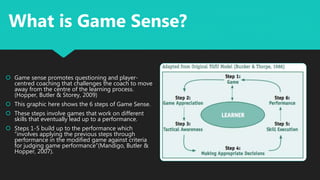
 This graphic here shows the 6 steps of Game Sense.
 These steps involve games that work on different
skills that eventually lead up to a performance.
 Steps 1-5 build up to the performance which
“involves applying the previous steps through
performance in the modified game against criteria
for judging game performance”(Mandigo, Butler &
Hopper, 2007).
What is Game Sense?
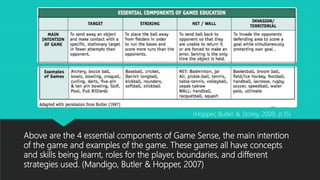
Above are the 4 essential components of Game Sense, the main intention
of the game and examples of the game. These games all have concepts
and skills being learnt, roles for the player, boundaries, and different
strategies used. (Mandigo, Butler & Hopper, 2007)
(Hopper, Butler & Storey, 2009, p.15)
Fundamental Movement Skills
 the static balance
 the sprint run
 the vertical jump the catch
 the hop
 the side gallop
 the skip
 the overarm throw
 the leap
 the kick
 the two-hand strike
 the dodge
(NSW Department of Education, 2000)
The development of children’s fundamental
movement skills is a significant step towards
establishing a lifelong commitment to health and
physical activity. (NSW Department of Education,
2000)
Research shows that children who are competent in
fundamental movement skills are more likely to
enjoy sports and activities and to develop a lifelong
commitment to physical activity. (NSW Department
of Education, 2000)
These fundamental skills are important in the Game
Sense approach and “are learnt within the context of
games or game-like situation and are thus more
easily transferred to competitive matches” (Light,
2006, p. 13).
Rationale
 The game sense approach links well with the
NSW Board of Studies Syllabus. It’s principles are
in line with the main objectives and content of
the Syllabus.
 A big part of game sense is the students
developing the skills to make appropriate
decisions which is also an objective in the
Syllabus.
 “It is only when skills have been learnt that
students can transfer and apply them to the less
predictable and dynamic contexts of different
physical activities, eg games, dance, gymnastics”
Board of Studies, 2007, p.48) This is the whole
basis of Game Sense, where students learn the
skills which they can then apply to their
performance, sport or game.
(Board of Studies, 2007)
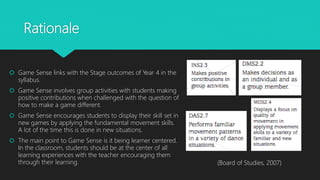
Rationale
 Game Sense links with the Stage outcomes of Year 4 in the
syllabus.
 Game Sense involves group activities with students making
positive contributions when challenged with the question of
how to make a game different.
 Game Sense encourages students to display their skill set in
new games by applying the fundamental movement skills.
A lot of the time this is done in new situations.
 The main point to Game Sense is it being learner centered.
In the classroom, students should be at the center of all
learning experiences with the teacher encouraging them
through their learning. (Board of Studies, 2007)
References
 Board of Studies. (2007). Personal Development, Health and Physical Education K-6 Syllabus.
Sydney: Board of Studies.
 Light, R. (2006). Game Sense: Innovation or just good coaching? Journal of Physical Education
New Zealand, 39(1), 8-19,3.
 Mandigo, J., Butler, J., & Hopper, T. (2007). What is teaching games for understanding? A
Canadian perspective. The Physical Health Education Journal, 73(2), 14–20.
 New South Wales. Dept. of Education Training. (2000). Get skilled, get active : A K-6 resource to
support the teaching of fundamental movement skills. Ryde, N.S.W.: NSW Dept. of Education and
Training, Curriculum Support Directorate.
 Teaching Games for Understanding International Conference, Hopper, T., Butler, J., & Storey, B., &
Physical and Health Education Canada (2009). TGFU - simply good pedagogy :understanding a
complex challenge. PHE Canada.

game sense

  • 1.
  • 2.
     Game sensepromotes questioning and player- centred coaching that challenges the coach to move away from the centre of the learning process. (Hopper, Butler & Storey, 2009)  This graphic here shows the 6 steps of Game Sense.  These steps involve games that work on different skills that eventually lead up to a performance.  Steps 1-5 build up to the performance which “involves applying the previous steps through performance in the modified game against criteria for judging game performance”(Mandigo, Butler & Hopper, 2007). What is Game Sense?
  • 3.
    Above are the4 essential components of Game Sense, the main intention of the game and examples of the game. These games all have concepts and skills being learnt, roles for the player, boundaries, and different strategies used. (Mandigo, Butler & Hopper, 2007) (Hopper, Butler & Storey, 2009, p.15)
  • 4.
    Fundamental Movement Skills the static balance  the sprint run  the vertical jump the catch  the hop  the side gallop  the skip  the overarm throw  the leap  the kick  the two-hand strike  the dodge (NSW Department of Education, 2000) The development of children’s fundamental movement skills is a significant step towards establishing a lifelong commitment to health and physical activity. (NSW Department of Education, 2000) Research shows that children who are competent in fundamental movement skills are more likely to enjoy sports and activities and to develop a lifelong commitment to physical activity. (NSW Department of Education, 2000) These fundamental skills are important in the Game Sense approach and “are learnt within the context of games or game-like situation and are thus more easily transferred to competitive matches” (Light, 2006, p. 13).
  • 5.
    Rationale  The gamesense approach links well with the NSW Board of Studies Syllabus. It’s principles are in line with the main objectives and content of the Syllabus.  A big part of game sense is the students developing the skills to make appropriate decisions which is also an objective in the Syllabus.  “It is only when skills have been learnt that students can transfer and apply them to the less predictable and dynamic contexts of different physical activities, eg games, dance, gymnastics” Board of Studies, 2007, p.48) This is the whole basis of Game Sense, where students learn the skills which they can then apply to their performance, sport or game. (Board of Studies, 2007)
  • 6.
    Rationale  Game Senselinks with the Stage outcomes of Year 4 in the syllabus.  Game Sense involves group activities with students making positive contributions when challenged with the question of how to make a game different.  Game Sense encourages students to display their skill set in new games by applying the fundamental movement skills. A lot of the time this is done in new situations.  The main point to Game Sense is it being learner centered. In the classroom, students should be at the center of all learning experiences with the teacher encouraging them through their learning. (Board of Studies, 2007)
  • 7.
    References  Board ofStudies. (2007). Personal Development, Health and Physical Education K-6 Syllabus. Sydney: Board of Studies.  Light, R. (2006). Game Sense: Innovation or just good coaching? Journal of Physical Education New Zealand, 39(1), 8-19,3.  Mandigo, J., Butler, J., & Hopper, T. (2007). What is teaching games for understanding? A Canadian perspective. The Physical Health Education Journal, 73(2), 14–20.  New South Wales. Dept. of Education Training. (2000). Get skilled, get active : A K-6 resource to support the teaching of fundamental movement skills. Ryde, N.S.W.: NSW Dept. of Education and Training, Curriculum Support Directorate.  Teaching Games for Understanding International Conference, Hopper, T., Butler, J., & Storey, B., & Physical and Health Education Canada (2009). TGFU - simply good pedagogy :understanding a complex challenge. PHE Canada.