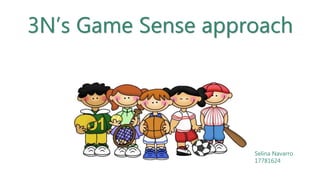
3N’s Game Sense approach
Selina Navarro
17781624
What is Game Sense?
Our class incorporates the ‘Game sense’ approach, also referred to as Teaching Games for
Understanding (TGfU). Game sense is a student-based approach, where skills and tactics are
learnt and promoted through play (Stolz & Pill, 2014).
Decision making, communication, problem solving and movement skills are learnt and built
on through participating in play, as opposed to traditional teacher directed or content-based
approaches (Light, 2013).
Game Sense Traditional Technique Based
• Student centered
• Allows students to develop their own
skills
• Increases student motivation and
participation
• Inclusive practice and enjoyment
• Holistic approach
• Cater for varying abilities
Webb, Pearson & Forrest(2006)
• Teacher directed
• Use of drills out of context
• Reliance on teacher
• Un-motivated students
• Need to master skills prior to
playing
Georgakis (2006)
Strengths as a teaching approach
According to Webb, Pearson and Forrest (2006), game sense is an approach that
thoroughly encapsulates quality teaching. Its student-centred approach is a great way
to develop students’:
• Thinking skills
• Game performance
• Cognitive responses
• Tactical knowledge
• Strategic thinking
• Decision making
• Problem solving
Hopper, Butler & Storey (2009)
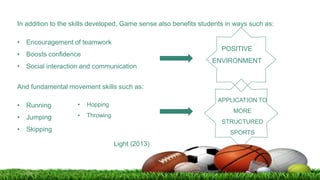
In addition to the skills developed, Game sense also benefits students in ways such as:
• Encouragement of teamwork
• Boosts confidence
• Social interaction and communication
POSITIVE
ENVIRONMENT
And fundamental movement skills such as:
• Running
• Jumping
• Skipping
• Hopping
• Throwing
Light (2013)
APPLICATION TO
MORE
STRUCTURED
SPORTS
Game Sense and the PDHPE Syllabus
This approach has strong links and relevance to the PDHPE syllabus. The outcomes are achieved in a
highly engaging, positive and motivational environment.
STAGE 2
GSS2.8 Participates and uses equipment in a variety of games and modified sports
Game sense allows students to practice and refine their movement skills through a variety of games. It also
teaches students to cooperatively and correctly use equipment, as well as demonstrating a range of skills in
practice and modified games
INS2.3 Makes positive contributions in group activities
Through Game sense, students can work together to achieve set tasks, and work independently and in
groups to devise simple games. More importantly, it encourages students to develop friendships and support
networks with a range of people.
REFERENCES
Board of Studies, NSW. (2007). Personal development, health and physical education K-6: Syllabus. Sydney, Australia
Georgakis, S. (2006). From drills to skills to Game Sense: The meta-cognitive revolution in physical education.
Proceedings for the Asia Pacific Conference of Teaching Sport and Physical Education for Understanding
(pp. 45 - 58). Sydney: University of Sydney.
Hooper, T., Butler, J., & Storey, B. (2009). TGfU... Simply Good Pedagogy: Understanding a Complex Challenge. PHE
Canada.
Light, R. (2013). Game Sense: Pedagogy for Performance, participation and enjoyment. Routledge: Abingdon, Oxon.
Stolz, S., & Pill, S. (2014). Narrative Approach to exploring TGfU-GS. Taylor and Francis Publications.
Webb, P.I., Pearson, P.J., & Forrest, G. (2006). Teaching Games for Understanding (TGfU) in Primary and Secondary
Physical Education. Faculty of Social Sciences: University of Woollongong. Retrieved from
http://ro.uow.edu.au/cgi/viewcontent.cgi?article=1075&context=edupapers

Game Sense in 3N

  • 1.
    3N’s Game Senseapproach Selina Navarro 17781624
  • 2.
    What is GameSense? Our class incorporates the ‘Game sense’ approach, also referred to as Teaching Games for Understanding (TGfU). Game sense is a student-based approach, where skills and tactics are learnt and promoted through play (Stolz & Pill, 2014). Decision making, communication, problem solving and movement skills are learnt and built on through participating in play, as opposed to traditional teacher directed or content-based approaches (Light, 2013).
  • 3.
    Game Sense TraditionalTechnique Based • Student centered • Allows students to develop their own skills • Increases student motivation and participation • Inclusive practice and enjoyment • Holistic approach • Cater for varying abilities Webb, Pearson & Forrest(2006) • Teacher directed • Use of drills out of context • Reliance on teacher • Un-motivated students • Need to master skills prior to playing Georgakis (2006)
  • 4.
    Strengths as ateaching approach According to Webb, Pearson and Forrest (2006), game sense is an approach that thoroughly encapsulates quality teaching. Its student-centred approach is a great way to develop students’: • Thinking skills • Game performance • Cognitive responses • Tactical knowledge • Strategic thinking • Decision making • Problem solving Hopper, Butler & Storey (2009)
  • 5.
    In addition tothe skills developed, Game sense also benefits students in ways such as: • Encouragement of teamwork • Boosts confidence • Social interaction and communication POSITIVE ENVIRONMENT And fundamental movement skills such as: • Running • Jumping • Skipping • Hopping • Throwing Light (2013) APPLICATION TO MORE STRUCTURED SPORTS
  • 6.
    Game Sense andthe PDHPE Syllabus This approach has strong links and relevance to the PDHPE syllabus. The outcomes are achieved in a highly engaging, positive and motivational environment. STAGE 2 GSS2.8 Participates and uses equipment in a variety of games and modified sports Game sense allows students to practice and refine their movement skills through a variety of games. It also teaches students to cooperatively and correctly use equipment, as well as demonstrating a range of skills in practice and modified games INS2.3 Makes positive contributions in group activities Through Game sense, students can work together to achieve set tasks, and work independently and in groups to devise simple games. More importantly, it encourages students to develop friendships and support networks with a range of people.
  • 7.
    REFERENCES Board of Studies,NSW. (2007). Personal development, health and physical education K-6: Syllabus. Sydney, Australia Georgakis, S. (2006). From drills to skills to Game Sense: The meta-cognitive revolution in physical education. Proceedings for the Asia Pacific Conference of Teaching Sport and Physical Education for Understanding (pp. 45 - 58). Sydney: University of Sydney. Hooper, T., Butler, J., & Storey, B. (2009). TGfU... Simply Good Pedagogy: Understanding a Complex Challenge. PHE Canada. Light, R. (2013). Game Sense: Pedagogy for Performance, participation and enjoyment. Routledge: Abingdon, Oxon. Stolz, S., & Pill, S. (2014). Narrative Approach to exploring TGfU-GS. Taylor and Francis Publications. Webb, P.I., Pearson, P.J., & Forrest, G. (2006). Teaching Games for Understanding (TGfU) in Primary and Secondary Physical Education. Faculty of Social Sciences: University of Woollongong. Retrieved from http://ro.uow.edu.au/cgi/viewcontent.cgi?article=1075&context=edupapers